
How Christchurch women cope with earthquake disaster Dr


- Slides: 19
How Christchurch women cope with earthquake disaster Dr Ruth Mc. Manus, University of Canterbury, Christchurch, New Zealand
Grief and solace in disasters • Finding Solace – Solace as an approach to the adjustments and transitions of grief ‘it is that which brings hope in the future in the face of despair’ (Klass, 1992). • Understanding solace in a disaster situation. – Disaster research on Western countries sees grief as complicated, solace difficult to achieve (as can’t do the usual things like say goodbye). Coping is through talking about the experiences and individual psychological counselling (Raphael, B. 2012). – Disaster research on non‐Western countries focuses on cultural characteristics as source of coping and solace (strong religious beliefs, strong communities etc. , which naturally generate the social space to talk with others as a form of witnessing in which ‘comfort was sought and gained through the process of sharing experiences of suffering’(Kanayake et al. , 2013). • Coping ( solace) is supposed to come through talking. . .
Grief and solace in disasters • Christchurch earthquake while in receipt of the psychologisation of disaster trauma (The Flying Squad), noted by the chief scientist that ‘What is clear from the field of disaster science and scholarship is that most people are resilient and will recover in time; however, a subset, likely to be in the order of about 5% (or more, depending on how the recovery process progresses), will have on‐going significant psychological morbidity requiring professional help’ (Gluckman, 2011). • 95% of Christchurch will cope by other means. . . what is that other means?
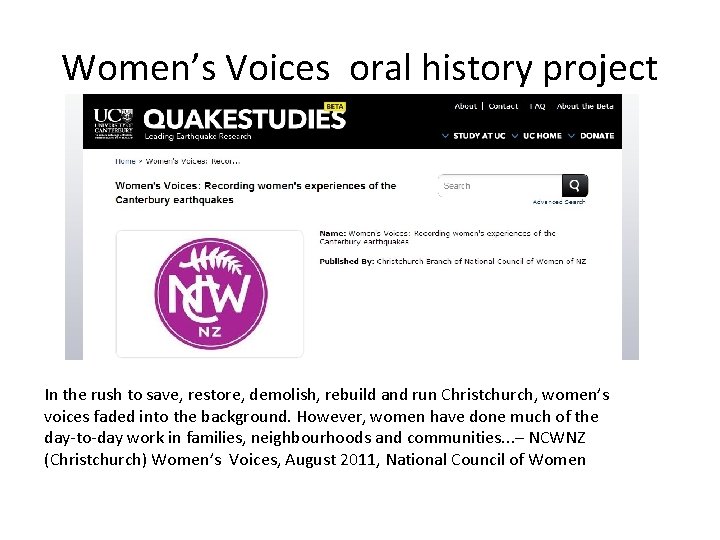
Women’s Voices oral history project In the rush to save, restore, demolish, rebuild and run Christchurch, women’s voices faded into the background. However, women have done much of the day‐to‐day work in families, neighbourhoods and communities. . . – NCWNZ (Christchurch) Women’s Voices, August 2011, National Council of Women
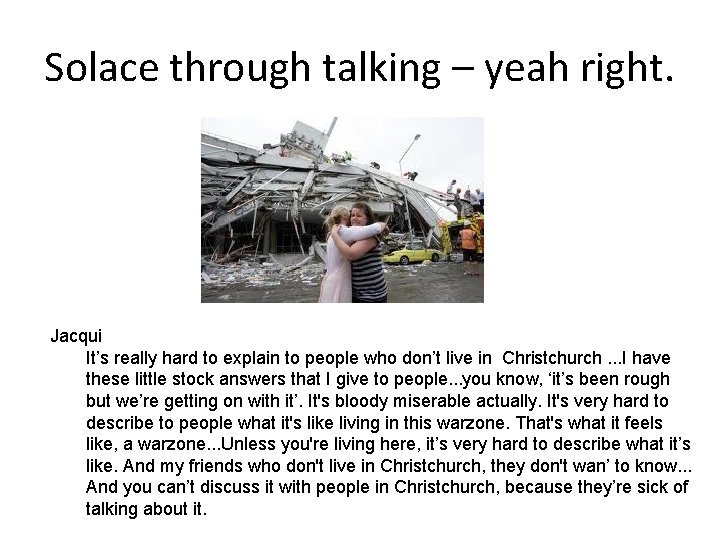
Solace through talking – yeah right. Jacqui It’s really hard to explain to people who don’t live in Christchurch. . . I have these little stock answers that I give to people. . . you know, ‘it’s been rough but we’re getting on with it’. It's bloody miserable actually. It's very hard to describe to people what it's like living in this warzone. That's what it feels like, a warzone. . . Unless you're living here, it’s very hard to describe what it’s like. And my friends who don't live in Christchurch, they don't wan’ to know. . . And you can’t discuss it with people in Christchurch, because they’re sick of talking about it.
Three narratives • Alex (community worker with human rights experience) 30 years old, NZ/Russian‐ Canadian, no children. • Helen ( farmer & stud breeder of merino sheep) married, 60 years old, grown children • Coralie (co‐ordinator of Gap Filler ) 30 years old, Ozzie born, Chch 6 years, partner, no children
Alex ‘And then we got in the car, drove round the corner, and the earthquake hit. We were in the car, in the central lane, there was the turning lane here, and the other lane here going the other way. And buildings on both sides of the road just collapsed and cars in this lane were completely totalled. There was a van behind us, which was instantly, crushed by this massive concrete beam, and it had people in it. We had bricks and dust and stuff all over us. My sister turned off the car, and we called out, and we tried to help the people in the van behind us. Three of them got out safely, and one of them unfortunately died. . . It was just chaos’.
Alex ‘I spent a couple of weeks just baking, everyone felt that we just wanted to do something to help. . . I’ve never been into baking much but I think , cause suddenly you’re stuck at home, I had no employment, our social life had been confined to just being at friends’ houses and stuff, so I really got into cooking. . . I guess I went into autopilot, and I was like I have to do something to help, I’m unemployed, what can I do. . . I threw myself into that’. Alex went on to organise the Baking Army and start the first Crisis Management programme for businesses in Christchurch.
Alex Looking at the whole situation, I thought I can either let this be a negative or I can use it as an opportunity. And I thought, what are my skills, what is my training and how can I use that to move forward? https: //www. facebook. com/Christchurch. B aking. Army
Helen ‘I knew the PGC building was in trouble and our accountants were in there ‐ they are Ashburton‐ based ‐ and our accountant from Ashburton comes up one day a week, on a Tuesday, and it was that day, and he was killed’. That night, reunited with Peter [husband]back at the farm at Swannanoa, Helen started cooking. ‘I think I made big bacon and egg pies and fruit cake and goodness knows what and I took the first batch of baking to the Rangiora Welfare Centre’.
Helen At first, Helen had wanted to go in to the city to help too. However, she realised that although she was highly competent, her family and farm were her priority. She also knew she stood little chance of being allowed into the disaster zone. ‘As a 60‐year‐old woman, you've got to weigh things up. You know jolly well the guys will look at you and say ‘what the heck can she do, anyway? ’ and where your uses are better (served). Are you better getting some food ready? ’
Helen went on to set up the catering co‐ ordination for the Farmy Army which brought supplies and cooked food to people for months after. ‘years of living in the high country had weathered me for a rugged existence and I was able to cope with working day after day at full stretch. My husband daughter were also involved in the Farmy Army’s emergency effort. . . the long days left me very tired, but not stressed, and I tried not to take the worries to bed. ’ https: //www. facebook. com/pages/Farmy‐Army‐Federated‐ Farmers/203178676360140
Coralie ‘One moment I would be crying, the next moment I would be fine’. Coralie mentioned that when she got to Wellington, ‘it was good to get away’, but strange to be away from Christchurch. ‘When I saw “I love Christchurch” posters I burst into tears. ’ And when she sat in Cuba St Mall, unable to make decisions, she felt like they were invisible. She said that the whole time she was aware of the architecture, and ‘all these beautiful old buildings that we don't have anymore’.
Coralie They came home the following Wednesday or Thursday. They came home because she ‘felt like I had to go home and help’. After getting their friend Kerry's stuff from her house, Coralie says that she slowly started to get back into the swing of things. It took her two weeks to ‘snap out of it’ and start work on the Gap Filler project.
Coralie. . . Vacant spaces, vacant buildings are a reality of any city, it's just part of the life cycle, so I would like. . . would love to see that become something, that becomes what we do in Christchurch; when there is a vacant space we let someone else use it until it gets developed or rented again, we don't waste space, cause kiwis. . . don't chuck stuff out, you don't waste it, you reuse it. That's why people have so much junk around their houses, “one day I might use that”. I think we are not a wasteful people, so I feel like this is an extension of that national psyche’. https: //www. facebook. com/Gap. Filler
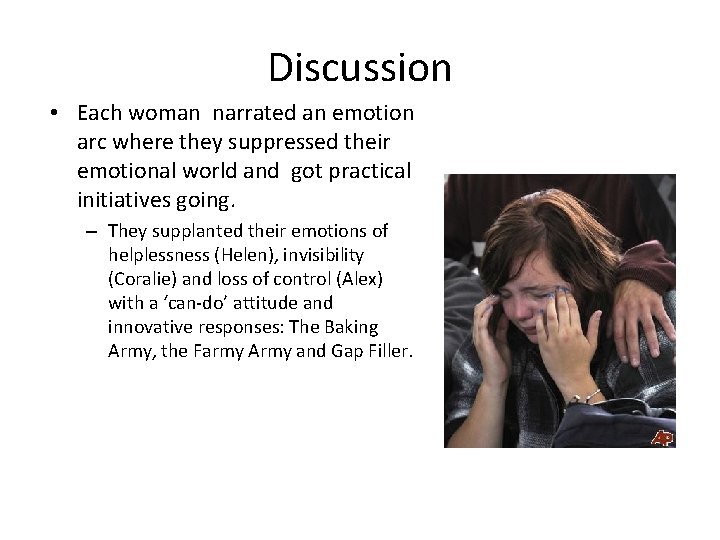
Discussion • Each woman narrated an emotion arc where they suppressed their emotional world and got practical initiatives going. – They supplanted their emotions of helplessness (Helen), invisibility (Coralie) and loss of control (Alex) with a ‘can‐do’ attitude and innovative responses: The Baking Army, the Farmy Army and Gap Filler.
Conclusion • For these women in Christchurch, solace is not about talking experiences of suffering but by doing practical things that inform and are shaped by existing personal narratives. • As they relayed this common arc, they also entered into national (and gendered) narrative themes of being practical, stoic, independent and resourceful in the face of tragedy and loss and so embody communal aspects of loss and grief unique to the New Zealand’s identity narrative. • These women’s narratives suggest it useful to rethink the key concepts that inform our understanding of coping with disaster and loss.
References used • • • Klass, D. 1992 ‘Religions Aspects in the Resolution of Parental Grief : Solace and Social Support’, in K. Pargament, R. E. Hess and K. I. Maton (eds), Religion and Prevention in Mental Health: Research, Vision, Action. New York: Routledge. Raphael, Beverley 2012, Handbook for Bereavement, Loss, Dislocation: Disasters and the Aftermath. New South Wales, Health Department. SAMANTHIKA KANAYAKE, MARTIN PRINCE, ATHULA SUMATHIPALA, SISIRA SIRIBADDANA, CRAIG MORGAN, 2013, “We lost all we had in a second”: coping with grief and loss after a natural disaster, (World Psychiatry 2013; 12: 69– 75) “The Flying Squad” http: //thechristchurchfiasco. wordpress. com/2012/12/13/the‐ flying‐squad‐post‐february‐ 22‐christchurch‐earthquake/ Gluckman, Peter (Chief Scientific Officer Ministry of Science, New Zealand. ) Christchurch Earthquakes: Psychosocial Effects Briefing Paper http: //www. pmcsa. org. nz/wp‐content/uploads/Christchurch‐Earthquake‐Briefing‐ Psychosocial‐Effects‐ 10 May 11. pdf NCWNZ ‐ https: //quakestudies. canterbury. ac. nz/