
How Cells Release Stored Energy Chapter 8 ATP

- Slides: 22
How Cells Release Stored Energy Chapter 8
ATP Is Universal Energy Source n Photosynthesizers get energy from the sun n Animals get energy second- or third-hand from plants or other organisms n Regardless, the energy is converted to the chemical bond energy of ATP
Making ATP n Plants n Cells make ATP during photosynthesis of all organisms make ATP by breaking down carbohydrates, fats, and protein
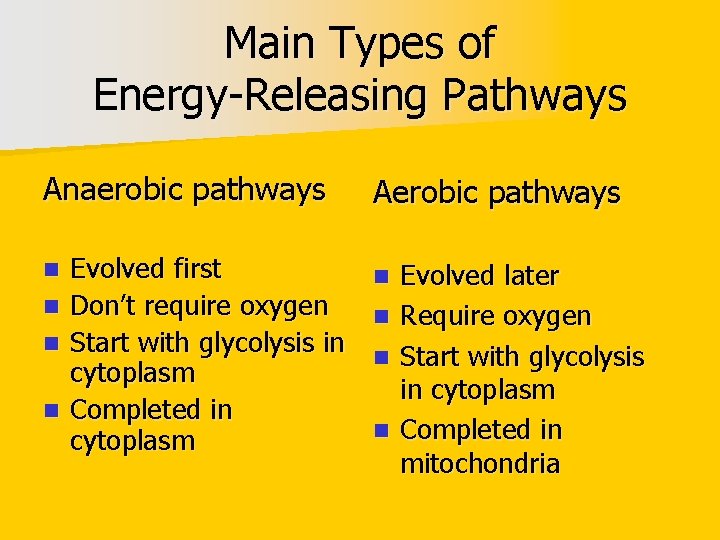
Main Types of Energy-Releasing Pathways Anaerobic pathways n n Evolved first Don’t require oxygen Start with glycolysis in cytoplasm Completed in cytoplasm Aerobic pathways n n Evolved later Require oxygen Start with glycolysis in cytoplasm Completed in mitochondria
Summary Equation for Aerobic Respiration C 6 H 1206 + 6 O 2 glucose oxygen 6 CO 2 + 6 H 20 carbon dioxide water
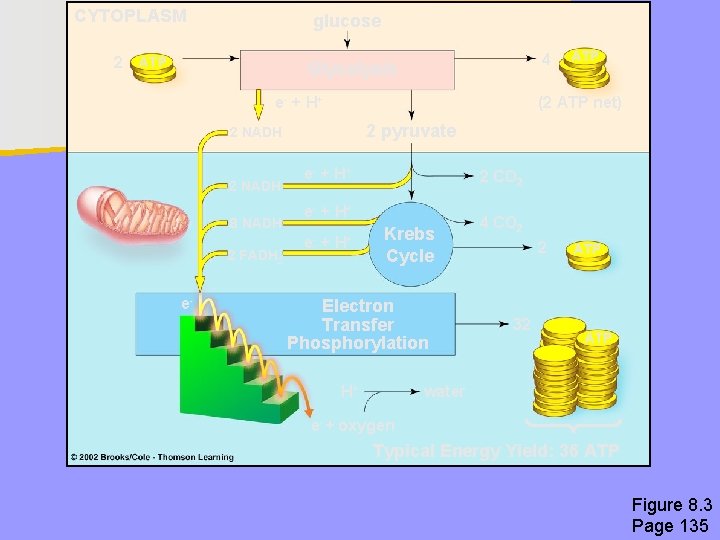
CYTOPLASM 2 glucose ATP 4 Glycolysis e- + H + (2 ATP net) 2 pyruvate 2 NADH Overview of Aerobic Krebs Respiration Cycle 2 NADH 8 NADH 2 FADH 2 e- ATP e- + H + 2 CO 2 e- + H + e- + 4 CO 2 H+ 2 Electron Transfer Phosphorylation H+ 32 ATP water e- + oxygen Typical Energy Yield: 36 ATP Figure 8. 3 Page 135
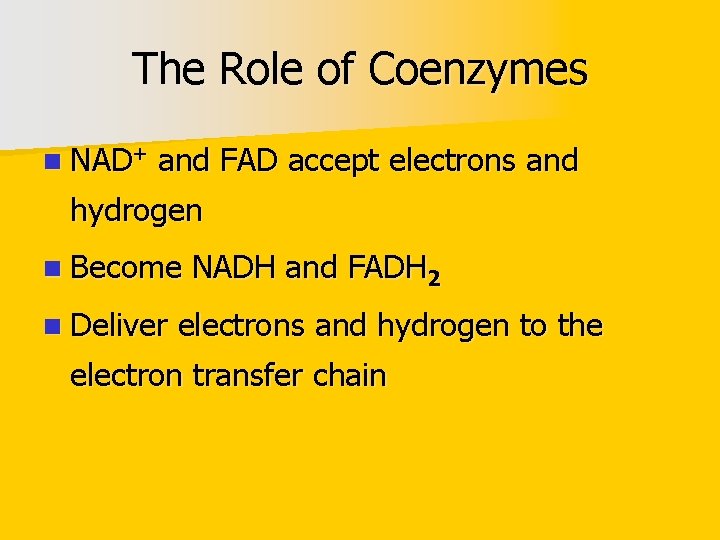
The Role of Coenzymes n NAD+ and FAD accept electrons and hydrogen n Become n Deliver NADH and FADH 2 electrons and hydrogen to the electron transfer chain
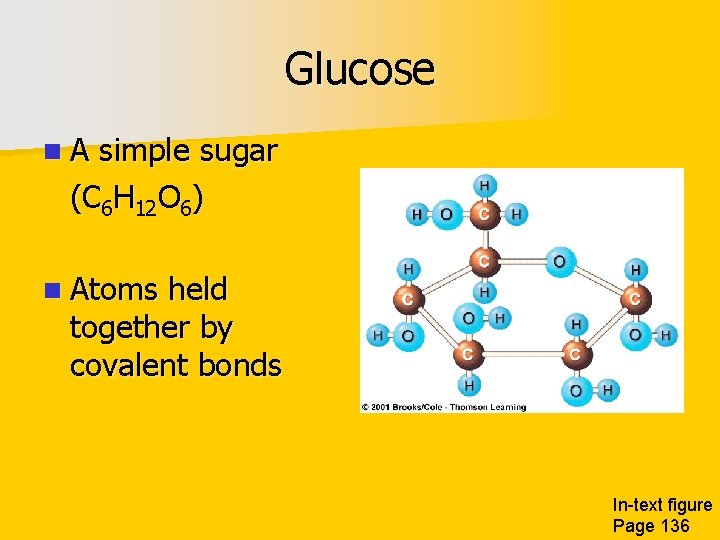
Glucose n. A simple sugar (C 6 H 12 O 6) n Atoms held together by covalent bonds In-text figure Page 136
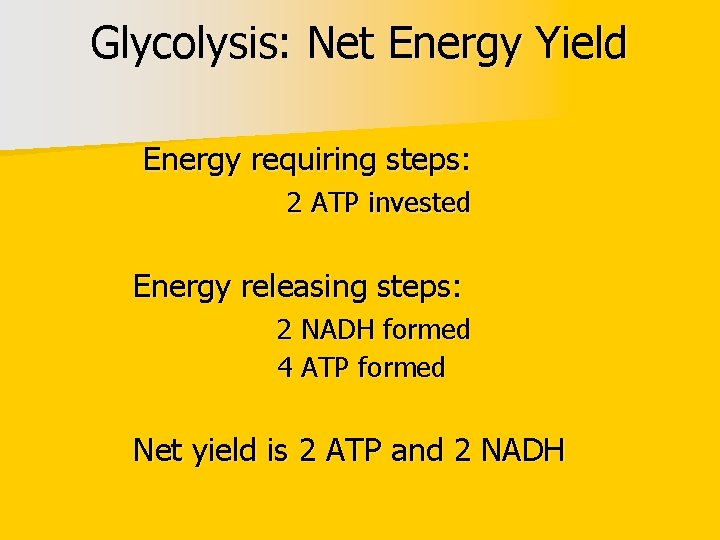
Glycolysis Occurs in Two Stages n Energy-requiring steps – ATP energy activates glucose and its six-carbon derivatives n Energy-releasing steps – The products of the first part are split into threecarbon pyruvate molecules – ATP and NADH form
Glycolysis: Net Energy Yield Energy requiring steps: 2 ATP invested Energy releasing steps: 2 NADH formed 4 ATP formed Net yield is 2 ATP and 2 NADH
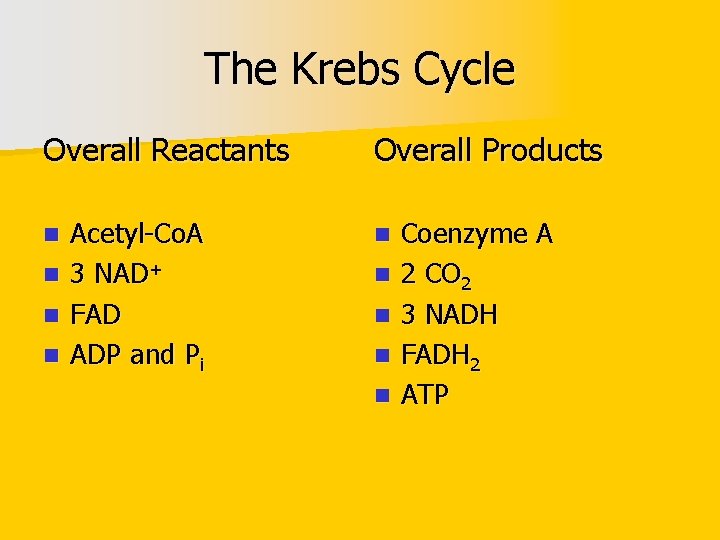
The Krebs Cycle Overall Reactants n n Acetyl-Co. A 3 NAD+ FAD ADP and Pi Overall Products n n n Coenzyme A 2 CO 2 3 NADH FADH 2 ATP
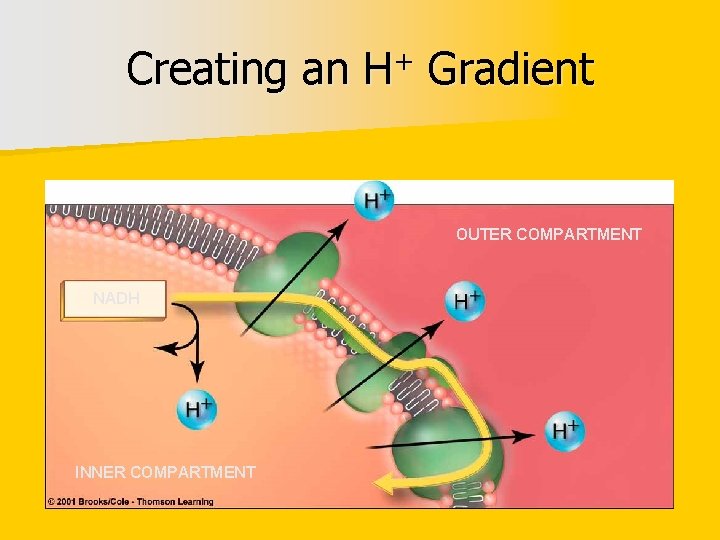
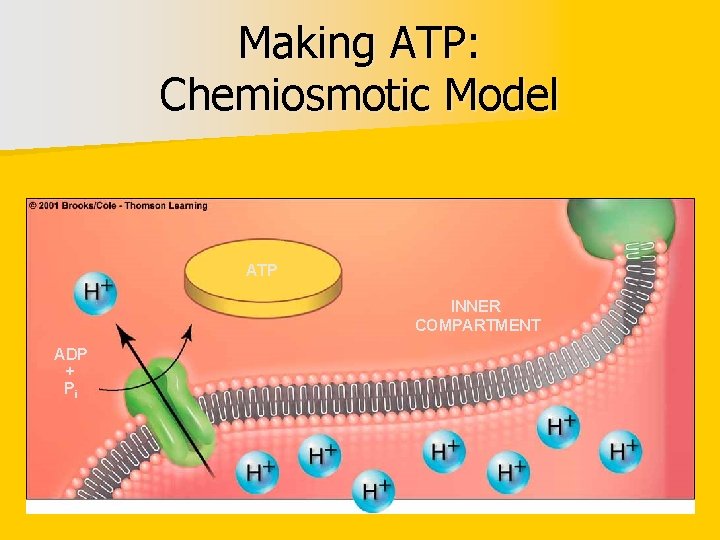
Electron Transfer Phosphorylation n Occurs in the mitochondria n Coenzymes deliver electrons to electron transfer chains n Electron transfer sets up H+ ion gradients n Flow of H+ down gradients powers ATP formation
Creating an H+ Gradient OUTER COMPARTMENT NADH INNER COMPARTMENT
Making ATP: Chemiosmotic Model ATP INNER COMPARTMENT ADP + Pi
Importance of Oxygen n Electron transport phosphorylation requires the presence of oxygen n Oxygen withdraws spent electrons from the electron transfer chain, then combines with H+ to form water
Summary of Energy Harvest (per molecule of glucose) n Glycolysis – 2 ATP formed by substrate-level phosphorylation n Krebs cycle and preparatory reactions – 2 ATP formed by substrate-level phosphorylation n Electron transport phosphorylation – 32 ATP formed
Efficiency of Aerobic Respiration n 686 kcal of energy are released n 7. 5 kcal are conserved in each ATP n When 36 ATP form, 270 kcal (36 X 7. 5) are captured in ATP n Efficiency is 270 / 686 X 100 = 39 percent n Most energy is lost as heat
Anaerobic Pathways n Do not use oxygen n Produce n Two less ATP than aerobic pathways types – Fermentation pathways – Anaerobic electron transport
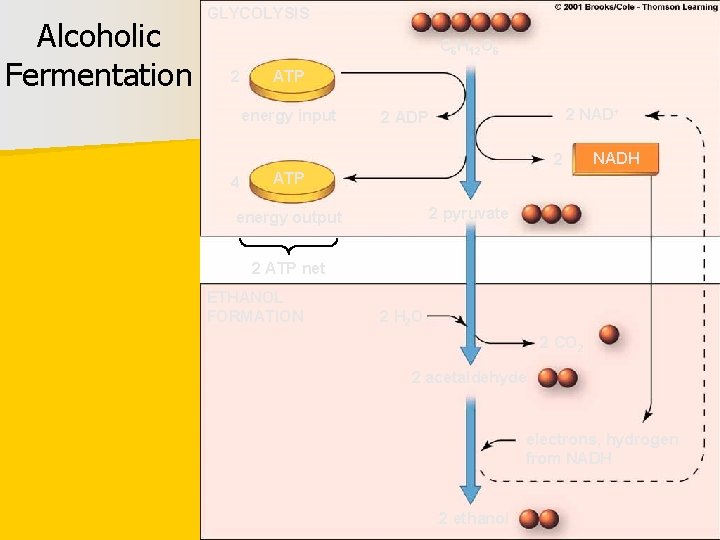
Fermentation Pathways n Begin with glycolysis n Do not break glucose down completely to carbon dioxide and water n Yield only the 2 ATP from glycolysis n Steps that follow glycolysis serve only to regenerate NAD+
Alcoholic Fermentation GLYCOLYSIS C 6 H 12 O 6 2 ATP energy input 2 NAD+ 2 ADP 2 4 NADH ATP 2 pyruvate energy output 2 ATP net ETHANOL FORMATION 2 H 2 O 2 CO 2 2 acetaldehyde electrons, hydrogen from NADH 2 ethanol
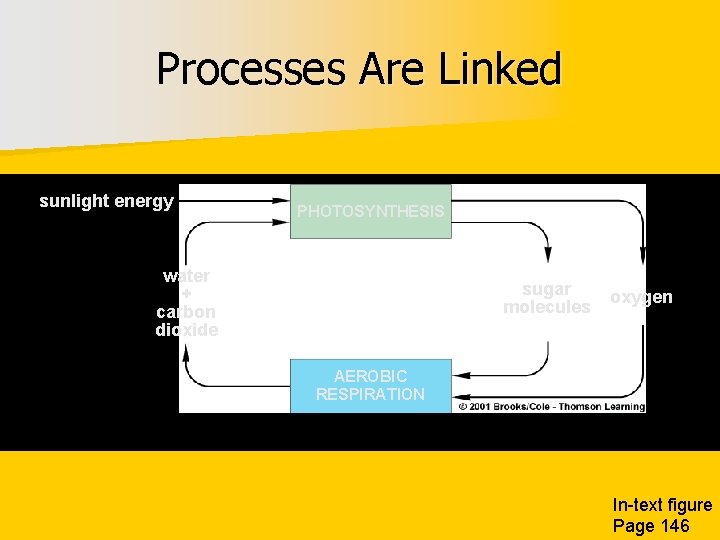
Evolution of Metabolic Pathways n When life originated, atmosphere had little oxygen n Earliest organisms used anaerobic pathways n Later, noncyclic pathway of photosynthesis increased atmospheric oxygen n Cells arose that used oxygen as final acceptor in electron transport
Processes Are Linked sunlight energy PHOTOSYNTHESIS water + carbon dioxide sugar molecules oxygen AEROBIC RESPIRATION In-text figure Page 146