
How Can We Tell the Difference Between Species
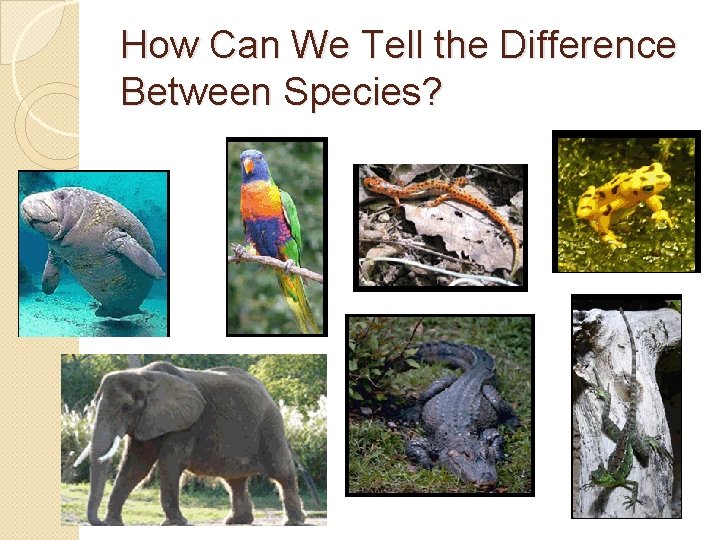
How Can We Tell the Difference Between Species?
Evolution: Classification Background Phylogeny Cladistics Dichotomous Keys Unit Objective: apply the basics of next generation taxonomy and classification and evaluate anatomical and molecular homologies to establish evolutionary relationships.
Classification �How do scientists classify & identify organisms? �Scientists identify organisms by studying their structure and functions. �Classification is based on similarities and differences �What are the reasons scientists do this? �A lot has to do with first, discovering our ancestry, helping to identify new organisms, predict the behaviors of organisms based upon the structures, functions, and behaviors of other organisms. �But most importantly, it helps us connect with the world so we can do things like find cures and treatments for diseases.
Biological Species Concept �Developed by biologist Ernst Mayr in 1942… �A species is a natural population that interbreeds reproductively isolated from other populations. �The Biological Species Concept blends the taxonomical philosophy of Linnaeus with the new information discovered in DNA. ◦ There are other ways of classifying species, but the technique of using the homologies in DNA & traits is the most common. In large part, the importance of species in biology derives from their importance in systematics, which is responsible for the taxonomic framework used in all branches of biology.
How Do We Name Organisms? �With all the diversity, how do we name organisms? �Taxonomy: ◦ The science of naming and classifying organisms. �We group species based on what we infer about their evolutionary relationships.
Classification �We use “The Linnaean System” ◦ It’s in Latin = so globally, everyone can understand what you’re talking about. �SPECIES ARE GROUPED INTO SUCCESSIVE LEVEL OF HEIRARCHY.
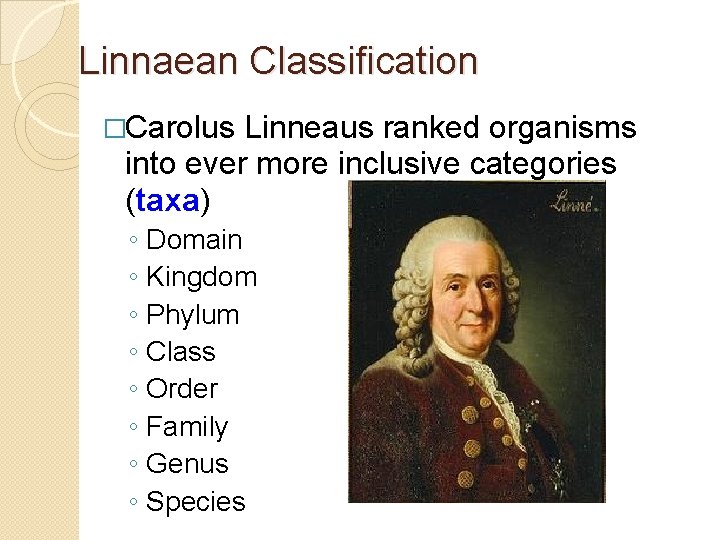
Linnaean Classification �Carolus Linneaus ranked organisms into ever more inclusive categories (taxa) ◦ ◦ ◦ ◦ Domain Kingdom Phylum Class Order Family Genus Species
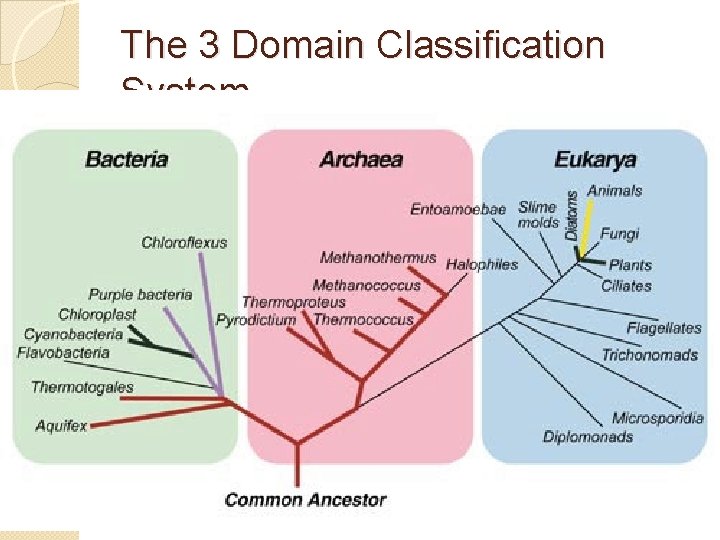
The 3 Domain Classification System
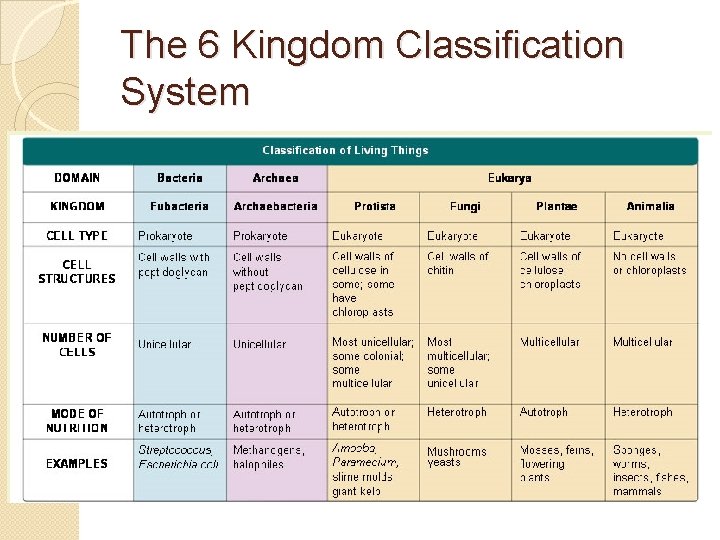
The 6 Kingdom Classification System
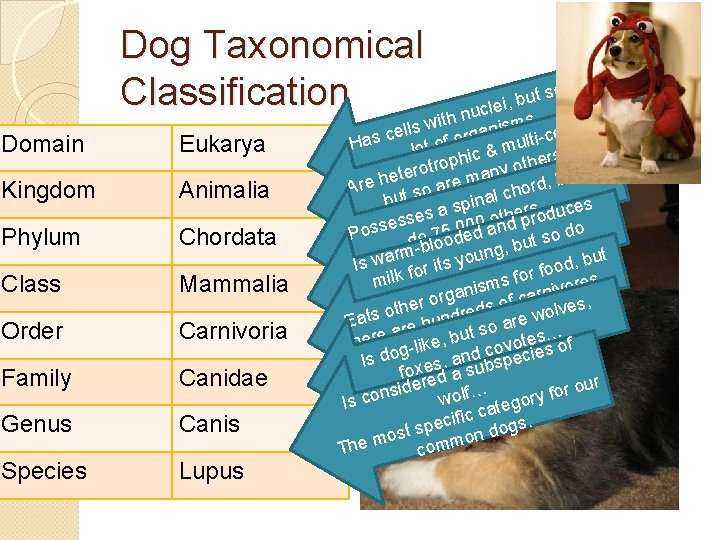
Dog Taxonomical Classification Domain Eukarya Kingdom Animalia Phylum Chordata Class Mammalia Order Carnivoria Family Canidae Genus Canis Species Lupus oa d o s , but i e l c h nu isms… t i r, w a l s l u l n l l e a e c org multi-c f Has o t o l ic & thers… h p o r so ny o erot t t a e u m h b are Are ord, o h s c t l bu pina ers…uces s a sses , 000 aonthd prod o e s s d Po d-obl 7 o 5 oded , but so rm t ung Is wa for its yo s… r food, bu milk otnhiesrms fo nivores… ar rga c o f r o e s th ves, d l o e o r s w t d Ea hun t so are e r a there g-like, bu coyotess…of Is do xes, andubspecie fo ed a s ur er o d i r s … o f n f ry wol o Is co g e t ic ca s. f i c e st sp mon dog o m The com
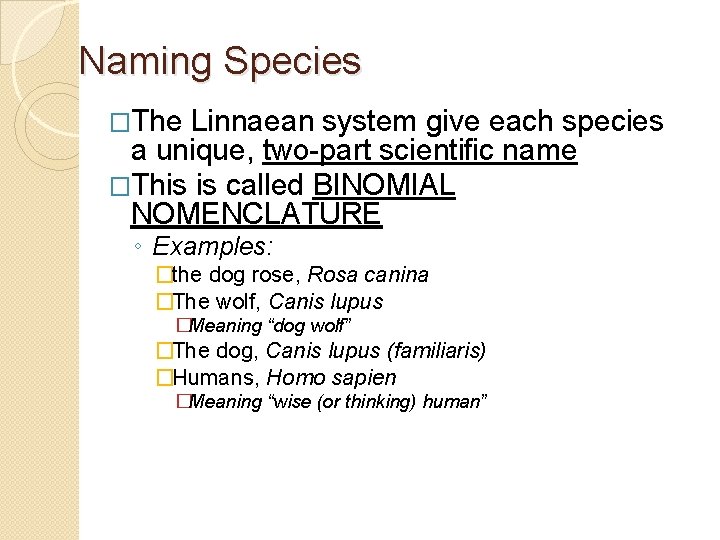
Naming Species �The Linnaean system give each species a unique, two-part scientific name �This is called BINOMIAL NOMENCLATURE ◦ Examples: �the dog rose, Rosa canina �The wolf, Canis lupus �Meaning “dog wolf” �The dog, Canis lupus (familiaris) �Humans, Homo sapien �Meaning “wise (or thinking) human”
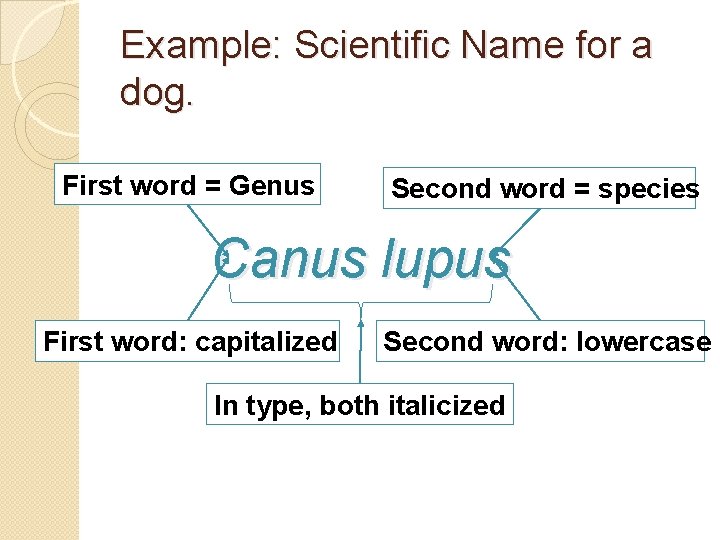
Example: Scientific Name for a dog. First word = Genus Second word = species Canus lupus First word: capitalized Second word: lowercase In type, both italicized
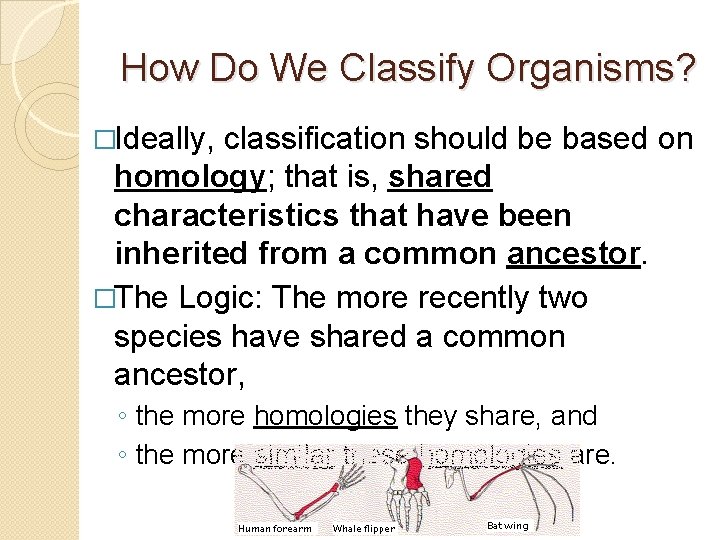
How Do We Classify Organisms? �Ideally, classification should be based on homology; that is, shared characteristics that have been inherited from a common ancestor. �The Logic: The more recently two species have shared a common ancestor, ◦ the more homologies they share, and ◦ the more similar these homologies are.
The Challenge With Taxonomy & The New Solution �Because of the fluid nature of evolution and speciation, it is difficult to properly name and classify organisms. �There exists challenges that make it less than 100% accurate on how scientists classify organisms. ◦ Deciding which traits to focus on. ◦ Missing links. ◦ Unknown organisms.
The Challenge With Taxonomy & The New Solution �What was once based primarily on homologous structures is now being updated with the use of technologies that allow us to see similarities on a molecular level. ◦ DNA ◦ Proteins �The benefit of using molecules is that they mutate at a reasonably constant rate. �Still, what is the better way to determine phylogeny; molecular or morphological? ◦ Remember, natural selection only acts on
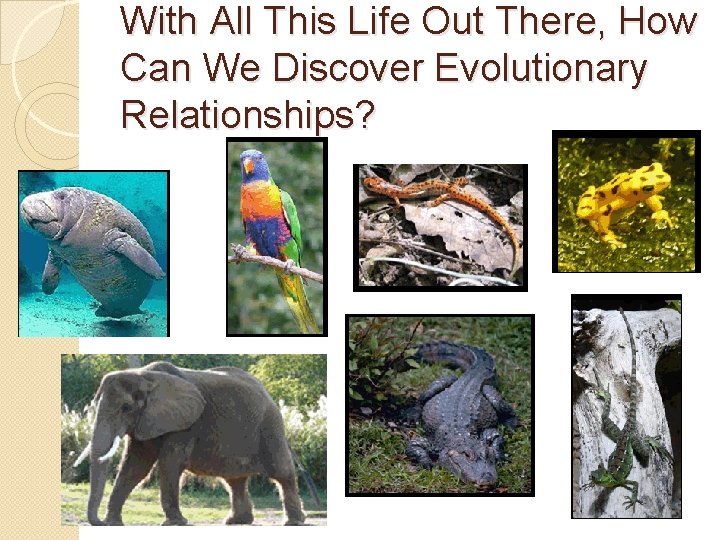
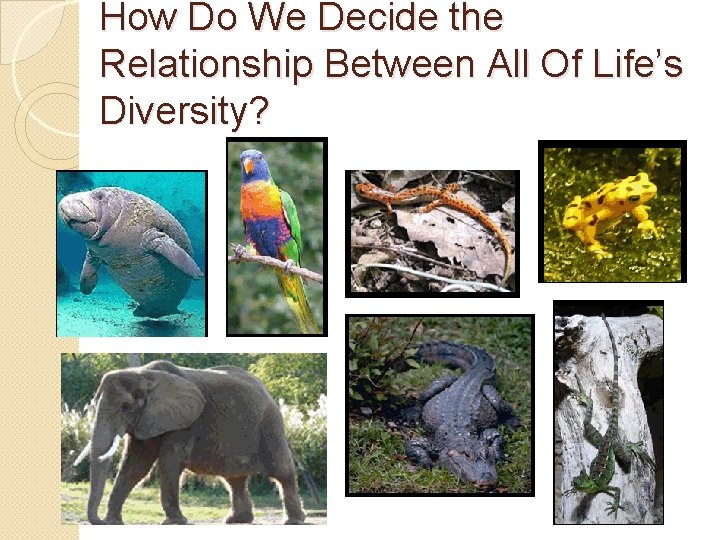
With All This Life Out There, How Can We Discover Evolutionary Relationships?
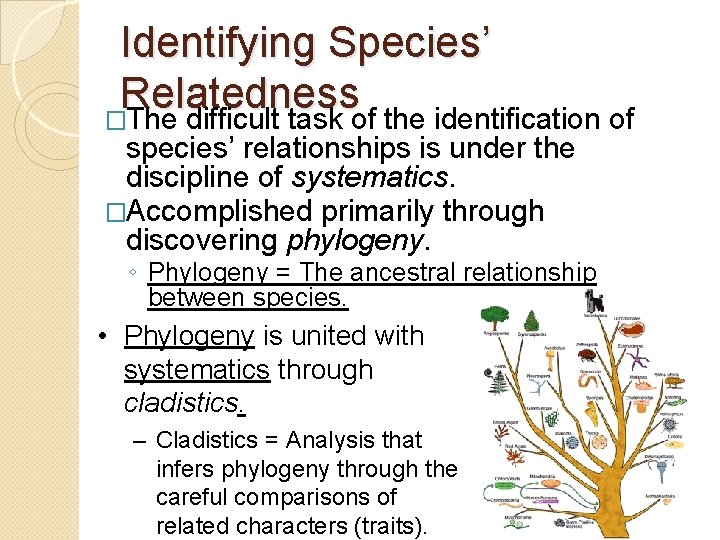
Identifying Species’ Relatedness �The difficult task of the identification of species’ relationships is under the discipline of systematics. �Accomplished primarily through discovering phylogeny. ◦ Phylogeny = The ancestral relationship between species. • Phylogeny is united with systematics through cladistics. – Cladistics = Analysis that infers phylogeny through the careful comparisons of related characters (traits).
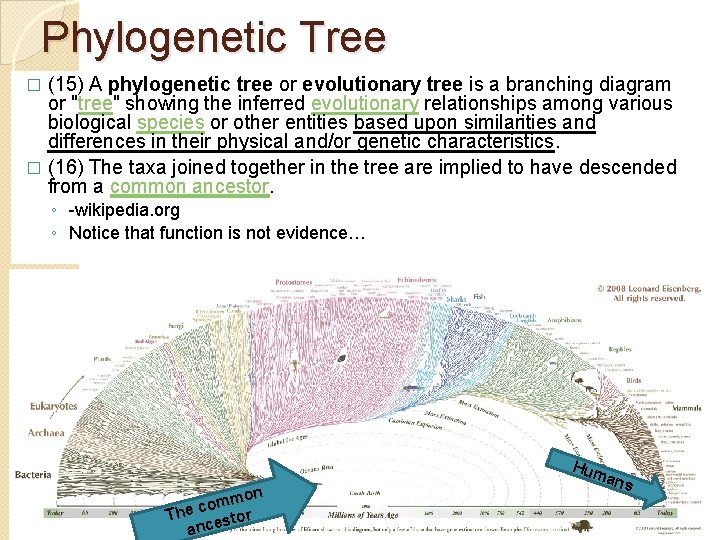
Phylogenetic Tree (15) A phylogenetic tree or evolutionary tree is a branching diagram or "tree" showing the inferred evolutionary relationships among various biological species or other entities based upon similarities and differences in their physical and/or genetic characteristics. � (16) The taxa joined together in the tree are implied to have descended from a common ancestor. � ◦ -wikipedia. org ◦ Notice that function is not evidence… mon m o c The estor anc Hum ans
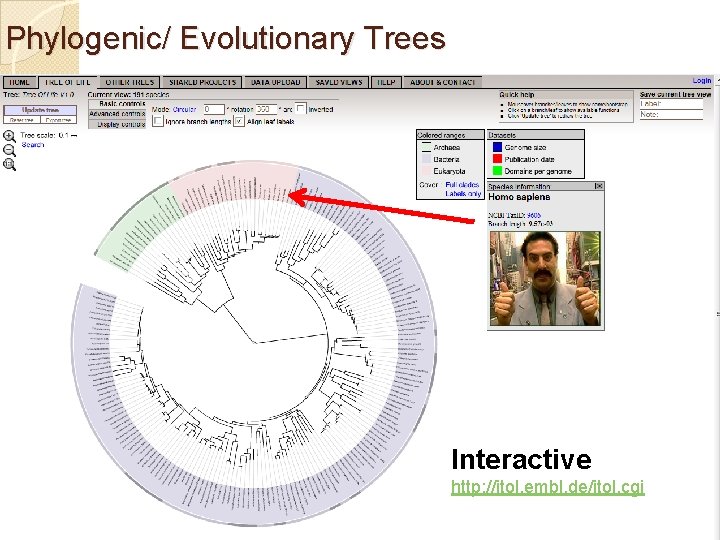
Phylogenic/ Evolutionary Trees Interactive http: //itol. embl. de/itol. cgi
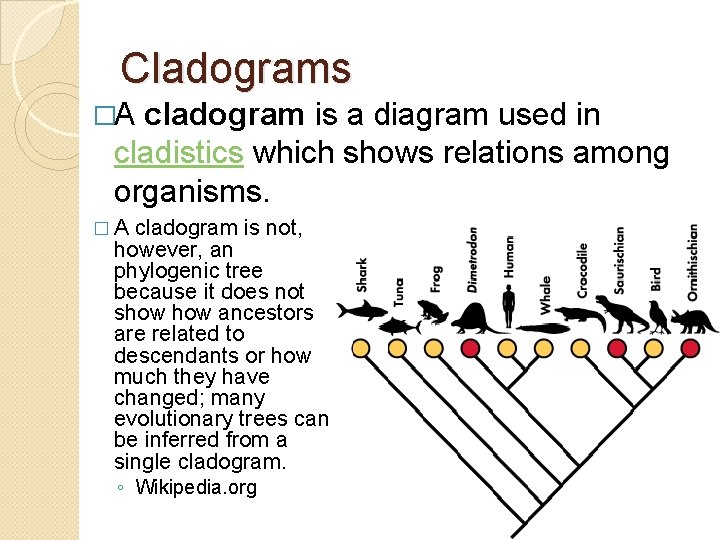
Cladograms �A cladogram is a diagram used in cladistics which shows relations among organisms. �A cladogram is not, however, an phylogenic tree because it does not show ancestors are related to descendants or how much they have changed; many evolutionary trees can be inferred from a single cladogram. ◦ Wikipedia. org
Cladograms �Cladistic analysis is used to select the most likely phylogeny among a given set of organisms. �The logic of establishing the phylogeny in cladograms is based on interpreting the evidence that establishes the relationships. 1. Morphology (Structure) 2. Molecular Evidence (DNA & Proteins) �Order & Time (DNA mutates at a constant rate so divergence can be approximated) �You will construct both kinds.
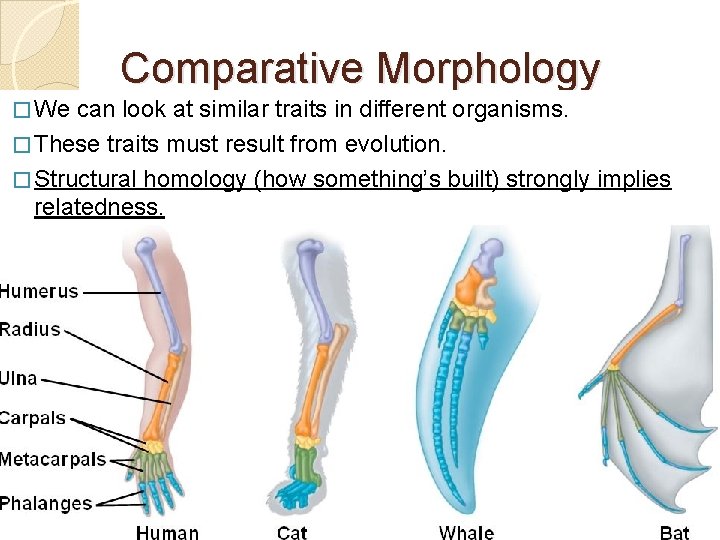
Comparative Morphology � We can look at similar traits in different organisms. � These traits must result from evolution. � Structural homology (how something’s built) strongly implies relatedness.
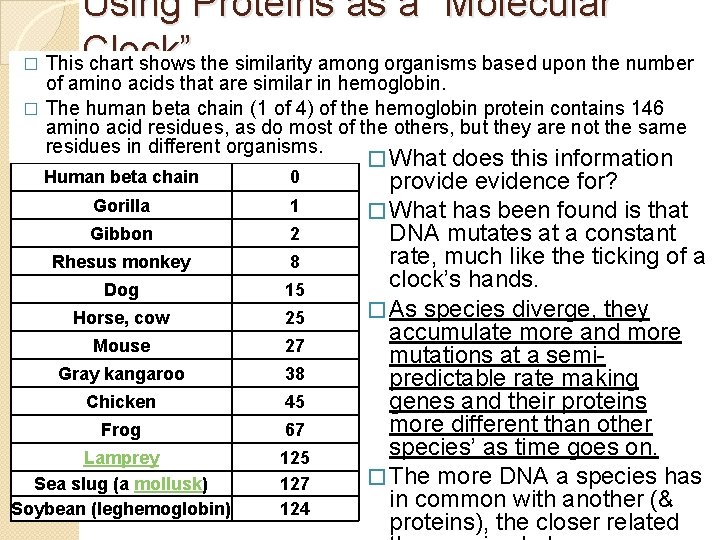
Using Proteins as a “Molecular � This. Clock” chart shows the similarity among organisms based upon the number of amino acids that are similar in hemoglobin. � The human beta chain (1 of 4) of the hemoglobin protein contains 146 amino acid residues, as do most of the others, but they are not the same residues in different organisms. � What does this information Human beta chain 0 Gorilla 1 Gibbon 2 Rhesus monkey 8 Dog 15 Horse, cow 25 Mouse 27 Gray kangaroo 38 Chicken 45 Frog 67 Lamprey Sea slug (a mollusk) Soybean (leghemoglobin) 125 127 124 provide evidence for? � What has been found is that DNA mutates at a constant rate, much like the ticking of a clock’s hands. � As species diverge, they accumulate more and more mutations at a semipredictable rate making genes and their proteins more different than other species’ as time goes on. � The more DNA a species has in common with another (& proteins), the closer related
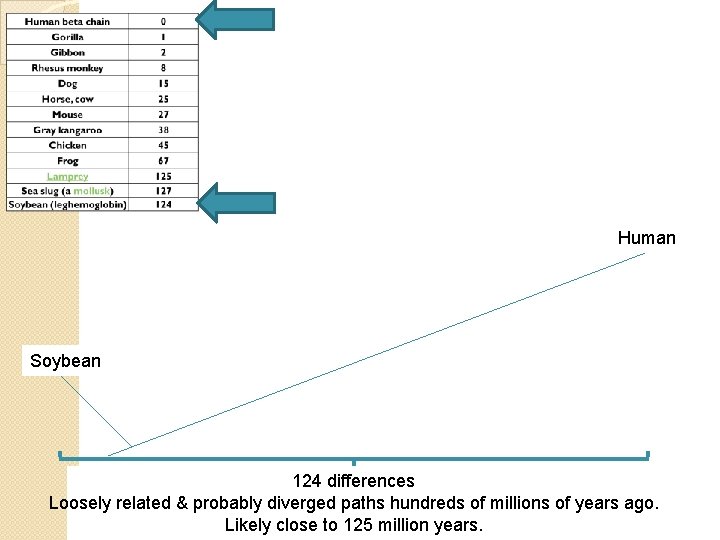
Human Soybean 124 differences Loosely related & probably diverged paths hundreds of millions of years ago. Likely close to 125 million years.
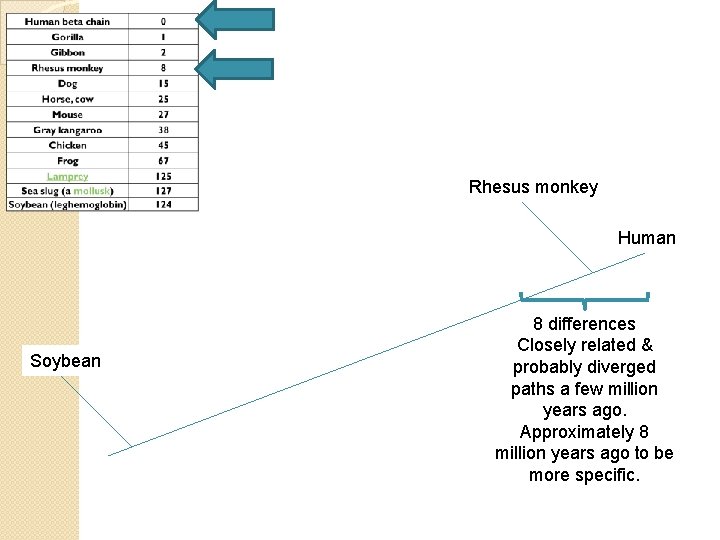
Rhesus monkey Human Soybean 8 differences Closely related & probably diverged paths a few million years ago. Approximately 8 million years ago to be more specific.
How Do We Decide the Relationship Between All Of Life’s Diversity?
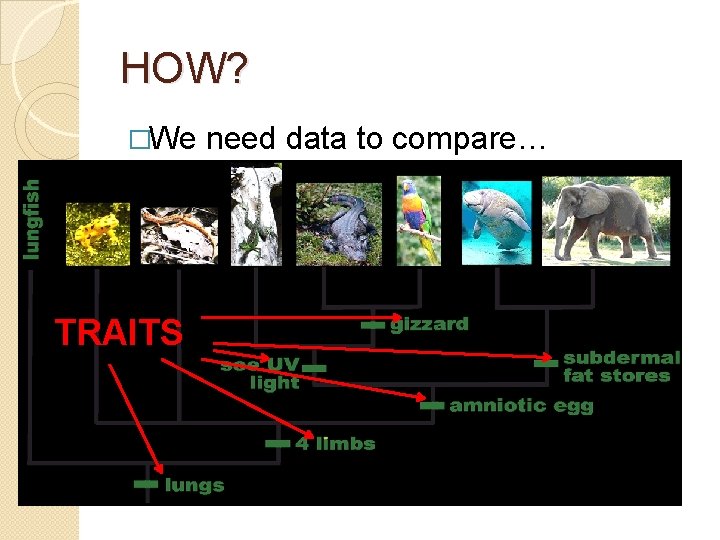
HOW? �We TRAITS need data to compare…
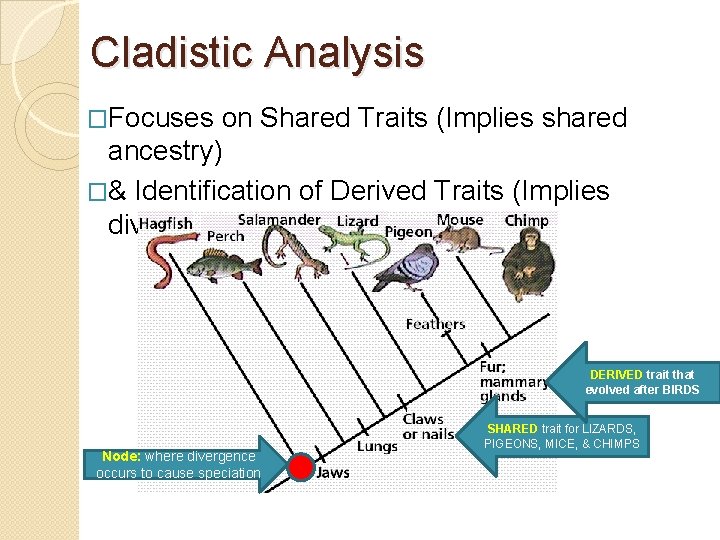
Cladistic Analysis �Focuses on Shared Traits (Implies shared ancestry) �& Identification of Derived Traits (Implies divergence) DERIVED trait that evolved after BIRDS Node: where divergence occurs to cause speciation SHARED trait for LIZARDS, PIGEONS, MICE, & CHIMPS
How Do You Construct Cladograms? �To make a cladogram, scientists first collect data on the features of all the organisms they hope to classify. �This data is then analyzed to determine which characteristics were present in what could have been a common ancestor and which might have been developed in later times. �SO: You need to know/observe/discover ◦ When the species evolved (oldest to youngest) ◦ Good traits to focus on.
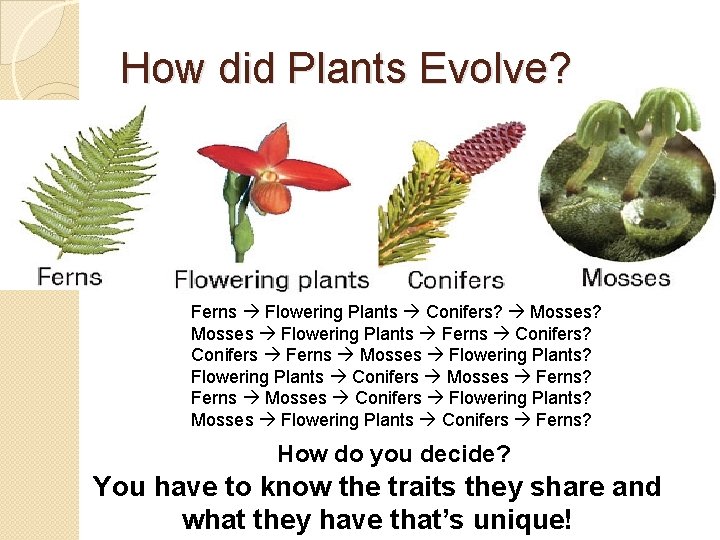
How did Plants Evolve? Ferns Flowering Plants Conifers? Mosses? Mosses Flowering Plants Ferns Conifers? Conifers Ferns Mosses Flowering Plants? Flowering Plants Conifers Mosses Ferns? Ferns Mosses Conifers Flowering Plants? Mosses Flowering Plants Conifers Ferns? How do you decide? You have to know the traits they share and what they have that’s unique!
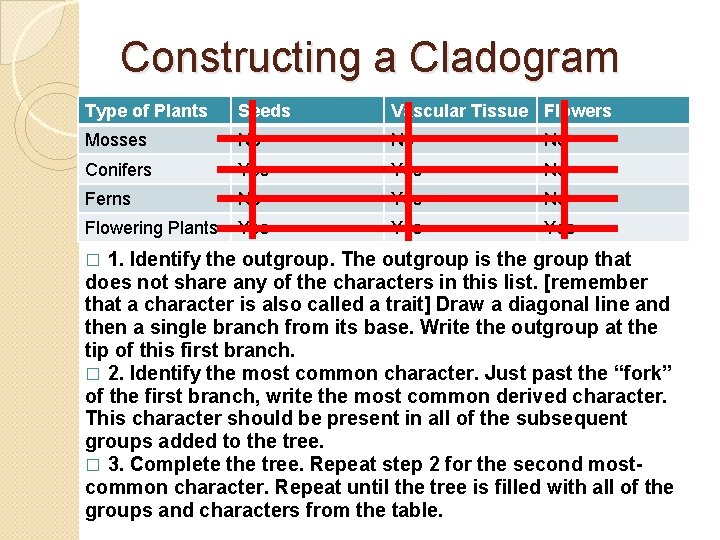
Constructing a Cladogram Type of Plants Seeds Vascular Tissue Flowers Mosses No No No Conifers Yes No Ferns No Yes No Flowering Plants Yes Yes 1. Identify the outgroup. The outgroup is the group that does not share any of the characters in this list. [remember that a character is also called a trait] Draw a diagonal line and then a single branch from its base. Write the outgroup at the tip of this first branch. � 2. Identify the most common character. Just past the “fork” of the first branch, write the most common derived character. This character should be present in all of the subsequent groups added to the tree. � 3. Complete the tree. Repeat step 2 for the second mostcommon character. Repeat until the tree is filled with all of the groups and characters from the table. �
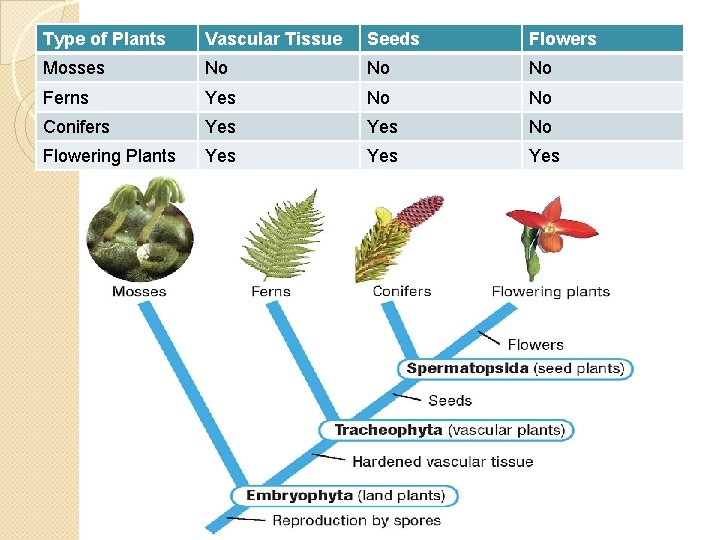
Type of Plants Vascular Tissue Seeds Flowers Mosses No No No Ferns Yes No No Conifers Yes No Flowering Plants Yes Yes
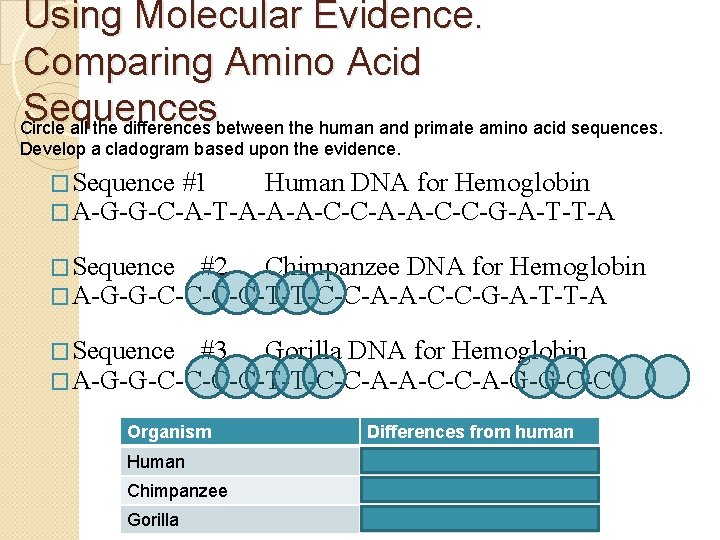
Using Molecular Evidence. Comparing Amino Acid Sequences Circle all the differences between the human and primate amino acid sequences. Develop a cladogram based upon the evidence. �Sequence #1 Human DNA for Hemoglobin �A-G-G-C-A-T-A-A-A-C-C-G-A-T-T-A �Sequence #2 Chimpanzee DNA for Hemoglobin �A-G-G-C-C-T-T-C-C-A-A-C-C-G-A-T-T-A �Sequence #3 Gorilla DNA for Hemoglobin �A-G-G-C-C-T-T-C-C-A-A-C-C-A-G-G-C-C Organism Differences from human Human 0 Chimpanzee 5 Gorilla 10
Cladogram Construction �Following the directions on the handout, construct cladogram for the 2 examples. �Answer the analysis questions. �Take 5 minutes then we’ll take a look at what you come up with for the 1 st example.
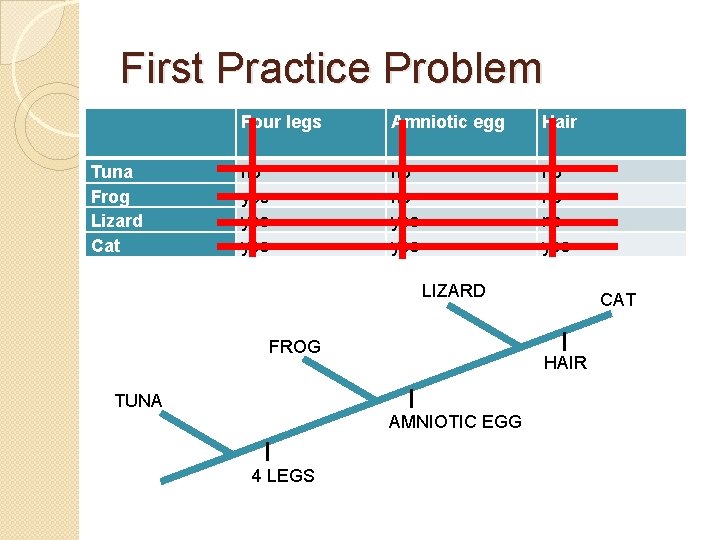
First Practice Problem Tuna Frog Lizard Cat Four legs Amniotic egg Hair no yes yes no no no yes LIZARD FROG HAIR TUNA AMNIOTIC EGG 4 LEGS CAT
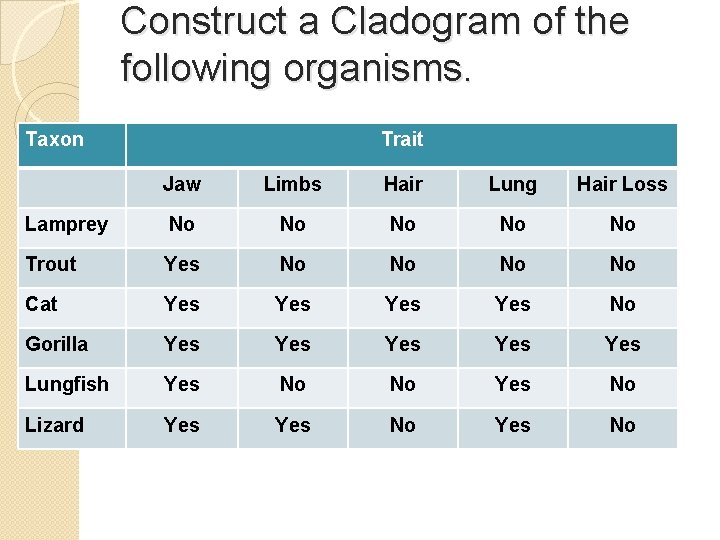
Construct a Cladogram of the following organisms. Taxon Trait Jaw Limbs Hair Lung Hair Loss Lamprey No No No Trout Yes No No Cat Yes Yes No Gorilla Yes Yes Yes Lungfish Yes No No Yes No Lizard Yes No
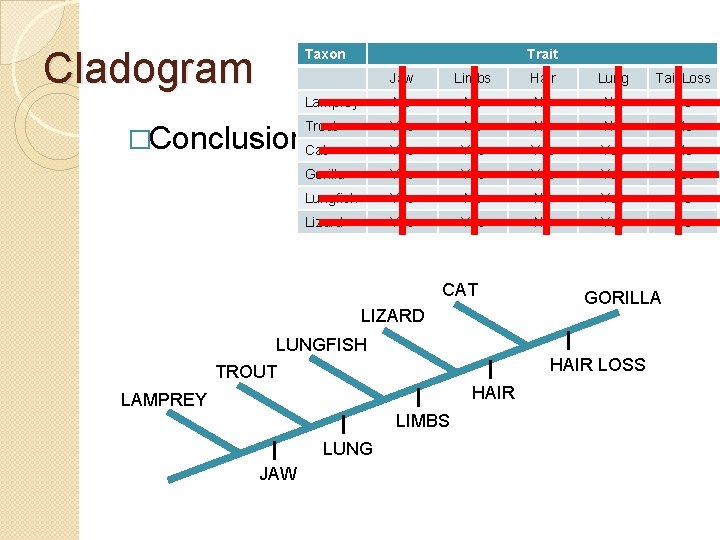
Cladogram Taxon Trait Jaw Limbs Hair Lung Tail Loss Lamprey No No No Trout Yes No No No Mo Yes Yes Mo Gorilla Yes Yes Yes Lungfish Yes No No Yes No Lizard Yes No �Conclusions Cat CAT LIZARD LUNGFISH TROUT HAIR LOSS HAIR LAMPREY LIMBS LUNG JAW GORILLA
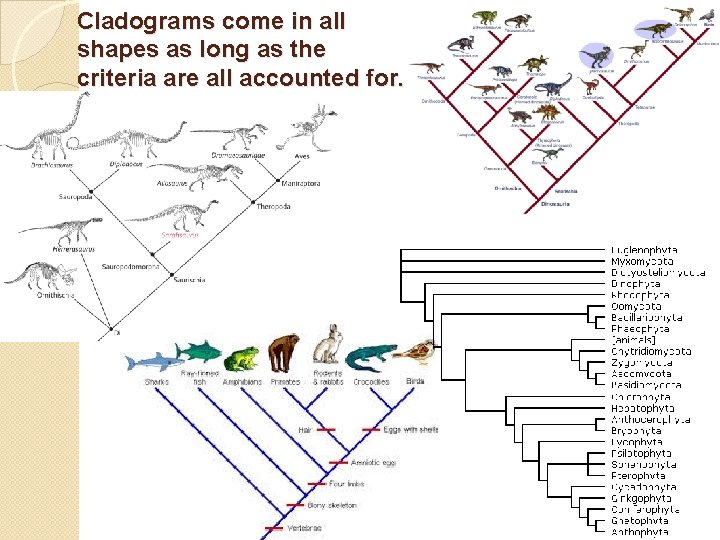
Cladograms come in all shapes as long as the criteria are all accounted for.

Who Knows What a Field Guide Is?
Biologists’ Field Guide �Field guides are a way for individuals not acquainted with the immediate area to avoid deadly situations (or less morbid, to gather relative biological information about an area). �In biology we use field guides to determine what species we are observing in the wild. �If we discover new organisms, we create new field guides of sorts, called dichotomous keys, that help us classify these organisms in an organized way.
Dichotomous Key �A dichotomy is any splitting of a whole into exactly two non-overlapping parts, meaning it is a procedure in which a whole is divided into two parts. It is a partition of a whole (or a set) into two parts (subsets) that are: ◦ jointly exhaustive: everything must belong to one part or the other, and ◦ mutually exclusive: nothing can belong simultaneously to both parts. �Wikipedia. org
Dichotomous Key � In biology, a dichotomy is a division of organisms into two groups, typically based on a characteristic present in one group and absent in the other. � Such dichotomies are used as part of the process of identifying species, as part of a dichotomous key, which asks a series of questions, each of which narrows down the set of organisms. � A well known dichotomy is the question "does it have a backbone? " used to divide species into vertebrates and invertebrates. ◦ Wikipedia. org � This “either-or” technique can be used to help identify and classify individuals or groups of organisms.
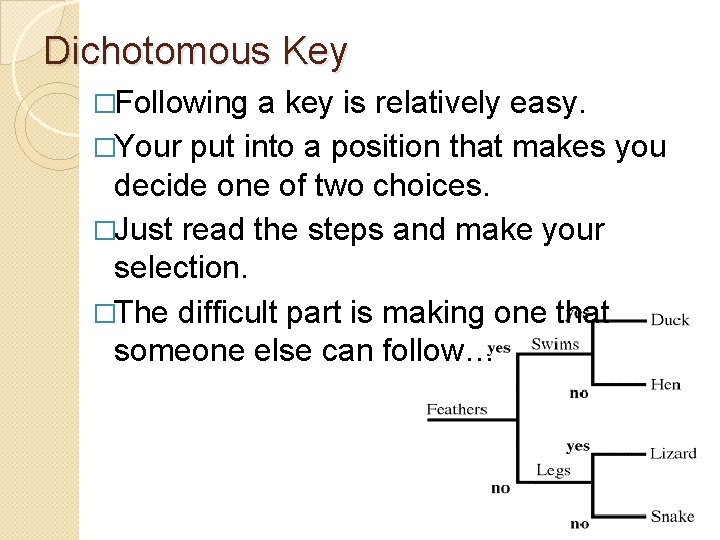
Dichotomous Key �Following a key is relatively easy. �Your put into a position that makes you decide one of two choices. �Just read the steps and make your selection. �The difficult part is making one that someone else can follow…
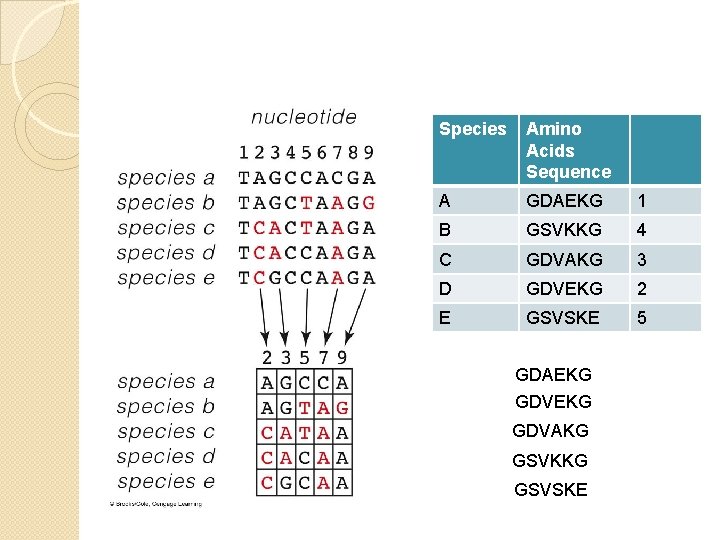
Species Amino Acids Sequence A GDAEKG 1 B GSVKKG 4 C GDVAKG 3 D GDVEKG 2 E GSVSKE 5 GDAEKG GDVAKG GSVKKG GSVSKE
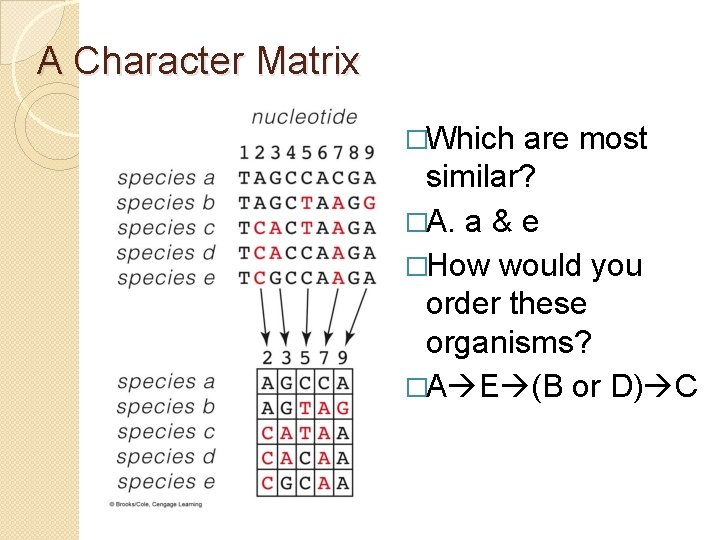
A Character Matrix �Which are most similar? �A. a & e �How would you order these organisms? �A E (B or D) C
- Slides: 45