
How can NAVSEA better meet fleet demands NSRP
How can NAVSEA better meet fleet demands? NSRP Charleston, SC March 2019 Howard Castle SEA 05 P 2 (202) 781 -5082 howard. castle@navy. mil Distribution A: Approved for Public Release
Overview • Technical Warrant scope and pyramid • NAVSEA Strategic Business Plan • Colors issues affecting various products and specifications • NAVSEA Standard Item updates • Hurdles to adopting industry standards • Improvements needed with product application Distribution A: Approved for Public Release
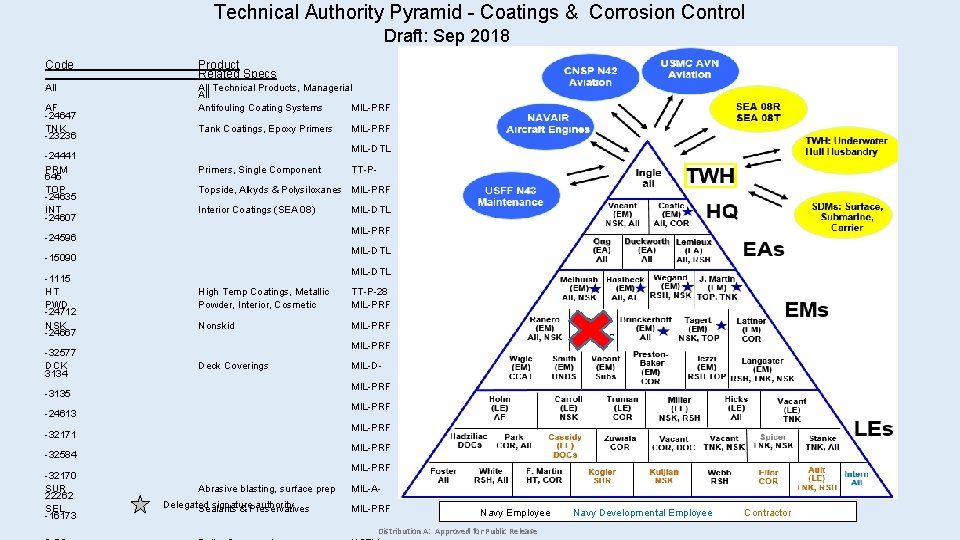
Technical Authority Pyramid - Coatings & Corrosion Control Draft: Sep 2018 Code Product Related Specs All Technical Products, Managerial All Antifouling Coating Systems MIL-PRF AF -24647 TNK -23236 -24441 PRM 645 TOP -24635 INT -24607 Tank Coatings, Epoxy Primers MIL-DTL Primers, Single Component Interior Coatings (SEA 08) MIL-DTL High Temp Coatings, Metallic Powder, Interior, Cosmetic TT-P-28 MIL-PRF Nonskid MIL-PRF Deck Coverings MIL-DMIL-PRF -3135 MIL-PRF -24613 MIL-PRF -32171 MIL-PRF -32584 -32170 SUR 22262 SEL -16173 MIL-DTL MIL-PRF -15090 -32577 DCK 3134 TT-P- Topside, Alkyds & Polysiloxanes MIL-PRF -24596 -1115 HT PWD -24712 NSK -24667 MIL-PRF Abrasive blasting, surface prep Delegated signature authority Sealants & Preservatives MIL-AMIL-PRF Navy Employee Distribution A: Approved for Public Release Navy Developmental Employee Contractor
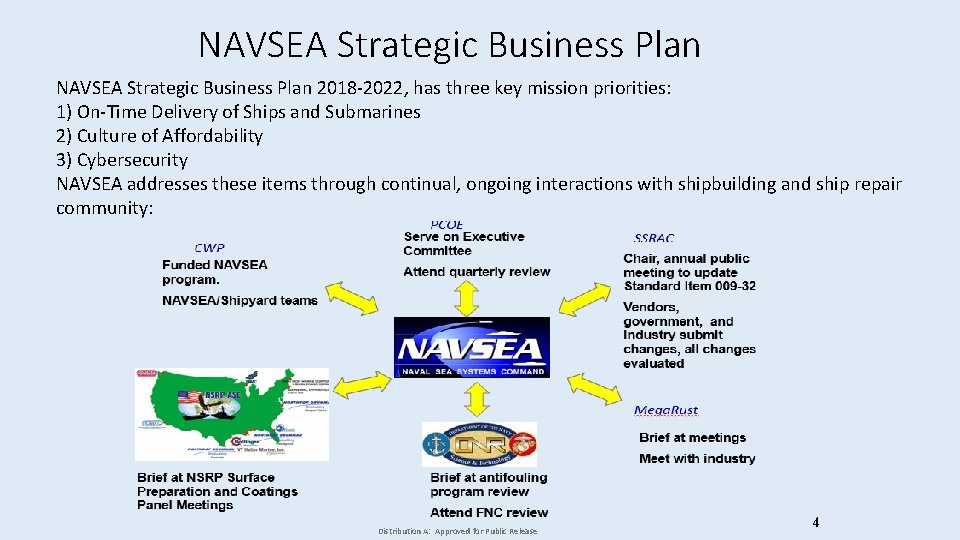
NAVSEA Strategic Business Plan 2018 -2022, has three key mission priorities: 1) On-Time Delivery of Ships and Submarines 2) Culture of Affordability 3) Cybersecurity NAVSEA addresses these items through continual, ongoing interactions with shipbuilding and ship repair community: Distribution A: Approved for Public Release 4
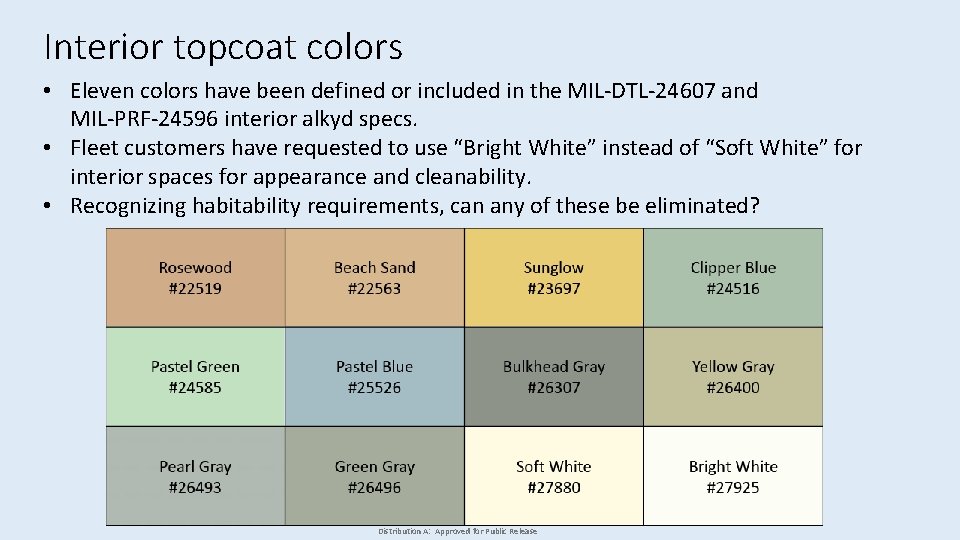
Interior topcoat colors • Eleven colors have been defined or included in the MIL-DTL-24607 and MIL-PRF-24596 interior alkyd specs. • Fleet customers have requested to use “Bright White” instead of “Soft White” for interior spaces for appearance and cleanability. • Recognizing habitability requirements, can any of these be eliminated? Distribution A: Approved for Public Release
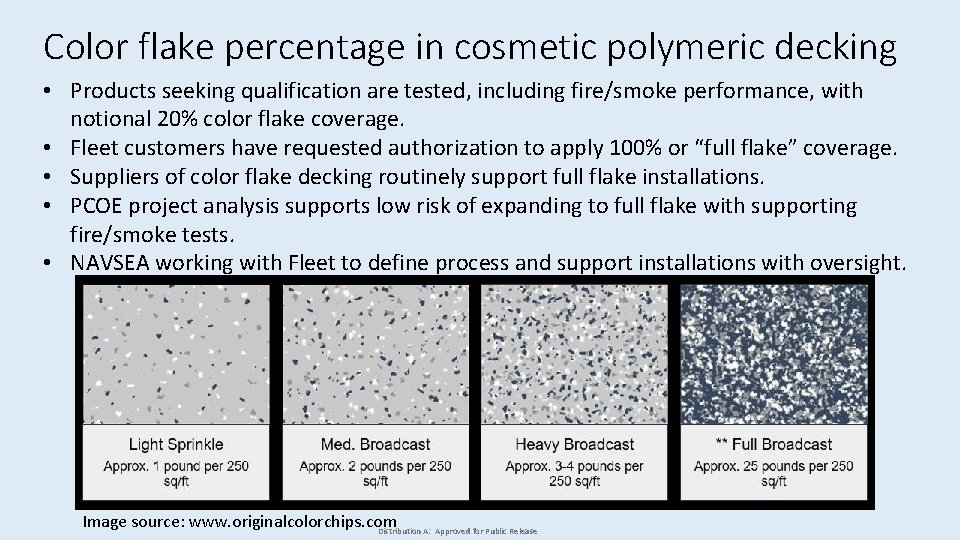
Color flake percentage in cosmetic polymeric decking • Products seeking qualification are tested, including fire/smoke performance, with notional 20% color flake coverage. • Fleet customers have requested authorization to apply 100% or “full flake” coverage. • Suppliers of color flake decking routinely support full flake installations. • PCOE project analysis supports low risk of expanding to full flake with supporting fire/smoke tests. • NAVSEA working with Fleet to define process and support installations with oversight. Image source: www. originalcolorchips. com Distribution A: Approved for Public Release
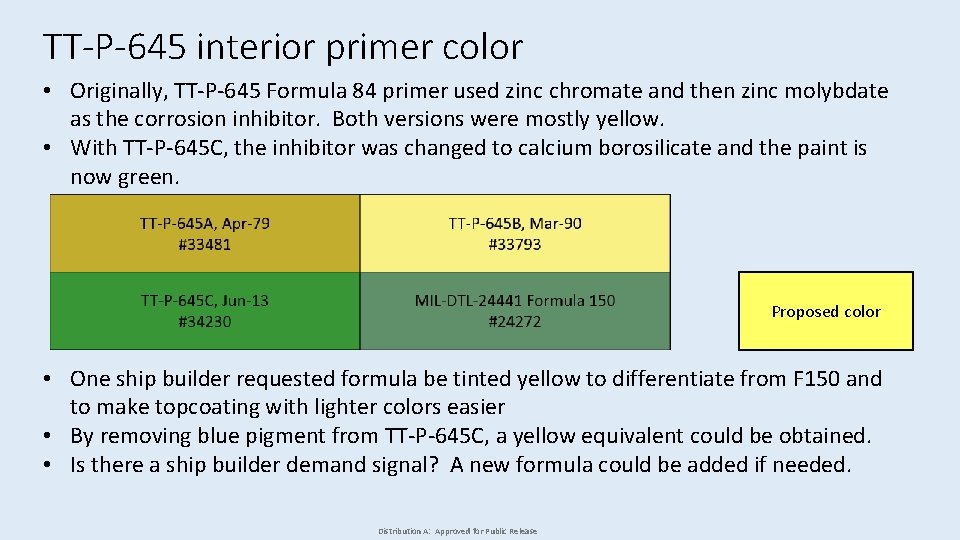
TT-P-645 interior primer color • Originally, TT-P-645 Formula 84 primer used zinc chromate and then zinc molybdate as the corrosion inhibitor. Both versions were mostly yellow. • With TT-P-645 C, the inhibitor was changed to calcium borosilicate and the paint is now green. Proposed color • One ship builder requested formula be tinted yellow to differentiate from F 150 and to make topcoating with lighter colors easier • By removing blue pigment from TT-P-645 C, a yellow equivalent could be obtained. • Is there a ship builder demand signal? A new formula could be added if needed. Distribution A: Approved for Public Release
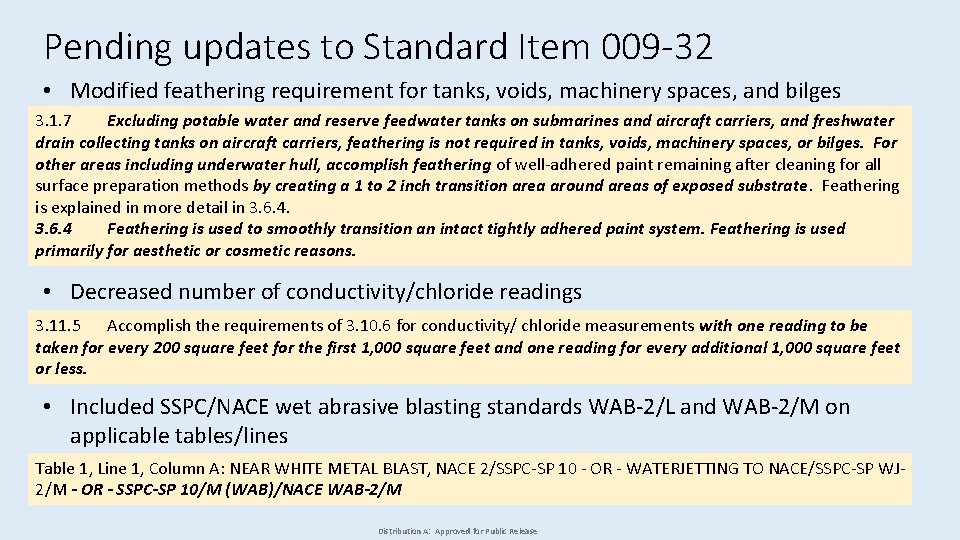
Pending updates to Standard Item 009 -32 • Modified feathering requirement for tanks, voids, machinery spaces, and bilges 3. 1. 7 Excluding potable water and reserve feedwater tanks on submarines and aircraft carriers, and freshwater drain collecting tanks on aircraft carriers, feathering is not required in tanks, voids, machinery spaces, or bilges. For other areas including underwater hull, accomplish feathering of well-adhered paint remaining after cleaning for all surface preparation methods by creating a 1 to 2 inch transition area around areas of exposed substrate. Feathering is explained in more detail in 3. 6. 4 Feathering is used to smoothly transition an intact tightly adhered paint system. Feathering is used primarily for aesthetic or cosmetic reasons. • Decreased number of conductivity/chloride readings 3. 11. 5 Accomplish the requirements of 3. 10. 6 for conductivity/ chloride measurements with one reading to be taken for every 200 square feet for the first 1, 000 square feet and one reading for every additional 1, 000 square feet or less. • Included SSPC/NACE wet abrasive blasting standards WAB-2/L and WAB-2/M on applicable tables/lines Table 1, Line 1, Column A: NEAR WHITE METAL BLAST, NACE 2/SSPC-SP 10 - OR - WATERJETTING TO NACE/SSPC-SP WJ 2/M - OR - SSPC-SP 10/M (WAB)/NACE WAB-2/M Distribution A: Approved for Public Release
Planned specification updates • MIL-PRF-24635 updates to pigment package for gray topcoats for total solar reflectance • MIL-PRF-24667 undergoing significant rewrite: • Types based on installation method (rolled vs. sprayed) and environment (standard vs. extended durability & surface vs. submerged) • Composition driven by aggregate used (hardness, density) • Removal of Type XI peel and stick nonskid to MIL-PRF-XX 642 solid decking specification (long pole) • MIL-PRF-16173 expansion of class definitions (temporary vs. persistent, hard vs. soft, solvent- vs. steam-removable, etc. ) • TT-C-492 update to define types (VOC-based), classes (thermal conductivity), and grade (condensation limit) Distribution A: Approved for Public Release
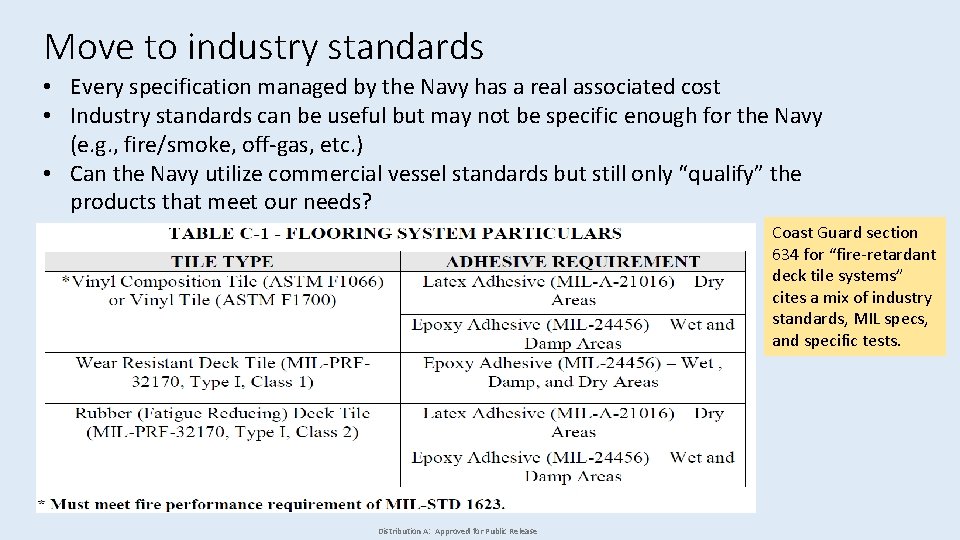
Move to industry standards • Every specification managed by the Navy has a real associated cost • Industry standards can be useful but may not be specific enough for the Navy (e. g. , fire/smoke, off-gas, etc. ) • Can the Navy utilize commercial vessel standards but still only “qualify” the products that meet our needs? Coast Guard section 634 for “fire-retardant deck tile systems” cites a mix of industry standards, MIL specs, and specific tests. Distribution A: Approved for Public Release
What risk is NAVSEA accepting with industry standards? • There are instances of invoking industry standards for processes… • SSPC-PA 2 for DFT measurements • NACE SP 0178 for minimum weld preparation before coating • SSPC/NACE for surface preparation • But relatively few for materials… • Inorganic Zinc Silicate Coatings are invoked in 009 -32 for CVN Catapult Water Brake Tanks and certain new construction ship specifications in chain lockers. • NAVSEA requires SSPC Paint 20, Type I-C (inorganic, self-curing vehicles). • Standard invokes ASTM D 520 for lead level in dust purity. Only D 520 Type III is permitted. • SSPC-AB 1 for abrasive media could theoretically be used instead of MIL-A 22262 but SSPC-AB 1 is silent on radioactivity tests. Distribution A: Approved for Public Release
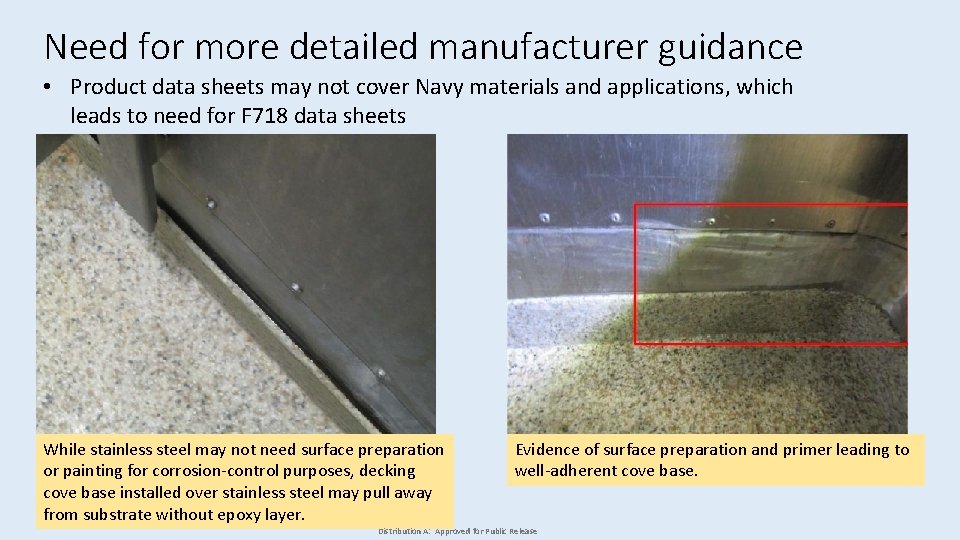
Need for more detailed manufacturer guidance • Product data sheets may not cover Navy materials and applications, which leads to need for F 718 data sheets While stainless steel may not need surface preparation or painting for corrosion-control purposes, decking cove base installed over stainless steel may pull away from substrate without epoxy layer. Evidence of surface preparation and primer leading to well-adherent cove base. Distribution A: Approved for Public Release
Conclusion • NAVSEA exists to support the fleet • NAVSEA has to balance “wants” vs. “needs” due to associated costs • Adopting industry standards is a good idea… until something goes wrong • NAVSEA leadership wants to be more responsive – requires commitment to change old ways of behavior • NAVSEA relies on industry partners to identify the right improvement opportunities Distribution A: Approved for Public Release
- Slides: 13