
How can I use water more responsibly By
How can I use water more responsibly? By Alexandra Soica & Andreea Huiu National College Barbu Stirbei, Calarasi, ROMANIA www. aces. or. at aces-sw/
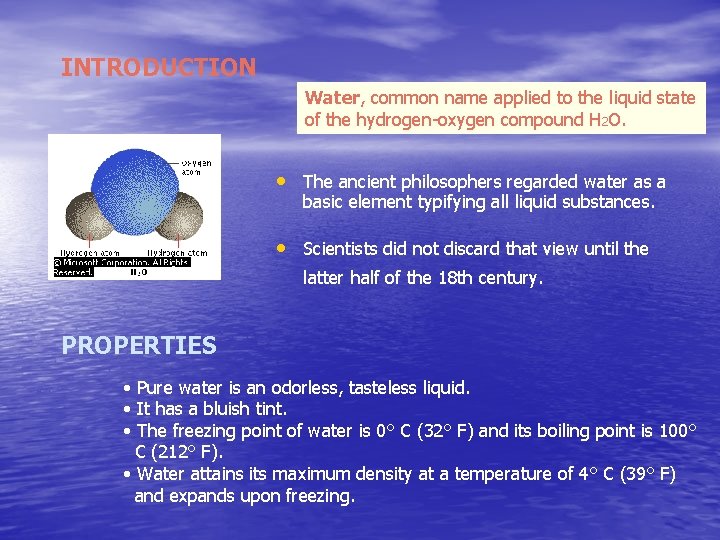
INTRODUCTION Water, common name applied to the liquid state of the hydrogen-oxygen compound H 2 O. • The ancient philosophers regarded water as a basic element typifying all liquid substances. • Scientists did not discard that view until the latter half of the 18 th century. PROPERTIES • Pure water is an odorless, tasteless liquid. • It has a bluish tint. • The freezing point of water is 0° C (32° F) and its boiling point is 100° C (212° F). • Water attains its maximum density at a temperature of 4° C (39° F) and expands upon freezing.
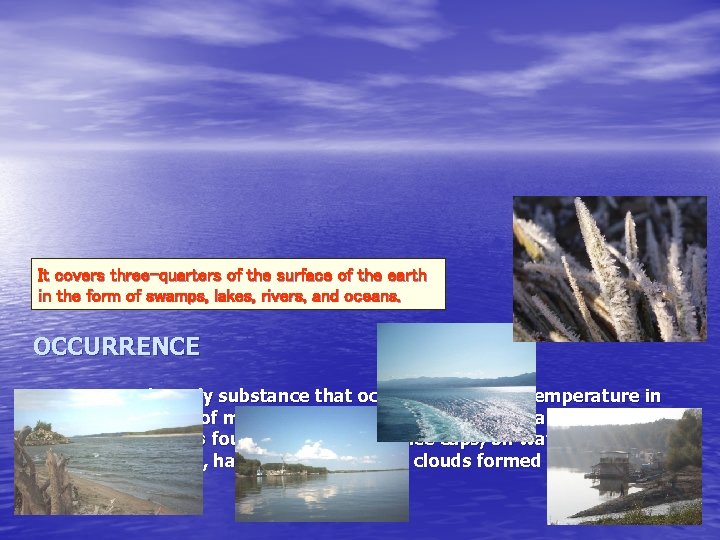
It covers three-quarters of the surface of the earth in the form of swamps, lakes, rivers, and oceans. OCCURRENCE Water is the only substance that occurs at ordinary temperature in all three states of matter, that is, as a solid, a liquid, and a gas. As a solid, or ice, it is found as glaciers and ice caps, on water surfaces in winter, as snow, hail, and frost, and as clouds formed of ice crystals.
WATER IN LIFE Water - more precious than gold Water flows and knows no borders So use water, but do it in the wise way. Be WATERSAVER. • Water is the major constituent of living matter. • From 50 to 90 percent of the weight of living organisms is water. • Protoplasm, the basic material of living cells, consists of a solution in • • water of fats, carbohydrates, proteins, salts, and similar chemicals. Blood in animals and sap in plants consist largely of water and serve to transport food and remove waste material. Water also plays a key role in the metabolic breakdown of such essential molecules as proteins and carbohydrates. This process, called hydrolysis, goes on continually in living cells.

How can I use water more responsibly? While the quantity of water on the continent is not so much of an issue, the quality and management of our water is far from satisfactory. Approximately 35% of the water comes out of our taps comes from surface waters (lakes, rivers) and 65% comes from groundwater also called ‘aquifers’, which hold the rainwater that seeps through the soil. The quality of drinking water in the European Union is generally very good, and tap water is safe to drink nearly everywhere. However, all water must be treated before it is safe to drink. The treatment of water is a costly and energy-consuming process. On average, 7% of the drinking water we use actually goes to drinking and cooking. 22% is used for dishwashing and laundry, 20% for sanitary systems, 39% for baths and showers, and 6% for car washing and watering the garden. Less than 1% of the planet’s water is available for human consumption and more than 1. 2 billion people have no access to safe drinking water.
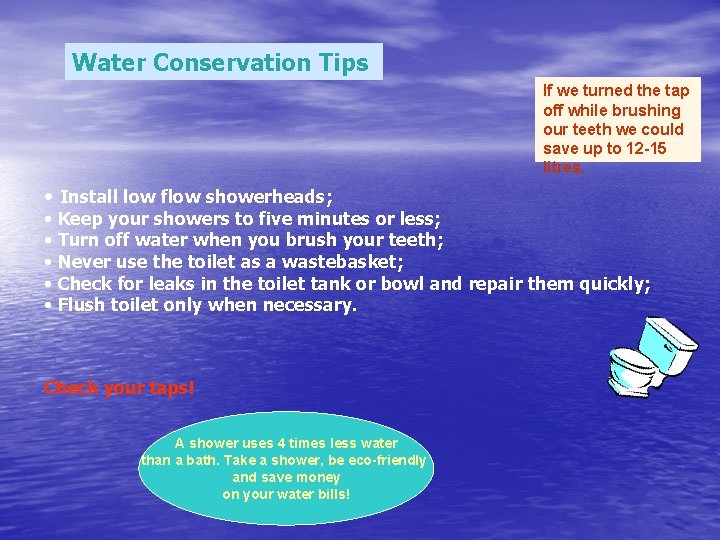
Water Conservation Tips If we turned the tap off while brushing our teeth we could save up to 12 -15 litres. • Install low flow showerheads; • Keep your showers to five minutes or less; • Turn off water when you brush your teeth; • Never use the toilet as a wastebasket; • Check for leaks in the toilet tank or bowl and repair them quickly; • Flush toilet only when necessary. Check your taps! A shower uses 4 times less water than a bath. Take a shower, be eco-friendly and save money on your water bills!
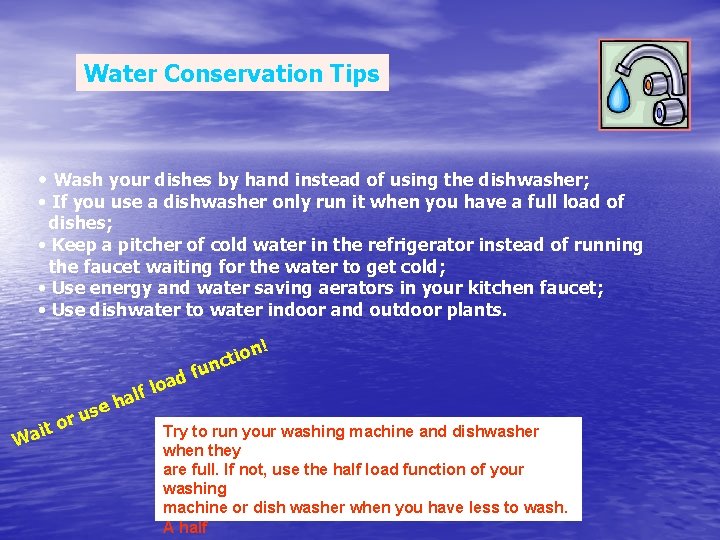
Water Conservation Tips • Wash your dishes by hand instead of using the dishwasher; • If you use a dishwasher only run it when you have a full load of dishes; • Keep a pitcher of cold water in the refrigerator instead of running the faucet waiting for the water to get cold; • Use energy and water saving aerators in your kitchen faucet; • Use dishwater to water indoor and outdoor plants. ! ion t c n d fu a r o t i Wa u f lo l a h se Try to run your washing machine and dishwasher when they are full. If not, use the half load function of your washing machine or dish washer when you have less to wash. A half
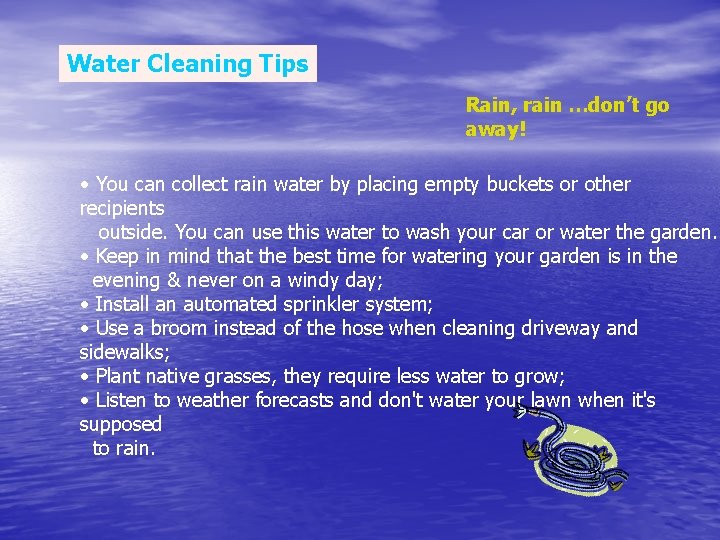
Water Cleaning Tips Rain, rain …don’t go away! • You can collect rain water by placing empty buckets or other recipients outside. You can use this water to wash your car or water the garden. • Keep in mind that the best time for watering your garden is in the evening & never on a windy day; • Install an automated sprinkler system; • Use a broom instead of the hose when cleaning driveway and sidewalks; • Plant native grasses, they require less water to grow; • Listen to weather forecasts and don't water your lawn when it's supposed to rain.
Thank you for your attention. May 2007
- Slides: 9