
How Can Automated Feedback Engage Middle School Students
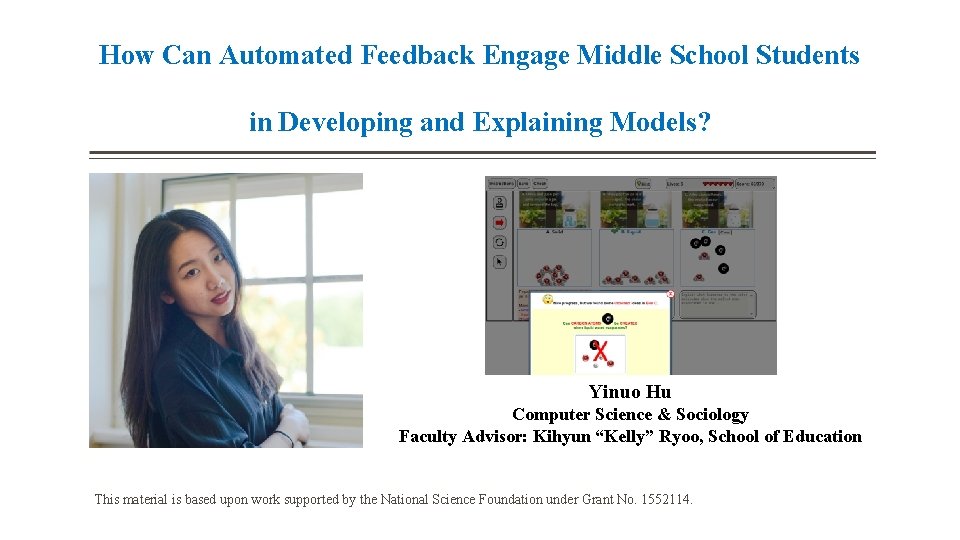
How Can Automated Feedback Engage Middle School Students in Developing and Explaining Models? Yinuo Hu Computer Science & Sociology Faculty Advisor: Kihyun “Kelly” Ryoo, School of Education This material is based upon work supported by the National Science Foundation under Grant No. 1552114.
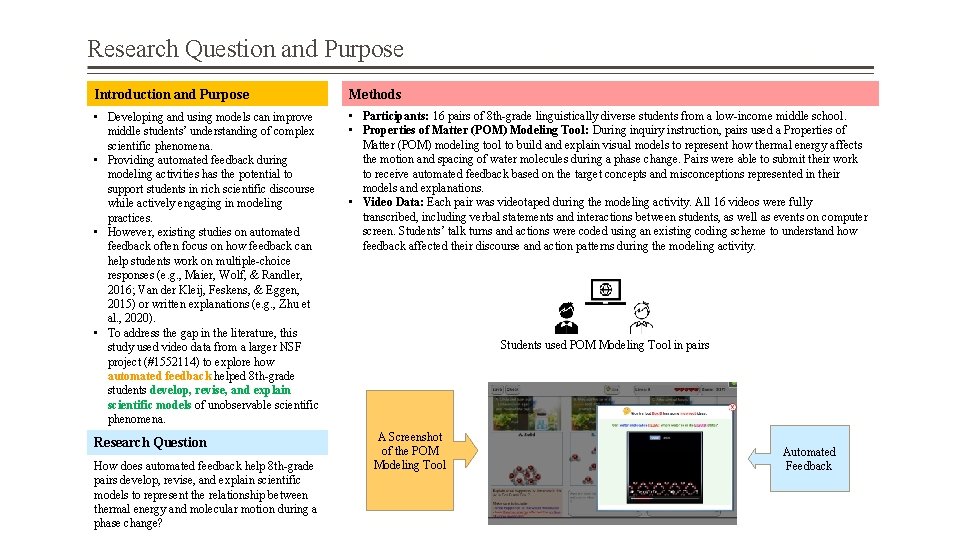
Research Question and Purpose Introduction and Purpose Methods • Developing and using models can improve middle students’ understanding of complex scientific phenomena. • Providing automated feedback during modeling activities has the potential to support students in rich scientific discourse while actively engaging in modeling practices. • However, existing studies on automated feedback often focus on how feedback can help students work on multiple-choice responses (e. g. , Maier, Wolf, & Randler, 2016; Van der Kleij, Feskens, & Eggen, 2015) or written explanations (e. g. , Zhu et al. , 2020). • To address the gap in the literature, this study used video data from a larger NSF project (#1552114) to explore how automated feedback helped 8 th-grade students develop, revise, and explain scientific models of unobservable scientific phenomena. • Participants: 16 pairs of 8 th-grade linguistically diverse students from a low-income middle school. • Properties of Matter (POM) Modeling Tool: During inquiry instruction, pairs used a Properties of Matter (POM) modeling tool to build and explain visual models to represent how thermal energy affects the motion and spacing of water molecules during a phase change. Pairs were able to submit their work to receive automated feedback based on the target concepts and misconceptions represented in their models and explanations. • Video Data: Each pair was videotaped during the modeling activity. All 16 videos were fully transcribed, including verbal statements and interactions between students, as well as events on computer screen. Students’ talk turns and actions were coded using an existing coding scheme to understand how feedback affected their discourse and action patterns during the modeling activity. Research Question How does automated feedback help 8 th-grade pairs develop, revise, and explain scientific models to represent the relationship between thermal energy and molecular motion during a phase change? Students used POM Modeling Tool in pairs A Screenshot of the POM Modeling Tool Automated Feedback
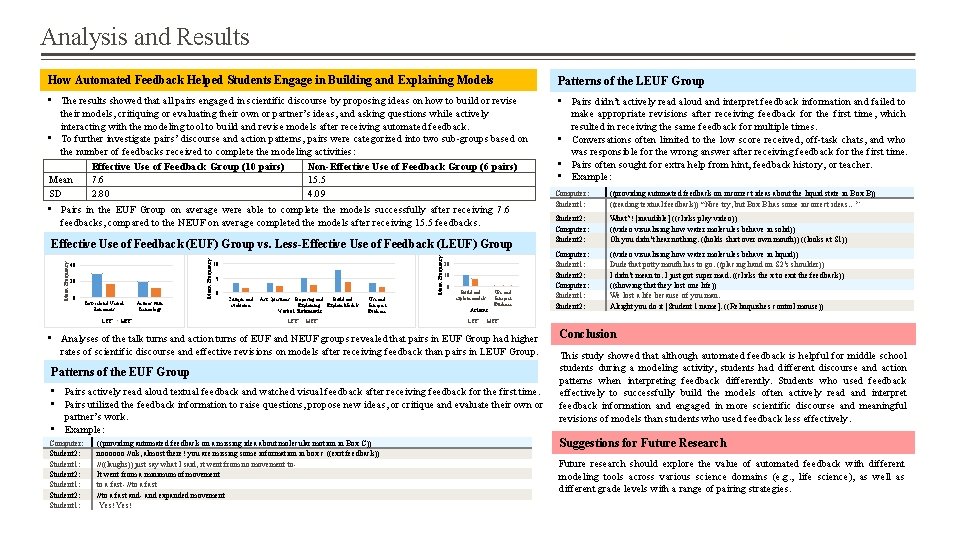
Analysis and Results How Automated Feedback Helped Students Engage in Building and Explaining Models Patterns of the LEUF Group • The results showed that all pairs engaged in scientific discourse by proposing ideas on how to build or revise their models, critiquing or evaluating their own or partner’s ideas, and asking questions while actively interacting with the modeling tool to build and revise models after receiving automated feedback. • To further investigate pairs’ discourse and action patterns, pairs were categorized into two sub-groups based on the number of feedbacks received to complete the modeling activities: Effective Use of Feedback Group (10 pairs) Non-Effective Use of Feedback Group (6 pairs) Mean 7. 6 15. 5 SD 2. 80 4. 09 • Pairs in the EUF Group on average were able to complete the models successfully after receiving 7. 6 feedbacks, compared to the NEUF on average completed the models after receiving 15. 5 feedbacks. • Pairs didn’t actively read aloud and interpret feedback information and failed to make appropriate revisions after receiving feedback for the first time, which resulted in receiving the same feedback for multiple times. • Conversations often limited to the low score received, off-task chats, and who was responsible for the wrong answer after receiving feedback for the first time. • Pairs often sought for extra help from hint, feedback history, or teacher. • Example: 40 20 0 Task-related Verbal Statements LFF Actions with Technology HFF Mean Frequency Effective Use of Feedback (EUF) Group vs. Less-Effective Use of Feedback (LEUF) Group 10 5 0 Critique and evaluaion Ask Questions Proposing and Build and Explaining Explain Models Verbal Statements LFF Use and Interpret Evidence HFF 20 10 0 Build and explain models Actions LFF Use and Interpret Evidence Patterns of the EUF Group • Pairs actively read aloud textual feedback and watched visual feedback after receiving feedback for the first time. • Pairs utilized the feedback information to raise questions, propose new ideas, or critique and evaluate their own or partner’s work. • Example: ((providing automated feedback on a missing idea about molecular motion in Box C)) noooooo //ok, almost there! you are missing some information in box c ((exit feedback)) //((laughs)) just say what I said, it went from no movement to. It went from a minimum of movement to a fast- //to a fast and- and expanded movement Yes! ((providing automated feedback on incorrect ideas about the liquid state in Box B)) ((reading textual feedback)) “Nice try, but Box B has some incorrect ideas…” Student 2: Computer: Student 2: What? ! [inaudible] ((clicks play video)) ((video visualizing how water molecules behave in solid)) Oh you didn’t hear nothing. ((holds shirt over own mouth)) ((looks at S 1)) Computer: Student 1: Student 2: ((video visualizing how water molecules behave in liquid)) Dude that potty mouth has to go. ((placing hand on S 2’s shoulder)) I didn’t mean to. I just got super mad. ((clicks the x to exit the feedback)) ((showing that they lost one life)) We lost a life because of you man. Alright you do it [Student 1 name]. ((Relinquishes control mouse)) HFF • Analyses of the talk turns and action turns of EUF and NEUF groups revealed that pairs in EUF Group had higher rates of scientific discourse and effective revisions on models after receiving feedback than pairs in LEUF Group. Computer: Student 2: Student 1: Computer: Student 1: Conclusion This study showed that although automated feedback is helpful for middle school students during a modeling activity, students had different discourse and action patterns when interpreting feedback differently. Students who used feedback effectively to successfully build the models often actively read and interpret feedback information and engaged in more scientific discourse and meaningful revisions of models than students who used feedback less effectively. Suggestions for Future Research Future research should explore the value of automated feedback with different modeling tools across various science domains (e. g. , life science), as well as different grade levels with a range of pairing strategies.
- Slides: 3