
HOW BIG IS THE NUCLEUS REALLY NUCLEAR RADIUS
HOW BIG IS THE NUCLEUS REALLY? ! NUCLEAR RADIUS MEASUREMENT:
CONTENTS: 1. 2. 3. 4. 5. Introduction. Rutherford’s estimation: low energy α scattering. Electron scattering experiments. Mirror nuclei method. Muonic X-ray method.
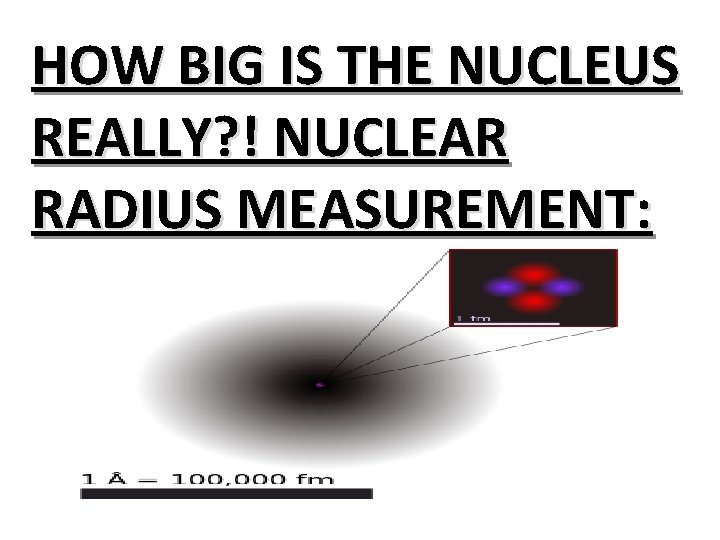
INTRODUCTION: Ø How big is the nucleus really? This was one of the first questions that came into the human mind as soon as the existence of nucleus become established with Rutherford’s α scattering experiment. The same experiment itself put some upper limit on the diameter of the nucleus to be of the order of a few femto-metre(fm-10 -15 m). Ø For comparison, size of the atom(distance from nucleus to outermost electron) is of the order of few Angstroms(10 -10 m). So the nucleus is approximately 105 times smaller than atom as a whole. Ø The problem of defining a radius for the atomic nucleus is similar to that of defining a radius for the entire atom; neither atoms nor their nuclei have definite boundaries. https: //youtu. be/1 ke. Kr. Goq. UAg
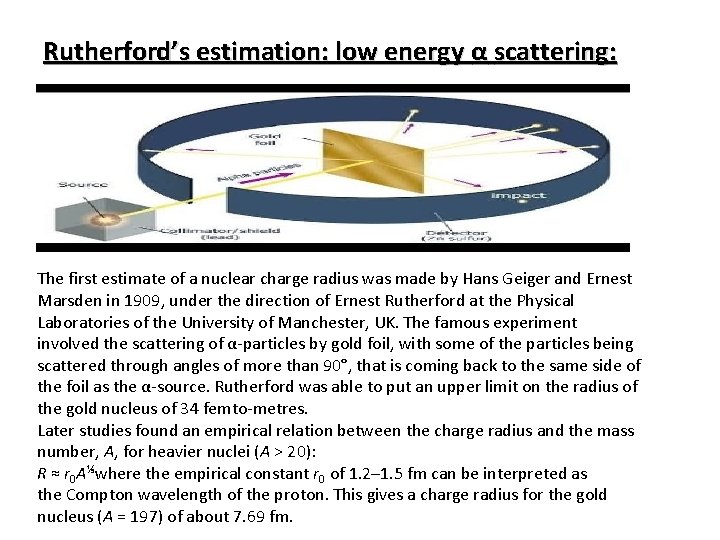
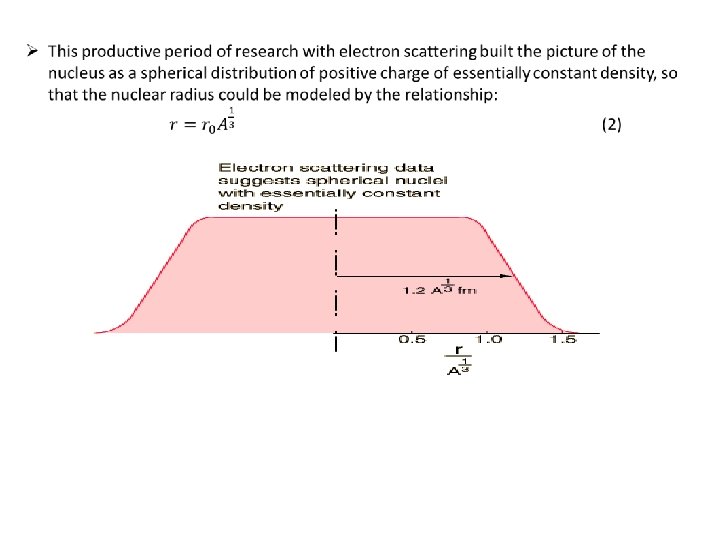
Rutherford’s estimation: low energy α scattering: The first estimate of a nuclear charge radius was made by Hans Geiger and Ernest Marsden in 1909, under the direction of Ernest Rutherford at the Physical Laboratories of the University of Manchester, UK. The famous experiment involved the scattering of α-particles by gold foil, with some of the particles being scattered through angles of more than 90°, that is coming back to the same side of the foil as the α-source. Rutherford was able to put an upper limit on the radius of the gold nucleus of 34 femto-metres. Later studies found an empirical relation between the charge radius and the mass number, A, for heavier nuclei (A > 20): R ≈ r 0 A⅓where the empirical constant r 0 of 1. 2– 1. 5 fm can be interpreted as the Compton wavelength of the proton. This gives a charge radius for the gold nucleus (A = 197) of about 7. 69 fm.
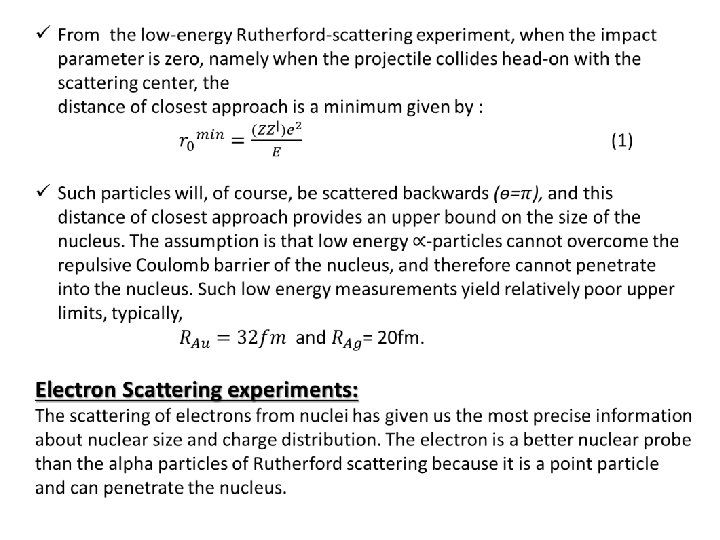
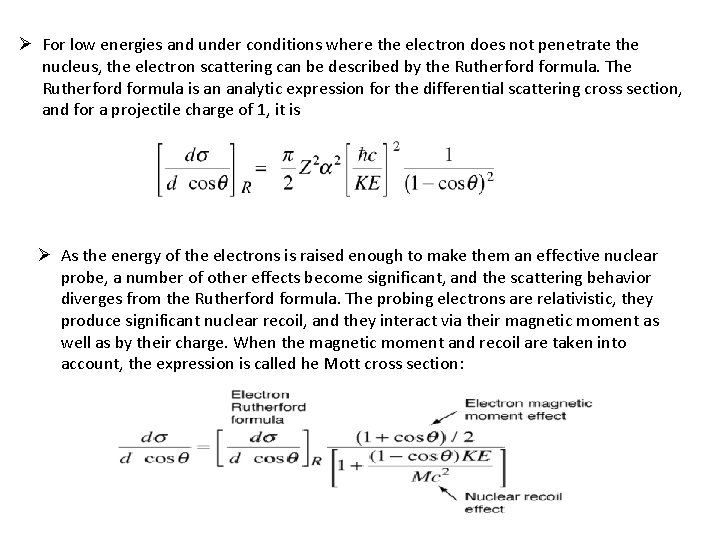
Ø For low energies and under conditions where the electron does not penetrate the nucleus, the electron scattering can be described by the Rutherford formula. The Rutherford formula is an analytic expression for the differential scattering cross section, and for a projectile charge of 1, it is Ø As the energy of the electrons is raised enough to make them an effective nuclear probe, a number of other effects become significant, and the scattering behavior diverges from the Rutherford formula. The probing electrons are relativistic, they produce significant nuclear recoil, and they interact via their magnetic moment as well as by their charge. When the magnetic moment and recoil are taken into account, the expression is called he Mott cross section:
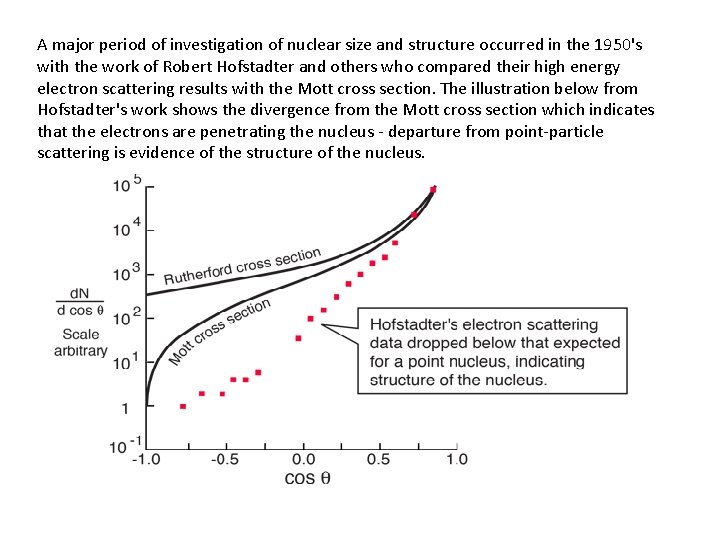
A major period of investigation of nuclear size and structure occurred in the 1950's with the work of Robert Hofstadter and others who compared their high energy electron scattering results with the Mott cross section. The illustration below from Hofstadter's work shows the divergence from the Mott cross section which indicates that the electrons are penetrating the nucleus - departure from point-particle scattering is evidence of the structure of the nucleus.
Mirror nuclei method: Ø Mirror nuclei are nuclei where the number of protons of element one (Z 1) equals the number of neutrons of element two (N 2) and the number of protons of element two (Z 2) equals the number of neutrons in element one (N 1), such that the mass number is the same (A = N 1 + Z 1 = N 2 + Z 2). Ø As that Z 1 = N 2 and Z 2 = N 1, A = N 1 + N 2 = Z 1 + Z 2. By making the substitution Z 1 = Z and Z 2 = Z − 1, the mass number can be rewritten in the form 2 Z - 1. Ø Examples of mirror nuclei: § 3 H and 3 He: Jπ = 1/2+ § 14 C and 14 O: Jπ = 0+ § 15 N and 15 O: Jπ = 1/2− § 24 Na and 24 Al: Jπ = 4+ § 24 m. Na and 24 m. Al: Jπ = 1+ Ø Pairs of mirror nuclei have the same spin and parity. If we constrain to odd number of nucleons (A=Z+N) then we find mirror nuclei that differ from one another by exchanging a proton by a neutron. Interesting to observe is their binding energy which is mainly due to the strong interaction and also due to Coulomb interaction. Since the strong interaction is invariant to protons and neutrons one can expect these mirror nuclei to have very similar binding energies.
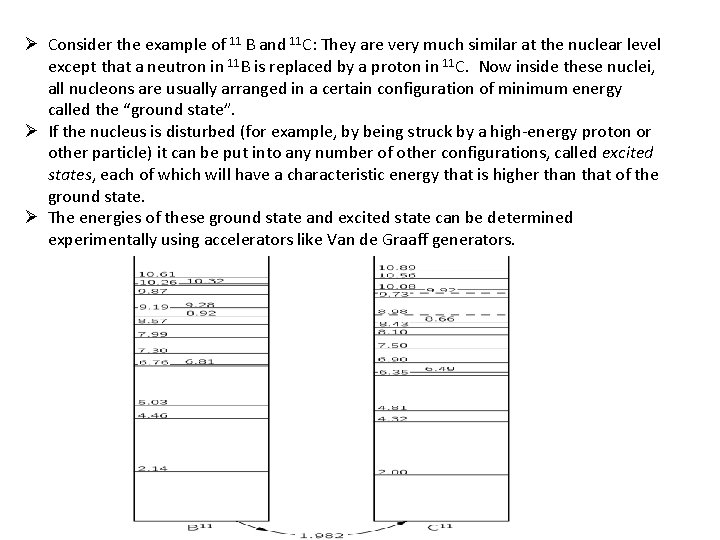
Ø Consider the example of 11 B and 11 C: They are very much similar at the nuclear level except that a neutron in 11 B is replaced by a proton in 11 C. Now inside these nuclei, all nucleons are usually arranged in a certain configuration of minimum energy called the “ground state”. Ø If the nucleus is disturbed (for example, by being struck by a high-energy proton or other particle) it can be put into any number of other configurations, called excited states, each of which will have a characteristic energy that is higher than that of the ground state. Ø The energies of these ground state and excited state can be determined experimentally using accelerators like Van de Graaff generators.
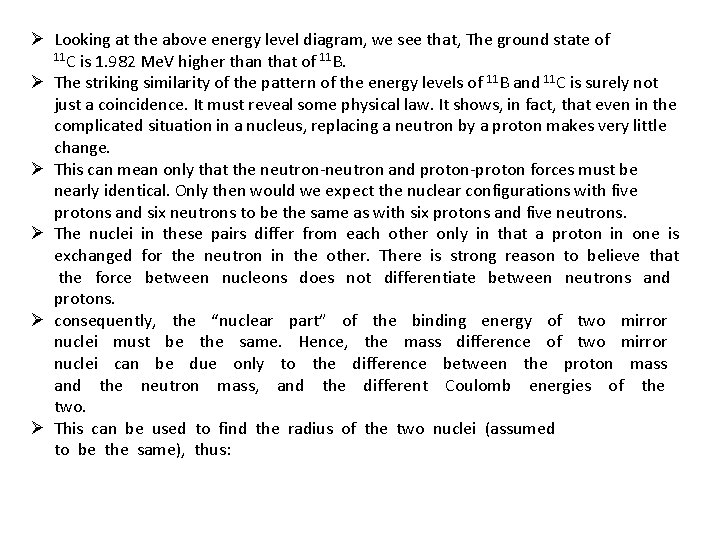
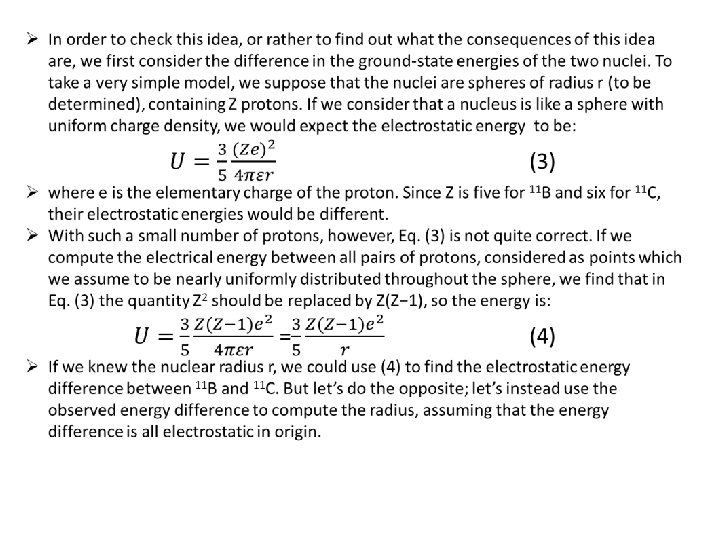
Ø Looking at the above energy level diagram, we see that, The ground state of 11 C is 1. 982 Me. V higher than that of 11 B. Ø The striking similarity of the pattern of the energy levels of 11 B and 11 C is surely not just a coincidence. It must reveal some physical law. It shows, in fact, that even in the complicated situation in a nucleus, replacing a neutron by a proton makes very little change. Ø This can mean only that the neutron-neutron and proton-proton forces must be nearly identical. Only then would we expect the nuclear configurations with five protons and six neutrons to be the same as with six protons and five neutrons. Ø The nuclei in these pairs differ from each other only in that a proton in one is exchanged for the neutron in the other. There is strong reason to believe that the force between nucleons does not differentiate between neutrons and protons. Ø consequently, the “nuclear part” of the binding energy of two mirror nuclei must be the same. Hence, the mass difference of two mirror nuclei can be due only to the difference between the proton mass and the neutron mass, and the different Coulomb energies of the two. Ø This can be used to find the radius of the two nuclei (assumed to be the same), thus:
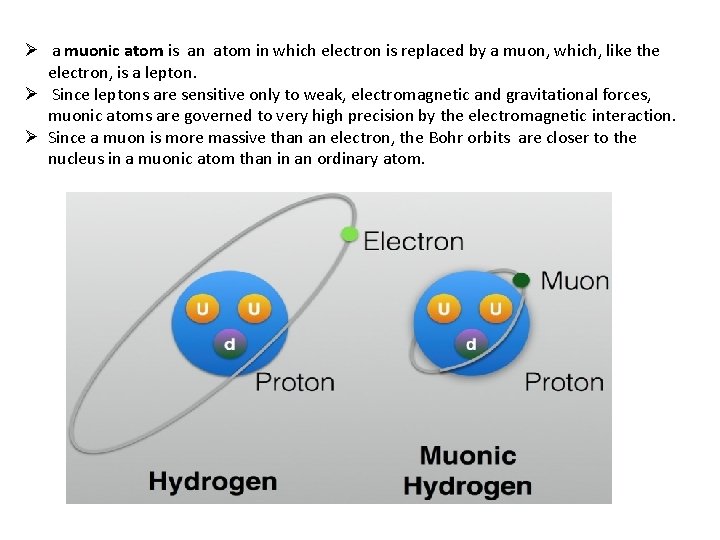
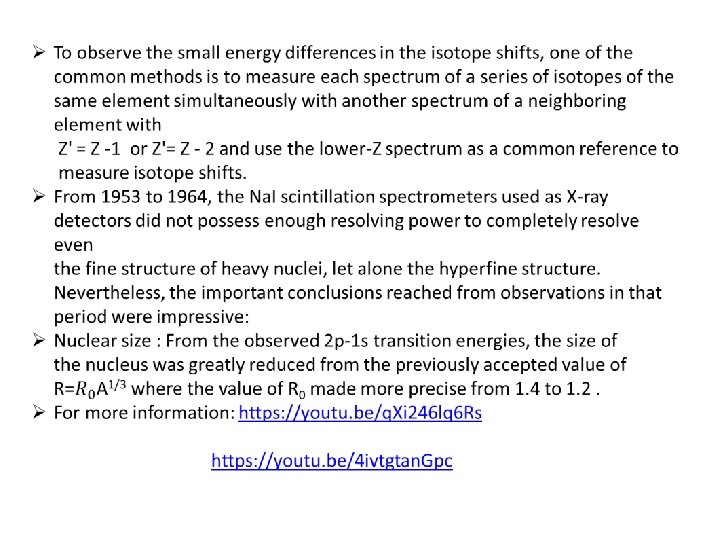
Ø a muonic atom is an atom in which electron is replaced by a muon, which, like the electron, is a lepton. Ø Since leptons are sensitive only to weak, electromagnetic and gravitational forces, muonic atoms are governed to very high precision by the electromagnetic interaction. Ø Since a muon is more massive than an electron, the Bohr orbits are closer to the nucleus in a muonic atom than in an ordinary atom.
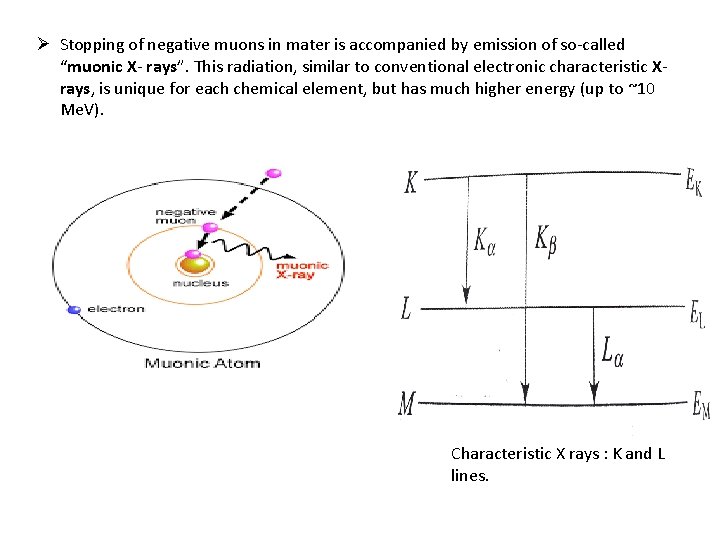
Ø Stopping of negative muons in mater is accompanied by emission of so-called “muonic X- rays”. This radiation, similar to conventional electronic characteristic Xrays, is unique for each chemical element, but has much higher energy (up to ~10 Me. V). Characteristic X rays : K and L lines.
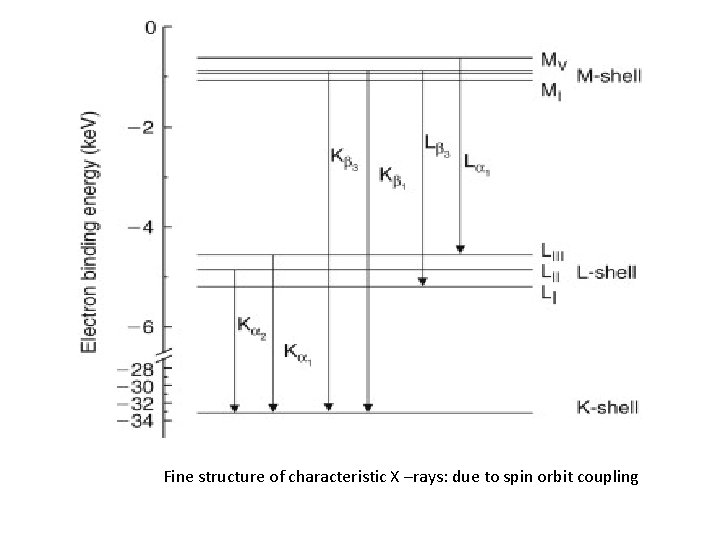
Fine structure of characteristic X –rays: due to spin orbit coupling
- Slides: 17