
How Baptists Understand the Local Church Baptist Principles

How Baptists Understand the Local Church Baptist Principles
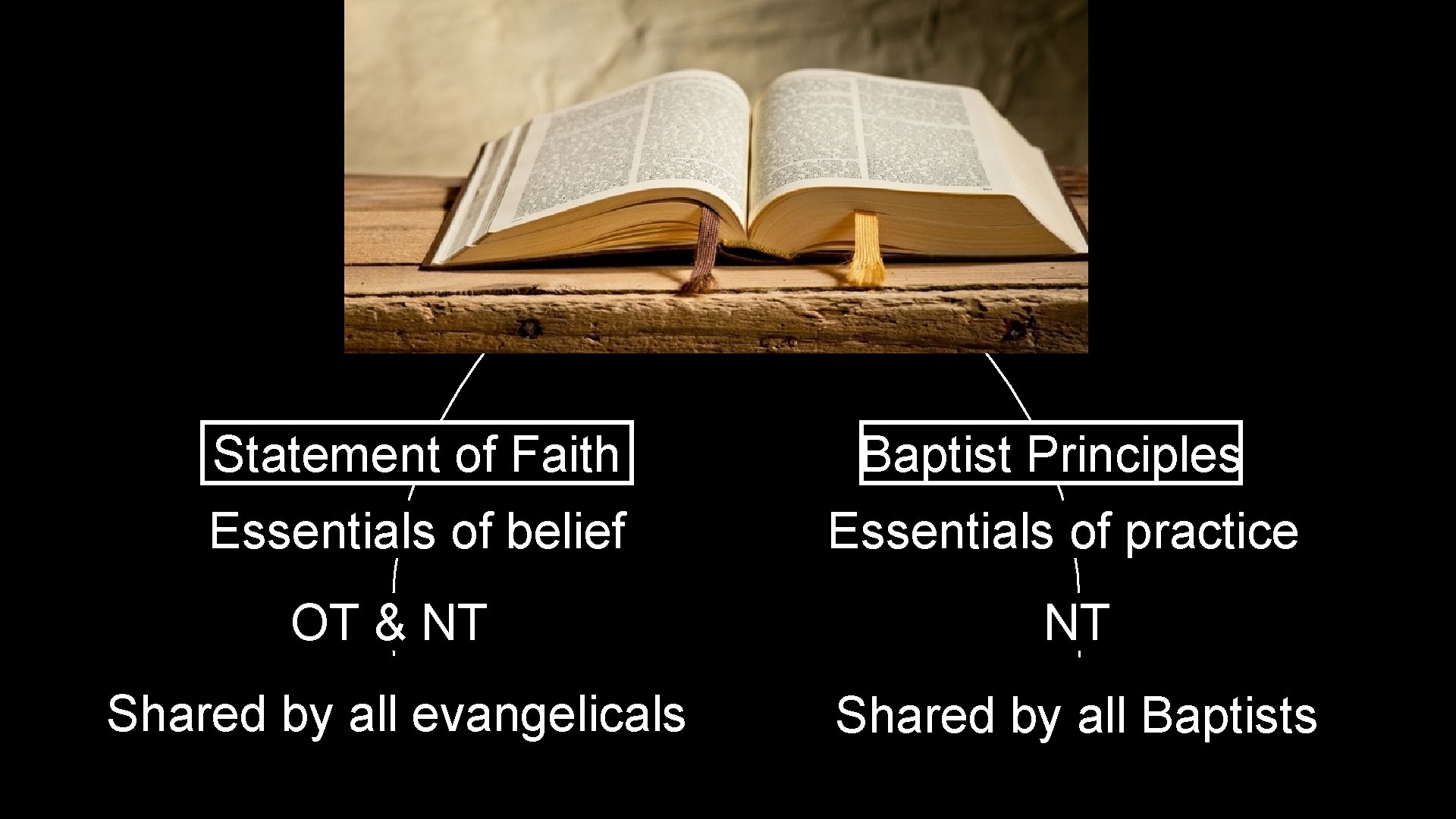
Statement of Faith Baptist Principles Essentials of belief Essentials of practice OT & NT NT Shared by all evangelicals Shared by all Baptists

Preamble We as Baptists share many areas of our faith with other members of the professing Christian Church. These include a belief in one God, Father, Son and Holy Spirit; in the supreme Lordship of Jesus Christ as Head of the Church; and in the Bible as the inspired Word of God, and as the final authority in all matters of faith and practice. There are however areas of principle and practice where we as Baptists make distinctive emphases arising out of our understanding of the Scriptures. It is to clarify these that the Wefollowing b e l istatement e v e i nis made.
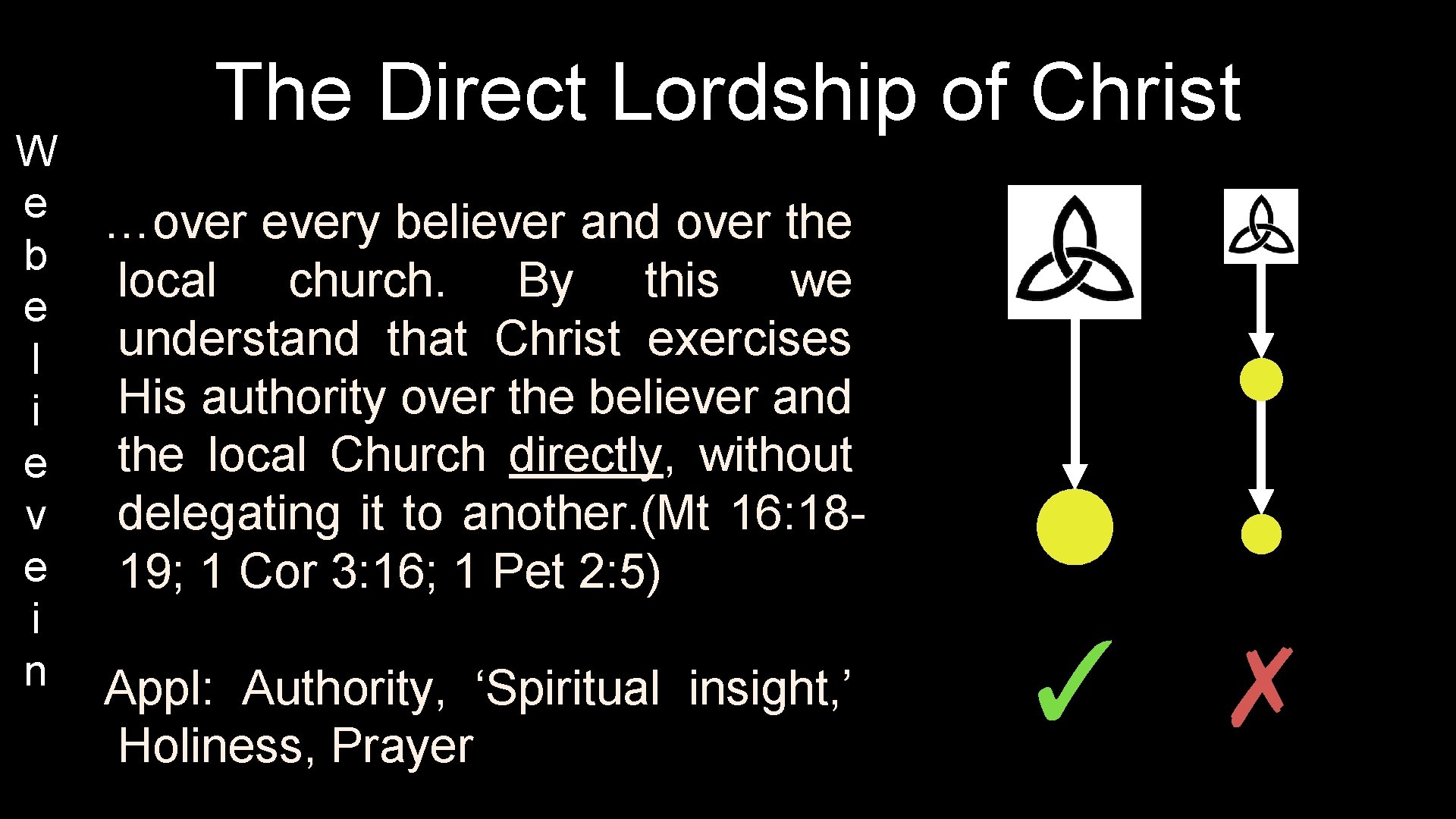
W e b e l i e v e i n The Direct Lordship of Christ …over every believer and over the local church. By this we understand that Christ exercises His authority over the believer and the local Church directly, without delegating it to another. (Mt 16: 1819; 1 Cor 3: 16; 1 Pet 2: 5) Appl: Authority, ‘Spiritual insight, ’ Holiness, Prayer ✓ ✗
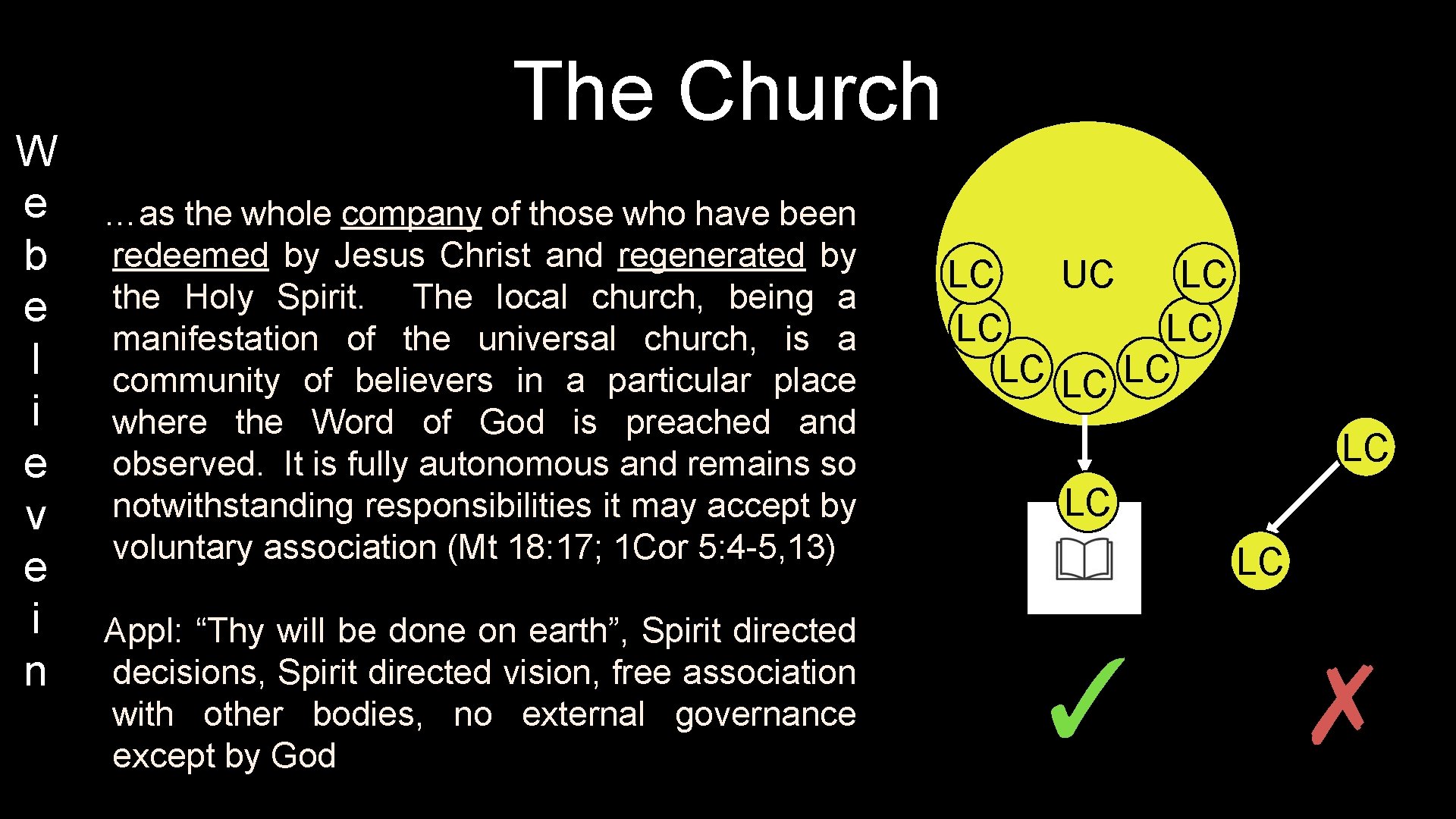
W e b e l i e v e i n The Church …as the whole company of those who have been redeemed by Jesus Christ and regenerated by the Holy Spirit. The local church, being a manifestation of the universal church, is a community of believers in a particular place where the Word of God is preached and observed. It is fully autonomous and remains so notwithstanding responsibilities it may accept by voluntary association (Mt 18: 17; 1 Cor 5: 4 -5, 13) Appl: “Thy will be done on earth”, Spirit directed decisions, Spirit directed vision, free association with other bodies, no external governance except by God LC LC UC LC LC ✓ ✗
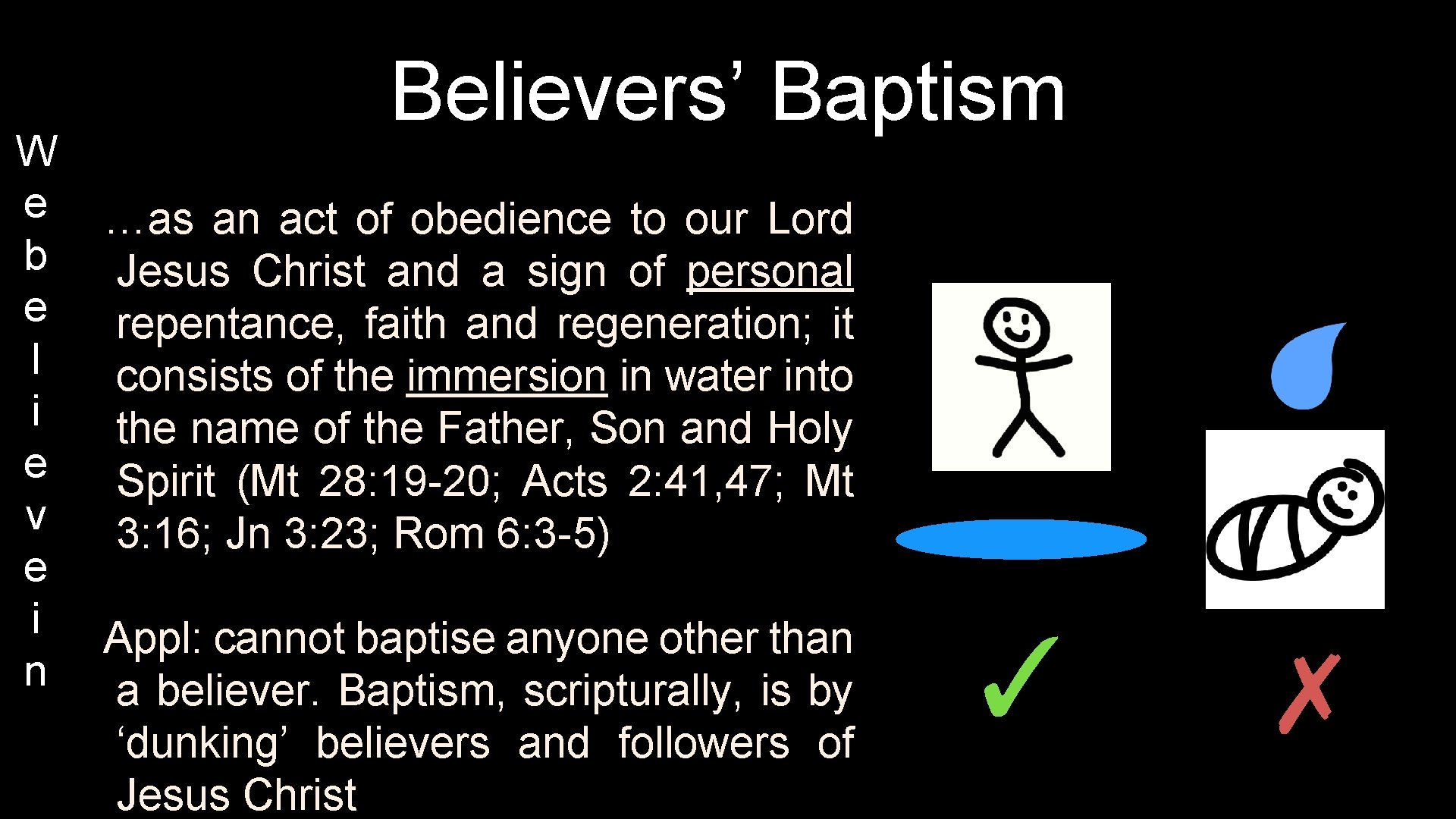
W e b e l i e v e i n Believers’ Baptism …as an act of obedience to our Lord Jesus Christ and a sign of personal repentance, faith and regeneration; it consists of the immersion in water into the name of the Father, Son and Holy Spirit (Mt 28: 19 -20; Acts 2: 41, 47; Mt 3: 16; Jn 3: 23; Rom 6: 3 -5) Appl: cannot baptise anyone other than a believer. Baptism, scripturally, is by ‘dunking’ believers and followers of Jesus Christ ✓ ✗
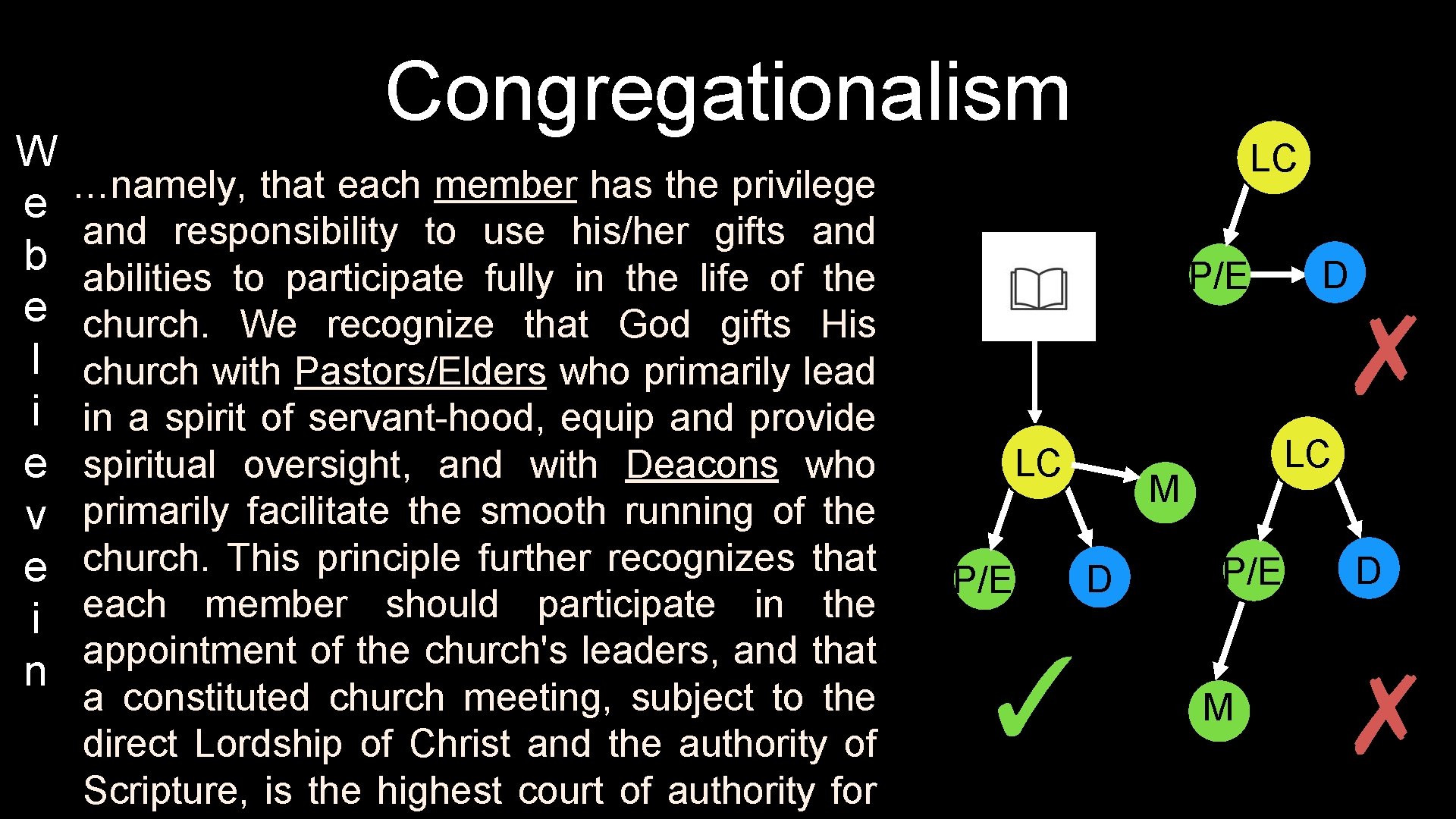
W e b e l i e v e i n Congregationalism …namely, that each member has the privilege and responsibility to use his/her gifts and abilities to participate fully in the life of the church. We recognize that God gifts His church with Pastors/Elders who primarily lead in a spirit of servant-hood, equip and provide spiritual oversight, and with Deacons who primarily facilitate the smooth running of the church. This principle further recognizes that each member should participate in the appointment of the church's leaders, and that a constituted church meeting, subject to the direct Lordship of Christ and the authority of Scripture, is the highest court of authority for LC P/E ✓ ✗ LC M D D P/E M D ✗
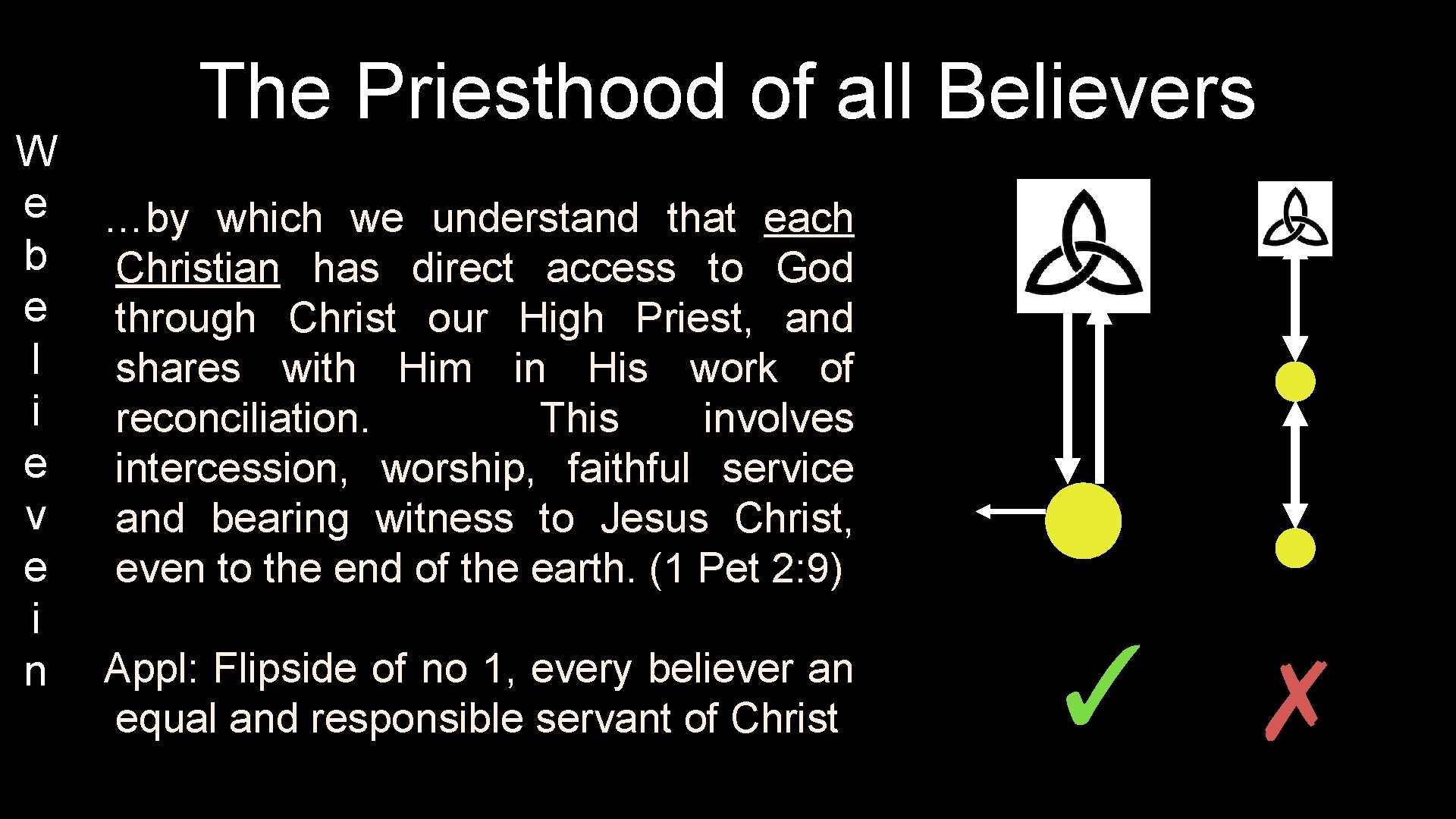
W e b e l i e v e i n The Priesthood of all Believers …by which we understand that each Christian has direct access to God through Christ our High Priest, and shares with Him in His work of reconciliation. This involves intercession, worship, faithful service and bearing witness to Jesus Christ, even to the end of the earth. (1 Pet 2: 9) Appl: Flipside of no 1, every believer an equal and responsible servant of Christ ✓ ✗
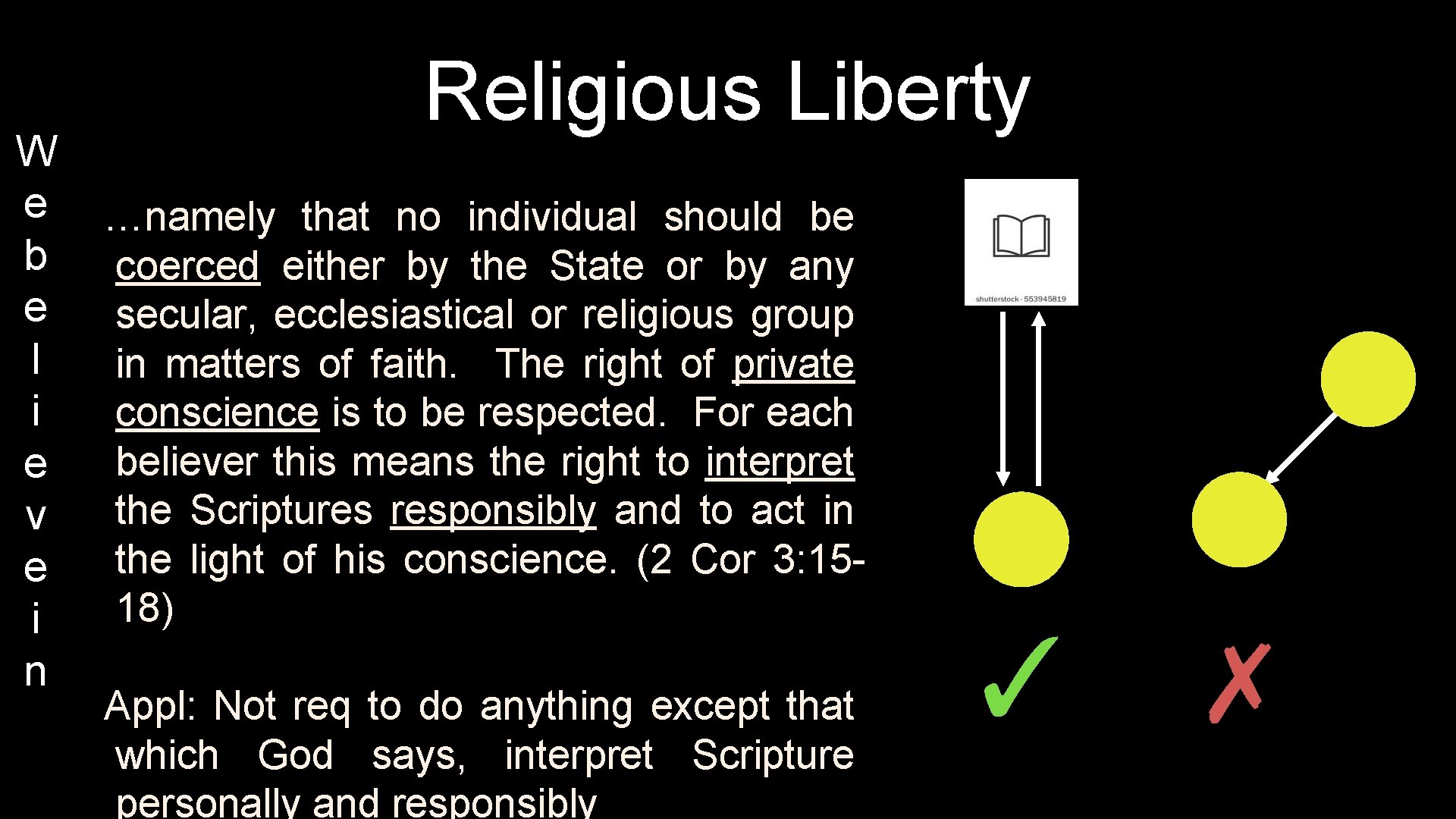
W e b e l i e v e i n Religious Liberty …namely that no individual should be coerced either by the State or by any secular, ecclesiastical or religious group in matters of faith. The right of private conscience is to be respected. For each believer this means the right to interpret the Scriptures responsibly and to act in the light of his conscience. (2 Cor 3: 1518) Appl: Not req to do anything except that which God says, interpret Scripture personally and responsibly ✓ ✗
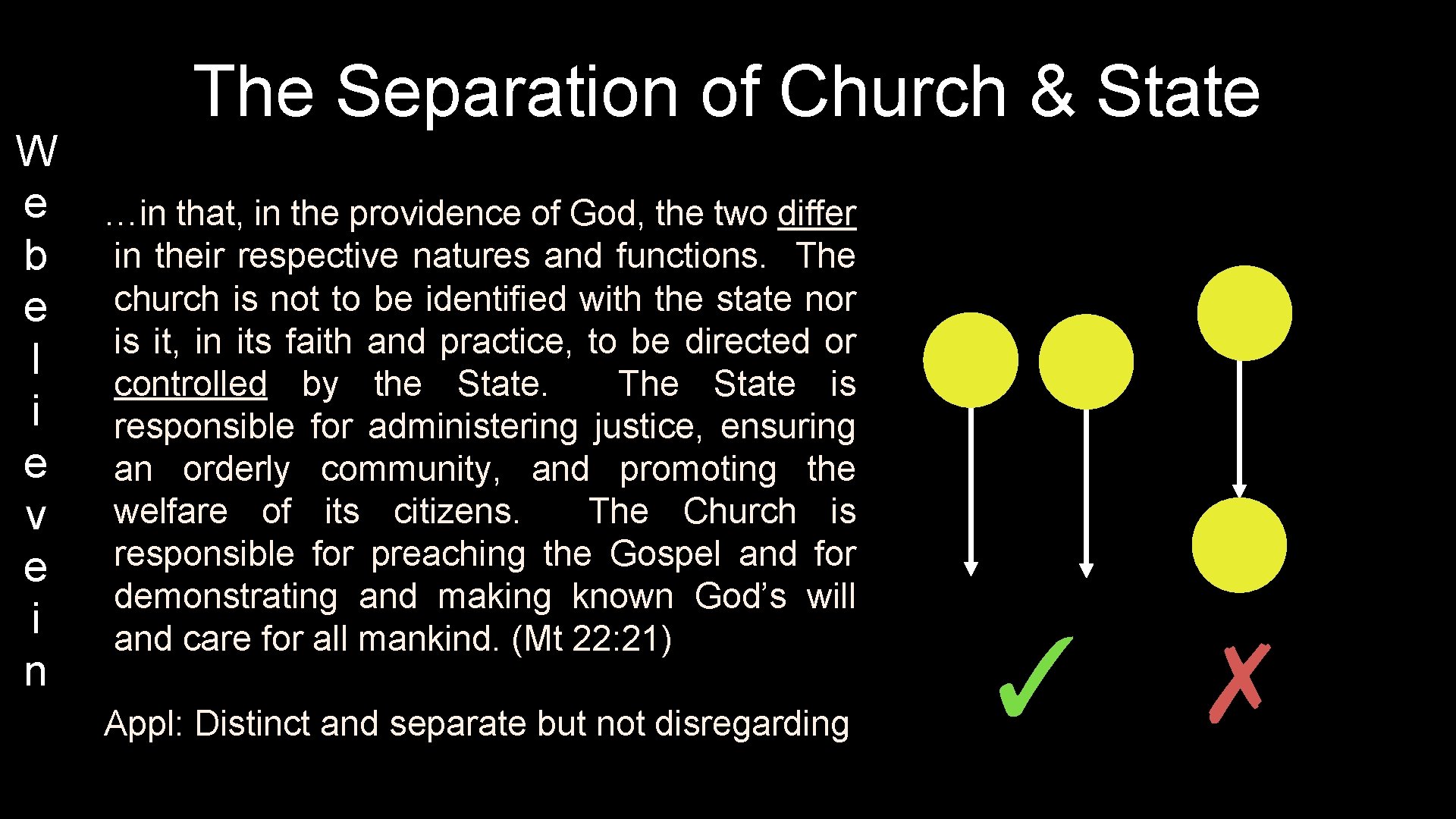
W e b e l i e v e i n The Separation of Church & State …in that, in the providence of God, the two differ in their respective natures and functions. The church is not to be identified with the state nor is it, in its faith and practice, to be directed or controlled by the State. The State is responsible for administering justice, ensuring an orderly community, and promoting the welfare of its citizens. The Church is responsible for preaching the Gospel and for demonstrating and making known God’s will and care for all mankind. (Mt 22: 21) Appl: Distinct and separate but not disregarding ✓ ✗
W e b e l i e v e i n Summary The Direct Lordship of Christ The Church Believers’ Baptism Congregationalism The Priesthood of all Believers Religious Liberty (of Believers) The Separation of Church & State
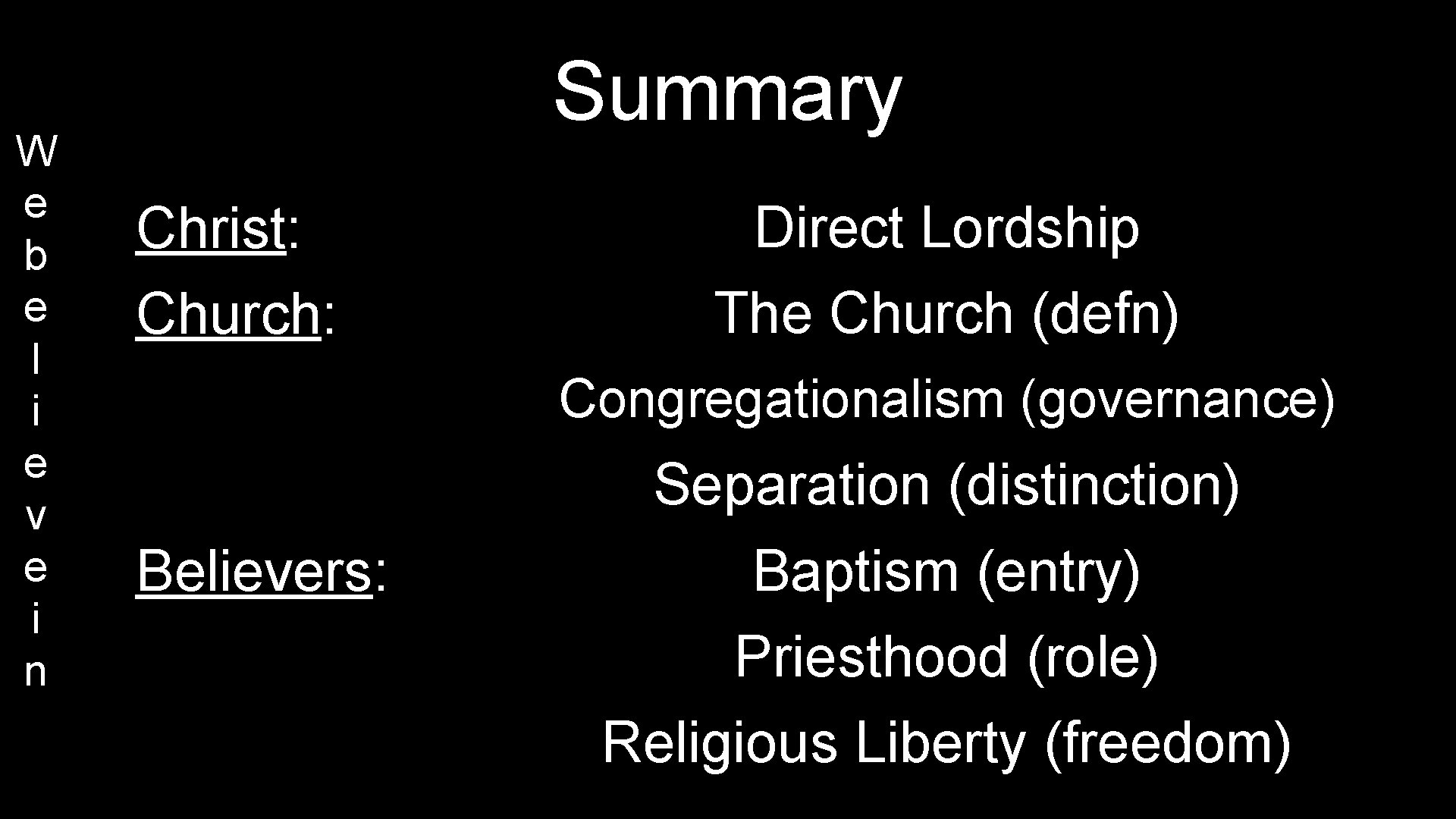
W e b e l i e v e i n Summary Christ: Church: Direct Lordship The Church (defn) Congregationalism (governance) Believers: Separation (distinction) Baptism (entry) Priesthood (role) Religious Liberty (freedom)

How Baptists Understand the Local Church Baptist Principles

- Slides: 14