
How banks create money 10 1 Learning objectives
How banks create money 10 -1
Learning objectives • Describe the simplified balance sheets of a single bank and the banking system • Explain the money-creating abilities of a single bank that is part of a multibank system • Explain the money-creating abilities of the banking system as a whole through multiple-deposit expansion, and compare this with the moneycreating abilities of the single bank 10 -2
Learning objectives (cont. ) • Define the monetary (or credit) multiplier • Discuss some of the limitations on the banking system’s ability to create deposits and expand the money supply • Describe how the banks’ lending activities may contribute to financial instability and to increased fluctuations in the level of economic activity 10 -3
Balance sheet • A statement of assets and claims that summarises the financial position of a firm at a point in time • Each side balances: – Assets are items of economic and financial value – Assets = Liabilities + Net worth 10 -4
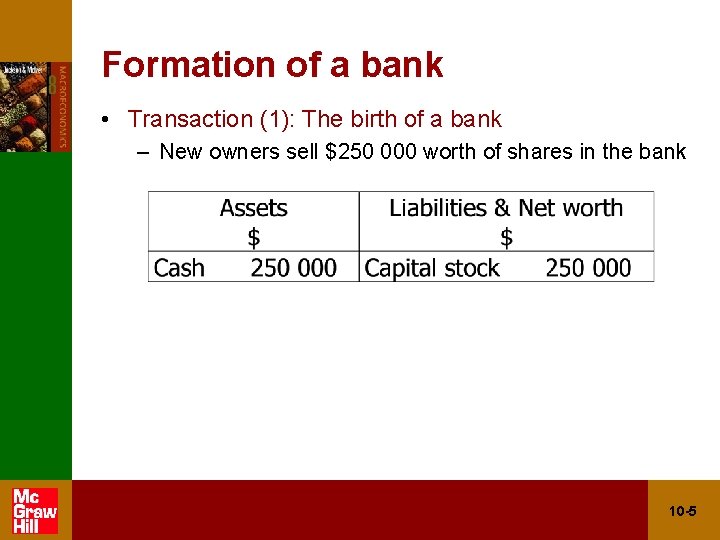
Formation of a bank • Transaction (1): The birth of a bank – New owners sell $250 000 worth of shares in the bank 10 -5
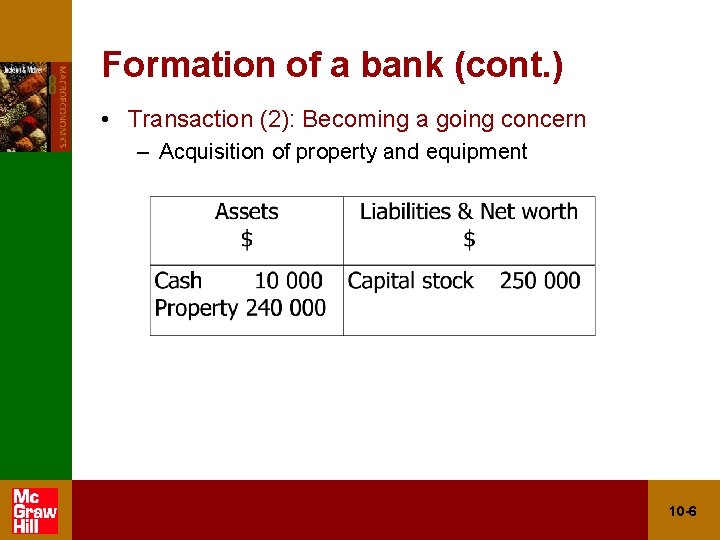
Formation of a bank (cont. ) • Transaction (2): Becoming a going concern – Acquisition of property and equipment 10 -6
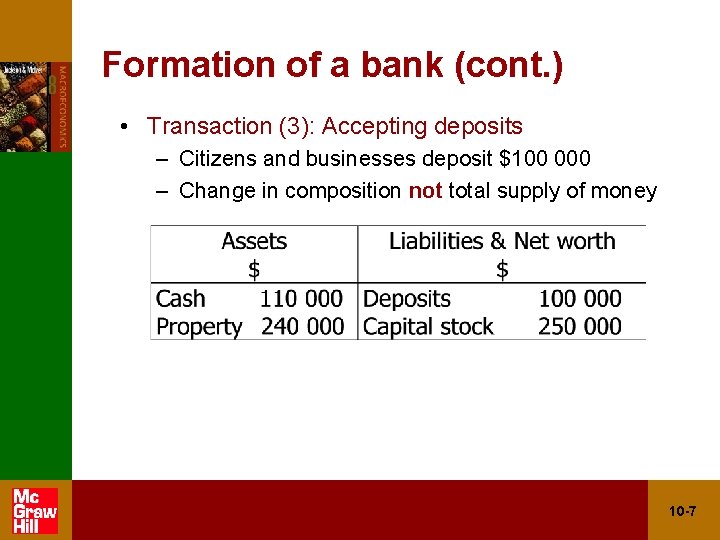
Formation of a bank (cont. ) • Transaction (3): Accepting deposits – Citizens and businesses deposit $100 000 – Change in composition not total supply of money 10 -7
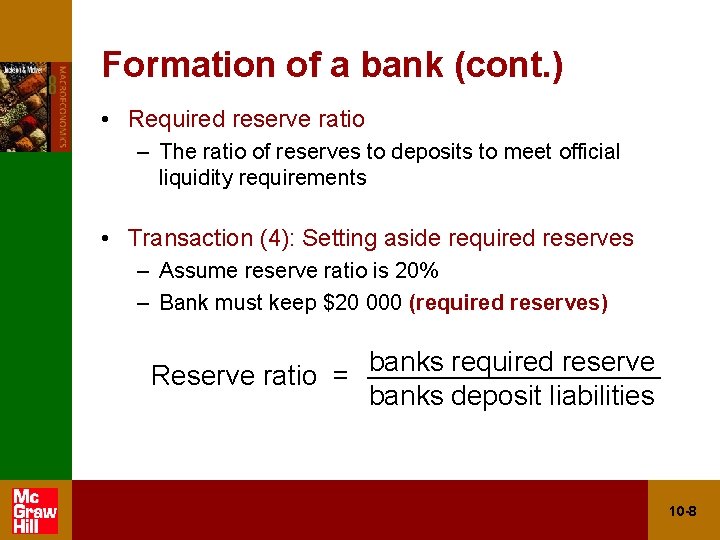
Formation of a bank (cont. ) • Required reserve ratio – The ratio of reserves to deposits to meet official liquidity requirements • Transaction (4): Setting aside required reserves – Assume reserve ratio is 20% – Bank must keep $20 000 (required reserves) banks required reserve Reserve ratio = banks deposit liabilities 10 -8
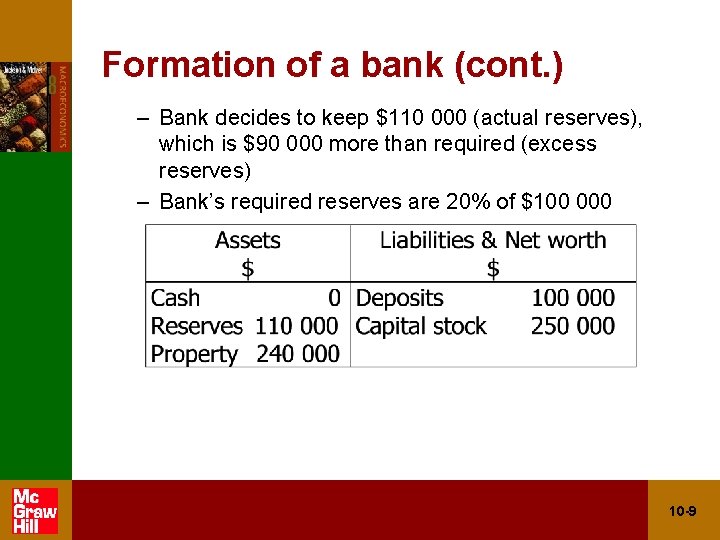
Formation of a bank (cont. ) – Bank decides to keep $110 000 (actual reserves), which is $90 000 more than required (excess reserves) – Bank’s required reserves are 20% of $100 000 10 -9
Formation of a bank (cont. ) • Transaction (5): Drawing a cheque – A citizen who has substantial deposits in the bank draws a cheque for $50 000 to buy goods – The seller of the goods deposits the cheque in another bank – The banking system as a whole has not lost or gained 10 -10
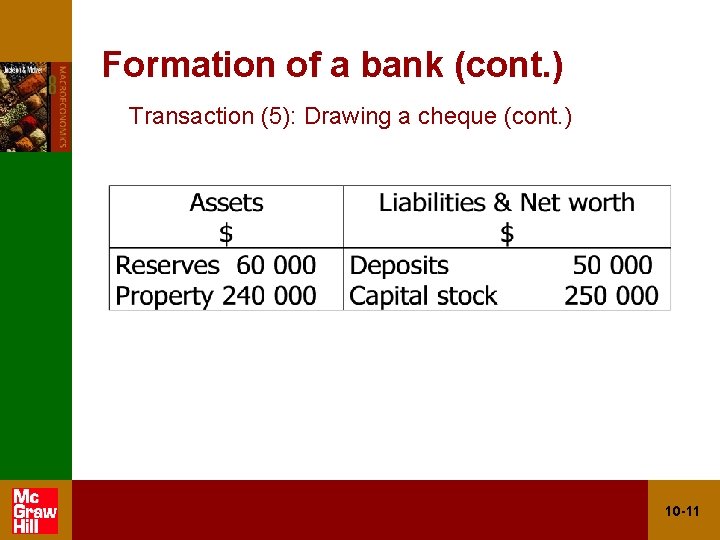
Formation of a bank (cont. ) Transaction (5): Drawing a cheque (cont. ) 10 -11
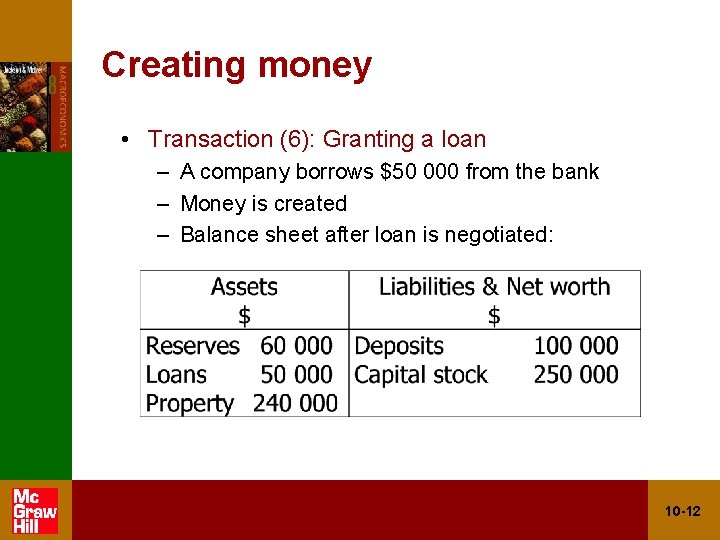
Creating money • Transaction (6): Granting a loan – A company borrows $50 000 from the bank – Money is created – Balance sheet after loan is negotiated: 10 -12
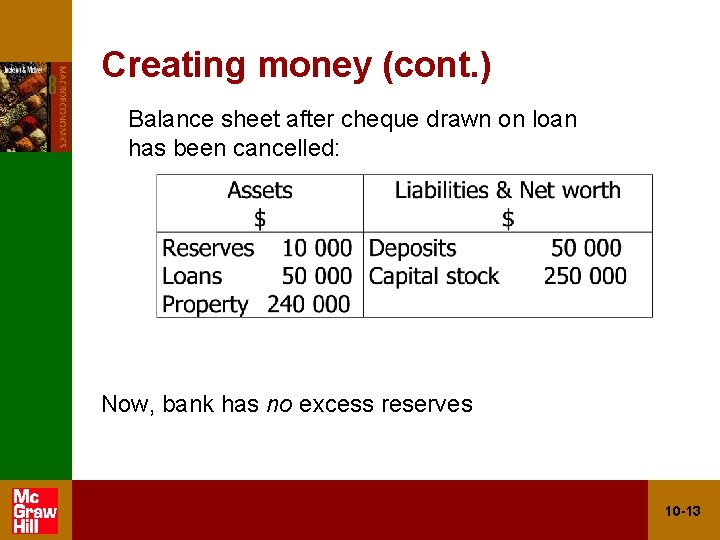
Creating money (cont. ) Balance sheet after cheque drawn on loan has been cancelled: Now, bank has no excess reserves 10 -13
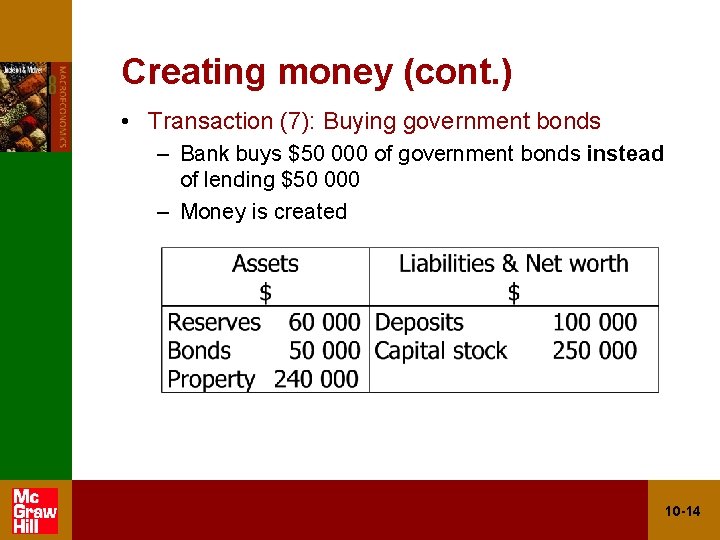
Creating money (cont. ) • Transaction (7): Buying government bonds – Bank buys $50 000 of government bonds instead of lending $50 000 – Money is created 10 -14
The banking system • Multiple banks: multiple-deposit expansion • Money is created by a multiple of the banking system’s excess reserves 10 -15
Multiple-deposit expansion • Assume initially: 20% reserve requirement • Bank A – Accepts a deposit for $100 § Does not alter money supply § Excess reserves of $80 – A loan of $80 is negotiated 10 -16
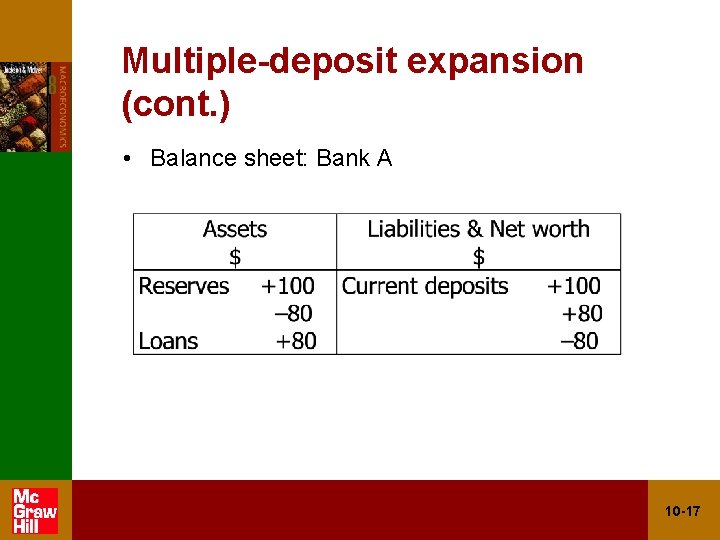
Multiple-deposit expansion (cont. ) • Balance sheet: Bank A 10 -17
Multiple-deposit expansion (cont. ) • Loan cheque of $80 is drawn on Bank A and deposited in Bank B • Bank B – Gains $80 in reserves and deposits – Excess reserves of $64 – Loans $64 10 -18
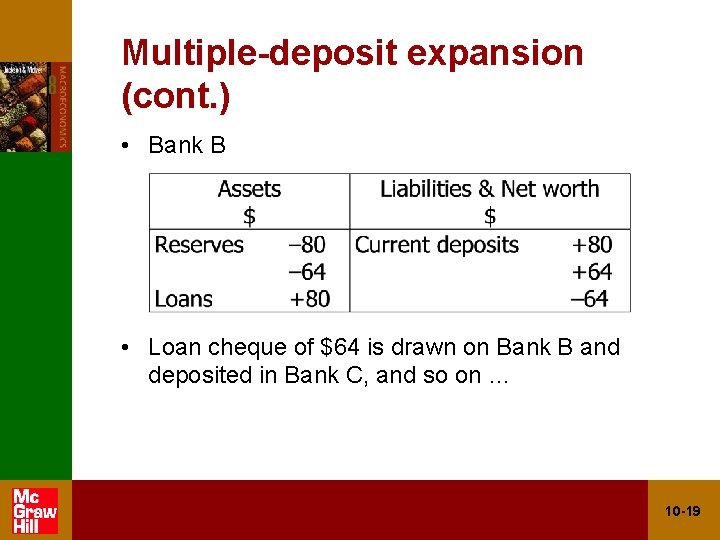
Multiple-deposit expansion (cont. ) • Bank B • Loan cheque of $64 is drawn on Bank B and deposited in Bank C, and so on … 10 -19
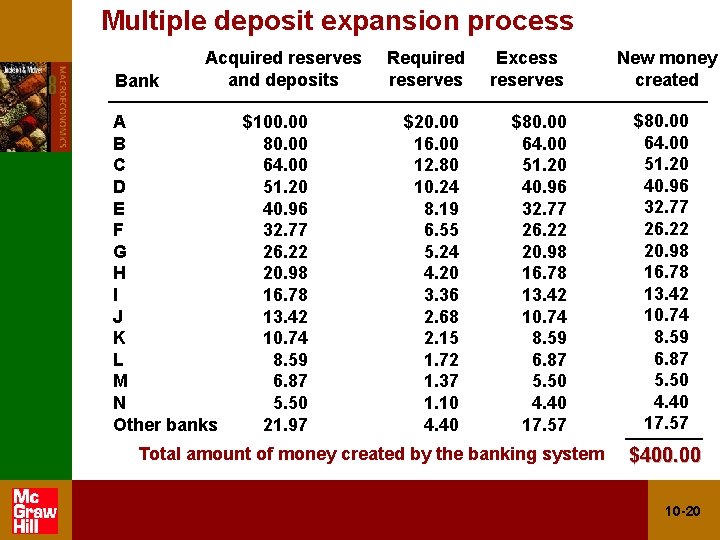
Multiple deposit expansion process Bank Acquired reserves and deposits A B C D E F G H I J K L M N Other banks $100. 00 80. 00 64. 00 51. 20 40. 96 32. 77 26. 22 20. 98 16. 78 13. 42 10. 74 8. 59 6. 87 5. 50 21. 97 Required reserves $20. 00 16. 00 12. 80 10. 24 8. 19 6. 55 5. 24 4. 20 3. 36 2. 68 2. 15 1. 72 1. 37 1. 10 4. 40 Excess reserves $80. 00 64. 00 51. 20 40. 96 32. 77 26. 22 20. 98 16. 78 13. 42 10. 74 8. 59 6. 87 5. 50 4. 40 17. 57 Total amount of money created by the banking system New money created $80. 00 64. 00 51. 20 40. 96 32. 77 26. 22 20. 98 16. 78 13. 42 10. 74 8. 59 6. 87 5. 50 4. 40 17. 57 $400. 00 10 -20
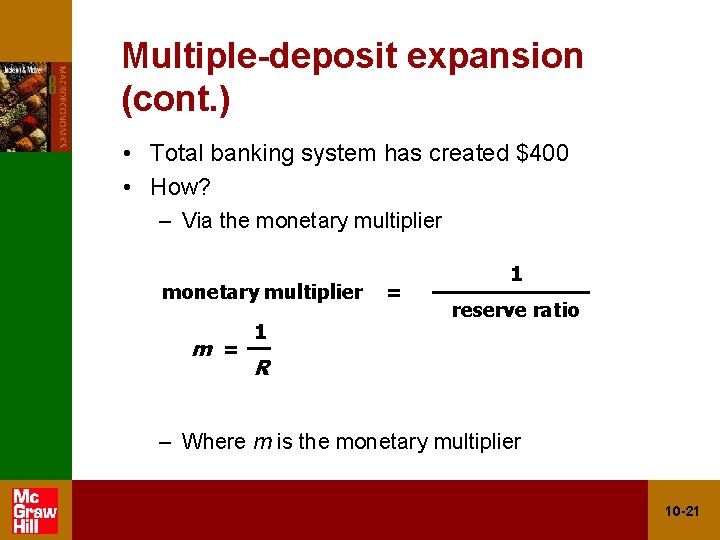
Multiple-deposit expansion (cont. ) • Total banking system has created $400 • How? – Via the monetary multiplier m = 1 reserve ratio R – Where m is the monetary multiplier 10 -21
Multiple-deposit contraction • The multiple credit expansion process is reversible and leads to a multiple reduction in the level of deposits — and hence the supply of money — if reserves are withdrawn 10 -22
Possible leakages • Currency drains – Loan may be paid in cash and remain in circulation • Transfer of deposits to non-bank financial institutions • Excess reserves – Individual banks may choose to have larger reserves than required (say 25% instead of 20%) 10 -23
Willingness to borrow • For the full multiplier effect to take place: – Borrowers must be willing and able to utilise the loans – Borrowing is likely to be low during a recession 10 -24
Banks and financial instability • Banks may contribute to business fluctuations • Can exacerbate recession, by holding back on credit expansion • May amplify inflationary pressures, by increasing lending and credit creation, during recovery and business cycle peaks 10 -25
- Slides: 25