
How Audience and Purpose Influence Lab Report Format
How Audience and Purpose Influence Lab Report Format EG Writing Program Polytechnic Institute of NYU Brooklyn, New York September 2009

This presentation details how to prepare lab reports for EG 1003. 1. Your Audience and Purpose. 2. How lab reports address Audience and Purpose. 3. Resources available to you at Poly.
Technical writing is the literature of science, technology, and systems development. This audience has a need for information that is: Effective: It contains no unnecessary words or phrases and is not vague but relates to specific cases. Reliable: Facts must be solid and a reader must be able to verify them Informative: A report is used to guide future action Your Audience and Purpose
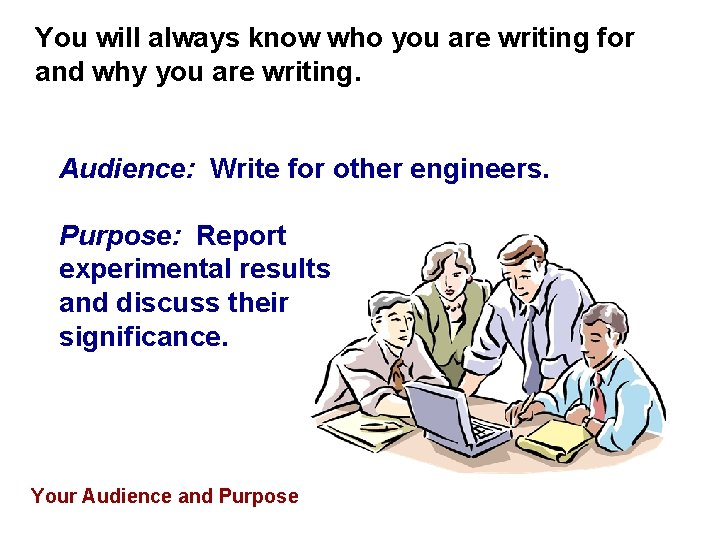
You will always know who you are writing for and why you are writing. Audience: Write for other engineers. Purpose: Report experimental results and discuss their significance. Your Audience and Purpose
Your audience values reliable knowledge. Write only what you can support with evidence. All statements must deal with your specific case. Avoid generalizations--your duty is to report only the results of your specific trial. Avoid the temptation to make claims that are larger than your evidence. Your Audience and Purpose
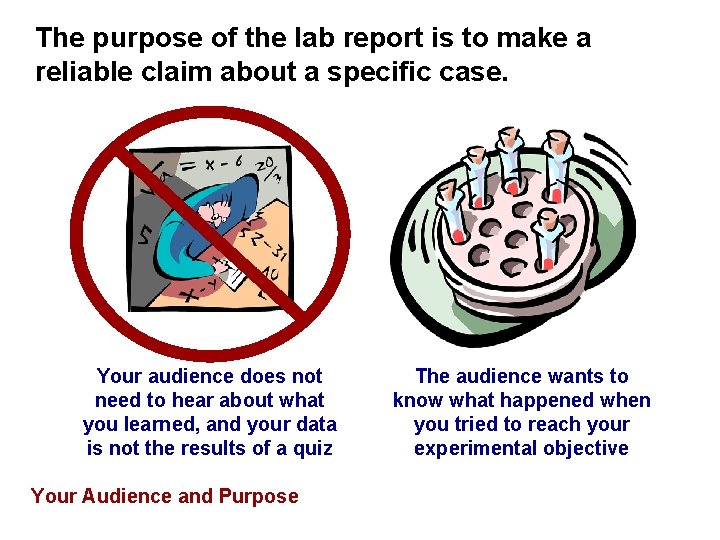
The purpose of the lab report is to make a reliable claim about a specific case. Your audience does not need to hear about what you learned, and your data is not the results of a quiz Your Audience and Purpose The audience wants to know what happened when you tried to reach your experimental objective
This presentation details how to prepare lab reports for EG 1003. 1. Your Audience and Purpose. 2. How lab reports address Audience and Purpose. 3. Resources available to you at Poly.
The audience of science, technology, and systems reports expect a certain format. Every report has a title page, followed by the following sections: Abstract Introduction Procedure Data/observations Discussion/conclusion How lab reports address Audience and Purpose
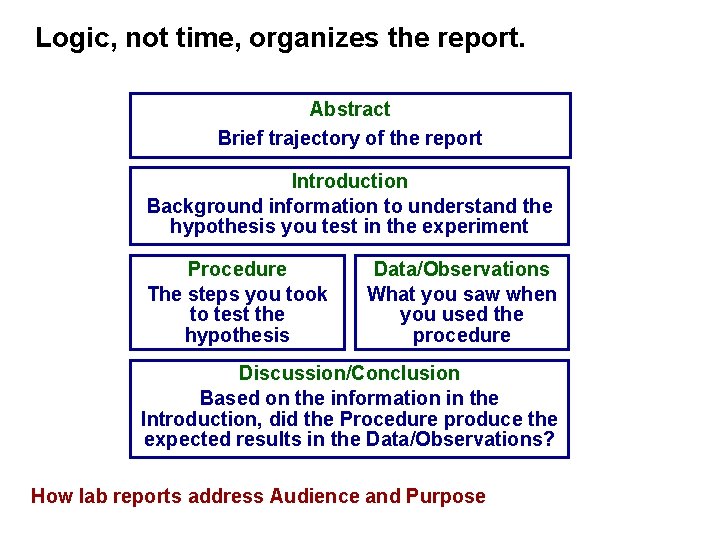
Logic, not time, organizes the report. Abstract Brief trajectory of the report Introduction Background information to understand the hypothesis you test in the experiment Procedure The steps you took to test the hypothesis Data/Observations What you saw when you used the procedure Discussion/Conclusion Based on the information in the Introduction, did the Procedure produce the expected results in the Data/Observations? How lab reports address Audience and Purpose
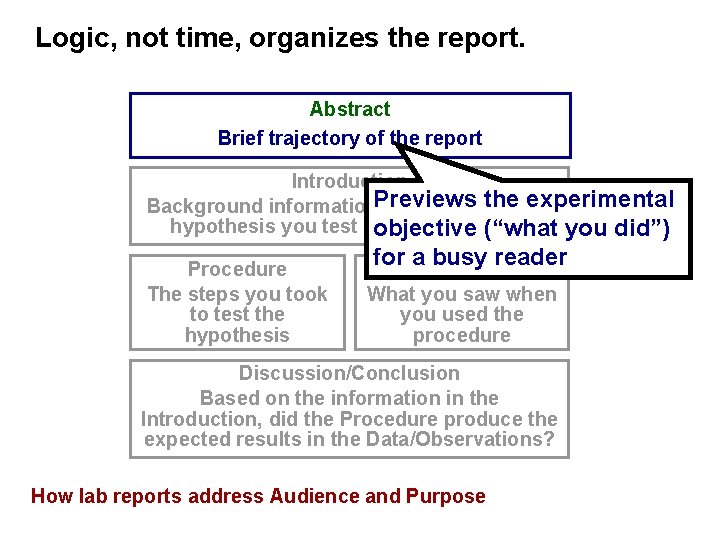
Logic, not time, organizes the report. Abstract Brief trajectory of the report Introduction the experimental Background information. Previews to understand hypothesis you test inobjective the experiment (“what you did”) Procedure The steps you took to test the hypothesis for a busy reader Data/Observations What you saw when you used the procedure Discussion/Conclusion Based on the information in the Introduction, did the Procedure produce the expected results in the Data/Observations? How lab reports address Audience and Purpose
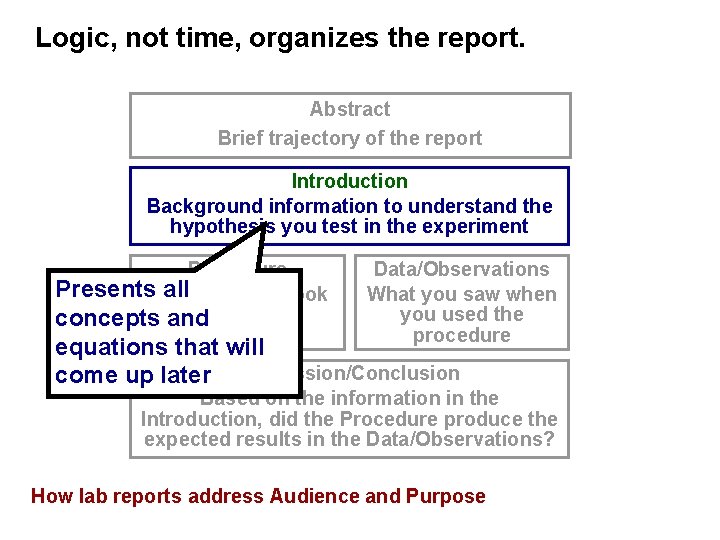
Logic, not time, organizes the report. Abstract Brief trajectory of the report Introduction Background information to understand the hypothesis you test in the experiment Procedure Presents. The allsteps you took to test the concepts and hypothesis Data/Observations What you saw when you used the procedure equations that will come up later Discussion/Conclusion Based on the information in the Introduction, did the Procedure produce the expected results in the Data/Observations? How lab reports address Audience and Purpose
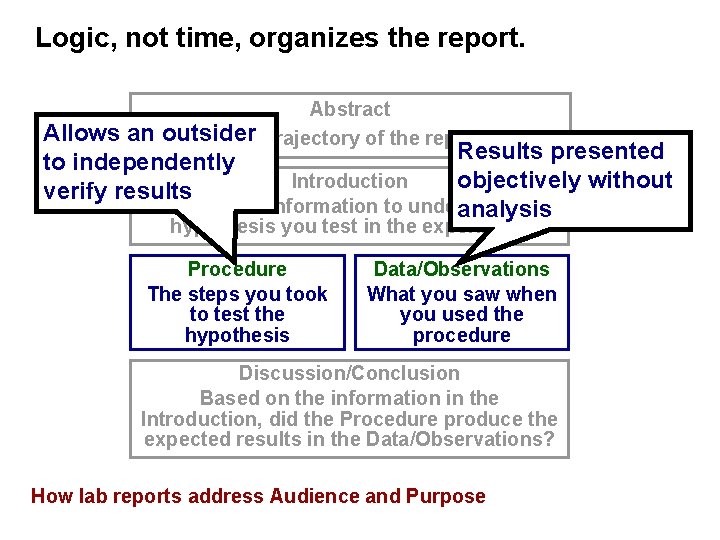
Logic, not time, organizes the report. Abstract outsider Brief trajectory of the report Allows an to independently verify results Results presented objectively without Introduction Background information to understand the analysis hypothesis you test in the experiment Procedure The steps you took to test the hypothesis Data/Observations What you saw when you used the procedure Discussion/Conclusion Based on the information in the Introduction, did the Procedure produce the expected results in the Data/Observations? How lab reports address Audience and Purpose
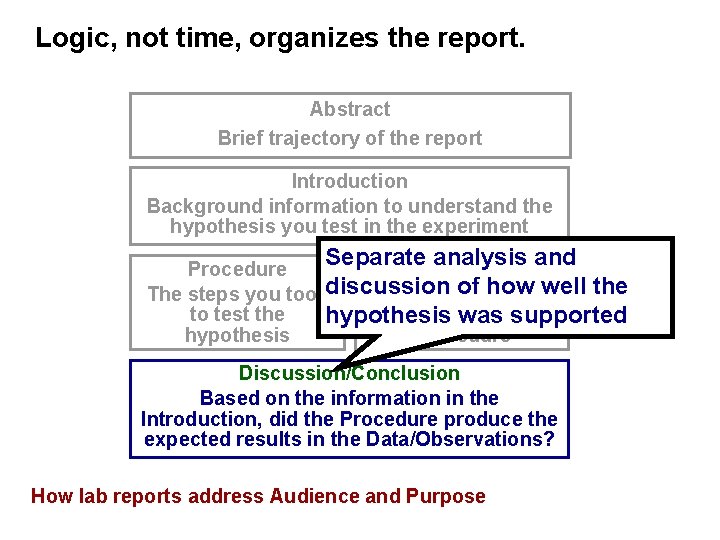
Logic, not time, organizes the report. Abstract Brief trajectory of the report Introduction Background information to understand the hypothesis you test in the experiment Separate analysis and Procedure Data/Observations how well the The steps you tookdiscussion What youof saw when to test the you used hypothesis wasthe supported hypothesis procedure Discussion/Conclusion Based on the information in the Introduction, did the Procedure produce the expected results in the Data/Observations? How lab reports address Audience and Purpose
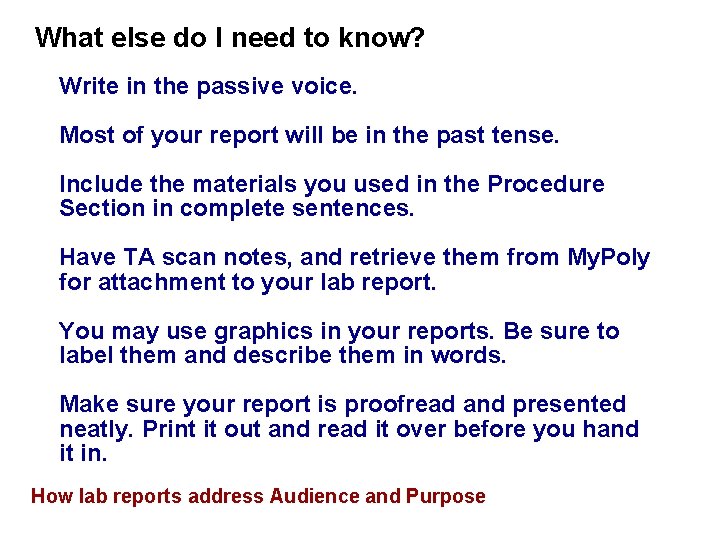
What else do I need to know? Write in the passive voice. Most of your report will be in the past tense. Include the materials you used in the Procedure Section in complete sentences. Have TA scan notes, and retrieve them from My. Poly for attachment to your lab report. You may use graphics in your reports. Be sure to label them and describe them in words. Make sure your report is proofread and presented neatly. Print it out and read it over before you hand it in. How lab reports address Audience and Purpose
This presentation details how to prepare lab reports for EG 1003. 1. Your Audience and Purpose. 2. How lab reports address Audience and Purpose. 3. Resources available to you at Poly.

Where to find help if you need it. The EG Lab Manual: egmanual. poly. edu EG website: eg. poly. edu The Writing Center, JAB 373 (718) 260 -3425 tutoring@poly. edu Your writing consultant Resources available to you at Poly
This presentation details how to prepare lab reports for EG 1004. 1. Your Audience and Purpose. 2. How lab reports address Audience and Purpose. 3. Resources available to you at Poly.
- Slides: 17