
How are touch receptors distributed in the integumentary
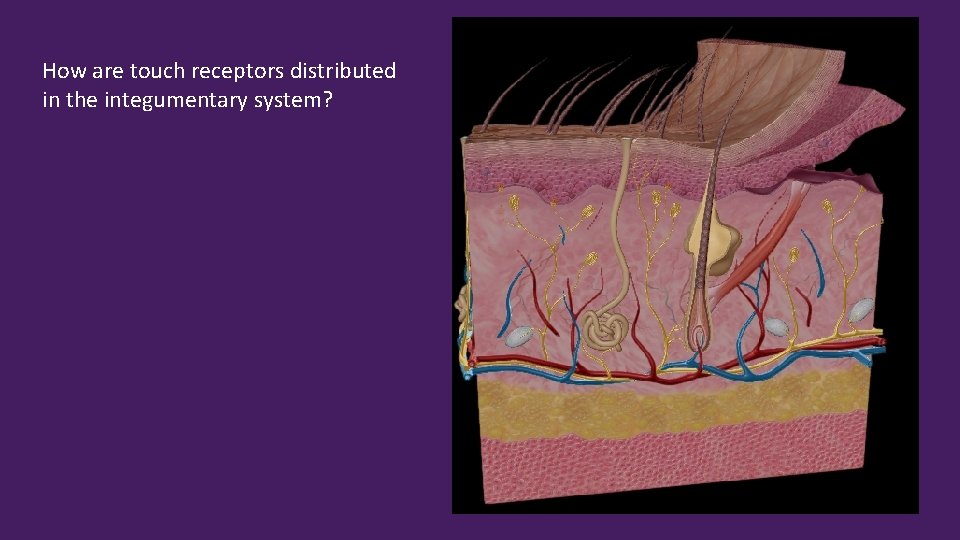
How are touch receptors distributed in the integumentary system?
What were some strengths of the way you planned or carried out your investigation? (What made it scientific? )
What were some weaknesses of the way you planned and carried out your investigation? (What made it less scientific? )
What rules should we make in order to ensure that our next investigation is scientific?
The error in localization of the buccal region is 1. 5 cm and the error of localization of the acromial region is 4. 2 cm because there are more Meissner and Pacinian corpuscles in the buccal region Is this an observation or an inference? Explain how you now.

Observations
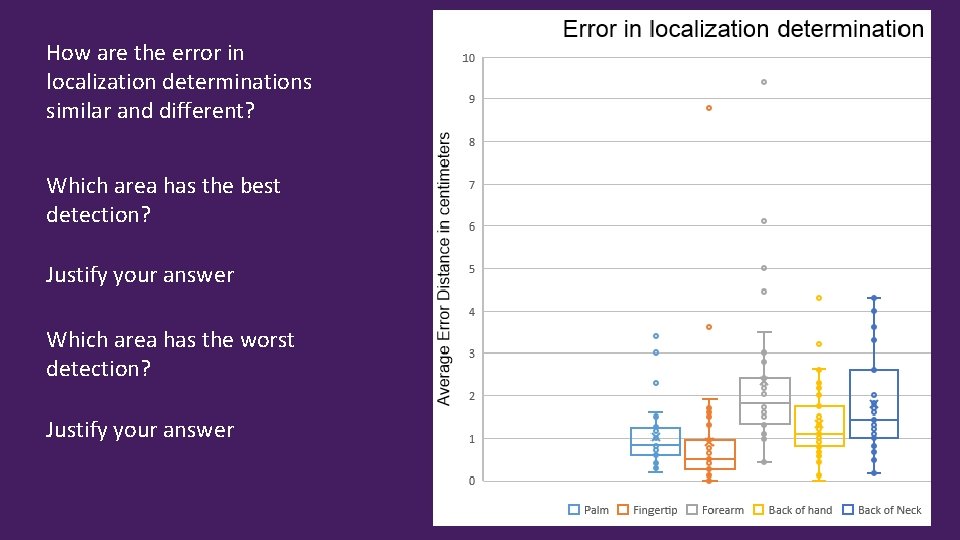
How are the error in localization determinations similar and different? Which area has the best detection? Justify your answer Which area has the worst detection? Justify your answer
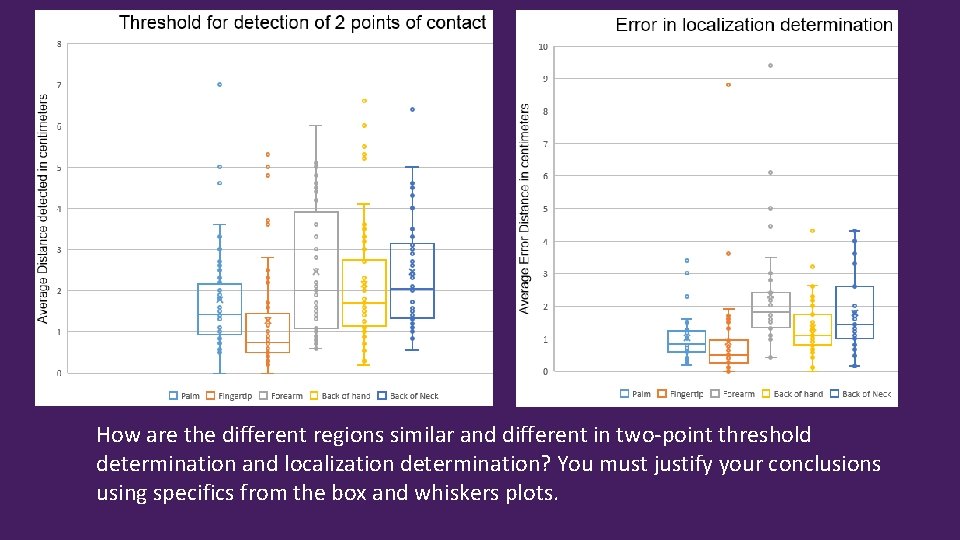
How are the different regions similar and different in two-point threshold determination and localization determination? You must justify your conclusions using specifics from the box and whiskers plots.
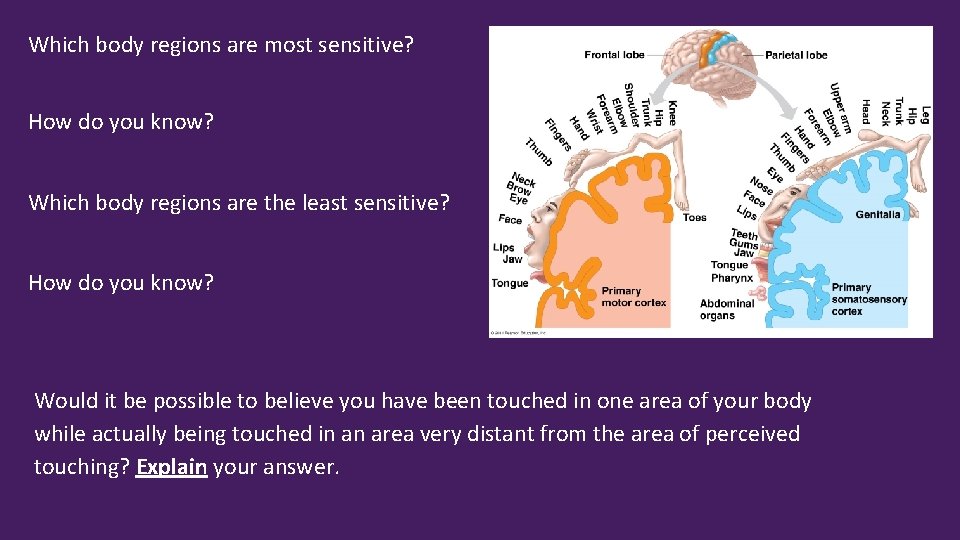
Which body regions are most sensitive? How do you know? Which body regions are the least sensitive? How do you know? Would it be possible to believe you have been touched in one area of your body while actually being touched in an area very distant from the area of perceived touching? Explain your answer.
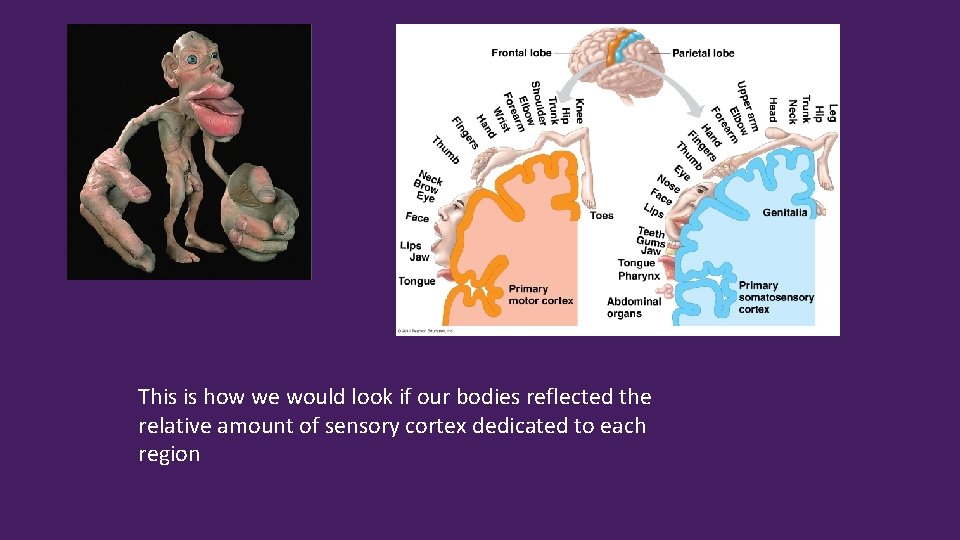
This is how we would look if our bodies reflected the relative amount of sensory cortex dedicated to each region
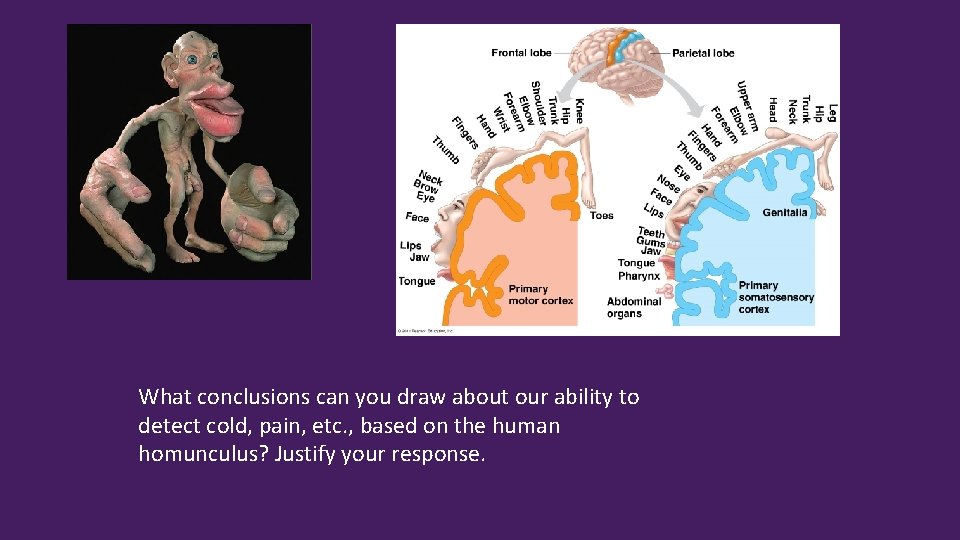
What conclusions can you draw about our ability to detect cold, pain, etc. , based on the human homunculus? Justify your response.
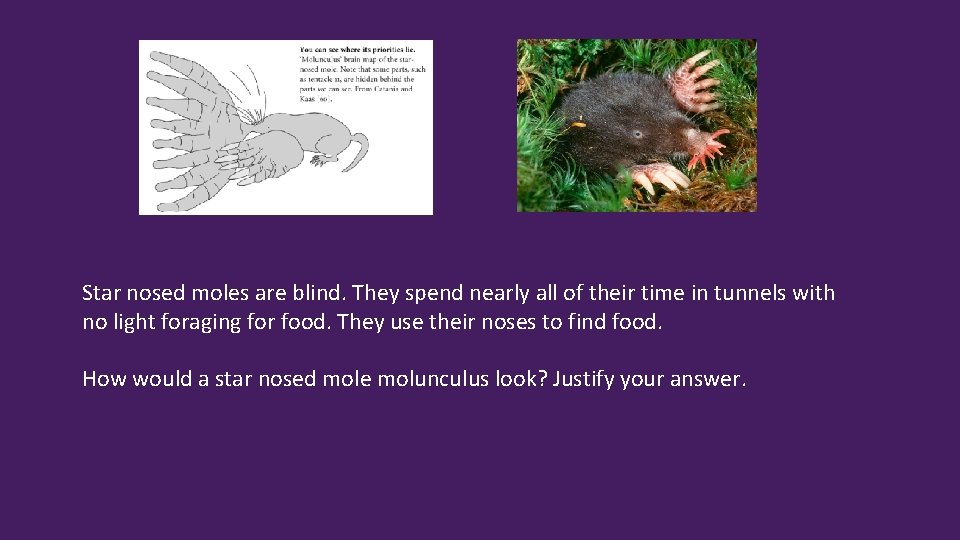
Star nosed moles are blind. They spend nearly all of their time in tunnels with no light foraging for food. They use their noses to find food. How would a star nosed mole molunculus look? Justify your answer.
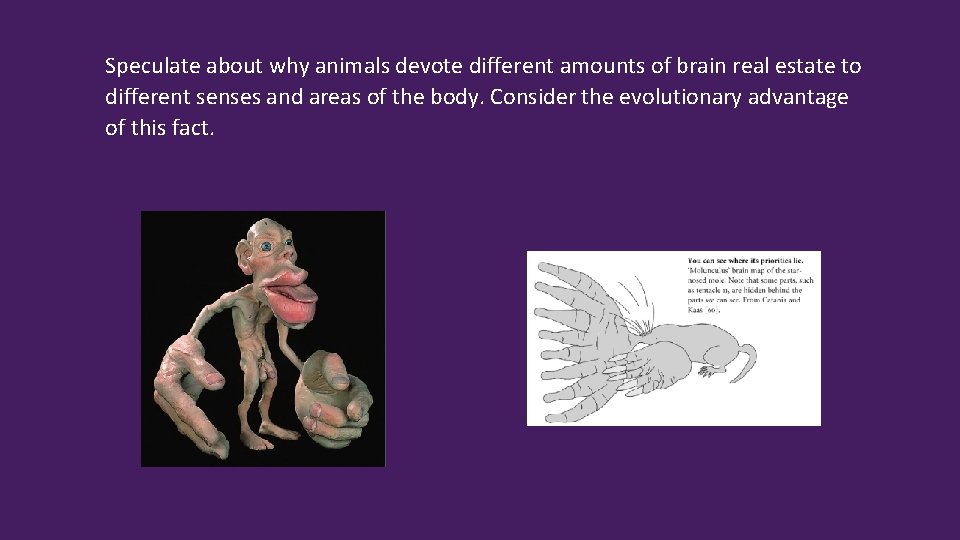
Speculate about why animals devote different amounts of brain real estate to different senses and areas of the body. Consider the evolutionary advantage of this fact.
Crosscutting concepts in science Patterns How was the following demonstrated in this lab? • Different patterns may be observed at each of the scales at which a system is studied and can provide evidence for causality in explanations of phenomena. • Empirical evidence is needed to identify patterns.
Crosscutting concepts in science Cause and effect: Mechanism and Prediction How was the following demonstrated in this lab? • Empirical evidence is required to differentiate between cause and correlation and make claims about specific causes and effects.

Crosscutting concepts in science Structure and Function How was the following demonstrated in this lab? • The functions and properties of natural and designed objects and systems can be inferred from their overall structure, the way their components are shaped and used, and the molecular substructures of its various materials.
- Slides: 19