
How are resources shared Scheduling 9 Victor S

![How PF scheduler works R 1[t] R 2[t] AT 1 Ri[t] AT 2 AT](https://slidetodoc.com/presentation_image_h2/d85915b843d1f18bed9ec432d92abae7/image-45.jpg "How PF scheduler works R 1[t] R 2[t] AT 1 Ri[t] AT 2 AT")
- Slides: 53
How are resources shared? Scheduling #9 Victor S. Frost Dan F. Servey Distinguished Professor Electrical Engineering and Computer Science University of Kansas 2335 Irving Hill Dr. Lawrence, Kansas 66045 Phone: (785) 864 -4833 FAX: (785) 864 -7789 e-mail: frost@eecs. ku. edu http: //www. ittc. ku. edu/ All material copyright 2006 Victor S. Frost, All Rights Reserved 04/08/05
How are resources shared? • Review general access network topology • Resource sharing principles • Resource reservation (call) model – Dedicated resources – Shared after reservation • Always-on model – Polling – Random Access • Asymmetric mechanisms – – Assumptions General descriptions Scheduling in the downstream Contention in the upstream • Scheduling #9 2
Outline • What is packet scheduling? • Why is it needed? • What are the requirements for scheduling algorithms? • Specific algorithms – – FIFO RR WFQ PFQ • How scheduling is used in access networks #9 3
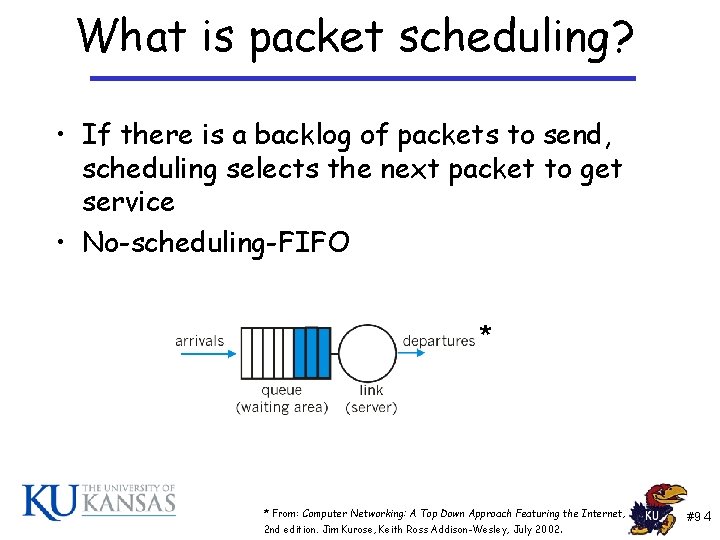
What is packet scheduling? • If there is a backlog of packets to send, scheduling selects the next packet to get service • No-scheduling-FIFO * * From: Computer Networking: A Top Down Approach Featuring the Internet, 2 nd edition. Jim Kurose, Keith Ross Addison-Wesley, July 2002. #9 4
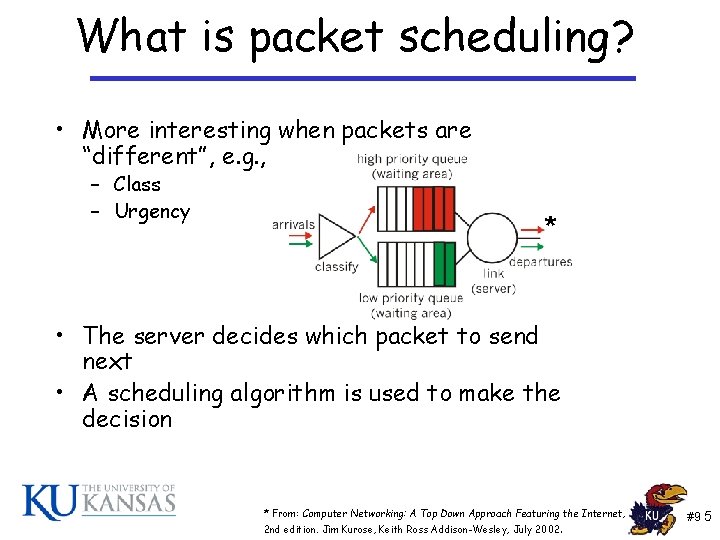
What is packet scheduling? • More interesting when packets are “different”, e. g. , – Class – Urgency * • The server decides which packet to send next • A scheduling algorithm is used to make the decision * From: Computer Networking: A Top Down Approach Featuring the Internet, 2 nd edition. Jim Kurose, Keith Ross Addison-Wesley, July 2002. #9 5
Why is it needed? • Decides who is next. • Need fairness, prevent one user from getting all the service • Some packets have deadlines, e. g. , for real-time services • Need scheduling to provide Co. S and Qo. S #9 6
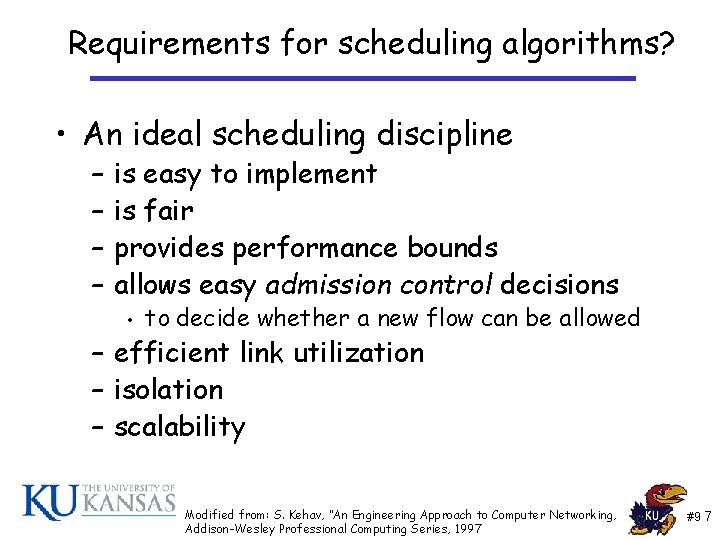
Requirements for scheduling algorithms? • An ideal scheduling discipline – – is easy to implement is fair provides performance bounds allows easy admission control decisions • to decide whether a new flow can be allowed – efficient link utilization – isolation – scalability Modified from: S. Kehav, “An Engineering Approach to Computer Networking, Addison-Wesley Professional Computing Series, 1997 #9 7
Ease of implementation • Scheduling touches every packet • Scheduling discipline has to make a decision once every few microseconds! • Should be implementable in a few instructions or hardware – for hardware: critical constraint is VLSI space • Work per packet should scale less than linearly with number of active connections From: S. Kehav, “An Engineering Approach to Computer Networking, Addison-Wesley Professional Computing Series, 1997
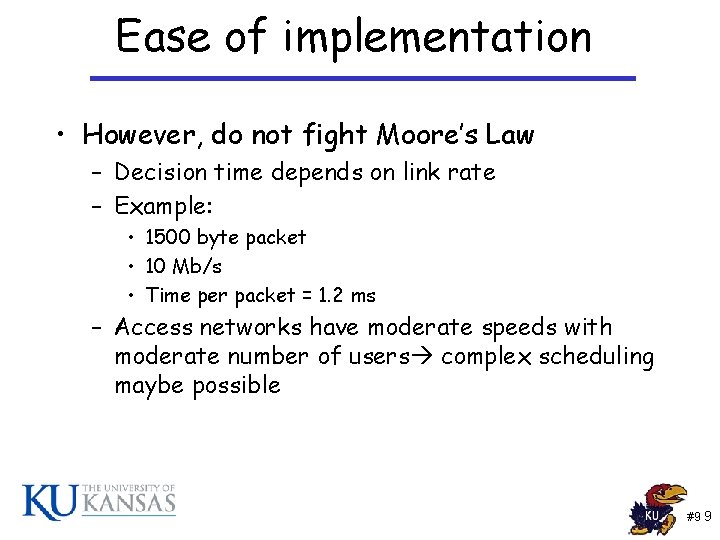
Ease of implementation • However, do not fight Moore’s Law – Decision time depends on link rate – Example: • 1500 byte packet • 10 Mb/s • Time per packet = 1. 2 ms – Access networks have moderate speeds with moderate number of users complex scheduling maybe possible #9 9
Fairness • Suppose there are n users requiring access to a link. • The users have equal right to access the link. • Users many have different requirements for resources • How should resources be divided? • Then what scheduling algorithm provides this division? #9 10
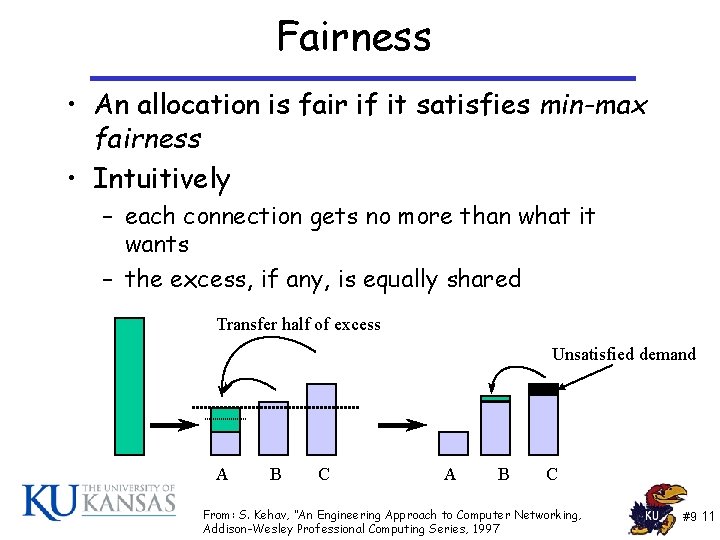
Fairness • An allocation is fair if it satisfies min-max fairness • Intuitively – each connection gets no more than what it wants – the excess, if any, is equally shared Transfer half of excess Unsatisfied demand A B C From: S. Kehav, “An Engineering Approach to Computer Networking, Addison-Wesley Professional Computing Series, 1997 #9 11
Fairness • Formally, – Resources are allocated in order of increasing demand – No source gets a share larger than its demand – Sources with unsatisfied demands get an equal share of the resources From: S. Kehav, “An Engineering Approach to Computer Networking, Addison-Wesley Professional Computing Series, 1997 #9 12
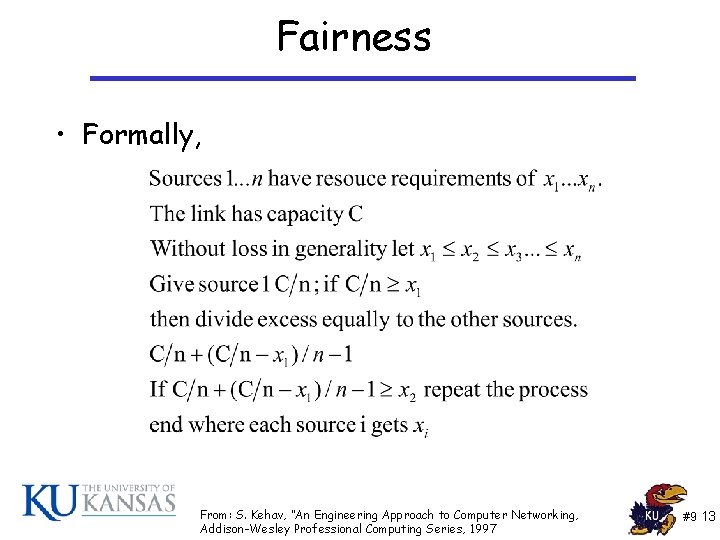
Fairness • Formally, From: S. Kehav, “An Engineering Approach to Computer Networking, Addison-Wesley Professional Computing Series, 1997 #9 13
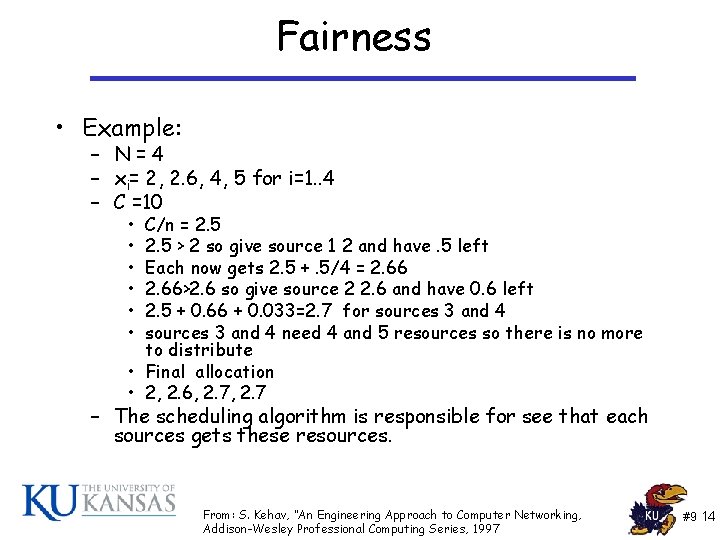
Fairness • Example: – N=4 – xi= 2, 2. 6, 4, 5 for i=1. . 4 – C =10 • • • C/n = 2. 5 > 2 so give source 1 2 and have. 5 left Each now gets 2. 5 +. 5/4 = 2. 66>2. 6 so give source 2 2. 6 and have 0. 6 left 2. 5 + 0. 66 + 0. 033=2. 7 for sources 3 and 4 need 4 and 5 resources so there is no more to distribute • Final allocation • 2, 2. 6, 2. 7 – The scheduling algorithm is responsible for see that each sources gets these resources. From: S. Kehav, “An Engineering Approach to Computer Networking, Addison-Wesley Professional Computing Series, 1997 #9 14
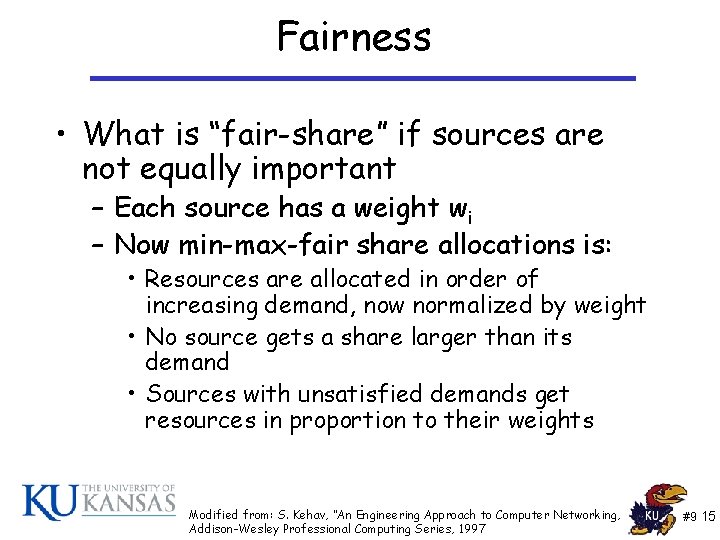
Fairness • What is “fair-share” if sources are not equally important – Each source has a weight wi – Now min-max-fair share allocations is: • Resources are allocated in order of increasing demand, now normalized by weight • No source gets a share larger than its demand • Sources with unsatisfied demands get resources in proportion to their weights Modified from: S. Kehav, “An Engineering Approach to Computer Networking, Addison-Wesley Professional Computing Series, 1997 #9 15
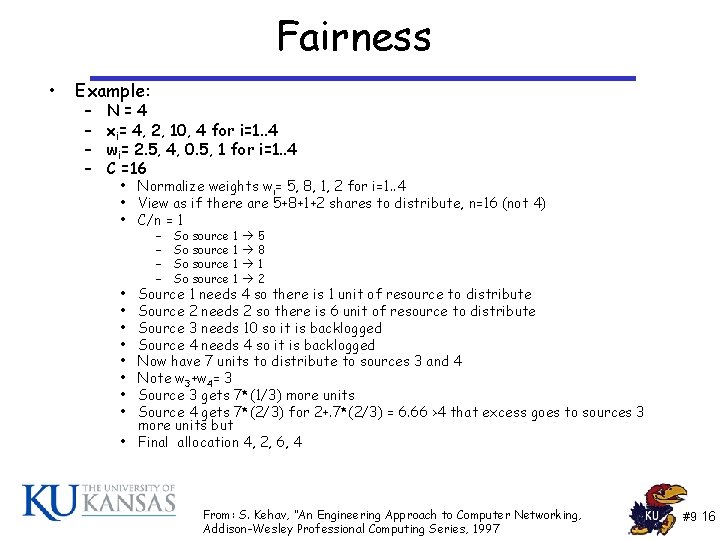
Fairness • Example: – – N=4 xi= 4, 2, 10, 4 for i=1. . 4 wi= 2. 5, 4, 0. 5, 1 for i=1. . 4 C =16 • Normalize weights wi= 5, 8, 1, 2 for i=1. . 4 • View as if there are 5+8+1+2 shares to distribute, n=16 (not 4) • C/n = 1 • • – – So source 1 5 8 1 2 Source 1 needs 4 so there is 1 unit of resource to distribute Source 2 needs 2 so there is 6 unit of resource to distribute Source 3 needs 10 so it is backlogged Source 4 needs 4 so it is backlogged Now have 7 units to distribute to sources 3 and 4 Note w 3+w 4= 3 Source 3 gets 7*(1/3) more units Source 4 gets 7*(2/3) for 2+. 7*(2/3) = 6. 66 >4 that excess goes to sources 3 more units but • Final allocation 4, 2, 6, 4 From: S. Kehav, “An Engineering Approach to Computer Networking, Addison-Wesley Professional Computing Series, 1997 #9 16
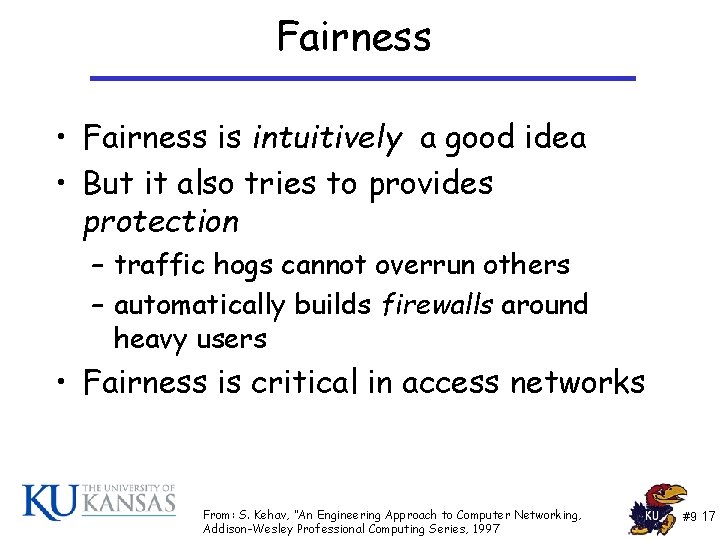
Fairness • Fairness is intuitively a good idea • But it also tries to provides protection – traffic hogs cannot overrun others – automatically builds firewalls around heavy users • Fairness is critical in access networks From: S. Kehav, “An Engineering Approach to Computer Networking, Addison-Wesley Professional Computing Series, 1997 #9 17
Performance bounds and Admission Control • Performance bounds – Deterministic – Statistical • Probability delay > x sec is less than p • Easy admission control decisions – Admission control needed to provide Qo. S – Overloaded resource cannot guarantee performance – Choice of scheduling discipline affects ease of admission control algorithm #9 18
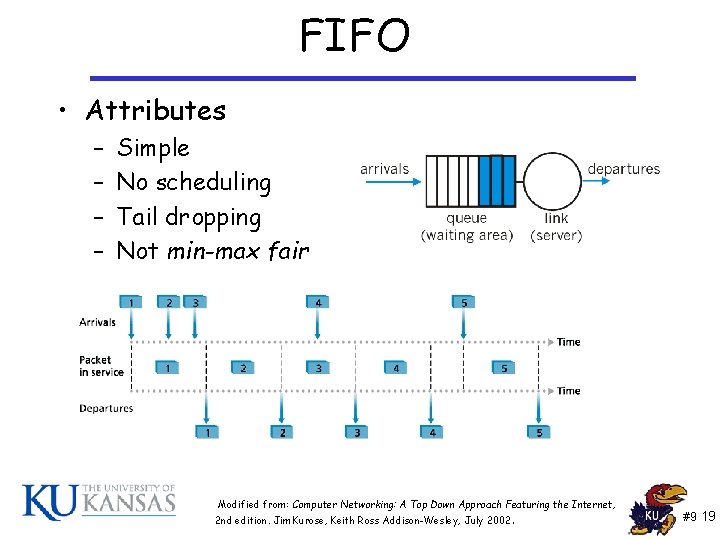
FIFO • Attributes – – Simple No scheduling Tail dropping Not min-max fair Modified from: Computer Networking: A Top Down Approach Featuring the Internet, 2 nd edition. Jim Kurose, Keith Ross Addison-Wesley, July 2002. #9 19
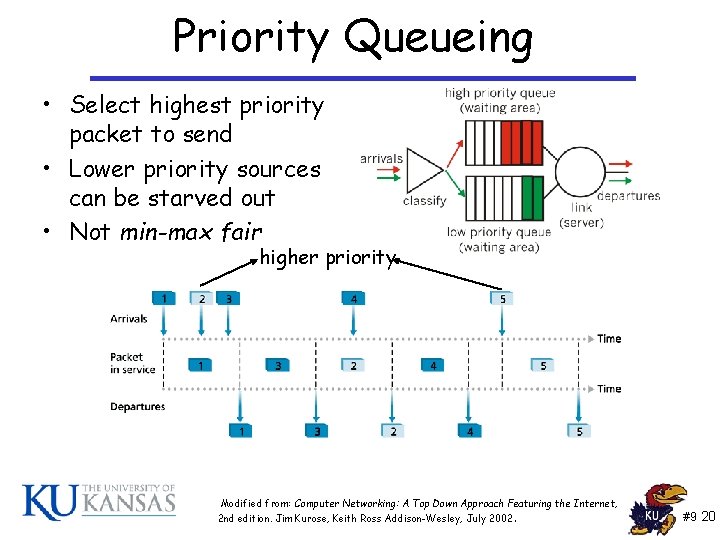
Priority Queueing • Select highest priority packet to send • Lower priority sources can be starved out • Not min-max fair higher priority Modified from: Computer Networking: A Top Down Approach Featuring the Internet, 2 nd edition. Jim Kurose, Keith Ross Addison-Wesley, July 2002. #9 20
Priority Queueing • Non-preemptive priority – Work-conserving – Complete service on packet being transmitted • Conservation Law- – Delay averaged over all sources is independent of service discipline • Assuming work-conserving • Delay weighted by source load – So if decease delay for some sources must increase the delay for others. • Priority only makes a difference at high loads #9 21
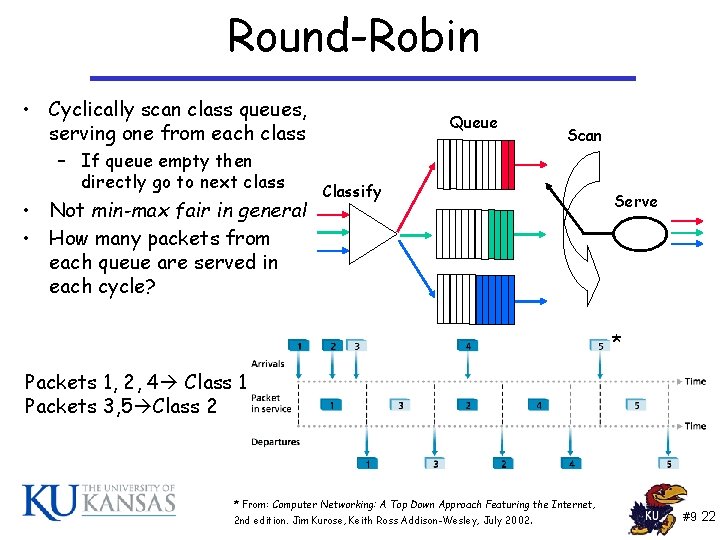
Round-Robin • Cyclically scan class queues, serving one from each class – If queue empty then directly go to next class • Not min-max fair in general • How many packets from each queue are served in each cycle? Queue Scan Classify Serve * Packets 1, 2, 4 Class 1 Packets 3, 5 Class 2 * From: Computer Networking: A Top Down Approach Featuring the Internet, 2 nd edition. Jim Kurose, Keith Ross Addison-Wesley, July 2002. #9 22
General Processor Sharing • Generalized processor sharing (GPS) provides manmin fair allocation – Each source has its own queue – Visit each non-empty queue in turn – Serve infinitesimal small amount of data from each queue • GPS is unimplementable! – we cannot serve infinitesimals, only packets • No packet discipline can be as fair as GPS – while a packet is being served, we are unfair to others • Other scheduling disciplines attempt to approximate GPS Modified from: S. Kehav, “An Engineering Approach to Computer Networking, Addison-Wesley Professional Computing Series, 1997 #9 23
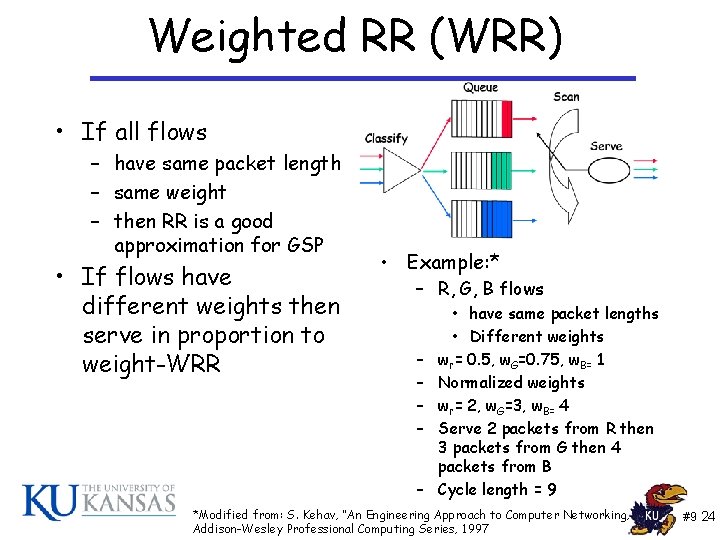
Weighted RR (WRR) • If all flows – have same packet length – same weight – then RR is a good approximation for GSP • If flows have different weights then serve in proportion to weight-WRR • Example: * – R, G, B flows – – – • have same packet lengths • Different weights wr= 0. 5, w. G=0. 75, w. B= 1 Normalized weights wr= 2, w. G=3, w. B= 4 Serve 2 packets from R then 3 packets from G then 4 packets from B Cycle length = 9 *Modified from: S. Kehav, “An Engineering Approach to Computer Networking, Addison-Wesley Professional Computing Series, 1997 #9 24
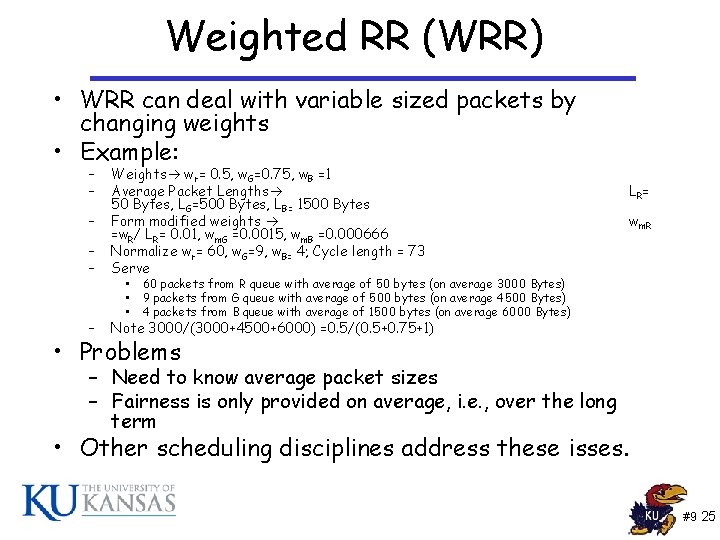
Weighted RR (WRR) • WRR can deal with variable sized packets by changing weights • Example: – – Weights wr= 0. 5, w. G=0. 75, w. B =1 Average Packet Lengths 50 Bytes, LG=500 Bytes, LB= 1500 Bytes Form modified weights =w. R/ LR= 0. 01, wm. G =0. 0015, wm. B =0. 000666 Normalize wr= 60, w. G=9, w. B= 4; Cycle length = 73 Serve – Note 3000/(3000+4500+6000) =0. 5/(0. 5+0. 75+1) – • • • LR= wm. R 60 packets from R queue with average of 50 bytes (on average 3000 Bytes) 9 packets from G queue with average of 500 bytes (on average 4500 Bytes) 4 packets from B queue with average of 1500 bytes (on average 6000 Bytes) • Problems – Need to know average packet sizes – Fairness is only provided on average, i. e. , over the long term • Other scheduling disciplines address these isses. #9 25
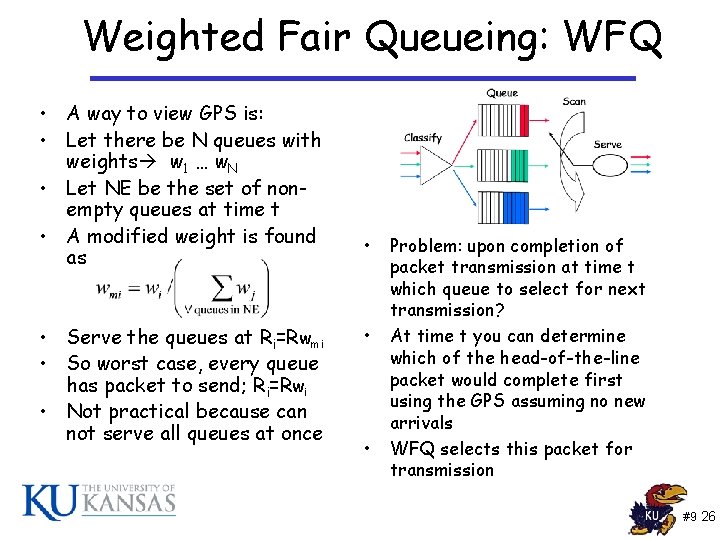
Weighted Fair Queueing: WFQ • A way to view GPS is: • Let there be N queues with weights w 1 … w. N • Let NE be the set of nonempty queues at time t • A modified weight is found as • Serve the queues at Ri=Rwmi • So worst case, every queue has packet to send; Ri=Rwi • Not practical because can not serve all queues at once • • • Problem: upon completion of packet transmission at time t which queue to select for next transmission? At time t you can determine which of the head-of-the-line packet would complete first using the GPS assuming no new arrivals WFQ selects this packet for transmission #9 26
Weighted Fair Queueing: WFQ • Properties of WFQ – Guarantee that any packet is transmitted within packet_length/Rwi • Can be used to provide guaranteed services • Achieve fair allocation • Can be used to protect well-behaved flows against malicious flows #9 27
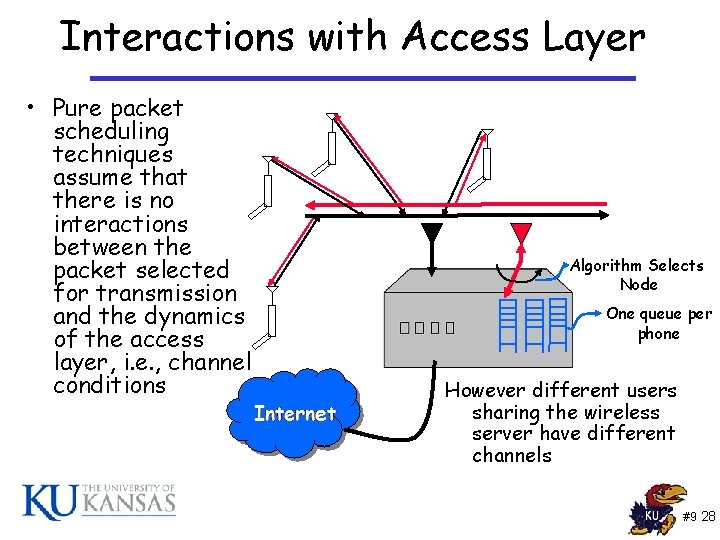
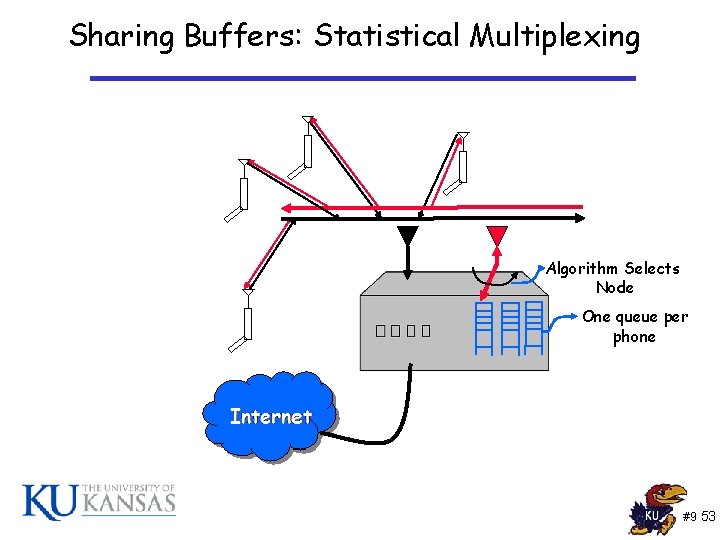
Interactions with Access Layer • Pure packet scheduling techniques assume that there is no interactions between the packet selected for transmission and the dynamics of the access layer, i. e. , channel conditions Algorithm Selects Node One queue per phone However different users sharing the wireless server have different channels #9 28
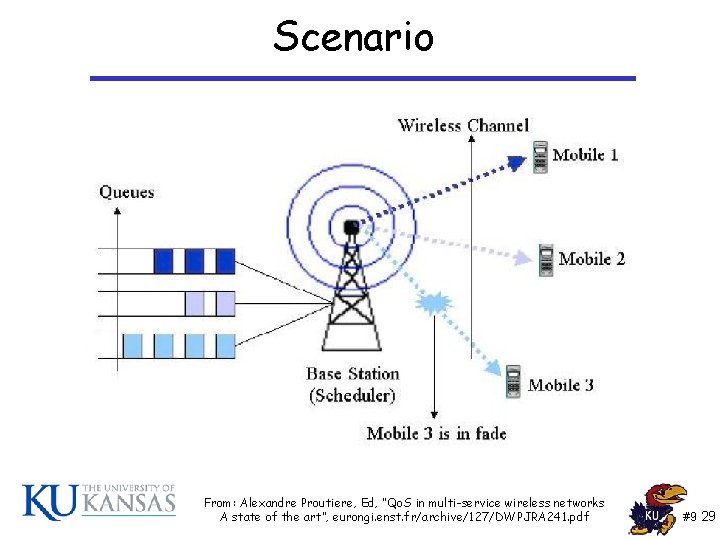
Scenario From: Alexandre Proutiere, Ed, “Qo. S in multi-service wireless networks A state of the art”, eurongi. enst. fr/archive/127/DWPJRA 241. pdf #9 29
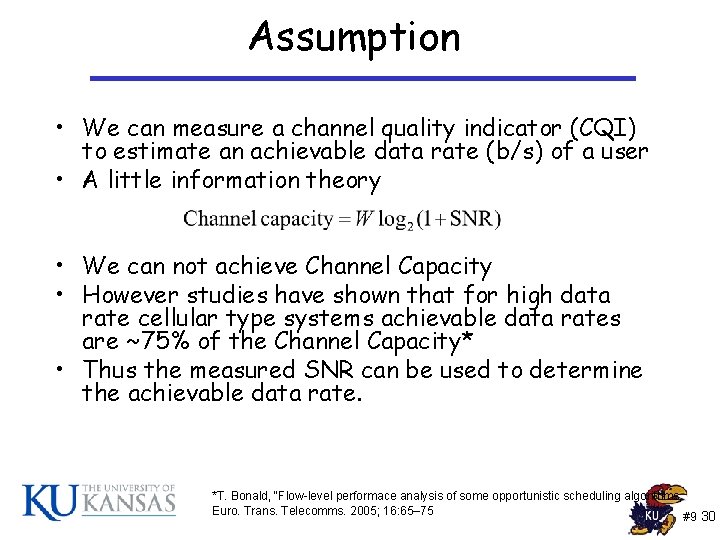
Assumption • We can measure a channel quality indicator (CQI) to estimate an achievable data rate (b/s) of a user • A little information theory • We can not achieve Channel Capacity • However studies have shown that for high data rate cellular type systems achievable data rates are ~75% of the Channel Capacity* • Thus the measured SNR can be used to determine the achievable data rate. *T. Bonald, “Flow-level performace analysis of some opportunistic scheduling algorithms, Euro. Trans. Telecomms. 2005; 16: 65– 75 #9 30
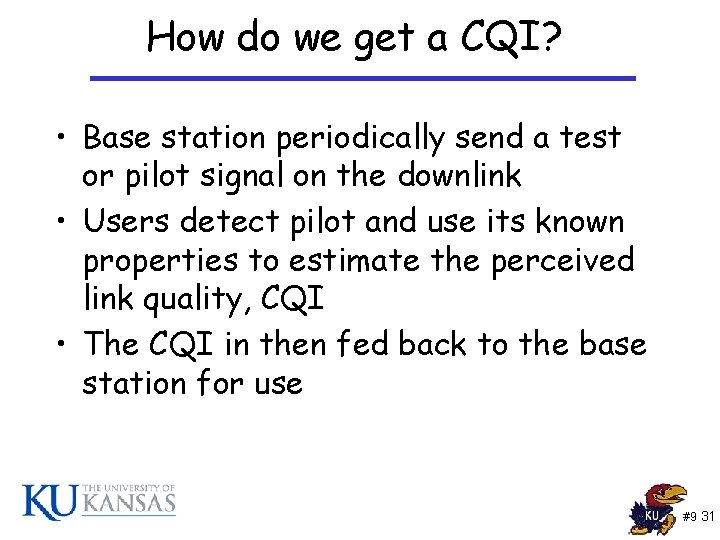
How do we get a CQI? • Base station periodically send a test or pilot signal on the downlink • Users detect pilot and use its known properties to estimate the perceived link quality, CQI • The CQI in then fed back to the base station for use #9 31
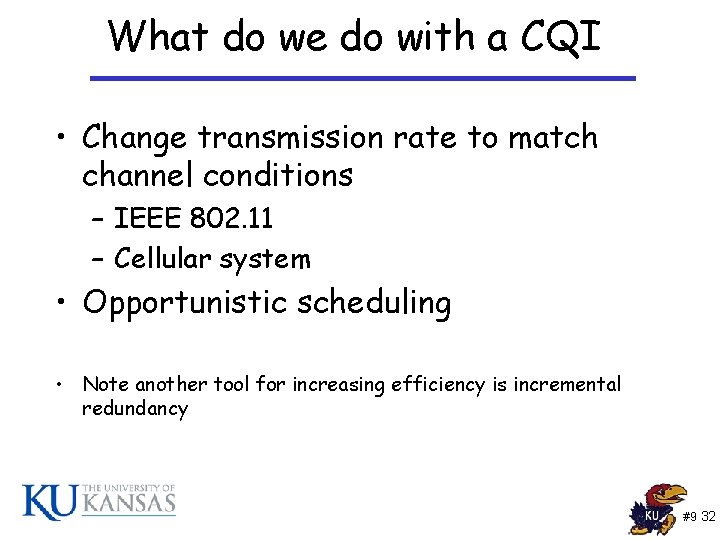
What do we do with a CQI • Change transmission rate to match channel conditions – IEEE 802. 11 – Cellular system • Opportunistic scheduling • Note another tool for increasing efficiency is incremental redundancy #9 32
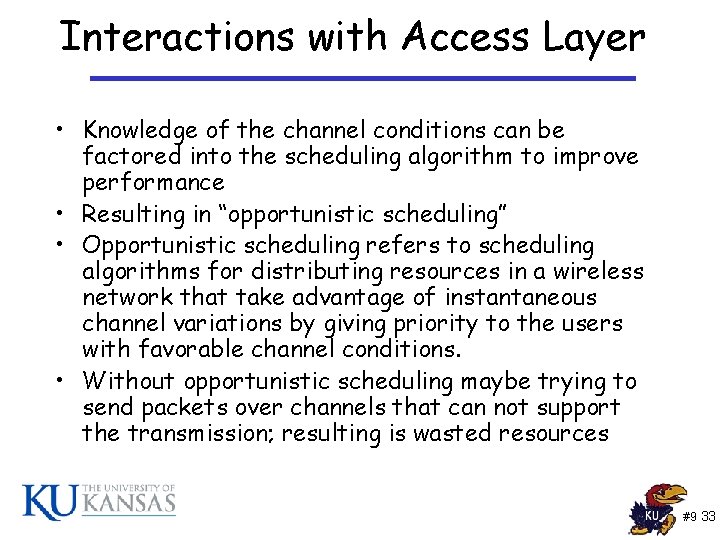
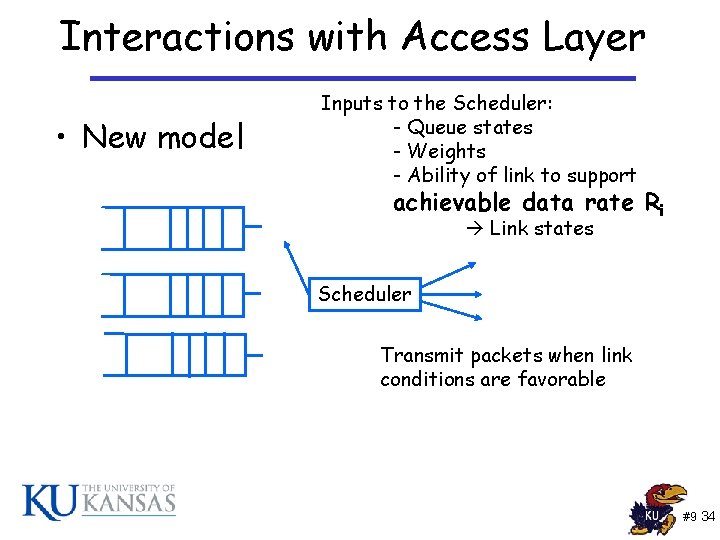
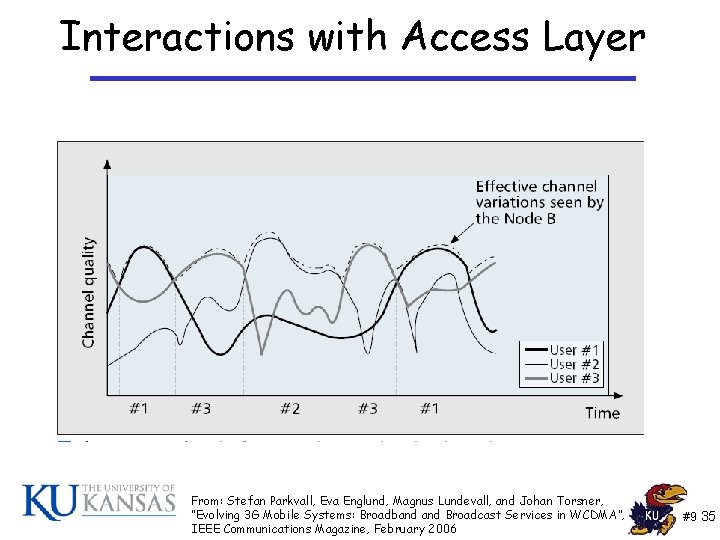
Interactions with Access Layer • Knowledge of the channel conditions can be factored into the scheduling algorithm to improve performance • Resulting in “opportunistic scheduling” • Opportunistic scheduling refers to scheduling algorithms for distributing resources in a wireless network that take advantage of instantaneous channel variations by giving priority to the users with favorable channel conditions. • Without opportunistic scheduling maybe trying to send packets over channels that can not support the transmission; resulting is wasted resources #9 33
Interactions with Access Layer • New model Inputs to the Scheduler: - Queue states - Weights - Ability of link to support achievable data rate Ri Link states Scheduler Transmit packets when link conditions are favorable #9 34
Interactions with Access Layer From: Stefan Parkvall, Eva Englund, Magnus Lundevall, and Johan Torsner, “Evolving 3 G Mobile Systems: Broadband Broadcast Services in WCDMA”, IEEE Communications Magazine, February 2006 #9 35
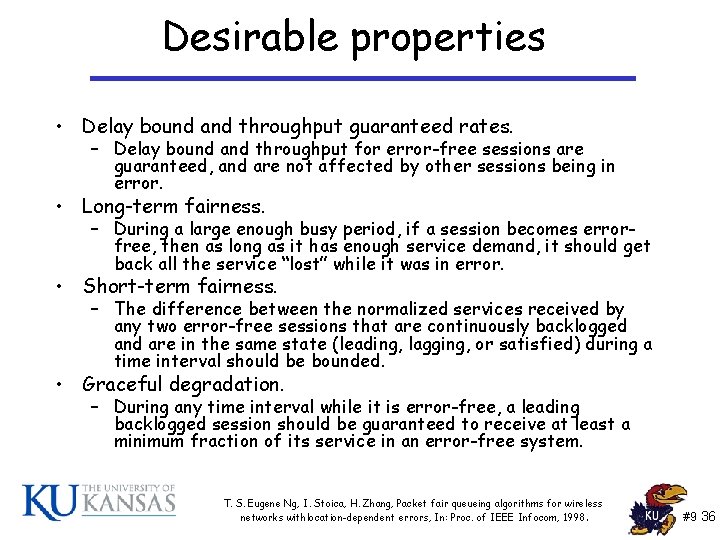
Desirable properties • Delay bound and throughput guaranteed rates. – Delay bound and throughput for error-free sessions are guaranteed, and are not affected by other sessions being in error. • Long-term fairness. – During a large enough busy period, if a session becomes errorfree, then as long as it has enough service demand, it should get back all the service “lost” while it was in error. • Short-term fairness. – The difference between the normalized services received by any two error-free sessions that are continuously backlogged and are in the same state (leading, lagging, or satisfied) during a time interval should be bounded. • Graceful degradation. – During any time interval while it is error-free, a leading backlogged session should be guaranteed to receive at least a minimum fraction of its service in an error-free system. T. S. Eugene Ng, I. Stoica, H. Zhang, Packet fair queueing algorithms for wireless networks withlocation-dependent errors, In: Proc. of IEEE Infocom, 1998. #9 36
RR scheduling • Round Robin scheduling maybe used • RR equalizes data rates for all active users • However, wastes radio resources #9 37
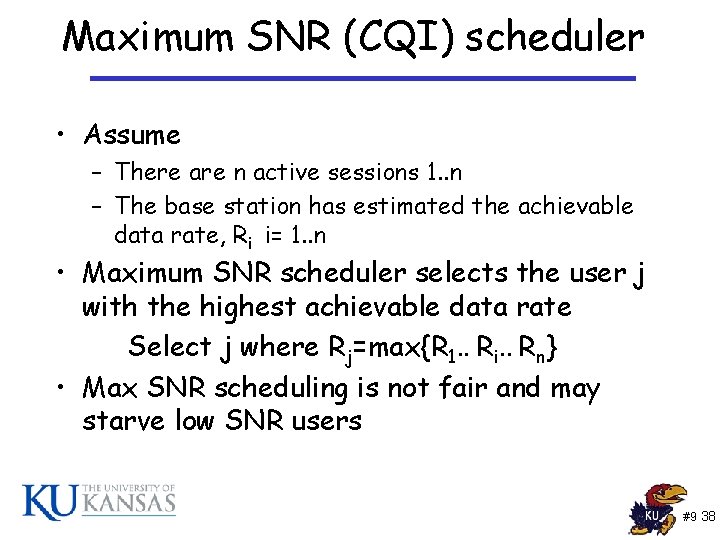
Maximum SNR (CQI) scheduler • Assume – There are n active sessions 1. . n – The base station has estimated the achievable data rate, Ri i= 1. . n • Maximum SNR scheduler selects the user j with the highest achievable data rate Select j where Rj=max{R 1. . Ri. . Rn} • Max SNR scheduling is not fair and may starve low SNR users #9 38
Proportional Fair (PF) Scheduler • The user with the highest achievable data rate with respect to its current mean rate gets to transmit • PF provides a trade-off between efficiency and fairness #9 39
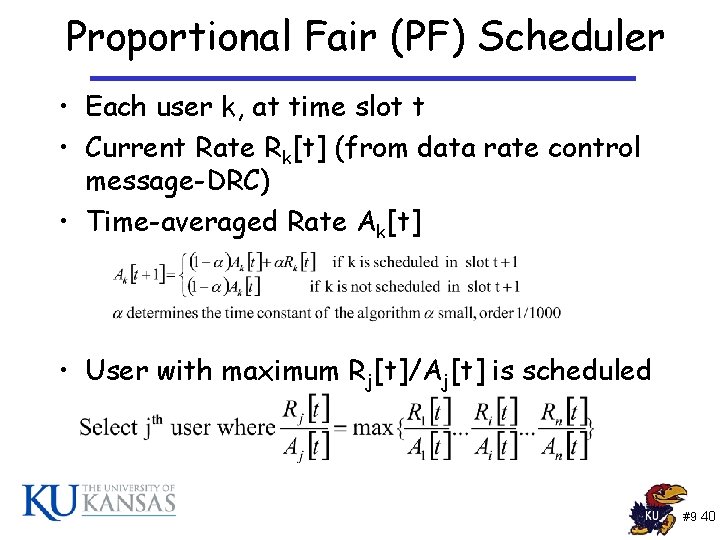
Proportional Fair (PF) Scheduler • Each user k, at time slot t • Current Rate Rk[t] (from data rate control message-DRC) • Time-averaged Rate Ak[t] • User with maximum Rj[t]/Aj[t] is scheduled #9 40
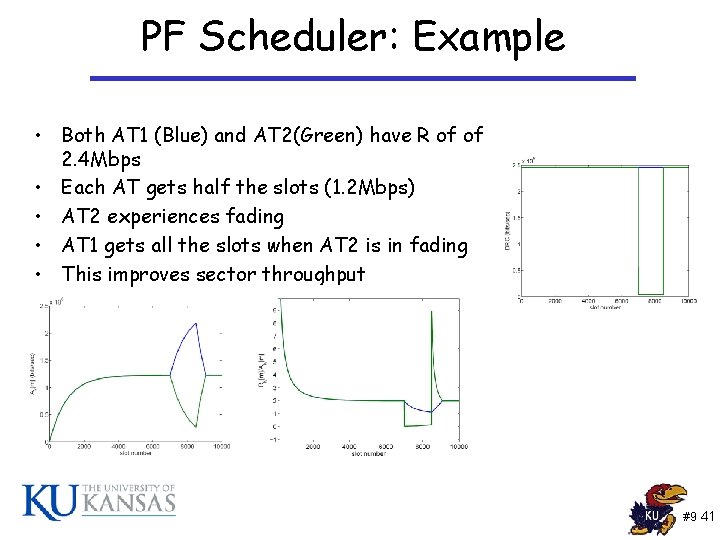
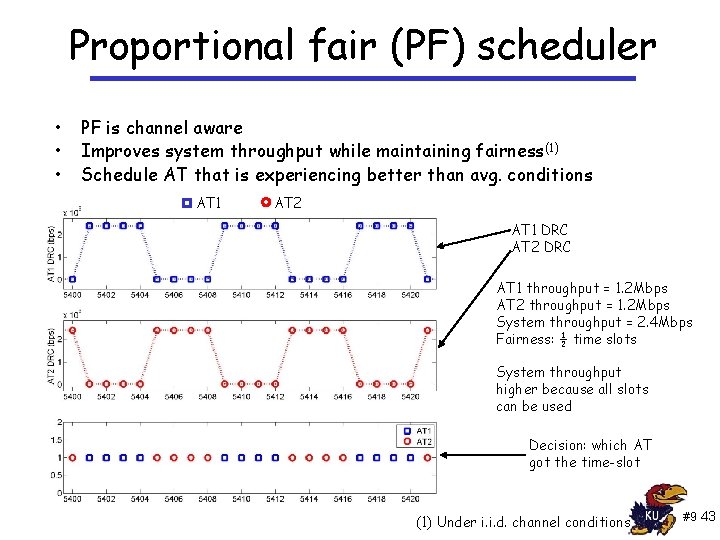
PF Scheduler: Example • Both AT 1 (Blue) and AT 2(Green) have R of of 2. 4 Mbps • Each AT gets half the slots (1. 2 Mbps) • AT 2 experiences fading • AT 1 gets all the slots when AT 2 is in fading • This improves sector throughput #9 41
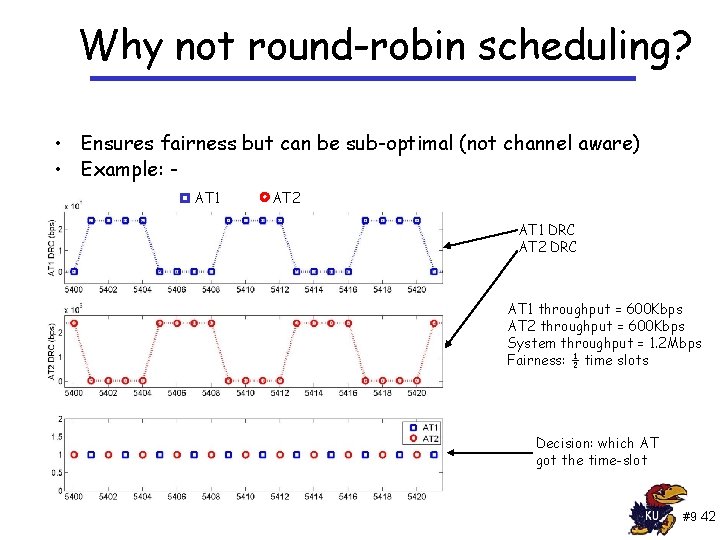
Why not round-robin scheduling? • Ensures fairness but can be sub-optimal (not channel aware) • Example: AT 1 AT 2 AT 1 DRC AT 2 DRC AT 1 throughput = 600 Kbps AT 2 throughput = 600 Kbps System throughput = 1. 2 Mbps Fairness: ½ time slots Decision: which AT got the time-slot #9 42
Proportional fair (PF) scheduler • • • PF is channel aware Improves system throughput while maintaining fairness (1) Schedule AT that is experiencing better than avg. conditions AT 1 AT 2 AT 1 DRC AT 2 DRC AT 1 throughput = 1. 2 Mbps AT 2 throughput = 1. 2 Mbps System throughput = 2. 4 Mbps Fairness: ½ time slots System throughput higher because all slots can be used Decision: which AT got the time-slot (1) Under i. i. d. channel conditions #9 43
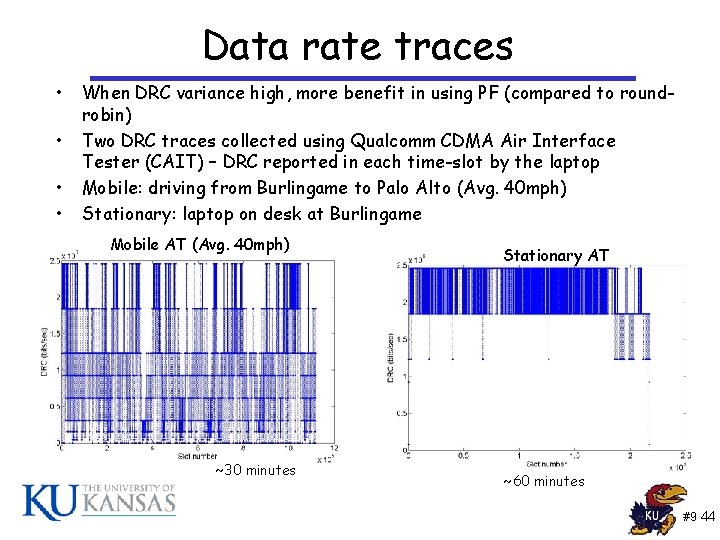
Data rate traces • • When DRC variance high, more benefit in using PF (compared to roundrobin) Two DRC traces collected using Qualcomm CDMA Air Interface Tester (CAIT) – DRC reported in each time-slot by the laptop Mobile: driving from Burlingame to Palo Alto (Avg. 40 mph) Stationary: laptop on desk at Burlingame Mobile AT (Avg. 40 mph) ~30 minutes Stationary AT ~60 minutes #9 44
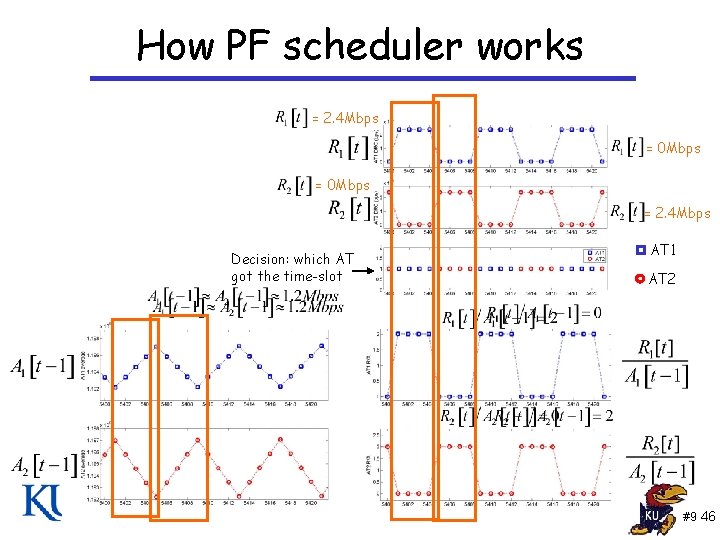
How PF scheduler works R 1[t] R 2[t] AT 1 Ri[t] AT 2 AT i Each AT k reports DRC Rk[t] at time slot t AT K Slot allocated to AT i Exponential weighted average throughput to each AT Schedule AT that has its better than average conditions i. e. , schedule AT with maximum R/A RK[t] AN computes Rk[t]/Ak[t-1] for each AT k AN allocates time slot to AT with maximum Rk[t]/Ak[t-1], say AT i Ai[t] of AT i updates as Ak[t] of all other ATs k updated #9 45
How PF scheduler works = 2. 4 Mbps = 0 Mbps = 2. 4 Mbps Decision: which AT got the time-slot AT 1 AT 2 #9 46
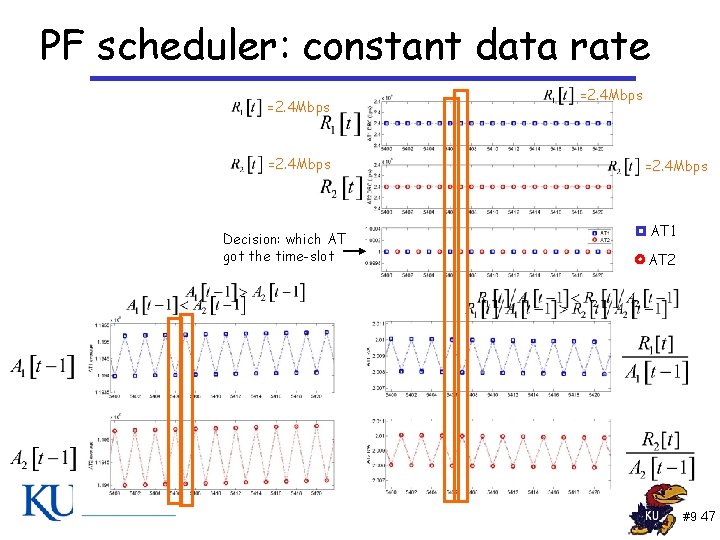
PF scheduler: constant data rate =2. 4 Mbps Decision: which AT got the time-slot =2. 4 Mbps AT 1 AT 2 #9 47
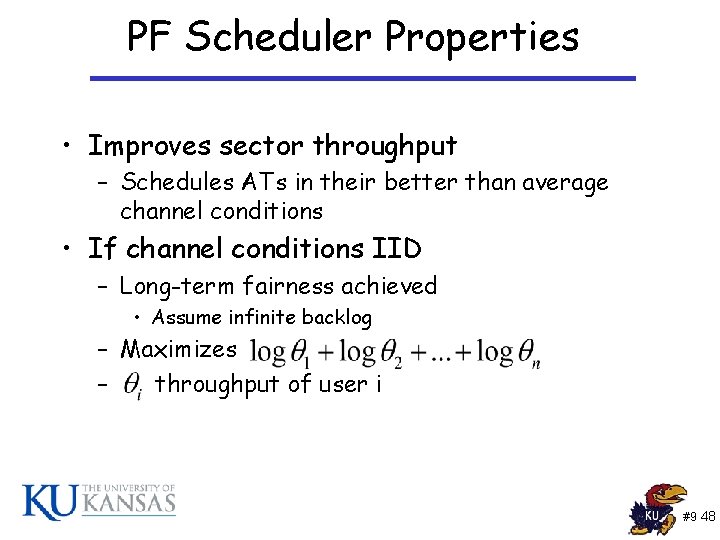
PF Scheduler Properties • Improves sector throughput – Schedules ATs in their better than average channel conditions • If channel conditions IID – Long-term fairness achieved • Assume infinite backlog – Maximizes – throughput of user i #9 48
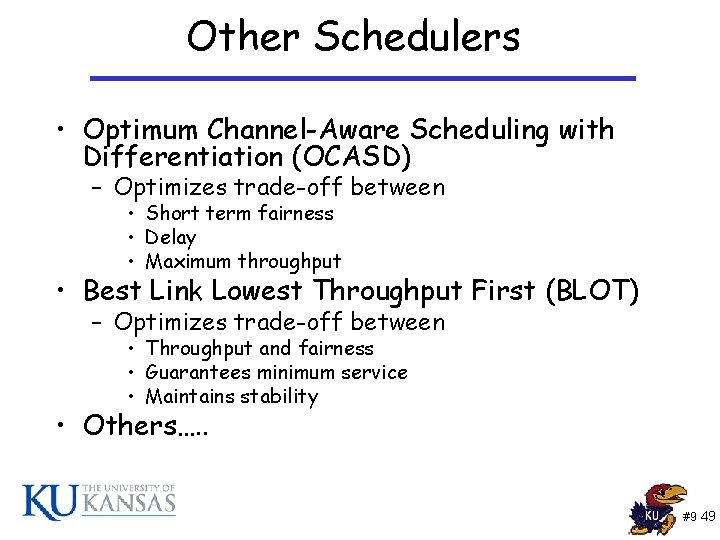
Other Schedulers • Optimum Channel-Aware Scheduling with Differentiation (OCASD) – Optimizes trade-off between • Short term fairness • Delay • Maximum throughput • Best Link Lowest Throughput First (BLOT) – Optimizes trade-off between • Throughput and fairness • Guarantees minimum service • Maintains stability • Others…. . #9 49
References #9 • • Computer Networking: A Top Down Approach Featuring the Internet, 2 nd edition. Jim Kurose, Keith Ross Addison-Wesley, July 2002. S. Kehav, “An Engineering Approach to Computer Networking, Addison-Wesley Professional Computing Series, 1997 Alexandre Proutiere, Ed, “Qo. S in multi-service wireless networks A state of the art”, eurongi. enst. fr/archive/127/DWPJRA 241. pdf T. Bonald, “Flow-level performace analysis of some opportunistic scheduling algorithms, Euro. Trans. Telecomms. 2005; 16: 65– 75 Stefan Parkvall, Eva Englund, Magnus Lundevall, and Johan Torsner, “Evolving 3 G Mobile Systems: Broadband Broadcast Services in WCDMA”, IEEE Communications Magazine, February 2006 T. S. Eugene Ng, I. Stoica, H. Zhang, Packet fair queueing algorithms for wireless networks with location-dependent errors, Proc. of IEEE Infocom, 1998. Schwartz, M. , Mobile wireless communications. 2005, Cambridge; New York: Cambridge University Press. xi, 457 p. #9 50
References • Andrews, M. , Instability of the proportional fair scheduling algorithm for HDR. 2002. p. 14. • Bonald, T. , Flow-level performance analysis of some opportunistic scheduling algorithms. European transactions on telecommunications 2005. 16(1): p. 65 -75. • Borst, S. User-level performance of channel-aware scheduling algorithms in wireless data networks. in Proceedings of IEEE INFOCOM '03. 2003. San Francisco, CA • Fattah, H. and C. Leung, An overview of scheduling algorithms in wireless multimedia networks. Wireless Communications, IEEE, 2002. 9(5): p. 76 -83. • Gyasi-Agyei, A. and S. -L. Kim, Cross-layer multiservice opportunistic scheduling for wireless networks. IEEE Communications Magazine, 2006. 44(6): p. 50 -57. #9 51
References #9 52
Sharing Buffers: Statistical Multiplexing Algorithm Selects Node One queue per phone #9 53