
How are enzyme activities affected by temperature and
How are enzyme activities affected by temperature and p. H ? 1 Temperature Enzyme activity is usually expressed in terms of reaction rate. • the rate at which substrates are used up or broken down, or the rate of formation of product(s) • increase to a maximum and then decrease as the temperature increases 1
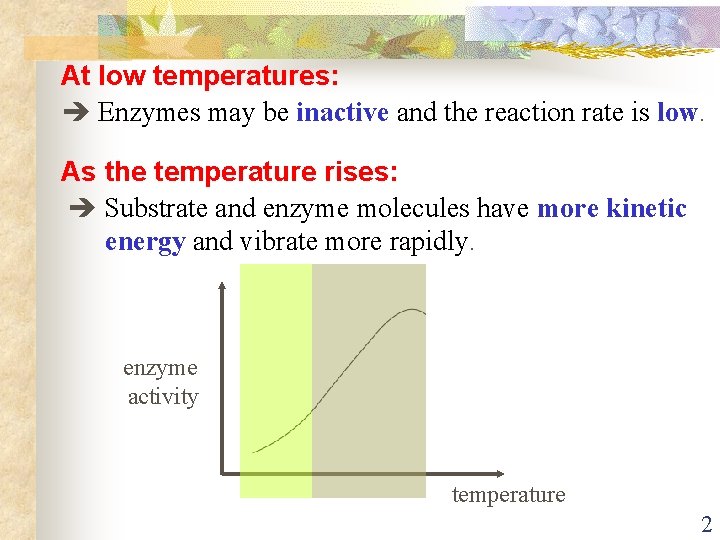
At low temperatures: Enzymes may be inactive and the reaction rate is low. As the temperature rises: Substrate and enzyme molecules have more kinetic energy and vibrate more rapidly. enzyme activity temperature 2
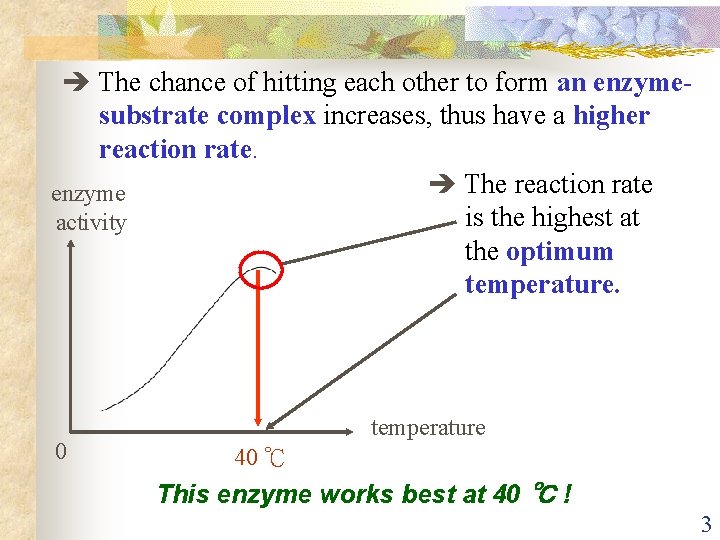
The chance of hitting each other to form an enzymesubstrate complex increases, thus have a higher reaction rate. The reaction rate enzyme is the highest at activity the optimum temperature. 0 temperature 40 ℃ This enzyme works best at 40 ℃ ! 3
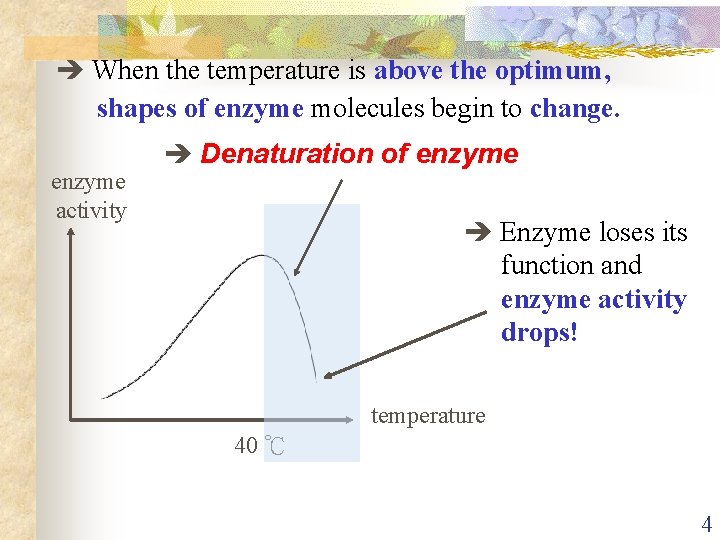
When the temperature is above the optimum, shapes of enzyme molecules begin to change. enzyme activity Denaturation of enzyme Enzyme loses its function and enzyme activity drops! temperature 40 ℃ 4
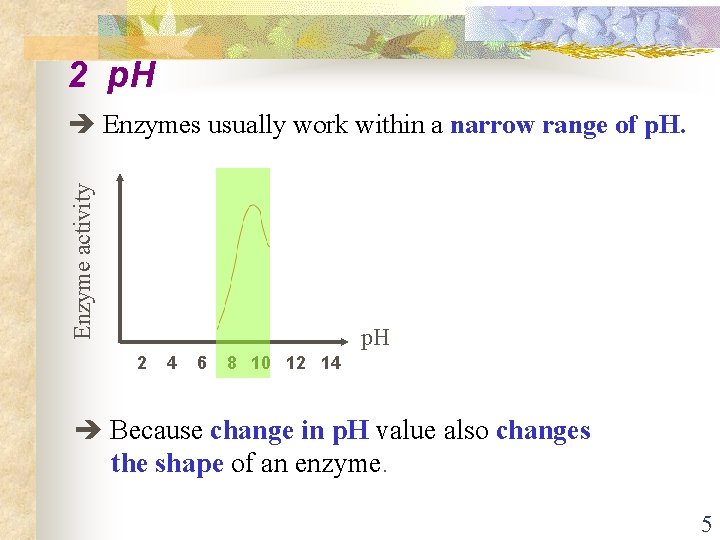
2 p. H Enzyme activity Enzymes usually work within a narrow range of p. H 2 4 6 8 10 12 14 Because change in p. H value also changes the shape of an enzyme. 5
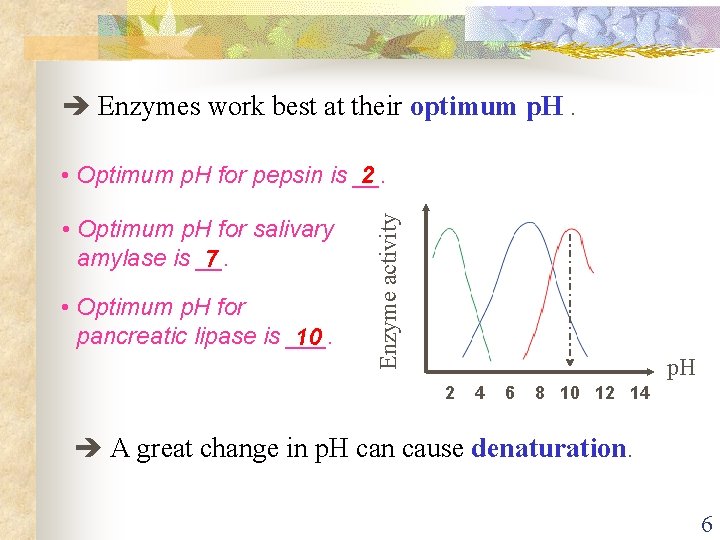
Enzymes work best at their optimum p. H. pepsin • Optimum p. H for salivary amylase is __. 7 • Optimum p. H for pancreatic lipase is ___. 10 Enzyme activity • Optimum p. H for pepsin is __. 2 salivary amylase pancreatic lipase p. H 2 4 6 8 10 12 14 A great change in p. H can cause denaturation. 6
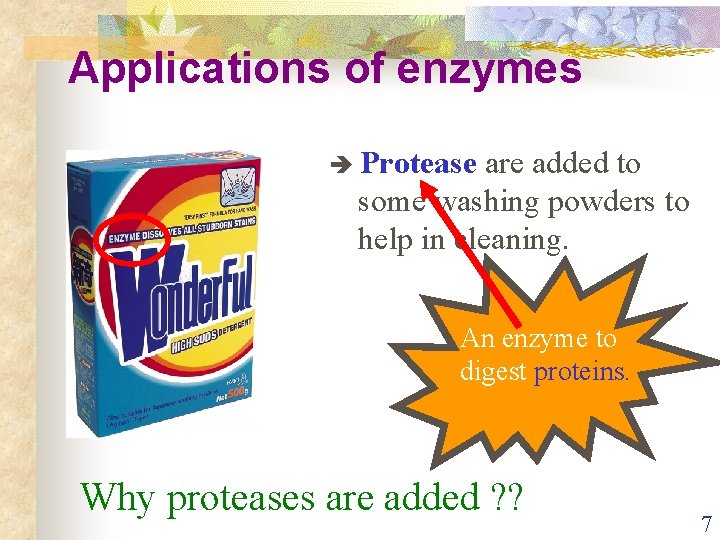
Applications of enzymes Protease are added to some washing powders to help in cleaning. An enzyme to digest proteins. Why proteases are added ? ? 7
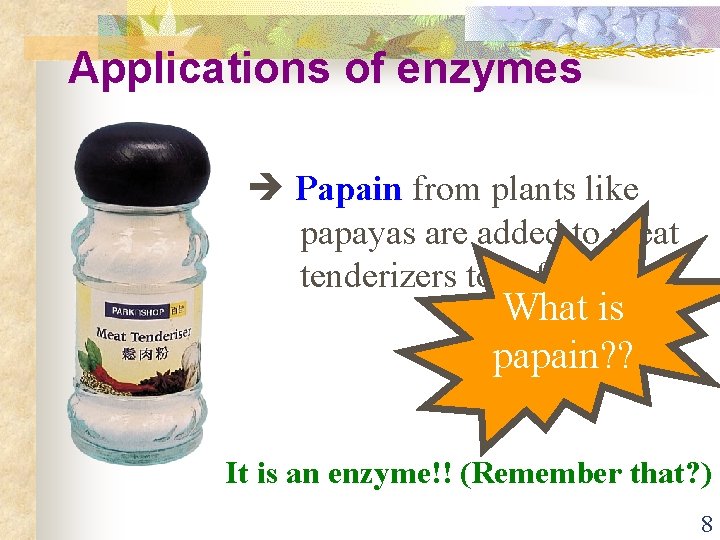
Applications of enzymes Papain from plants like papayas are added to meat tenderizers to soften meat. What is papain? ? It is an enzyme!! (Remember that? ) 8
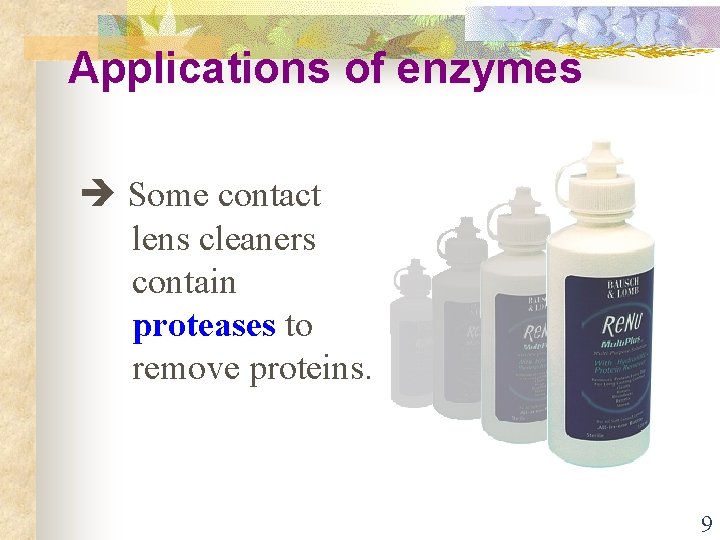
Applications of enzymes Some contact lens cleaners contain proteases to remove proteins. 9
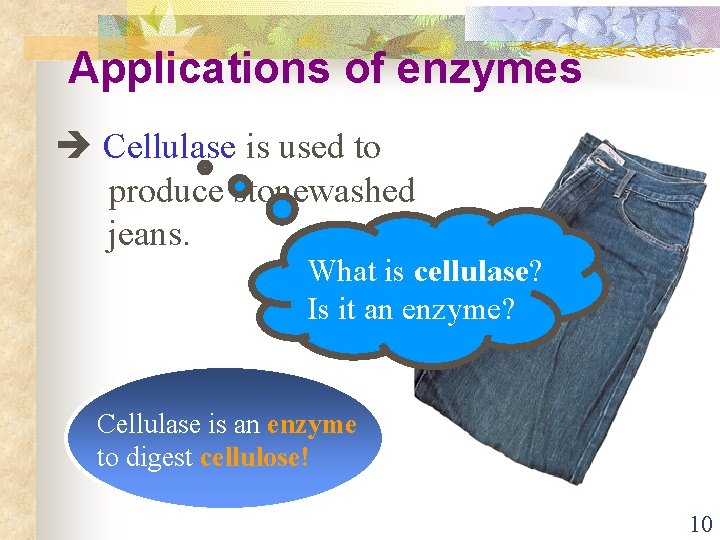
Applications of enzymes Cellulase is used to produce stonewashed jeans. What is cellulase? Is it an enzyme? Cellulase is an enzyme to digest cellulose! 10

Design a fair test to compare the enzyme activities of two biological washing powders. Discuss with your group members and present your ideas on the following items: 1. The method used to solve the problem. (Use labelled diagrams to illustrate the procedures!). 2. The way by which experimental results is collected. 3. The independent, dependent and controlled variables of this investigation. 11
Investigation of protease activities in different fruit juices Procedures: 1 Heat the end of a cork borer in a Bunsen flame and allow it to cool. 2 Gently press the borer down into the milk-agar to make 5 wells. Replace the lid quickly. 3 Make a mark on the plate to indicate the arrangement of samples. 12
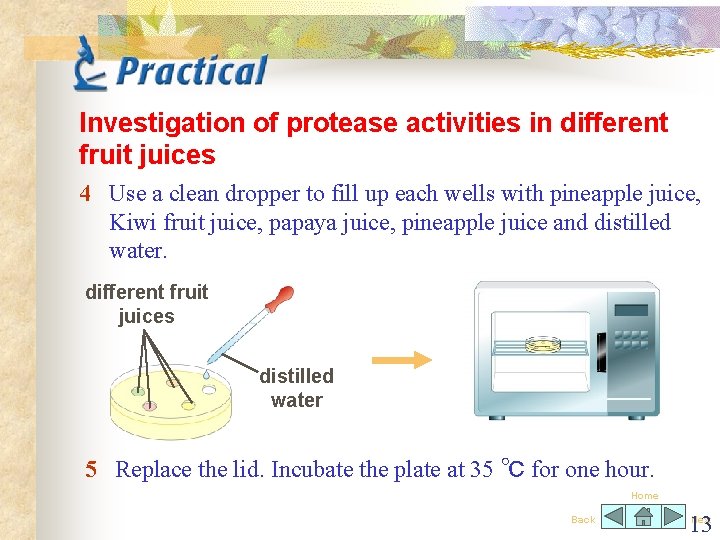
Investigation of protease activities in different fruit juices 4 Use a clean dropper to fill up each wells with pineapple juice, Kiwi fruit juice, papaya juice, pineapple juice and distilled water. different fruit juices distilled water 5 Replace the lid. Incubate the plate at 35 ℃ for one hour. Home Back Next 13
Investigation of protease activities in different fruit juices 6 Measure the diameter of the clear zones around the wells by placing the plate on a graph paper and examining against light. Home Back Next 14
- Slides: 14