
How ADHD Impacts Estimated Life Expectancy Announcements ACO




- Slides: 16
How ADHD Impacts Estimated Life Expectancy
Announcements ACO Programs Case Collaborations ACO Case Collaborations take place the 3 rd Wednesday of the month from 10: 00 -11: 00 am ET March Case Collaboration: Powerful Questioning and Direct Communication with Students April Case Collaboration: Powerful Questioning and Direct Communication with Adults
Housekeeping Tips • Email opening and closing words to cceu@adhdcoaches. org within 24 hours to receive a Core Competency CCEU. Today’s Opening Word: Health Housekeeping – Keep your line muted to control background noise. – To participate: raise hand or type in chat box, and unmute yourself when you wish to speak.
Health Outcomes of ADHD • Dr. Russell Barkley presented his research at 2018 International Conference on ADHD • JAD article • Hyperactive Child Syndrome and Estimated Life Expectancy at Young Adult Follow-Up: The Role of ADHD Persistence and Other Potential Predictors • Connecting ADHD type with hyperactivity to reduced estimated life expectancy (ELE) • This is a longitudinal study • Participants were from the Milwaukee Study 1978 -1980 aged 4 -12 yrs. • Evaluated 1987 -1988 aged 12 -20 yrs, 1992 -1996 aged 1325 yrs, 1998 -2004 aged 24 -32 yrs. • ELE calculator used was from the Goldenson Center for Actuarial Research, University of Connecticut
Health Concerns Related to ADHD • Greater risk of traumatic brain injuries • Greater risk of accidental injuries • Across childhood into adulthood • Higher risk for early pregnancy and to contract sexually transmitted diseases • Poorer physical health by young adulthood • Greater occurrence of migraine headaches • Less healthy high carb diet
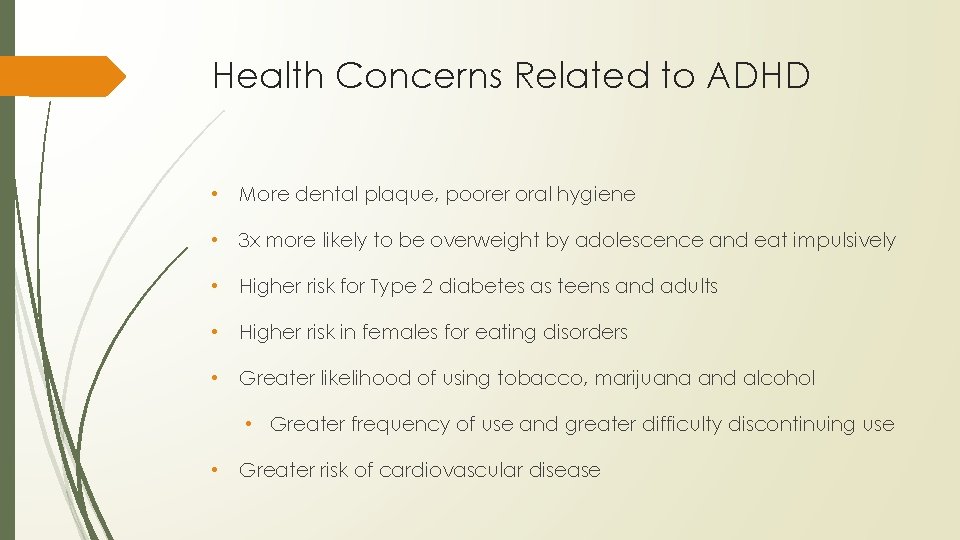
Health Concerns Related to ADHD • More dental plaque, poorer oral hygiene • 3 x more likely to be overweight by adolescence and eat impulsively • Higher risk for Type 2 diabetes as teens and adults • Higher risk in females for eating disorders • Greater likelihood of using tobacco, marijuana and alcohol • Greater frequency of use and greater difficulty discontinuing use • Greater risk of cardiovascular disease
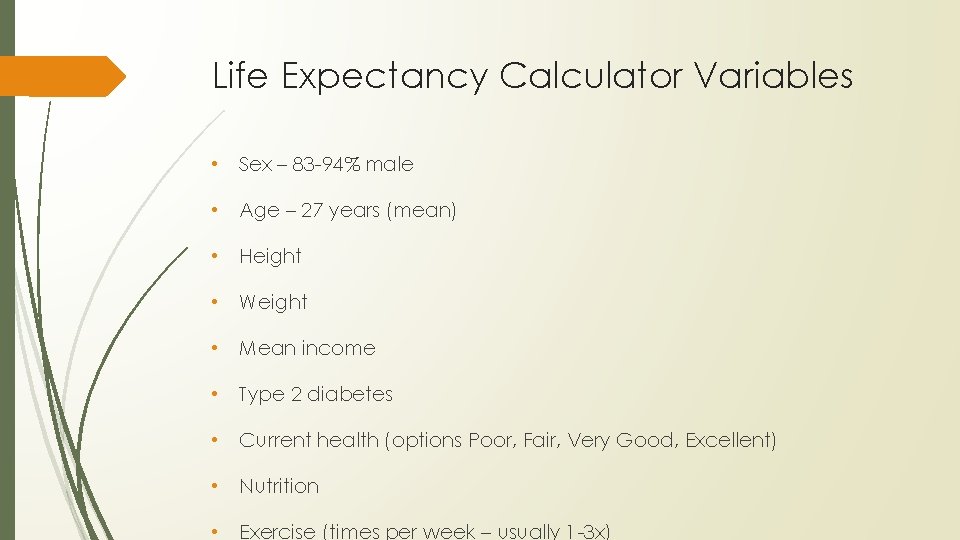
Life Expectancy Calculator Variables • Sex – 83 -94% male • Age – 27 years (mean) • Height • Weight • Mean income • Type 2 diabetes • Current health (options Poor, Fair, Very Good, Excellent) • Nutrition • Exercise (times per week – usually 1 -3 x)
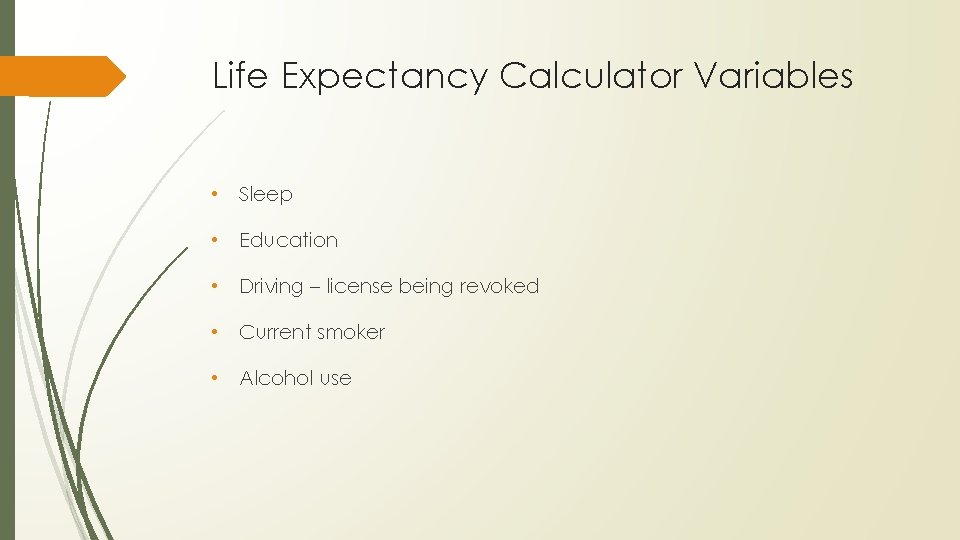
Life Expectancy Calculator Variables • Sleep • Education • Driving – license being revoked • Current smoker • Alcohol use
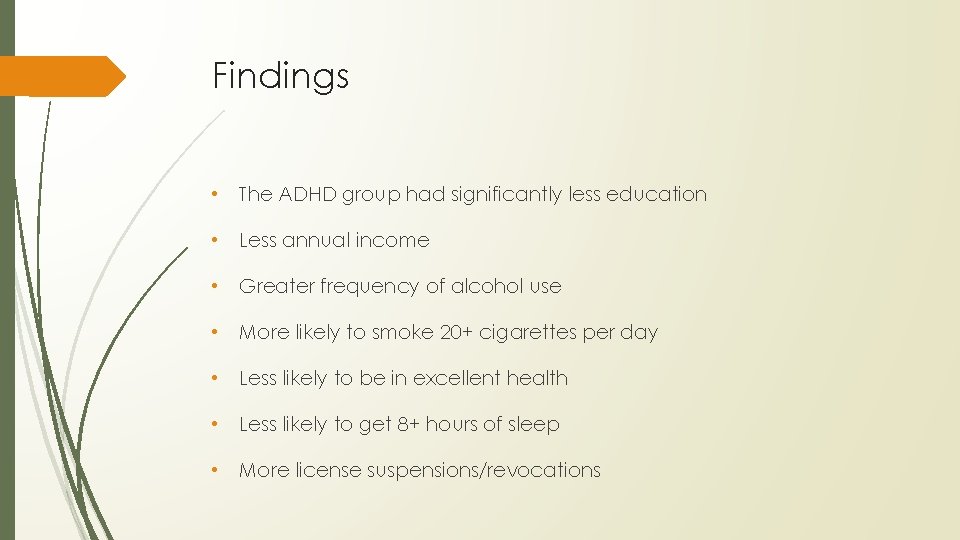
Findings • The ADHD group had significantly less education • Less annual income • Greater frequency of alcohol use • More likely to smoke 20+ cigarettes per day • Less likely to be in excellent health • Less likely to get 8+ hours of sleep • More license suspensions/revocations
Findings • ADHD is a disorder of self-regulation • Connected to several serious impairments in major life activities • Linked to other health risks generally known to negatively impact life expectancy
The Take Aways ● ADHD is a Public Health Problem ● ADHD will affect longevity and life span IF not treated ● This is especially true during the adolescent years. ● 30% of variation in human lifespan is the trait of impulsiveness.
The Good News! ● All the variables included for a decrease in lifespan can be changed. ● If these variables are changed, then lifespan outcomes are improved. ● As professions working with individuals with ADHD, we can help people live a normal life and have normal expectancy.
As coaches, what can we do? Discussion
What are YOUR take aways? What are your NEXT STEPS as you think about specific clients and your coaching practice? Jot down your thoughts.
Announcements Today’s Closing Word Matters *send opening & closing words to cceu@adhdcoaches. org Next Case Collaborations: March Case Collaboration: Powerful Questioning and Direct Communication with Students April Case Collaboration: Powerful Questioning and Direct Communication with Adults
References • Barkley, R. A. , (2018, November). Health Outcomes of ADHD: Is there an Effect on Life Expectancy? Power. Point slides presented at the 2018 Annual international Conference on ADHD Conference, St. Louis, MO. • Barkley, R. A. , Murphy, K. R. , & Fischer, M. (2008). ADHD in Adults: What the science says. New York: Guilford Press.