
How Actions Can Be Morally Evaluated MotiveIntention Character
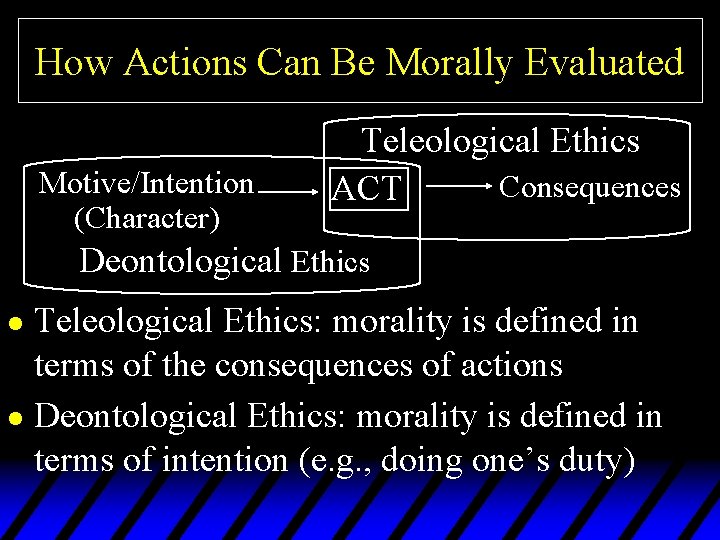
How Actions Can Be Morally Evaluated Motive/Intention (Character) Teleological Ethics Consequences ACT Deontological Ethics Teleological Ethics: morality is defined in terms of the consequences of actions l Deontological Ethics: morality is defined in terms of intention (e. g. , doing one’s duty) l
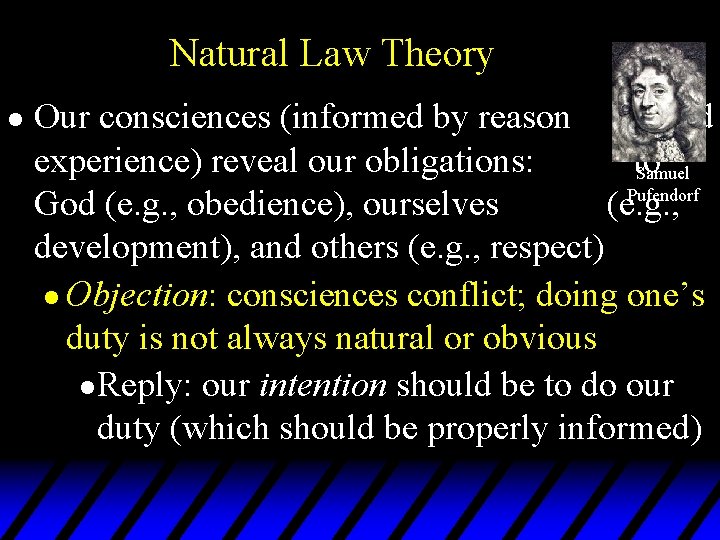
Natural Law Theory l Our consciences (informed by reason and experience) reveal our obligations: to Samuel Pufendorf God (e. g. , obedience), ourselves (e. g. , development), and others (e. g. , respect) l Objection: consciences conflict; doing one’s duty is not always natural or obvious l Reply: our intention should be to do our duty (which should be properly informed)
Kant’s Ethics (Formalism) l Morality is not based on character or consequences, for virtues or happiness are morally good only if informed by a good will– the intent to act for the sake of doing your duty l Morality is about obligation (for everyone): the form of moral obligation is its universality, its categorical (vs. hypothetical) character l Humans can act for the sake of doing their duty, so treat them as ends-in-themselves
Kant: The Categorical Imperative l Always act only on maxims (rules) that you could will everyone universally to adopt l Tests for universalizing a maxim: consistency (universalizability without contradiction) and acceptability (can be accepted if universalized) l. W. D. Ross: duties sometimes conflict; this shows how they are valid only prima facie l. T. Regan: duties to animals are not indirect
- Slides: 4