
How accurately will SWOT measurements be able to
How accurately will SWOT measurements be able to characterize river discharge? Michael Durand, Doug Alsdorf, Paul Bates, Ernesto Rodríguez, Kostas Andreadis, Elizabeth Clark AGU Fall Meeting December 17, 2008

Outline 1. Algorithms: How will we estimate discharge from SWOT observations? 2. Virtual Mission: Simulating true water depth and discharge, and simulating SWOT observations 3. Discharge Accuracy: Comparing SWOT discharge estimates with true discharge The SWOT Ka-band radar interferometer
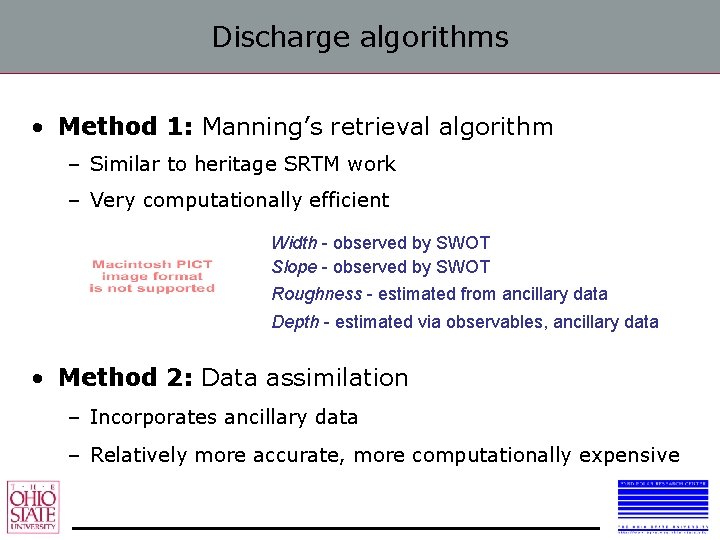
Discharge algorithms • Method 1: Manning’s retrieval algorithm – Similar to heritage SRTM work – Very computationally efficient Width - observed by SWOT Slope - observed by SWOT Roughness - estimated from ancillary data Depth - estimated via observables, ancillary data • Method 2: Data assimilation – Incorporates ancillary data – Relatively more accurate, more computationally expensive
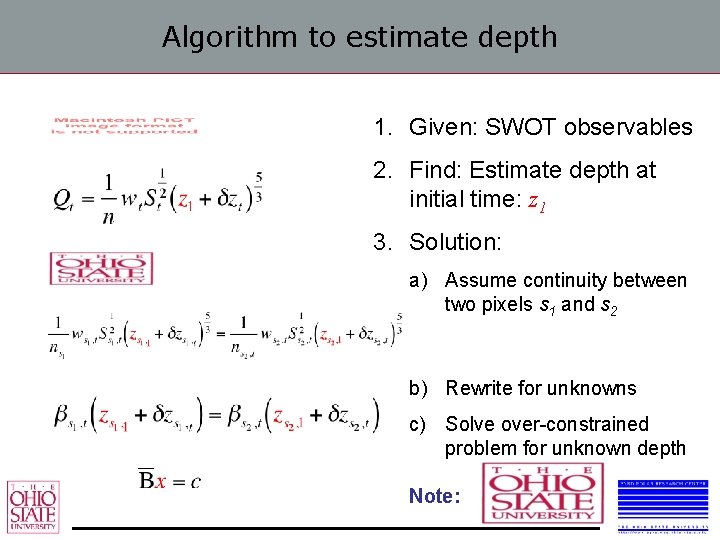
Algorithm to estimate depth 1. Given: SWOT observables 2. Find: Estimate depth at initial time: z 1 3. Solution: a) Assume continuity between two pixels s 1 and s 2 b) Rewrite for unknowns c) Solve over-constrained problem for unknown depth Note:
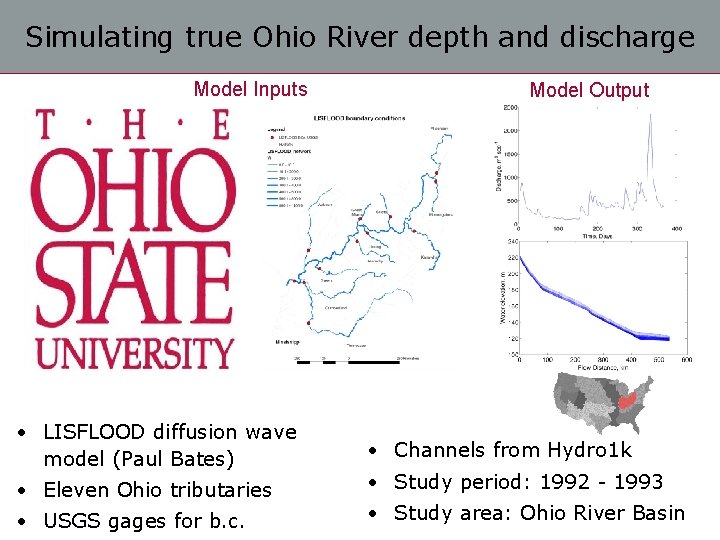
Simulating true Ohio River depth and discharge Model Inputs • LISFLOOD diffusion wave model (Paul Bates) • Eleven Ohio tributaries • USGS gages for b. c. Model Output • Channels from Hydro 1 k • Study period: 1992 - 1993 • Study area: Ohio River Basin
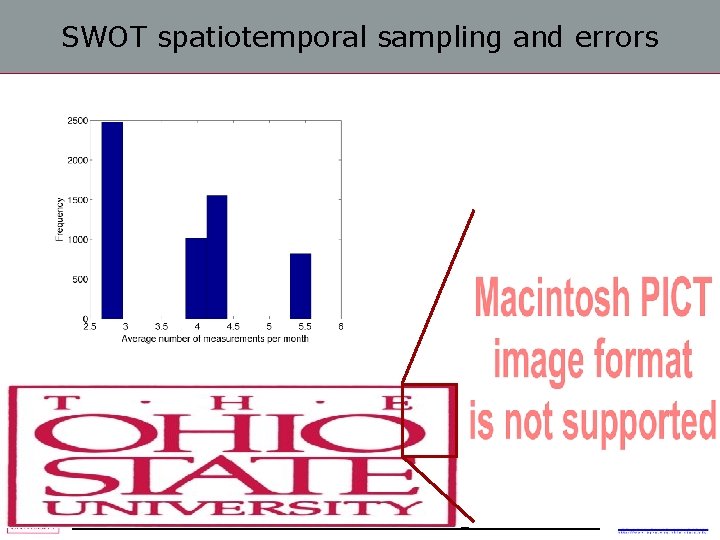
SWOT spatiotemporal sampling and errors
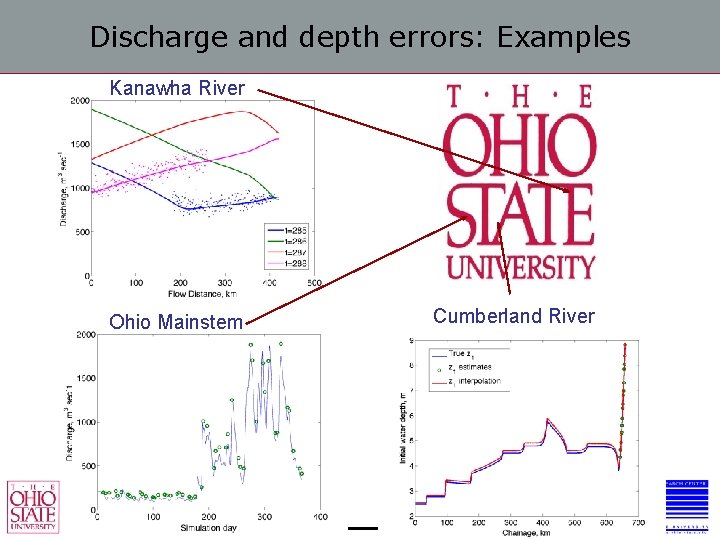
Discharge and depth errors: Examples Kanawha River Ohio Mainstem Cumberland River
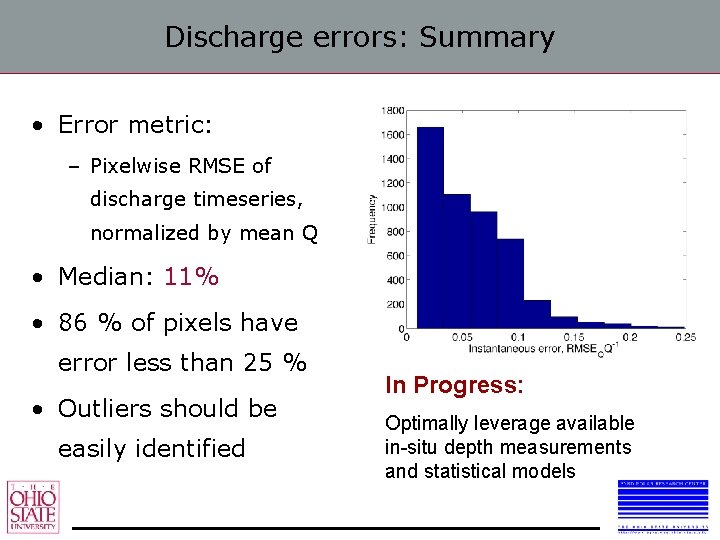
Discharge errors: Summary • Error metric: – Pixelwise RMSE of discharge timeseries, normalized by mean Q • Median: 11% • 86 % of pixels have error less than 25 % • Outliers should be easily identified In Progress: Optimally leverage available in-situ depth measurements and statistical models
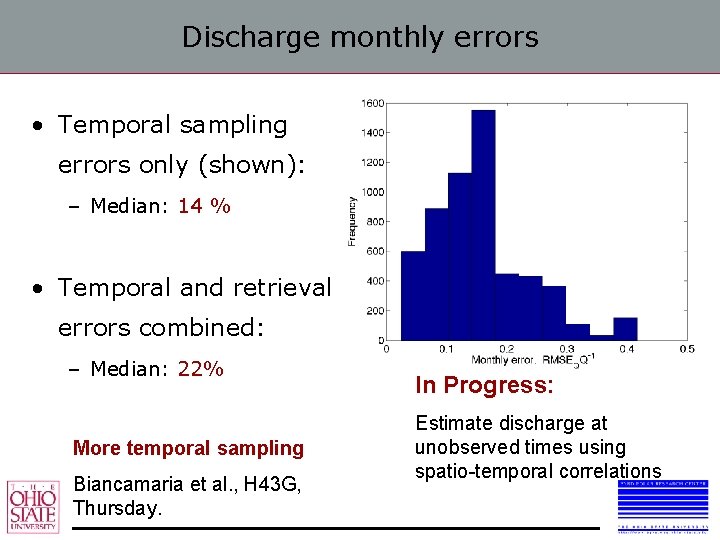
Discharge monthly errors • Temporal sampling errors only (shown): – Median: 14 % • Temporal and retrieval errors combined: – Median: 22% More temporal sampling Biancamaria et al. , H 43 G, Thursday. In Progress: Estimate discharge at unobserved times using spatio-temporal correlations
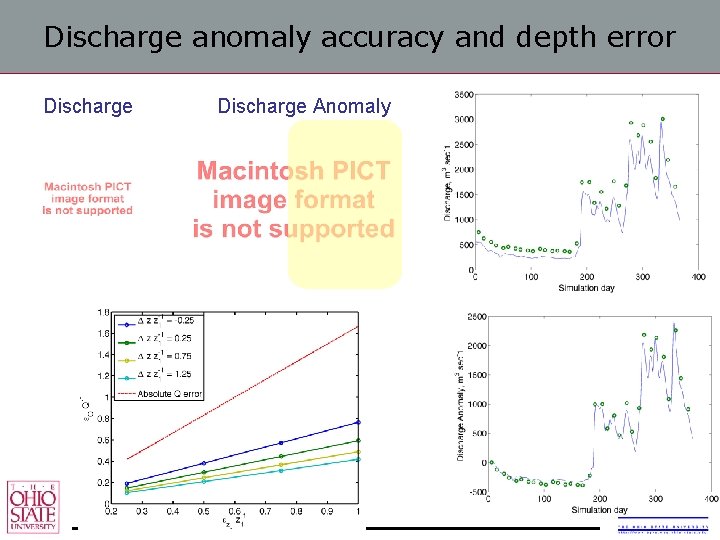
Discharge anomaly accuracy and depth error Discharge Anomaly
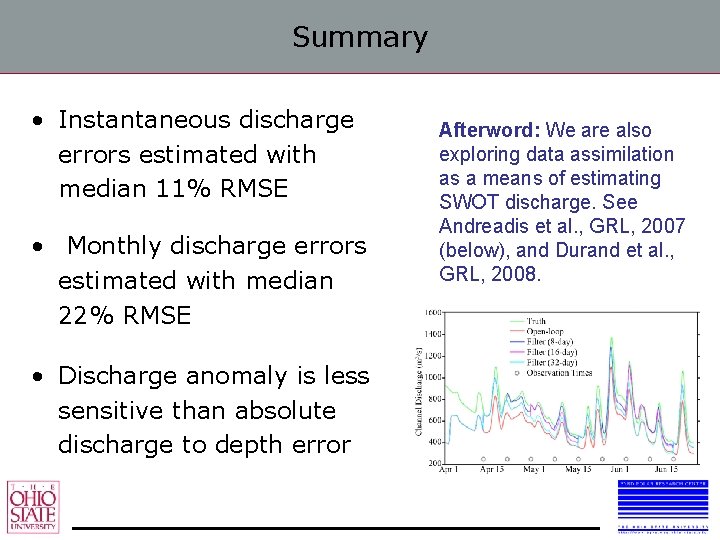
Summary • Instantaneous discharge errors estimated with median 11% RMSE • Monthly discharge errors estimated with median 22% RMSE • Discharge anomaly is less sensitive than absolute discharge to depth error Afterword: We are also exploring data assimilation as a means of estimating SWOT discharge. See Andreadis et al. , GRL, 2007 (below), and Durand et al. , GRL, 2008.

Thanks and Acknowledgments • Funding from OSU’s Climate Water Carbon program • Funding from NASA’s Physical Oceanography and Terrestrial Hydrology programs • Paul Bates at University of Bristol - use of LISFLOOD model
- Slides: 12