
How Aboriginal Art Centres can change communities Assoc
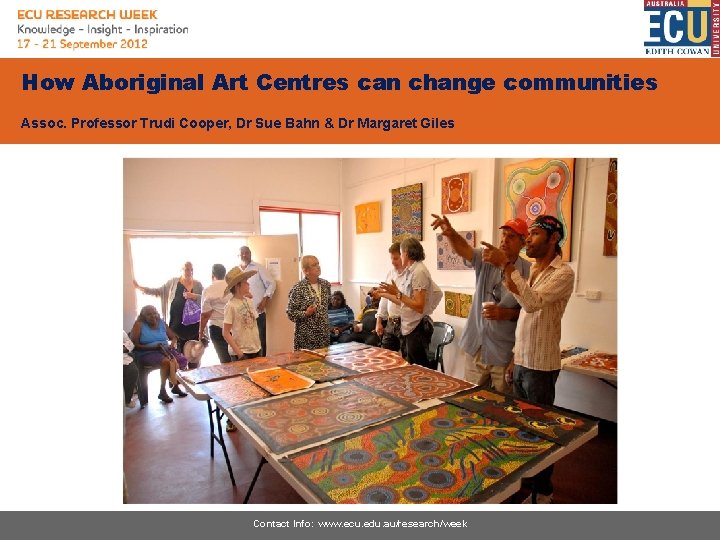
How Aboriginal Art Centres can change communities Assoc. Professor Trudi Cooper, Dr Sue Bahn & Dr Margaret Giles Contact Info: www. ecu. edu. au/research/week
Presentation • This presentation provides an snapshot of some of the findings of the Wirnda Barna Aboriginal Art Centre study in Mount Magnet • The purpose of the project was to develop culturally appropriate holistic indicators of the impact of a newly established Aboriginal Art Centre in a remote area of WA Contact Info: www. ecu. edu. au/research/week
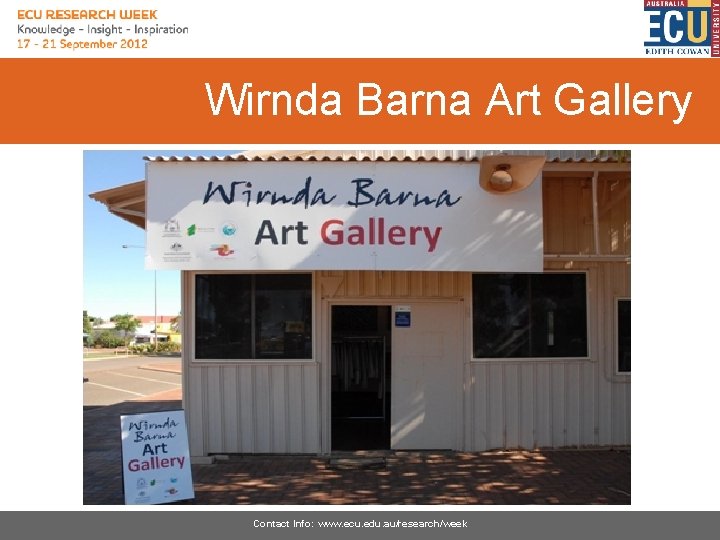
Wirnda Barna Art Gallery Contact Info: www. ecu. edu. au/research/week
Background • Wirnda Barna Art Centre is located in Mount Magnet, 550 kilometres north of Perth on the Great Northern Highway • The Centre serves six communities: Mount Magnet, Cue (55 K north), Meekatharra (200 k north), Sandstone (55 k E) and Yalgoo (60 K W) and Yulga Jinna (330 km N) • The Art Centre was official opened on 30 th September 2010. • The project was completed in February 2012 Contact Info: www. ecu. edu. au/research/week
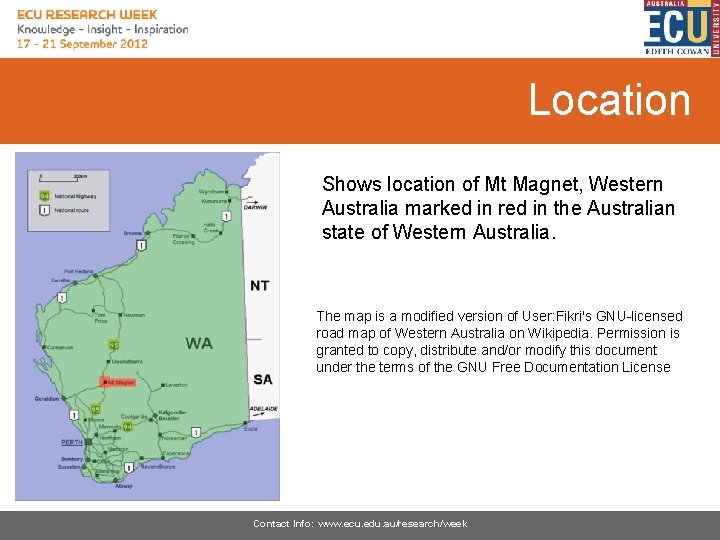
Location Shows location of Mt Magnet, Western Australia marked in red in the Australian state of Western Australia. The map is a modified version of User: Fikri's GNU-licensed road map of Western Australia on Wikipedia. Permission is granted to copy, distribute and/or modify this document under the terms of the GNU Free Documentation License Contact Info: www. ecu. edu. au/research/week
Funding • Wirnda Barna was established with financial support from many agencies including DIA, DCA, MWDC, Mt Magnet Shire Council, the Australia Council, Commonwealth Office of the Arts, and others, in response to a request from artists from six communities, following a feasibility study. • This research was funded through an ECU Collaborative grant with the Department of Indigenous Affairs Contact Info: www. ecu. edu. au/research/week
What we wanted to find out • What contribution does an Aboriginal Art Centre make to rural economic, cultural and community development? • How can it be measured? • What are the limitations of existing measurement and how it be improved? Contact Info: www. ecu. edu. au/research/week
Research design • Theoretical frameworks (Multi-lens): – economic development (Altman; Kenyon & Black) – social capital community development and well-being (Pope; Eckersley) – arts development (Brown) – socio-cultural (La. Flamme; Morphy; Altman) – identity (Garfinkel) • Case study Methodology • Methods: – Qualitative in-depth interview – Cost effectiveness analysis – Social data Contact Info: www. ecu. edu. au/research/week
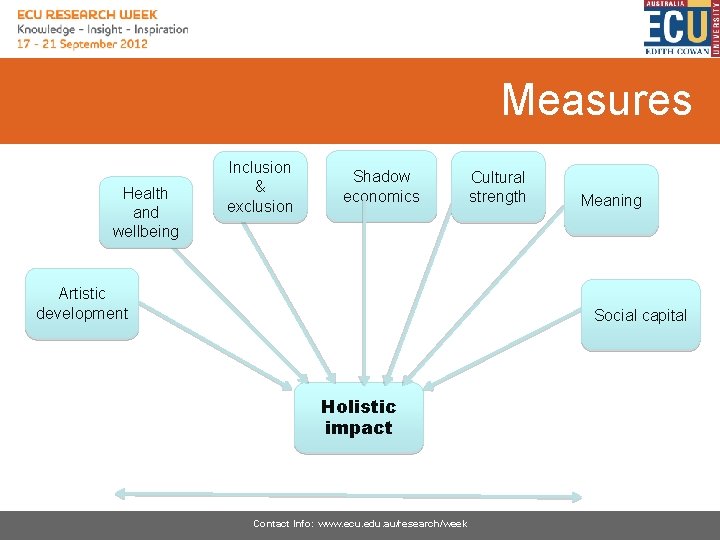
Measures Health and wellbeing Inclusion & exclusion Shadow economics Artistic development Cultural strength Meaning Social capital Holistic impact Contact Info: www. ecu. edu. au/research/week
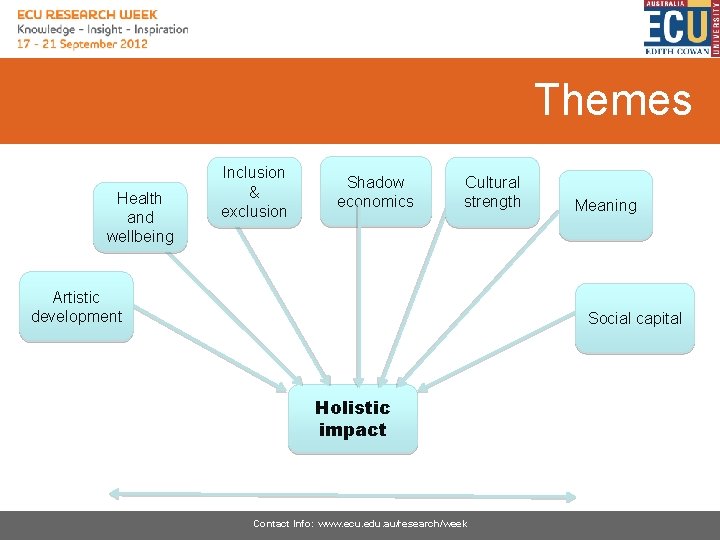
Themes Health and wellbeing Inclusion & exclusion Shadow economics Cultural strength Artistic development Meaning Social capital Holistic impact Contact Info: www. ecu. edu. au/research/week
Some conclusions • Aboriginal Art Centre enabled many positive personal, social, cultural and community changes • Some changes were immediate, especially health, well-being and community cohesion, and cultural pride • Important non-economic, non-artistic changes included: – Community reconciliation and reduced community tension, – Mental and physical health, therapeutic and social hub – Self-efficacy and governance skills – Meaningful occupation, hope for the future, cultural preservation, – Point of contact between Aboriginal people and service providers Contact Info: www. ecu. edu. au/research/week
Some conclusions • Funding sources did not align well with community health and welfare benefits or with the likely time-scale to complete selfsufficiency • Economic sustainability is a long-term goal, and may take 1520 years, but all funding was short-term • Funding through multiple short-term sources with different reporting requirements is inefficient • Art Centre Manager role is very important, difficult to recruit and requires very diverse skill-set and high personal resilience –needs more support Contact Info: www. ecu. edu. au/research/week
Policy implications • Aboriginal Art Centre provided a cost effective means to achieve many government policy initiatives, including Closing the Gap • Reconciliation and cultural recognition are essential to success of Closing the Gap • Hope for the future is necessary to address cycles of intergenerational disadvantage and despair, for positive mental health and to reduce substance abuse • Meaningful contribution is necessary for self-respect, health, personal and community well-being, and inter-generational change Contact Info: www. ecu. edu. au/research/week
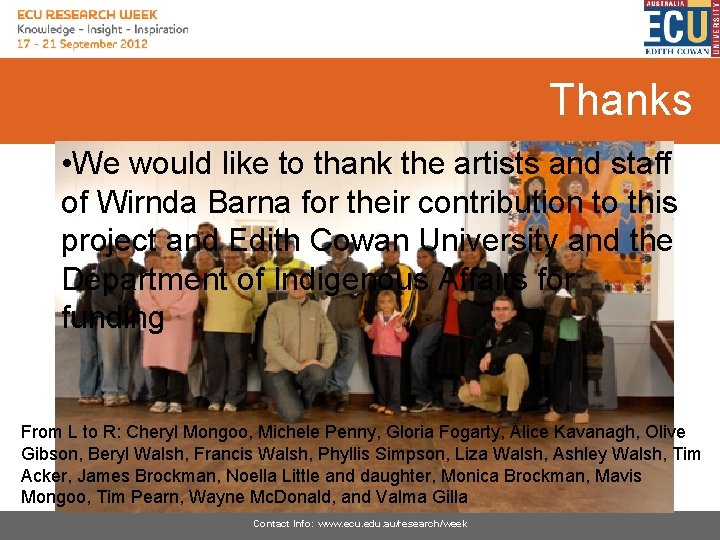
Thanks • We would like to thank the artists and staff of Wirnda Barna for their contribution to this project and Edith Cowan University and the Department of Indigenous Affairs for funding From L to R: Cheryl Mongoo, Michele Penny, Gloria Fogarty, Alice Kavanagh, Olive Gibson, Beryl Walsh, Francis Walsh, Phyllis Simpson, Liza Walsh, Ashley Walsh, Tim Acker, James Brockman, Noella Little and daughter, Monica Brockman, Mavis Mongoo, Tim Pearn, Wayne Mc. Donald, and Valma Gilla Contact Info: www. ecu. edu. au/research/week
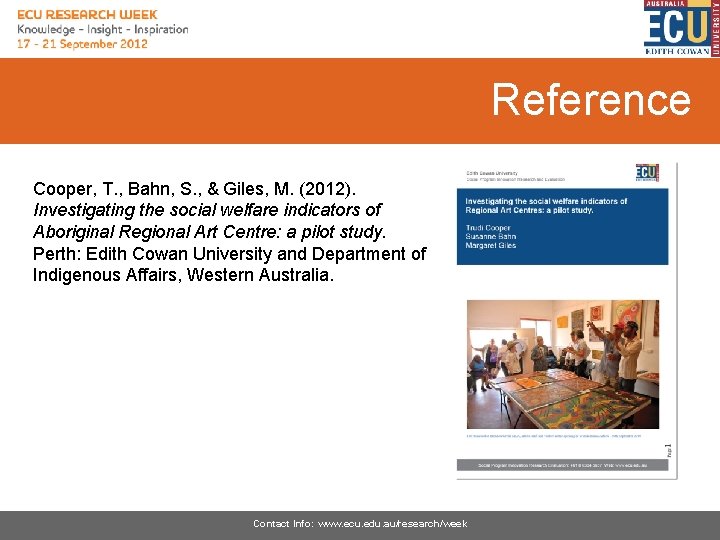
Reference Cooper, T. , Bahn, S. , & Giles, M. (2012). Investigating the social welfare indicators of Aboriginal Regional Art Centre: a pilot study. Perth: Edith Cowan University and Department of Indigenous Affairs, Western Australia. Contact Info: www. ecu. edu. au/research/week
- Slides: 15