
How a READ Scientific to Paper How to


- Slides: 33
How a READ Scientific to Paper
How to Read a Scientific Paper Why? How? Anatomy
How to Read a Scientific Paper Why? Does your professor just want to ruin your life? Or is there a good reason to read the literature?
How to Read a Scientific Paper From Soup to Nuts How? How to make reading scientific papers as painless as possible.
How to Read a Scientific Paper The Scientific Paper Exposed Anatomy Everything you ever wanted to know… why it’s there and what it’s good for.
Why Read? It’s Current! Textbooks can be years out of date by the time they are published. Journals tell you what is happening… RIGHT NOW!
Why Read? It’s Current! It Can Be Replicated! Popular articles and books give you general information and results. Scholarly journals give you enough information that you could do the experiment yourself. You can verify the research to see if you get the same results.
Why Read? It’s Current! It Can Be Replicated! It Has Actual Data! If you need to know exact results or properties for your own research… Articles include actual data, uncertainties, conditions of the experiment, and much more.
Why Read? It’s Current! It Can Be Replicated! It Has Actual Data! You Can Evaluate The Conclusions! Do You Believe It… Or Not? Articles provide the authors’ explanation of their results and conclusions. You can see their assumptions and determine whether you believe them or not.
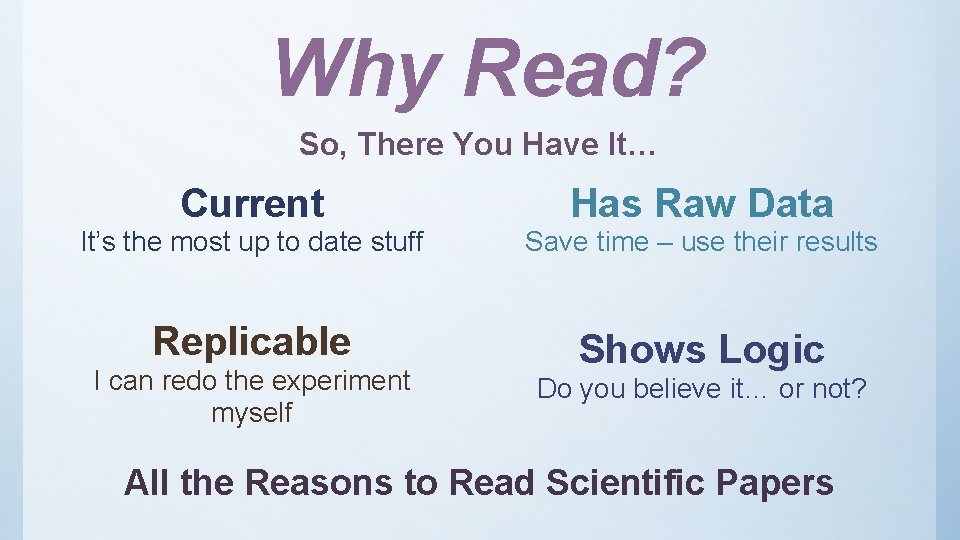
Why Read? So, There You Have It… Current Has Raw Data It’s the most up to date stuff Save time – use their results Replicable Shows Logic I can redo the experiment myself Do you believe it… or not? All the Reasons to Read Scientific Papers
How to Read a Scientific Paper Why? How? Anatomy
How to Read a Scientific Paper From Soup to Nuts How? How to make reading scientific papers as painless as possible.
STO P How To Read… Don’t Read Straight Through! It’s like walking through quicksand!
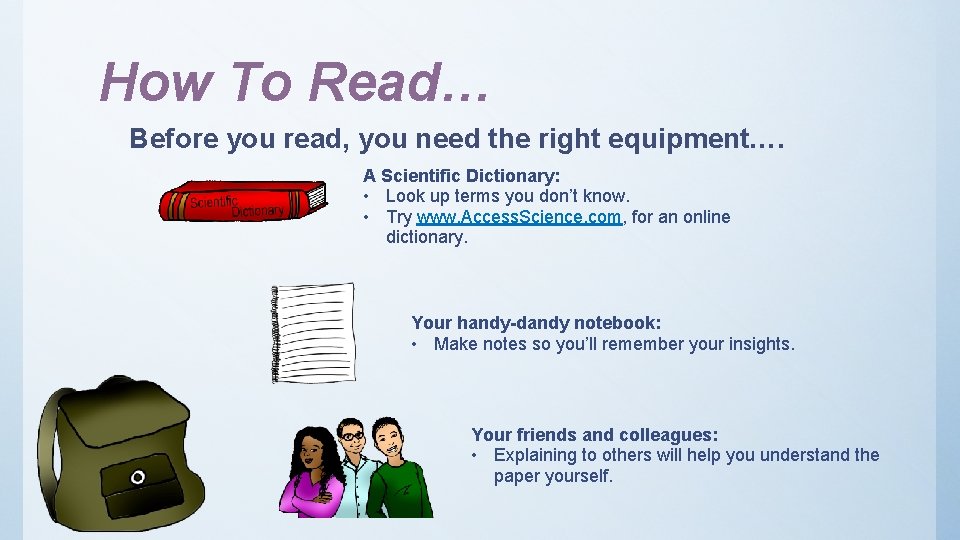
How To Read… Before you read, you need the right equipment…. A Scientific Dictionary: • Look up terms you don’t know. • Try www. Access. Science. com, for an online dictionary. Your handy-dandy notebook: • Make notes so you’ll remember your insights. Your friends and colleagues: • Explaining to others will help you understand the paper yourself.
How To Read… Okay, all packed? Then, let’s go!
How To Read… Okay, let’s start our trip to understanding scientific papers! In this section, we will read sections of a paper in the order that makes for faster, more efficient comprehension than reading the paper straight through.
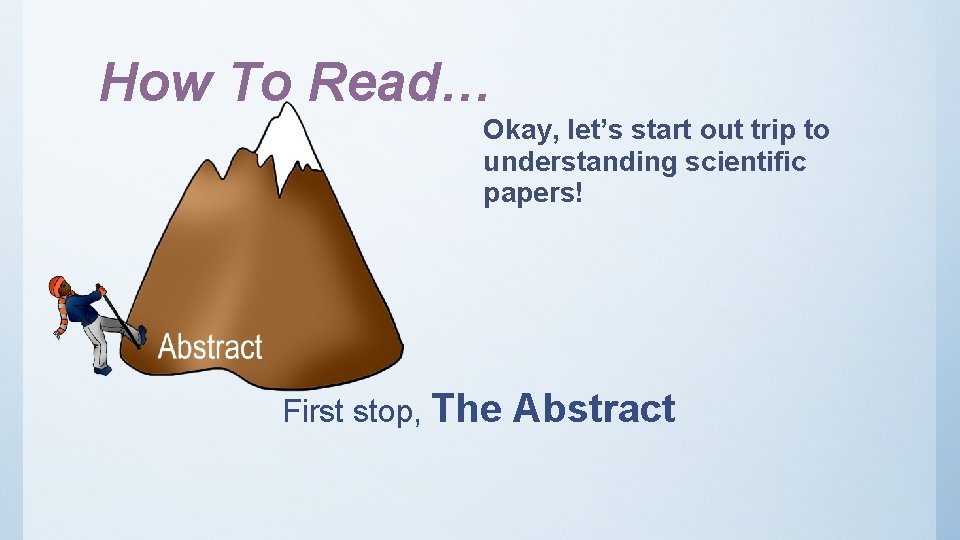
How To Read… Okay, let’s start out trip to understanding scientific papers! First stop, The Abstract
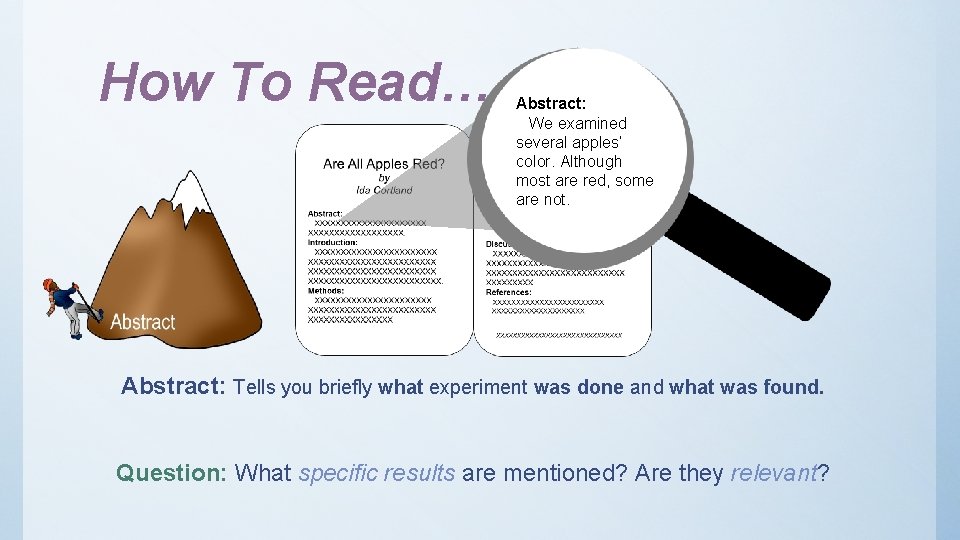
How To Read… Abstract: We examined several apples’ color. Although most are red, some are not. Abstract: Tells you briefly what experiment was done and what was found. Question: What specific results are mentioned? Are they relevant?
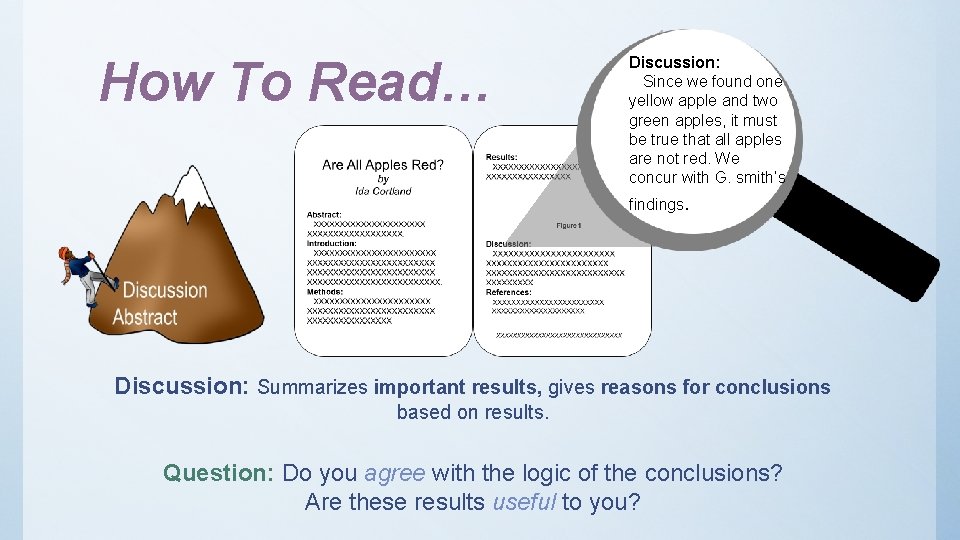
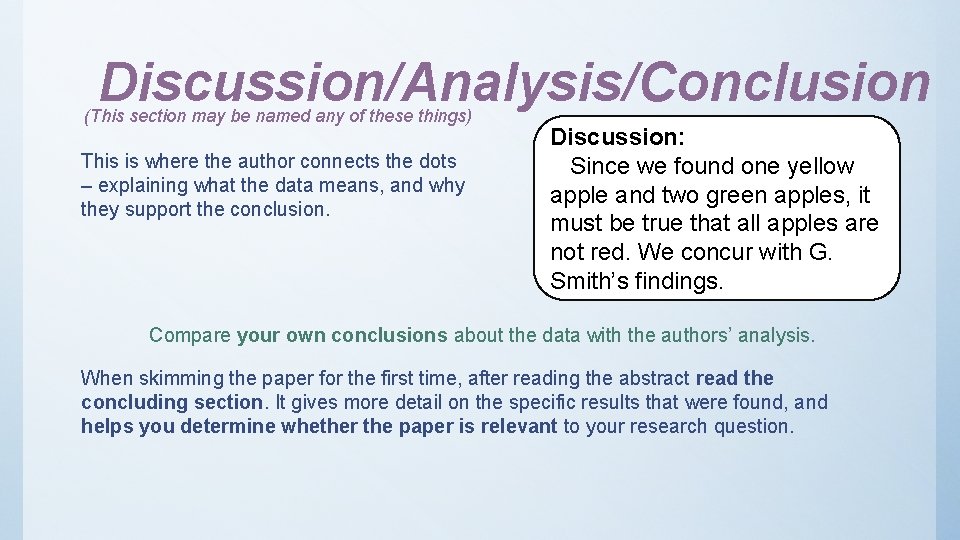
How To Read… Discussion: Since we found one yellow apple and two green apples, it must be true that all apples are not red. We concur with G. smith’s findings. Discussion: Summarizes important results, gives reasons for conclusions based on results. Question: Do you agree with the logic of the conclusions? Are these results useful to you?
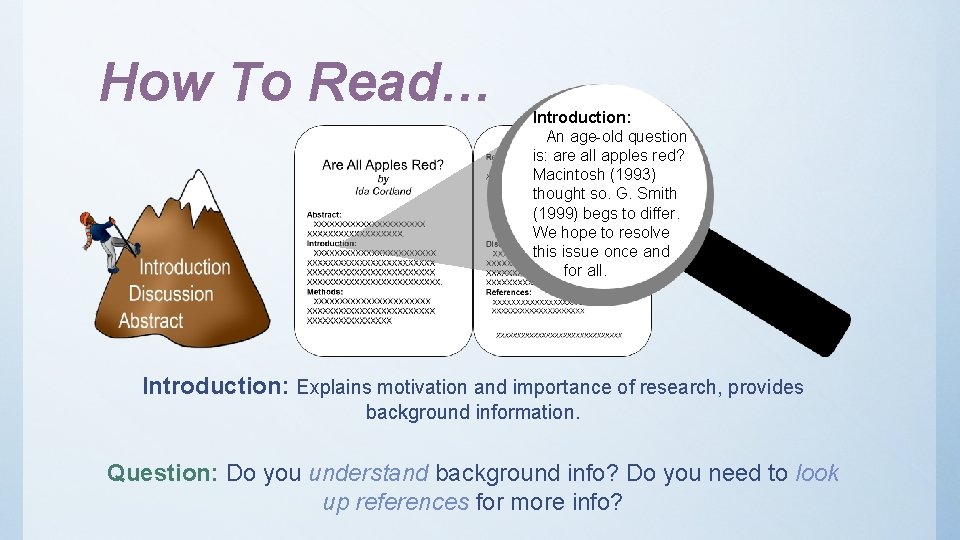
How To Read… Introduction: An age-old question is: are all apples red? Macintosh (1993) thought so. G. Smith (1999) begs to differ. We hope to resolve this issue once and for all. Introduction: Explains motivation and importance of research, provides background information. Question: Do you understand background info? Do you need to look up references for more info?
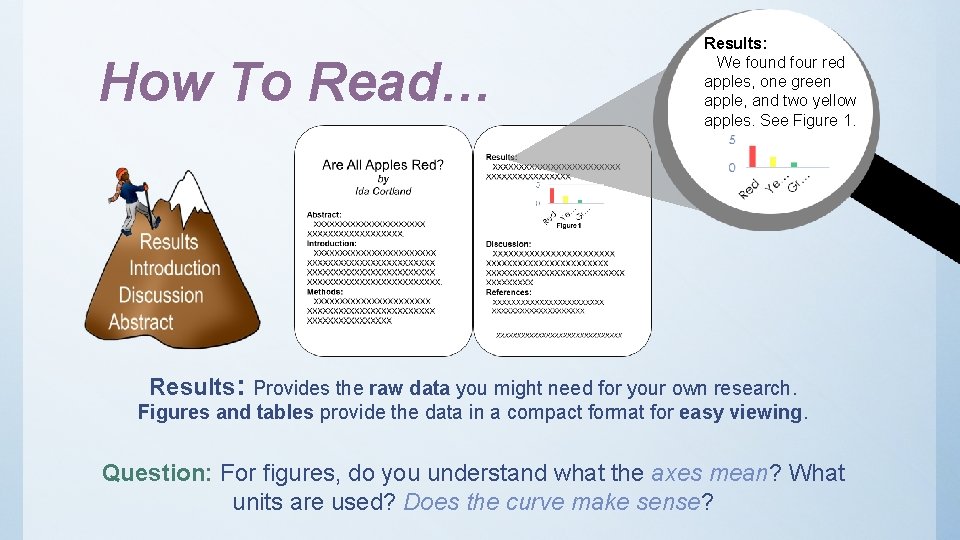
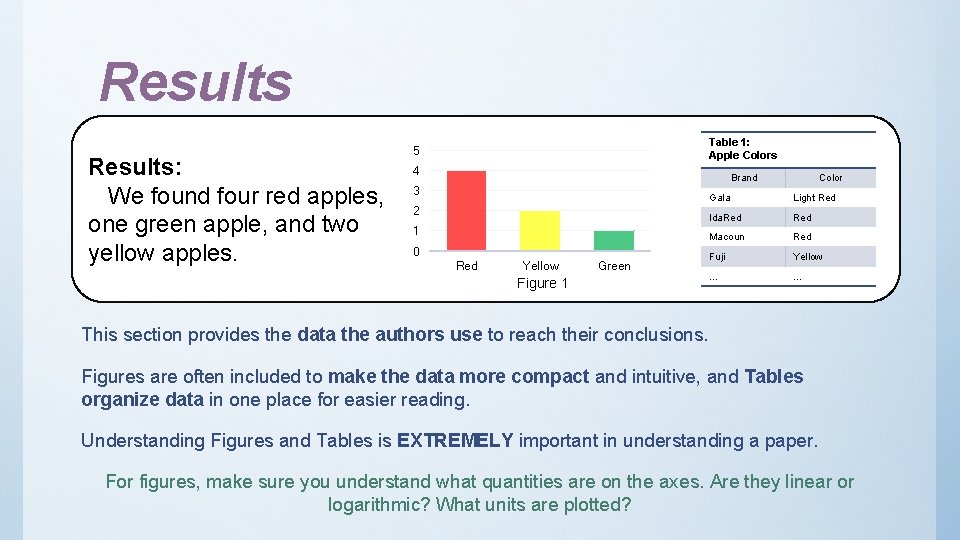
How To Read… Results: We found four red apples, one green apple, and two yellow apples. See Figure 1. Results: Provides the raw data you might need for your own research. Figures and tables provide the data in a compact format for easy viewing. Question: For figures, do you understand what the axes mean? What units are used? Does the curve make sense?
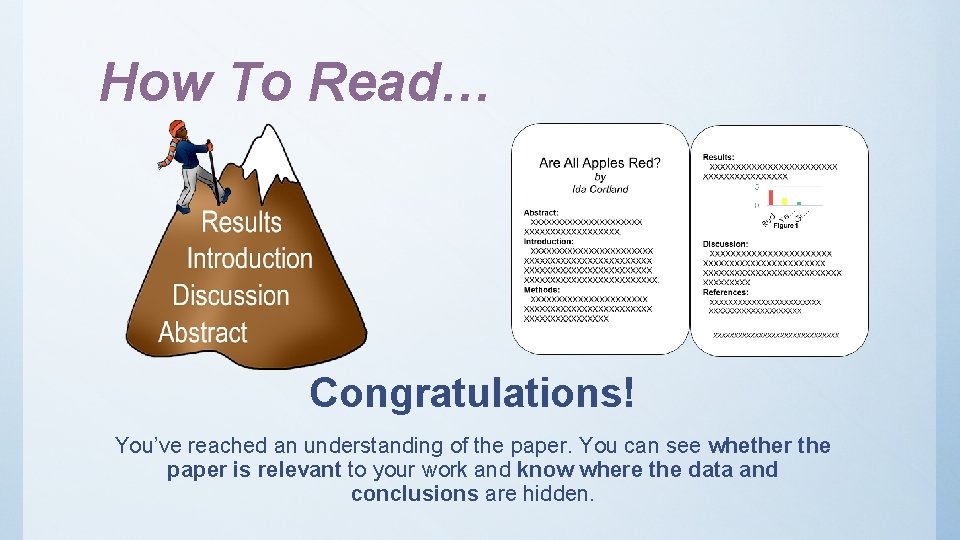
How To Read… Congratulations! You’ve reached an understanding of the paper. You can see whether the paper is relevant to your work and know where the data and conclusions are hidden.
How to Read a Scientific Paper Why? How? Anatomy
How to Read a Scientific Paper The Scientific Paper Exposed Anatomy Everything you ever wanted to know… why it’s there and what it’s good for.
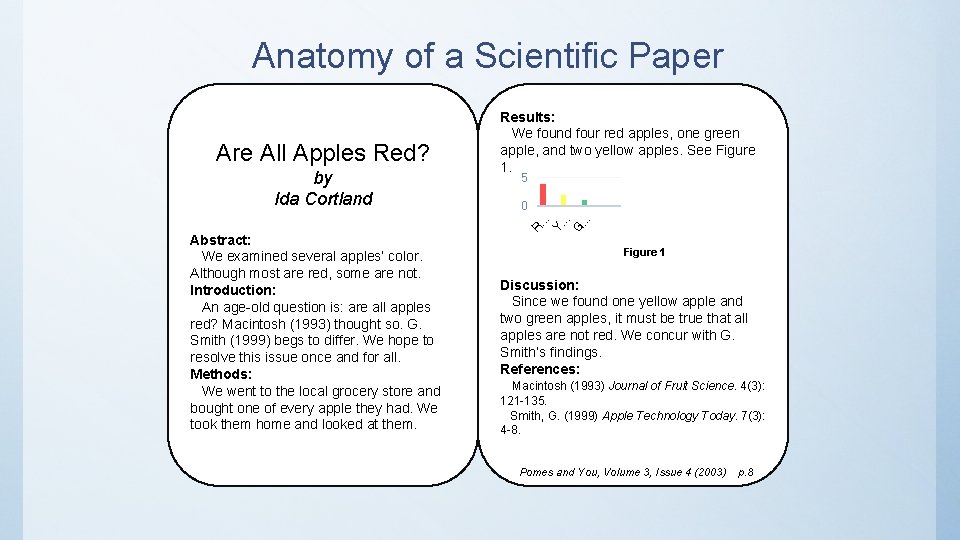
Anatomy of a Scientific Paper 5 0 Y. Abstract: We examined several apples’ color. Although most are red, some are not. Introduction: An age-old question is: are all apples red? Macintosh (1993) thought so. G. Smith (1999) begs to differ. We hope to resolve this issue once and for all. Methods: We went to the local grocery store and bought one of every apple they had. We took them home and looked at them. R . . . by Ida Cortland . . G. . . Are All Apples Red? Results: We found four red apples, one green apple, and two yellow apples. See Figure 1 Discussion: Since we found one yellow apple and two green apples, it must be true that all apples are not red. We concur with G. Smith’s findings. References: Macintosh (1993) Journal of Fruit Science. 4(3): 121 -135. Smith, G. (1999) Apple Technology Today. 7(3): 4 -8. Pomes and You, Volume 3, Issue 4 (2003) p. 8
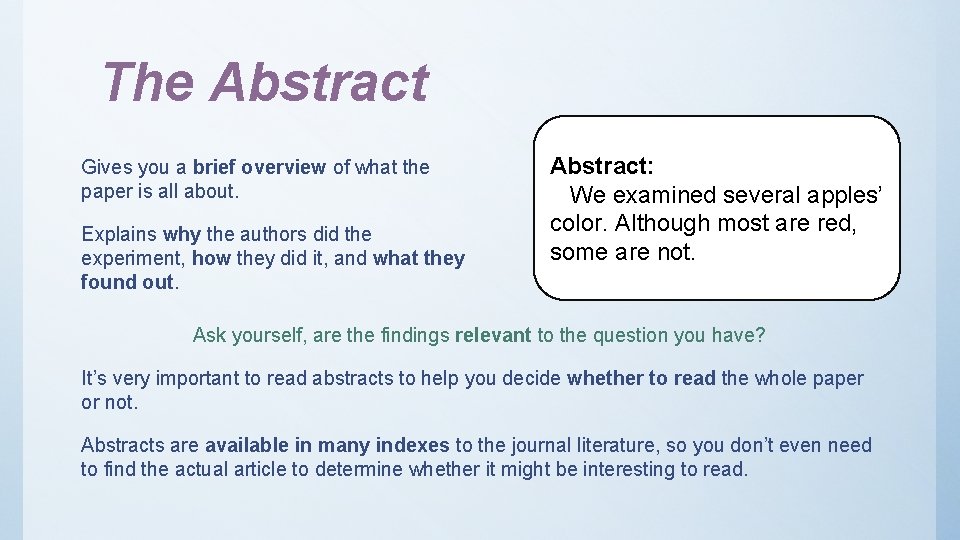
The Abstract Gives you a brief overview of what the paper is all about. Explains why the authors did the experiment, how they did it, and what they found out. Abstract: We examined several apples’ color. Although most are red, some are not. Ask yourself, are the findings relevant to the question you have? It’s very important to read abstracts to help you decide whether to read the whole paper or not. Abstracts are available in many indexes to the journal literature, so you don’t even need to find the actual article to determine whether it might be interesting to read.
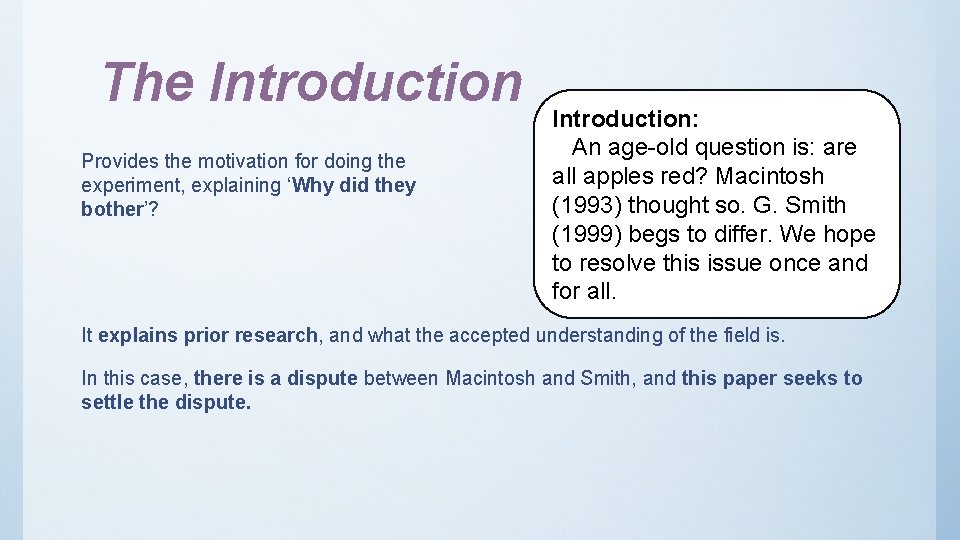
The Introduction Provides the motivation for doing the experiment, explaining ‘Why did they bother’? Introduction: An age-old question is: are all apples red? Macintosh (1993) thought so. G. Smith (1999) begs to differ. We hope to resolve this issue once and for all. It explains prior research, and what the accepted understanding of the field is. In this case, there is a dispute between Macintosh and Smith, and this paper seeks to settle the dispute.
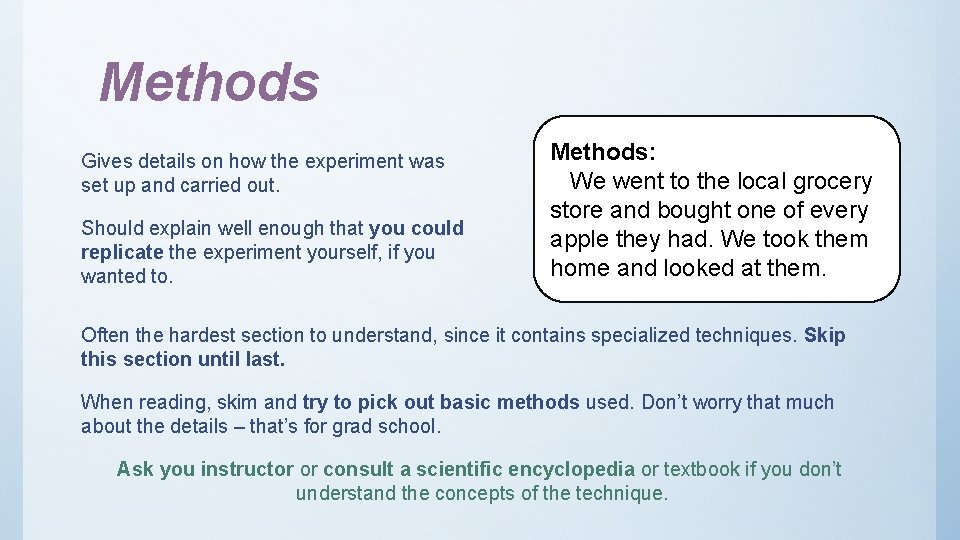
Methods Gives details on how the experiment was set up and carried out. Should explain well enough that you could replicate the experiment yourself, if you wanted to. Methods: We went to the local grocery store and bought one of every apple they had. We took them home and looked at them. Often the hardest section to understand, since it contains specialized techniques. Skip this section until last. When reading, skim and try to pick out basic methods used. Don’t worry that much about the details – that’s for grad school. Ask you instructor or consult a scientific encyclopedia or textbook if you don’t understand the concepts of the technique.
Results: We found four red apples, one green apple, and two yellow apples. Table 1: Apple Colors 5 4 Brand 3 2 1 0 Red Yellow Green Figure 1 Color Gala Light Red Ida. Red Macoun Red Fuji Yellow … … This section provides the data the authors use to reach their conclusions. Figures are often included to make the data more compact and intuitive, and Tables organize data in one place for easier reading. Understanding Figures and Tables is EXTREMELY important in understanding a paper. For figures, make sure you understand what quantities are on the axes. Are they linear or logarithmic? What units are plotted?
Discussion/Analysis/Conclusion (This section may be named any of these things) This is where the author connects the dots – explaining what the data means, and why they support the conclusion. Discussion: Since we found one yellow apple and two green apples, it must be true that all apples are not red. We concur with G. Smith’s findings. Compare your own conclusions about the data with the authors’ analysis. When skimming the paper for the first time, after reading the abstract read the concluding section. It gives more detail on the specific results that were found, and helps you determine whether the paper is relevant to your research question.
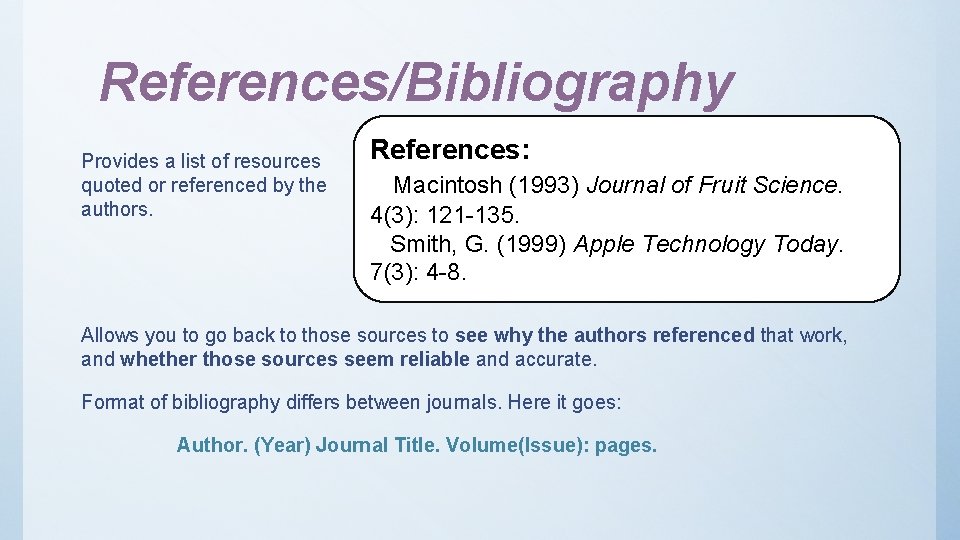
References/Bibliography Provides a list of resources quoted or referenced by the authors. References: Macintosh (1993) Journal of Fruit Science. 4(3): 121 -135. Smith, G. (1999) Apple Technology Today. 7(3): 4 -8. Allows you to go back to those sources to see why the authors referenced that work, and whether those sources seem reliable and accurate. Format of bibliography differs between journals. Here it goes: Author. (Year) Journal Title. Volume(Issue): pages.
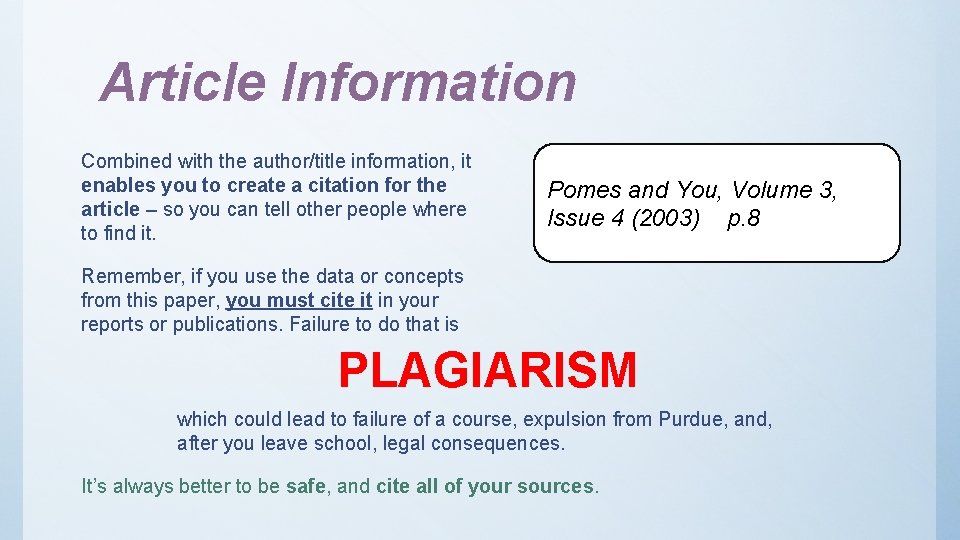
Article Information Combined with the author/title information, it enables you to create a citation for the article – so you can tell other people where to find it. Pomes and You, Volume 3, Issue 4 (2003) p. 8 Remember, if you use the data or concepts from this paper, you must cite it in your reports or publications. Failure to do that is PLAGIARISM which could lead to failure of a course, expulsion from Purdue, and, after you leave school, legal consequences. It’s always better to be safe, and cite all of your sources.