
How a coordinated entry system works and the


- Slides: 32
How a coordinated entry system works and the implementation of a housing first approach to ending homelessness By Cassie Carter, MSSW, CSW HHCK, Housing Program Manager Ameri. Corps PSO 2019
ABOUT ME I grew up in Southern Indiana, 20 minutes North of Louisville Graduated from Asbury University in May 2016 with my BASW Graduated from U of L, Kent School of Social Work with my MSSW in May 2017 Married on May 26, 2018 Living in Lexington, KY with my husband, two pugs, and two cats Housing Stabilization Specialist at HHCK from August 2017 to January 2019 Housing Program Manager at HHCK since January 2019
Three Components HOUSING FIRST COORDINATED ENTRY SYSTEM ANY DOOR KY
History of Ending Homelessness First Come, First Serve Waiting List Lack of evidence based practice Housing Ready Inconsistent Intake/Application Program Centered High barrier
HOUSING READINESS Prior to Housing First, housing providers primarily used a housing ready approach to ending homelessness in which an individual must prove they are “ready” for housing prior to receiving assistance. For example: Someone with a substance use disorder must complete a treatment program and pass “X” amount of drugs tests prior to receiving assistance. Barriers: such as someone’s housing and criminal history prevented them from receiving housing assistance Limitations: ex: attending skills classes (parenting, finances) These cause delays to being housed and prolongs one’s experience of homelessness. They have proven to be ineffective in ending homelessness
Housing First Considers housing to be a basic human right Answers the basic question of “how do we solve homelessness? ” Housing first does NOT mean that housing is the only need, but it must be the first stage of assisting someone with housing stability. A housing first approach still recognizes the need for supportive through progressive engagement. Implements case management once housing is achieved to provide support and connect individuals and families to resources in their community based on their needs. Case management is not a requirement but is highly encouraged. Houses people where they want to be housed
Housing First cont. Practices harm reduction: A model of substance-use intervention that focuses on helping people who use substances to better manage their use and reduce the harmful consequences to themselves and others. Client centered: Housing is available no matter what is going on in someone’s personal life. It if flexible and allows the client to decide where they want to be housed. The client is the expert on their situation, their needs, and the goals they want to achieve.
Housing First: Principles Into Practice
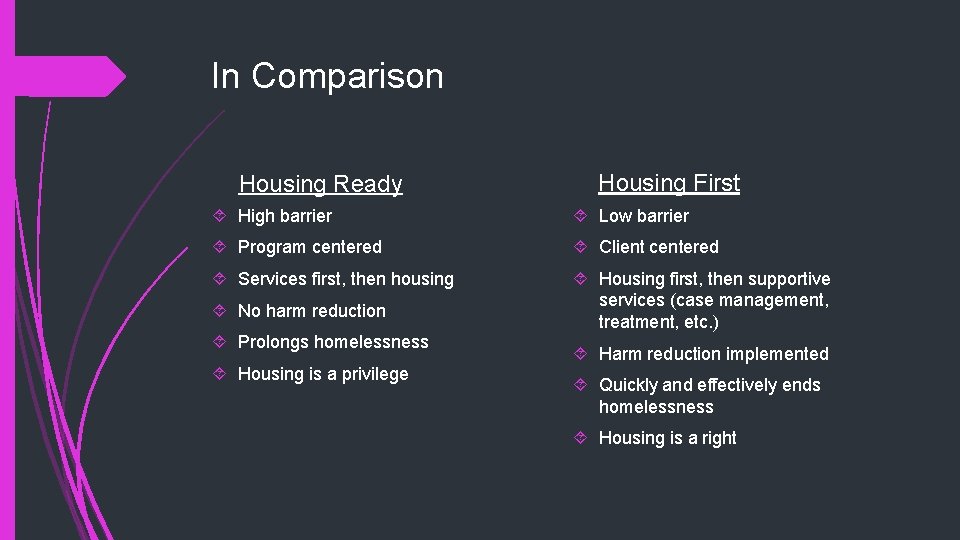
In Comparison Housing Ready Housing First High barrier Low barrier Program centered Client centered Services first, then housing Housing first, then supportive services (case management, treatment, etc. ) No harm reduction Prolongs homelessness Housing is a privilege Harm reduction implemented Quickly and effectively ends homelessness Housing is a right
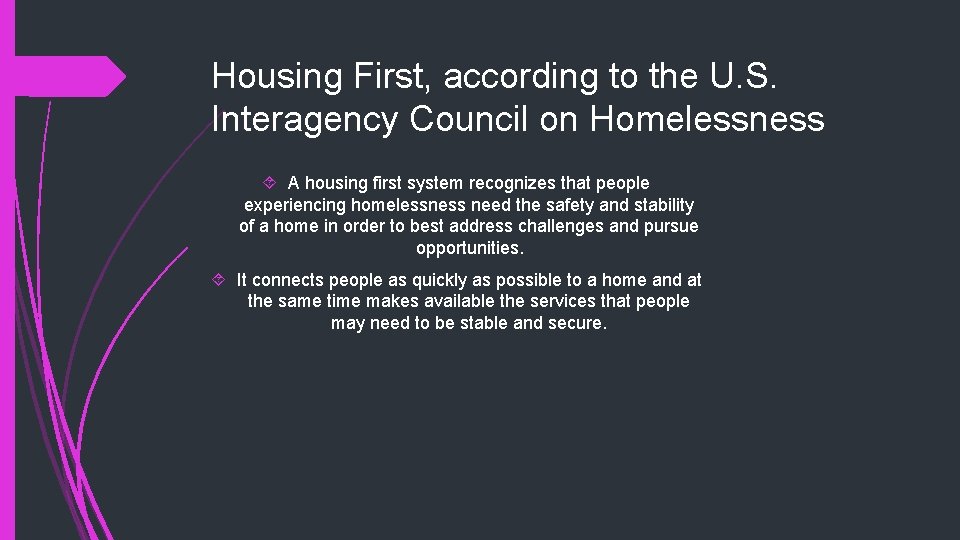
Housing First, according to the U. S. Interagency Council on Homelessness A housing first system recognizes that people experiencing homelessness need the safety and stability of a home in order to best address challenges and pursue opportunities. It connects people as quickly as possible to a home and at the same time makes available the services that people may need to be stable and secure.
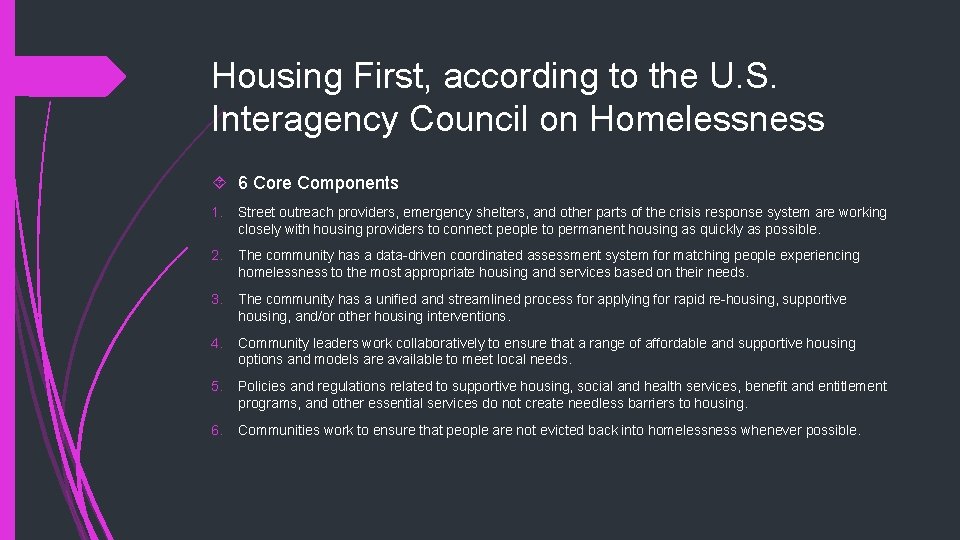
Housing First, according to the U. S. Interagency Council on Homelessness 6 Core Components 1. Street outreach providers, emergency shelters, and other parts of the crisis response system are working closely with housing providers to connect people to permanent housing as quickly as possible. 2. The community has a data-driven coordinated assessment system for matching people experiencing homelessness to the most appropriate housing and services based on their needs. 3. The community has a unified and streamlined process for applying for rapid re-housing, supportive housing, and/or other housing interventions. 4. Community leaders work collaboratively to ensure that a range of affordable and supportive housing options and models are available to meet local needs. 5. Policies and regulations related to supportive housing, social and health services, benefit and entitlement programs, and other essential services do not create needless barriers to housing. 6. Communities work to ensure that people are not evicted back into homelessness whenever possible.
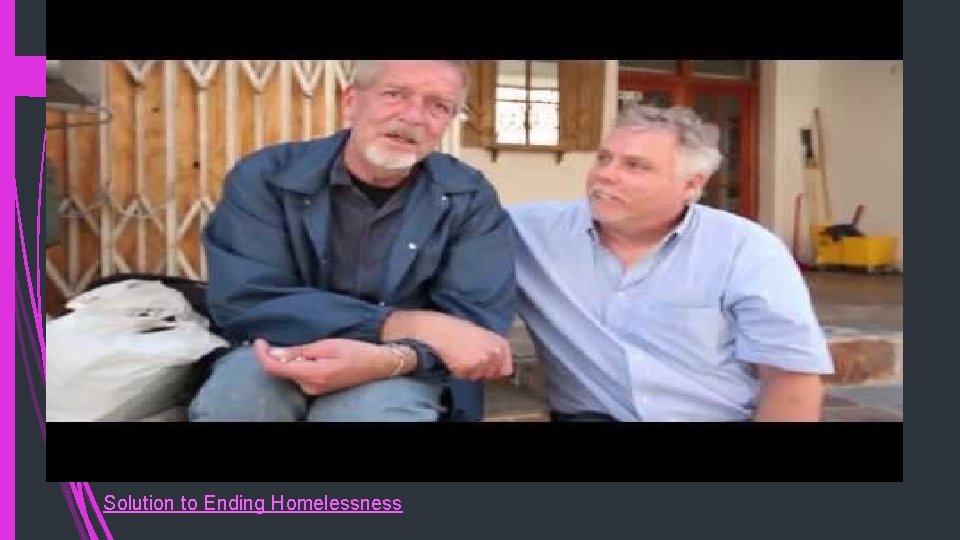
Solution to Ending Homelessness
Coordinated Entry System and the Common Assessment
What is coordinated entry? “A centralized or coordinated process designed to coordinate program participant intake, assessment, and provision of referrals across a geographic area. The system covers the geographic area (designated by the Co. C), is easily accessed by individuals and families seeking housing or services, is well advertised, and includes a comprehensive and standardized assessment tool. ” (24 CFR Section 578. 7). It is the responsibility of each Co. C to implement Coordinated Entry in their geographic area. The goal is to connect individuals and families experiencing homelessness to housing and supportive services as quickly as possible.
A coordinated entry system aims to: Divert those who can solve their own homelessness away from entering the coordinated entry system Move people from homelessness to permanent housing quickly and effectively Create an effective role for emergency shelters and transitional housing Use the correct housing intervention Reduce length of time homeless Increase housing stability End homelessness across communities, not just within individual programs
What’s a Co. C? Continuum of Care (Co. C) is a geographical area designated by each state to receive federal HUD funding Kentucky has three Co. C’s: Balance of State Co. C (118 counties across KY) Lexington Co. C (Fayette county) Louisville Co. C (Jefferson county)
How does the intake/assessment process work? All agencies that receive Emergency Solutions Grant (ESG) or Co. C funding from HUD or the Kentucky Housing Corporation (KHC) is an access point for the Coordinated Entry System. This means that a person experiencing homelessness could go to any of those agencies to complete the common triage tool (VI-SPDAT) The housing provider will then have the individual complete a Kentucky Homeless Management Information System (KYHMIS) Release of Information as consent to administer the VI-SPDAT’s can also be completed over the phone with the use of the verbal KYHMIS ROI
A VI what? ! VI = Vulnerability Index by Community Solutions. It was made popular during the 100, 000 Homes Campaign that began in 2010, ended in 2014, and included 200 communities. Administered as a Survey SPDAT = Service Prioritization Decision Assistance Tool. Developed by Org. Code Consulting, Inc. In depth evaluation tool, takes 1 to 2 hours to complete Must be trained by Org. Code certified trainer to administer
VI-SPDAT The combination of the VI and SPDAT began in 2013 through Org. Code’s collaboration with Community Solutions. They built it upon reviewing existing tools, interviews with direct service providers, an academic panel, and hundreds of published journal articles, reports, and tools. Developed to quickly determine if an individual or family has high, moderate, or low acuity Training can be completed online
VI-SPDAT Vulnerability Index – Service Prioritization Decision Assistance Tool An evidence based triage tool utilized by all housing providers in the Balance of State Co. C to determine acuity for the purpose of housing triage, prioritization, and housing placement. Three types Single adult VI-SPDAT Family VI-SPDAT Youth TAY-VI-SPDAT (for individuals 24 and under) Identifies a housing intervention recommendation based off an individual or families specific needs
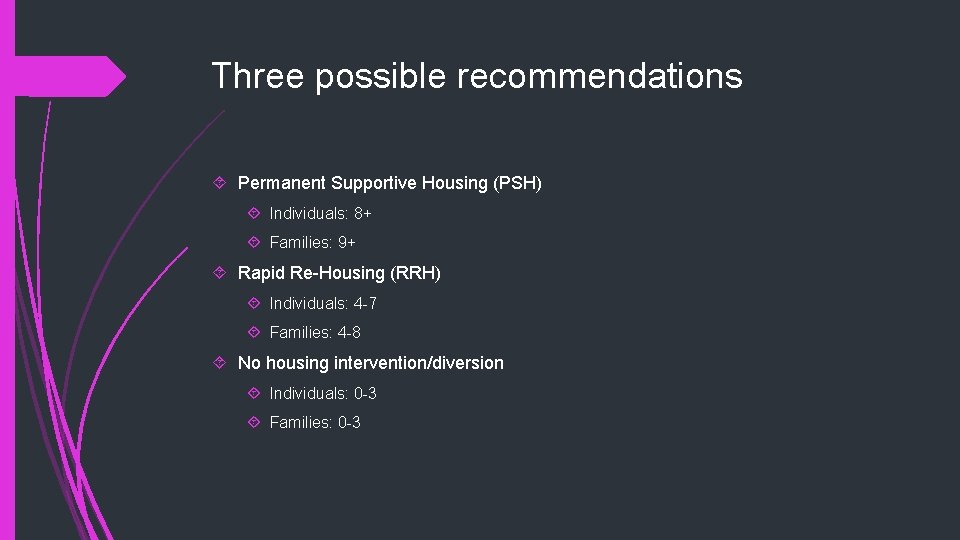
Three possible recommendations Permanent Supportive Housing (PSH) Individuals: 8+ Families: 9+ Rapid Re-Housing (RRH) Individuals: 4 -7 Families: 4 -8 No housing intervention/diversion Individuals: 0 -3 Families: 0 -3
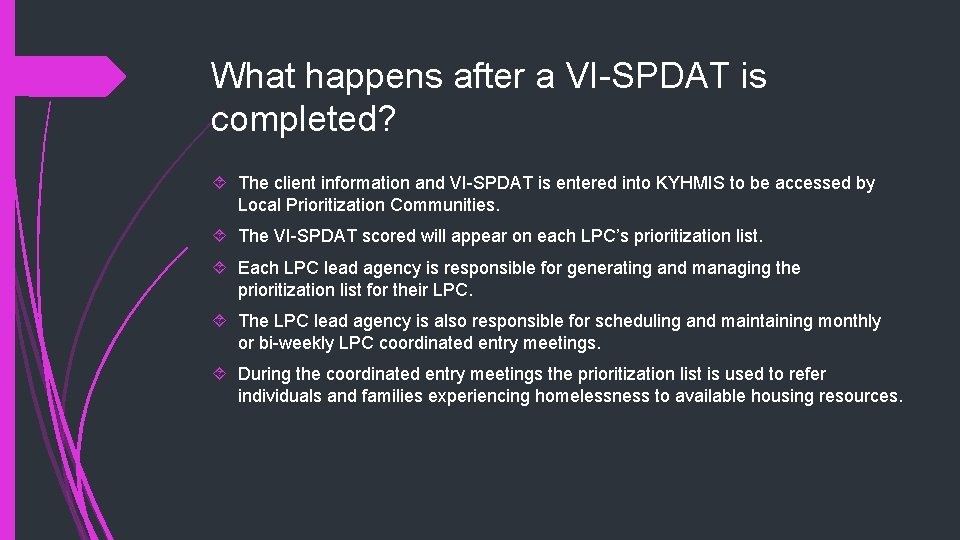
What happens after a VI-SPDAT is completed? The client information and VI-SPDAT is entered into KYHMIS to be accessed by Local Prioritization Communities. The VI-SPDAT scored will appear on each LPC’s prioritization list. Each LPC lead agency is responsible for generating and managing the prioritization list for their LPC. The LPC lead agency is also responsible for scheduling and maintaining monthly or bi-weekly LPC coordinated entry meetings. During the coordinated entry meetings the prioritization list is used to refer individuals and families experiencing homelessness to available housing resources.
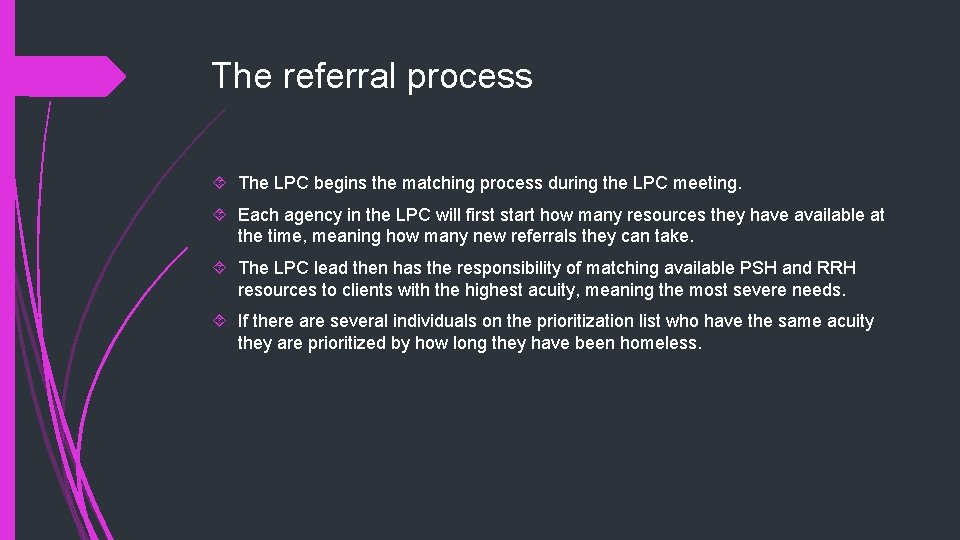
The referral process The LPC begins the matching process during the LPC meeting. Each agency in the LPC will first start how many resources they have available at the time, meaning how many new referrals they can take. The LPC lead then has the responsibility of matching available PSH and RRH resources to clients with the highest acuity, meaning the most severe needs. If there are several individuals on the prioritization list who have the same acuity they are prioritized by how long they have been homeless.
Prioritization The matching/referral process is also known as prioritization. Prioritization takes the place of “waiting list” and serves those with most severe needs first The process is similar to how an emergency room opertates
After referral Once a referral has been made for an individual or family, the goal is to get them into permanent housing as quickly and effectively as possible The agency that completed the initial VI-SPDAT is responsible for completing documentation and paperwork required by the housing provider. Once all paperwork has been completed, the referring agency will send it all to the housing provider. The housing provider takes over from there and works with the client to identify an available unit and get them leased up.
After Referral LPC’s focus on housing navigation and matching households to the best available intervention Participating agencies accepts all eligible referrals unless the Co. C has a documented protocol for rejecting referrals, however that is a rare occurrence Coordinated entry has written standards for eligibility for all housing interventions The goal is for the process to be operationally defined, include client feedback throughout, stay client-centered and data driven, and evaluate the system regularly
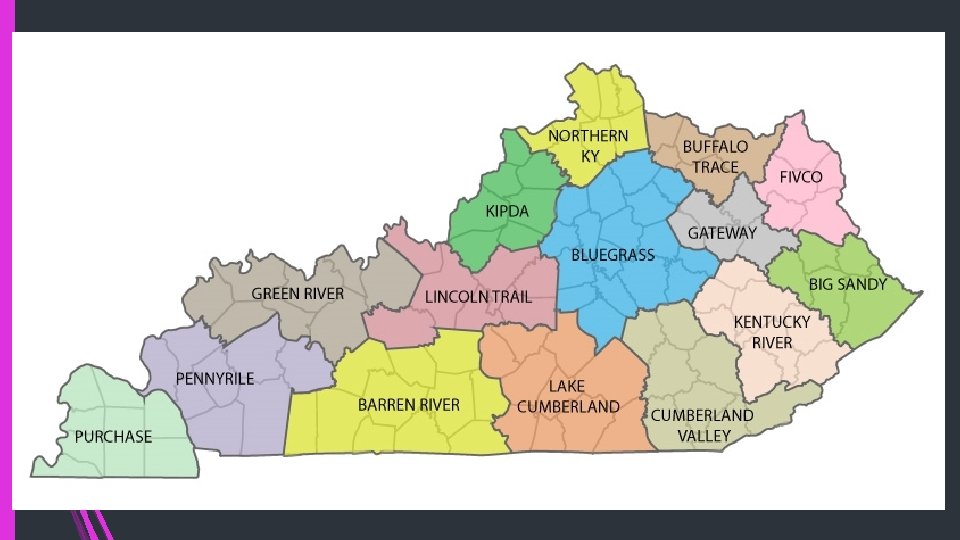
How we operate in the Bluegrass LPC The bluegrass LPC includes the 16 counties surrounding Lexington. Began meeting in July of 2015 and continues to meet bi-weekly HHCK serves as the lead agency for the LPC Bi-weekly meetings happen in person and via webinar and we continue to communicate between meetings via Base. Camp listserv The CE Policies and Procedures for the Bo. S are updated regularly by the coordinated entry committee Lack of housing resources and gaps are identified Ongoing need for more program flexibility and shifting to low-barrier and HF model.
http: //www. cc. com/video-clips/lntv 3 q/the-daily-show-withjon-stewart-the-homeless-homed
Additional helpful videos https: //www. youtube. com/watch? v=Dal 6 Ru. Jc 2 t 4 https: //www. youtube. com/watch? v=Hs. FHV-Mcd. Po https: //vimeo. com/64412408 https: //www. youtube. com/watch? v=4 u. Ck. QS_DPME https: //www. youtube. com/watch? v=Fy. IVEll. Fjn. U
Thanks for listening! Contact Information: Resources: Cassie Carter www. orgcode. com Housing Program Manager National Alliance to End Homelessness: www. endhomelessness. org ccarter@hhck. org 502 -223 -1834 x 106 U. S. Interagency Council on Homelessness: www. usich. gov www. hudexchange. info KHC helpdesk: https: //kyhmis. zendesk. com/hc/en-us