
How A Bill Becomes A Law REVIEW ACTIVITIES

How A Bill Becomes A Law REVIEW & ACTIVITIES

Bicameral Brainstorm REVIEW OF LEGISLATIVE BRANCH
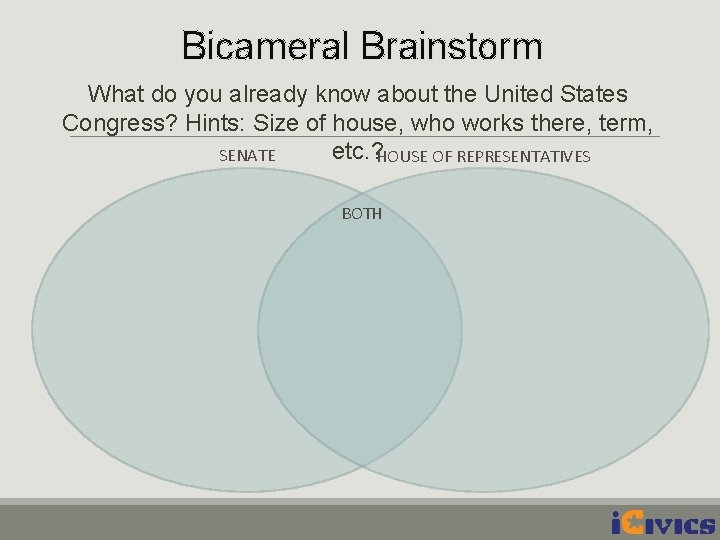
Bicameral Brainstorm What do you already know about the United States Congress? Hints: Size of house, who works there, term, etc. ? HOUSE OF REPRESENTATIVES SENATE BOTH

Legislating legislators in the legislature… REVIEW OF HOW A BILL BECOMES A LAW
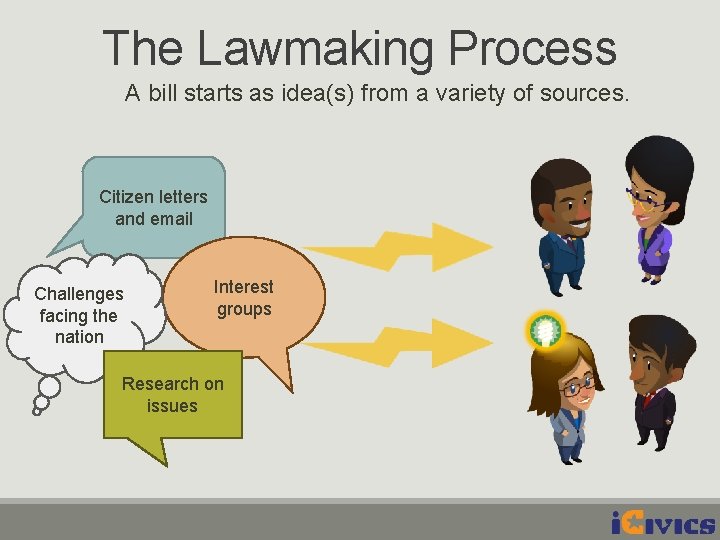
The Lawmaking Process A bill starts as idea(s) from a variety of sources. Citizen letters and email Challenges facing the nation Interest groups Research on issues
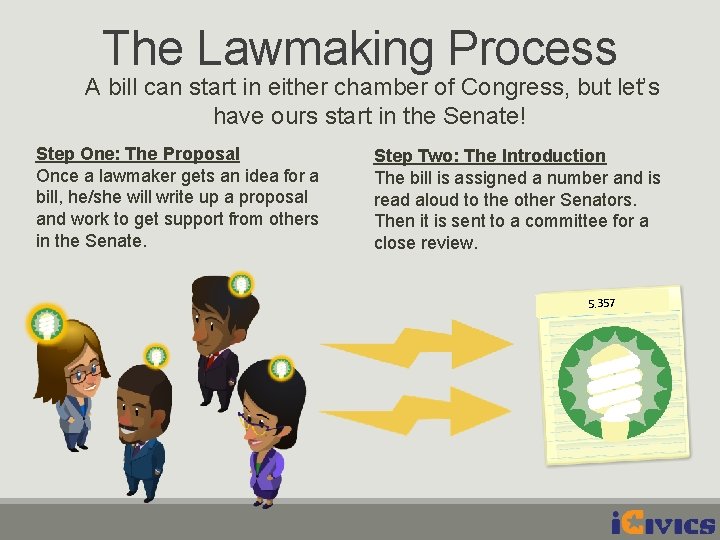
The Lawmaking Process A bill can start in either chamber of Congress, but let’s have ours start in the Senate! Step One: The Proposal Once a lawmaker gets an idea for a bill, he/she will write up a proposal and work to get support from others in the Senate. Step Two: The Introduction The bill is assigned a number and is read aloud to the other Senators. Then it is sent to a committee for a close review. S. 357

The Lawmaking Process Step Three: The Bill is assigned to a committee within the Senate to discuss & debate. Step Four: The Bill will then go to the whole Senate for discussion, debate & vote. The Report: If the committee likes it, it will be sent to the whole Senate for debate. The Floor Debate: All of the Senators get a chance to read the bill and debate whether it should be supported or opposed. The bill is read again and changes are suggested. The Vote: The whole Senate is called to vote on the bill. They can vote yes, no, or present (if they don’t want to vote on that particular bill). Senate Vote on S. 357 59 39 2 Yeas Nay Present
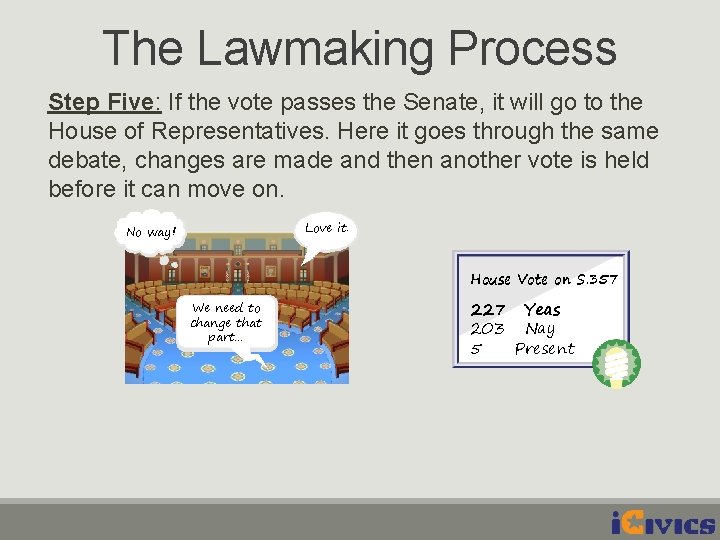
The Lawmaking Process Step Five: If the vote passes the Senate, it will go to the House of Representatives. Here it goes through the same debate, changes are made and then another vote is held before it can move on. Love it. No way! House Vote on S. 357 We need to change that part… 227 Yeas 203 Nay 5 Present
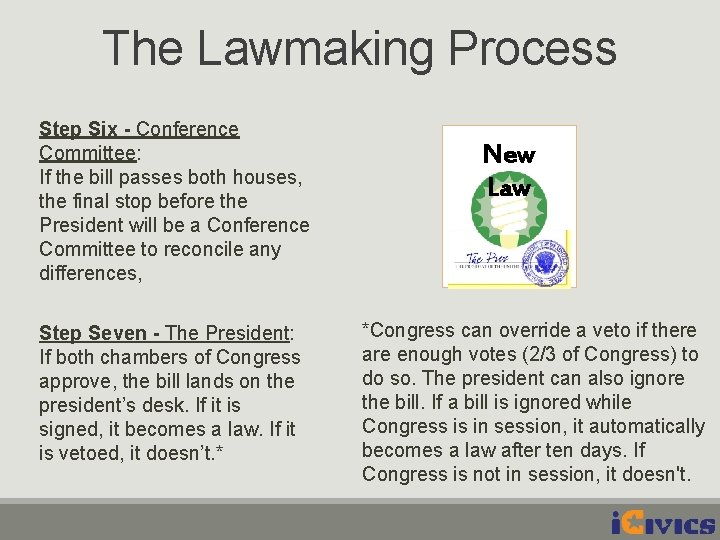
The Lawmaking Process Step Six - Conference Committee: If the bill passes both houses, the final stop before the President will be a Conference Committee to reconcile any differences, Step Seven - The President: If both chambers of Congress approve, the bill lands on the president’s desk. If it is signed, it becomes a law. If it is vetoed, it doesn’t. * New Law *Congress can override a veto if there are enough votes (2/3 of Congress) to do so. The president can also ignore the bill. If a bill is ignored while Congress is in session, it automatically becomes a law after ten days. If Congress is not in session, it doesn't.

A Tale of Two Bills CREATING YOUR OWN BILL
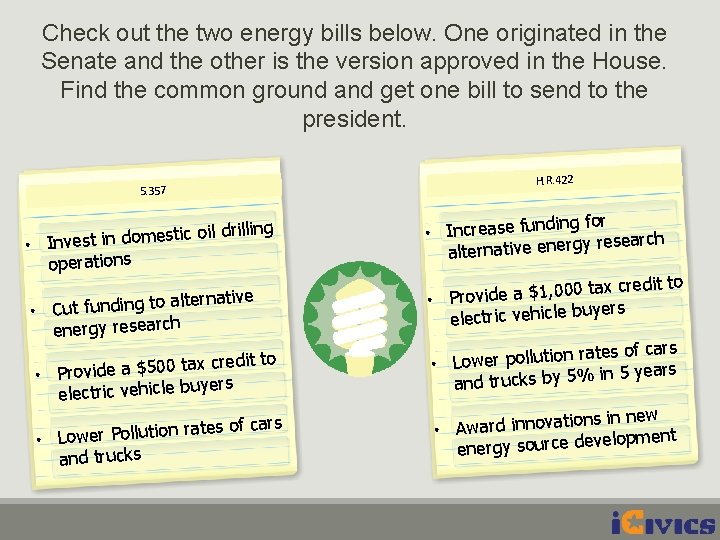
Check out the two energy bills below. One originated in the Senate and the other is the version approved in the House. Find the common ground and get one bill to send to the president. S. 357 c oil drilling ti s e m o d in t s e v • In operations alternative to g in d n fu t u C • energy research 0 tax credit to 0 5 $ a e id v ro P • uyers electric vehicle b tes of cars ra n o ti u ll o P r e w o • L and trucks H. R. 422 g for • Increase fundin y research alternative energ 00 tax credit to , 0 1 $ a e id v ro P • uyers electric vehicle b tes of cars ra n o ti u ll o p r e w • Lo 5 years in % 5 y b s k c u tr and tions in new a v o n in rd a w A • velopment e d e rc u o s y rg e n e
Based on the common ground you found in the Senate and House version of the bill, make a compromise version. You need to have at least two items in the bill. Compromise Bill
Now that you know how a bill becomes a law… can you pass one of your own?
- Slides: 13