
How a Bill Becomes A Law Introduction n
How a Bill Becomes A Law
Introduction n Article 1, Section 7 • Details the process by which a bill becomes a law. n All laws begin as a bill • A bill is a proposed law n All bills have a sponsor or sponsors • This is/are the individual(s) that introduce the bill • If a bill has several co-sponsors it is an indication that the bill has wide spread support

Types of Bills n n Public and Private Public Means that it deals with a large group of individuals • Social security, drug control, federal highways n Private means that it deals with a individual • Honoring a person for service to the country, granting of citizenship
Introducing a Bill & the Process Contact your representatives Read about bills and votes n www. congress. org n Format of a Bill n http: //thomas. loc. gov/

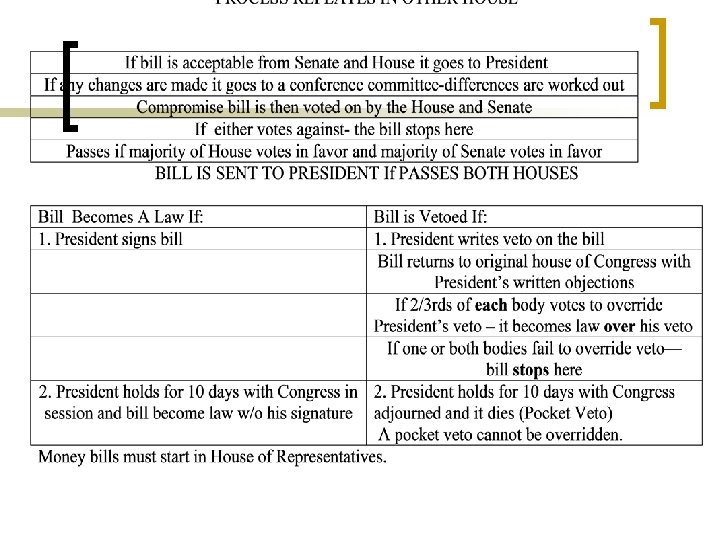
Ways President can deal with a bill n Becomes law • simple signature • does not sign or veto it for 10 days and Congress is in session n Goes back to Congress • veto by writing veto on bill • veto by not signing it within 10 days with Congress adjourned Pocket Veto
Three Types of Resolution n Simple Resolutions • needs the opinion of one chamber n Concurrent Resolution • a rule change; both houses must pass; no president signature n Joint Resolution • both houses must pass; with President’s signature
Other facts about Section 7 n n Money/revenue bills must start in the House If President vetoes a bill he must send it back to the original house of Congress with his written objections President’s veto power is a check on Congress’ power to pass a bill over the President’s veto is a check on the President’s power.

Time to review, listen carefully!!!!
- Slides: 10