
How a Bill becomes a law How It
How a Bill becomes a law!
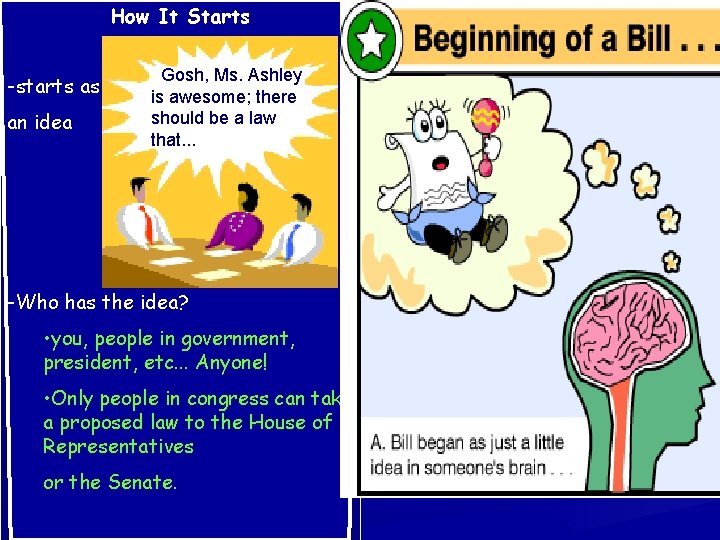
How It Starts -starts as an idea Gosh, Ms. Ashley is awesome; there should be a law that. . . -Who has the idea? • you, people in government, president, etc. . . Anyone! • Only people in congress can take a proposed law to the House of Representatives or the Senate.
Split Process -a new bill must pass both parts of Congress -the bill must also pass both parts in exactly the same form • Not one thing can be different • Exact bill
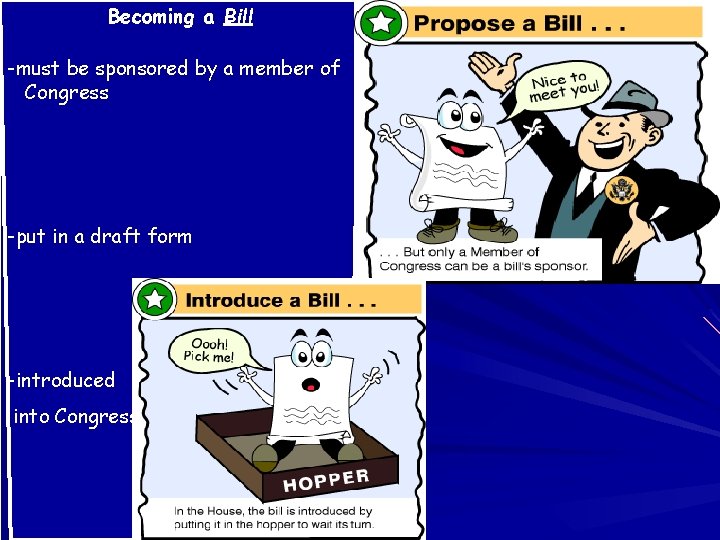
Becoming a Bill -must be sponsored by a member of Congress -put in a draft form -introduced into Congress
Box 3 Bills can be introduced whenever the House is in session. In the House, bills are officially introduced by placing them in a special box known as the hopper, which is located at the rostrum, or Speaker's platform. In the Senate, a bill is introduced by placing it on the presiding officer's desk or by formally introducing it on the Senate Floor. In the House, a bill clerk assigns the bill a number. House bills begin with "H. R. " Senate bills begin with "S. " The first reading of a bill means the bill's title is read on the House Floor. The bill is then referred to a committee for markup. The Library of Congress then receives an electronic copy of the bill and posts the bill and its status on THOMAS, a public website.
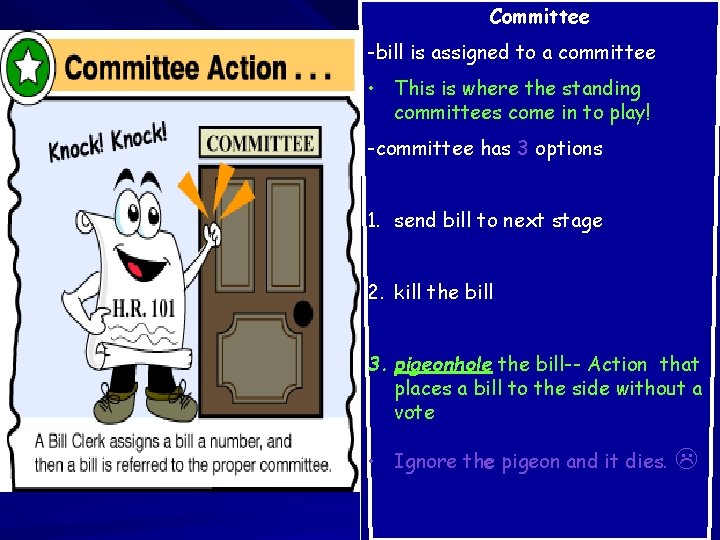
Committee -bill is assigned to a committee • This is where the standing committees come in to play! -committee has 3 options 1. send bill to next stage 2. kill the bill 3. pigeonhole the bill-- Action that places a bill to the side without a vote • Ignore the pigeon and it dies.
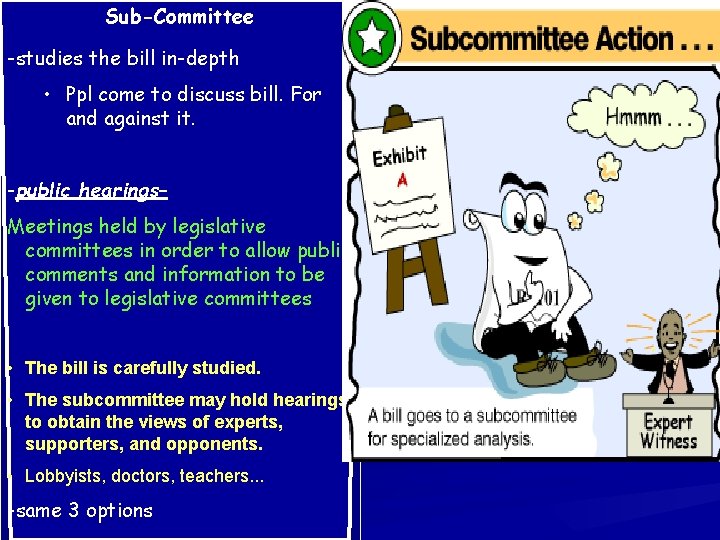
Sub-Committee -studies the bill in-depth • Ppl come to discuss bill. For and against it. -public hearings– Meetings held by legislative committees in order to allow public comments and information to be given to legislative committees • The bill is carefully studied. • The subcommittee may hold hearings to obtain the views of experts, supporters, and opponents. • Lobbyists, doctors, teachers. . . -same 3 options
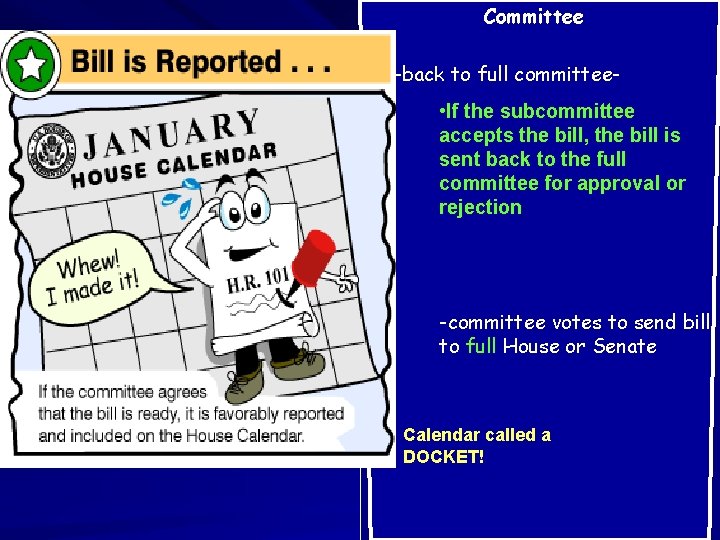
Committee --back to full committee- • If the subcommittee accepts the bill, the bill is sent back to the full committee for approval or rejection -committee votes to send bill to full House or Senate Calendar called a DOCKET!
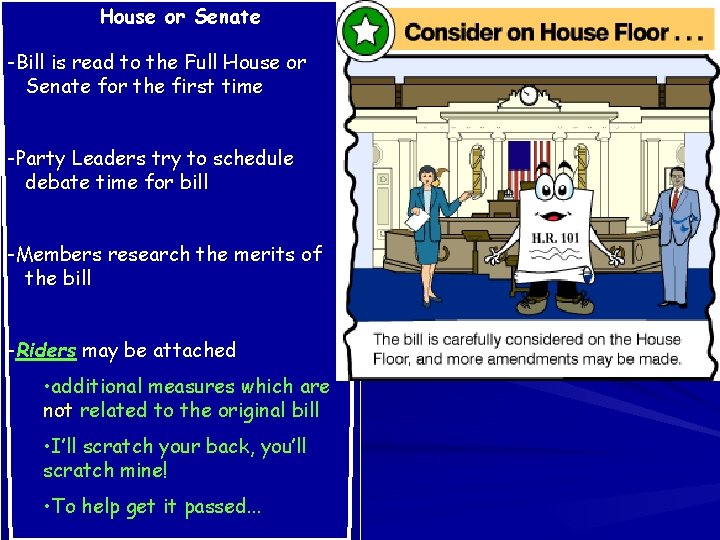
House or Senate -Bill is read to the Full House or Senate for the first time -Party Leaders try to schedule debate time for bill -Members research the merits of the bill -Riders may be attached • additional measures which are not related to the original bill • I’ll scratch your back, you’ll scratch mine! • To help get it passed. . .
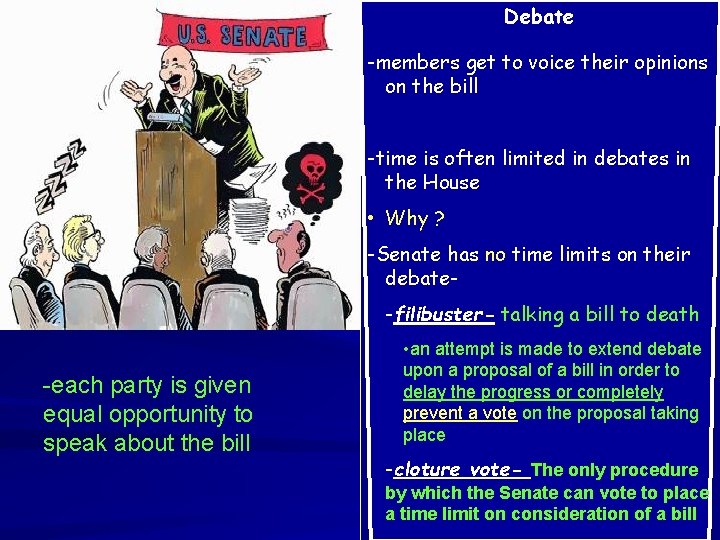
Debate -members get to voice their opinions on the bill -time is often limited in debates in the House • Why ? -Senate has no time limits on their debate-filibuster- talking a bill to death -each party is given equal opportunity to speak about the bill • an attempt is made to extend debate upon a proposal of a bill in order to delay the progress or completely prevent a vote on the proposal taking place -cloture vote- The only procedure by which the Senate can vote to place a time limit on consideration of a bill
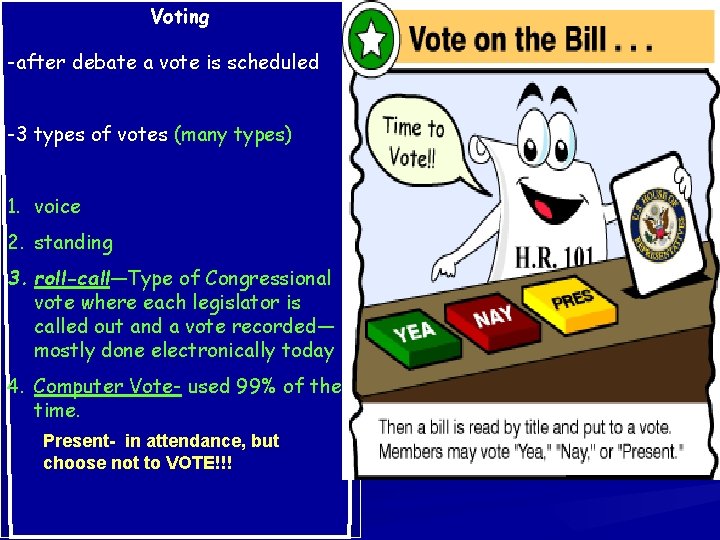
Voting -after debate a vote is scheduled -3 types of votes (many types) 1. voice 2. standing 3. roll-call—Type of Congressional vote where each legislator is called out and a vote recorded— mostly done electronically today 4. Computer Vote- used 99% of the time. Present- in attendance, but choose not to VOTE!!!
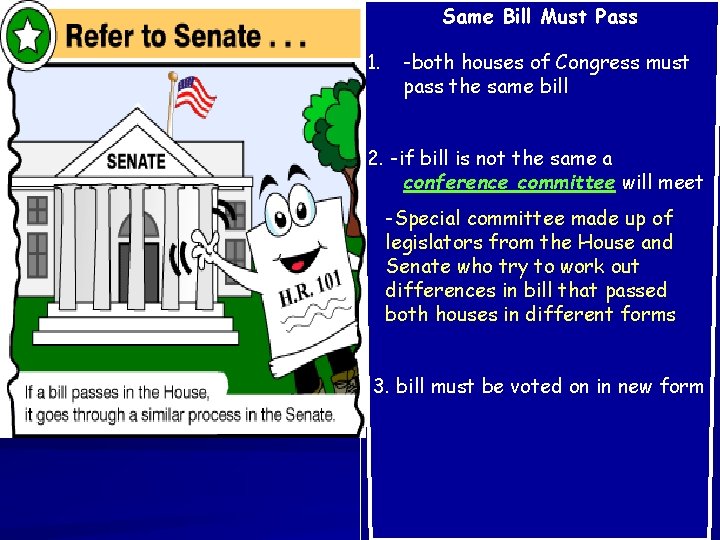
Same Bill Must Pass 1. -both houses of Congress must pass the same bill 2. -if bill is not the same a conference committee will meet -Special committee made up of legislators from the House and Senate who try to work out differences in bill that passed both houses in different forms 3. bill must be voted on in new form
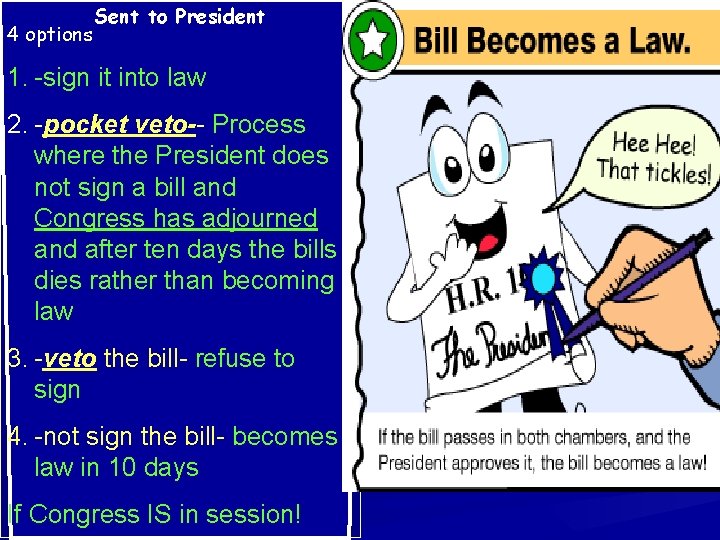
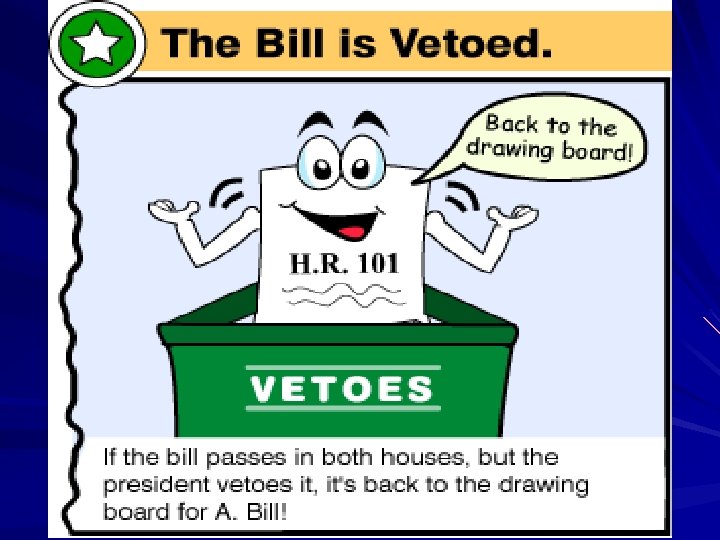
4 options Sent to President 1. -sign it into law 2. -pocket veto-- Process where the President does not sign a bill and Congress has adjourned and after ten days the bills dies rather than becoming law 3. -veto the bill- refuse to sign 4. -not sign the bill- becomes law in 10 days If Congress IS in session!
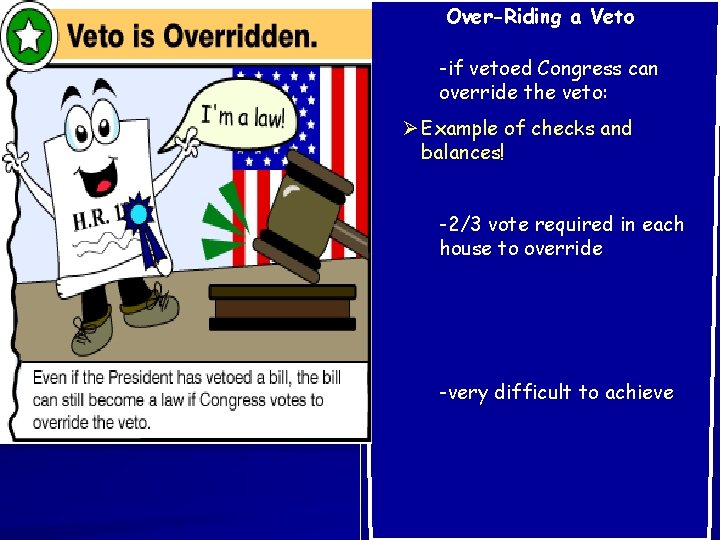
Over-Riding a Veto -if vetoed Congress can override the veto: Ø Example of checks and balances! -2/3 vote required in each house to override -very difficult to achieve
• I’m just a bill, • Yes, I’m only a bill, • And I’m sitting here on Capitol Hill. • Well, it’s a long, long journey • To the capital city, • It’s a long, long wait • While I’m sitting in committee • But I know I’ll be a law someday. . .
• • At least I hope and pray that I will, But today I’m still just a bill. {Interlude} I’m just a bill, Yes I’m only a bill, And I got as far as Capitol Hill. Well, now I’m stuck in committee And I sit here and wait
• While a few key Congressmen • Discuss and debate • Whether they should • Let me be a law… • Oh how I hope and pray that they will, • But today I am still just a bill. • {Interlude}
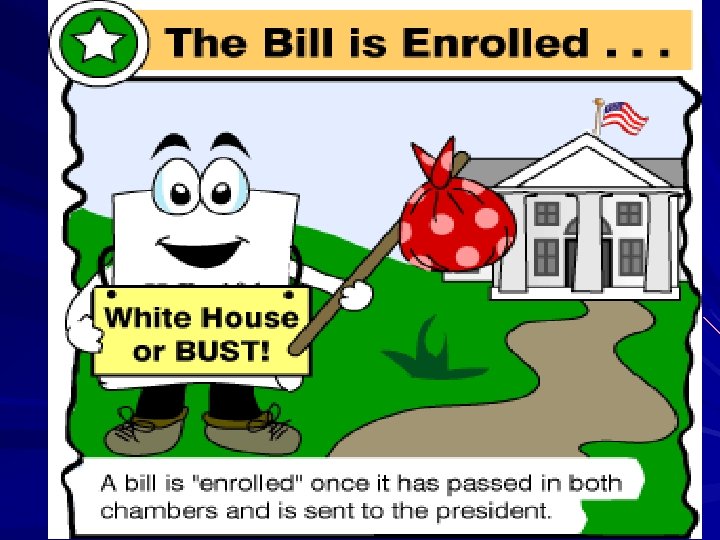
• I’m just a bill, • Yes I’m only a bill, • And if they vote for me on Capitol Hill, • Well then I’m off to the White House • Where I’ll wait in a line • With a lot of other bills • For the President to sign.
• And if he signs me then I’ll be a law. . . • Oh, how I hope and pray that he will, • But today I am still just a bill. • {Interlude} • No! But how I hope and I pray that I will, • But today I am still just a bill! • {Interlude}
Acknowledgement for Song • School House Rocks website. – http: //media. atlanticrecords. com/media/schoolhouse_ro ck_rocks/schoolhouse_rocks/ bill. wav
- Slides: 24