
Housing Value Resilience in TOD vs TAD Evidence

![Spatial Lag Model Design • Weight Matrix [W] o Tested 1 st, 2 nd](https://slidetodoc.com/presentation_image_h/ebf7249d08fe7534b8818a3a281f75bc/image-9.jpg "Spatial Lag Model Design • Weight Matrix [W] o Tested 1 st, 2 nd")


- Slides: 17
Housing Value Resilience in TOD vs. TAD: Evidence from the City of Atlanta Wenwen Zhang, Fangru Wang, Camille Barchers , and Yongsung Lee School of City and Regional Planning | Georgia Institute of Technology Presentation at the 56 th ACSP Annual Conference Nov 5 th, 2016
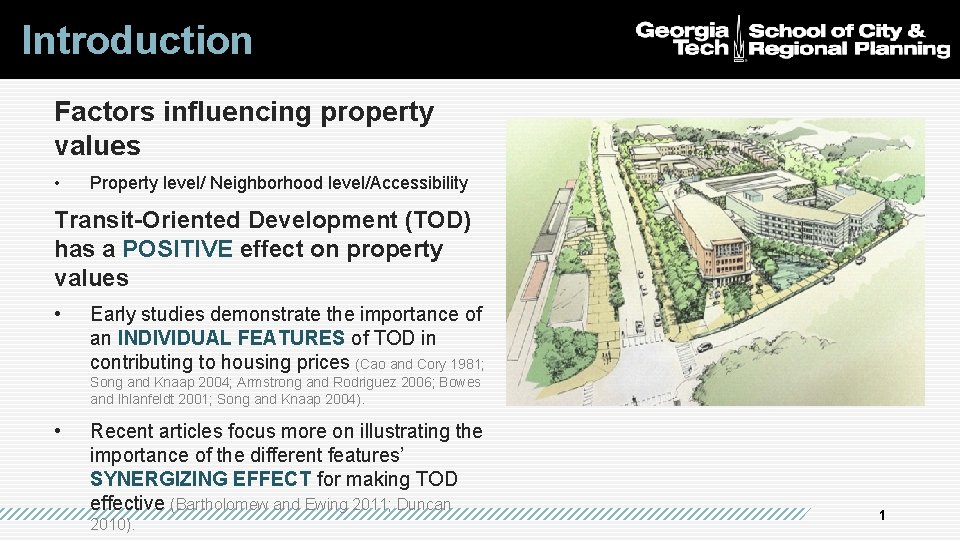
Introduction Factors influencing property values • Property level/ Neighborhood level/Accessibility Transit-Oriented Development (TOD) has a POSITIVE effect on property values • Early studies demonstrate the importance of an INDIVIDUAL FEATURES of TOD in contributing to housing prices (Cao and Cory 1981; Song and Knaap 2004; Armstrong and Rodriguez 2006; Bowes and Ihlanfeldt 2001; Song and Knaap 2004). • Recent articles focus more on illustrating the importance of the different features’ SYNERGIZING EFFECT for making TOD effective (Bartholomew and Ewing 2011; Duncan 2010). 1
Introduction Factors influencing property value RESILIENCE? • Highway network improvements have POSITIVE effect on housing value resilience in the aftermath of the recent real estate market crisis (Concas, 2012); • Longer term effects of social characteristics (e. g. race) have a SIGNIFICANT impact on neighborhood recovery post-recession in Metro Atlanta (E. Raymond, Wang, and Immergluck 2015). • TOD? The recent economic recession and new open source data (e. g. Zillow) have provided a new way to study this relationship 2
Research Question Does being located in a Transit Oriented Development (TOD) area contribute to Single Family Property Price Resilience during economic downturn, compared to being located in a Transit-Adjacent Development (TAD) area, in the City of Atlanta? The measurement of property value resilience • Percentage of reduction in property values during the recession • Recovery of property values after the recession 3
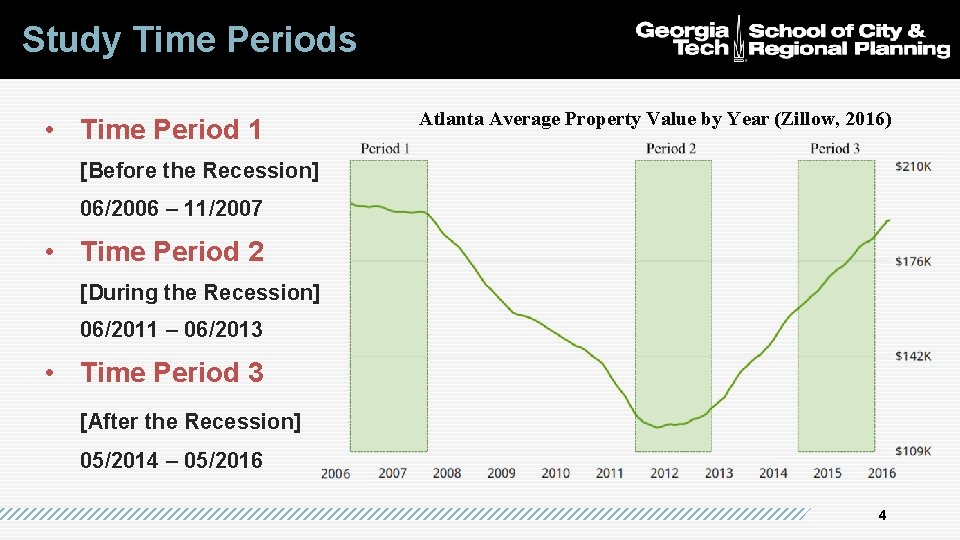
Study Time Periods • Time Period 1 Atlanta Average Property Value by Year (Zillow, 2016) [Before the Recession] 06/2006 – 11/2007 • Time Period 2 [During the Recession] 06/2011 – 06/2013 • Time Period 3 [After the Recession] 05/2014 – 05/2016 4
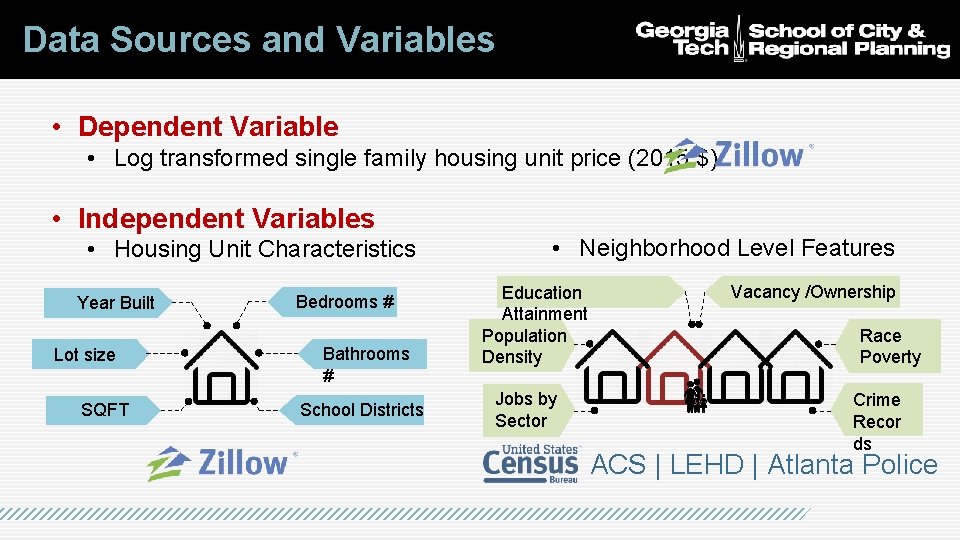
Data Sources and Variables • Dependent Variable • Log transformed single family housing unit price (2015 $) • Independent Variables • Housing Unit Characteristics Year Built Lot size SQFT Bedrooms # Bathrooms # School Districts • Neighborhood Level Features Education Attainment Population Density Jobs by Sector Vacancy /Ownership Race Poverty Crime Recor ds ACS | LEHD | Atlanta Police
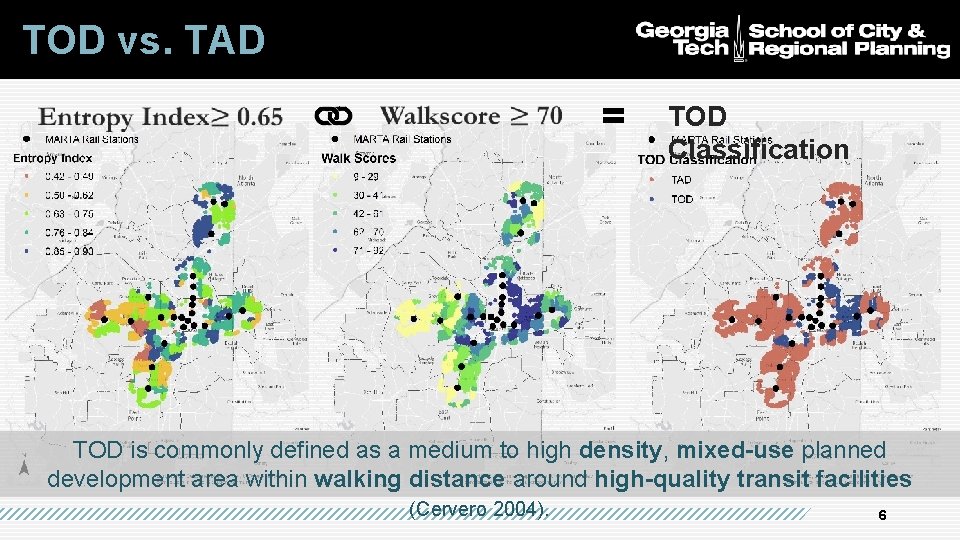
TOD vs. TAD • TOD Classification TOD is commonly defined as a medium to high density, mixed-use planned development area within walking distance around high-quality transit facilities (Cervero 2004). 6
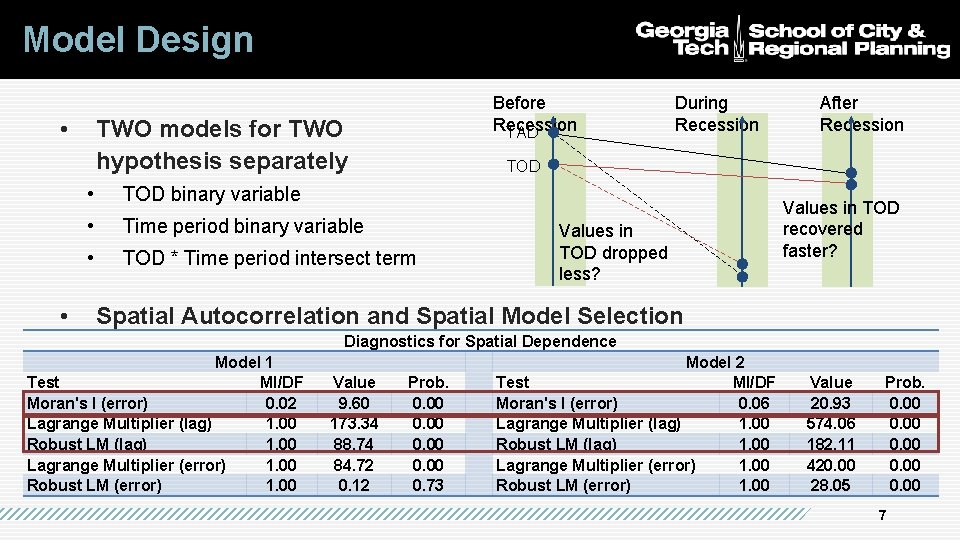
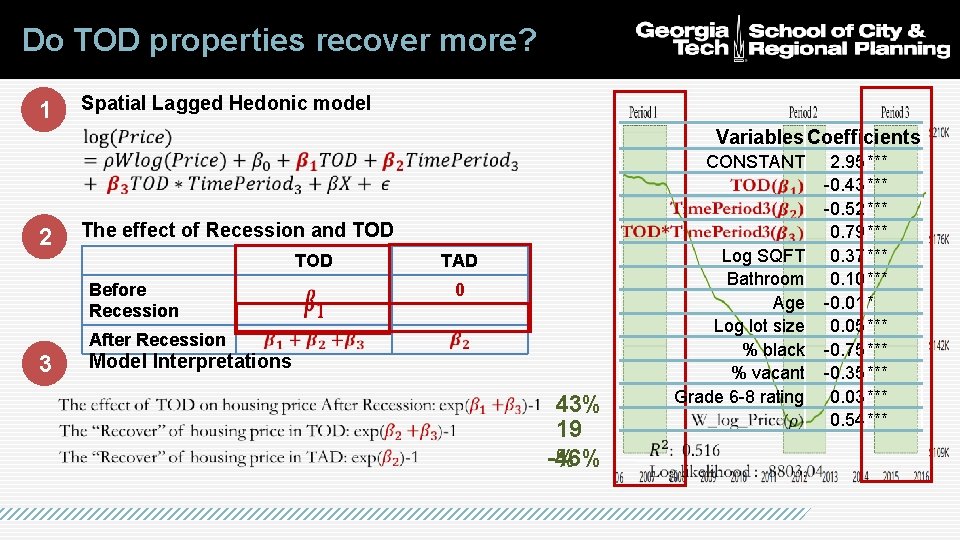
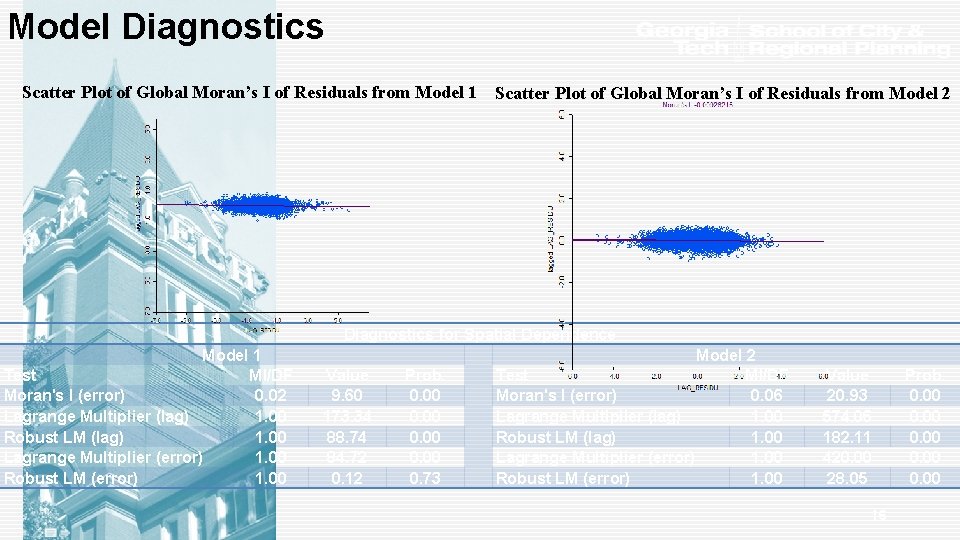
Model Design • • Before Recession TAD TWO models for TWO hypothesis separately During Recession After Recession TOD • TOD binary variable • Time period binary variable • TOD * Time period intersect term Values in TOD dropped less? Values in TOD recovered faster? Spatial Autocorrelation and Spatial Model Selection Diagnostics for Spatial Dependence Model 1 Test MI/DF Moran's I (error) 0. 02 Lagrange Multiplier (lag) 1. 00 Robust LM (lag) 1. 00 Lagrange Multiplier (error) 1. 00 Robust LM (error) 1. 00 Value 9. 60 173. 34 88. 74 84. 72 0. 12 Prob. 0. 00 0. 73 Model 2 Test MI/DF Moran's I (error) 0. 06 Lagrange Multiplier (lag) 1. 00 Robust LM (lag) 1. 00 Lagrange Multiplier (error) 1. 00 Robust LM (error) 1. 00 Value 20. 93 574. 06 182. 11 420. 00 28. 05 Prob. 0. 00 7
Spatial Lag Model Design • Weight Matrix [W] o Tested 1 st, 2 nd and 3 rd Observation of Interest 1 st Order neighbors 2 nd Order neighbors 3 rd Order neighbors Order of QUEEN Adjacency o 3 rd order is used in the final model • Spatial Lag Model Formula 8
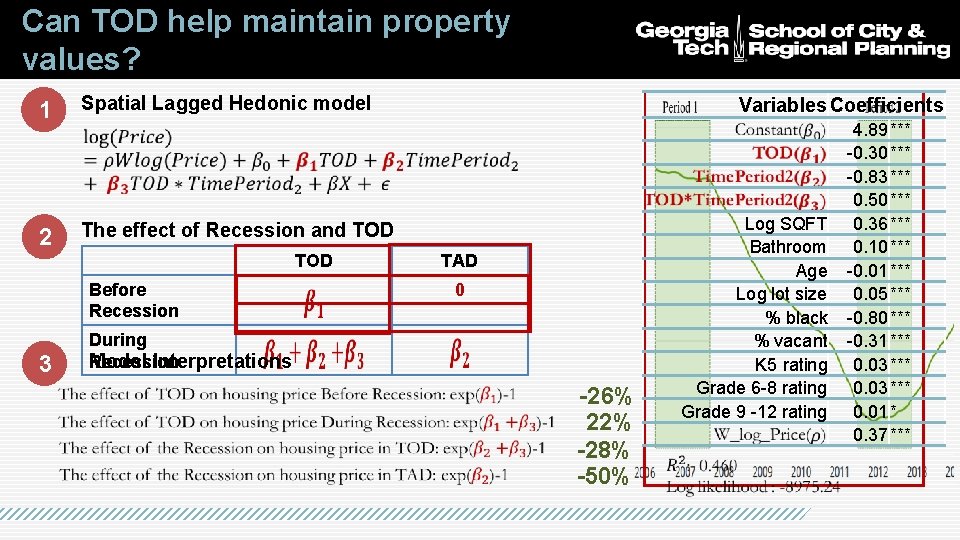
Can TOD help maintain property values? Spatial Lagged Hedonic model 1 Variables Coefficients Log SQFT Bathroom Age Log lot size % black % vacant K 5 rating Grade 6 -8 rating Grade 9 -12 rating The effect of Recession and TOD 2 TOD Before Recession TAD 0 During Recession Model Interpretations 3 -26% 22% -28% -50% 4. 89*** -0. 30*** -0. 83*** 0. 50*** 0. 36*** 0. 10*** -0. 01*** 0. 05*** -0. 80*** -0. 31*** 0. 03*** 0. 01* 0. 37***
Do TOD properties recover more? Spatial Lagged Hedonic model 1 Variables Coefficients CONSTANT The effect of Recession and TOD 2 TOD Before Recession Log SQFT Bathroom Age Log lot size % black % vacant Grade 6 -8 rating TAD 0 After Recession Model Interpretations 3 43% 19 % -46% 2. 95*** -0. 43*** -0. 52*** 0. 79*** 0. 37*** 0. 10*** -0. 01* 0. 05*** -0. 75*** -0. 35*** 0. 03*** 0. 54***
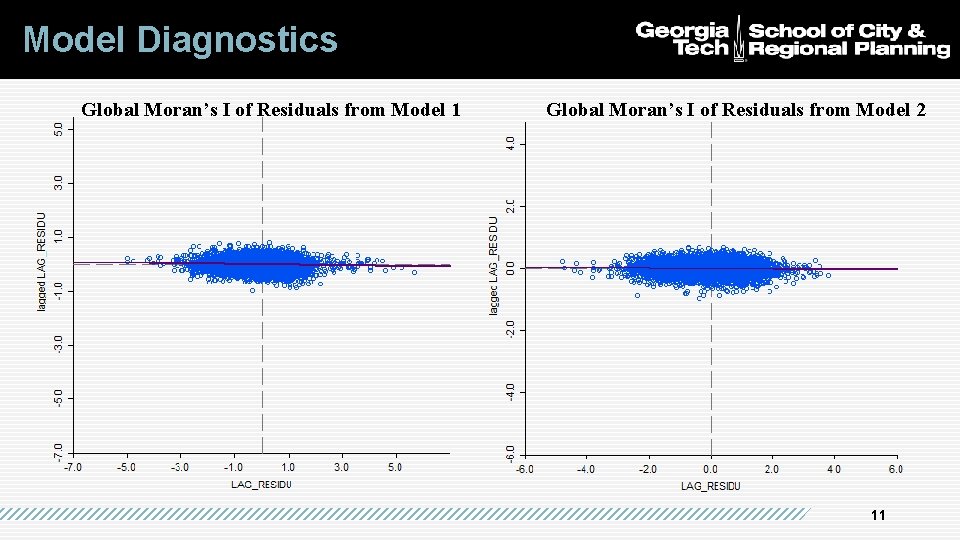
Model Diagnostics Global Moran’s I of Residuals from Model 1 Global Moran’s I of Residuals from Model 2 11
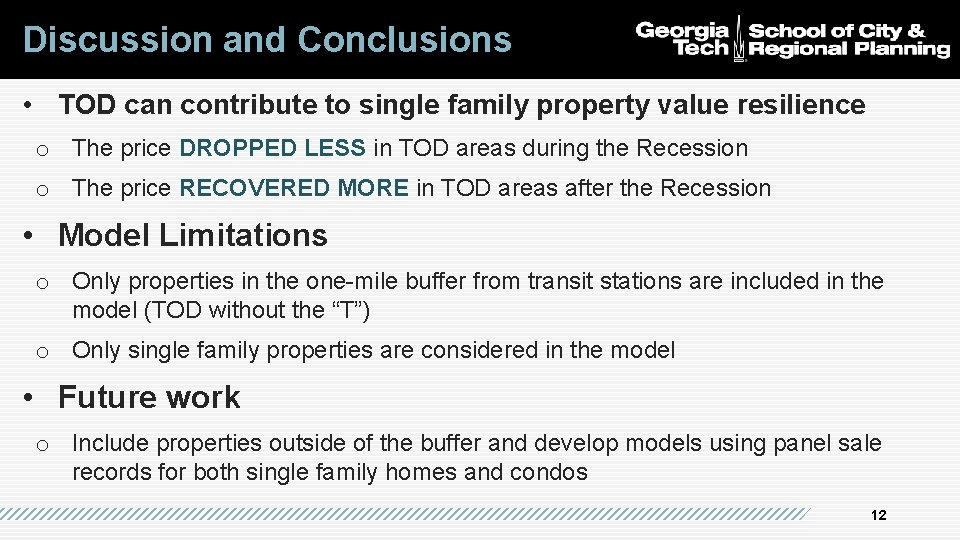
Discussion and Conclusions • TOD can contribute to single family property value resilience o The price DROPPED LESS in TOD areas during the Recession o The price RECOVERED MORE in TOD areas after the Recession • Model Limitations o Only properties in the one-mile buffer from transit stations are included in the model (TOD without the “T”) o Only single family properties are considered in the model • Future work o Include properties outside of the buffer and develop models using panel sale records for both single family homes and condos 12
THANK YOU! Wenwen Zhang |Email: wzhang 300@gatech. edu Fangru Wang |Email: fangru@gatech. edu Camille Barchers |Email: cbarchers 3@gatech. edu Yongsung Lee |Email: yongsung. lee@gatech. edu
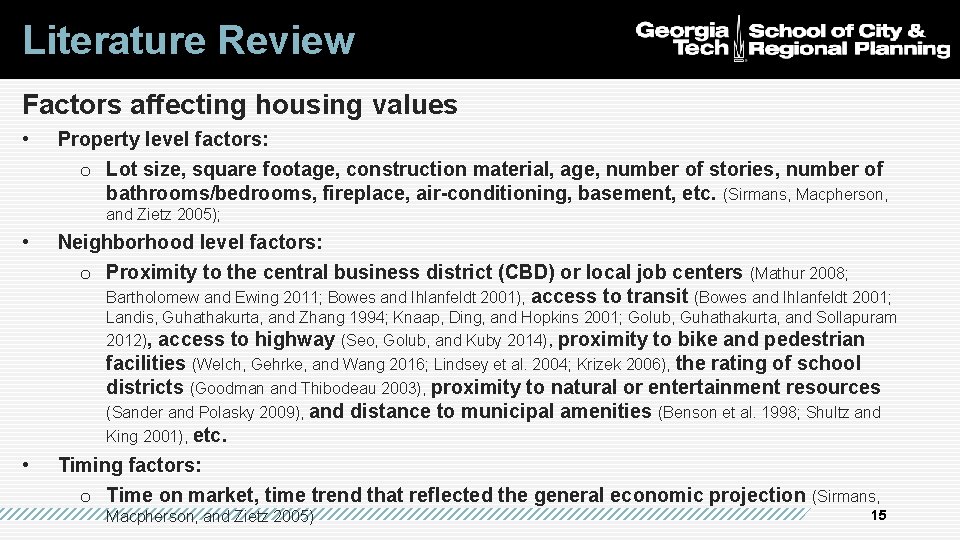
Literature Review Factors affecting housing values • Property level factors: o Lot size, square footage, construction material, age, number of stories, number of bathrooms/bedrooms, fireplace, air-conditioning, basement, etc. (Sirmans, Macpherson, and Zietz 2005); • Neighborhood level factors: o Proximity to the central business district (CBD) or local job centers (Mathur 2008; Bartholomew and Ewing 2011; Bowes and Ihlanfeldt 2001), access to transit (Bowes and Ihlanfeldt 2001; Landis, Guhathakurta, and Zhang 1994; Knaap, Ding, and Hopkins 2001; Golub, Guhathakurta, and Sollapuram 2012), access to highway (Seo, Golub, and Kuby 2014), proximity to bike and pedestrian facilities (Welch, Gehrke, and Wang 2016; Lindsey et al. 2004; Krizek 2006), the rating of school districts (Goodman and Thibodeau 2003), proximity to natural or entertainment resources (Sander and Polasky 2009), and distance to municipal amenities (Benson et al. 1998; Shultz and King 2001), etc. • Timing factors: o Time on market, time trend that reflected the general economic projection (Sirmans, Macpherson, and Zietz 2005) 15
Model Diagnostics Scatter Plot of Global Moran’s I of Residuals from Model 1 Scatter Plot of Global Moran’s I of Residuals from Model 2 Diagnostics for Spatial Dependence Model 1 Test MI/DF Moran's I (error) 0. 02 Lagrange Multiplier (lag) 1. 00 Robust LM (lag) 1. 00 Lagrange Multiplier (error) 1. 00 Robust LM (error) 1. 00 Value 9. 60 173. 34 88. 74 84. 72 0. 12 Prob. 0. 00 0. 73 Model 2 Test MI/DF Moran's I (error) 0. 06 Lagrange Multiplier (lag) 1. 00 Robust LM (lag) 1. 00 Lagrange Multiplier (error) 1. 00 Robust LM (error) 1. 00 Value 20. 93 574. 06 182. 11 420. 00 28. 05 16 Prob. 0. 00