
Housing Maintenance Zachary Ho Irin Phatraprasit Emma Xie
- Slides: 8
Housing Maintenance Zachary Ho, Irin Phatraprasit, Emma Xie, and Ava Zhu
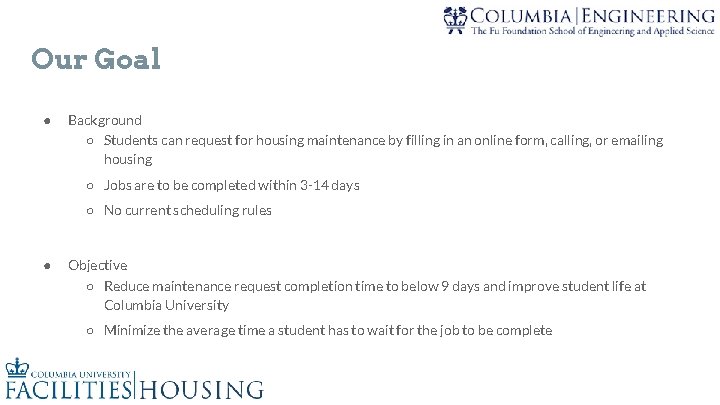
Our Goal ● Background ○ Students can request for housing maintenance by filling in an online form, calling, or emailing housing ○ Jobs are to be completed within 3 -14 days ○ No current scheduling rules ● Objective ○ Reduce maintenance request completion time to below 9 days and improve student life at Columbia University ○ Minimize the average time a student has to wait for the job to be complete
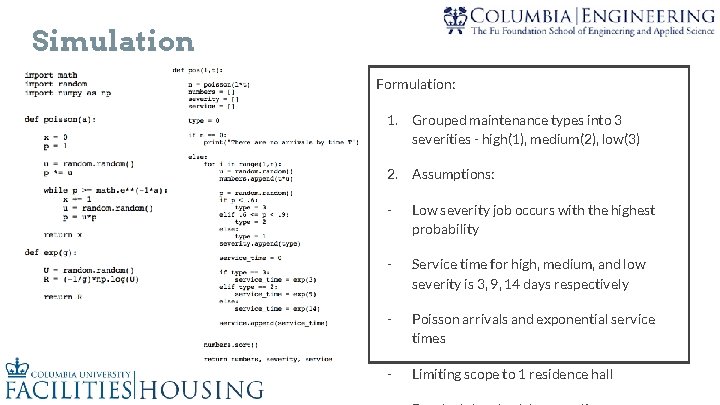
Simulation Formulation: 1. Grouped maintenance types into 3 severities - high(1), medium(2), low(3) 2. Assumptions: - Low severity job occurs with the highest probability - Service time for high, medium, and low severity is 3, 9, 14 days respectively - Poisson arrivals and exponential service times - Limiting scope to 1 residence hall
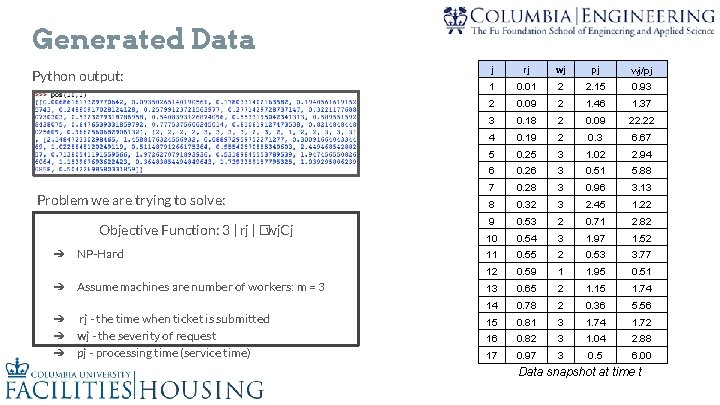
Generated Data Python output: Problem we are trying to solve: Objective Function: 3 | rj | �wj. Cj ➔ NP-Hard ➔ Assume machines are number of workers: m = 3 ➔ rj - the time when ticket is submitted ➔ wj - the severity of request ➔ pj - processing time (service time) j rj wj pj wj/pj 1 0. 01 2 2. 15 0. 93 2 0. 09 2 1. 46 1. 37 3 0. 18 2 0. 09 22. 22 4 0. 19 2 0. 3 6. 67 5 0. 25 3 1. 02 2. 94 6 0. 26 3 0. 51 5. 88 7 0. 28 3 0. 96 3. 13 8 0. 32 3 2. 45 1. 22 9 0. 53 2 0. 71 2. 82 10 0. 54 3 1. 97 1. 52 11 0. 55 2 0. 53 3. 77 12 0. 59 1 1. 95 0. 51 13 0. 65 2 1. 15 1. 74 14 0. 78 2 0. 36 5. 56 15 0. 81 3 1. 74 1. 72 16 0. 82 3 1. 04 2. 88 17 0. 97 3 0. 5 6. 00 Data snapshot at time t
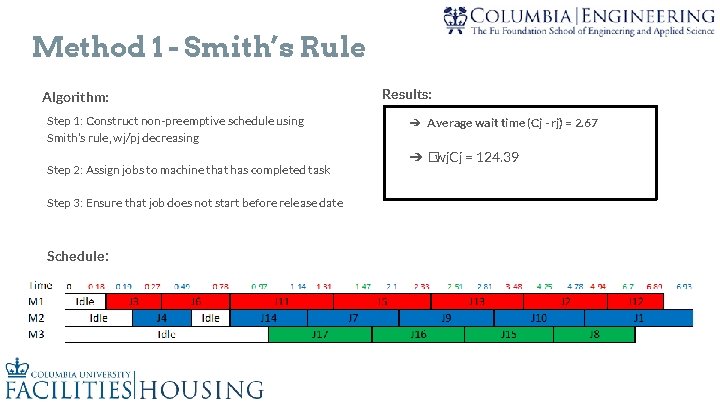
Method 1 - Smith’s Rule Algorithm: Step 1: Construct non-preemptive schedule using Smith’s rule, wj/pj decreasing Step 2: Assign jobs to machine that has completed task Step 3: Ensure that job does not start before release date Schedule: Results: ➔ Average wait time (Cj - rj) = 2. 67 ➔ �wj. Cj = 124. 39
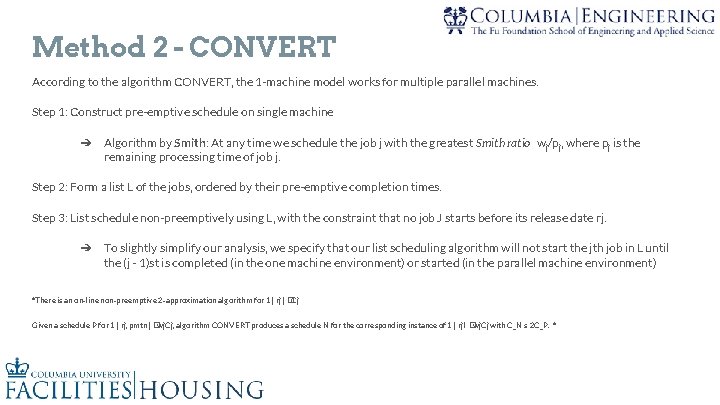
Method 2 - CONVERT According to the algorithm CONVERT, the 1 -machine model works for multiple parallel machines. Step 1: Construct pre-emptive schedule on single machine ➔ Algorithm by Smith: At any time we schedule the job j with the greatest Smith ratio wj/pj, where pj is the remaining processing time of job j. Step 2: Form a list L of the jobs, ordered by their pre-emptive completion times. Step 3: List schedule non-preemptively using L, with the constraint that no job J starts before its release date rj. ➔ To slightly simplify our analysis, we specify that our list scheduling algorithm will not start the jth job in L until the (j - 1)st is completed (in the one machine environment) or started (in the parallel machine environment) *There is an on-line non-preemptive 2 -approximation algorithm for 1 | rj | �Cj Given a schedule P for 1 | rj, pmtn | �wj. Cj, algorithm CONVERT produces a schedule N for the corresponding instance of 1 | rj l �wj. Cj with C_N ≤ 2 C_P. *
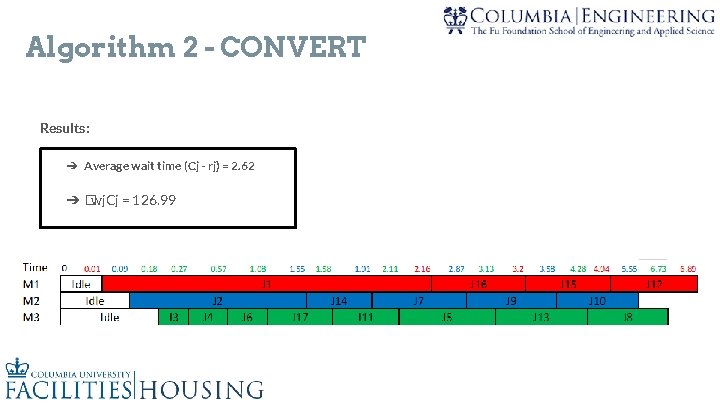
Algorithm 2 - CONVERT Results: ➔ Average wait time (Cj - rj) = 2. 62 ➔ �wj. Cj = 126. 99
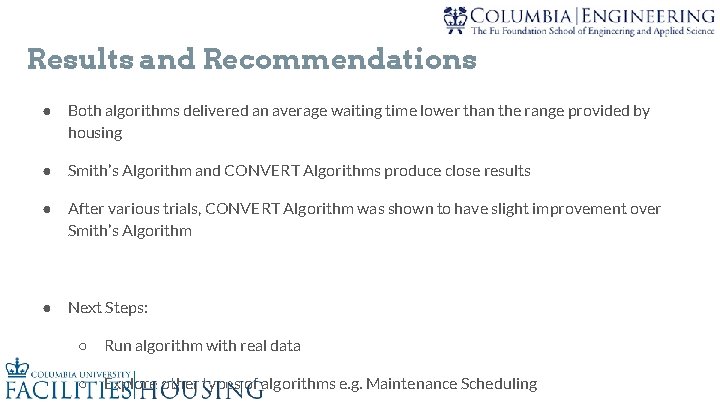
Results and Recommendations ● Both algorithms delivered an average waiting time lower than the range provided by housing ● Smith’s Algorithm and CONVERT Algorithms produce close results ● After various trials, CONVERT Algorithm was shown to have slight improvement over Smith’s Algorithm ● Next Steps: ○ Run algorithm with real data ○ Explore other types of algorithms e. g. Maintenance Scheduling