
HOUSING FIRST IN CASE MANAGEMENT Case Management Intensive
- Slides: 19
HOUSING FIRST IN CASE MANAGEMENT
Case Management Intensive vs. brokerage case management Relationship based, 13— 20 clients per staff Average one visit per week Client centred, goal oriented, partnership Supporting goals related to all area of psycho- social-medical Advocating for resources and providing services as needed
Some Examples of Models of Housing First Streets to Homes Model Outreach worker who houses client refers to follow up worker for continued support Housing is provided without subsidies Follow up model provides one year of support Both intensive and moderate needs clients are referred At Home/Chez Soi Research Project Most clients are complex; often with concurrent disorder and other issues Subsidies are attached to client; they are portable Intensive long term support provided
Comparing the Two Models The hand off from outreach worker to follow up worker has been problematic People can be housed without a subsidy but the choices are greatly enhanced with a subsidy The more complex the issues the longer the supports should be provided for Housing First can be implemented with less resources but is more successful with greater resources
“Kevin” Man in his 40 s referred to At Home with a diagnosis of PTSD, poly substance use, majority of his adult life spent in prison, estranged from family, had never been housed Difficult to engage with, assessed high risk of violence towards staff, chaotic substance use
“Tiffany” Woman in her 20 s, referred to At Home with diagnosis of depression and anxiety. Trauma history, working the sex trade, poly substance use, multiple suicide attempts, volatile relationship with family Difficult to locate, assessed high risk of suicide, entire personal support network involved in substance use and sex work
Ideally, What is Needed in ICM to Support Complex Clients Within Housing First? Psychiatrist consultation, mobile assessment, flexible psychiatric support (case management looking more like ACT) Flexible physician support, access to clinics Crisis support—if not within team, agreement with another crisis program Life skills teaching—if possible within team or another agency, peer support would be ideal Landlord recruitment, liaison with landlords Consultation for Clients with ABI, Dual Diagnosis, Substance Use, other issues
Training for Case Managers Recovery Harm Reduction Trauma Informed Care Risk Assessment Housing Knowledge and Skills
Recovery The client has the right to make mistakes and learn from them In other words discuss consequences without cushioning every “fall” The client not their worker has the right to decide when they are “ready” for housing Housing First is the foundation upon which other steps towards recovery can be made
Harm Reduction Is any program or policy designed to reduce substance related harm without requiring the cessation of substances Abstinence and harm reduction are on a continuum of use Case Manager provides information and support to reduce harms but ultimately this is the client’s decision
Trauma Informed Support Severely traumatized clients are challenging to engage. Staff should provide clear, firm boundaries, access to concrete items, genuine warmth, yet not be perceived as “too kind” or clients can be triggered that they ”owe staff. ” Trauma training helped staff to create safety— how to pace disclosures, and how to manage attempts to push boundaries
Risk Assessment Team and managers benefitted greatly from having specialist train them in risk assessment Case Managers became more confident in their ability to work with more aggressive clients and those with continuing criminal justice involvement Case Managers reported feeling safer in their work and in the community
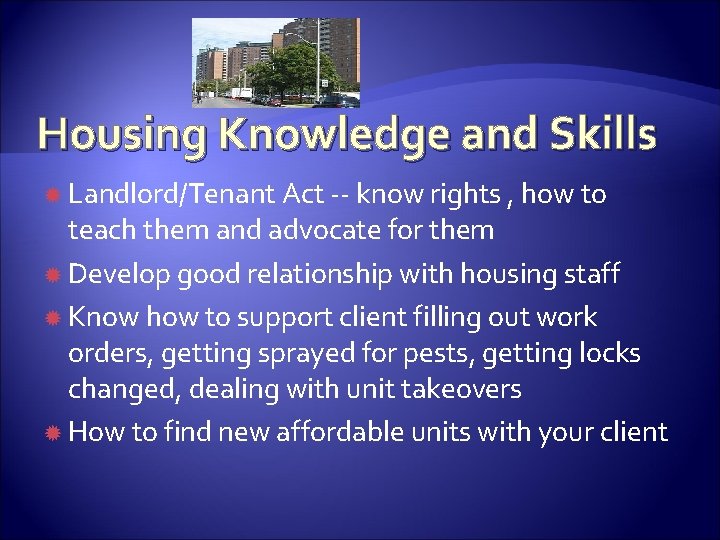
Housing Knowledge and Skills Landlord/Tenant Act -- know rights , how to teach them and advocate for them Develop good relationship with housing staff Know how to support client filling out work orders, getting sprayed for pests, getting locks changed, dealing with unit takeovers How to find new affordable units with your client
Progress Kevin began trying out romantic/intimate relationships creating more complications but a sign of beginning recovery Tiffany became pregnant and was motivated to keep her baby As Kevin trusted more, he explored issues regarding spirituality, hope; wanting to connect with family Tiffany dreamed of going back to school, and began to pull away from her street involved friends
More Progress Kevin worked on harm reduction, realizing that risk was high when he was using alcohol, lower with other substances For Tiffany harm reduction goal became abstinence as she worked with a wrap around team to be able to keep her baby Kevin finally lived in his first apartment of his adult life but was then evicted after a few months Tiffany enrolled in full time university while pregnant which completely pulled her away from her old dysfunctional personal support network
And now… Tiffany continues to work hard towards obtaining her B. A. , is successfully raising her child and continues to be abstinent. She struggles with loneliness, however, and has not reconciled with her family Kevin is out of jail again full of resolve to try to move into a new apartment , wants to be abstinent from substances, has increased in trust and insight , and is grateful he has continued support These two clients highlight some of the complexity the At Home team faced and why it was crucial to keep staff/ client ratios low
Contrast Between Various Models Lower resources—Housing First still possible Best if same worker houses and supports client Works better if complexity of client issues are lower Greater resources -- increased complexity of clients Lower client staff ratios Housing subsidies --better units, greater choice Money for damages, storage units, moving costs Housing coordinator takes burden off staff Special training for staff Psychiatric consultation and support, crisis support
Continuing Challenges… Some of our clients have been re-housed. Choices become narrower with each re-housing A few of our clients are now in rooms, and others are in boarding homes—supportive housing is also a choice We have the ability to provide “step up” “step down” services with our partnership with Cota ACT — blended ACT and ICM is another option, but most case managers don’t have these choices
Thank you! Questions and Answers Jo Connelly, Toronto North Support Services, 416 -499 -5659 x 223, joc@tnss. ca