
Housestaff Lean Academy Module 3 Examining the Current

- Slides: 15
Housestaff Lean Academy Module 3: Examining the Current State (Process Mapping, Observations, and Waste) Robert Martin, Psy. D Performance Excellence UCLA Health 1
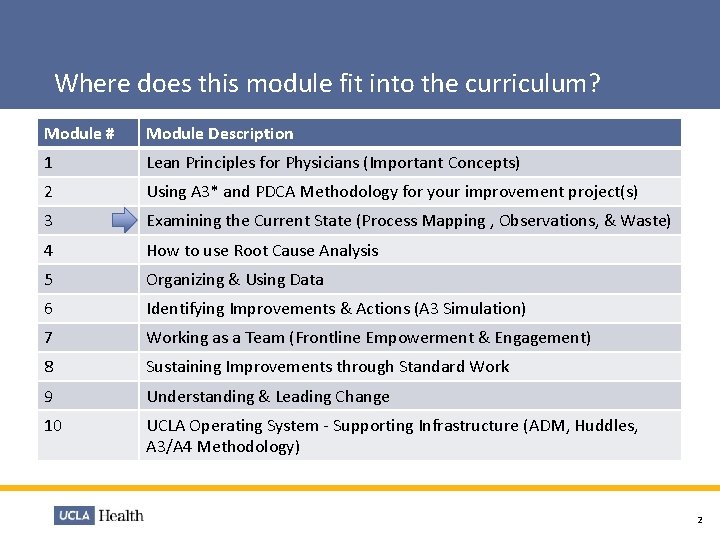
Where does this module fit into the curriculum? Module # Module Description 1 Lean Principles for Physicians (Important Concepts) 2 Using A 3* and PDCA Methodology for your improvement project(s) 3 Examining the Current State (Process Mapping , Observations, & Waste) 4 How to use Root Cause Analysis 5 Organizing & Using Data 6 Identifying Improvements & Actions (A 3 Simulation) 7 Working as a Team (Frontline Empowerment & Engagement) 8 Sustaining Improvements through Standard Work 9 Understanding & Leading Change 10 UCLA Operating System - Supporting Infrastructure (ADM, Huddles, A 3/A 4 Methodology) 2
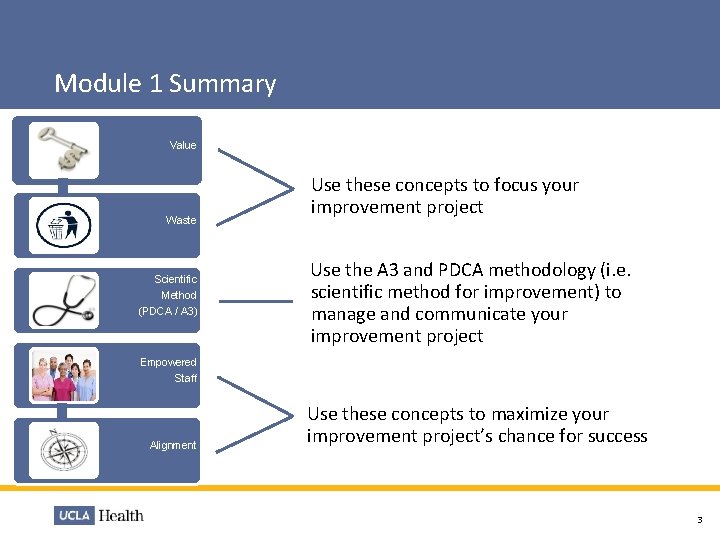
Module 1 Summary Value Waste Scientific Method (PDCA / A 3) Use these concepts to focus your improvement project Use the A 3 and PDCA methodology (i. e. scientific method for improvement) to manage and communicate your improvement project Empowered Staff Alignment Use these concepts to maximize your improvement project’s chance for success 3
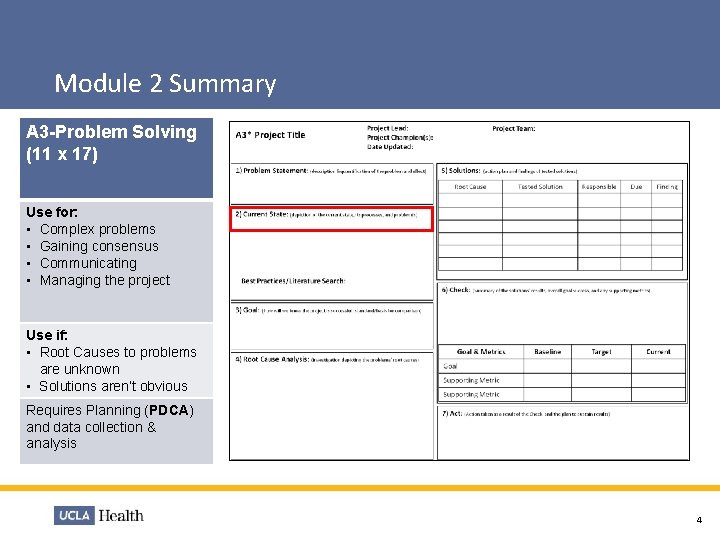
Module 2 Summary A 3 -Problem Solving (11 x 17) Use for: • Complex problems • Gaining consensus • Communicating • Managing the project Use if: • Root Causes to problems are unknown • Solutions aren’t obvious Requires Planning (PDCA) and data collection & analysis 4
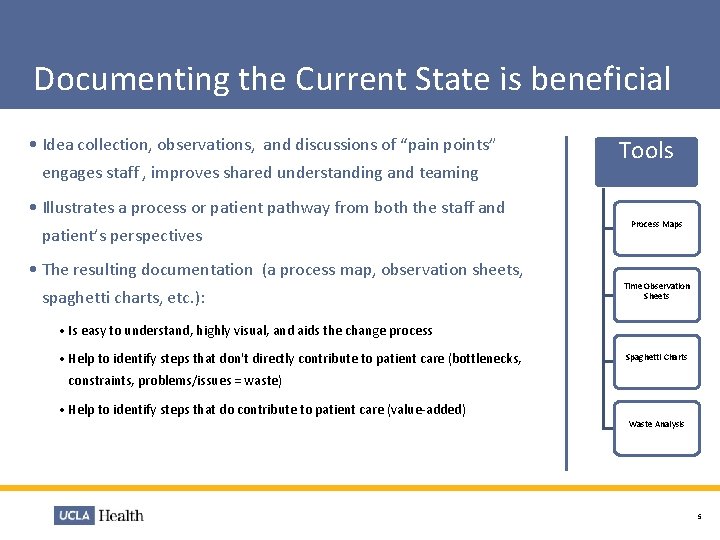
Documenting the Current State is beneficial • Idea collection, observations, and discussions of “pain points” engages staff , improves shared understanding and teaming Tools • Illustrates a process or patient pathway from both the staff and patient’s perspectives • The resulting documentation (a process map, observation sheets, spaghetti charts, etc. ): Process Maps Time Observation Sheets • Is easy to understand, highly visual, and aids the change process • Help to identify steps that don't directly contribute to patient care (bottlenecks, Spaghetti Charts constraints, problems/issues = waste) • Help to identify steps that do contribute to patient care (value-added) Waste Analysis 5
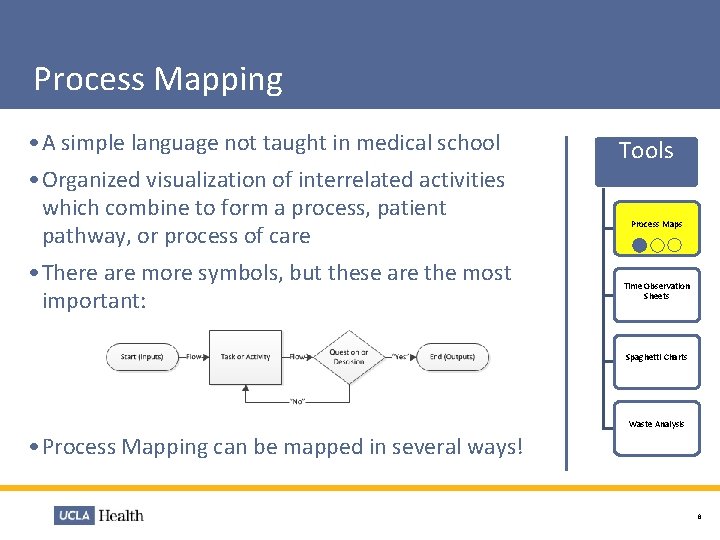
Process Mapping • A simple language not taught in medical school • Organized visualization of interrelated activities which combine to form a process, patient pathway, or process of care • There are more symbols, but these are the most important: Tools Process Maps Time Observation Sheets Spaghetti Charts Waste Analysis • Process Mapping can be mapped in several ways! 6
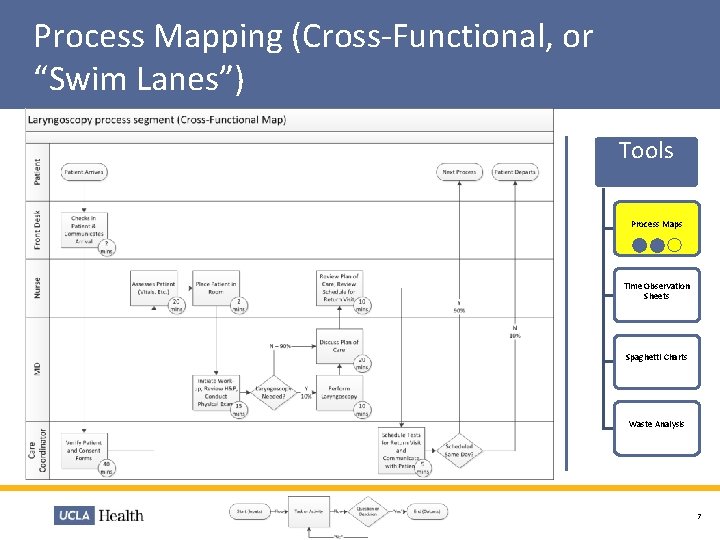
Process Mapping (Cross-Functional, or “Swim Lanes”) Tools Process Maps Time Observation Sheets Spaghetti Charts Waste Analysis 7
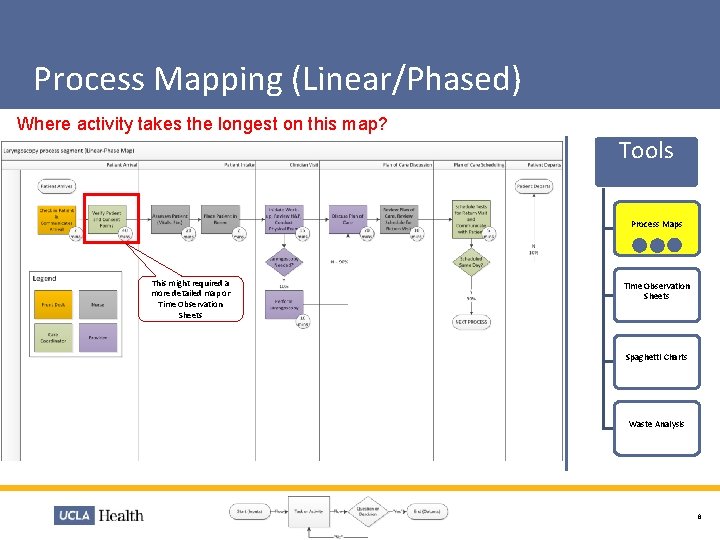
Process Mapping (Linear/Phased) Where activity takes the longest on this map? Tools Process Maps This might required a more detailed map or Time Observation Sheets Spaghetti Charts Waste Analysis 8
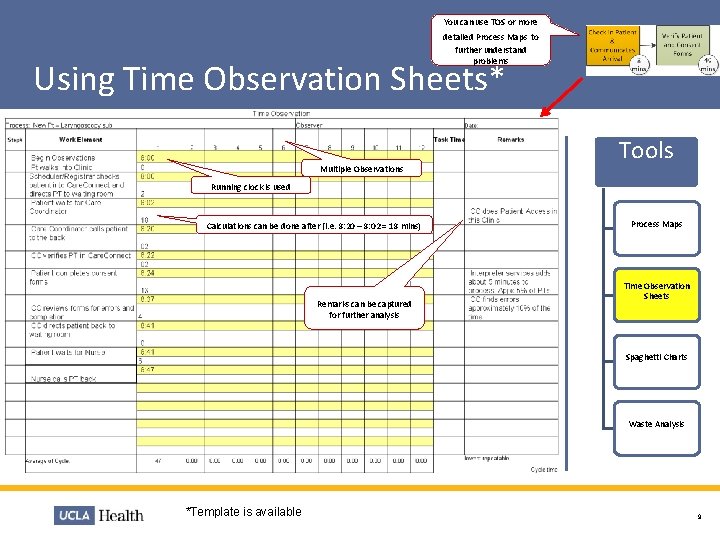
You can use TOS or more detailed Process Maps to further understand problems Using Time Observation Sheets* Multiple Observations Tools Running clock is used Calculations can be done after (i. e. 8: 20 – 8: 02 = 18 mins) Remarks can be captured for further analysis Process Maps Time Observation Sheets Spaghetti Charts Waste Analysis *Template is available 9
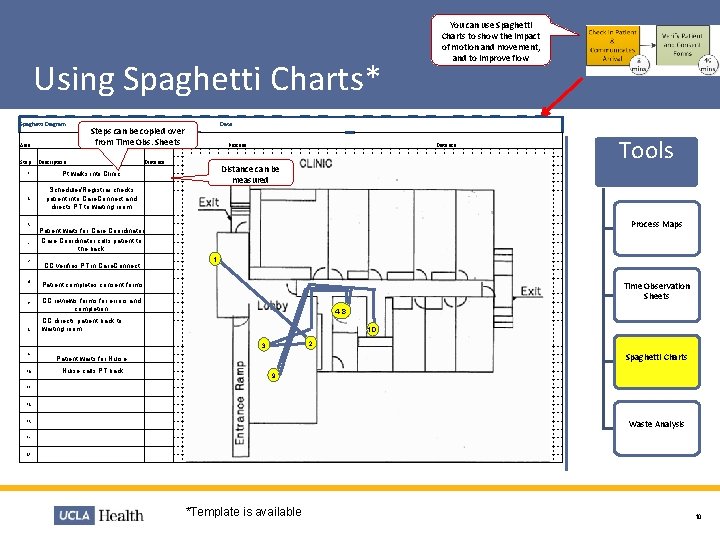
You can use Spaghetti Charts to show the impact of motion and movement, and to improve flow Using Spaghetti Charts* Spaghetti Diagram Area: Step Description Distance Pt walks into Clinic 1 Scheduler/Registrar checks patient into Care. Connect and directs PT to waiting room 2 3 Patient waits for Care Coordinator calls patient to the back 4 5 CC verifies PT in Care. Connect 6 8 Process: Distance: 1 4 -8 Distance can be measured Patient completes consent forms CC reviews forms for errors and completion CC directs patient back to waiting room 9 Patient waits for Nurse 10 7 Date: Steps can be copied over from Time Obs. Sheets Nurse calls PT back 11 12 13 14 21 Process Maps Time Observation Sheets 10 Tools 3 2 9 Spaghetti Charts Waste Analysis *Template is available 10
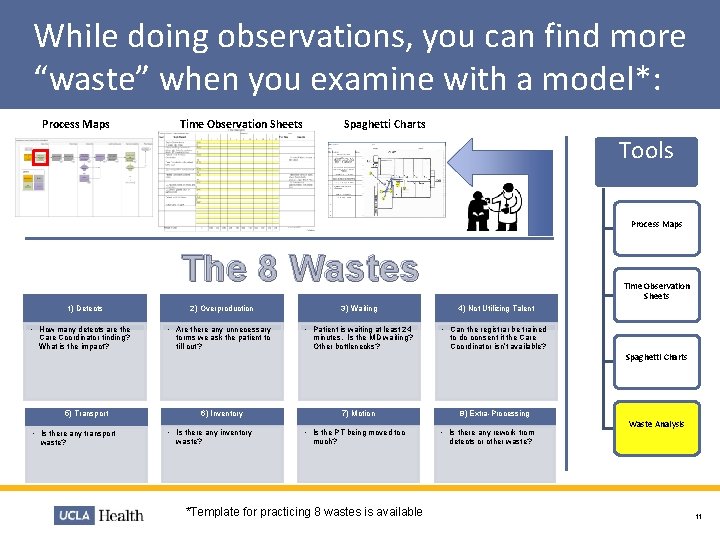
While doing observations, you can find more “waste” when you examine with a model*: Process Maps Time Observation Sheets Spaghetti Charts Tools Process Maps The 8 Wastes 1) Defects • How many defects are the Care Coordinator finding? What is the impact? Time Observation Sheets 2) Overproduction 3) Waiting 4) Not Utilizing Talent • Are there any unnecessary forms we ask the patient to fill out? • Patient is waiting at least 24 minutes. Is the MD waiting? Other bottlenecks? • Can the registrar be trained to do consent if the Care Coordinator isn’t available? Spaghetti Charts 5) Transport • Is there any transport waste? 6) Inventory • Is there any inventory waste? 7) Motion • Is the PT being moved too much? 8) Extra-Processing • Is there any rework from defects or other waste? Waste Analysis *Template for practicing 8 wastes is available 11
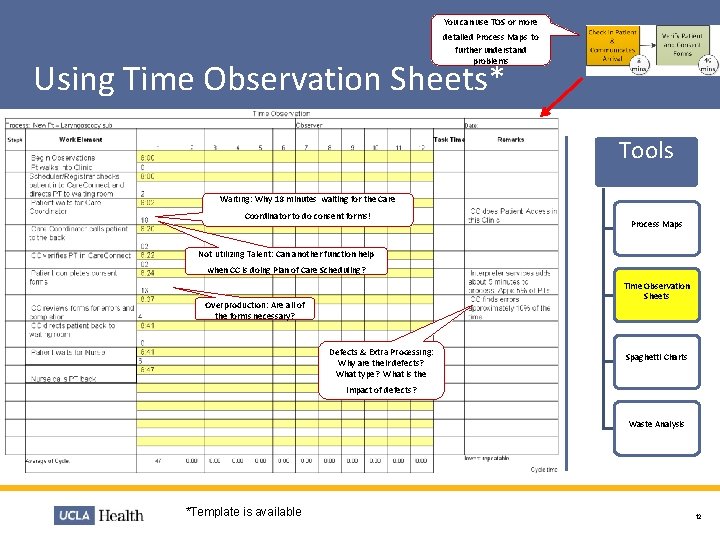
You can use TOS or more detailed Process Maps to further understand problems Using Time Observation Sheets* Tools Waiting: Why 18 minutes waiting for the Care Coordinator to do consent forms! Process Maps Not utilizing Talent: Can another function help when CC is doing Plan of Care Scheduling? Overproduction: Are all of the forms necessary? Defects & Extra Processing: Why are their defects? What type? What is the Time Observation Sheets Spaghetti Charts impact of defects? Waste Analysis *Template is available 12
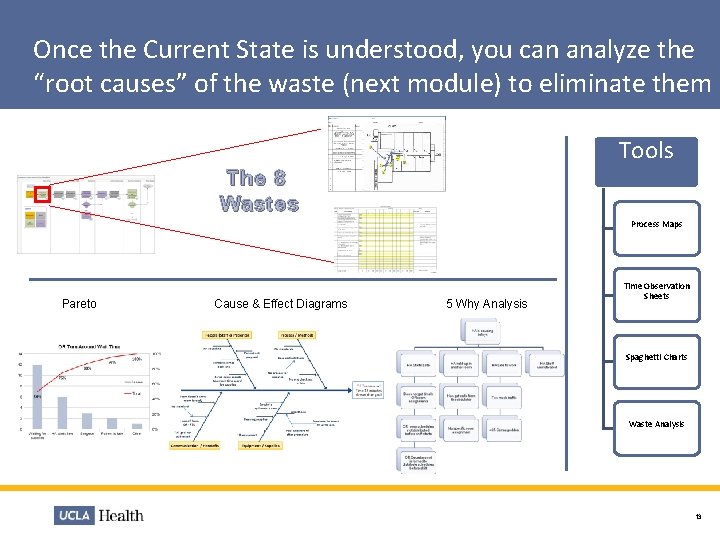
Once the Current State is understood, you can analyze the “root causes” of the waste (next module) to eliminate them Tools The 8 Wastes Process Maps Pareto Cause & Effect Diagrams 5 Why Analysis Time Observation Sheets Spaghetti Charts Waste Analysis 13
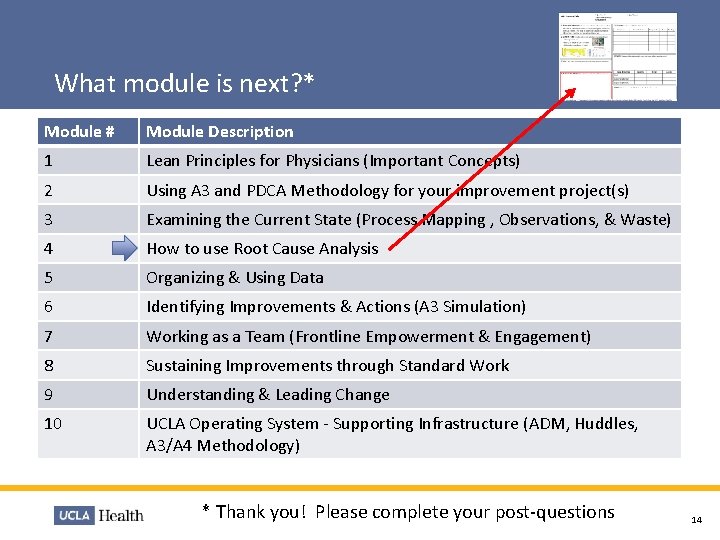
What module is next? * Module # Module Description 1 Lean Principles for Physicians (Important Concepts) 2 Using A 3 and PDCA Methodology for your improvement project(s) 3 Examining the Current State (Process Mapping , Observations, & Waste) 4 How to use Root Cause Analysis 5 Organizing & Using Data 6 Identifying Improvements & Actions (A 3 Simulation) 7 Working as a Team (Frontline Empowerment & Engagement) 8 Sustaining Improvements through Standard Work 9 Understanding & Leading Change 10 UCLA Operating System - Supporting Infrastructure (ADM, Huddles, A 3/A 4 Methodology) * Thank you! Please complete your post-questions 14
15