
Hour 6 ERP Implementation Training User Training Maintenance
- Slides: 27
Hour 6: ERP Implementation & Training User Training Maintenance
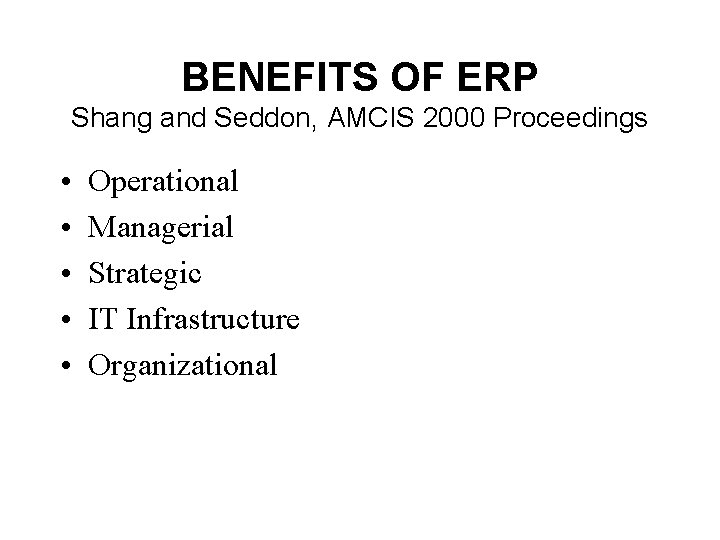
BENEFITS OF ERP Shang and Seddon, AMCIS 2000 Proceedings • • • Operational Managerial Strategic IT Infrastructure Organizational
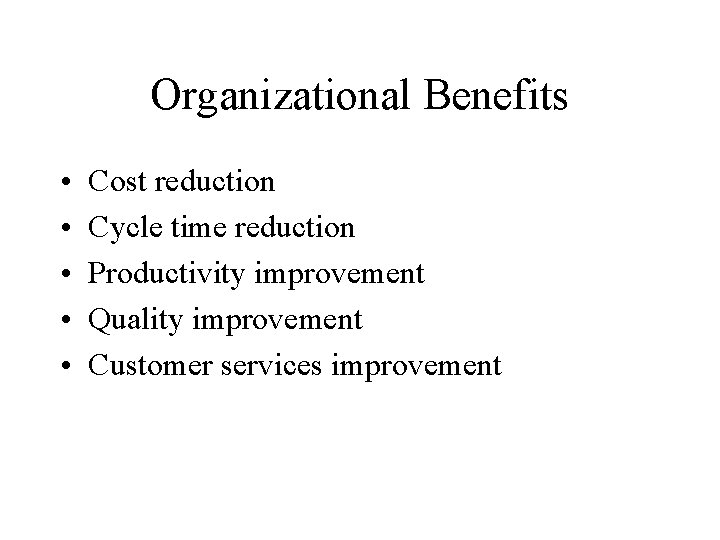
Organizational Benefits • • • Cost reduction Cycle time reduction Productivity improvement Quality improvement Customer services improvement
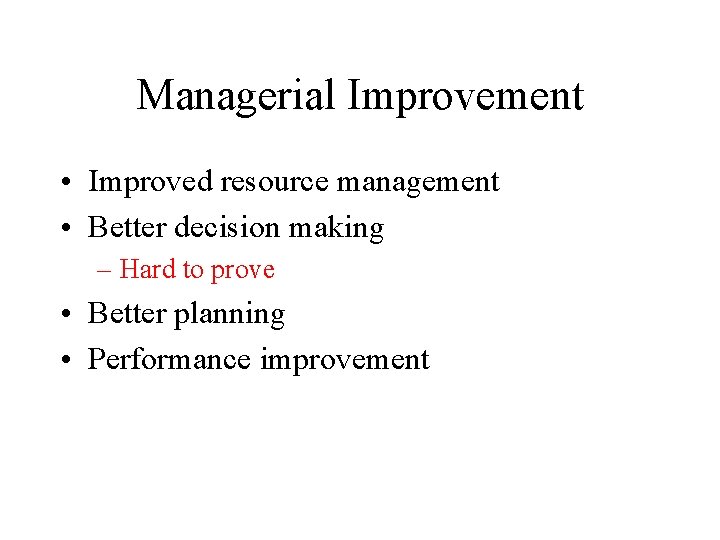
Managerial Improvement • Improved resource management • Better decision making – Hard to prove • Better planning • Performance improvement
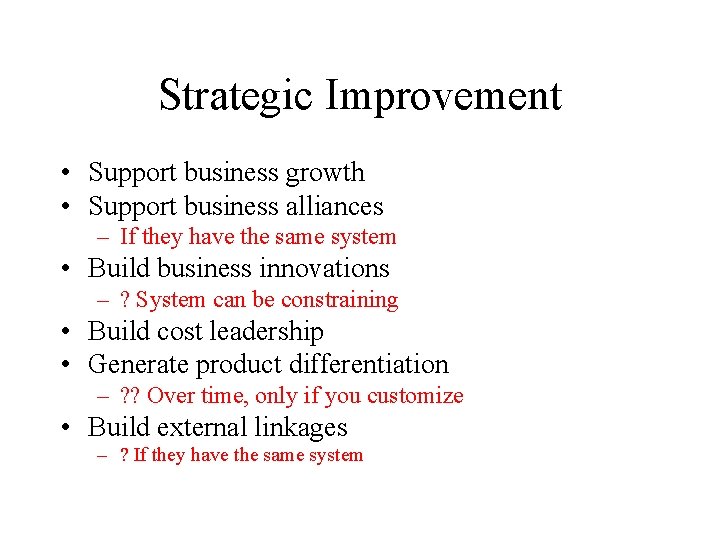
Strategic Improvement • Support business growth • Support business alliances – If they have the same system • Build business innovations – ? System can be constraining • Build cost leadership • Generate product differentiation – ? ? Over time, only if you customize • Build external linkages – ? If they have the same system
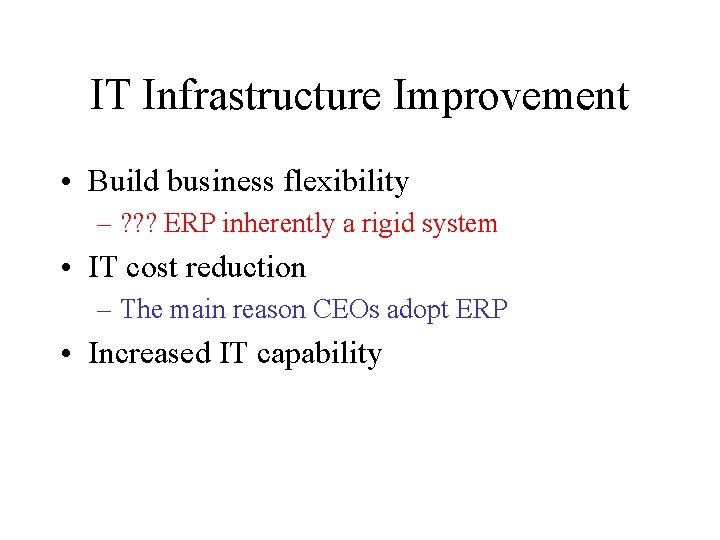
IT Infrastructure Improvement • Build business flexibility – ? ? ? ERP inherently a rigid system • IT cost reduction – The main reason CEOs adopt ERP • Increased IT capability
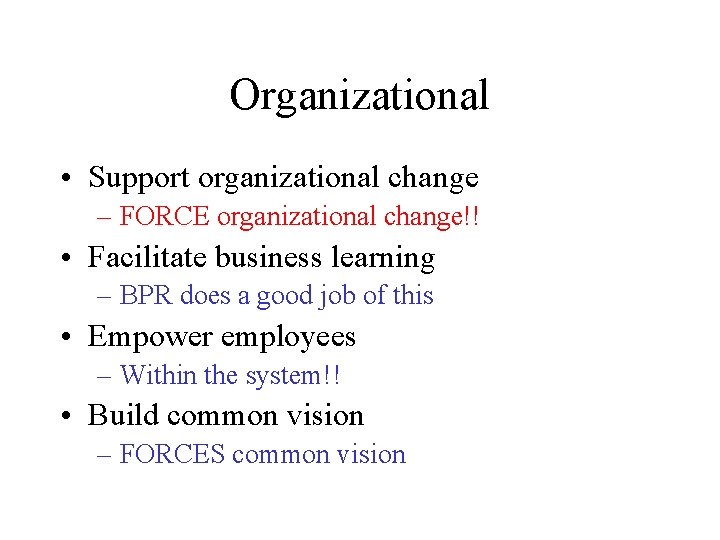
Organizational • Support organizational change – FORCE organizational change!! • Facilitate business learning – BPR does a good job of this • Empower employees – Within the system!! • Build common vision – FORCES common vision
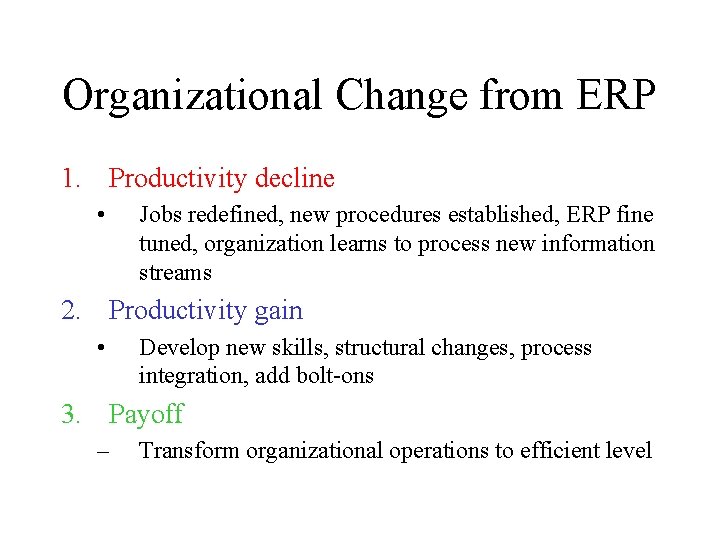
Organizational Change from ERP 1. Productivity decline • Jobs redefined, new procedures established, ERP fine tuned, organization learns to process new information streams 2. Productivity gain • Develop new skills, structural changes, process integration, add bolt-ons 3. Payoff – Transform organizational operations to efficient level
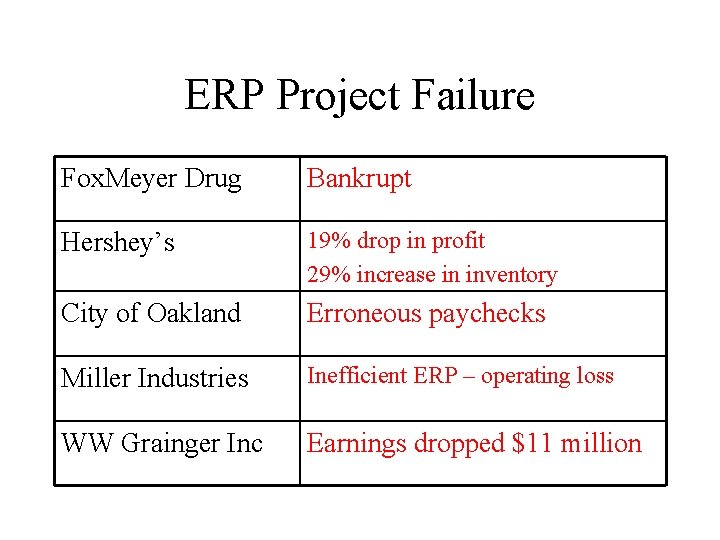
ERP Project Failure Fox. Meyer Drug Bankrupt Hershey’s 19% drop in profit 29% increase in inventory City of Oakland Erroneous paychecks Miller Industries Inefficient ERP – operating loss WW Grainger Inc Earnings dropped $11 million
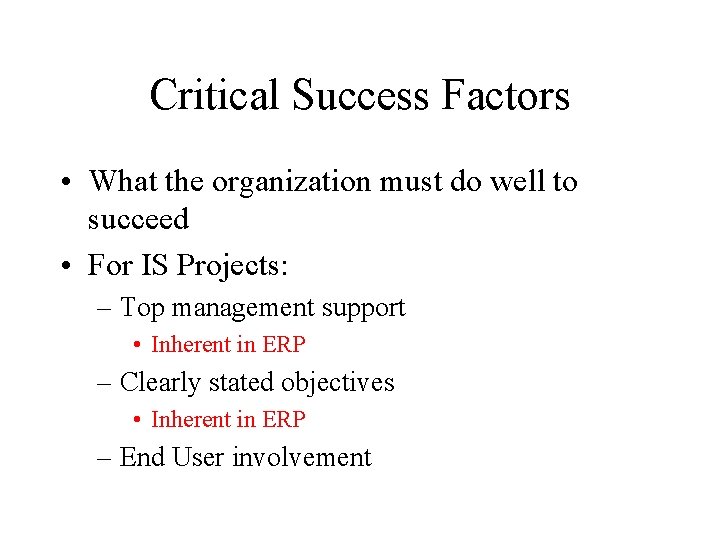
Critical Success Factors • What the organization must do well to succeed • For IS Projects: – Top management support • Inherent in ERP – Clearly stated objectives • Inherent in ERP – End User involvement
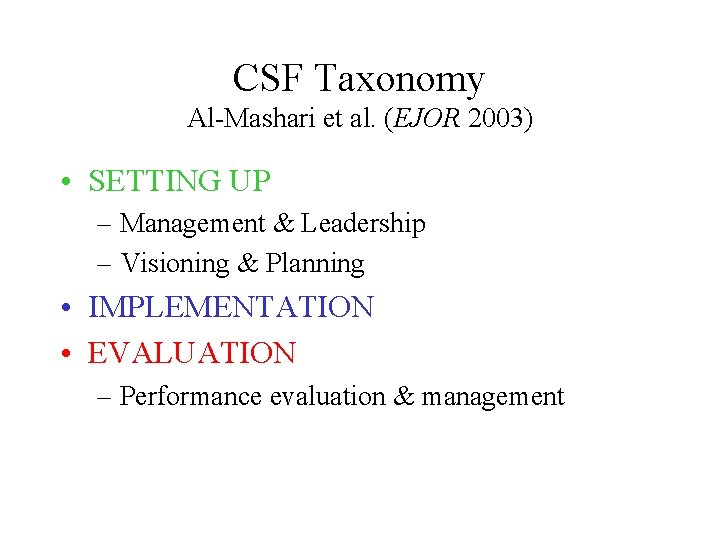
CSF Taxonomy Al-Mashari et al. (EJOR 2003) • SETTING UP – Management & Leadership – Visioning & Planning • IMPLEMENTATION • EVALUATION – Performance evaluation & management
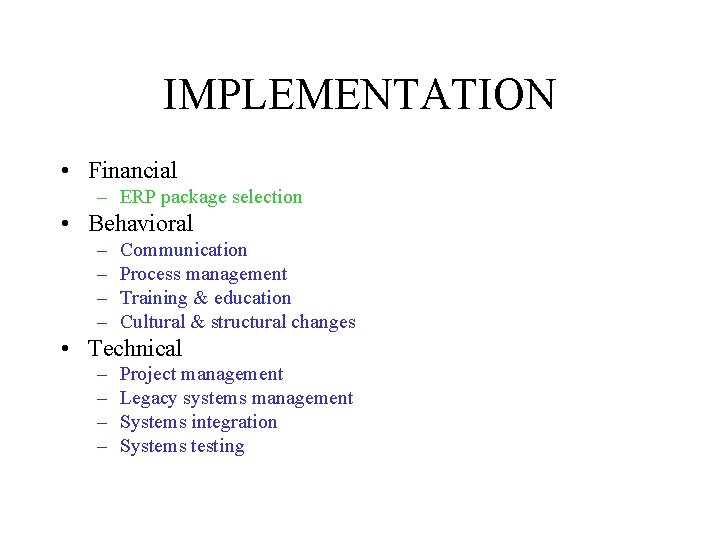
IMPLEMENTATION • Financial – ERP package selection • Behavioral – – Communication Process management Training & education Cultural & structural changes • Technical – – Project management Legacy systems management Systems integration Systems testing
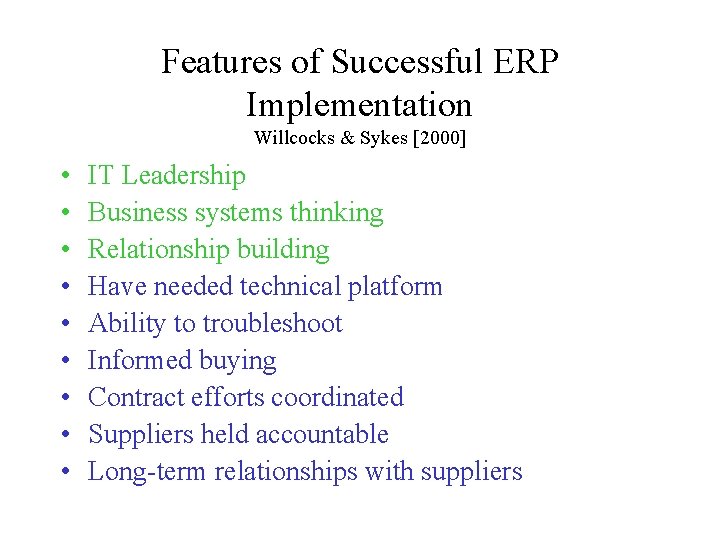
Features of Successful ERP Implementation Willcocks & Sykes [2000] • • • IT Leadership Business systems thinking Relationship building Have needed technical platform Ability to troubleshoot Informed buying Contract efforts coordinated Suppliers held accountable Long-term relationships with suppliers
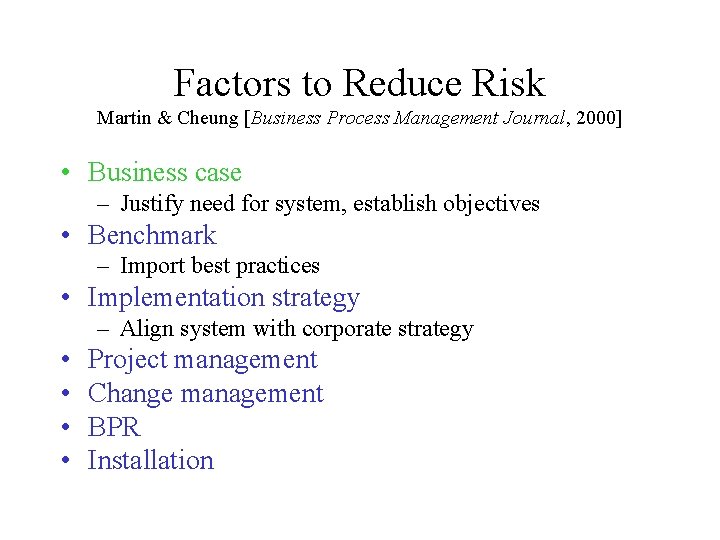
Factors to Reduce Risk Martin & Cheung [Business Process Management Journal, 2000] • Business case – Justify need for system, establish objectives • Benchmark – Import best practices • Implementation strategy – Align system with corporate strategy • • Project management Change management BPR Installation
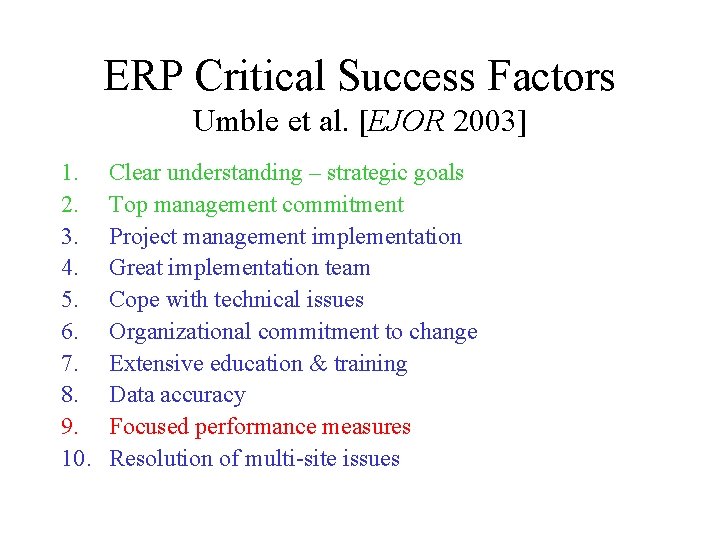
ERP Critical Success Factors Umble et al. [EJOR 2003] 1. 2. 3. 4. 5. 6. 7. 8. 9. 10. Clear understanding – strategic goals Top management commitment Project management implementation Great implementation team Cope with technical issues Organizational commitment to change Extensive education & training Data accuracy Focused performance measures Resolution of multi-site issues
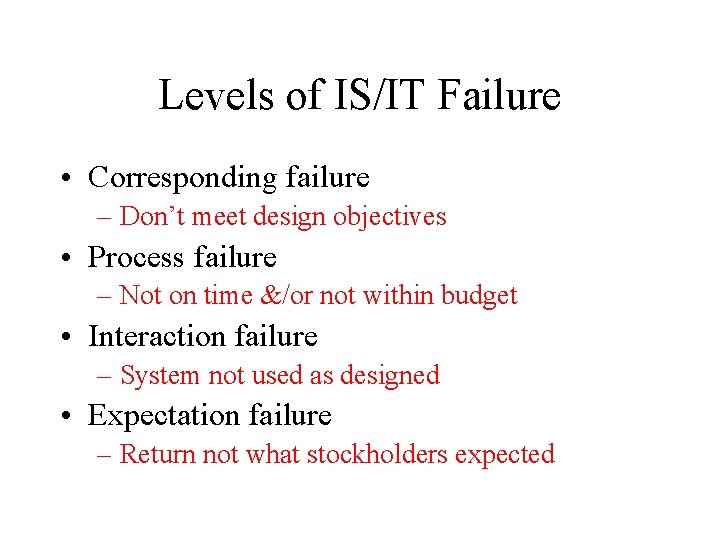
Levels of IS/IT Failure • Corresponding failure – Don’t meet design objectives • Process failure – Not on time &/or not within budget • Interaction failure – System not used as designed • Expectation failure – Return not what stockholders expected
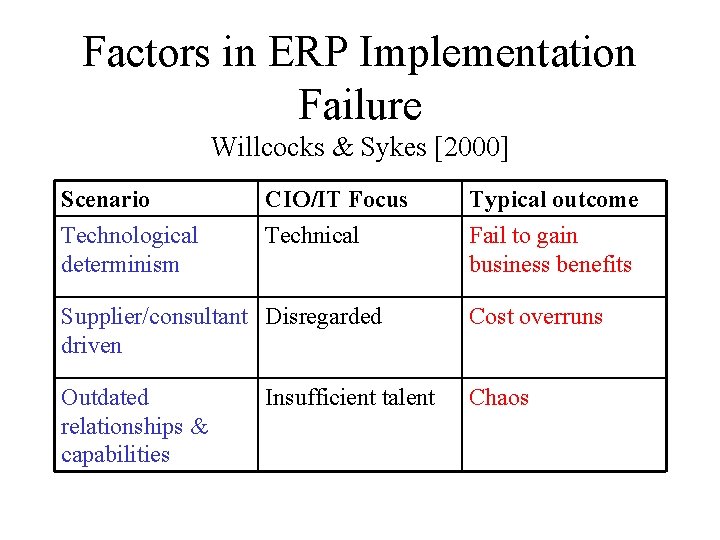
Factors in ERP Implementation Failure Willcocks & Sykes [2000] Scenario Technological determinism CIO/IT Focus Technical Typical outcome Fail to gain business benefits Supplier/consultant Disregarded driven Cost overruns Outdated relationships & capabilities Chaos Insufficient talent
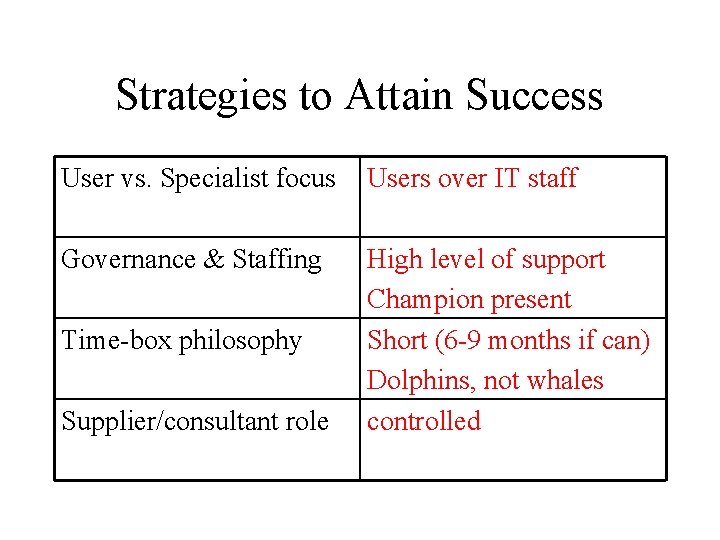
Strategies to Attain Success User vs. Specialist focus Users over IT staff Governance & Staffing High level of support Champion present Short (6 -9 months if can) Dolphins, not whales controlled Time-box philosophy Supplier/consultant role
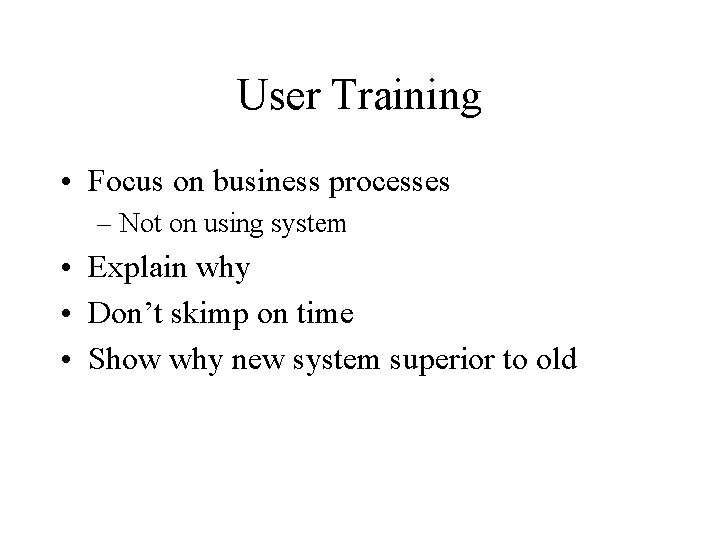
User Training • Focus on business processes – Not on using system • Explain why • Don’t skimp on time • Show why new system superior to old
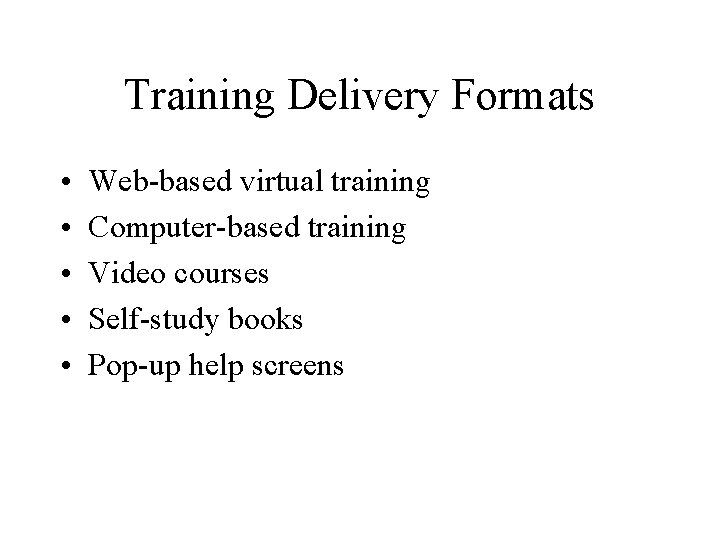
Training Delivery Formats • • • Web-based virtual training Computer-based training Video courses Self-study books Pop-up help screens
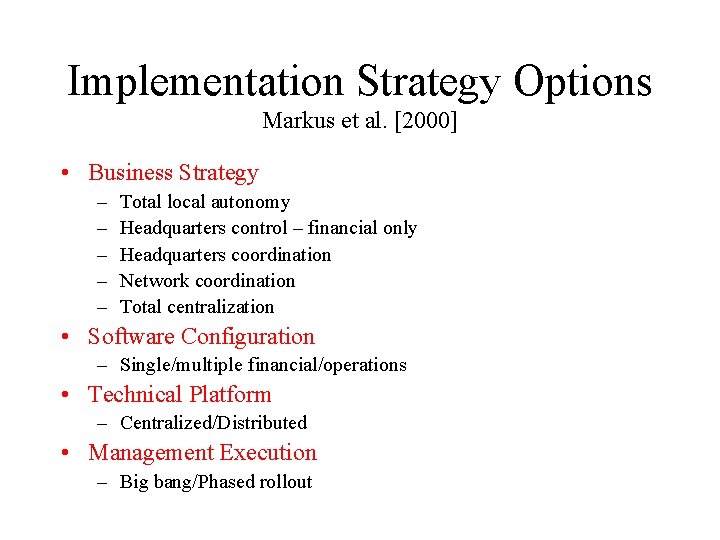
Implementation Strategy Options Markus et al. [2000] • Business Strategy – – – Total local autonomy Headquarters control – financial only Headquarters coordination Network coordination Total centralization • Software Configuration – Single/multiple financial/operations • Technical Platform – Centralized/Distributed • Management Execution – Big bang/Phased rollout
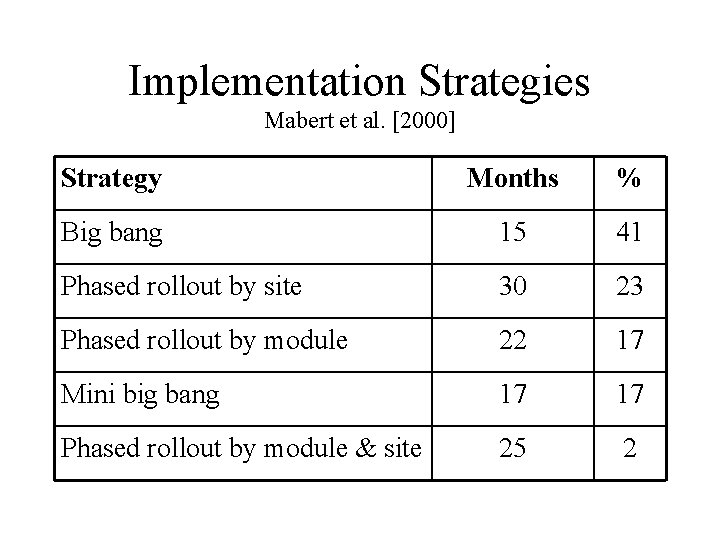
Implementation Strategies Mabert et al. [2000] Strategy Months % Big bang 15 41 Phased rollout by site 30 23 Phased rollout by module 22 17 Mini big bang 17 17 Phased rollout by module & site 25 2
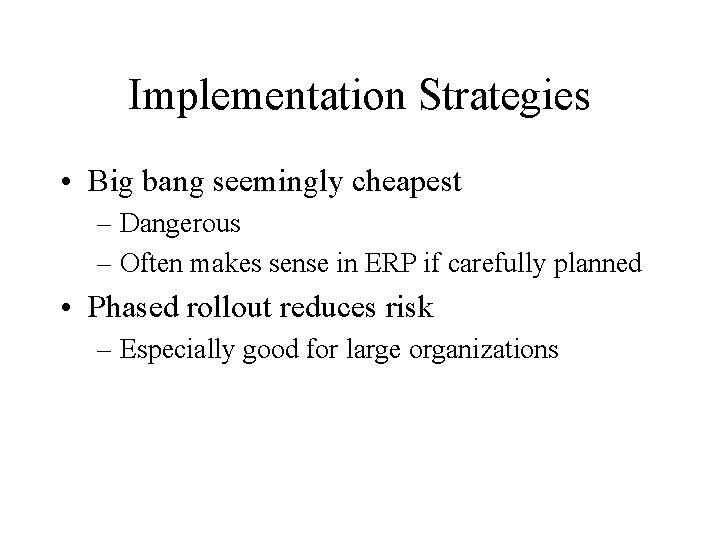
Implementation Strategies • Big bang seemingly cheapest – Dangerous – Often makes sense in ERP if carefully planned • Phased rollout reduces risk – Especially good for large organizations
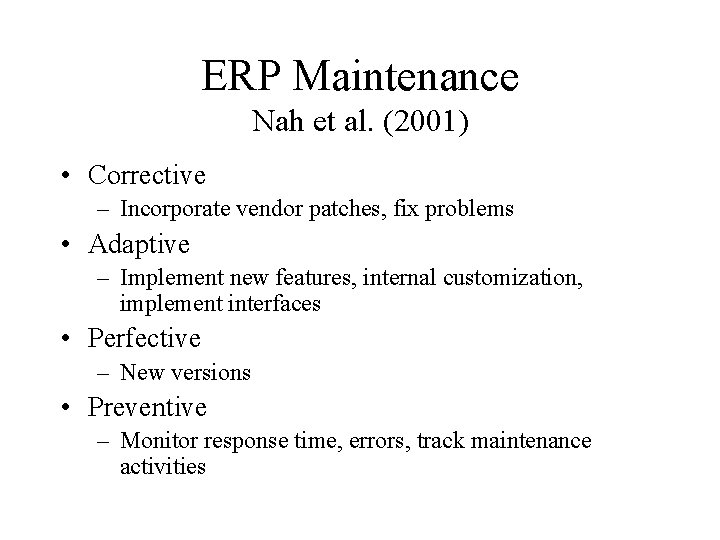
ERP Maintenance Nah et al. (2001) • Corrective – Incorporate vendor patches, fix problems • Adaptive – Implement new features, internal customization, implement interfaces • Perfective – New versions • Preventive – Monitor response time, errors, track maintenance activities
ERP System Migration • Over time, need to adopt changes – Minor modifications – Maybe system replacement – Vendors change products • WHY – The longer the time between upgrades, the harder – Easier to support a smaller number of software versions – Migrations can increase sales of seats, add-ons
User Reasons to Migrate • • Added functionality Compliance with new standards Discontinued vendor support Customer problems in linked systems
Summary • Time, cost, functionality tradeoff – In ERP, functionality the most important • Critical success factors – Top support & clear objectives inherent in ERP – Need User Involvement • Phased implementation reduces risk – but increases time • Once installed, still many pitfalls – Vendors change products – User training critical