
HOUGH TRANSFORM Presentation by Sumit Tandon Department of
HOUGH TRANSFORM Presentation by Sumit Tandon Department of Electrical Engineering University of Texas at Arlington Course # EE 6358 Computer Vision
Contents o Introduction o Advantages of Hough transform o Hough Transform for Straight Line Detection o Hough Transform for Circle Detection o Recap and list of parameters o Generalized Hough Transform o Improvisation of Hough Transform o Examples o References EE 6358 - Computer Vision 2
1. Introduction o Performed after Edge Detection o It is a technique to isolate the curves of a given shape / shapes in a given image o Classical Hough Transform can locate regular curves like straight lines, circles, parabolas, ellipses, etc. n Requires that the curve be specified in some parametric form o Generalized Hough Transform can be used where a simple analytic description of feature is not possible EE 6358 - Computer Vision 3
2. Advantages of Hough Transform o The Hough Transform is tolerant of gaps in the edges o It is relatively unaffected by noise o It is also unaffected by occlusion in the image EE 6358 - Computer Vision 4
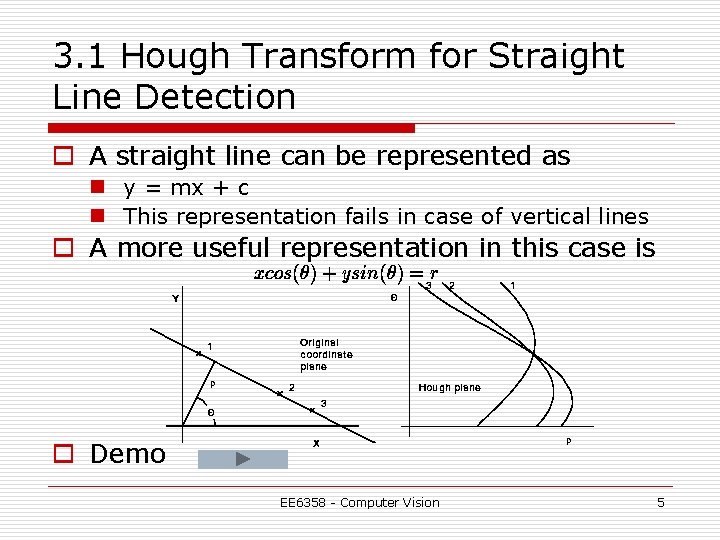
3. 1 Hough Transform for Straight Line Detection o A straight line can be represented as n y = mx + c n This representation fails in case of vertical lines o A more useful representation in this case is o Demo EE 6358 - Computer Vision 5
3. 2 Hough Transform for Straight Lines o Advantages of Parameterization n Values of ‘r’ and ‘q’ become bounded o How to find intersection of the parametric curves n Use of accumulator arrays – concept of ‘Voting’ n To reduce the computational load use Gradient information EE 6358 - Computer Vision 6
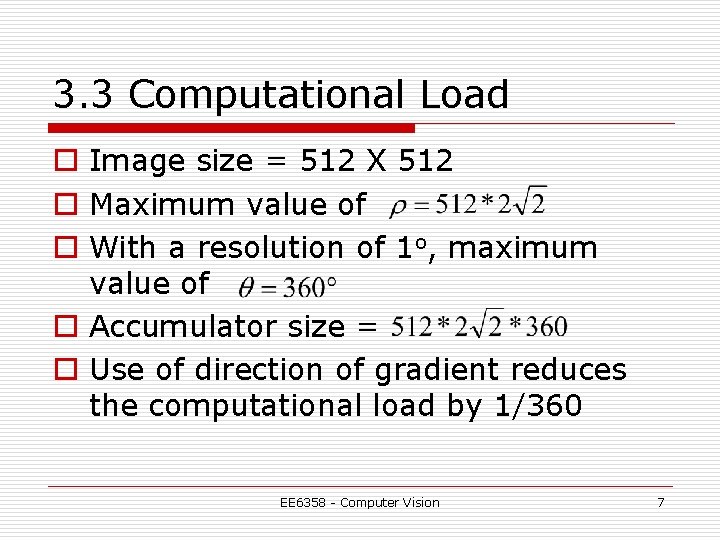
3. 3 Computational Load o Image size = 512 X 512 o Maximum value of o With a resolution of 1 o, maximum value of o Accumulator size = o Use of direction of gradient reduces the computational load by 1/360 EE 6358 - Computer Vision 7
3. 4 Hough Transform for Straight Lines - Algorithm o Quantize the Hough Transform space: identify the maximum and minimum values of r and q o Generate an accumulator array A(r, q); set all values to zero o For all edge points (xi, yi) in the image n Use gradient direction for q n Compute r from the equation n Increment A(r, q) by one o For all cells in A(r, q) n Search for the maximum value of A(r, q) n Calculate the equation of the line o To reduce the effect of noise more than one element (elements in a neighborhood) in the accumulator array are increased EE 6358 - Computer Vision 8
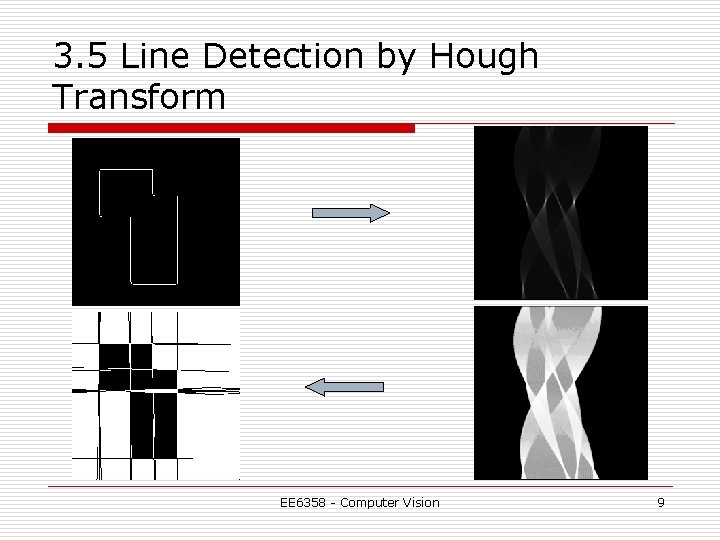
3. 5 Line Detection by Hough Transform EE 6358 - Computer Vision 9
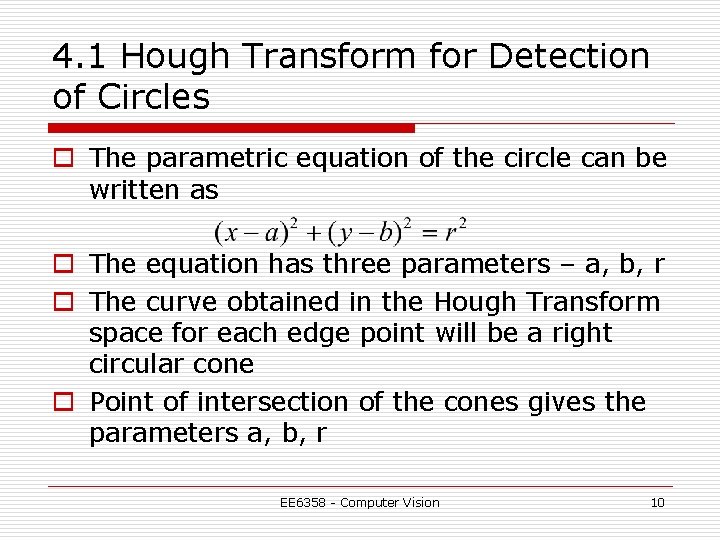
4. 1 Hough Transform for Detection of Circles o The parametric equation of the circle can be written as o The equation has three parameters – a, b, r o The curve obtained in the Hough Transform space for each edge point will be a right circular cone o Point of intersection of the cones gives the parameters a, b, r EE 6358 - Computer Vision 10
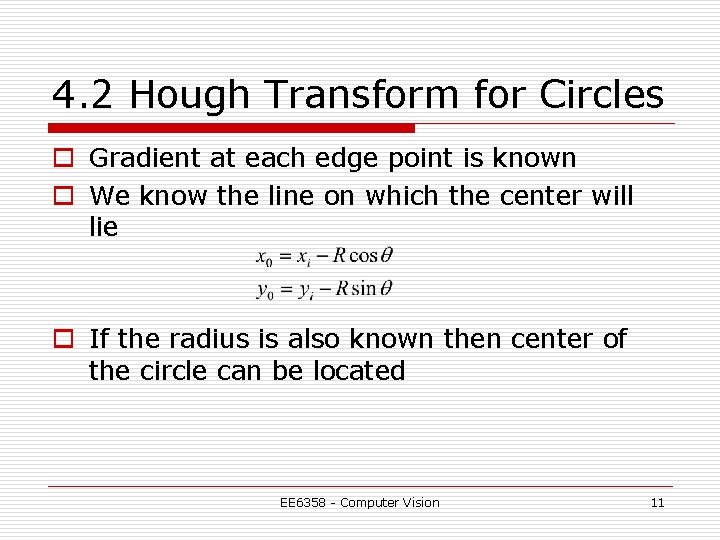
4. 2 Hough Transform for Circles o Gradient at each edge point is known o We know the line on which the center will lie o If the radius is also known then center of the circle can be located EE 6358 - Computer Vision 11
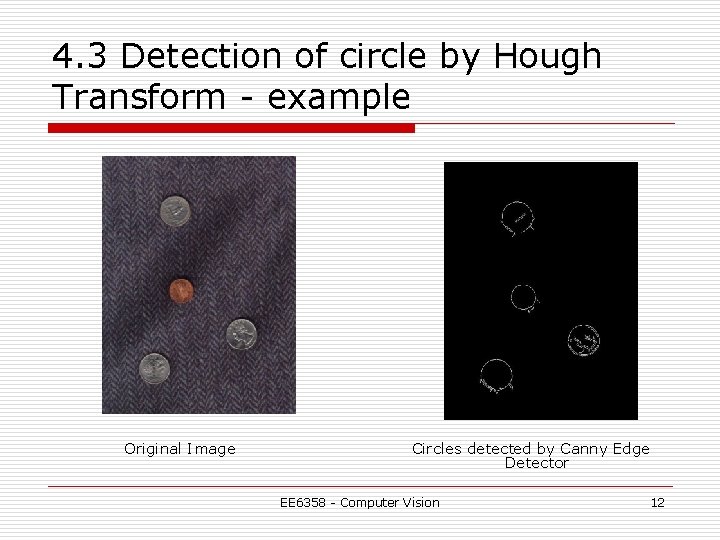
4. 3 Detection of circle by Hough Transform - example Original Image Circles detected by Canny Edge Detector EE 6358 - Computer Vision 12
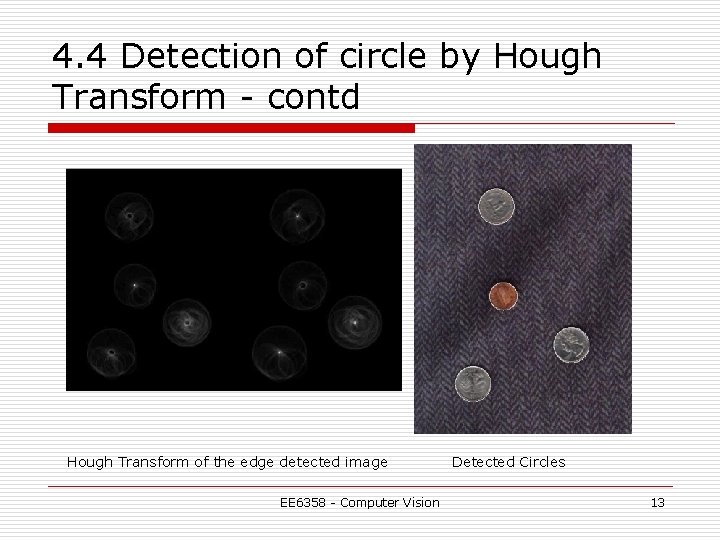
4. 4 Detection of circle by Hough Transform - contd Hough Transform of the edge detected image EE 6358 - Computer Vision Detected Circles 13
5. 1 Recap o In detecting lines n The parameters r and q were found out relative to the origin (0, 0) o In detecting circles n The radius and center were found out o In both the cases we have knowledge of the shape o We aim to find out its location and orientation in the image o The idea can be extended to shapes like ellipses, parabolas, etc. EE 6358 - Computer Vision 14
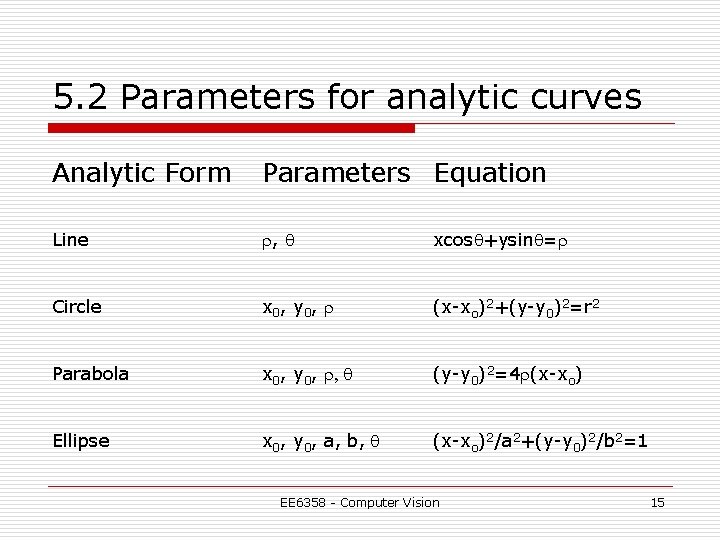
5. 2 Parameters for analytic curves Analytic Form Parameters Equation Line r, q xcosq+ysinq=r Circle x 0, y 0, r (x-xo)2+(y-y 0)2=r 2 Parabola x 0, y 0, r, q (y-y 0)2=4 r(x-xo) Ellipse x 0, y 0, a, b, q (x-xo)2/a 2+(y-y 0)2/b 2=1 EE 6358 - Computer Vision 15
6. 1 Generalized Hough Transform o The Generalized Hough transform can be used to detect arbitrary shapes o Complete specification of the exact shape of the target object is required in the form of the R-Table o Information that can be extracted are n n Location Size Orientation Number of occurrences of that particular shape EE 6358 - Computer Vision 16
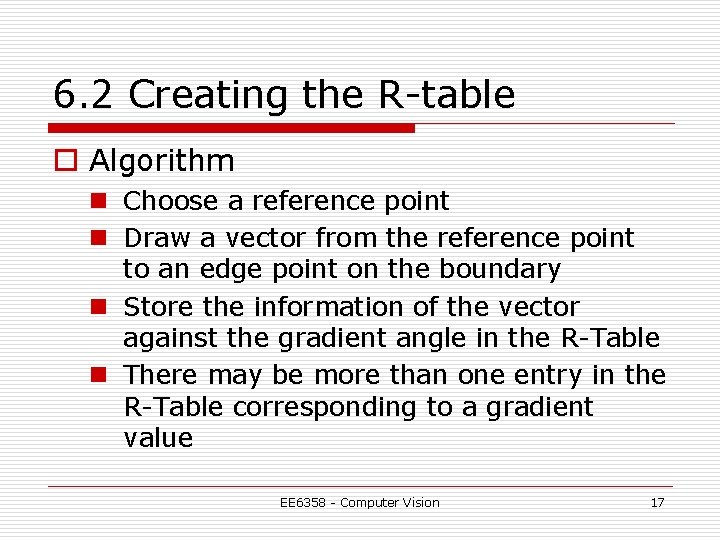
6. 2 Creating the R-table o Algorithm n Choose a reference point n Draw a vector from the reference point to an edge point on the boundary n Store the information of the vector against the gradient angle in the R-Table n There may be more than one entry in the R-Table corresponding to a gradient value EE 6358 - Computer Vision 17
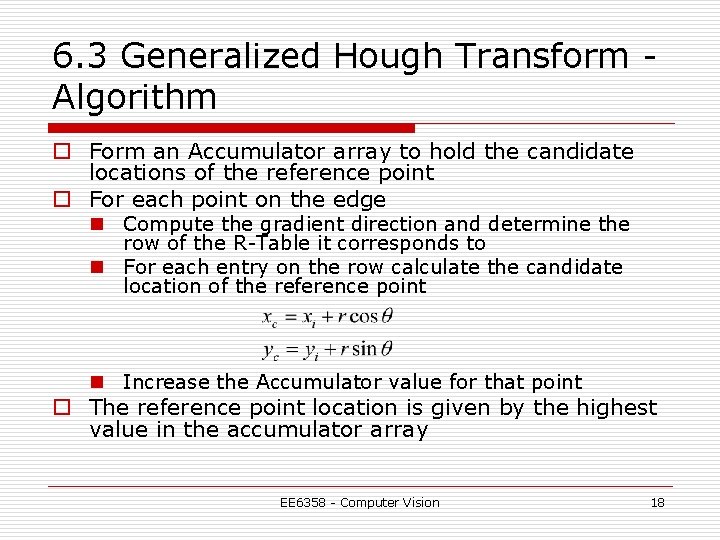
6. 3 Generalized Hough Transform Algorithm o Form an Accumulator array to hold the candidate locations of the reference point o For each point on the edge n Compute the gradient direction and determine the row of the R-Table it corresponds to n For each entry on the row calculate the candidate location of the reference point n Increase the Accumulator value for that point o The reference point location is given by the highest value in the accumulator array EE 6358 - Computer Vision 18
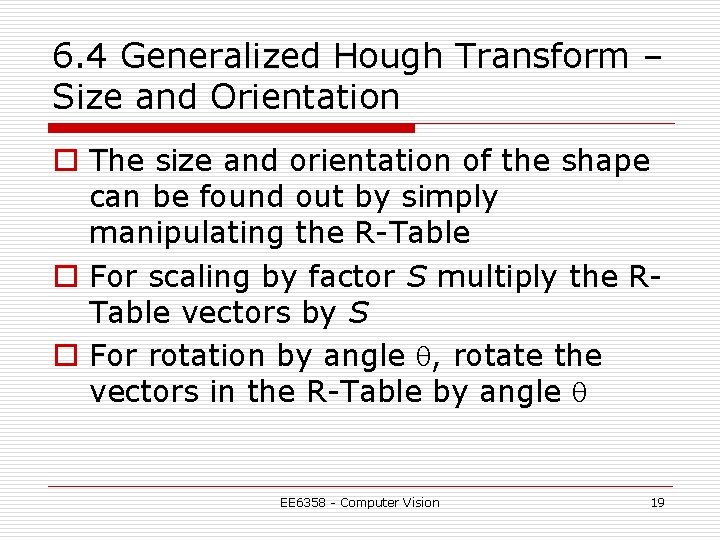
6. 4 Generalized Hough Transform – Size and Orientation o The size and orientation of the shape can be found out by simply manipulating the R-Table o For scaling by factor S multiply the RTable vectors by S o For rotation by angle q, rotate the vectors in the R-Table by angle q EE 6358 - Computer Vision 19
6. 5 Generalized Hough Transform – Advantages and disadvantages o Advantages n n A method for object recognition Robust to partial deformation in shape Tolerant to noise Can detect multiple occurrences of a shape in the same pass o Disadvantages n Lot of memory and computation is required EE 6358 - Computer Vision 20
7. 1 Improvisation of the Hough transform for detecting straight line segments o Hough Transform lacks the ability to detect the end points of lines – localized information is lost during HT o Peak points in the accumulator can be difficult to locate in presence of noisy or parallel edges o Efficiency of the algorithm decreases if image becomes too large o New approach is proposed to reduce these problems EE 6358 - Computer Vision 21
7. 2 Spatial decomposition o This technique preserves the localized information o Divide the image recursively into quad -trees, each quad-tree representing a part of the image i. e. a sub-image o The leaf nodes will be voted for feature points which are in the subimage represented by the leaf node EE 6358 - Computer Vision 22
7. 2 Spatial Decomposition of Hough Transform o Parameter space is defined from a global origin rather than a local one o Each node contains information about the sub-nodes as well as the number of feature points in the sub-image represented by the node o Pruning of sub-trees is done if the number of the feature points falls below a threshold o An accumulator is assigned for each leaf node EE 6358 - Computer Vision 23
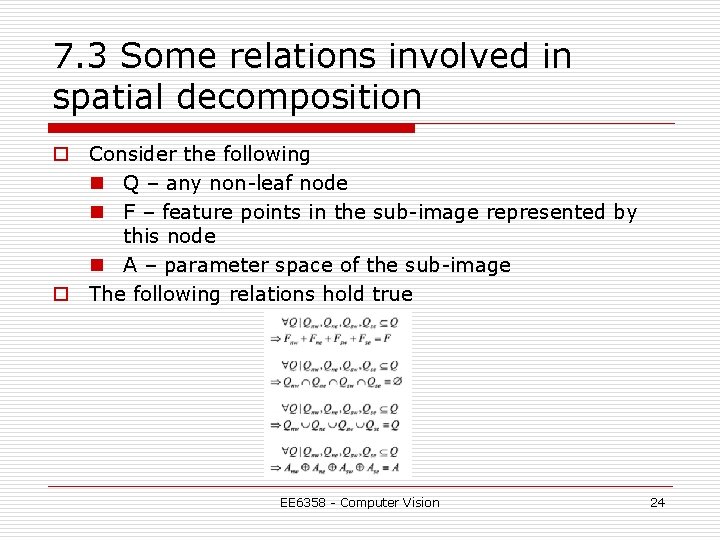
7. 3 Some relations involved in spatial decomposition o Consider the following n Q – any non-leaf node n F – feature points in the sub-image represented by this node n A – parameter space of the sub-image o The following relations hold true EE 6358 - Computer Vision 24
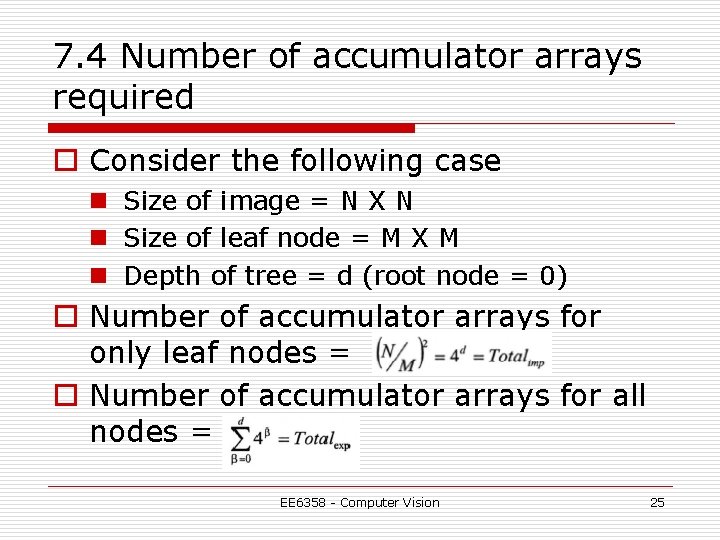
7. 4 Number of accumulator arrays required o Consider the following case n Size of image = N X N n Size of leaf node = M X M n Depth of tree = d (root node = 0) o Number of accumulator arrays for only leaf nodes = o Number of accumulator arrays for all nodes = EE 6358 - Computer Vision 25
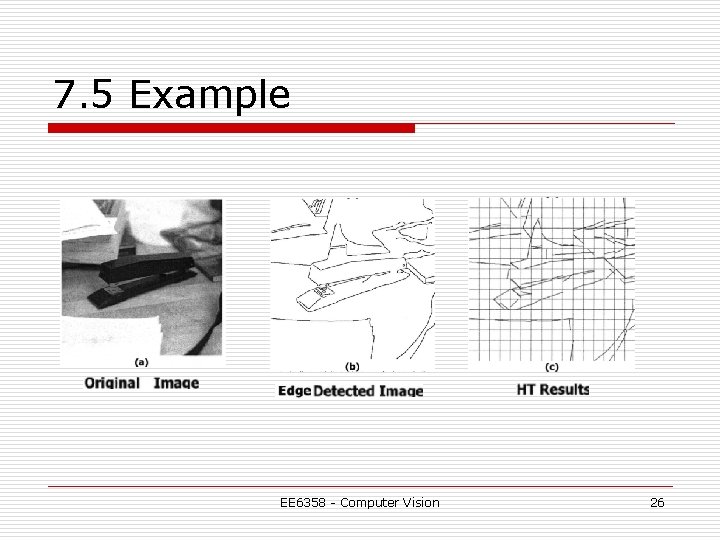
7. 5 Example EE 6358 - Computer Vision 26
References o Generalizing The Hough Transform to Detect Arbitrary Shapes – D H Ballard – 1981 o Spatial Decomposition of The Hough Transform – Heather and Yang – IEEE computer Society – May 2005 o Hypermedia Image Processing Reference 2 – http: //homepages. inf. ed. ac. uk/rbf/HIPR 2/hipr_top. ht m o Machine Vision – Ramesh Jain, Rangachar Kasturi, Brian G Schunck, Mc. Graw-Hill, 1995 o Machine Vision - Wesley E. Snyder, Hairong Qi, Cambridge University Press, 2004 EE 6358 - Computer Vision 27
- Slides: 27