
HOTK Token Draft Discussion OAuth WG IETF 84

- Slides: 12
HOTK Token Draft Discussion OAuth WG, IETF 84 Vancouver
Acknowledgements • • • John Bradley Brian Campbell Phil Hunt Leif Johansson Mike Jones Lucy Lynch Tony Nadalin Klaas Wierenga Hannes Tschofenig 12 -07 -03 CONFIDENTIAL 2
Introduction • OAuth 2 provides a number of flows to enable a client application to obtain "authorization" to access a resource in the form of a token • There a number of risks to client and server that are exposed when using bearer tokens. • Desire is to have some sort of "proof" token which validates client right to use. 12 -07 -03 CONFIDENTIAL 3
• Trust Assumptions – Tokens don't need to prove trust • Clients usually issued client identifiers by the resource site (out-of-band) – Trust evaluated during token request flows • Classic Authentication – Previously established in 2 & 3 leg flows • Solution does not have to be broad – Simple 'proof' of possession beyond simple possession is needed 12 -07 -03 CONFIDENTIAL 4
Primary Problems • Is the wielder of a token is the same entity that received the token? – In public client cases, we want to confirm the instance of the client is the same. • Token Mis-appropriation – Attack on Client – sites obtaining bearer tokens as proof of authentication become subject to attack (Facebook Graph Attack) – Attack on Resource – using a stolen token to access a protected resource. – Examples: Cloning of device, bad proxy 12 -07 -03 CONFIDENTIAL 5
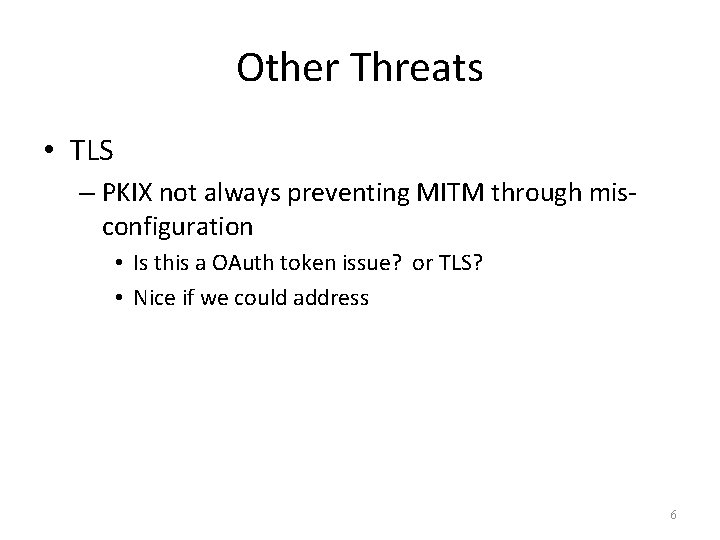
Other Threats • TLS – PKIX not always preventing MITM through misconfiguration • Is this a OAuth token issue? or TLS? • Nice if we could address 12 -07 -03 CONFIDENTIAL 6
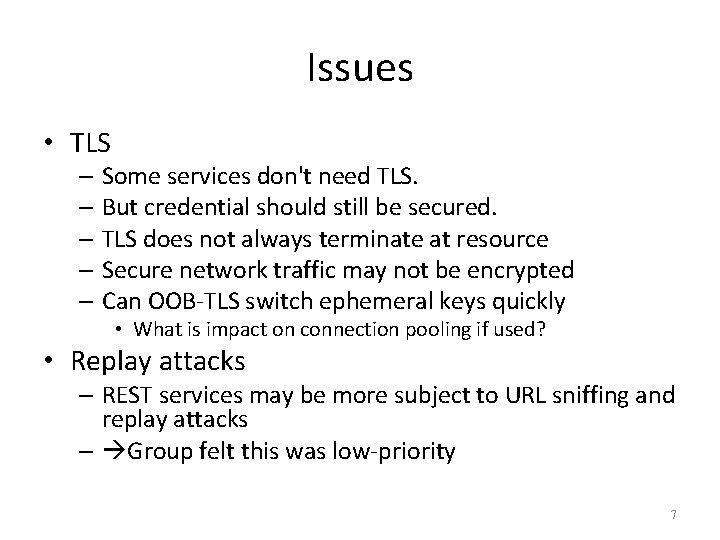
Issues • TLS – Some services don't need TLS. – But credential should still be secured. – TLS does not always terminate at resource – Secure network traffic may not be encrypted – Can OOB-TLS switch ephemeral keys quickly • What is impact on connection pooling if used? • Replay attacks – REST services may be more subject to URL sniffing and replay attacks – Group felt this was low-priority 12 -07 -03 CONFIDENTIAL 7
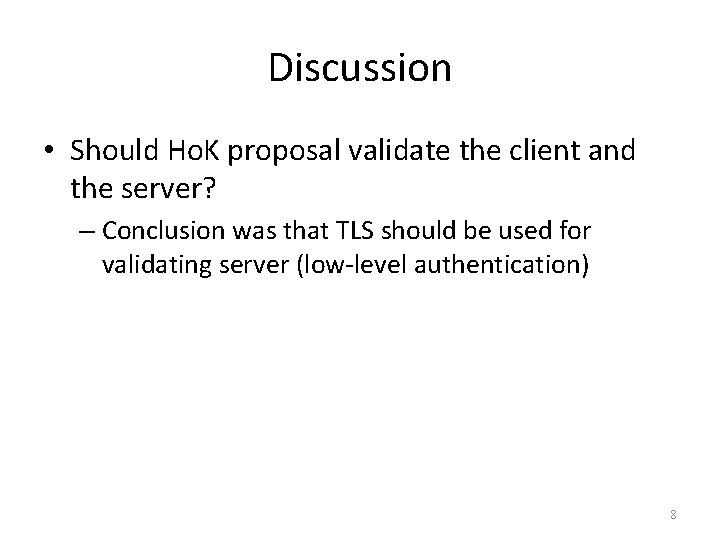
Discussion • Should Ho. K proposal validate the client and the server? – Conclusion was that TLS should be used for validating server (low-level authentication) 12 -07 -03 CONFIDENTIAL 8
3 CASES 12 -07 -03 CONFIDENTIAL 9
Case 1: TLS as Proof of Key • A public client accesses a resource over TLS – Original draft proposal from Hannes – Uses TLS as both two-way authentication and secure communication – TLS itself is the Ho. K proof for access token – Easy for mobile clients to use – For confidential clients connection pooling may be a challenge 8/2/12 10
Case 2: Separate TLS / Key Proof • Intended for confidential clients accessing resources with many tokens. • TLS channel is established as either one-way or two-way – Potentially based on client app private key • TLS not altered per token. • Separate token proof is used within authentication header • Works for TLS terminating at load balancers 12 -07 -03 CONFIDENTIAL 11
Case 3: Non-Secure Resources • TLS is not used • Token Proof used to both protect token and validate client right to use • Provides marginal improvement over browser scenarios using unprotected cookies or basic authentication credentials • A simple variation (no-TLS) of Case 2 12 -07 -03 CONFIDENTIAL 12