
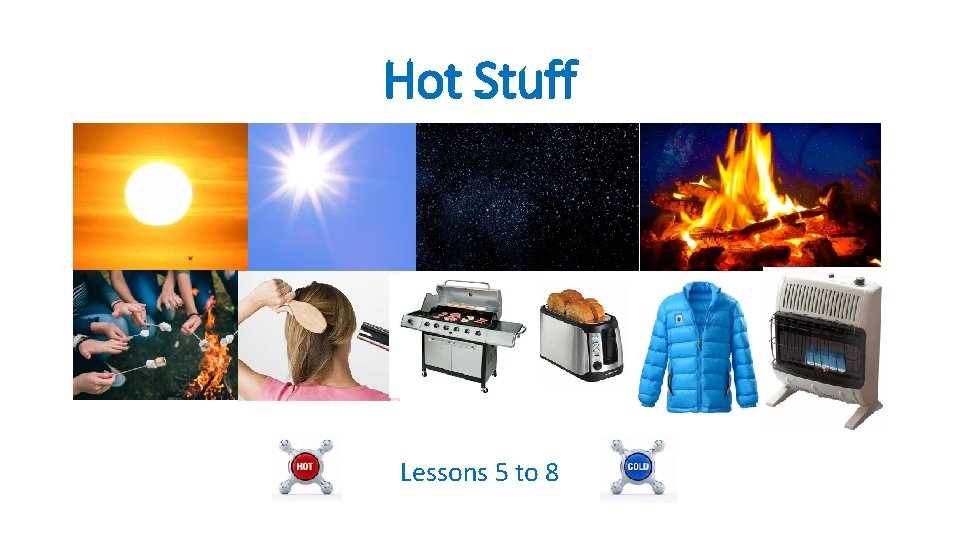
Hot Stuff Lessons 5 to 8 Lesson 5
- Slides: 61
Hot Stuff Lessons 5 to 8
Lesson 5: Hot spoon, cool spoon • Working in groups, we explore the transfer of heat in metals and non-metals. • We then participate in a class investigation to determine which metal: copper, iron or aluminium, is the best heat conductor. • Finally we use your understanding of phonons to explain heat transfer.
Lesson 3 learning intentions Students will: • know that heat can be transferred in solids by conduction • understand that heat is transferred by phonon vibrations travelling and creating vibrations at other places • explain why metals conduct heat better than non-metals • know that metals conduct heat at different rates.
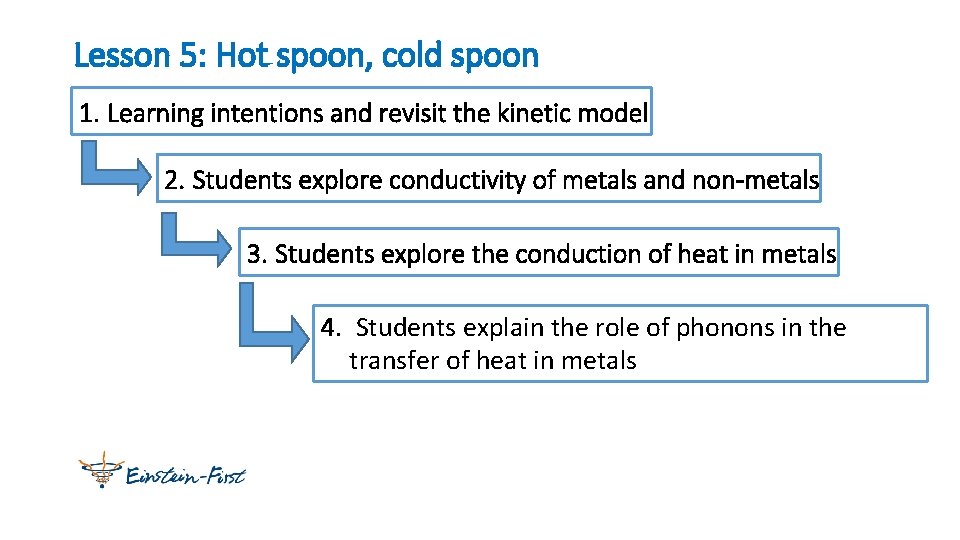
Lesson 5: Hot spoon, cold spoon 1. Learning intentions and revisit the kinetic model 2. Students explore conductivity of metals and non-metals 3. Students explore the conduction of heat in metals 4. Students explain the role of phonons in the transfer of heat in metals
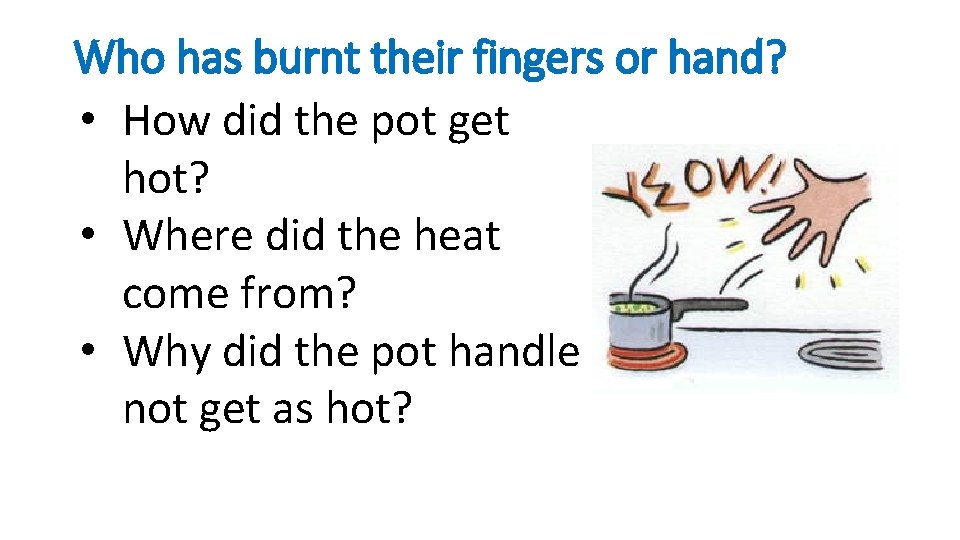
Who has burnt their fingers or hand? • How did the pot get hot? • Where did the heat come from? • Why did the pot handle not get as hot?
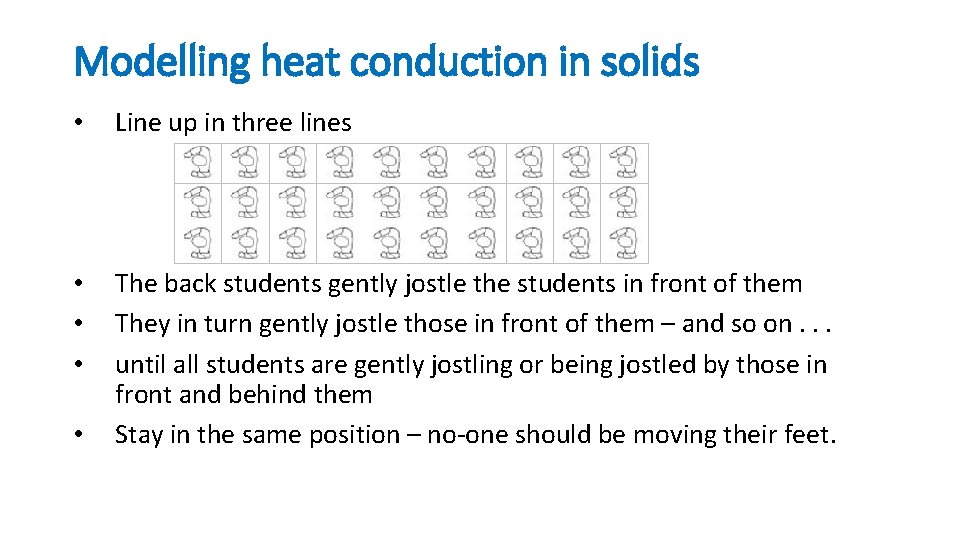
Modelling heat conduction in solids • Line up in three lines • • • The back students gently jostle the students in front of them They in turn gently jostle those in front of them – and so on. . . until all students are gently jostling or being jostled by those in front and behind them Stay in the same position – no-one should be moving their feet. •
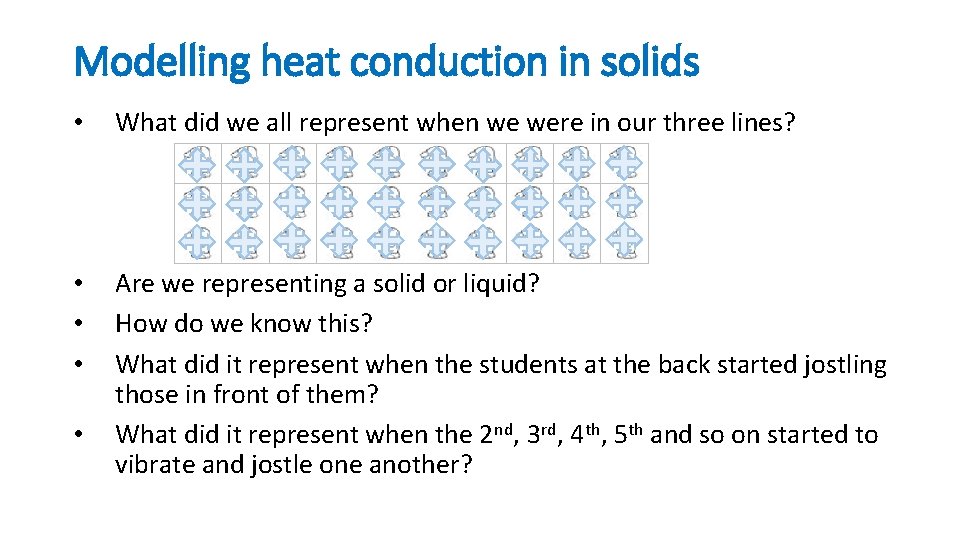
Modelling heat conduction in solids • What did we all represent when we were in our three lines? • • • Are we representing a solid or liquid? How do we know this? What did it represent when the students at the back started jostling those in front of them? What did it represent when the 2 nd, 3 rd, 4 th, 5 th and so on started to vibrate and jostle one another? •
Heat conduction Heat Transfer - Conduction https: //youtu. be/9 jo. LYfayee 8? t=15 • Now that you have seen the video, compare the heat conduction model in the video with your ‘human line’ model. • Which is best in helping you understand conduction? • Be sure to give a reason why. The model which helped me understand conduction the best was the [‘human line’ or ‘vibrating ball’ model] because. . .
Three spoons • investigate whether a wooden, plastic or metal spoon transfers heat most quickly. • Record results and observations in your science journal.
Three spoons • Which spoon was the best conductor? • What is heat ‘conduction’? • What is a heat ‘conductor’? • Who has heard the work insulator? • What is a heat ‘insulator’? • Who can give me an example of a heat insulator? • Can anyone explain what ‘insulation’ is?
Magic of metals Why are metals conductors while. . . non-metals like plastic are insulators? ‘Sea’ of electrons • Atoms in metals are packed closely which let phonons together with a ‘sea’ of electrons move through very quickly. between them. • The phonons, or ‘bundles’ of vibrations, pass very quickly through the ‘sea’ of electrons. Metal atoms packed in a very neat pattern. • So the metal conducts heat very well. • In non-metals like plastic, all electrons are used ìn bonding and are not free to allow phonons to move through them very easily.
Lesson 6: How hot is it? In this lesson we recognise heat and measure its effect using a thermometer. We also examine and use different types of thermometers and using a spirit or digital thermometer read temperatures in °C (degrees Celsius).
Lesson 6 learning intentions Students will: • • • measure temperature using a digital and standard spirit thermometer know that degrees Celsius, written °C, is the unit used when measuring temperature explain that temperature is a measure of how fast atoms and molecules move.
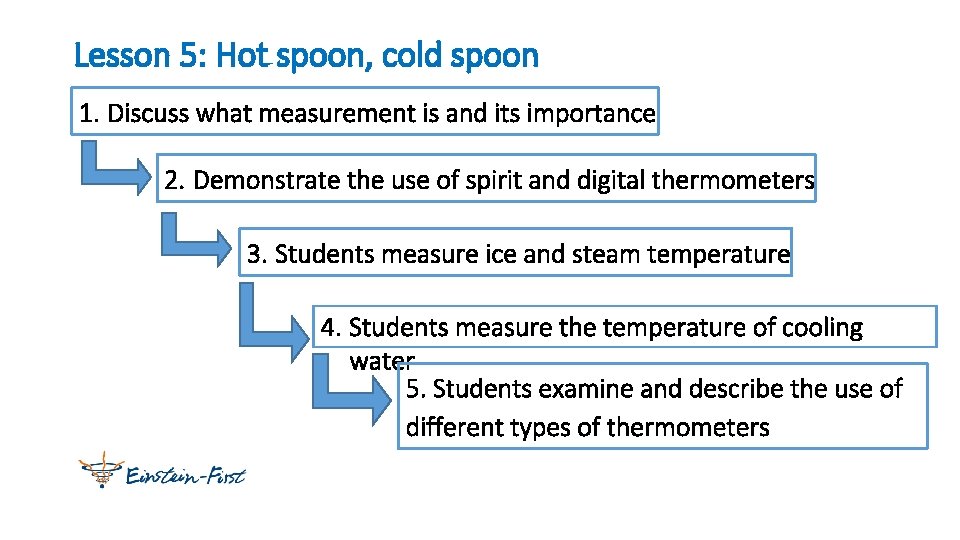
Lesson 5: Hot spoon, cold spoon 1. Discuss what measurement is and its importance 2. Demonstrate the use of spirit and digital thermometers 3. Students measure ice and steam temperature 4. Students measure the temperature of cooling water 5. Students examine and describe the use of different types of thermometers
Do you remember? • What is heat? Ø Heat is the energy of moving atoms and molecules which vibrate and transfer their vibrational energy to other places. • What are phonons? Ø Tiny ‘bundles’ of vibrational energy. • What happens to the movement of the atoms and molecules when something gets hotter? Ø The hotter an object is the more phonons there and the faster the atoms and molecules vibrate.
Measuring things • What is measurement? Ø Measurement uses an instrument of some sort, for example ruler or bathroom scales, to find the size, amount, weight or degree of something. Ø Measurement normally uses standard units such as metre or kilogram. Ø Two or more measurements of the same thing should be the same. Ø Measurement normally have the number and the unit used • Review activity.
Measuring temperature • • Ask students why we might want to measure the temperature of something or someone? How do we measure temperature? Is today hot or cold? How do we know? What is our body temperature? What instrument do we use to measure temperature? Does anyone know the units we use to measure temperature?
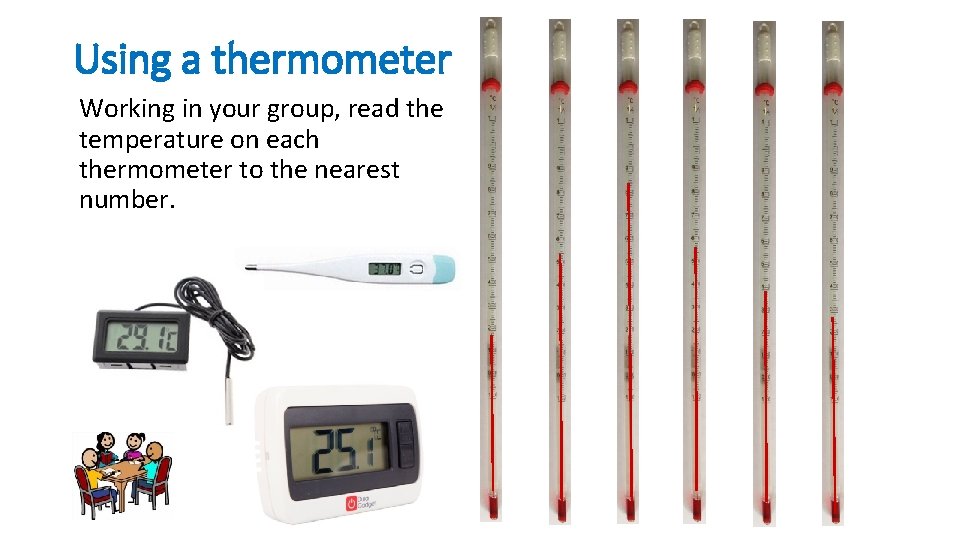
Using a thermometer Working in your group, read the temperature on each thermometer to the nearest number.
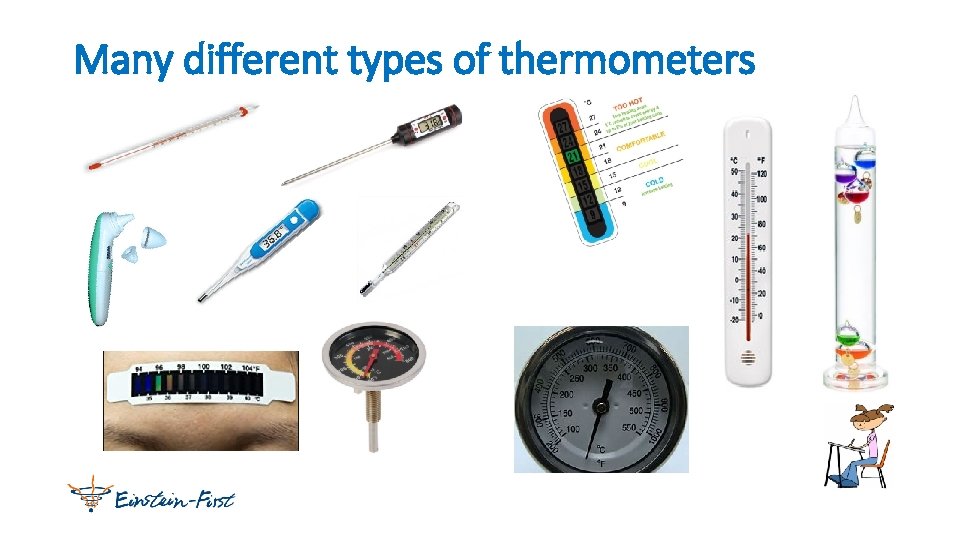
Many different types of thermometers
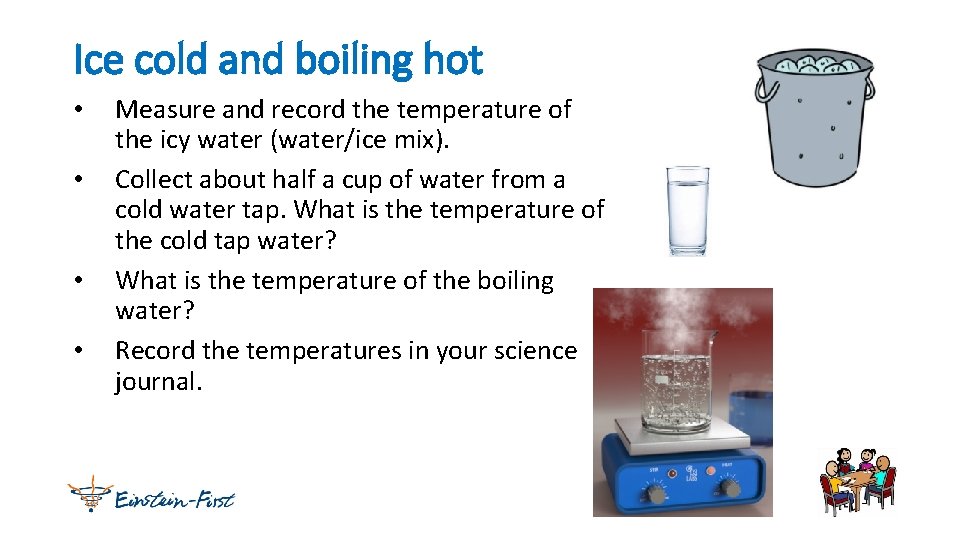
Ice cold and boiling hot • • Measure and record the temperature of the icy water (water/ice mix). Collect about half a cup of water from a cold water tap. What is the temperature of the cold tap water? What is the temperature of the boiling water? Record the temperatures in your science journal.
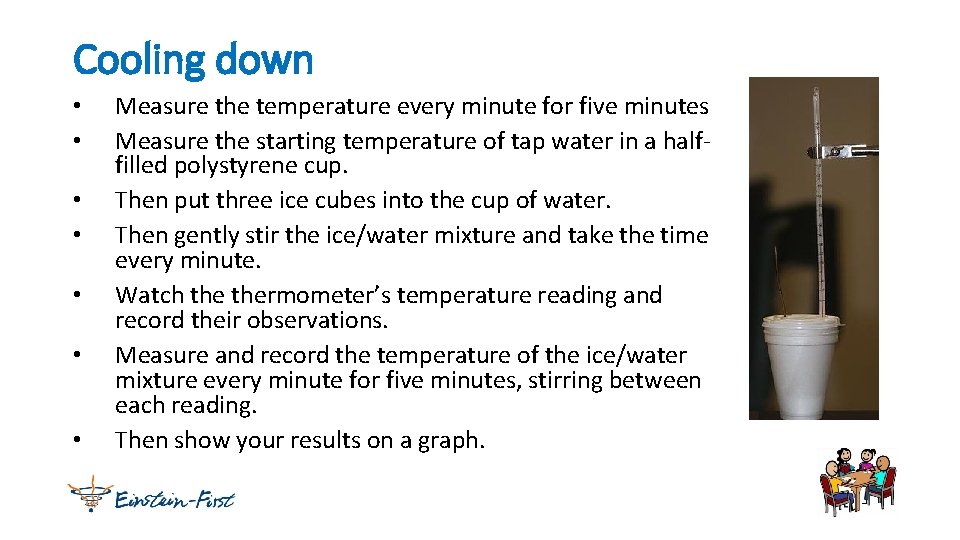
Cooling down • • Measure the temperature every minute for five minutes Measure the starting temperature of tap water in a halffilled polystyrene cup. Then put three ice cubes into the cup of water. Then gently stir the ice/water mixture and take the time every minute. Watch thermometer’s temperature reading and record their observations. Measure and record the temperature of the ice/water mixture every minute for five minutes, stirring between each reading. Then show your results on a graph.
Cooling down discussion What happened to the temperature of the water? What happened to the ice? Why did we need to continually stir the water-ice mixture? Where did the heat energy move to? • Temperature is a measure of how fast atoms and molecules move. • Molecules which are gaining heat energy will move faster and those losing heat energy will move more slowly. Remember the simulator • • • https: //phet. colorado. edu/sims/html/states-of-matter/latest/states-of-matter_en. html
Lesson 7: Making heat In this lesson we explore ways heat can be produced and moved from one object to another. Working in groups, we conduct the activity at each ‘heat producing’ station. The activities are followed up with a discussion about sources of energy and how the energy is changed into heat energy.
Lesson 7 learning intentions Students will: • • • know that heat is produced in several ways explain that heating makes atoms and molecules vibrate more, cooling slows the vibration down explain that heating needs addition of heat energy while cooling removes heat energy.
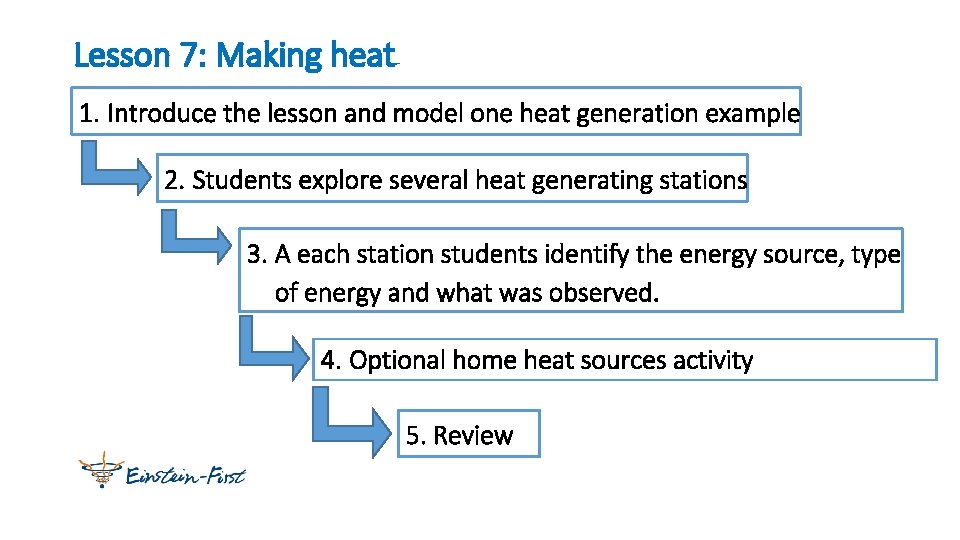
Lesson 7: Making heat 1. Introduce the lesson and model one heat generation example 2. Students explore several heat generating stations 3. A each station students identify the energy source, type of energy and what was observed. 4. Optional home heat sources activity 5. Review
Do you remember? • What is heat? Ø Heat is the energy of moving atoms and molecules which vibrate and transfer their vibrational energy to other places. • What happens to the movement of the atoms and molecules when something gets hotter? Ø The hotter an object is the more phonons there and the faster the atoms and molecules vibrate. • Does heat move from hot to cold or cold to hot? Ø Hot to cold
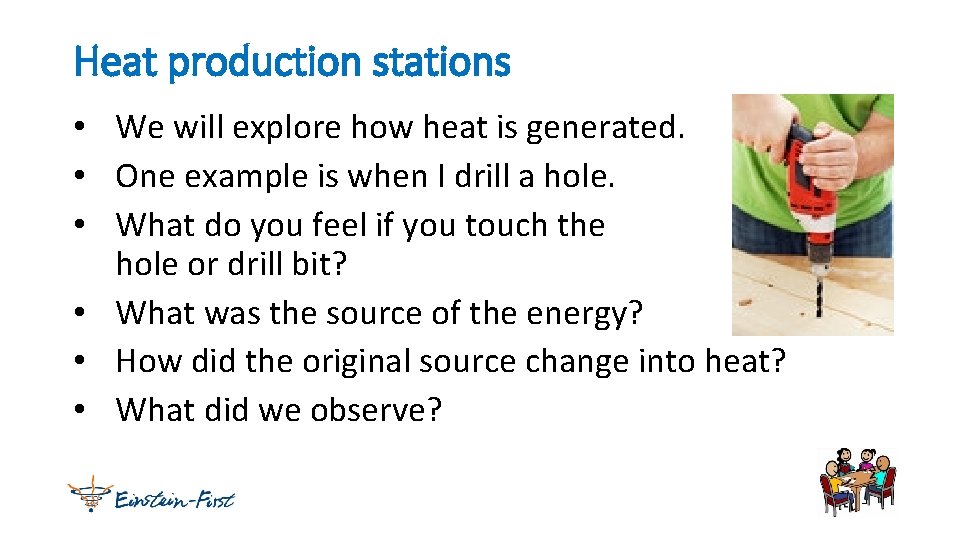
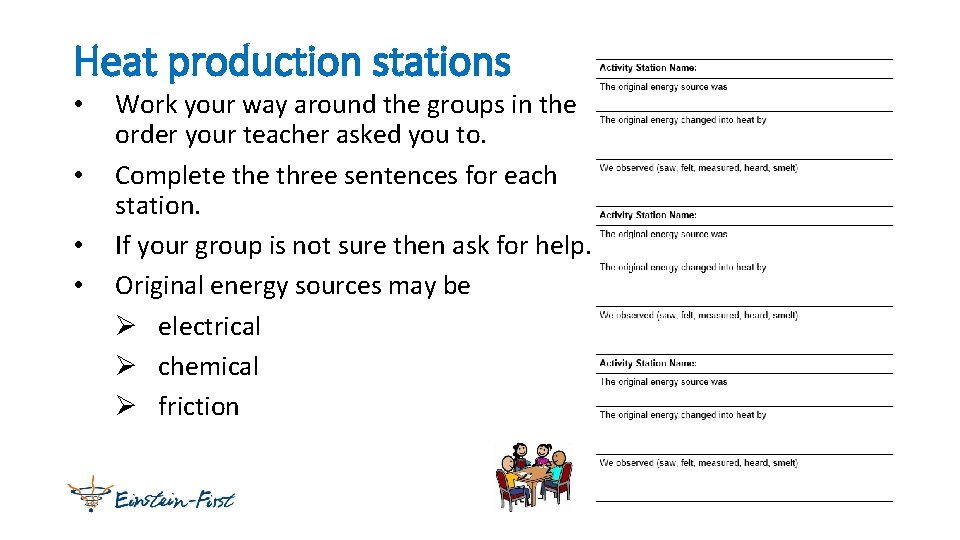
Heat production stations • We will explore how heat is generated. • One example is when I drill a hole. • What do you feel if you touch the hole or drill bit? • What was the source of the energy? • How did the original source change into heat? • What did we observe?
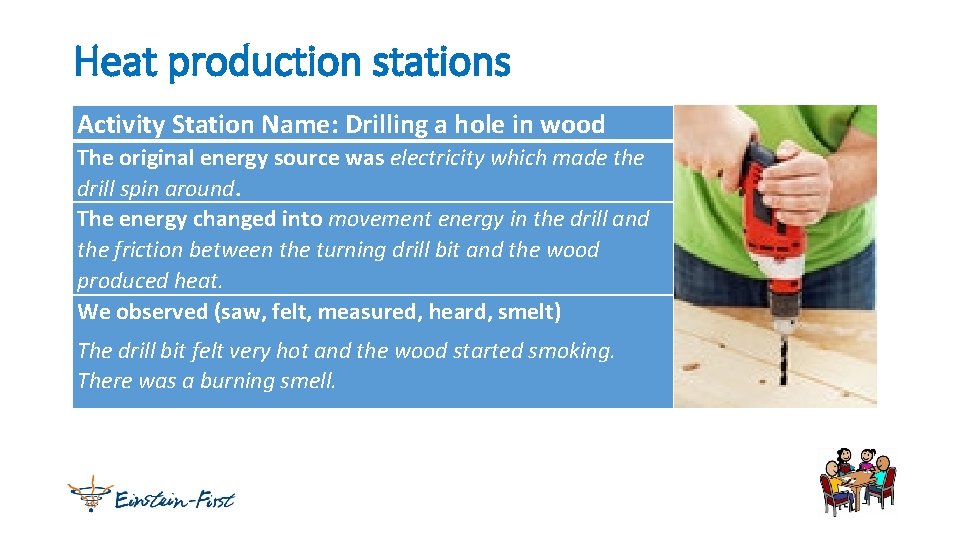
Heat production stations Activity Station Name: Drilling a hole in wood The original energy source was electricity which made the drill spin around. The energy changed into movement energy in the drill and the friction between the turning drill bit and the wood produced heat. We observed (saw, felt, measured, heard, smelt) The drill bit felt very hot and the wood started smoking. There was a burning smell.
Heat production stations • • Work your way around the groups in the order your teacher asked you to. Complete three sentences for each station. If your group is not sure then ask for help. Original energy sources may be Ø electrical Ø chemical Ø friction
Heat production discussion Review learning about how atoms and molecules move and reinforce the idea that temperature is a measure of how fast atoms and molecules move. • Optional video: Summary of main lesson points about heat energy: • The 6½-minute video Kids Learn About Heat Energy https: //www. youtube. com/watch? v=c. Vl. F 2 GGljew • Optional Home Activity: Students list appliances in their family kitchen that rely on heating. For each, identify the energy source (electricity, gas etc) and how the energy is changed to cause heating. •
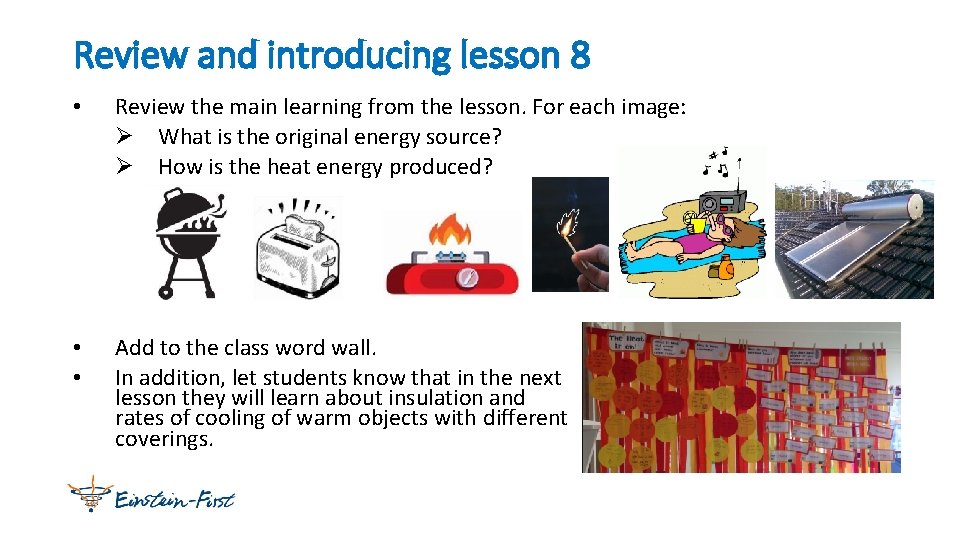
Review and introducing lesson 8 • Review the main learning from the lesson. For each image: Ø What is the original energy source? Ø How is the heat energy produced? • • Add to the class word wall. In addition, let students know that in the next lesson they will learn about insulation and rates of cooling of warm objects with different coverings.
Lesson 8: Keeping things warm In this lesson we learn about insulation. They then we design and conduct a ‘fair’ investigation of the rates of cooling of warm objects with different coverings and use scientific understandings and language to explain different rates of heat transfer. There is an optional discussion with links to Biology and an extension science investigation.
Lesson 8 learning intentions Students will: • • know what insulation is and how insulators prevent transfer of heat energy use scientific understandings and language to explain different cooling and warming rates
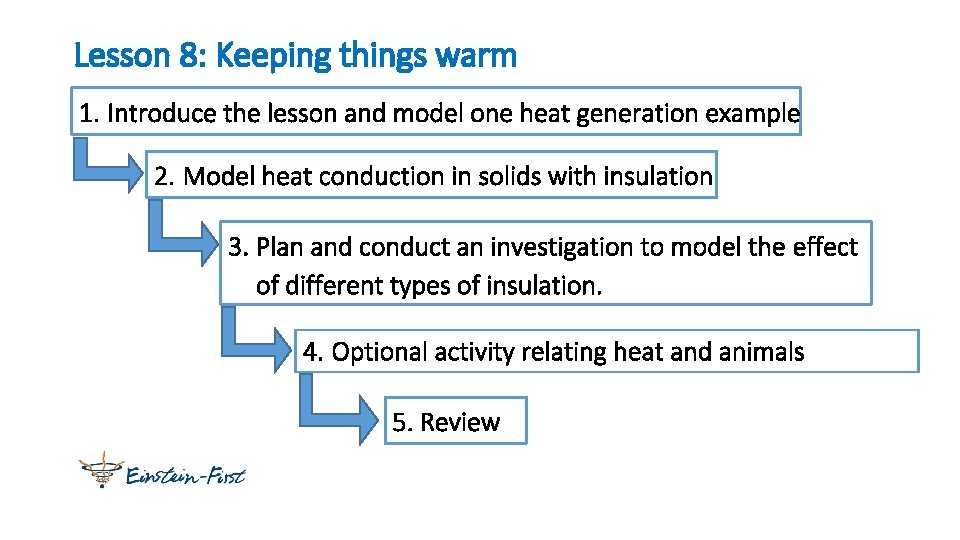
Lesson 8: Keeping things warm 1. Introduce the lesson and model one heat generation example 2. Model heat conduction in solids with insulation 3. Plan and conduct an investigation to model the effect of different types of insulation. 4. Optional activity relating heat and animals 5. Review
Do you remember? • What is heat? Ø Heat is the energy of moving atoms and molecules which vibrate and transfer their vibrational energy to other places. • What happens to the movement of the atoms and molecules when something gets hotter? Ø The hotter an object is the more phonons there and the faster the atoms and molecules vibrate. • Does heat move from hot to cold or cold to hot? Ø Hot to cold • How does heat transfer in solids? Ø By conduction, phonons carry the energy of the vibrating particles through the material.
Modelling heat conduction in solids with insulation • Who can explain the difference between a heat conductor and a heat insulator? • Can anyone name a some good heat conductors? • What about some good heat insulators? • Remember in Lesson 3 we modelled the transfer of heat energy in atoms and molecules via phonons. • We will repeat this, but with insulation added!
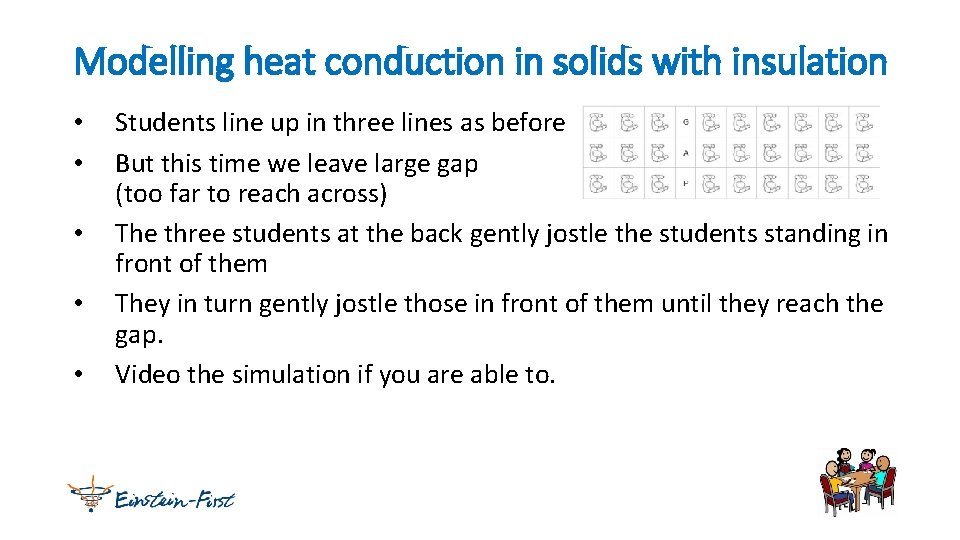
Modelling heat conduction in solids with insulation • • • Students line up in three lines as before But this time we leave large gap (too far to reach across) The three students at the back gently jostle the students standing in front of them They in turn gently jostle those in front of them until they reach the gap. Video the simulation if you are able to.
Modelling heat conduction in solids with insulation Discuss the model in groups by answering the following questions: • • What did we all represent when we were in our three lines? Are we representing a solid or liquid? How do we know this? What did it represent when the students at the back started jostling those in front of them? What happened when students in their lines had a gap – representing insulation – in front of them? Now we will check your answers.
Modelling heat conduction in solids with insulation Answers to the questions: • • • What did we all represent when we were in our three lines? (atoms or molecules) Are we representing a solid or liquid? (solid) How do we know this? (atoms or molecules are moving backwards and forwards or vibrating around a fixed position) What did it represent when the students at the back started jostling those in front of them? (heating the back of the line) What happened when students in their lines had a gap – representing insulation – in front of them? (they could not jostle the next students in front of them because of the gap) This is what happens when there is insulation: the vibrating phonons cannot pass on the heat energy through the insulation.
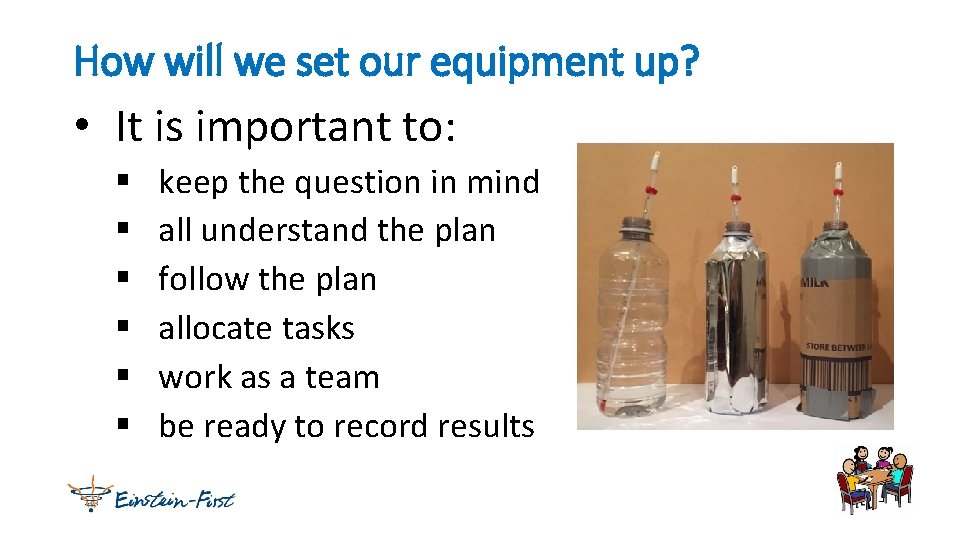
Investigating different insulators • • • We will now plan and conduct an investigation to model the effect of different types of insulation. We will use two bottles of warm water with coverings of corrugated cardboard and aluminium foil; the third bottle with no covering will be our control. Conducting a fair test will help us understand how having a foil covering or a cardboard covering will affect how well the bottles are insulated. The better insulator will keep a bottle warm by not letting heat energy be conducted out through the insulation.
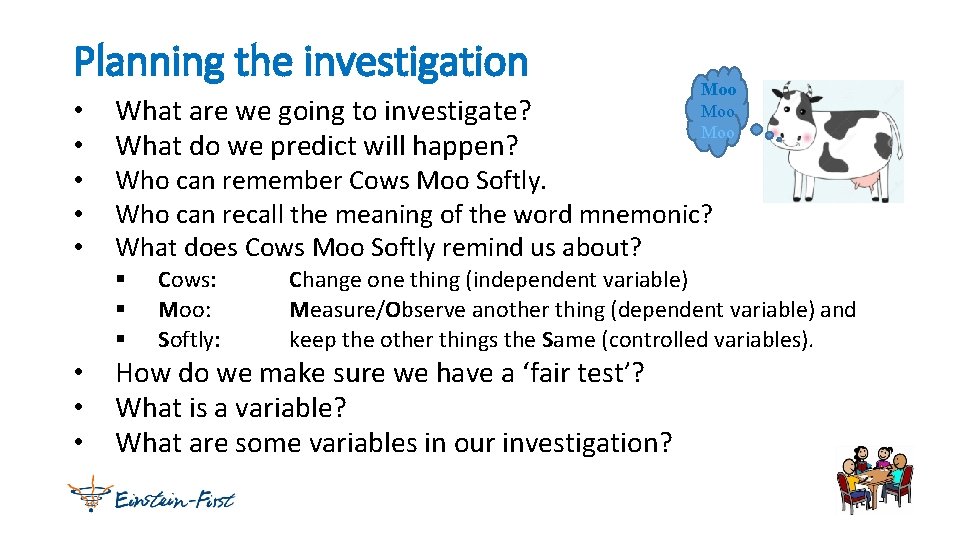
Planning the investigation • • • What are we going to investigate? What do we predict will happen? Who can remember Cows Moo Softly. Who can recall the meaning of the word mnemonic? What does Cows Moo Softly remind us about? § § § • • • Moo Moo Cows: Moo: Softly: Change one thing (independent variable) Measure/Observe another thing (dependent variable) and keep the other things the Same (controlled variables). How do we make sure we have a ‘fair test’? What is a variable? What are some variables in our investigation?
How will we set our equipment up? • It is important to: § § § keep the question in mind all understand the plan follow the plan allocate tasks work as a team be ready to record results
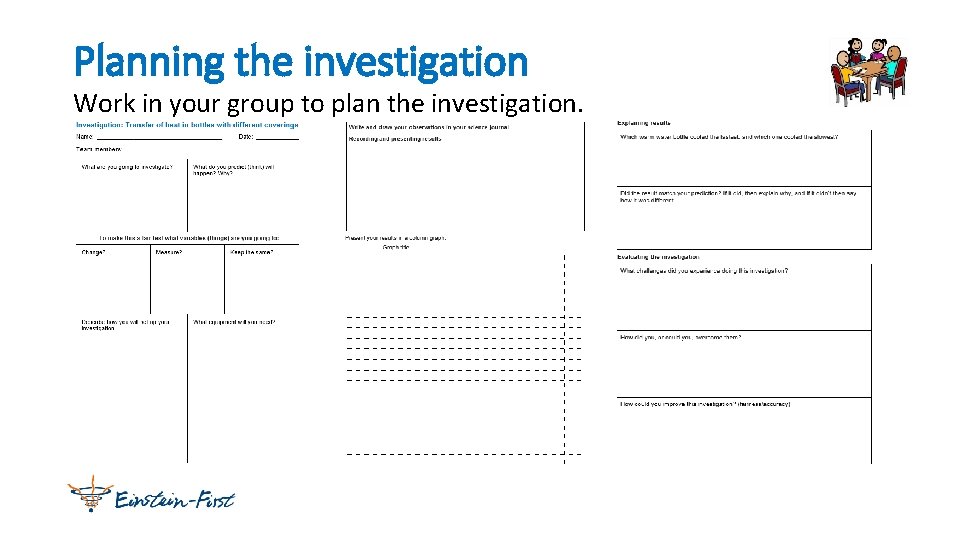
Planning the investigation Work in your group to plan the investigation.
Discussion When you have finished and packed up. • What did your group find about the different insulation around the bottles and the effect that had on heat transfer? • What can we say about insulation? • Use what you learnt by doing the simulation at the start of the lesson to explain how insulators work.
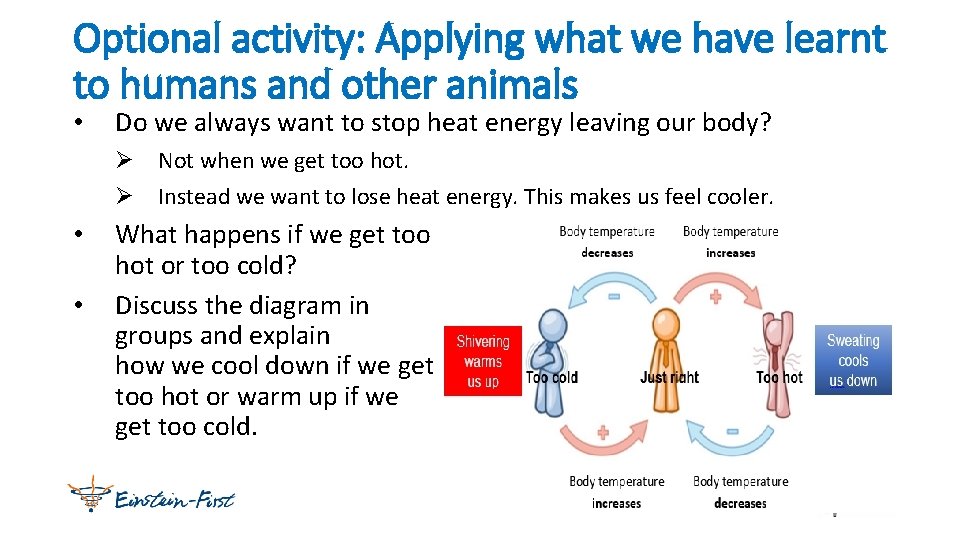
Optional activity: Applying what we have learnt to humans and other animals • Do we always want to stop heat energy leaving our body? Ø Not when we get too hot. Ø Instead we want to lose heat energy. This makes us feel cooler. • • What happens if we get too hot or too cold? Discuss the diagram in groups and explain how we cool down if we get too hot or warm up if we get too cold.
Discussion How does sweating help cool us down? How does shivering help to warm us up? Why do birds have feathers? What are birds often seen doing on cold mornings? Why do they do this? • What about animals that have fur? Do they do anything to protect themselves from the cold? • •
Discussion • How does sweating help cool us down? (heat energy from our bodies is used to evaporate the water in our sweat) • How does shivering help to warm us up? (our muscles contract and expand rapidly which produces heat which helps to raise our body temperature) • Why do birds have feathers? (apart from to help them fly, they help keep their small bodies warm) • What are birds often seen doing on cold mornings? Why do they do this? (They fluff up their feathers - by fluffing up their feathers birds trap body heat close to them. Air is a good insulator and the air trapped within the feathers does not readily circulate. ) • What about animals that have fur?
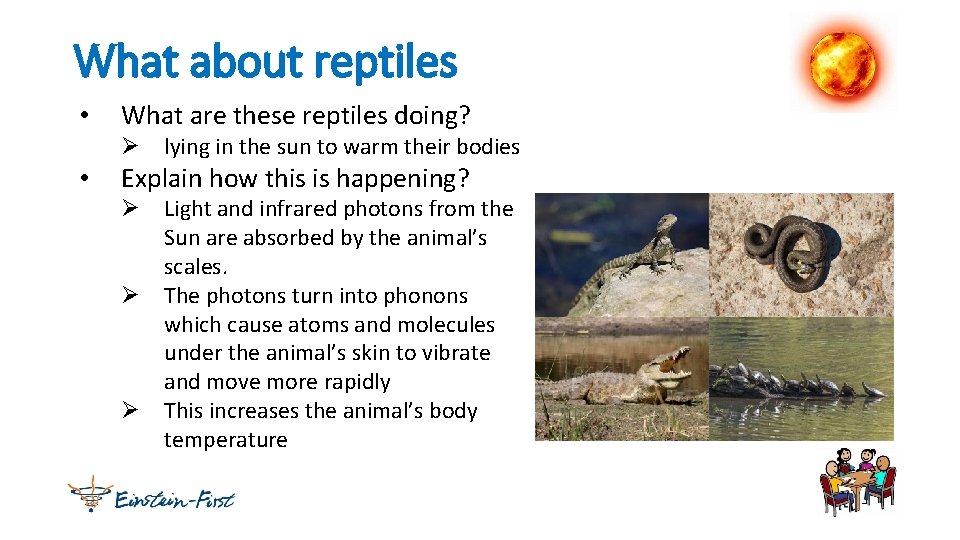
What about reptiles • What are these reptiles doing? Ø lying in the sun to warm their bodies • Explain how this is happening? Ø Light and infrared photons from the Sun are absorbed by the animal’s scales. Ø The photons turn into phonons which cause atoms and molecules under the animal’s skin to vibrate and move more rapidly Ø This increases the animal’s body temperature
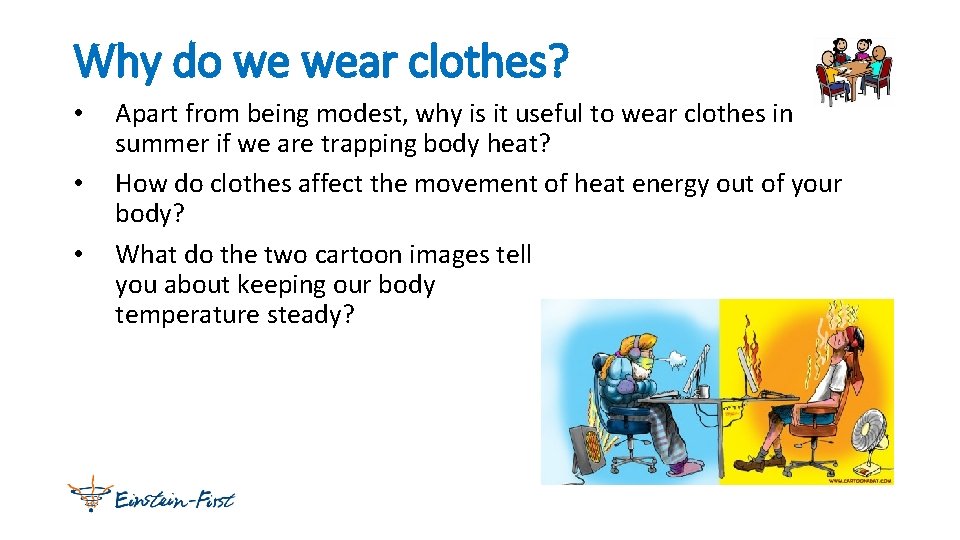
Why do we wear clothes? • • • Apart from being modest, why is it useful to wear clothes in summer if we are trapping body heat? How do clothes affect the movement of heat energy out of your body? What do the two cartoon images tell you about keeping our body temperature steady?
Optional STEM Lesson: Building a model solar oven Working in groups, we will design and build a pizza box solar oven and then test it out in a separate lesson. We will then use a poster, Power. Point or other presentation to document and present our work and evaluation of how well our oven worked. .
Optional STEM Lesson: learning intentions Students will: • • use scientific principles relating to sunlight and heat to build a pizza box solar oven create a sequence of steps to solve a given task select and safely use appropriate materials and equipment to make the oven after testing the solar oven, document their work and evaluation of the success of their oven design, in a poster or presentation
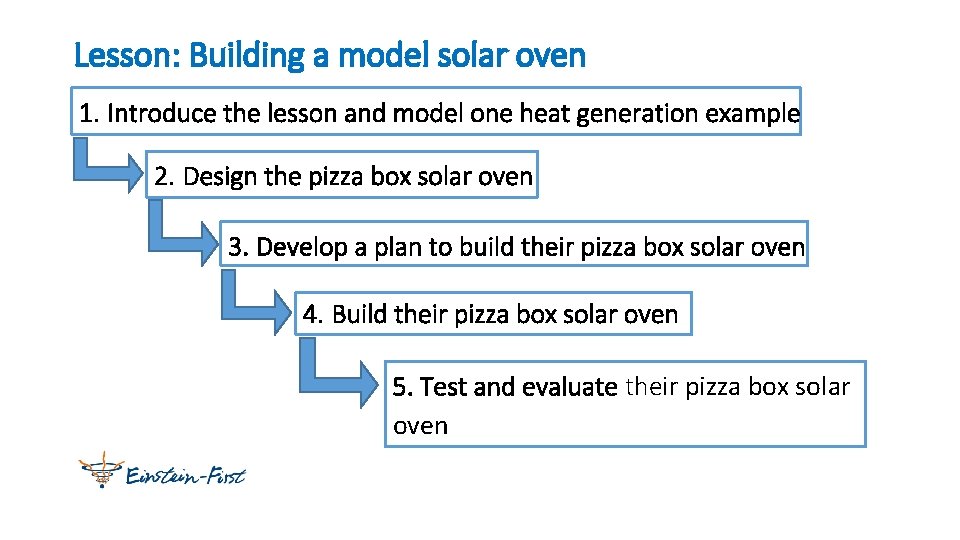
Lesson: Building a model solar oven 1. Introduce the lesson and model one heat generation example 2. Design the pizza box solar oven 3. Develop a plan to build their pizza box solar oven 4. Build their pizza box solar oven 5. Test and evaluate their pizza box solar oven
Review of knowledge and information needed • Where does most of Earth’s energy come from? Ø Heat is the energy of moving atoms and molecules which vibrate and transfer their vibrational energy to other places. • What happens to the movement of the atoms and molecules when something gets hotter? Ø The hotter an object is the more phonons there and the faster the atoms and molecules vibrate. • Does heat move from hot to cold or cold to hot? Ø Hot to cold • How does heat transfer in solids? Ø By conduction, phonons carry the energy of the vibrating particles through the material.
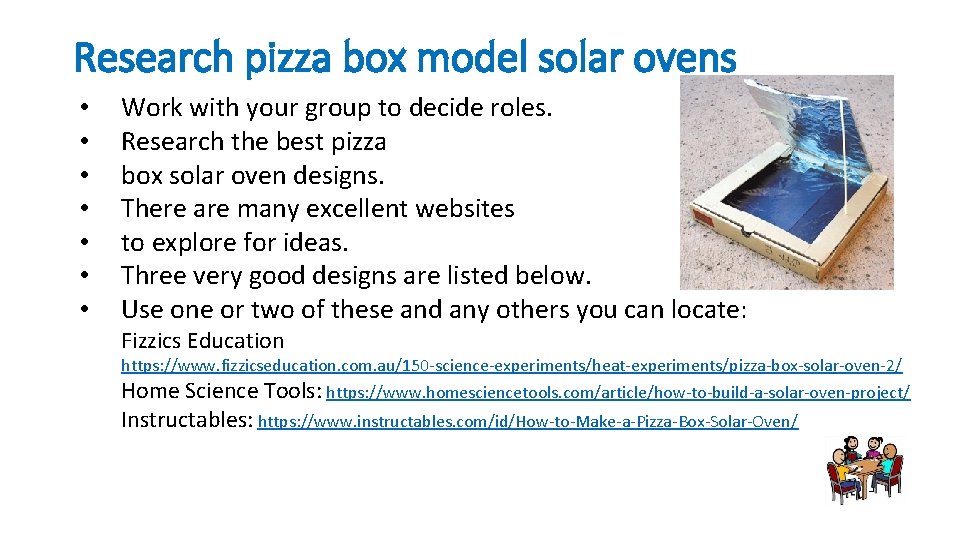
Research pizza box model solar ovens • • Work with your group to decide roles. Research the best pizza box solar oven designs. There are many excellent websites to explore for ideas. Three very good designs are listed below. Use one or two of these and any others you can locate: Fizzics Education https: //www. fizzicseducation. com. au/150 -science-experiments/heat-experiments/pizza-box-solar-oven-2/ Home Science Tools: https: //www. homesciencetools. com/article/how-to-build-a-solar-oven-project/ Instructables: https: //www. instructables. com/id/How-to-Make-a-Pizza-Box-Solar-Oven/
Understanding the pizza box model solar oven • • Why did most ovens have a large square hole cut of the lid along three sides and the side near the hinge was folded upwards? Why was aluminium foil used to cover the inside of the cut-out square? Most designs have something else to hold the lid open at a particular angle. Why is this? What could your group use for this? Did any designs have extra ‘wings’ or sheets of aluminium foil covered cardboard around the other three sides? What could these have been for? Most designs had a clear plastic wrap covering the open part of the box lid. What purpose does this have? Why did most designs have black paper or card on the base of the oven? Were there any other design features that all ovens had? What purpose did each of these serve?
Developing your plan Use the ideas you found through your research and information from our class discussion to develop your plan. Draw your plan. You could show and label: • the square hole you plan to cut out • the way your cut out square will fold back and what you will do to help it reflect photons into the oven • the clear plastic cover for the oven • the black card oven floor • any other special design features that you include – your own ideas or ideas for your website research Briefly say why each feature is needed – its function.
Building your pizza box solar oven Remember your group roles, ask the Manager to collect the equipment. Use your plan to guide your work. • Danger: please be very careful with the safety cutter. • Work out who will do what and share tasks. • Work as a team.
Using your pizza box solar oven What part to photons, phonons and insulation play? • What does the Sun produce for us? • How does this get to us? they learnt about the Sun giving off huge amounts of energy in the form of photons. • Why are photons so important? • Review phonons. • The photons pass through the Gladwrap cover and strike the black base. • This heats the base. • It re-radiates a large amount of infrared radiation that heats the air that is trapped in the oven by the clear plastic wrap. • What else helps the oven stay hot and heat up further?
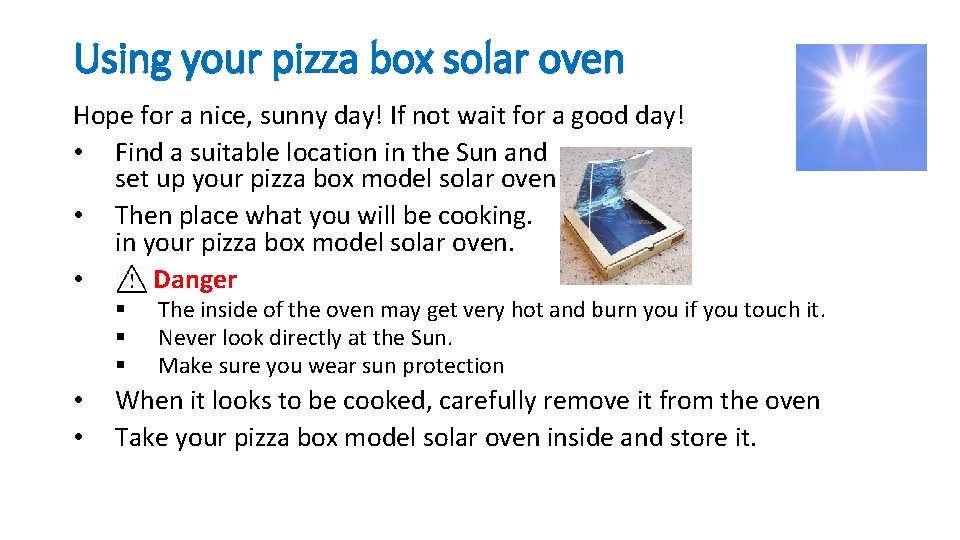
Using your pizza box solar oven Hope for a nice, sunny day! If not wait for a good day! • Find a suitable location in the Sun and set up your pizza box model solar oven • Then place what you will be cooking. in your pizza box model solar oven. • Danger § § § • • The inside of the oven may get very hot and burn you if you touch it. Never look directly at the Sun. Make sure you wear sun protection When it looks to be cooked, carefully remove it from the oven Take your pizza box model solar oven inside and store it.
Evaluating your pizza box solar oven After cooking, students should reflect on their solar oven design in their groups: • How well did it cook? • Could we adjust our design to get more heat into our oven? How? • Does heat escape from our oven? If so, how else could we stop this happening? Each team reporter should share their overall experience with the class, including how they could improve their design if they were to do this again.
Review of Hot Stuff and How much did you learn? Complete the review worksheet which will be broken into four areas: • What is heat? • How does heat move from one place to another? • How do we measure heat? • How do we make heat? • How can we keep things warm? Work with your team members to complete the worksheet and to test one another about your understandings about heat. Finally, remind students that in the next lesson you will be asked about how much you now know about heat.