
Hot semiarid grassland ecosystems Click on an option
- Slides: 11
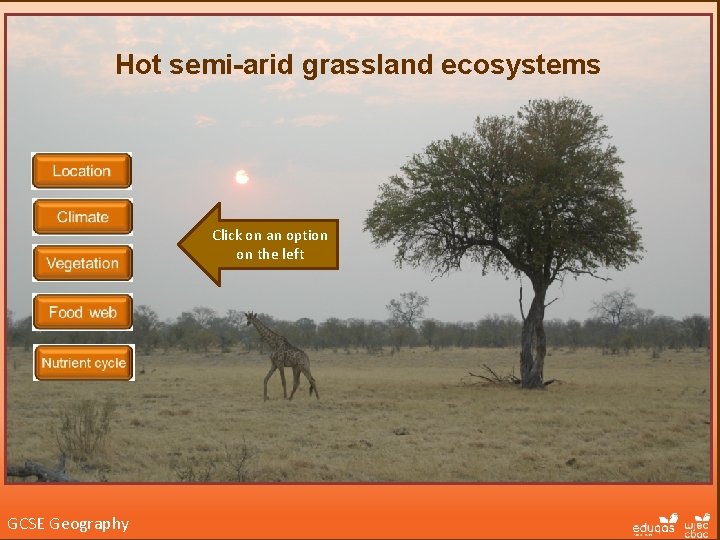
Hot semi-arid grassland ecosystems Click on an option on the left GCSE Geography
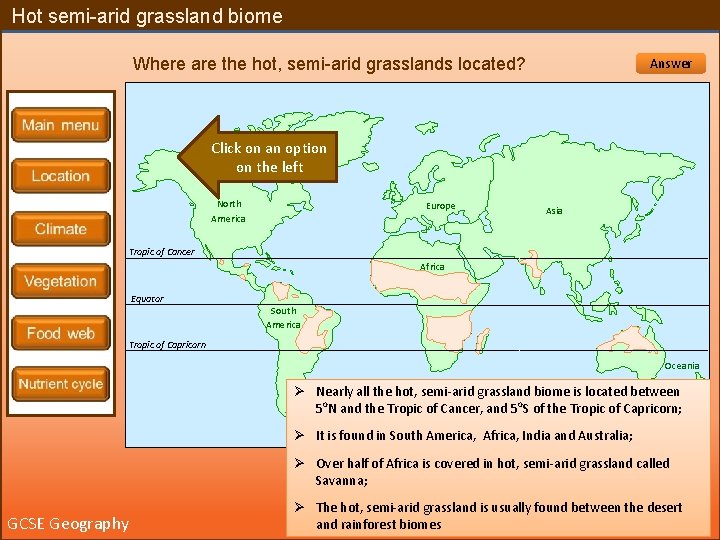
Hot semi-arid grassland biome Where are the hot, semi-arid grasslands located? Answer Click on an option on the left North America Europe Asia Tropic of Cancer Africa Equator South America Tropic of Capricorn Oceania Ø Nearly all the hot, semi-arid grassland biome is located between 5 o. N and the Tropic of Cancer, and 5 o. S of the Tropic of Capricorn; Ø It is found in South America, Africa, India and Australia; Ø Over half of Africa is covered in hot, semi-arid grassland called Savanna; GCSE Geography Ø The hot, semi-arid grassland is usually found between the desert and rainforest biomes
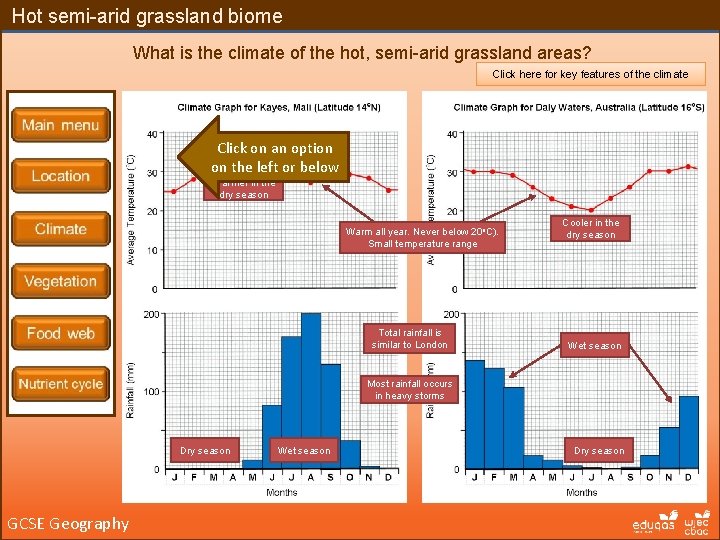
Hot semi-arid grassland biome What is the climate of the hot, semi-arid grassland areas? Click here for key features of the climate Click on an option on the left or below Warmer in the dry season Warm all year. Never below 20 o. C). Small temperature range Total rainfall is similar to London Cooler in the dry season Wet season Most rainfall occurs in heavy storms Dry season GCSE Geography Wet season Dry season
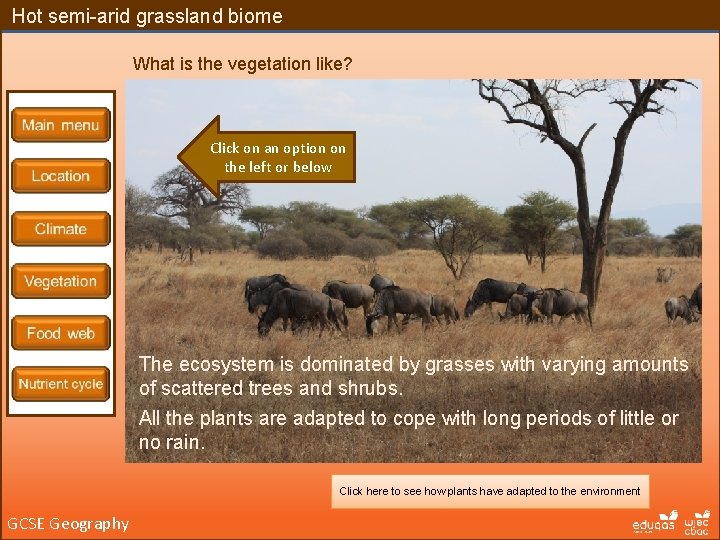
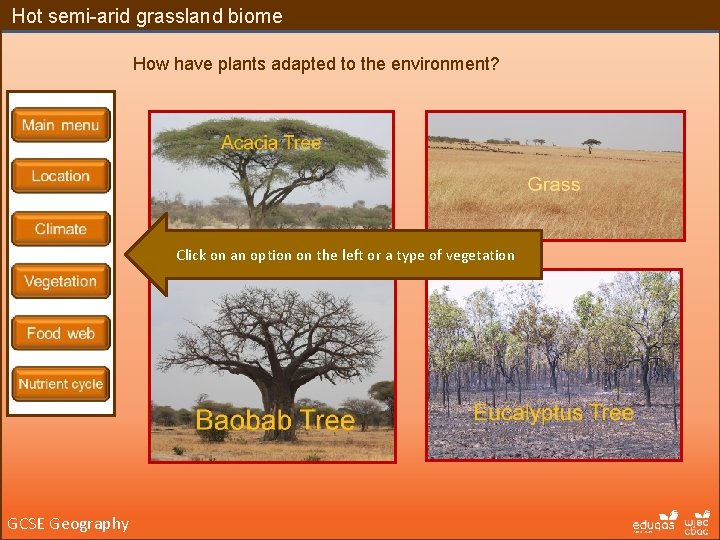
Hot semi-arid grassland biome What is the vegetation like? Click on an option on the left or below The ecosystem is dominated by grasses with varying amounts of scattered trees and shrubs. All the plants are adapted to cope with long periods of little or no rain. Click here to see how plants have adapted to the environment GCSE Geography
Hot semi-arid grassland biome How have plants adapted to the environment? Click on an option on the left or a type of vegetation GCSE Geography
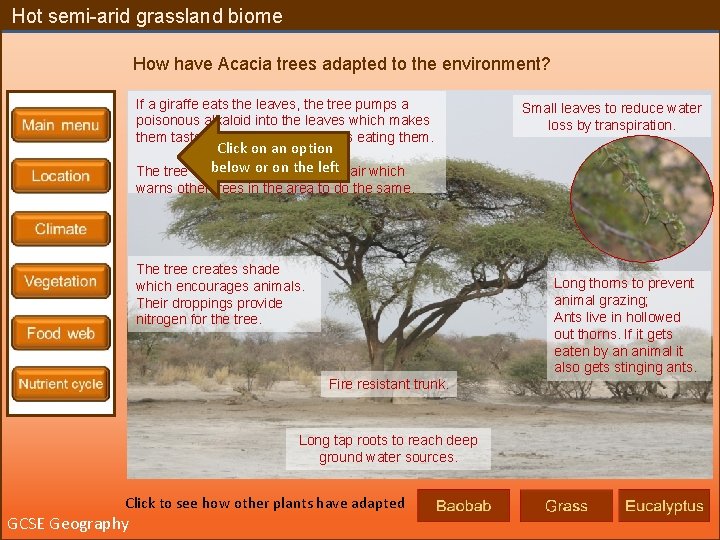
Hot semi-arid grassland biome How have Acacia trees adapted to the environment? If a giraffe eats the leaves, the tree pumps a poisonous alkaloid into the leaves which makes them taste bad so the animal stops eating them. Small leaves to reduce water loss by transpiration. Click on an option below or on the The tree emits a chemical intoleft the air which warns other trees in the area to do the same. The tree creates shade which encourages animals. Their droppings provide nitrogen for the tree. Long thorns to prevent animal grazing; Ants live in hollowed out thorns. If it gets eaten by an animal it also gets stinging ants. Fire resistant trunk. Long tap roots to reach deep ground water sources. Click to see how other plants have adapted GCSE Geography
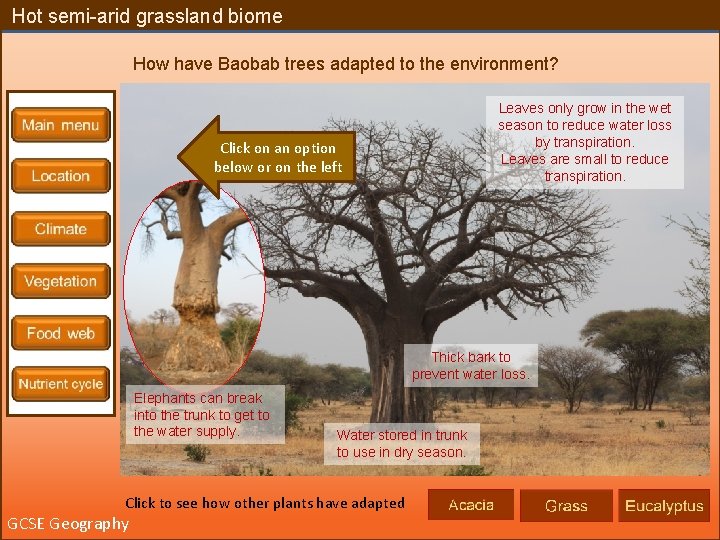
Hot semi-arid grassland biome How have Baobab trees adapted to the environment? Leaves only grow in the wet season to reduce water loss by transpiration. Leaves are small to reduce transpiration. Click on an option below or on the left Thick bark to prevent water loss. Elephants can break into the trunk to get to the water supply. Water stored in trunk to use in dry season. Click to see how other plants have adapted GCSE Geography
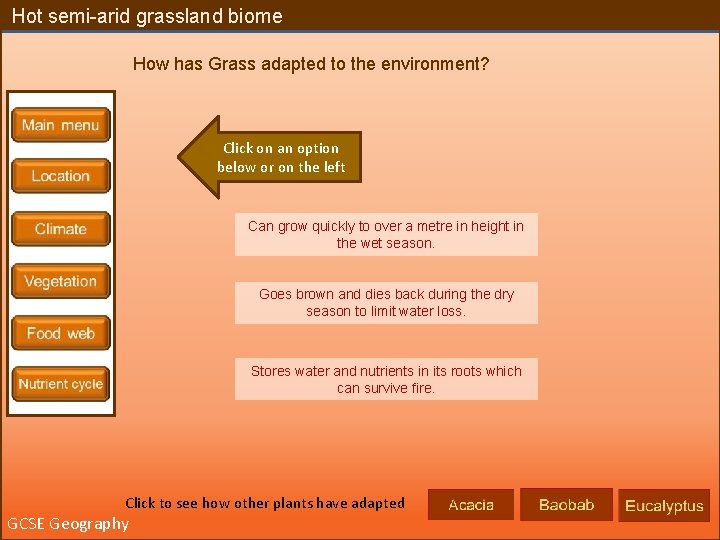
Hot semi-arid grassland biome How has Grass adapted to the environment? Click on an option below or on the left Can grow quickly to over a metre in height in the wet season. Goes brown and dies back during the dry season to limit water loss. Stores water and nutrients in its roots which can survive fire. Click to see how other plants have adapted GCSE Geography
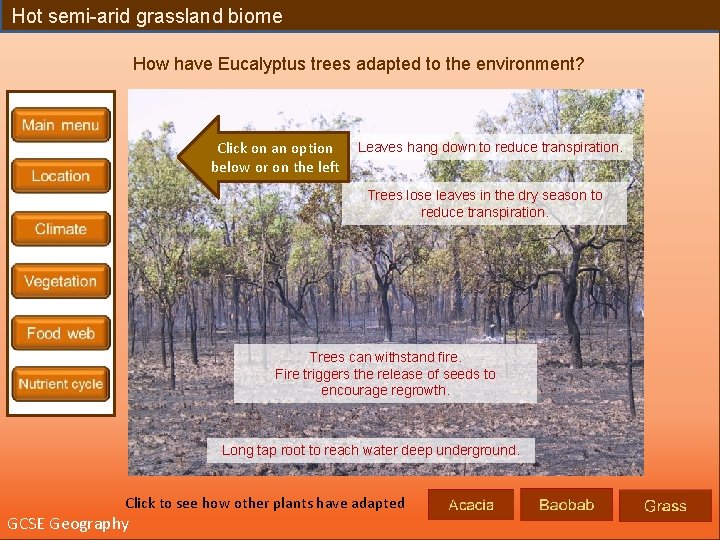
Hot semi-arid grassland biome How have Eucalyptus trees adapted to the environment? Click on an option below or on the left Leaves hang down to reduce transpiration. Trees lose leaves in the dry season to reduce transpiration. Trees can withstand fire. Fire triggers the release of seeds to encourage regrowth. Long tap root to reach water deep underground. Click to see how other plants have adapted GCSE Geography
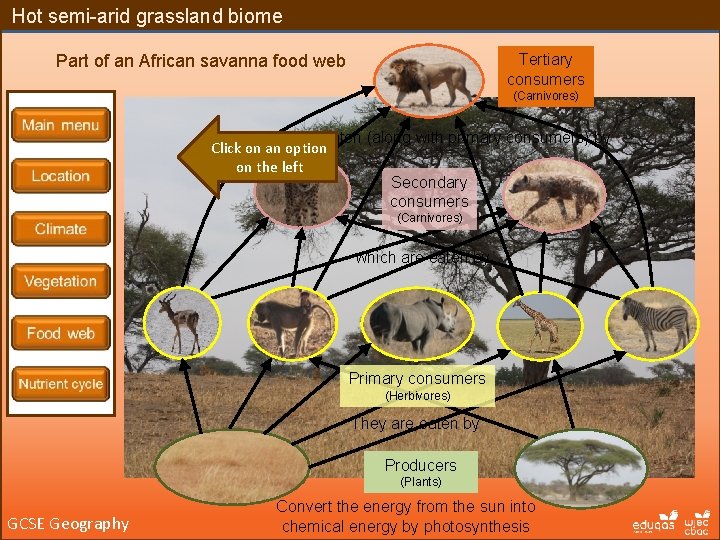
Hot semi-arid grassland biome Part of an African savanna food web Tertiary consumers (Carnivores) which are eaten (along with primary consumers) by Click on an option on the left Secondary consumers (Carnivores) which are eaten by Primary consumers (Herbivores) They are eaten by Producers (Plants) GCSE Geography Convert the energy from the sun into chemical energy by photosynthesis
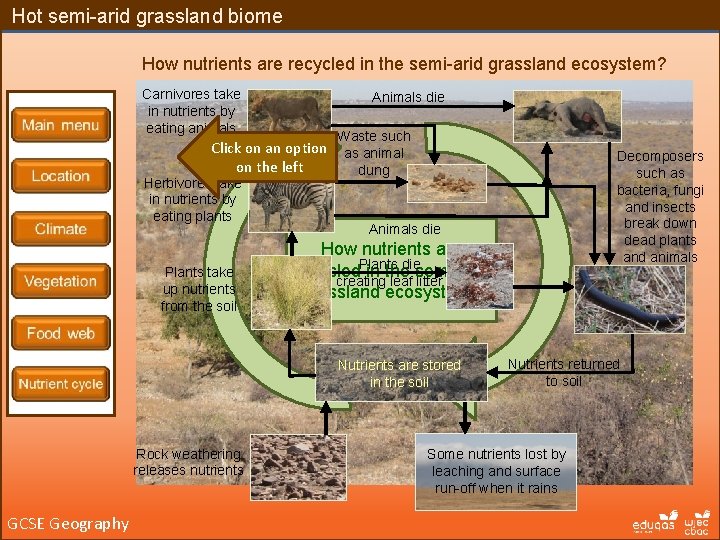
Hot semi-arid grassland biome How nutrients are recycled in the semi-arid grassland ecosystem? Carnivores take in nutrients by eating animals Animals die Click on an option on the left Herbivores take in nutrients by eating plants Plants take up nutrients from the soil Waste such as animal dung Animals die How nutrients are recycled. Plants in thediesemi-arid creating leaf litter grassland ecosystem? Nutrients are stored in the soil Rock weathering releases nutrients GCSE Geography Decomposers such as bacteria, fungi and insects break down dead plants and animals Nutrients returned to soil Some nutrients lost by leaching and surface run-off when it rains