
Hot Accretion Flow A brief history of Hot

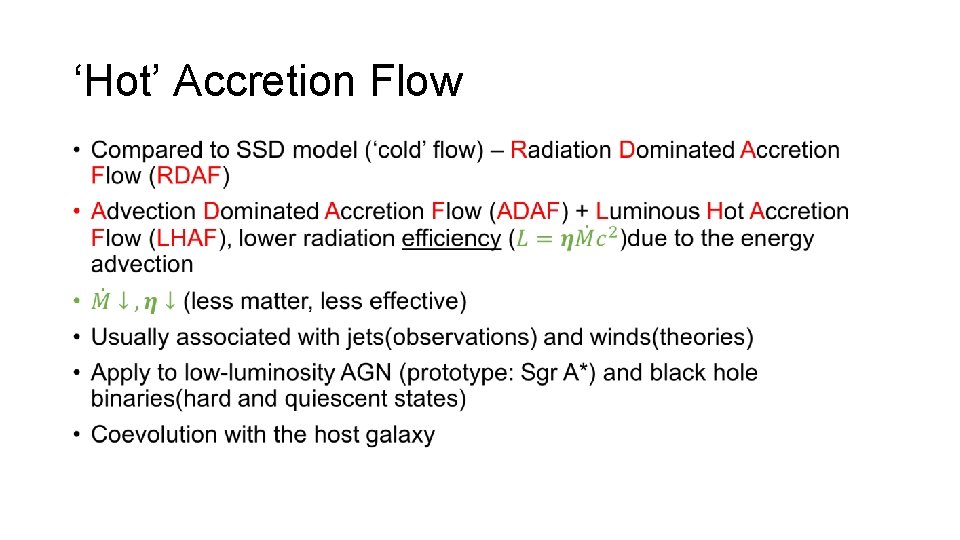
‘Hot’ Accretion Flow •
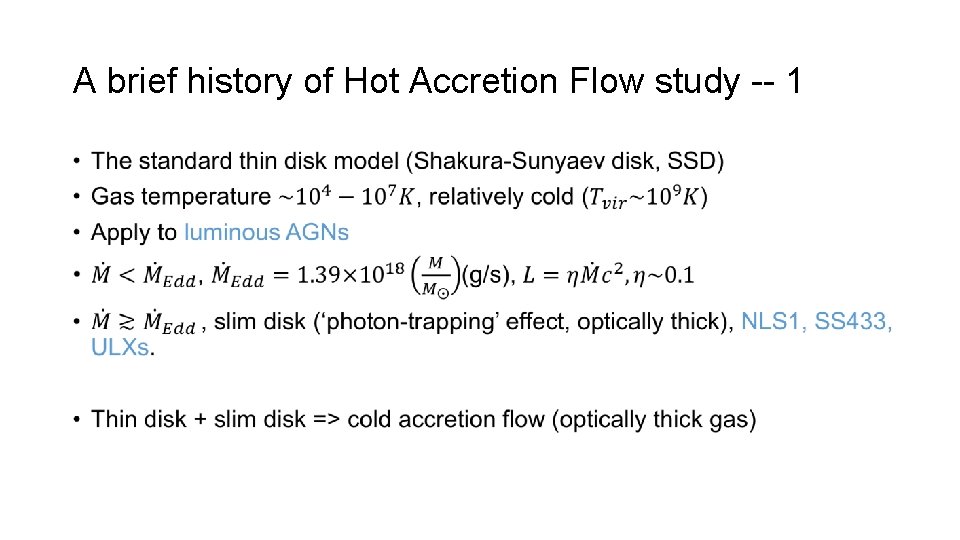
A brief history of Hot Accretion Flow study -- 1 •
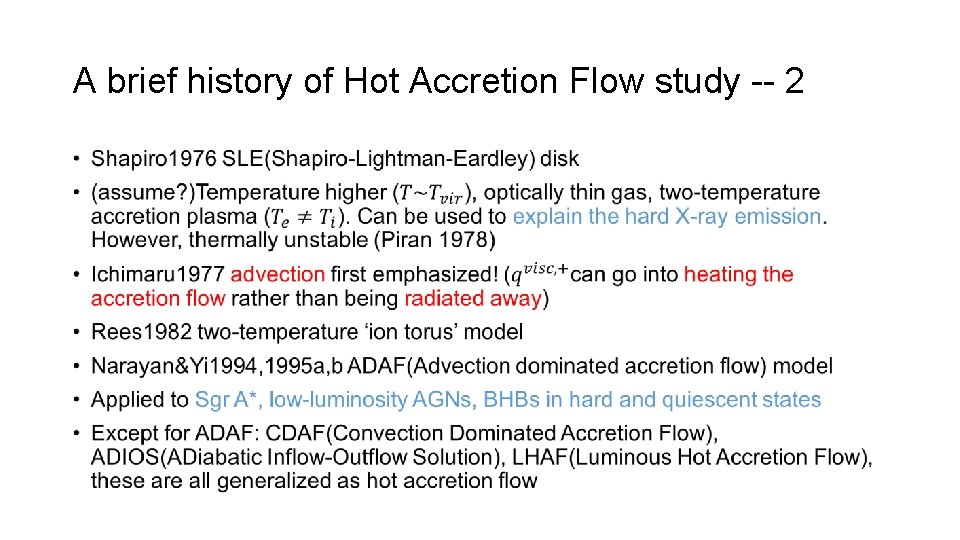
A brief history of Hot Accretion Flow study -- 2 •
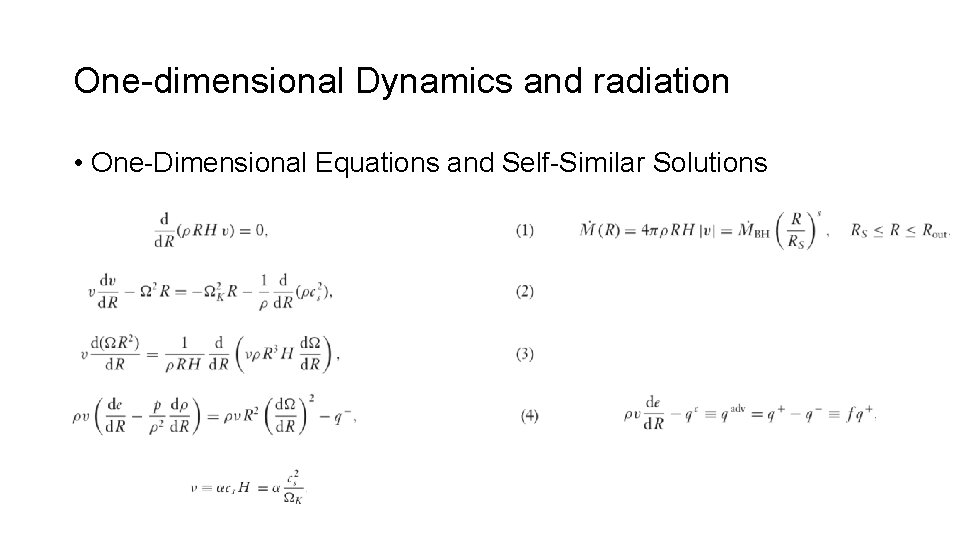
One-dimensional Dynamics and radiation • One-Dimensional Equations and Self-Similar Solutions
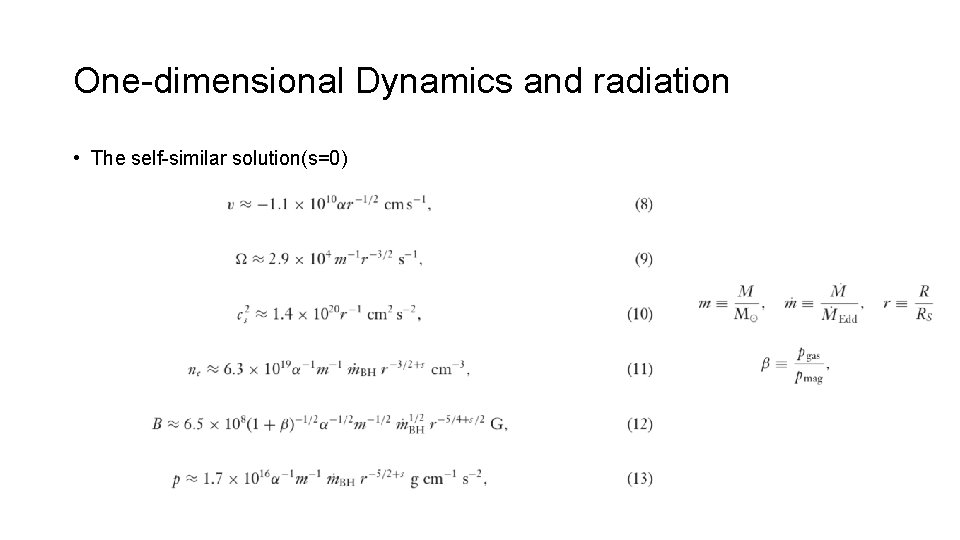
One-dimensional Dynamics and radiation • The self-similar solution(s=0)
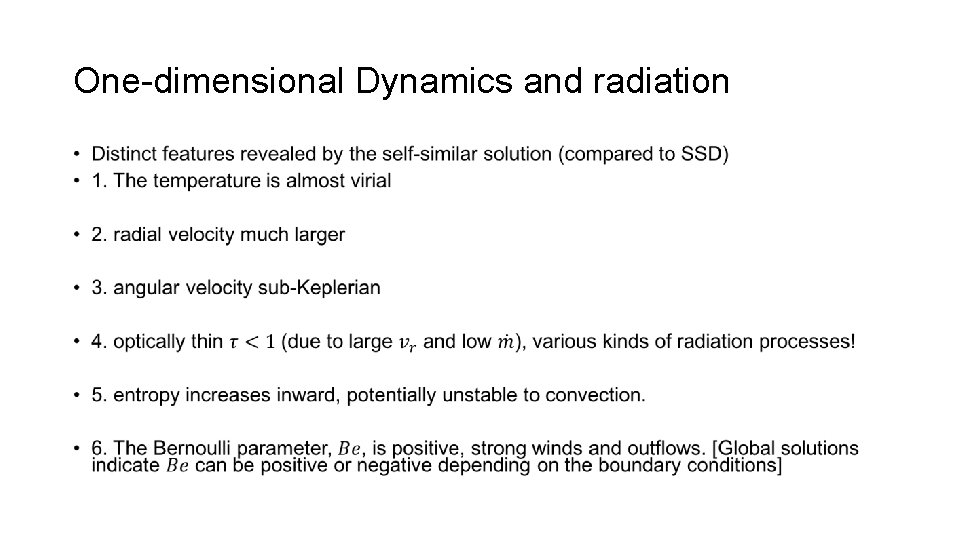
One-dimensional Dynamics and radiation •
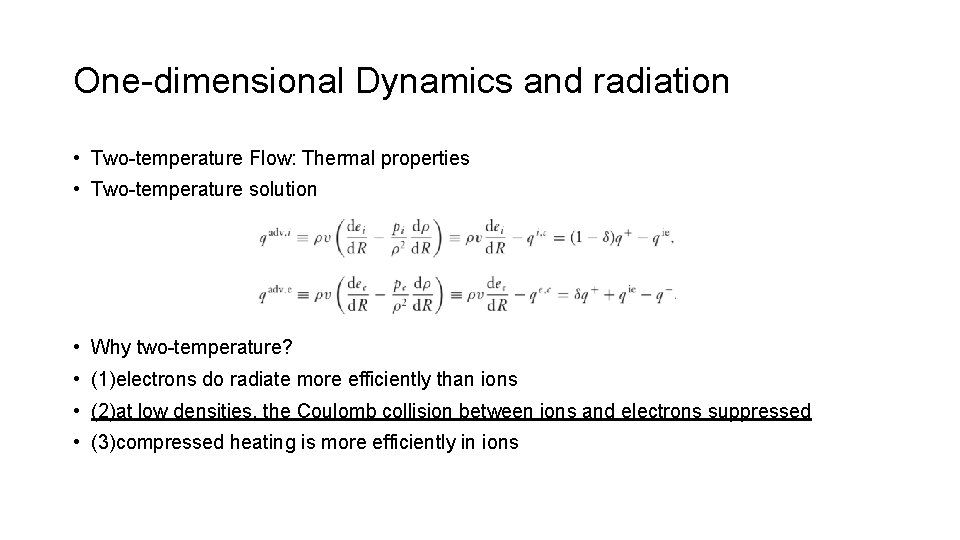
One-dimensional Dynamics and radiation • Two-temperature Flow: Thermal properties • Two-temperature solution • Why two-temperature? • (1)electrons do radiate more efficiently than ions • (2)at low densities, the Coulomb collision between ions and electrons suppressed • (3)compressed heating is more efficiently in ions
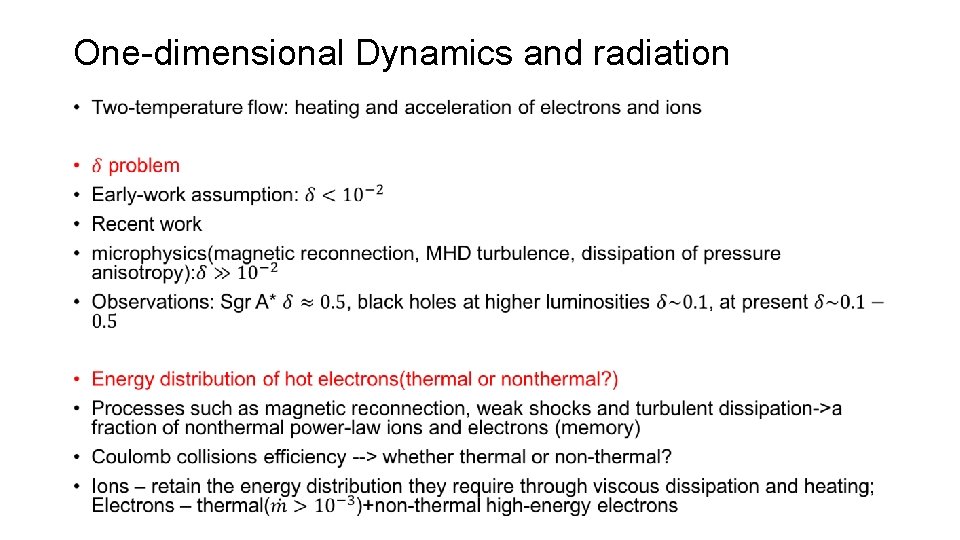
One-dimensional Dynamics and radiation •
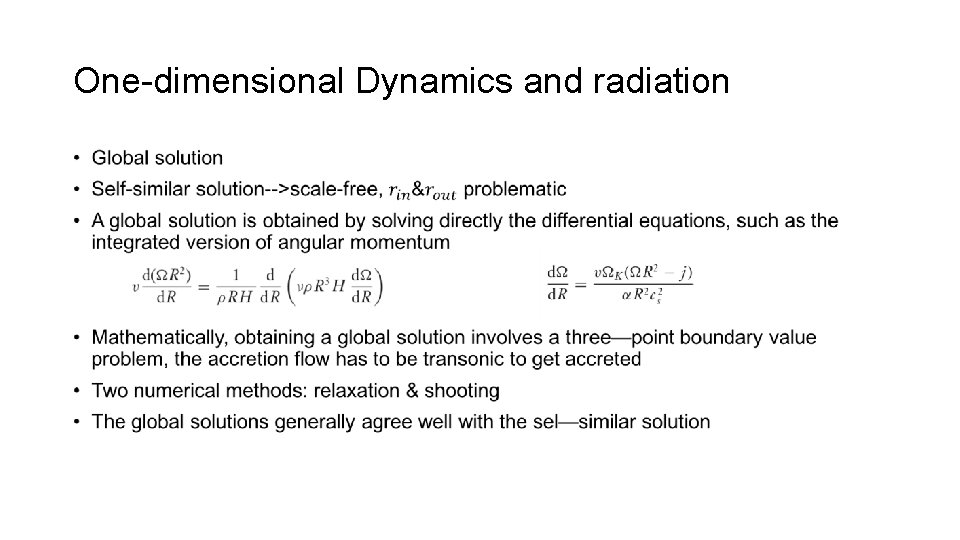
One-dimensional Dynamics and radiation •
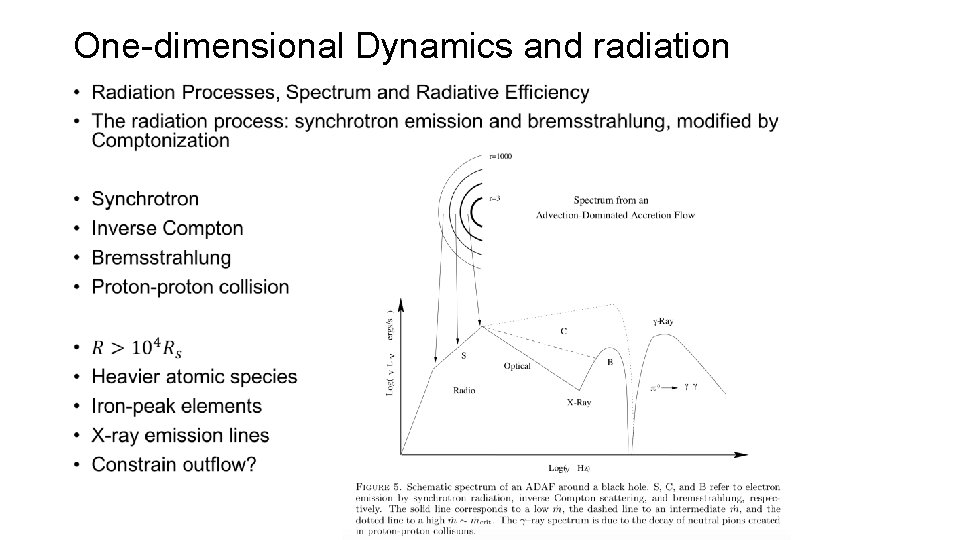
One-dimensional Dynamics and radiation •
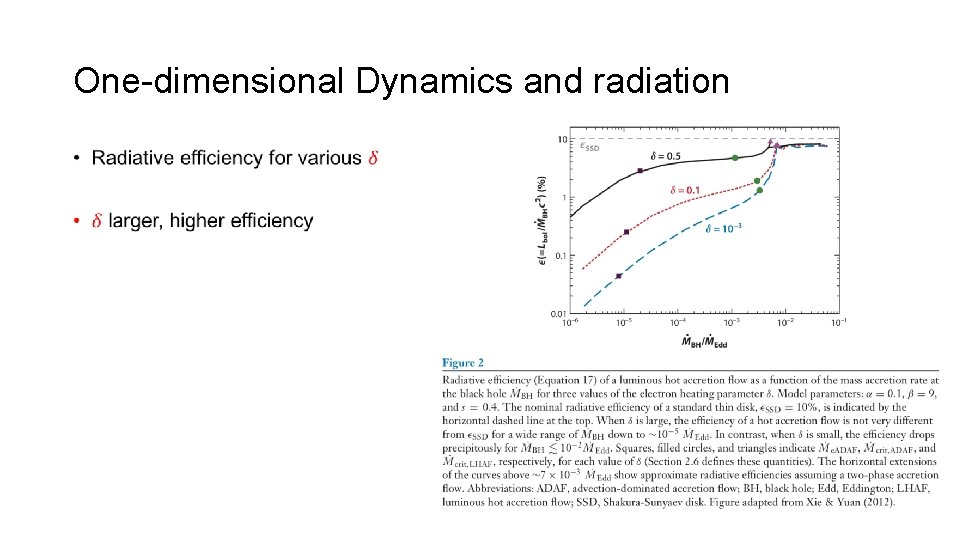
One-dimensional Dynamics and radiation •
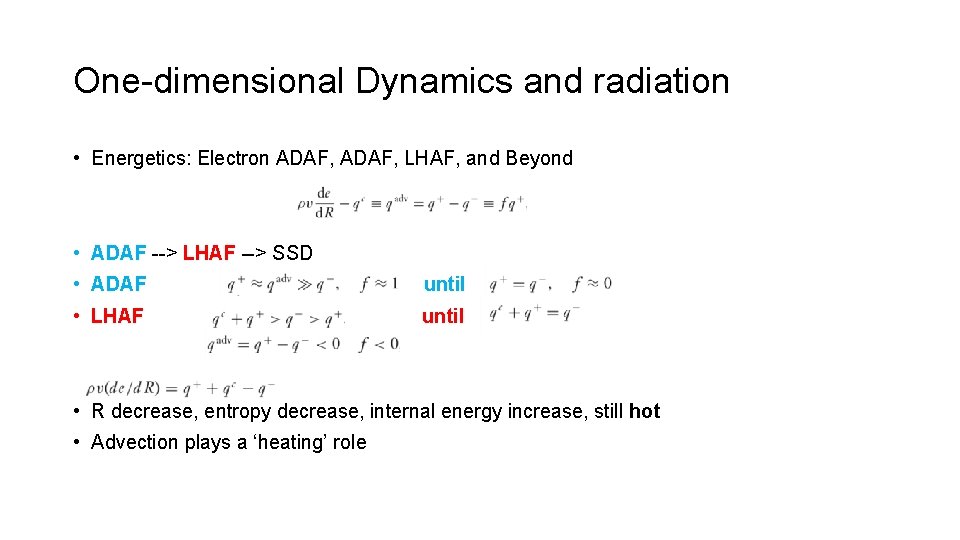
One-dimensional Dynamics and radiation • Energetics: Electron ADAF, LHAF, and Beyond • ADAF --> LHAF --> SSD • ADAF until • LHAF until • R decrease, entropy decrease, internal energy increase, still hot • Advection plays a ‘heating’ role
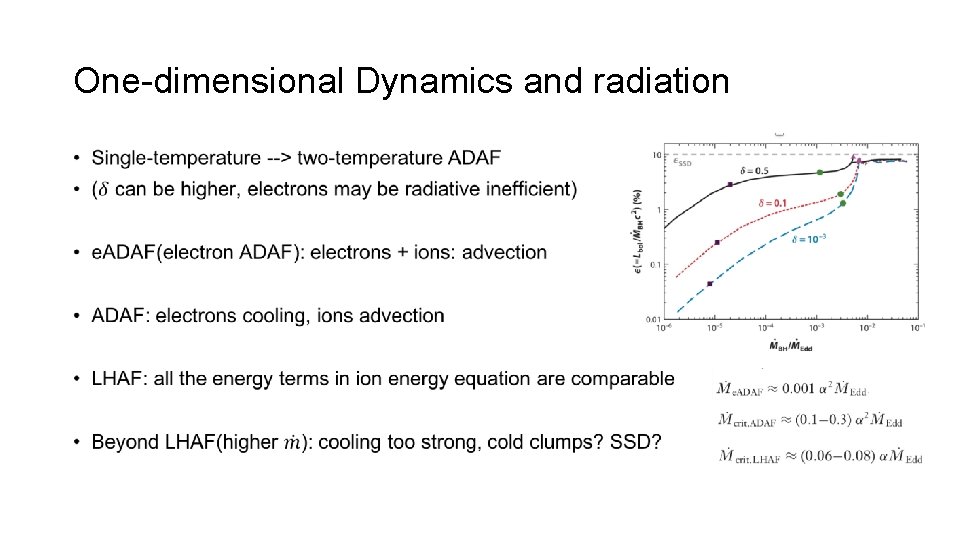
One-dimensional Dynamics and radiation •
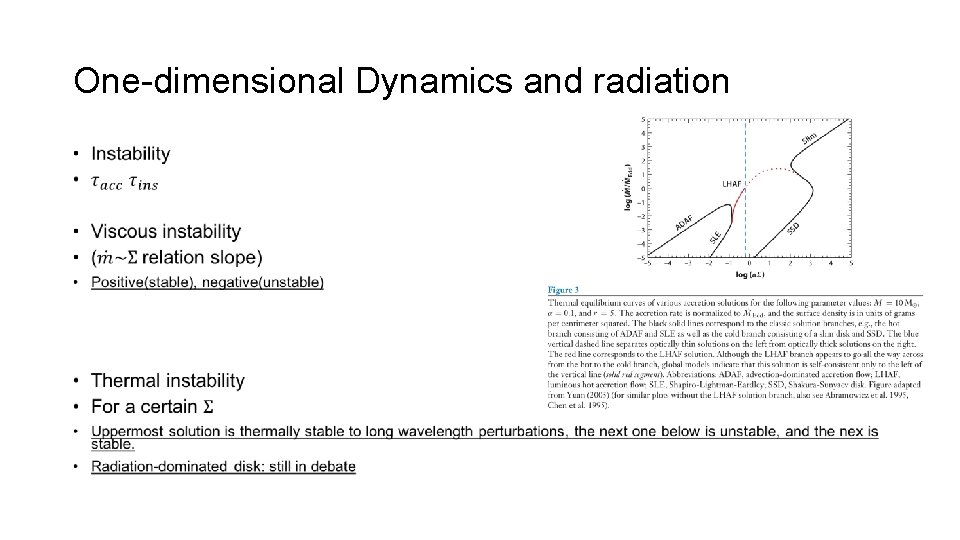
One-dimensional Dynamics and radiation •
One-dimensional Dynamics and radiation • What does nature choose between ‘hot’ and ‘cold’ solution? • Narayan&Yi 1995 b • 1. outer boundary condition, start from a SSD or ADAF? • 2. (so-called strong ADAF principle)accretion occurs via the SSD solution only if it is the sole stable solution available
Numerical Simulations(multidimensional structure) • Why numerical simulations? • Geometrically thick actually, also the outflows • Hydrodynamic(HD) Simulations(no magnetic fields) • Convections revealed • Limitations in radial dynamic range • A radial power-law distribution of various quantities, consistent with the self-similar solution
Numerical Simulations(multidimensional structure) •

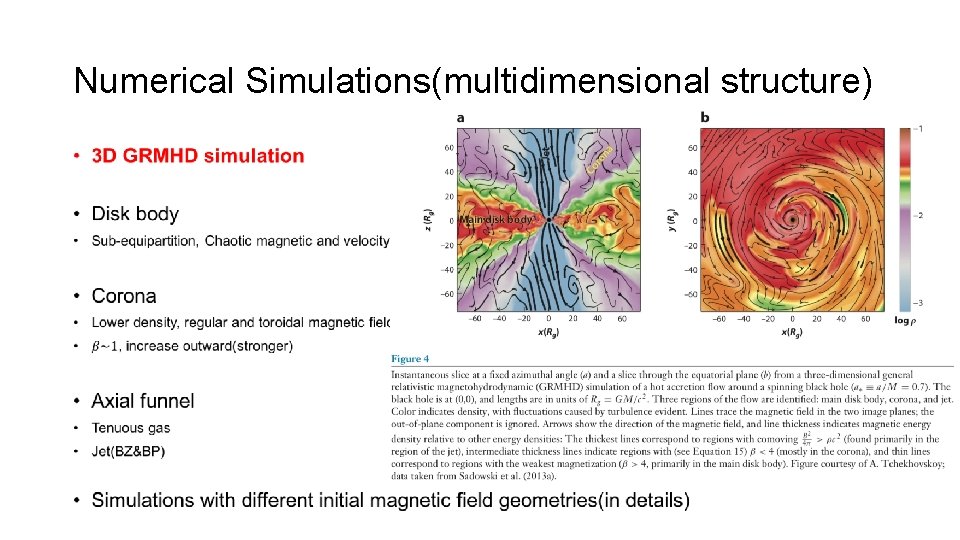
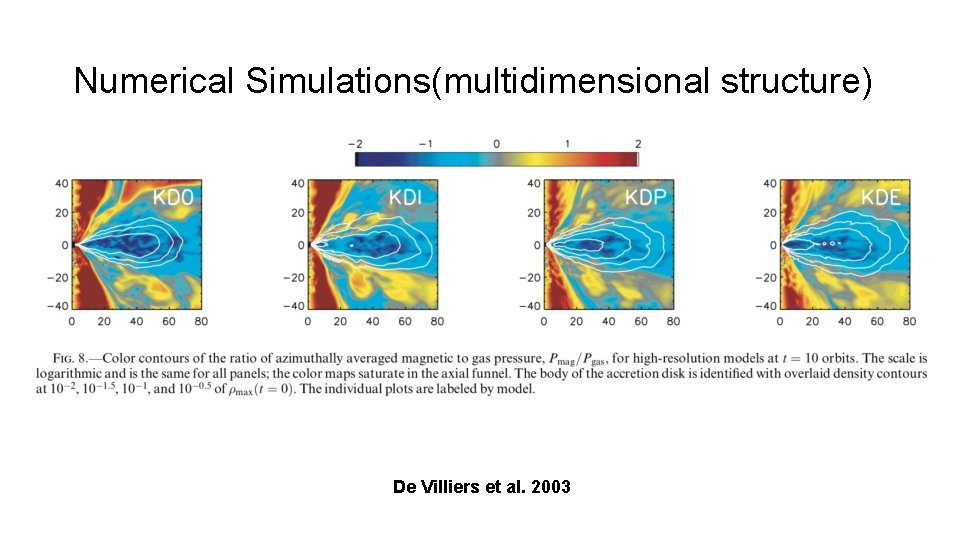
Numerical Simulations(multidimensional structure) • Global simulations: general results • Compared to global HD simulations: self-consistently generate shear stress through MRIinduced MHD turbulence • Compared to shearing box simulations: enable the MRI to sample much larger radial and azimuthal wavelengths • Hawley 2000 use two different initial configurations of B(toroidal and vertical), and find global and shearing box simulations behave similarly • Representative results from 3 D GRMHD simulations: De Villiers and collaborators, also Gammie and collaborators.
Numerical Simulations(multidimensional structure) •
Numerical Simulations(multidimensional structure) De Villiers et al. 2003
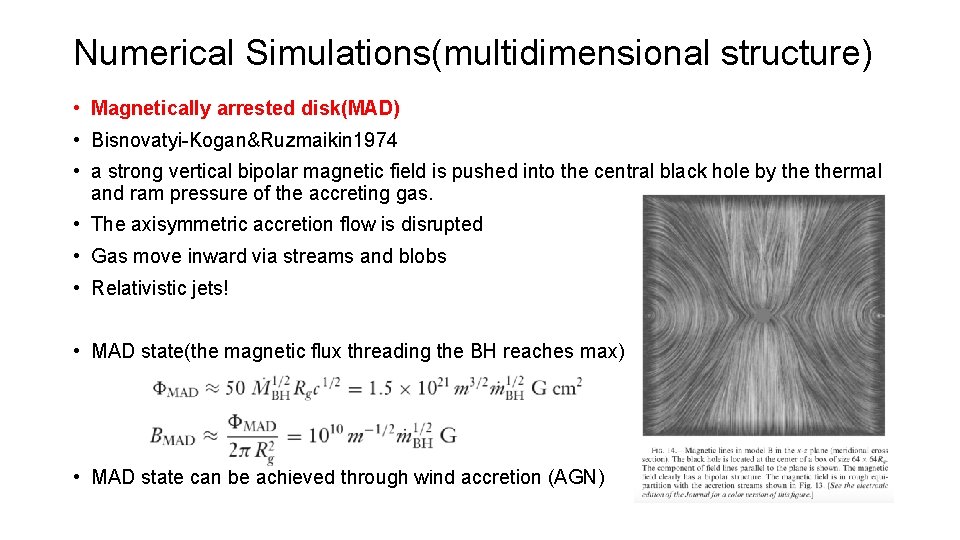
Numerical Simulations(multidimensional structure) • Magnetically arrested disk(MAD) • Bisnovatyi-Kogan&Ruzmaikin 1974 • a strong vertical bipolar magnetic field is pushed into the central black hole by thermal and ram pressure of the accreting gas. • The axisymmetric accretion flow is disrupted • Gas move inward via streams and blobs • Relativistic jets! • MAD state(the magnetic flux threading the BH reaches max) • MAD state can be achieved through wind accretion (AGN)
Numerical Simulations(multidimensional structure) •
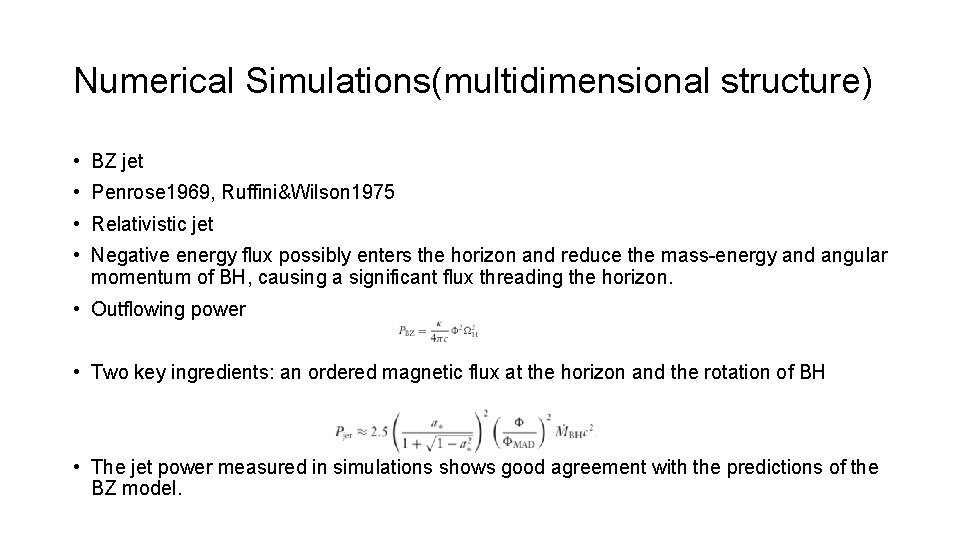
Numerical Simulations(multidimensional structure) • BZ jet • Penrose 1969, Ruffini&Wilson 1975 • Relativistic jet • Negative energy flux possibly enters the horizon and reduce the mass-energy and angular momentum of BH, causing a significant flux threading the horizon. • Outflowing power • Two key ingredients: an ordered magnetic flux at the horizon and the rotation of BH • The jet power measured in simulations shows good agreement with the predictions of the BZ model.
Numerical Simulations(multidimensional structure) •
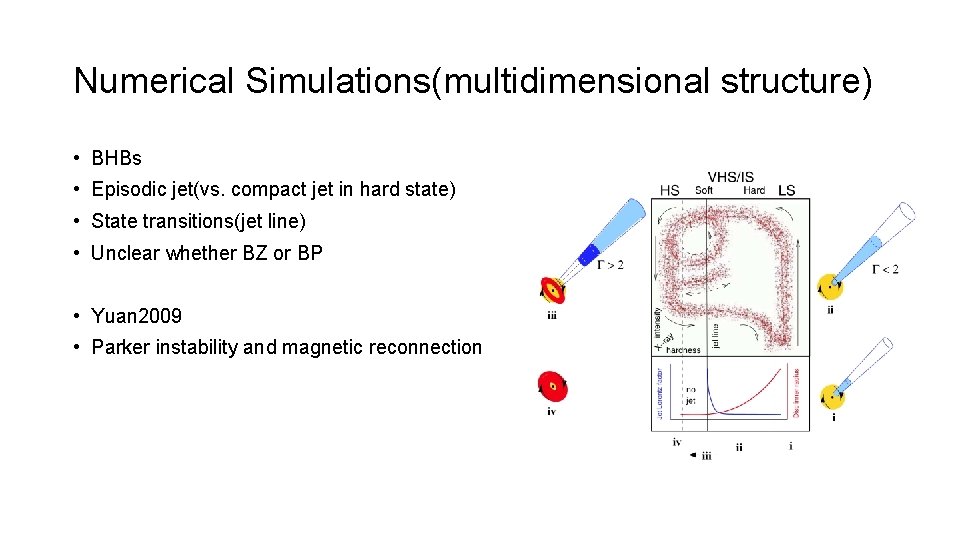
Numerical Simulations(multidimensional structure) • BHBs • Episodic jet(vs. compact jet in hard state) • State transitions(jet line) • Unclear whether BZ or BP • Yuan 2009 • Parker instability and magnetic reconnection
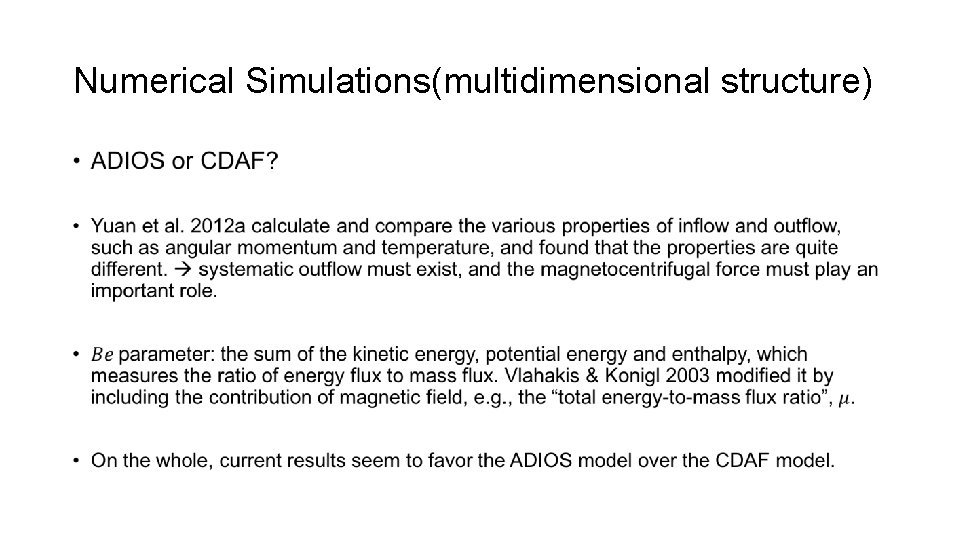
Numerical Simulations(multidimensional structure) • Disk wind from Hot Accretion Flows • Non-relativistic, moves slowly, larger solid angle • Mass loss rate high, energy rate small • No unambiguous way to identify the boundary between the disk jet and disk wind • Narayan & Yi 1994, 1995 a, ADAF will have strong winds, unable to derive the amount of mass loss quantitatively • Blanford & Begelman 1999 a family of self-similar solutions with a wide range of assumed outflow efficiencies; inability of analytical models • Significance: (a)mass loss can strongly affect the dynamics of accreting gas (b)AGN feedback
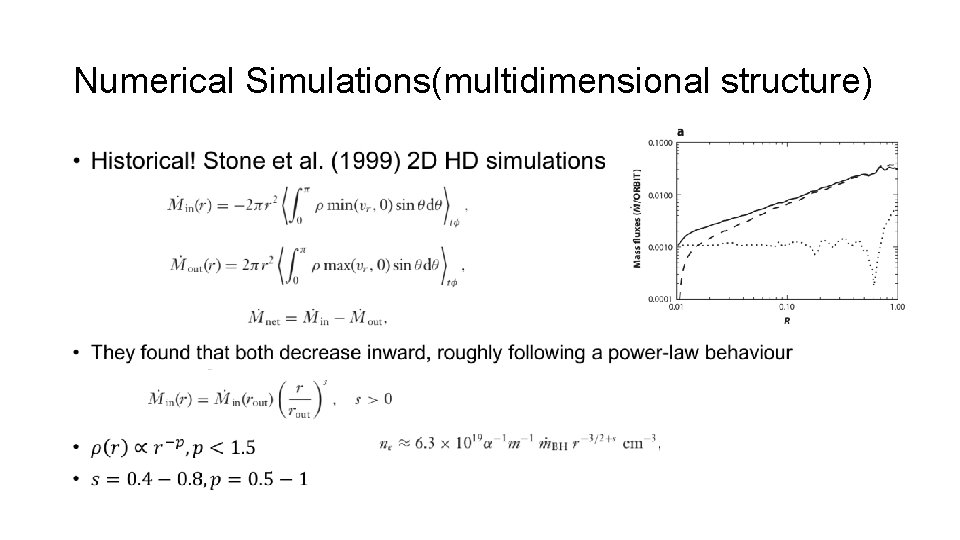
Numerical Simulations(multidimensional structure) •
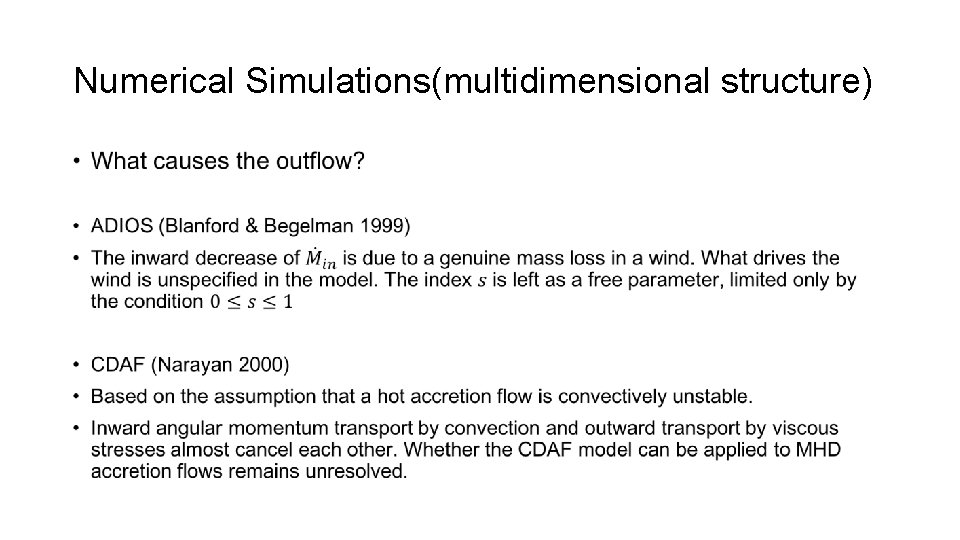
Numerical Simulations(multidimensional structure) •
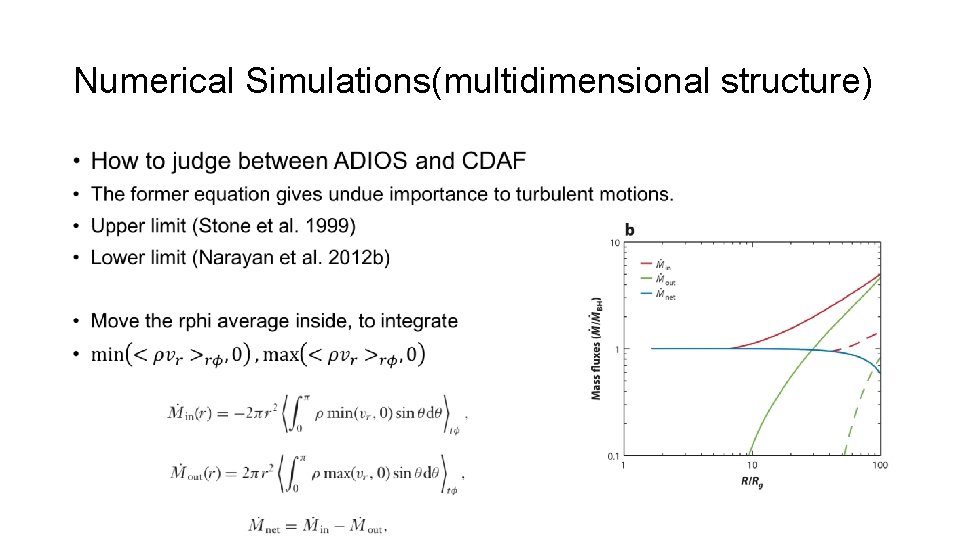
Numerical Simulations(multidimensional structure) •
Numerical Simulations(multidimensional structure) •
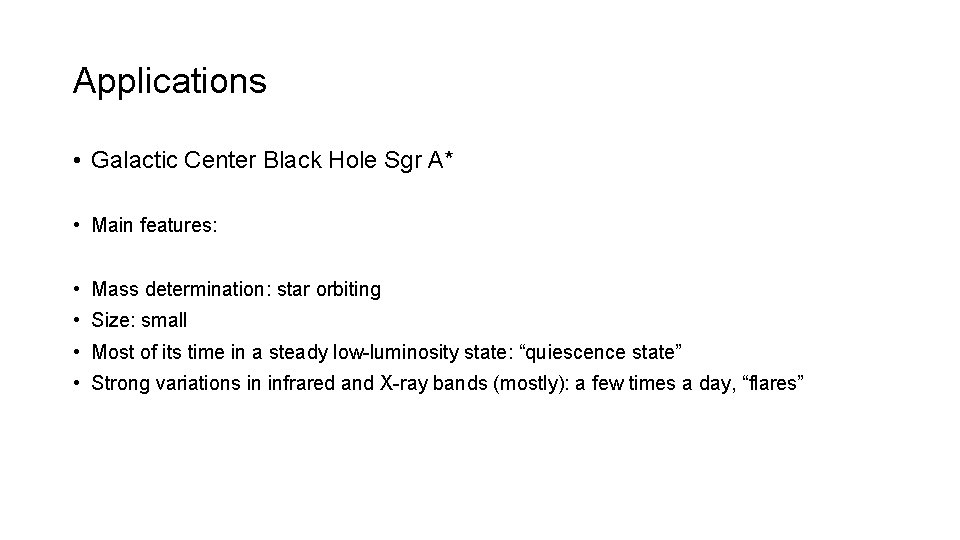
Applications • Galactic Center Black Hole Sgr A* • Main features: • Mass determination: star orbiting • Size: small • Most of its time in a steady low-luminosity state: “quiescence state” • Strong variations in infrared and X-ray bands (mostly): a few times a day, “flares”
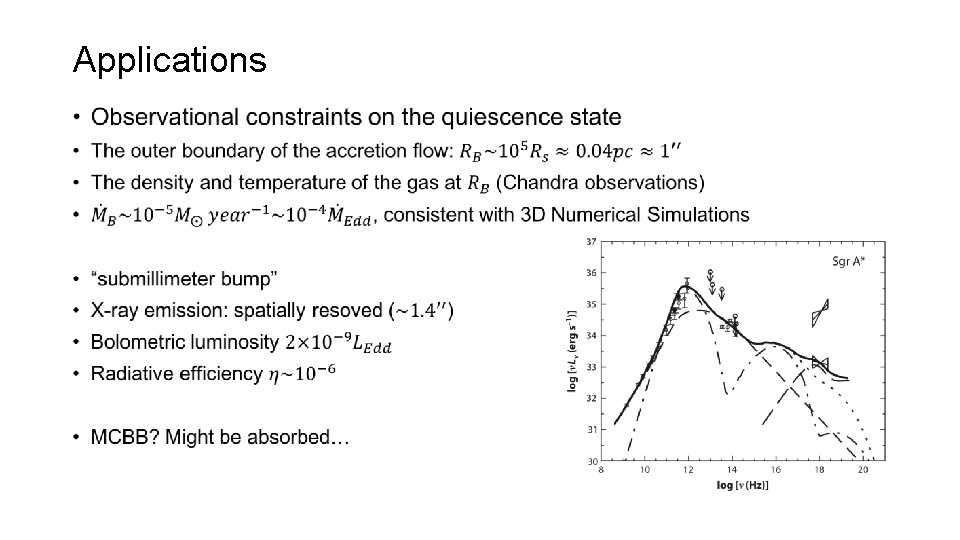
Applications •
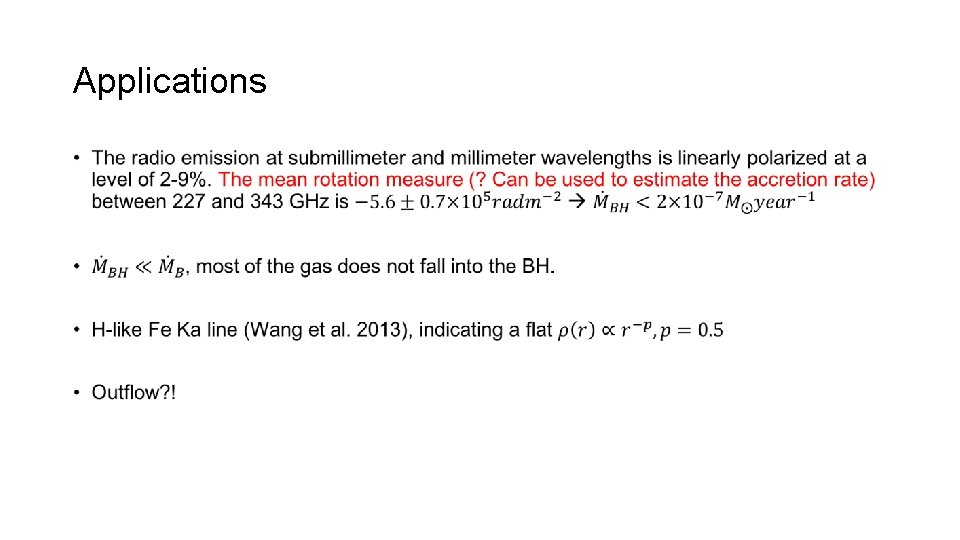
Applications •
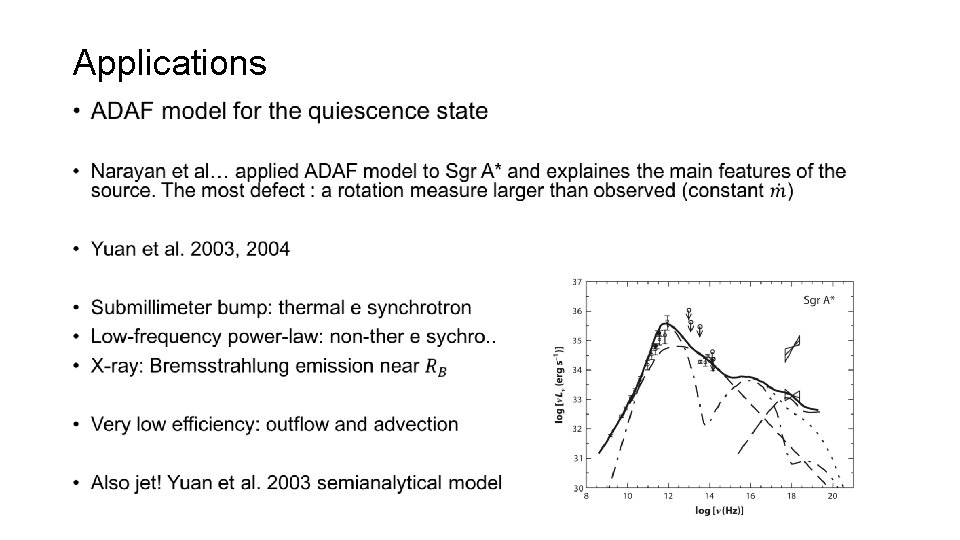
Applications •
Applications • Multiwaveband flares • Strongest in X-rays and infrared: the flux can increase up to a factor of 100 and 5 respectively. • The observations suggest that flares in different wavebands are likely physically related. • The infrared flare is generally believed to be due to pure synchrotron emission • Debate on whether the X-ray flare is due to synchrotron, sychrotron-self-Compton or external inverse Compton? • Yusef-Zadeh et al. 2006 43 GHz lead 22 GHz ~ 20 -40 min, expanding plasma blob model
Applications •
Applications •
Applications • Low-luminosity sources (BHBs and LLAGNs) • BHBs • Spectral states : high/soft, low/hard, quiescence state (also a VHS/SPL state) • High/soft/thermal state: a strong blackbody or thermal spectrum, SSD model • • • Low/hard state: a weak blackbody component A dominated strong hard power-law with a cutoff at 100 ke. V highly variably, often exhibits QPOs a steady jet. • ADAF model? ! Ability to produce the spectrum and explain the transition!
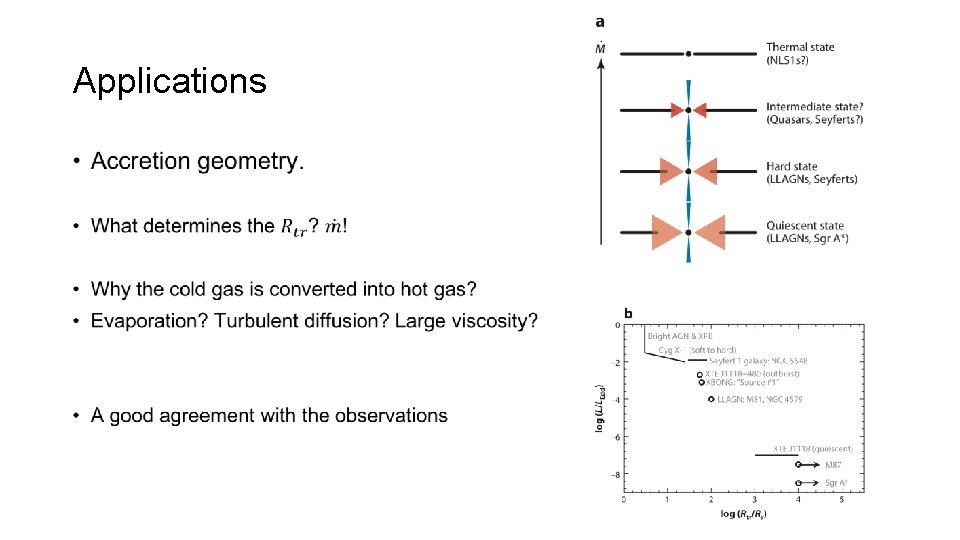
Applications •
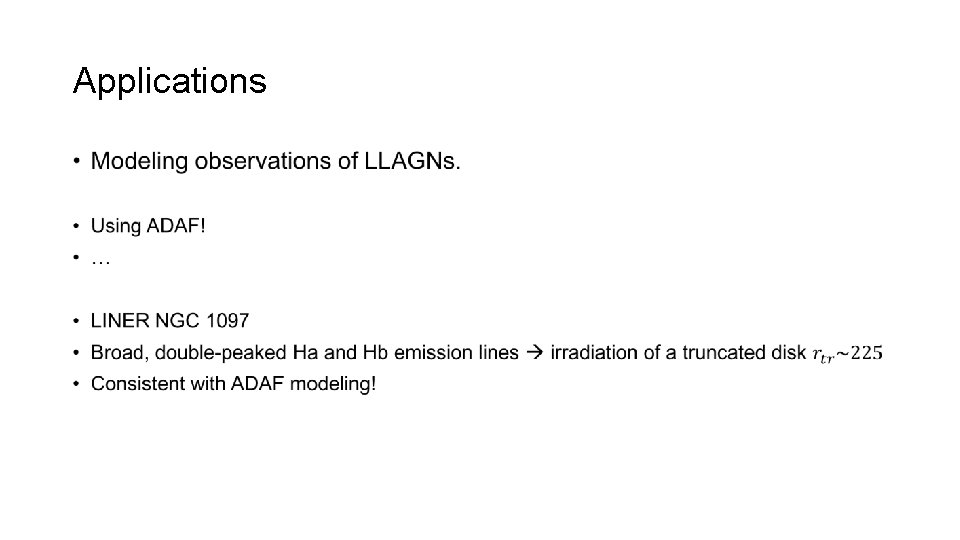
Applications •
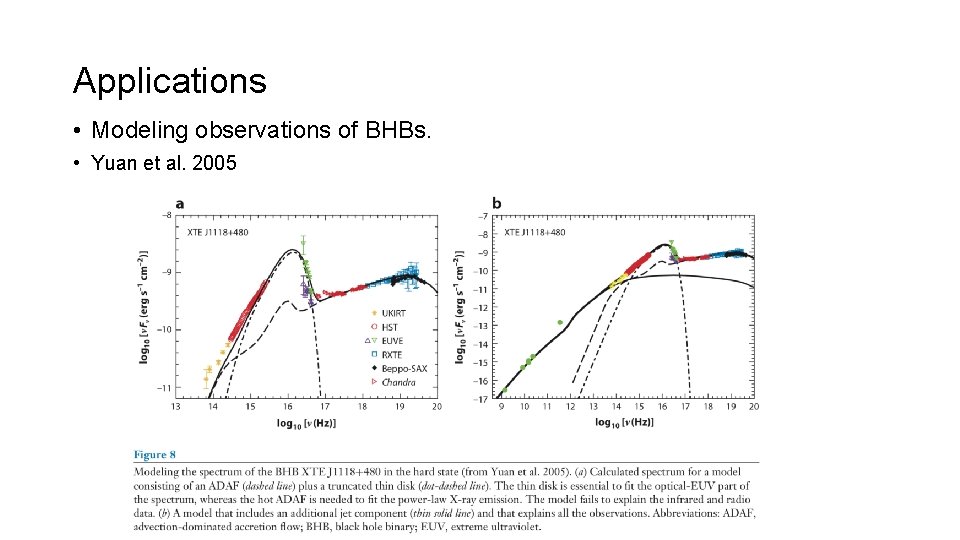
Applications • Modeling observations of BHBs. • Yuan et al. 2005
Applications • Modeling observations of BHBs. • A number of observations confirmed the basic features of the truncated disk scenario in BHBs. • (a) a truncated disk is required to model thermal component in quiescence state • (b) the observed transient behavior, time delay between the optical and X-ray outbursts • (c) a reflection model is seen in X-ray spectrum in the hard state • (d) the truncated disk model explains the correlation between luminosity and photon index • (e) QPO frequency increases with increasing X-ray luminosity • (f) state-transition
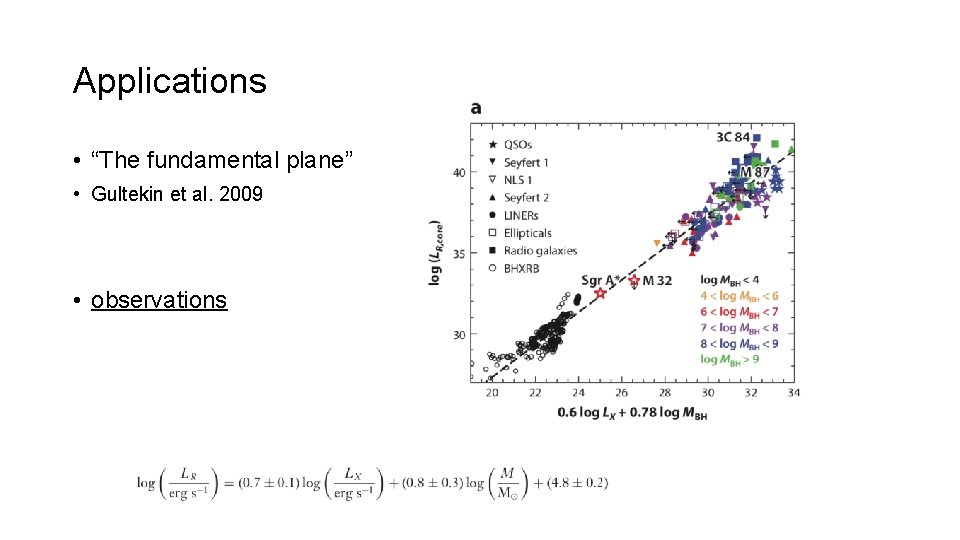
Applications • “The fundamental plane” • Gultekin et al. 2009 • observations
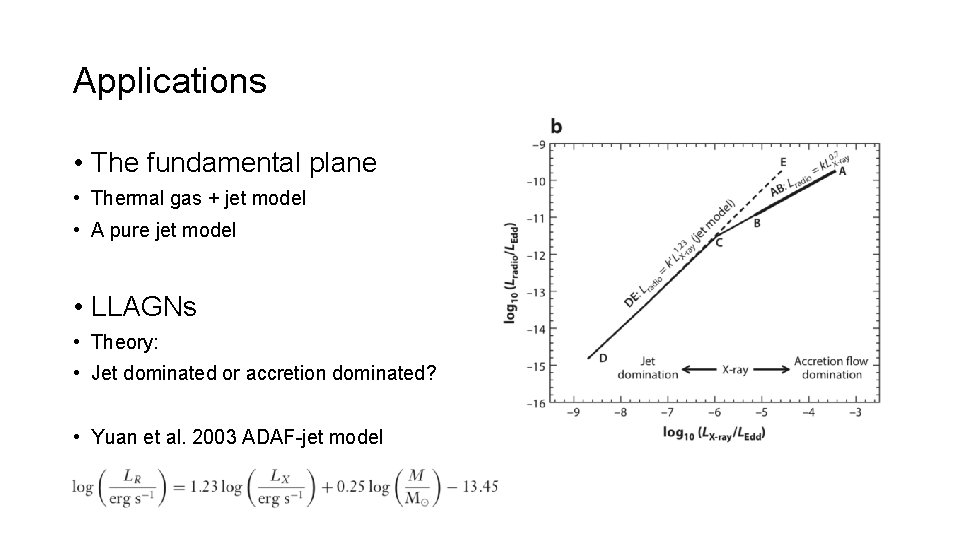
Applications • The fundamental plane • Thermal gas + jet model • A pure jet model • LLAGNs • Theory: • Jet dominated or accretion dominated? • Yuan et al. 2003 ADAF-jet model • Below a critical rate
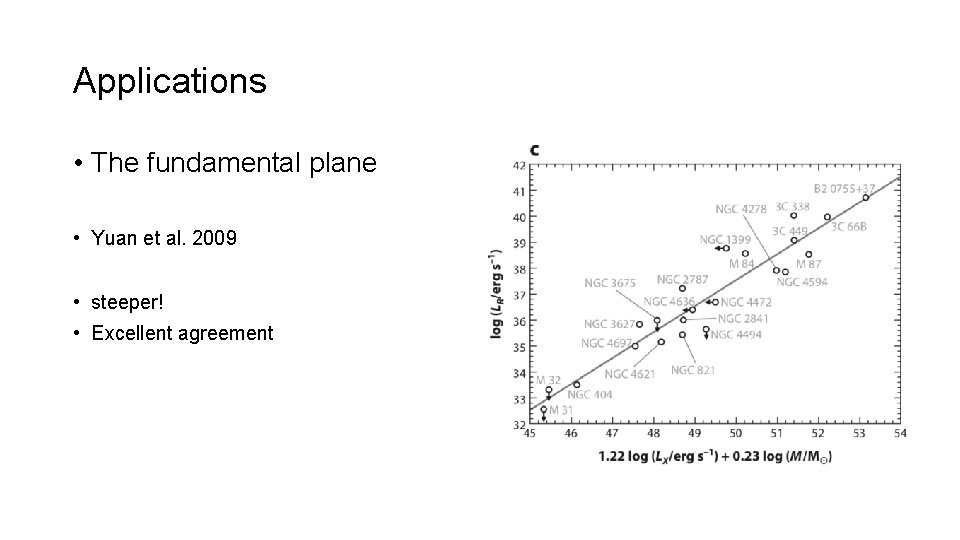
Applications • The fundamental plane • Yuan et al. 2009 • steeper! • Excellent agreement
Applications • Jets and black hole spin • Fundamental plane do not involve BH spin parameter • 1. a narrow range • 2. the jet property: may not be the MAD jet disk jet
Applications • Alternative models for the hard state • Disk-corona model: full disk + “patchy” corona, or with an outward-moving jet • Jet model • Markoff et al. 2005

Hot Accretion and AGN feedback • Not closely related…
- Slides: 49