
HOST PARASITE RELATIONSHIP Ms Dunishiya de Silva Microbes
HOST PARASITE RELATIONSHIP Ms. Dunishiya de Silva
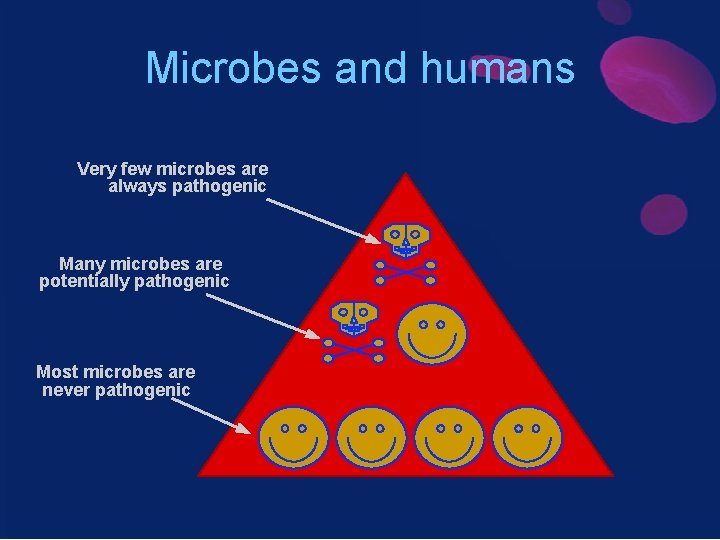
Microbes and humans Very few microbes are always pathogenic Many microbes are potentially pathogenic Most microbes are never pathogenic
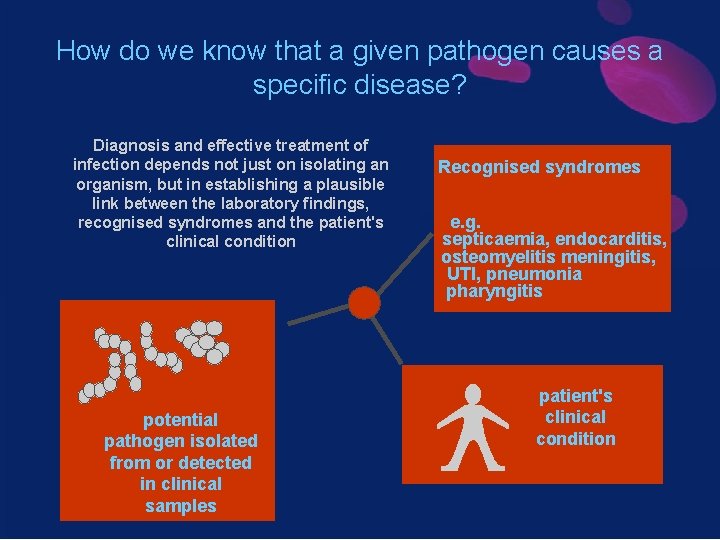
How do we know that a given pathogen causes a specific disease? Diagnosis and effective treatment of infection depends not just on isolating an organism, but in establishing a plausible link between the laboratory findings, recognised syndromes and the patient's clinical condition potential pathogen isolated from or detected in clinical samples Recognised syndromes e. g. septicaemia, endocarditis, osteomyelitis meningitis, UTI, pneumonia pharyngitis patient's clinical condition
Normal flora • All body surfaces possess a rich normal bacterial flora, especially the mouth, nose, gingival crevice, large bowel, skin – This can be a nuisance in that • it can contaminate specimens • it can cause disease – This is beneficial in that • it can protect against infection by preventing pathogens colonising epithelial surfaces (colonisation resistance) • removal of the normal flora with antibiotics can cause superinfection, usually with resistant microbes
Pathogenesis of bacterial infection • Humans and animals have abundant normal microflora. • Most bacteria do not produce disease but achieve a balance with the host that ensures – the survival, growth, and propagation of both the bacteria and the host. • Sometimes bacteria that are clearly pathogens (e. g. Salmonella typhi) are present, but infection remains latent or subclinical and the host is a "carrier" of the bacteria.

It can be difficult to show that a specific bacterial species is the cause of a particular disease. In 1884, Robert Koch proposed a series of postulates in his treatise on Mycobacterium tuberculosis. These postulates have been applied more broadly to link many specific bacterial species with particular diseases.
Basic terms frequently used in describing aspects of pathogenesis: • Infection: – Multiplication of an infectious agent within the body. – Multiplication of the bacteria that are part of normal flora of gastrointestinal tract, skin, etc, is generally not considered an infection. – On the other hand, multiplication of pathogenic bacteria (e. g. Salmonella species), even if the person is asymptomatic, is deemed an infection.
Basic terms frequently used in describing aspects of pathogenesis: • Pathogenicity: – The ability of an infectious agent to cause disease. • Virulence: – The quantitative ability of an agent to cause disease. – Virulent agents cause disease when introduced into the host in small numbers. – Virulence involves invasiveness and toxigenicity.
Basic terms frequently used in describing aspects of pathogenesis: • Toxigenicity: – The ability of a microorganism to produce a toxin that contributes to the development of disease. • Invasion: – The process whereby bacteria, parasites, fungi and viruses enter the host cells or tissues and spread in the body.
Basic terms frequently used in describing aspects of pathogenesis: • Pathogen: – A microorganism capable of causing disease. • Non-pathogen: – A microorganism that does not cause disease. It may be part of the normal flora. • Opportunistic pathogen: – An agent capable of causing disease only when the host´s resistance is impaired (e. g. the patient is immunocompromised). – An agent capable of causing disease only when spread from the site with normal bacterial microflora to the sterile tissue or organ.
Toxins • Toxins produced by bacteria are generally classified into two groups: – Exotoxins – Endotoxins
Endotoxins of Gram-negative bacteria • The endotoxins of Gram-negative bacteria are complex lipopolysaccharides derived from bacterial cell walls and are often liberated when the bacteria lyse. • The substances are heat-stable and can be extracted (e. g. with phenol-water).
• Pathophysiological effects of endotoxins are similar regardless of their bacterial origin: – fever – leukopenia – hypotension – impaired organ perfusion and acidosis – activation of C 3 and complement cascade – disseminated intravascular coagulation (DIC) – death
Exotoxins • Many Gram-positive and Gram-negative bacteria produce exotoxins of considerable medical importance. • Some of these toxins have had major role in world history (e. g. toxin of Clostridium tetani).
Diphtheria toxin (toxin of Corynebacterium diphtheriae) • Corynebacterium diphtheriae strains that carry a temperate bacteriophage with the structural gene for the toxin are toxigenic and produce diphtheria toxin. • This native toxin is enzymatically degraded into two fragments: A and B, linked together by a disulfide bound. Both fragments are necessary for toxin activity.
Tetanospasmin (toxin of Clostridium tetani) • Clostridium tetani is an anaerobic gram-positive rod that is widespread in the environment. • Clostridium tetani contaminates wounds, and the spores germinate in the anaerobic environment of the devitalized tissue. The vegetative forms of Clostridium tetani produce toxin tetanospasmin. The released toxin has two peptides linked by disulfide bounds. Toxin reaches the central nervous system by retrograde transport along axons and through the systemic circulation. The toxin acts by blocking release of an inhibitory mediator in motor neuron synapses. The result is initially localized then generalized, muscle spasms. Extremely small amount of toxin can be lethal for humans.
Botulotoxin (toxin of Clostridium botulinum) • Clostridium botulinum is found in soil or water and may grow in foods if the environment is appropriately anaerobic. • An exceedingly potent toxin (the most potent toxin known) is produced by Clostridium botulinum strains. It is heat-labile and is destroyed by sufficient heating. There are eight disctinct serological types of toxin. Types A, B and E are most commonly associated wih human disease. Toxin is absorbed from the gut and carried to motor nerves, where it blocks the release of acetylcholine at synapses and neuromuscular junctions. Muscle contraction does not occur, and paralysis results.
Toxins of Clostridium perfringens • Spores of Clostridium perfringens are introduced into the wounds by contamination with soil or faeces. In the presence of necrotic tissue (an anaerobic environment), spores germinate and vegetative cells produce several different toxins. • Many of these are necrotizing and hemolytic and favour the spread of gangrene: – alpha toxin is a lecithinase that damages cell membranes – theta toxin also has a necrotizing affect – and other
Streptococcal erythrogenic toxin • Some strains of hemolytic lysogenic streptococci produce a toxin that results in a punctate maculopapular erythematous rash, as in scarlet fewer. • Production of erythrogenic toxin is under the genetic control of temperate bacteriophage. If the phage is lost, the streptococi cannot produce toxin.
Toxic shock syndrom toxin - 1 (TSST-1) • Some Staphylococcus aureus strains growing on mucous membranes (e. g. on the vagina in association with menstruation), or in wounds, elaborate TSST-1. • Although the toxin has been associated with toxic shock syndrome, the mechanism of action in unknown. • The illness is characterized by shock, high fewer, and a diffuse red rash that later desquamates, multiple other organs systems are involved as well.
Exotoxins associated with diarrheal diseases • Vibrio cholerae toxin • Staphylococcus aureus enterotoxin • Other enterotoxins - enterotoxins are also produced by some strains of: – Yersinia enterocolitica – Vibrio parahaemolyticus – Aeromonas species
- Slides: 21