
Hospitals and Health Systems Case Studies on Implementation
- Slides: 30
Hospitals and Health Systems: Case Studies on Implementation of Large-Scale Systems HIT Summit October 22, 2004 Robert M. Kolodner, M. D. Acting Chief Health Informatics Officer, VHA & Acting Deputy CIO Department of Veterans Affairs
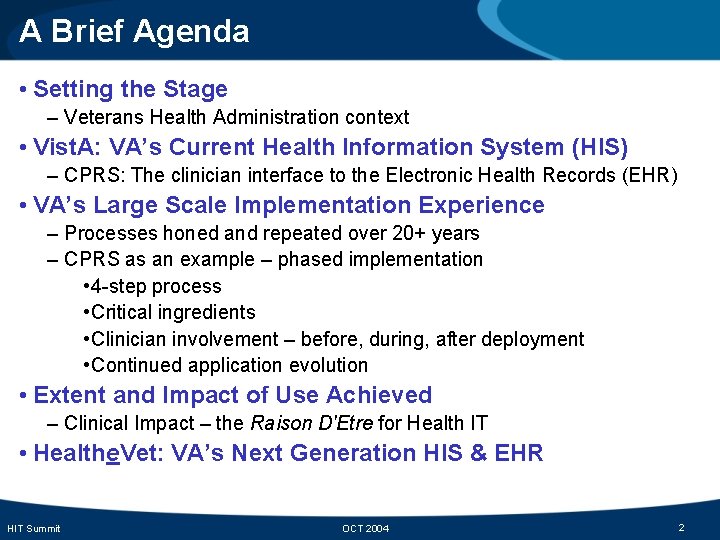
A Brief Agenda • Setting the Stage – Veterans Health Administration context • Vist. A: VA’s Current Health Information System (HIS) – CPRS: The clinician interface to the Electronic Health Records (EHR) • VA’s Large Scale Implementation Experience – Processes honed and repeated over 20+ years – CPRS as an example – phased implementation • 4 -step process • Critical ingredients • Clinician involvement – before, during, after deployment • Continued application evolution • Extent and Impact of Use Achieved – Clinical Impact – the Raison D'Etre for Health IT • Healthe. Vet: VA’s Next Generation HIS & EHR HIT Summit OCT 2004 2
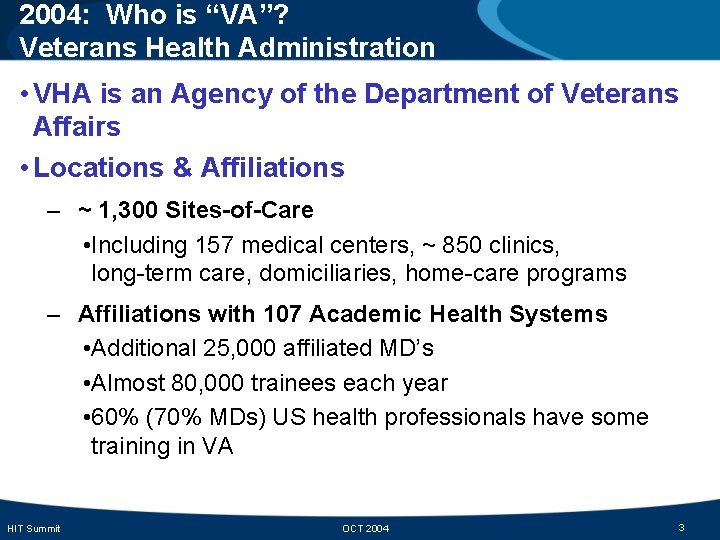
2004: Who is “VA”? Veterans Health Administration • VHA is an Agency of the Department of Veterans Affairs • Locations & Affiliations – ~ 1, 300 Sites-of-Care • Including 157 medical centers, ~ 850 clinics, long-term care, domiciliaries, home-care programs – Affiliations with 107 Academic Health Systems • Additional 25, 000 affiliated MD’s • Almost 80, 000 trainees each year • 60% (70% MDs) US health professionals have some training in VA HIT Summit OCT 2004 3
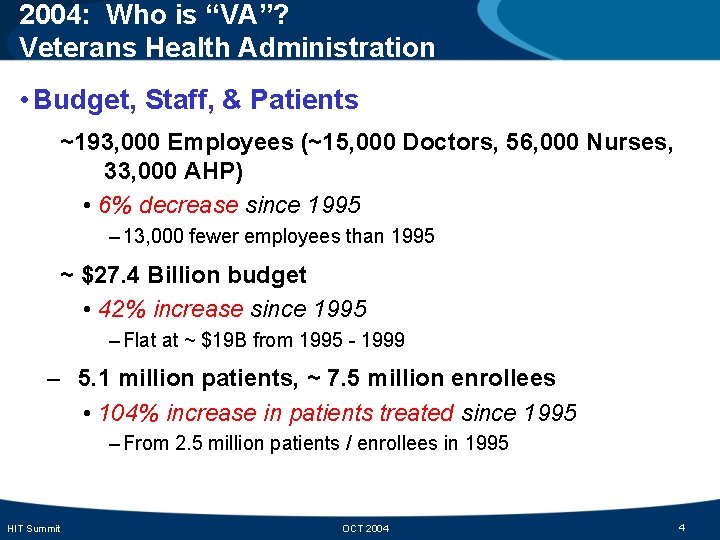
2004: Who is “VA”? Veterans Health Administration • Budget, Staff, & Patients ~193, 000 Employees (~15, 000 Doctors, 56, 000 Nurses, 33, 000 AHP) • 6% decrease since 1995 – 13, 000 fewer employees than 1995 ~ $27. 4 Billion budget • 42% increase since 1995 – Flat at ~ $19 B from 1995 - 1999 – 5. 1 million patients, ~ 7. 5 million enrollees • 104% increase in patients treated since 1995 – From 2. 5 million patients / enrollees in 1995 HIT Summit OCT 2004 4
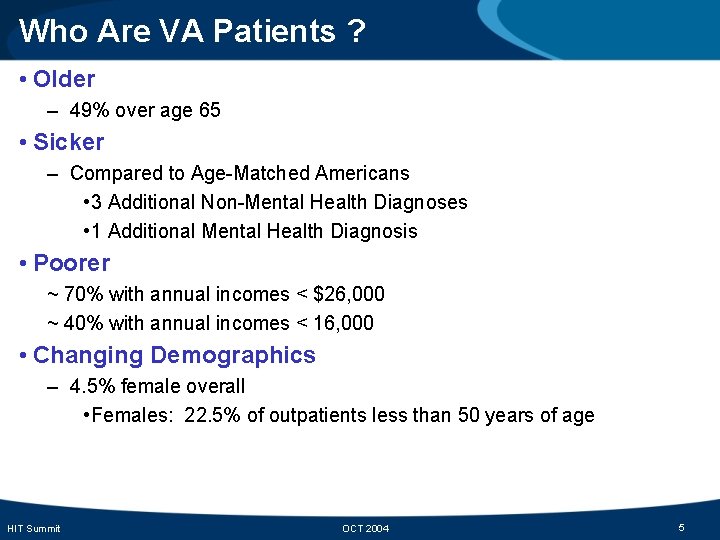
Who Are VA Patients ? • Older – 49% over age 65 • Sicker – Compared to Age-Matched Americans • 3 Additional Non-Mental Health Diagnoses • 1 Additional Mental Health Diagnosis • Poorer ~ 70% with annual incomes < $26, 000 ~ 40% with annual incomes < 16, 000 • Changing Demographics – 4. 5% female overall • Females: 22. 5% of outpatients less than 50 years of age HIT Summit OCT 2004 5
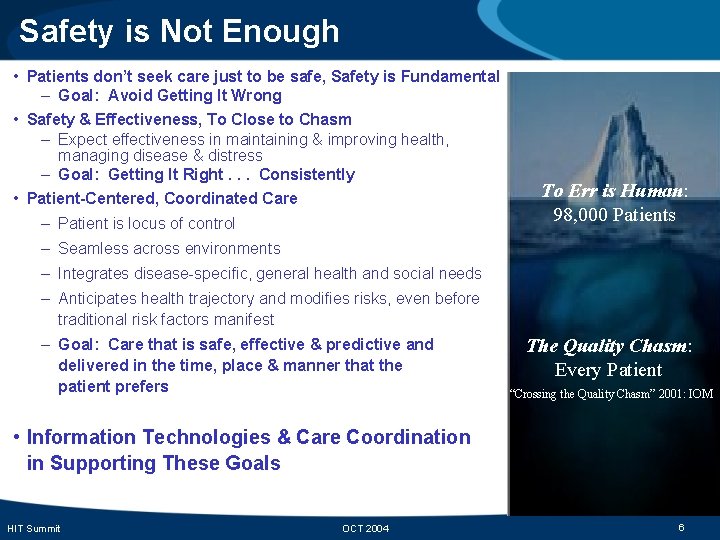
Safety is Not Enough • Patients don’t seek care just to be safe, Safety is Fundamental – Goal: Avoid Getting It Wrong • Safety & Effectiveness, To Close to Chasm – Expect effectiveness in maintaining & improving health, managing disease & distress – Goal: Getting It Right. . . Consistently • Patient-Centered, Coordinated Care – Patient is locus of control To Err is Human: 98, 000 Patients – Seamless across environments – Integrates disease-specific, general health and social needs – Anticipates health trajectory and modifies risks, even before traditional risk factors manifest – Goal: Care that is safe, effective & predictive and delivered in the time, place & manner that the patient prefers The Quality Chasm: Every Patient “Crossing the Quality Chasm” 2001: IOM • Information Technologies & Care Coordination in Supporting These Goals HIT Summit OCT 2004 6
HIT Summit OCT 2004 7
Success In Supporting Health Care Delivery For Millions Of Veterans • Vist. A is a success – Built by “fire” of VHA collaboration – Publicly owned by VA; plan to remain so for the next generation system – Strong interest by public/private in using Vist. A • National software w/ local flexibility/innovation: – Innovation developed locally & enterprise wide – Standard packages distributed enterprise wide, e. g. latest version of CPRS • Initial system (1983 -1996) was built around “dumb terminals” – – HIT Summit “Decentralized Hospital Computer Program (DHCP)” Steady deployment of packages and enhancements Applications separated out by Hospital/Clinic “Service” Simple “roll-and-scroll” screens OCT 2004 8
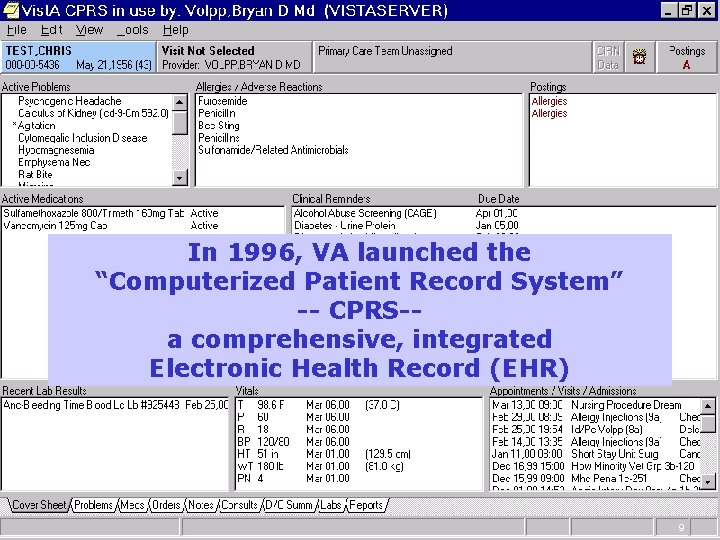
In 1996, VA launched the “Computerized Patient Record System” -- CPRS-a comprehensive, integrated Electronic Health Record (EHR) HIT Summit OCT 2004 9
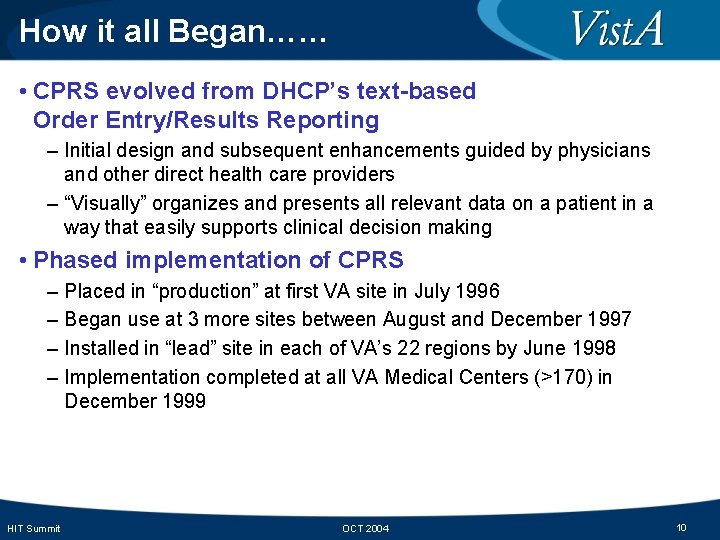
How it all Began…… • CPRS evolved from DHCP’s text-based Order Entry/Results Reporting – Initial design and subsequent enhancements guided by physicians and other direct health care providers – “Visually” organizes and presents all relevant data on a patient in a way that easily supports clinical decision making • Phased implementation of CPRS – – HIT Summit Placed in “production” at first VA site in July 1996 Began use at 3 more sites between August and December 1997 Installed in “lead” site in each of VA’s 22 regions by June 1998 Implementation completed at all VA Medical Centers (>170) in December 1999 OCT 2004 10
Insight on Successful Software Development “Try, fail. Try, succeed, deploy. ” William W. Stead, M. D. Associate Vice Chancellor for Health Affairs & Professor of Medicine and Biomedical Informatics Vanderbilt University HIT Summit OCT 2004 11
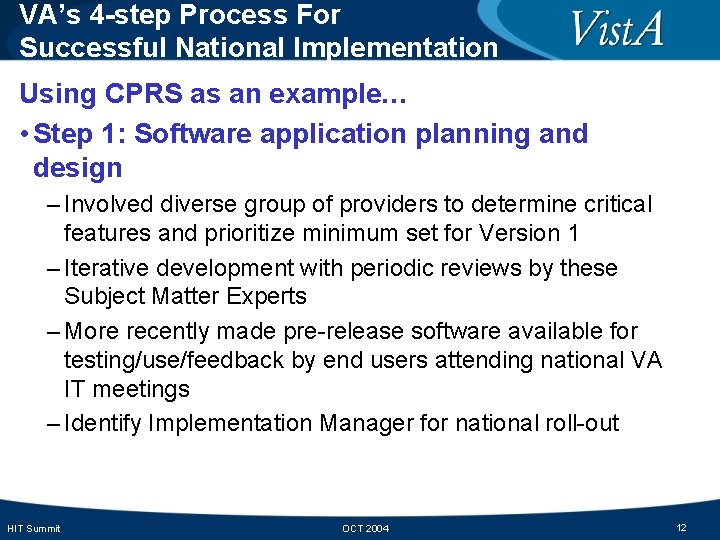
VA’s 4 -step Process For Successful National Implementation Using CPRS as an example… • Step 1: Software application planning and design – Involved diverse group of providers to determine critical features and prioritize minimum set for Version 1 – Iterative development with periodic reviews by these Subject Matter Experts – More recently made pre-release software available for testing/use/feedback by end users attending national VA IT meetings – Identify Implementation Manager for national roll-out HIT Summit OCT 2004 12
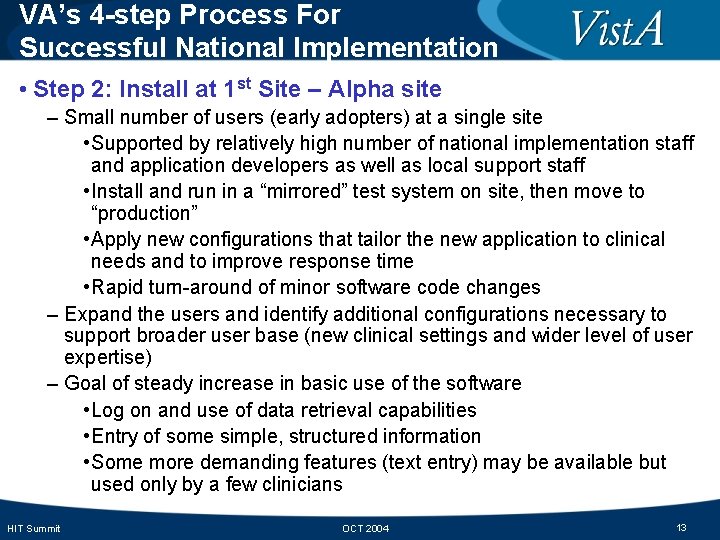
VA’s 4 -step Process For Successful National Implementation • Step 2: Install at 1 st Site – Alpha site – Small number of users (early adopters) at a single site • Supported by relatively high number of national implementation staff and application developers as well as local support staff • Install and run in a “mirrored” test system on site, then move to “production” • Apply new configurations that tailor the new application to clinical needs and to improve response time • Rapid turn-around of minor software code changes – Expand the users and identify additional configurations necessary to support broader user base (new clinical settings and wider level of user expertise) – Goal of steady increase in basic use of the software • Log on and use of data retrieval capabilities • Entry of some simple, structured information • Some more demanding features (text entry) may be available but used only by a few clinicians HIT Summit OCT 2004 13
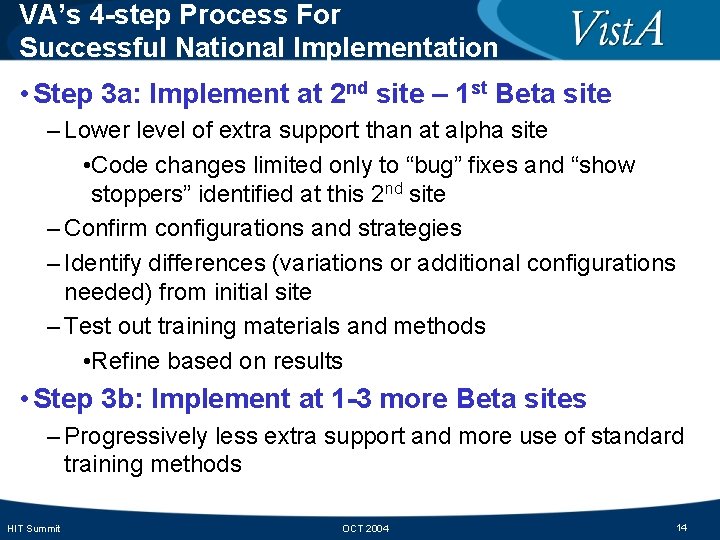
VA’s 4 -step Process For Successful National Implementation • Step 3 a: Implement at 2 nd site – 1 st Beta site – Lower level of extra support than at alpha site • Code changes limited only to “bug” fixes and “show stoppers” identified at this 2 nd site – Confirm configurations and strategies – Identify differences (variations or additional configurations needed) from initial site – Test out training materials and methods • Refine based on results • Step 3 b: Implement at 1 -3 more Beta sites – Progressively less extra support and more use of standard training methods HIT Summit OCT 2004 14
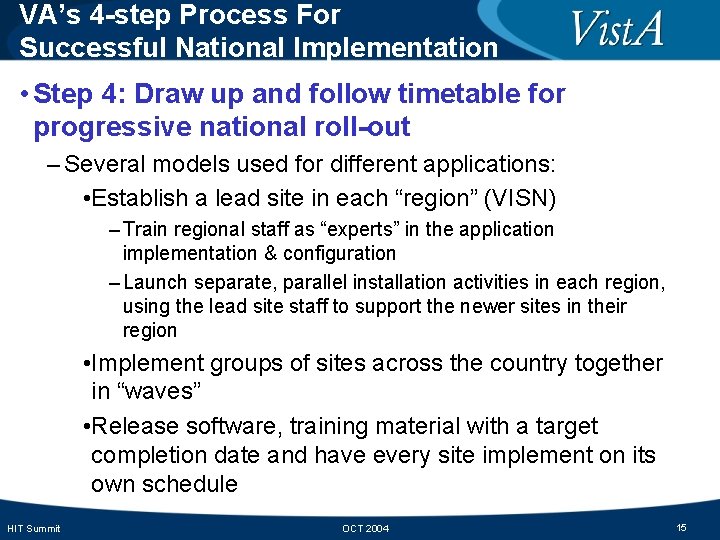
VA’s 4 -step Process For Successful National Implementation • Step 4: Draw up and follow timetable for progressive national roll-out – Several models used for different applications: • Establish a lead site in each “region” (VISN) – Train regional staff as “experts” in the application implementation & configuration – Launch separate, parallel installation activities in each region, using the lead site staff to support the newer sites in their region • Implement groups of sites across the country together in “waves” • Release software, training material with a target completion date and have every site implement on its own schedule HIT Summit OCT 2004 15
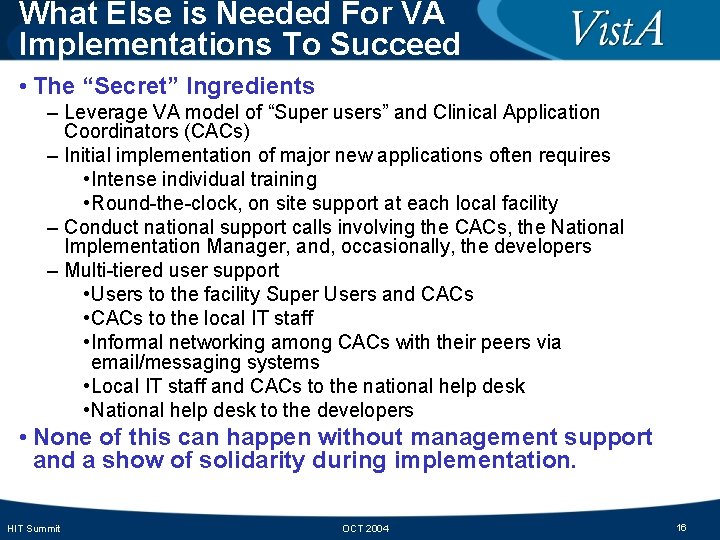
What Else is Needed For VA Implementations To Succeed • The “Secret” Ingredients – Leverage VA model of “Super users” and Clinical Application Coordinators (CACs) – Initial implementation of major new applications often requires • Intense individual training • Round-the-clock, on site support at each local facility – Conduct national support calls involving the CACs, the National Implementation Manager, and, occasionally, the developers – Multi-tiered user support • Users to the facility Super Users and CACs • CACs to the local IT staff • Informal networking among CACs with their peers via email/messaging systems • Local IT staff and CACs to the national help desk • National help desk to the developers • None of this can happen without management support and a show of solidarity during implementation. HIT Summit OCT 2004 16
Guidance for IT Development Staff Who Work With Clinicians “If you give me what I tell you I want, then I’ll tell you what I really want (and actually need). ” It’s NOT “scope creep; ” it’s actually part of the process of refining what will work in a clinical setting. Usability testing with a plan for iterative cycles of design need to be built into the plan. HIT Summit OCT 2004 17
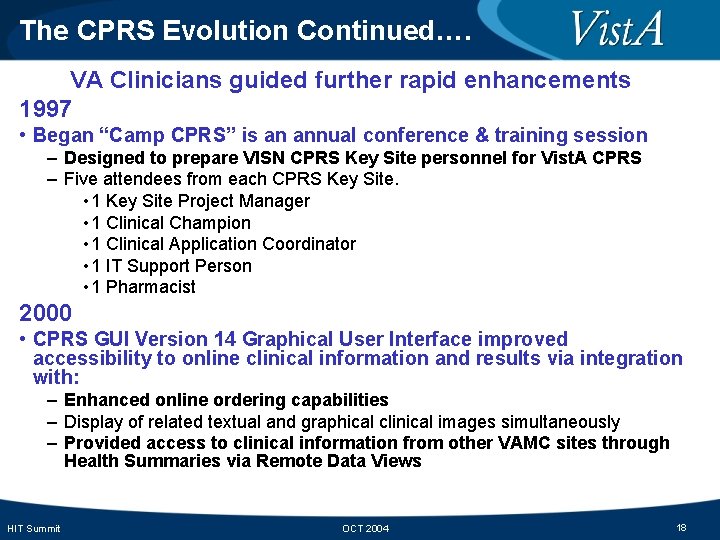
The CPRS Evolution Continued…. VA Clinicians guided further rapid enhancements 1997 • Began “Camp CPRS” is an annual conference & training session – Designed to prepare VISN CPRS Key Site personnel for Vist. A CPRS – Five attendees from each CPRS Key Site. • 1 Key Site Project Manager • 1 Clinical Champion • 1 Clinical Application Coordinator • 1 IT Support Person • 1 Pharmacist 2000 • CPRS GUI Version 14 Graphical User Interface improved accessibility to online clinical information and results via integration with: – Enhanced online ordering capabilities – Display of related textual and graphical clinical images simultaneously – Provided access to clinical information from other VAMC sites through Health Summaries via Remote Data Views HIT Summit OCT 2004 18
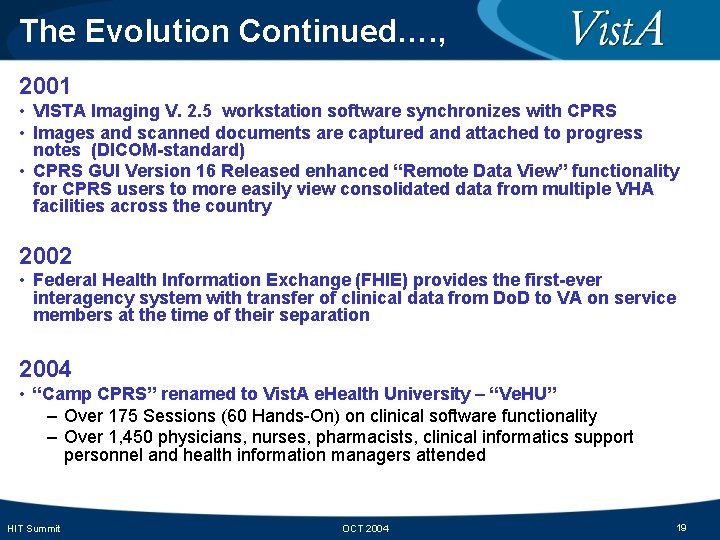
The Evolution Continued…. , 2001 • VISTA Imaging V. 2. 5 workstation software synchronizes with CPRS • Images and scanned documents are captured and attached to progress notes (DICOM-standard) • CPRS GUI Version 16 Released enhanced “Remote Data View” functionality for CPRS users to more easily view consolidated data from multiple VHA facilities across the country 2002 • Federal Health Information Exchange (FHIE) provides the first-ever interagency system with transfer of clinical data from Do. D to VA on service members at the time of their separation 2004 • “Camp CPRS” renamed to Vist. A e. Health University – “Ve. HU” – Over 175 Sessions (60 Hands-On) on clinical software functionality – Over 1, 450 physicians, nurses, pharmacists, clinical informatics support personnel and health information managers attended HIT Summit OCT 2004 19
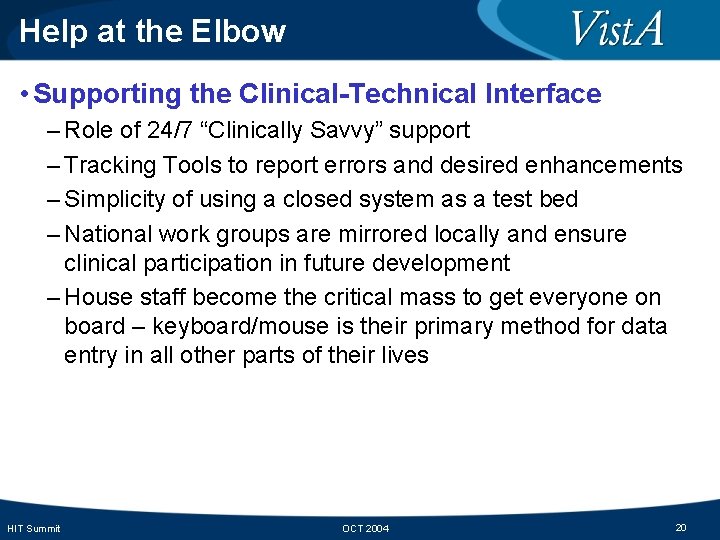
Help at the Elbow • Supporting the Clinical-Technical Interface – Role of 24/7 “Clinically Savvy” support – Tracking Tools to report errors and desired enhancements – Simplicity of using a closed system as a test bed – National work groups are mirrored locally and ensure clinical participation in future development – House staff become the critical mass to get everyone on board – keyboard/mouse is their primary method for data entry in all other parts of their lives HIT Summit OCT 2004 20
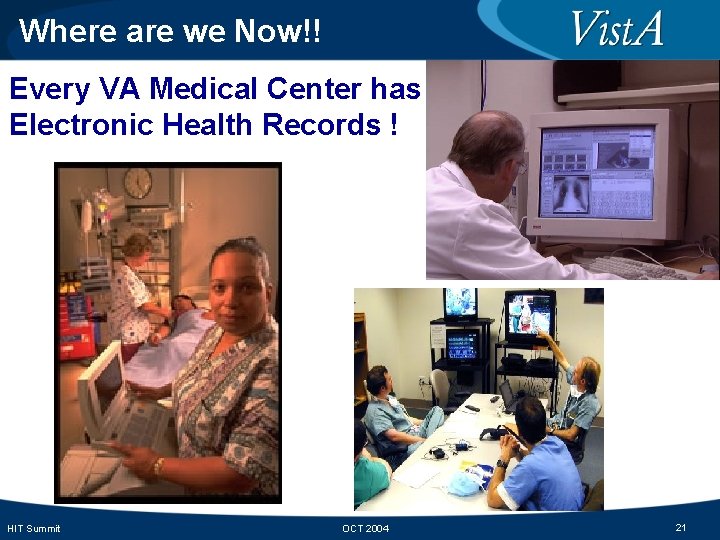
Where are we Now!! Every VA Medical Center has Electronic Health Records ! HIT Summit OCT 2004 21
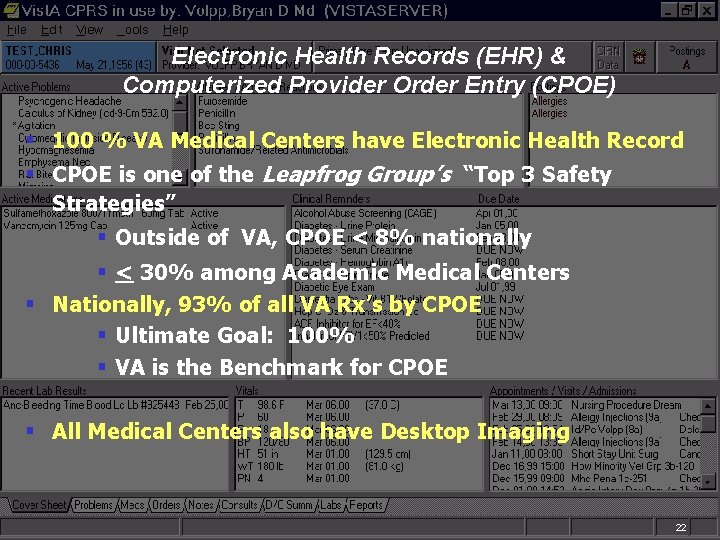
Electronic Health Records (EHR) & Computerized Provider Order Entry (CPOE) § 100 % VA Medical Centers have Electronic Health Record § CPOE is one of the Leapfrog Group’s “Top 3 Safety Strategies” § Outside of VA, CPOE < 8% nationally § < 30% among Academic Medical Centers § Nationally, 93% of all VA Rx’s by CPOE § Ultimate Goal: 100% § VA is the Benchmark for CPOE § All Medical Centers also have Desktop Imaging HIT Summit OCT 2004 22
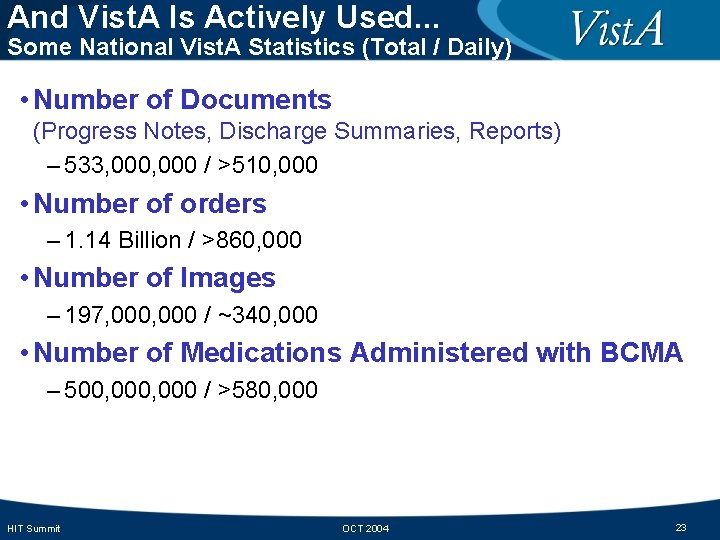
And Vist. A Is Actively Used. . . Some National Vist. A Statistics (Total / Daily) • Number of Documents (Progress Notes, Discharge Summaries, Reports) – 533, 000 / >510, 000 • Number of orders – 1. 14 Billion / >860, 000 • Number of Images – 197, 000 / ~340, 000 • Number of Medications Administered with BCMA – 500, 000 / >580, 000 HIT Summit OCT 2004 23
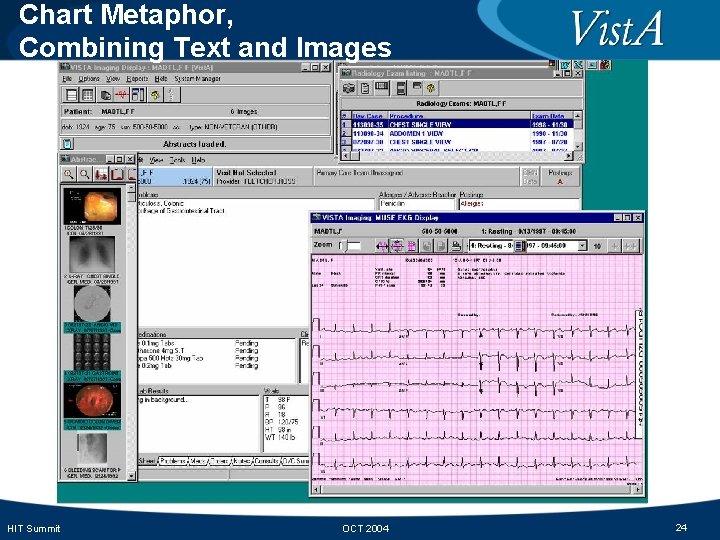
Chart Metaphor, Combining Text and Images HIT Summit OCT 2004 24
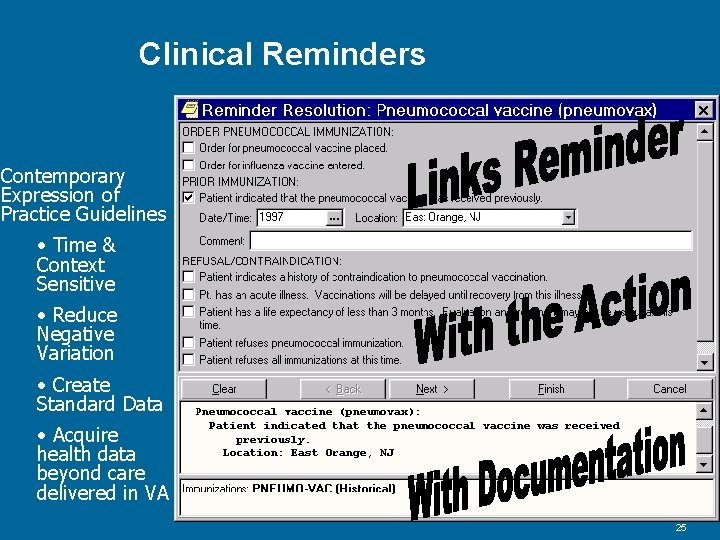
Clinical Reminders Contemporary Expression of Practice Guidelines • Time & Context Sensitive • Reduce Negative Variation • Create Standard Data • Acquire health data beyond care delivered in VA HIT Summit OCT 2004 25
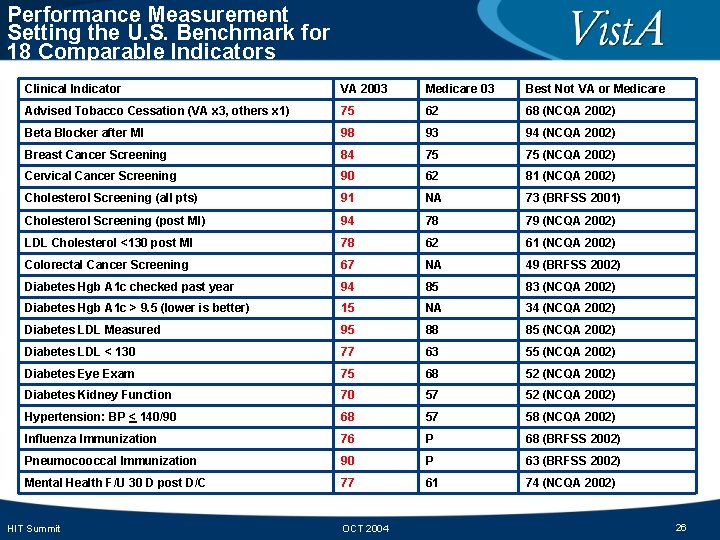
Performance Measurement Setting the U. S. Benchmark for 18 Comparable Indicators Clinical Indicator VA 2003 Medicare 03 Best Not VA or Medicare Advised Tobacco Cessation (VA x 3, others x 1) 75 62 68 (NCQA 2002) Beta Blocker after MI 98 93 94 (NCQA 2002) Breast Cancer Screening 84 75 75 (NCQA 2002) Cervical Cancer Screening 90 62 81 (NCQA 2002) Cholesterol Screening (all pts) 91 NA 73 (BRFSS 2001) Cholesterol Screening (post MI) 94 78 79 (NCQA 2002) LDL Cholesterol <130 post MI 78 62 61 (NCQA 2002) Colorectal Cancer Screening 67 NA 49 (BRFSS 2002) Diabetes Hgb A 1 c checked past year 94 85 83 (NCQA 2002) Diabetes Hgb A 1 c > 9. 5 (lower is better) 15 NA 34 (NCQA 2002) Diabetes LDL Measured 95 88 85 (NCQA 2002) Diabetes LDL < 130 77 63 55 (NCQA 2002) Diabetes Eye Exam 75 68 52 (NCQA 2002) Diabetes Kidney Function 70 57 52 (NCQA 2002) Hypertension: BP < 140/90 68 57 58 (NCQA 2002) Influenza Immunization 76 P 68 (BRFSS 2002) Pneumocooccal Immunization 90 P 63 (BRFSS 2002) Mental Health F/U 30 D post D/C 77 61 74 (NCQA 2002) HIT Summit OCT 2004 26
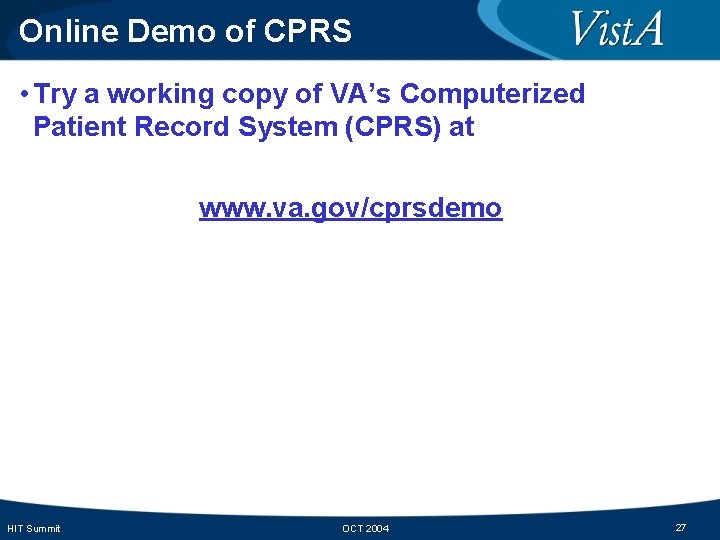
Online Demo of CPRS • Try a working copy of VA’s Computerized Patient Record System (CPRS) at www. va. gov/cprsdemo HIT Summit OCT 2004 27
The Future…. . HIT Summit OCT 2004 28
Next Generation Vist. A • Healthe. Vet-Vist. A is a modernization effort that includes: – Systems Platform – Software Design – Development Methodology • Based on state-of-the-art technology • Business process re-engineering HIT Summit OCT 2004 29
Healthe. Vet – Strategy Overview • Moves from facility-centric to person/data-centric – Uses national, person-focused health data repository for production & management/analysis/research • Builds on, enhances & utilizes Vist. A – Moves from legacy Vist. A to Healthe. Vet-Vista • Uses best, appropriate modern technology – Programming, software, hardware, networking • Standardizes the “core” applications – Provides processes for local enhancements beyond the “core” • Standardizes data & communications HIT Summit OCT 2004 30