
Hospitality and Catering Knowledge Organiser AC 2 1
- Slides: 2
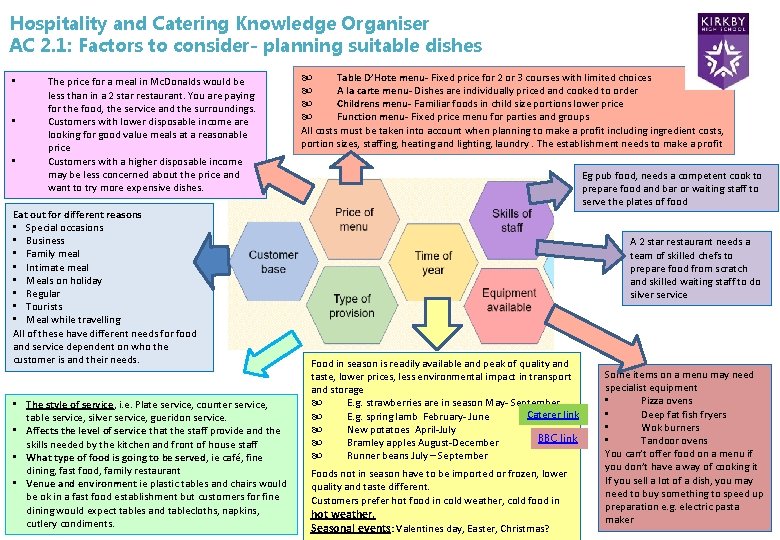
Hospitality and Catering Knowledge Organiser AC 2. 1: Factors to consider- planning suitable dishes • • • The price for a meal in Mc. Donalds would be less than in a 2 star restaurant. You are paying for the food, the service and the surroundings. Customers with lower disposable income are looking for good value meals at a reasonable price Customers with a higher disposable income may be less concerned about the price and want to try more expensive dishes. Eat out for different reasons • Special occasions • Business • Family meal • Intimate meal • Meals on holiday • Regular • Tourists • Meal while travelling All of these have different needs for food and service dependent on who the customer is and their needs. • The style of service, i. e. Plate service, counter service, table service, silver service, gueridon service. • Affects the level of service that the staff provide and the skills needed by the kitchen and front of house staff • What type of food is going to be served, ie café, fine dining, fast food, family restaurant • Venue and environment ie plastic tables and chairs would be ok in a fast food establishment but customers for fine dining would expect tables and tablecloths, napkins, cutlery condiments. Table D’Hote menu- Fixed price for 2 or 3 courses with limited choices A la carte menu- Dishes are individually priced and cooked to order Childrens menu- Familiar foods in child size portions lower price Function menu- Fixed price menu for parties and groups All costs must be taken into account when planning to make a profit including ingredient costs, portion sizes, staffing, heating and lighting, laundry. The establishment needs to make a profit Eg pub food, needs a competent cook to prepare food and bar or waiting staff to serve the plates of food A 2 star restaurant needs a team of skilled chefs to prepare food from scratch and skilled waiting staff to do silver service Food in season is readily available and peak of quality and taste, lower prices, less environmental impact in transport and storage E. g. strawberries are in season May- September Caterer link E. g. spring lamb February- June New potatoes April-July BBC link Bramley apples August-December Runner beans July – September Foods not in season have to be imported or frozen, lower quality and taste different. Customers prefer hot food in cold weather, cold food in hot weather. Seasonal events: Valentines day, Easter, Christmas? Some items on a menu may need specialist equipment • Pizza ovens • Deep fat fish fryers • Wok burners • Tandoor ovens You can’t offer food on a menu if you don’t have a way of cooking it If you sell a lot of a dish, you may need to buy something to speed up preparation e. g. electric pasta maker
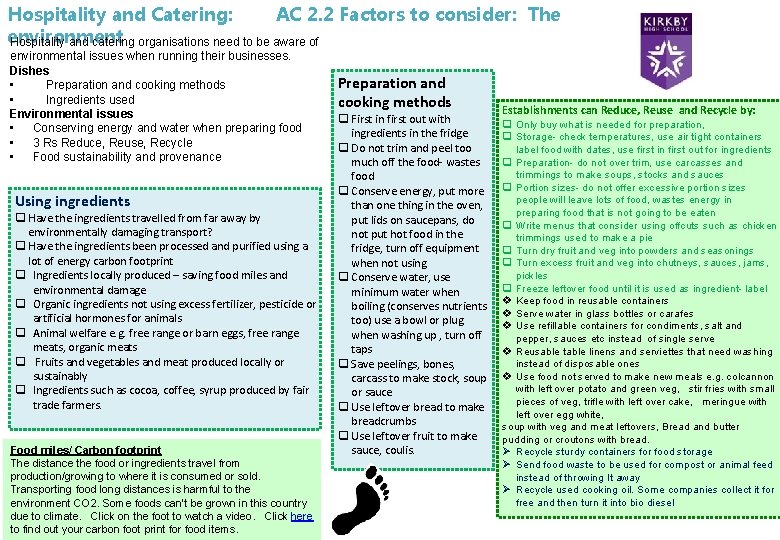
Hospitality and Catering: AC 2. 2 Factors to consider: The environment Hospitality and catering organisations need to be aware of environmental issues when running their businesses. Dishes • Preparation and cooking methods • Ingredients used Environmental issues • Conserving energy and water when preparing food • 3 Rs Reduce, Reuse, Recycle • Food sustainability and provenance Using ingredients q Have the ingredients travelled from far away by environmentally damaging transport? q Have the ingredients been processed and purified using a lot of energy carbon footprint q Ingredients locally produced – saving food miles and environmental damage q Organic ingredients not using excess fertilizer, pesticide or artificial hormones for animals q Animal welfare e. g. free range or barn eggs, free range meats, organic meats q Fruits and vegetables and meat produced locally or sustainably q Ingredients such as cocoa, coffee, syrup produced by fair trade farmers. Food miles/ Carbon footprint The distance the food or ingredients travel from production/growing to where it is consumed or sold. Transporting food long distances is harmful to the environment CO 2. Some foods can’t be grown in this country due to climate. Click on the foot to watch a video. Click here to find out your carbon foot print for food items. Preparation and cooking methods q First in first out with ingredients in the fridge q Do not trim and peel too much off the food- wastes food q Conserve energy, put more than one thing in the oven, put lids on saucepans, do not put hot food in the fridge, turn off equipment when not using q Conserve water, use minimum water when boiling (conserves nutrients too) use a bowl or plug when washing up , turn off taps q Save peelings, bones, carcass to make stock, soup or sauce q Use leftover bread to make breadcrumbs q Use leftover fruit to make sauce, coulis. Establishments can Reduce, Reuse and Recycle by: q Only buy what is needed for preparation, q Storage- check temperatures, use air tight containers label food with dates, use first in first out for ingredients q Preparation- do not over trim, use carcasses and trimmings to make soups, stocks and sauces q Portion sizes- do not offer excessive portion sizes people will leave lots of food, wastes energy in preparing food that is not going to be eaten q Write menus that consider using offcuts such as chicken trimmings used to make a pie q Turn dry fruit and veg into powders and seasonings q Turn excess fruit and veg into chutneys, sauces, jams, pickles q Freeze leftover food until it is used as ingredient- label v Keep food in reusable containers v Serve water in glass bottles or carafes v Use refillable containers for condiments, salt and pepper, sauces etc instead of single serve v Reusable table linens and serviettes that need washing instead of disposable ones v Use food not served to make new meals e. g. colcannon with left over potato and green veg, stir fries with small pieces of veg, trifle with left over cake, meringue with left over egg white, soup with veg and meat leftovers, Bread and butter pudding or croutons with bread. Ø Recycle sturdy containers for food storage Ø Send food waste to be used for compost or animal feed instead of throwing It away Ø Recycle used cooking oil. Some companies collect it for free and then turn it into bio diesel