
Hospital Emergency Preparedness Developing a Hazard Vulnerability Analysis
Hospital Emergency Preparedness Developing a Hazard Vulnerability Analysis for Your Hospital
JCAHO Changes in 2001 § Term changed to “Emergency Management” § Changes in alignment with NFPA 99, Chapter. 11 Community Response § Intent is to ensure more effective response to disasters (global).

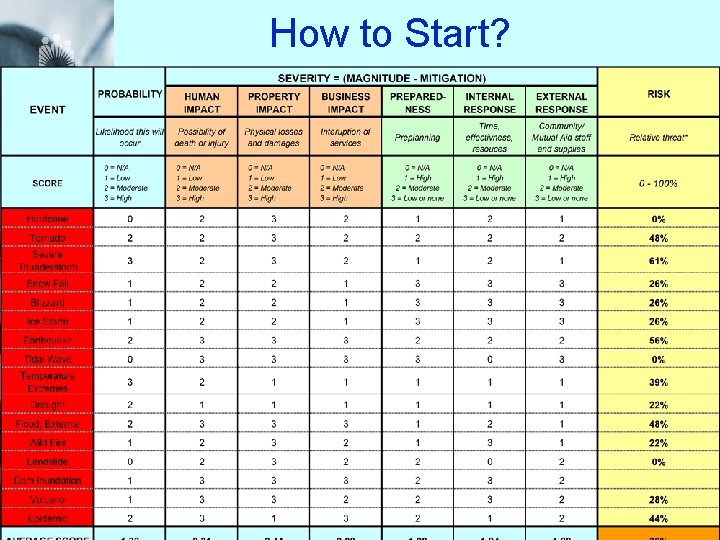
Environment of Care EC 1. 4 (a) HVA Definition: “The identification of hazards and the direct and indirect effect these hazards may have on the hospital. ” ASHE Definition of Risk = Probability * Severity
Probability Issues to consider for probability include, but are not limited to: 1 Known risk 2 Historical data 3 Manufacturer/vendor statistics Score: 0 = N/A, 1 = Low, 2 = Moderate, 3 = High
Severity (Magnitude - Mitigation) Magnitude (Impact) ò Human ò Property ò Business
Severity (Magnitude - Mitigation) Issues to consider for human impact include, but are not limited to: 1 Potential for staff death or injury 2 Potential for patient death or injury Score: 0 = N/A, 1 = Low, 2 = Moderate, 3 = High
Severity (Magnitude - Mitigation) Issues to consider for property impact include, but are not limited to: 1 Cost to replace 2 Cost to set up temporary replacement 3 Cost to repair 4 Time to recover Score: 0 = N/A, 1 = Low, 2 = Moderate, 3 = High
Severity (Magnitude - Mitigation) Issues to consider for business impact include, but are not limited to: 1 2 3 4 5 6 7 8 9 Business interruption Employees unable to report to work Customers unable to reach facility Company in violation of contractual agreements Imposition of fines and penalties or legal costs Interruption of critical supplies Interruption of product distribution Reputation and public image Financial impact/burden Score: 0 = N/A, 1 = Low, 2 = Moderate, 3 = High
Severity (Magnitude - Mitigation) Mitigation ò Preparedness ò Internal Response ò External Response
Severity (Magnitude - Mitigation) Issues to consider for preparedness include, but are not limited to: 1 2 3 4 5 Status of current plans Frequency of drills Training status Insurance Availability of alternate sources for critical supplies/services Score: 0 = N/A, 1 = High, 2 = Moderate, 3 = Low or none
Severity (Magnitude - Mitigation) Issues to consider for internal resources include, but are not limited to: 1 2 3 4 5 6 Types of supplies on hand/will they meet need? Volume of supplies on hand/will they meet need? Staff availability Coordination with Clinics's Availability of back-up systems Internal resources ability to withstand disasters/survivability Score: 0 = N/A, 1 = High, 2 = Moderate, 3 = Low or none
Severity (Magnitude - Mitigation) Issues to consider for external resources include, but are not limited to: 1 Types of agreements with community agencies/drills? 2 Coordination with local and state agencies 3 Coordination with proximal health care facilities 4 Coordination with treatment specific facilities 5 Community resources Score: 0 = N/A, 1 = High, 2 = Moderate, 3 = Low or none
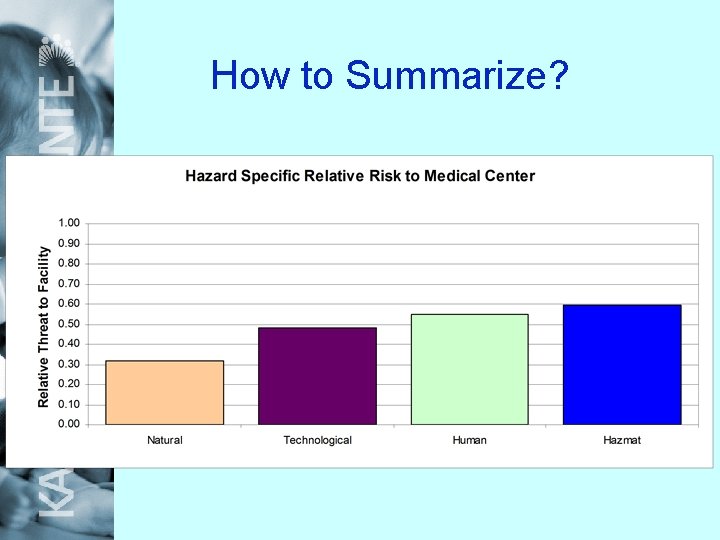
What To Review? Hospital Areas of Concern: Natural Hazards Technological Hazards Human Hazards Hazardous Materials
How to Start? Hospital Collaboration: çFacilities çEngineering çDesign and Construction çSafety çSecurity çEmergency Department çLeadership çOthers
How to Start? External Collaboration: çLEMSA çDHS çHealth/Haz. Mat çFire Department çLaw Enforcement çEnvironmental Health çOther Hospitals çOthers
How to Start?
How to Summarize?
How to Summarize? Operationalized Subjective Data: çAreas of Strength çAreas Weakness çJustification for Funding çJustification for Training çJCAHO Compliant çHospital Awareness çCommunity Awareness çOrganizational Awareness
Questions? Mitch Saruwatari Kaiser Permanente Western EH&S 100 South Los Robles, Suite 410 Pasadena, CA 91188 (626) 564 -3817 mitch. saruwatari@kp. org Worksheet available at: www. emsa. ca. gov
- Slides: 19