
Horse Trials Guide Rosemary Buczak Pakenham Pony Club

Horse Trials Guide Rosemary Buczak Pakenham Pony Club, November, 2008
Disclaimer n n This guide has been written by a parent for the parent community. It represents a personal view, gained from many years experience with pony club competition. The views expressed do not represent the PCAV or Pakenham Pony Club. The material that refers to PCAV rules and guidelines were current on the PCAV website as at 1 November 2008. Parents and competitors should check the PCAV website for any changes and amendments. The author accepts no responsibility for the accuracy of the content.
What is Horse Trials or Eventing? n A competition of three phases: A dressage test ¨ Cross-country course ¨ One showjumping round ¨ n The competition is run as follows: Dressage is always scheduled first: ¨ In higher level competition the order is Dressage/X-country & Showjumping ¨ At lower grades the showjumping may come before X-country to allow the organisers flexibility to fit all the groups in arenas etc. ¨
n Most pony club competitions offer grades 25: ¨ Some offer Grade 1 – which requires a longer/complex course. ¨ Some offer Grade 1 -4 … and may run a separate competition for Grade 5 on another day. ¨ Entry form will stipulate grades offered. n The height and complexity of the course is scaled to each grade. ¨ Whilst all clubs need to adhere to the guidelines for the heights/spreads of jumps some courses are easier than others due to terrain.
Eligibility n In order to enter a Pony Club competition a number of eligibility criteria need to be met: ¨ ¨ - Your child needs to be a current financial member of Pony Club Victoria Child needs to be at least 8 years of age Child/pony need to be graded (minimum grade 5) To be graded, or enter a competition the horse must be at least 4 years of age Child needs to have attended at least 50% of the rallies in the last 12 months.

Entering n Pony club advertise their events on: ¨ PCAV n website – calendar: www. ponyclubvic. org. au/calendar ¨ Through their zone ¨ Entry forms at Saddler’s & Feedstores ¨ Complete the form and send with your cheque: n n DC’s signature is no longer required (even though some old forms still have it. . ) Some pony clubs advise the times for the competition on their website … if not, you will need to enclose a stamped/addressed envelope with the entry.
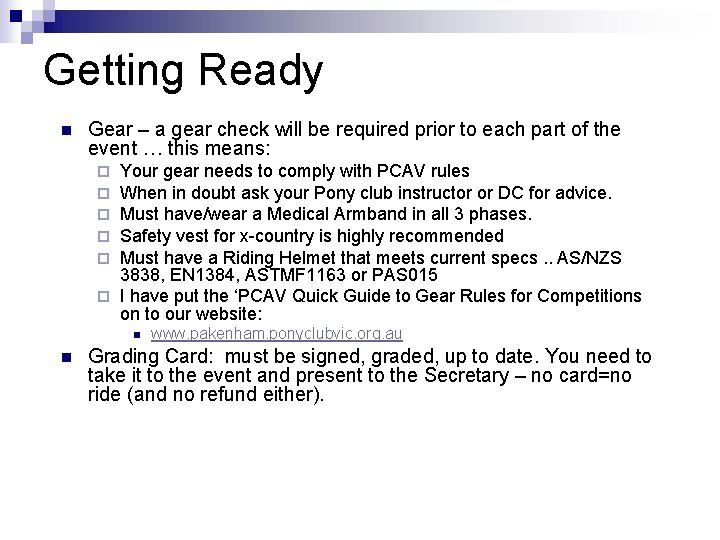
Getting Ready n Gear – a gear check will be required prior to each part of the event … this means: Your gear needs to comply with PCAV rules When in doubt ask your Pony club instructor or DC for advice. Must have/wear a Medical Armband in all 3 phases. Safety vest for x-country is highly recommended Must have a Riding Helmet that meets current specs. . AS/NZS 3838, EN 1384, ASTMF 1163 or PAS 015 ¨ I have put the ‘PCAV Quick Guide to Gear Rules for Competitions on to our website: ¨ ¨ ¨ n n www. pakenham. ponyclubvic. org. au Grading Card: must be signed, graded, up to date. You need to take it to the event and present to the Secretary – no card=no ride (and no refund either).
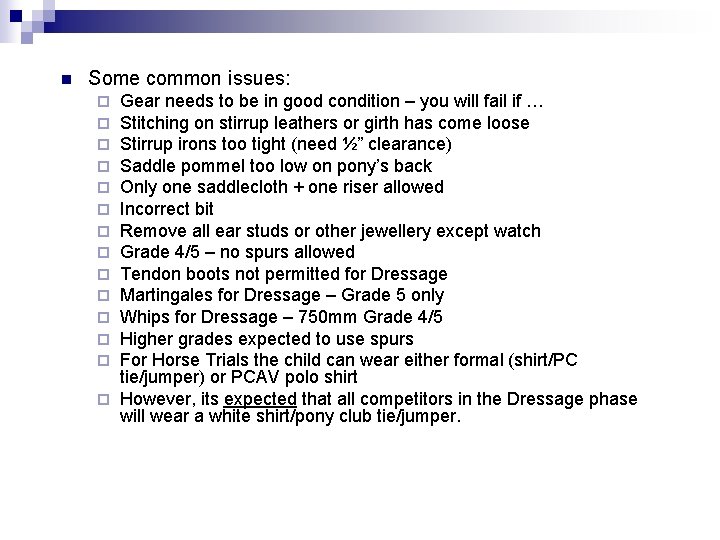
n Some common issues: Gear needs to be in good condition – you will fail if … Stitching on stirrup leathers or girth has come loose Stirrup irons too tight (need ½” clearance) Saddle pommel too low on pony’s back Only one saddlecloth + one riser allowed Incorrect bit Remove all ear studs or other jewellery except watch Grade 4/5 – no spurs allowed Tendon boots not permitted for Dressage Martingales for Dressage – Grade 5 only Whips for Dressage – 750 mm Grade 4/5 Higher grades expected to use spurs For Horse Trials the child can wear either formal (shirt/PC tie/jumper) or PCAV polo shirt ¨ However, its expected that all competitors in the Dressage phase will wear a white shirt/pony club tie/jumper. ¨ ¨ ¨ ¨
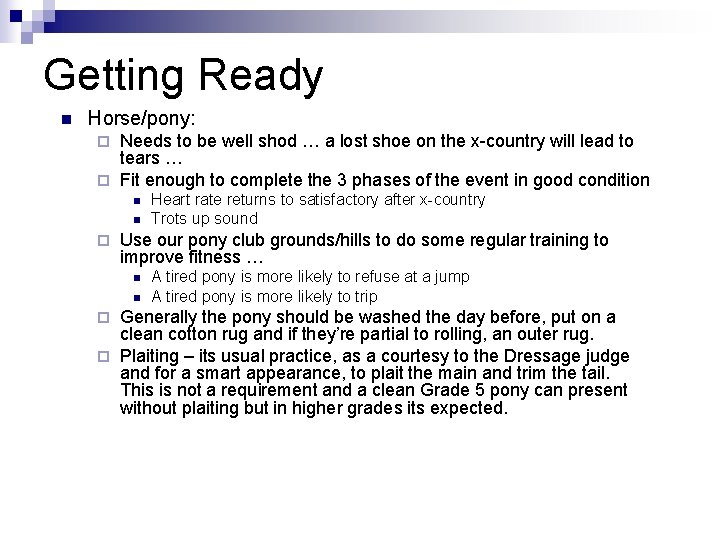
Getting Ready n Horse/pony: Needs to be well shod … a lost shoe on the x-country will lead to tears … ¨ Fit enough to complete the 3 phases of the event in good condition ¨ n n ¨ Heart rate returns to satisfactory after x-country Trots up sound Use our pony club grounds/hills to do some regular training to improve fitness … n n A tired pony is more likely to refuse at a jump A tired pony is more likely to trip Generally the pony should be washed the day before, put on a clean cotton rug and if they’re partial to rolling, an outer rug. ¨ Plaiting – its usual practice, as a courtesy to the Dressage judge and for a smart appearance, to plait the main and trim the tail. This is not a requirement and a clean Grade 5 pony can present without plaiting but in higher grades its expected. ¨
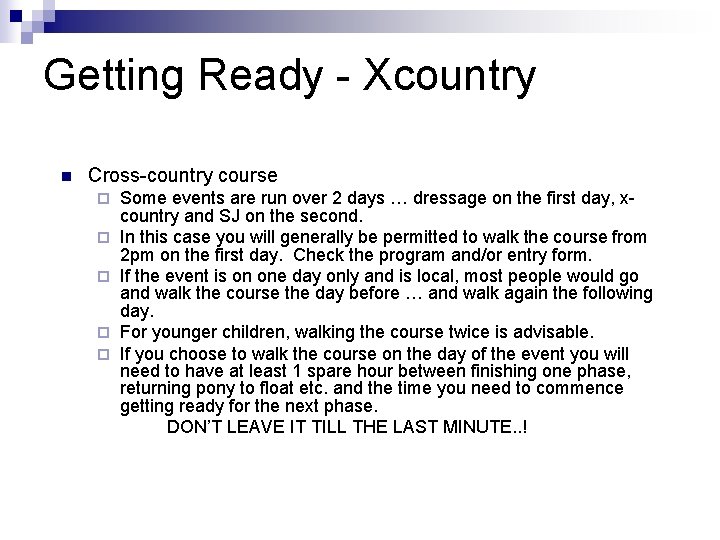
Getting Ready - Xcountry n Cross-country course ¨ ¨ ¨ Some events are run over 2 days … dressage on the first day, xcountry and SJ on the second. In this case you will generally be permitted to walk the course from 2 pm on the first day. Check the program and/or entry form. If the event is on one day only and is local, most people would go and walk the course the day before … and walk again the following day. For younger children, walking the course twice is advisable. If you choose to walk the course on the day of the event you will need to have at least 1 spare hour between finishing one phase, returning pony to float etc. and the time you need to commence getting ready for the next phase. DON’T LEAVE IT TILL THE LAST MINUTE. . !
Walking the X-country n Things to observe: ¨ ¨ ¨ ¨ ¨ Follow the map provided by the Secretary Teach your child to follow the jump numbers … Look for landmarks/memory joggers, especially when there are turns … turn left after jump 7, near the green gate Look for compulsory flags Turn back from time to time on your course walk to revise a group of jumps Help the rider to plan their approach to a jump – stop and talk about the direction. . Where they’ve come from … getting a good straight line to the jump … and the line to the next jump. If in doubt ask a senior rider to walk with you … some clubs do a conducted walk Ensure your child finishes thru the final flags … it’s a right of passage that all children will at some time miss the final flags … Don’t get anxious about a jump you think may cause an issue … ride on. . Water: n n n Grade 5 do not go in the water (but may ride alongside it. . ) Grade 4 go through the water Grade 3 jump into the water Grade 2 jump into and out of the water Grade 1 jump into and out of the water and will have a jump combination
Starting the Day… n Arrive at least an hour (preferably 1. 5 hours for new competitors) prior to the start of the dressage phase: ¨ ¨ ¨ ¨ Step 1: unload the pony, put out water and hay Step 2: take the PCAV grading card to the Event Secretary … who will retain the card, give you a back number and a program for the day. Also take Riding Helmet as Secretary sometimes wants to check that the hat meets current specifications ** Step 3: check that the start times for each phase are the same as advised (check either on the board near the Secretary where results will be posted or with the Secretary. Step 4: check the Ring number where your child will compete and the location of the Gear Check. Step 5: check in the program (or with the Secretary) whether the rider needs to present to the Dressage judge (usually yes, but not always …). That means – ride up to the Dressage judge’s car, give your name etc. Step 6: return to float/pony and get ready. Step 7: present for gear check (at least 20 minutes prior to start time) and warm up ** This will only occur when you have parked your float the maximum distance from the Secretary’s desk. .
Dressage n n n n n Dressage Tests are available on the PCAV website (link on our Pakenham Pony Club website). Practice on the ground/in the lounge first – learn the test before trying on the pony. Grade 4 & 5 compete in an arena 20 x 40 mtrs, Grade 1 -3, 20 x 60 mtrs. Some children learn patterns, some learn like a maths formula. Most lower grade tests repeat the pattern on both sides of the arena. Most judges want to see a calm, well behaved pony execute a pleasant test rather than pinpoint accuracy at lower levels. Get the basics right – a square halt, a smart salute etc. make a great start. . Don’t over-practice – smart ponies will learn/anticipate … but not always at the right spots ! Its not VCE – don’t get stressed. .
X-Country n n n n n Having memorised the course, tack-up, do gear check and warm up at least 30 minutes prior to the scheduled start time. A jumping or general purpose saddle is fine, use a martingale as it provides a ‘grab handle’ if things gets a bit wobbly. Sturdy Grade 5 ponies don’t usually need tendon boots but they do provide good support for finer bred/larger horses. Start times are either 2 mins or 1. 5 mins apart – you need to be ready and positioned for your start time. The horse must start from a halt or walk …No zooming thru at a canter ! The starter will do a ‘countdown’ from 10 secs to 0. It is not necessary for lower grades to wear a watch – try get round safely. Eventing watches are fine for competitive Grade 2+ but not for less experienced riders. At the completion of the course the rider will go into the Vet check area where the horse should be walked for 5 -10 mins. The Vet will take the horse’s heart rate and ask to see the horse trotted up. If the heart rate is too high they will usually ask the rider to continue walking. If the heart rate fails to come down in a reasonable amount of time (usually 15 mins) the horse may fail the vet check and be eliminated. Horses that have done fitness training on our hill are unlikely to fail a vet check …!
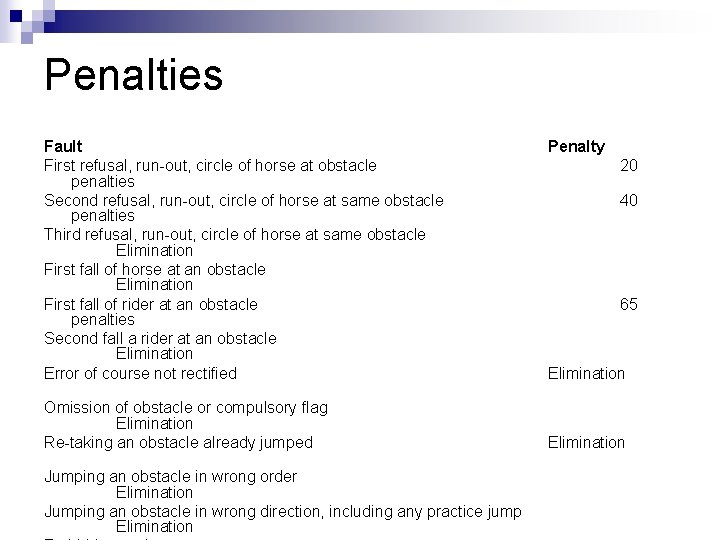
Penalties Fault First refusal, run-out, circle of horse at obstacle penalties Second refusal, run-out, circle of horse at same obstacle penalties Third refusal, run-out, circle of horse at same obstacle Elimination First fall of horse at an obstacle Elimination First fall of rider at an obstacle penalties Second fall a rider at an obstacle Elimination Error of course not rectified Omission of obstacle or compulsory flag Elimination Re-taking an obstacle already jumped Jumping an obstacle in wrong order Elimination Jumping an obstacle in wrong direction, including any practice jump Elimination Penalty 20 40 65 Elimination
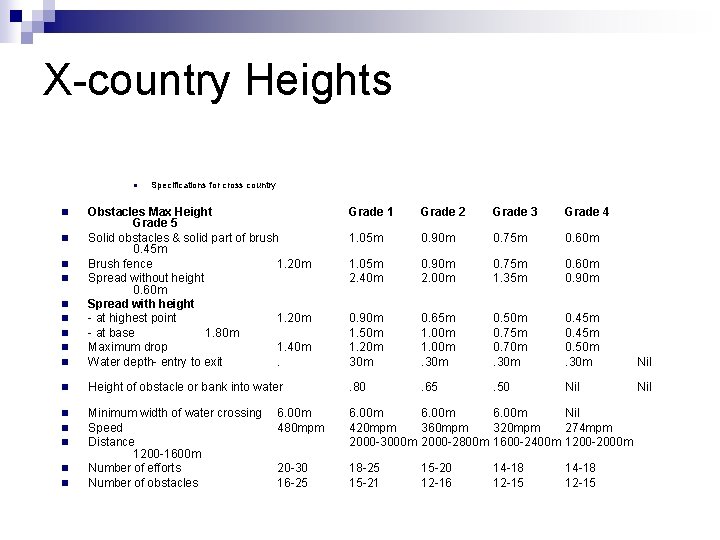
X-country Heights n Specifications for cross country Grade 1 Grade 2 Grade 3 Grade 4 1. 05 m 0. 90 m 0. 75 m 0. 60 m 1. 05 m 2. 40 m 0. 90 m 2. 00 m 0. 75 m 1. 35 m 0. 60 m 0. 90 m n Obstacles Max Height Grade 5 Solid obstacles & solid part of brush 0. 45 m Brush fence 1. 20 m Spread without height 0. 60 m Spread with height - at highest point 1. 20 m - at base 1. 80 m Maximum drop 1. 40 m Water depth- entry to exit. 0. 90 m 1. 50 m 1. 20 m 30 m 0. 65 m 1. 00 m. 30 m 0. 50 m 0. 75 m 0. 70 m. 30 m 0. 45 m 0. 50 m. 30 m Nil n Height of obstacle or bank into water . 80 . 65 . 50 Nil n Minimum width of water crossing Speed Distance 1200 -1600 m Number of efforts Number of obstacles 6. 00 m 480 mpm 6. 00 m Nil 420 mpm 360 mpm 320 mpm 274 mpm 2000 -3000 m 2000 -2800 m 1600 -2400 m 1200 -2000 m 20 -30 16 -25 18 -25 15 -21 n n n 15 -20 12 -16 14 -18 12 -15
Showjumping n n The final phase is showjumping, designed to test that the horse/rider can come back from the x-country and complete a disciplined jumping round. A course walk is usually scheduled 15 mins prior to the start of the class or the time will be advised in the program. The showjumping round is a straightforward Table A (no second round or jumpoff). Heights are lower for HT SJ than pure showjumping. Ensure that you go to gear check prior to your round.
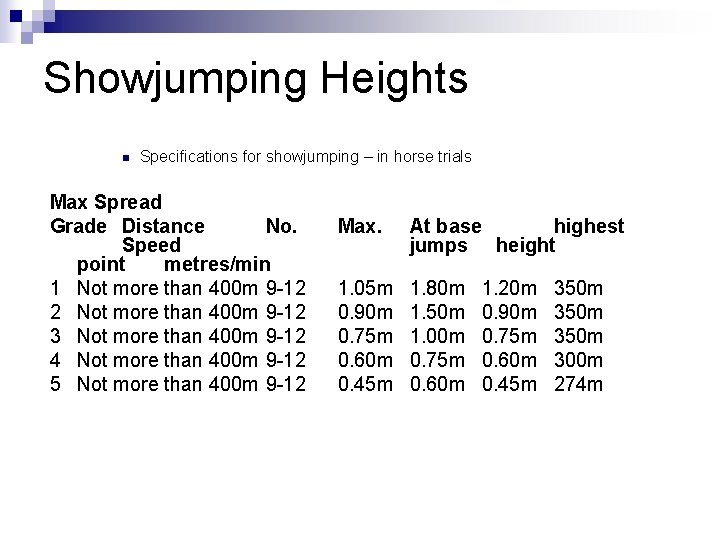
Showjumping Heights n Specifications for showjumping – in horse trials Max Spread Grade Distance No. Speed point metres/min 1 Not more than 400 m 9 -12 2 Not more than 400 m 9 -12 3 Not more than 400 m 9 -12 4 Not more than 400 m 9 -12 5 Not more than 400 m 9 -12 Max. At base highest jumps height 1. 05 m 0. 90 m 0. 75 m 0. 60 m 0. 45 m 1. 80 m 1. 50 m 1. 00 m 0. 75 m 0. 60 m 1. 20 m 0. 90 m 0. 75 m 0. 60 m 0. 45 m 350 m 300 m 274 m
At the end n n n Results will be posted after each phase on the noticeboard near the Secretary’s office. Dressage test score sheets will also be available for collection by riders – these provide useful feedback on the test. Preliminary final results are posted but riders have 20 mins to protest if they believe there has been a mistake, such as: ¨ ¨ ¨ n n n Penalties for a refusal that you don’t believe occurred Time penalties Elimination for missing a jump, or jumping the wrong jump (a common problem) If this happens to you go and see the Club DC and explain the concern. If your protest is upheld the results will be changed. If your child has won/placed you should stay for the ribbons to be given … there might be a prize too (bag of feed, saddlery items) At the end of the day you need to return the back-number and you will be given your Grading card back in return.
Care of your horse after the event. . n n n Even with a fit horse good after-care will avoid health issues. Most small ponies, doing lower grades, don’t incur tendon sprains (below the knee). . But with our drought conditions/harder ground and finer built larger ponies/horses a fast xcountry can produce heat/strain. Cheapest/best solution is ice. .
How to make cheap ice boots n n n Find an old lilo (everyone has one with a slow leak somewhere). Cut the lilo to leg lengths, from the hoof to top of the knee. Fill the pockets with ice, strap on with masking tape/velco/bandage Put on front legs for 20 mins, top up ice, put on back legs for 20 mins, repeat if required. There are some fancy gel pads with arnica available at the feedstore – very effective but expensive. Some riders take their horse for a walk/light ride the day after an event … my preference is to rest them for 3 days.
Feed n n You may need to give your horse some hard feed prior to the event but do not continue with any additional feeding afterwards – this can lead to too much protein/tying up If your horse sweats a lot add a teaspoon of salt to the feed for 5 days prior to the event and the following day.
Other things : n n n n n Only the rider can lunge a horse at a competition (not the parent) Gear check must be completed prior to each phase. The person conducting the gear check is not allowed to change/adjust any part of the gear … so if the girth needs tightening the rider or supervising adult needs to do it. If using the formal uniform (white shirt, PC tie, jumper) the rider may not remove the jumper unless advised by the organising club to do so. Saddle blankets – use either PC saddle blanket or white (looks good for dressage) Don’t forget to collect your grading card. Some horses don’t like the taste of different water – best to take your own. If your horse doesn’t drink whilst away from home make up a simple rehydration fluid: water, squirt of molasses (from sauce bottle), pinch of salt (no need for expensive mixes) Leave the dog at home. Pony clubs usually provide good food (EFA usually have terrible food). HAVE FUN …………. . !
Things to Take n Rider ¨ ¨ ¨ ¨ ¨ n Grading card Medical Arm Band Uniform, formal for dressage, polo shirt for x-country/SJ. Safety vest Sunscreen Hat Watch Dressage test sheet Start times Float ¨ ¨ Bucket & sponge Hay net Poo scoop or shovel Water n Horse ¨ ¨ ¨ ¨ Saddle with girth Saddle blankets Bridle Martingale Tendon boots First-aid kit Spare reins/stirrup leather Plaiting stuff – elastic bands, scissors, spray Towel Water bucket (drinking) Halter Rugs Whip Ice boots & ice
- Slides: 24