
Horizontally III Fired Projectile A projectile object is
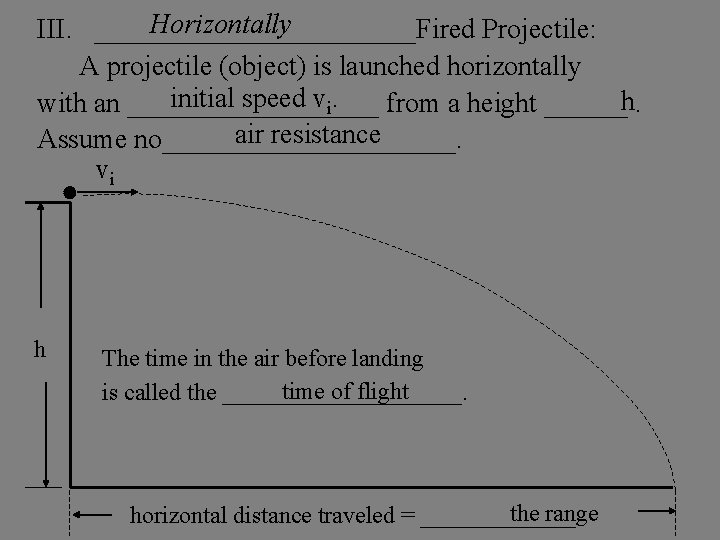
Horizontally III. ____________Fired Projectile: A projectile (object) is launched horizontally initial speed vi. with an _________ from a height ______h. air resistance Assume no___________. vi h The time in the air before landing time of flight is called the __________. the range horizontal distance traveled = _______
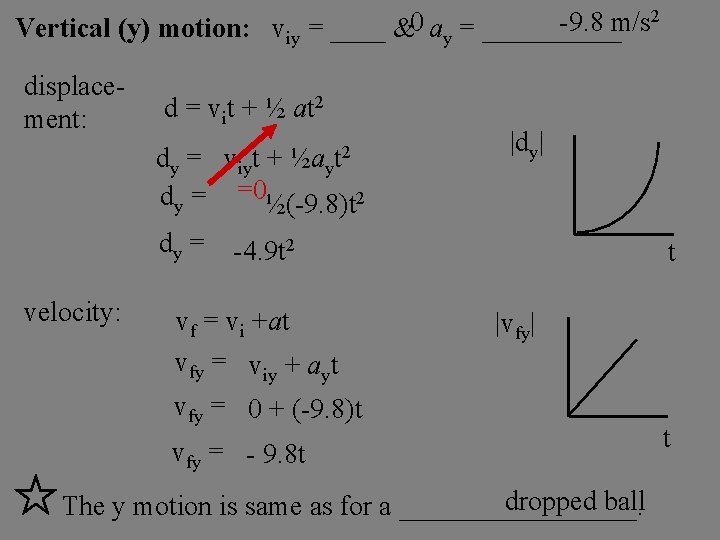
2 0 -9. 8 m/s Vertical (y) motion: viy = ____ & ay = _____ displacement: d = vit + ½ at 2 ½ayt 2 dy = viyt + dy = =0½(-9. 8)t 2 dy = -4. 9 t 2 velocity: vf = vi +at vfy = viy + ayt vfy = 0 + (-9. 8)t |dy| t |vfy| vfy = - 9. 8 t dropped ball The y motion is same as for a _________. t
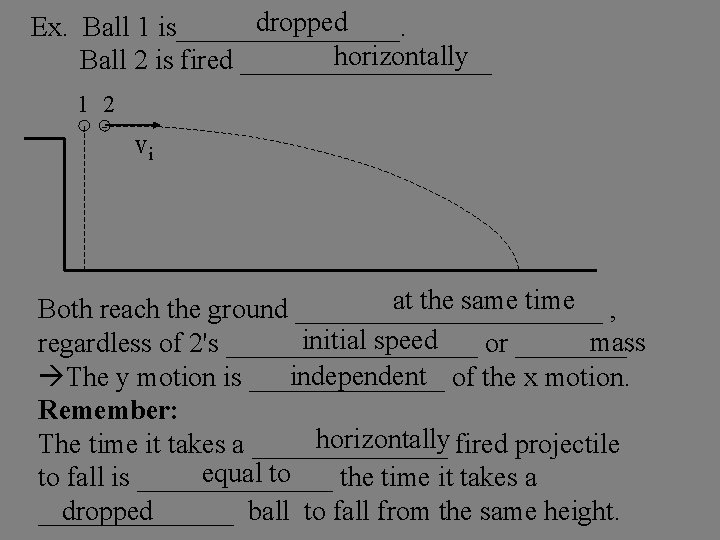
dropped Ex. Ball 1 is________. horizontally Ball 2 is fired _________ 1 2 vi at the same time , Both reach the ground ___________ initial speed mass regardless of 2's _________ or ____. independent of the x motion. The y motion is _______ Remember: horizontally fired projectile The time it takes a _______ equal to to fall is _______ the time it takes a dropped _______ ball to fall from the same height.
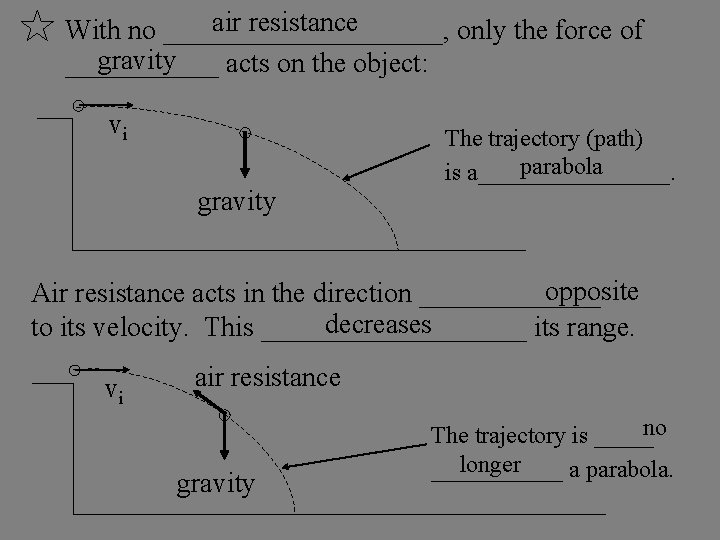
air resistance With no __________, only the force of gravity ______ acts on the object: vi gravity The trajectory (path) parabola is a________. opposite Air resistance acts in the direction _______ decreases to its velocity. This __________ its range. vi air resistance gravity The trajectory is _____no longer ______ a parabola.
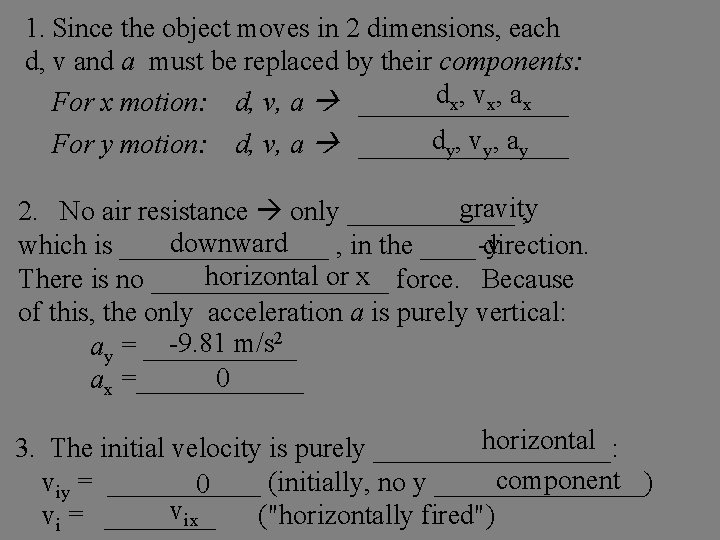
1. Since the object moves in 2 dimensions, each d, v and a must be replaced by their components: dx, vx, ax For x motion: d, v, a ________ dy, vy, ay For y motion: d, v, a ________ gravity 2. No air resistance only ______ , downward which is ________ , in the ____ -y direction. horizontal or x force. Because There is no _________ of this, the only acceleration a is purely vertical: -9. 81 m/s 2 ay = ______ 0 ax =______ horizontal 3. The initial velocity is purely _________: component viy = ______ (initially, no y ________) 0 vix vi = ____ ("horizontally fired")
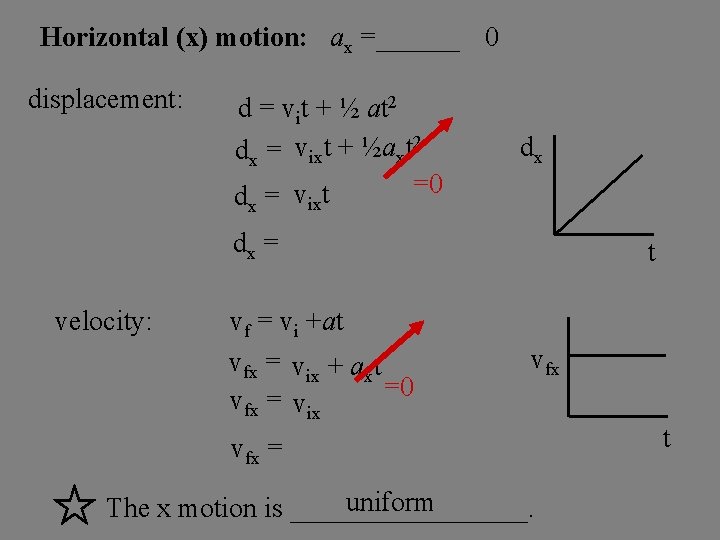
Horizontal (x) motion: ax =______ 0 displacement: d = vit + ½ at 2 dx = vixt + ½axt 2 =0 d = v t x dx ix dx = velocity: vf = vi +at vfx = vix + axt =0 vfx = vix t vfx = uniform The x motion is _________. t
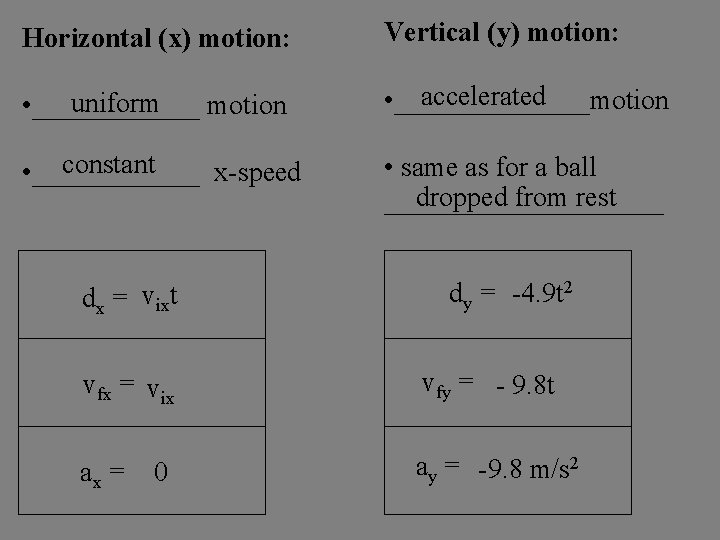
Horizontal (x) motion: Vertical (y) motion: uniform • ______ motion accelerated • _______motion constant • ______ x-speed • same as for a ball dropped from rest __________ dx = vixt dy = -4. 9 t 2 vfx = vix vfy = - 9. 8 t ax = ay = -9. 8 m/s 2 0
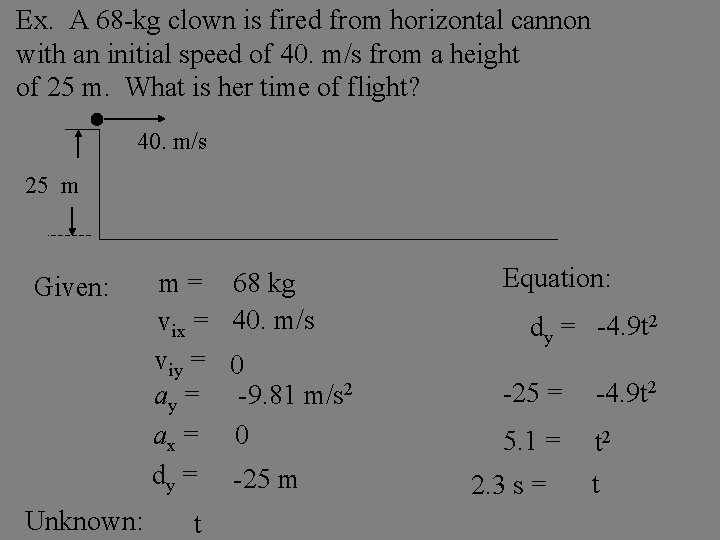
Ex. A 68 -kg clown is fired from horizontal cannon with an initial speed of 40. m/s from a height of 25 m. What is her time of flight? 40. m/s 25 m Given: Unknown: m= vix = viy = ax = dy = t 68 kg 40. m/s 0 -9. 81 m/s 2 0 -25 m Equation: dy = -4. 9 t 2 -25 = -4. 9 t 2 5. 1 = t 2. 3 s =
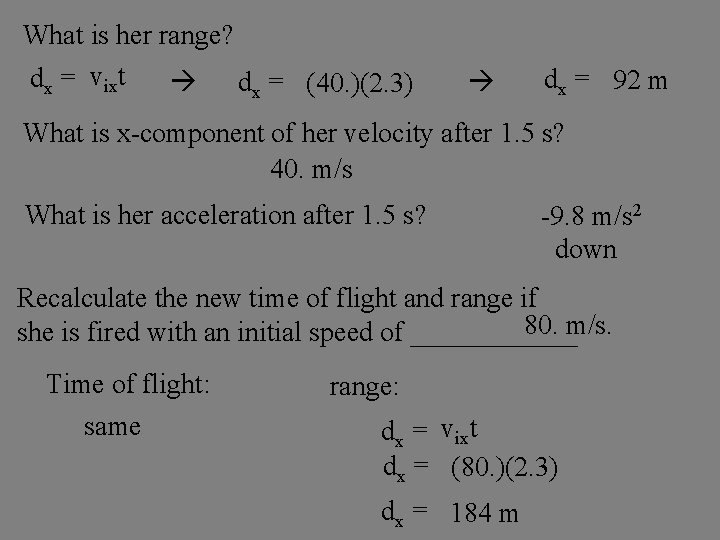
What is her range? dx = vixt dx = (40. )(2. 3) dx = 92 m What is x-component of her velocity after 1. 5 s? 40. m/s What is her acceleration after 1. 5 s? -9. 8 m/s 2 down Recalculate the new time of flight and range if 80. m/s. she is fired with an initial speed of ______ Time of flight: same range: dx = vixt dx = (80. )(2. 3) dx = 184 m
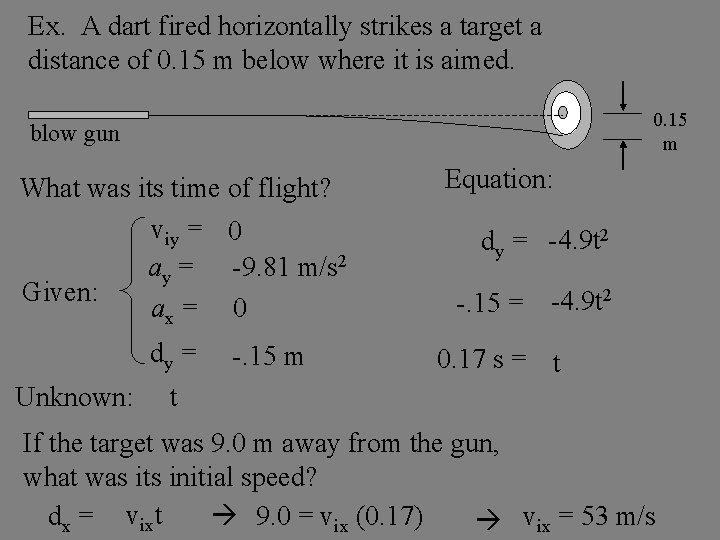
Ex. A dart fired horizontally strikes a target a distance of 0. 15 m below where it is aimed. 0. 15 m blow gun What was its time of flight? viy = 0 ay = -9. 81 m/s 2 Given: ax = 0 dy = Unknown: -. 15 m Equation: dy = -4. 9 t 2 -. 15 = -4. 9 t 2 0. 17 s = t t If the target was 9. 0 m away from the gun, what was its initial speed? dx = vixt 9. 0 = vix (0. 17) vix = 53 m/s
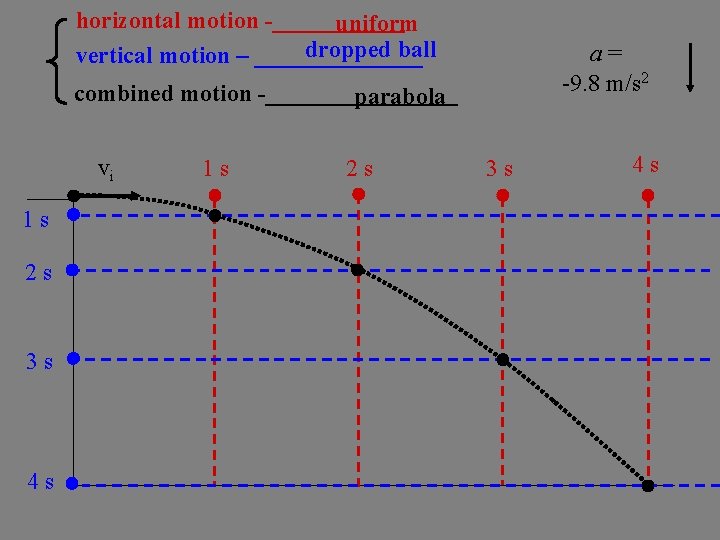
horizontal motion -______ uniform dropped ball vertical motion – _______ a= -9. 8 m/s 2 combined motion -________ parabola vi 1 s 2 s 3 s 4 s
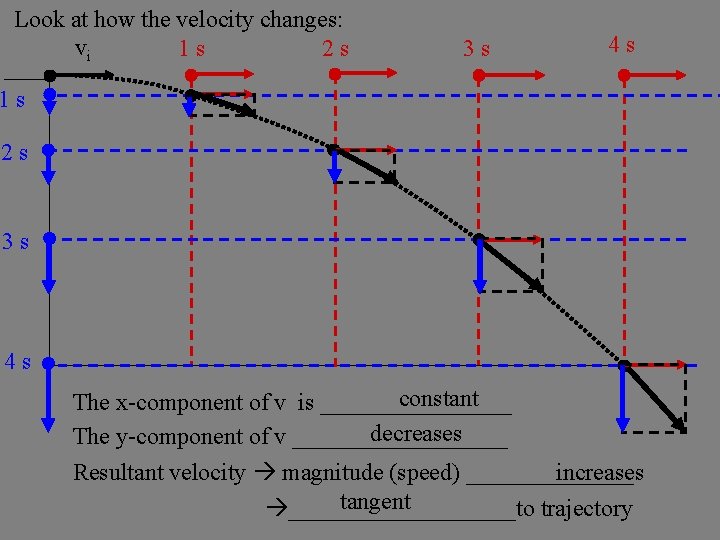
Look at how the velocity changes: vi 1 s 2 s 3 s 4 s constant The x-component of v is ________ decreases The y-component of v _________ increases Resultant velocity magnitude (speed) _______ tangent __________to trajectory
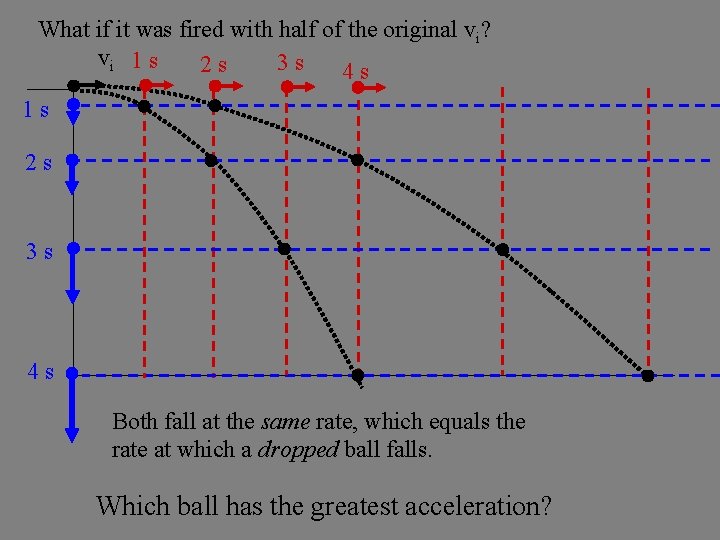
What if it was fired with half of the original vi? vi 1 s 3 s 2 s 4 s 1 s 2 s 3 s 4 s Both fall at the same rate, which equals the rate at which a dropped ball falls. Which ball has the greatest acceleration?
- Slides: 13