
Horizontal Test Facility and Test Plans by US
Horizontal Test Facility and Test Plans by US HL-LHC-AUP Guram Chlachidze MQXF International Review – CERN, June 7 th – 10 th, 2016
Outline § Horizontal Magnet Test Facility at Fermilab § Options for cold mass tests § Expected test facility upgrades § Test plans § Open Questions § Risk and Hazard Analysis § Conclusions Guram Chlachidze – MQXF International Review, June 7 th-10 th 2016 2
Horizontal Test Facility Horizontal Test Stand 4 at Fermilab’s Magnet Test Facility (MTF) § Previously used for testing the LHC IR quadrupoles in 2002 -2006 Guram Chlachidze – MQXF International Review, June 7 th-10 th 2016 3
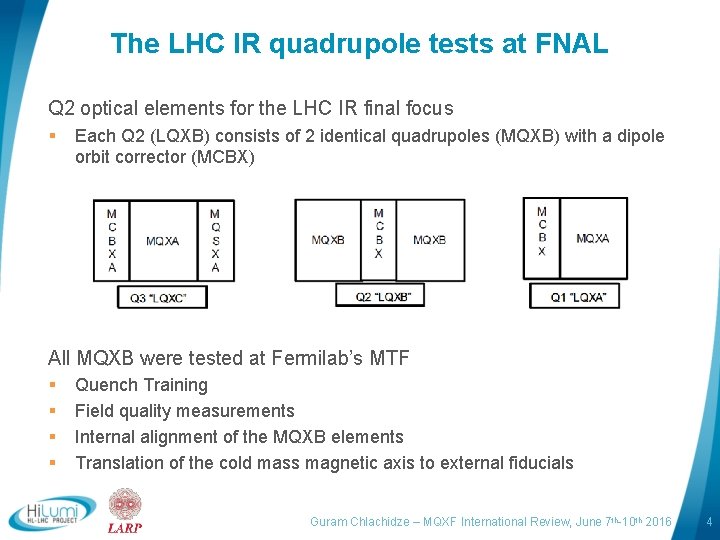
The LHC IR quadrupole tests at FNAL Q 2 optical elements for the LHC IR final focus § Each Q 2 (LQXB) consists of 2 identical quadrupoles (MQXB) with a dipole orbit corrector (MCBX) All MQXB were tested at Fermilab’s MTF § § Quench Training Field quality measurements Internal alignment of the MQXB elements Translation of the cold mass magnetic axis to external fiducials Guram Chlachidze – MQXF International Review, June 7 th-10 th 2016 4
LQXB Magnetic measurements Cold field harmonics measurements § § § 0. 8 m long tangential probe 8 locations throughout the MQXB length Each MQXB measured separately Integral field strength measurement with the Single Stretched Wire System (SSW) LQXB alignment § § To determine the average magnetic field axis of the MQXB pair and translate this to external fiducials on the LQXB cryostat SSW measurement of the magnetic axis before cool down, at 4. 5 K and at room temperature again The beam tube axis determined using a “geo-mole” system supplied by CERN Guram Chlachidze – MQXF International Review, June 7 th-10 th 2016 5
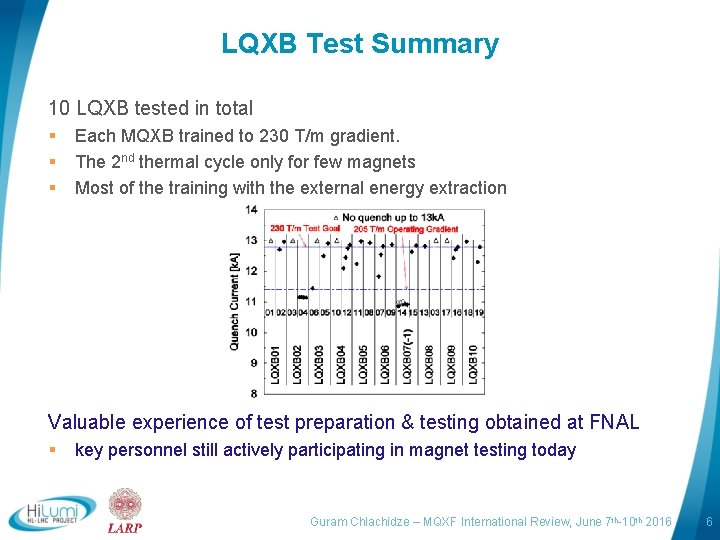
LQXB Test Summary 10 LQXB tested in total § § § Each MQXB trained to 230 T/m gradient. The 2 nd thermal cycle only for few magnets Most of the training with the external energy extraction Valuable experience of test preparation & testing obtained at FNAL § key personnel still actively participating in magnet testing today Guram Chlachidze – MQXF International Review, June 7 th-10 th 2016 6
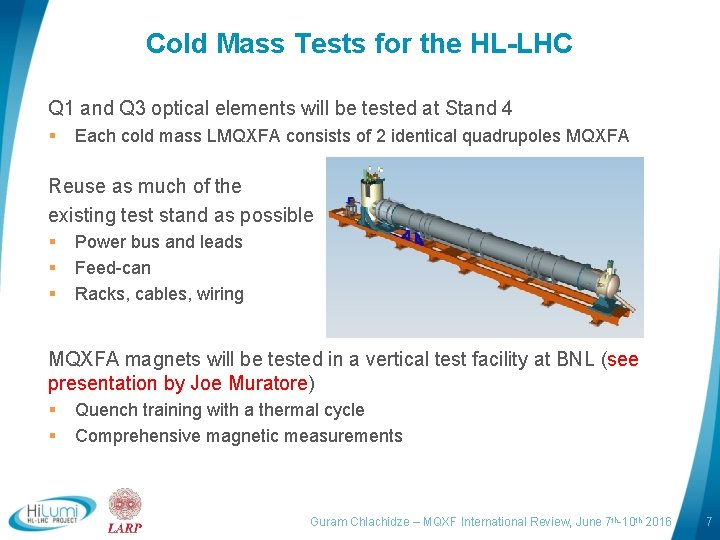
Cold Mass Tests for the HL-LHC Q 1 and Q 3 optical elements will be tested at Stand 4 § Each cold mass LMQXFA consists of 2 identical quadrupoles MQXFA Reuse as much of the existing test stand as possible § § § Power bus and leads Feed-can Racks, cables, wiring MQXFA magnets will be tested in a vertical test facility at BNL (see presentation by Joe Muratore) § § Quench training with a thermal cycle Comprehensive magnetic measurements Guram Chlachidze – MQXF International Review, June 7 th-10 th 2016 7
Options for a Cold Mass Test The baseline test option is Option 1: Cold mass test with powering the magnet up to 15 k. A only § § Existing 15 k. A current leads will be used Magnetic measurements with 46 -mm diameter probes Option 2: Full power test of the cold mass in a reusable cryostat § § § Full qualification of the US deliverable Power tests up to the ultimate current (17. 8 k. A) Magnetic measurements with 100 -mm diameter probes Option 3: Full power test of the cold mass in a final (CERN) cryostat § § § Full qualification of the US deliverable Power tests up to the ultimate current (17. 8 k. A) Time and cost-effective solution (no need to build re-usable cryostat) Guram Chlachidze – MQXF International Review, June 7 th-10 th 2016 8
Expected Test Facility Upgrades DAQ, Protection and Magnetic measurement system upgrades required in all test scenarios Minimum upgrades of the cryogenic system is required also in all test options § § Valves, piping, instrumentation The turn-around-can Specific upgrades: For the baseline test option: § Re-usable cryostat For the alternative test options: § § § Power leads rated up to 20 k. A New warm bore tube Assembly of CERN cryostat Guram Chlachidze – MQXF International Review, June 7 th-10 th 2016 9
Test Plans for the Baseline Option Cold mass test with powering the magnet up to 15 k. A § MQXFA training up to the ultimate current of 17. 8 k. A, and comprehensive field quality measurements performed at BNL’s vertical test facility Electrical inspection of cold mass § Warm and cold Hipoting tests. Splices, leads and bus bars will be inspected at room temperature and after cool down Cold mass performance tests: § § § Check magnet retraining and confirm stable operation at a maximum current of 15 k. A Confirm magnet protection with protection heaters and CLIQ in one or two cold mass assemblies: heater induced quenches, no external energy extraction (EE) Continue further tests and measurements with the EE in order to reduce the quench recovery time and save helium Guram Chlachidze – MQXF International Review, June 7 th-10 th 2016 10
Test Plans (cont’d) Warm Magnetic measurements: § Average integral roll angle between two magnets § SSW system, individual MQXFA powering to 10 A § Alignment of magnets’ axes § 130 -mm diameter rotating probe with a laser tracker target, individual MQXFA powering to 10 A § Suggested probe length: Two 220 -mm long probes § Will determine straightness of beam tube, and magnetic axis with respect to average magnetic axis § Integral field strength § SSW measurements at 10 A § Multipole harmonics § 130 -mm diameter rotating probe, individual MQXFA powering to 10 A § Confirm room temperature measurements at BNL Guram Chlachidze – MQXF International Review, June 7 th-10 th 2016 11
Test Plans (cont’d) Cold Magnetic measurements: § Average integral roll angle between magnets § SSW system, individual MQXFA powering to 10 A § Alignment of individual magnets’ axes § § § 46 -mm diameter rotating probe with a laser tracker target, individual MQXFA powering to 10 A Suggested probe length: Two 220 -mm long probes Verify straightness of beam tube and magnetic axis with respect to average magnetic axis after cool down § Accurate integral strength measurement with SSW at 15 k. A § Multipole harmonics at 15 k. A § § § 46 -mm diameter rotating probe Field strength vs Z Measure final positions of cold masses axially Guram Chlachidze – MQXF International Review, June 7 th-10 th 2016 12
Test Plans (cont’d) Thermal cycle will be done only for a couple of cold masses § Check magnet settling in a cold mass Cold Magnetic measurements after thermal cycle: § Average integral roll angle between magnets § SSW system, individual MQXFA powering to 10 A § Alignment of individual magnets’ axes § § 46 -mm diameter rotating probe with a laser tracker target, individual MQXFA powering to 10 A Verify straightness of beam tube and magnetic axis with respect to average magnetic axis after thermal cycle § Multipole harmonics § 46 -mm diameter rotating probe, individual MQXFA powering to 10 A Minimal magnetic measurements at room temperature after the test § 130 -mm diameter rotating probe, individual MQXFA powering to 10 A Guram Chlachidze – MQXF International Review, June 7 th-10 th 2016 13
Test Plans for the alternative test options Option 2: Full power test of the cold mass in a re-usable cryostat § § § Full qualification of US deliverables Power tests up to the ultimate current of 17. 8 k. A Magnetic measurements with 100 -mm diameter probes Test plan is the same as in the baseline option, only with the maximum test current increased to 17. 8 k. A, and probe diameters increased to 100 mm Option 3: Full power test of the cold mass in a final (CERN) cryostat § § § Change in the list of US deliverables Full qualification of US deliverables Time and cost-effective solution (no need in re-usable cryostat) Test plan is the same as for the option 2, only the cold mass magnetic axis will be translated to the external fiducials on the final cryostat Guram Chlachidze – MQXF International Review, June 7 th-10 th 2016 14
Open Questions The baseline test option to be finalized § § § Cold mass test in a re-usable cryostat or in a final cryostat Powering MQXFA to 15 k. A or to the ultimate current of 17. 8 k. A Reference radius of magnetic measurements Acceptance requirements for the US deliverables § § Field quality requirements Alignment requirements Required test stand upgrades and Test schedule § Depends on the baseline test scenario Guram Chlachidze – MQXF International Review, June 7 th-10 th 2016 15
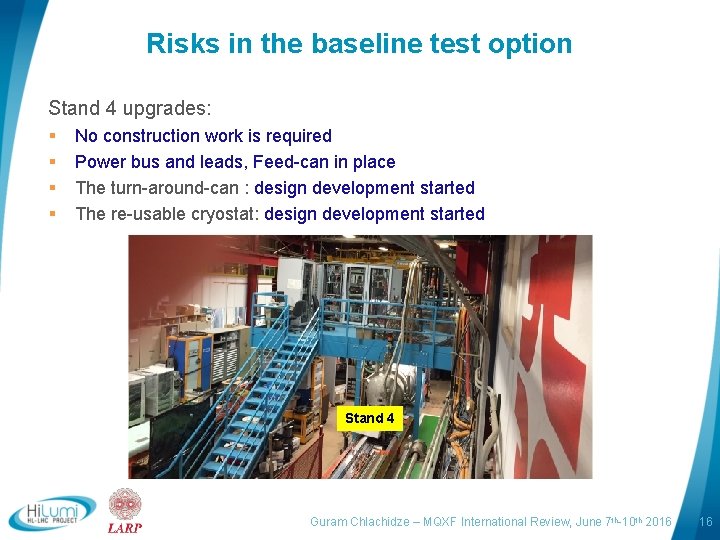
Risks in the baseline test option Stand 4 upgrades: § § No construction work is required Power bus and leads, Feed-can in place The turn-around-can : design development started The re-usable cryostat: design development started Stand 4 Guram Chlachidze – MQXF International Review, June 7 th-10 th 2016 16
Risks analysis (cont’d) DAQ and monitoring systems: § § § DAQ racks, cabling and wiring in place PLC upgrade: Existing Siemens PLC will be upgraded to Allen-Bradley Quench characterization systems: existing VME/Vx. Works system is obsolete. New FPGA-based system (3 rd generation) already developed for Mu 2 e experiment. New isoamplifier design already deployed in other test areas Quench protection: § § § Most of the wiring in place New digital and analog systems already developed for Mu 2 e experiment CLIQ leads: First tests will be performed with the short model at Fermilab, and then with the full-length magnets at BNL Detailed plans, cost estimate and schedule for DAQ and Quench protection upgrades were presented at LMQXF cold mass review at FNAL (April 25, 2016) Guram Chlachidze – MQXF International Review, June 7 th-10 th 2016 17
Risks analysis (cont’d) Magnetic measurement system: § DAQ, motion control upgrade and new motion stages: New DAQ system deployed recently for the KEK experiment § Dual probe ferret (mole type) probe: already developed at Fermilab Manpower: § § Key personnel with experience of testing the LHC IR quadrupoles still available New team members obtained significant experience of testing short and long models of Nb 3 Sn magnets Stand 4 Cryogenics: § § § LHe inventory: Nominal He liquefaction rate is 300 liters/hour Refurbishment of the vacuum (Kinney I and II skids) pumps Risks eliminated when connected to the new Kinney pumps with 4 skids installed in parallel Guram Chlachidze – MQXF International Review, June 7 th-10 th 2016 18
Operational Hazards and mitigation plans Cryogenic systems § § Long history of operating cryogenic plant Engineering notes with safety calculations for Stand 4 Pressure test of the system Safety review High Current Power Supply § § § All sub-systems commissioned and operational up to 15 k. A LOTO procedure, authorized user training procedures available Engineering note and Safety review required for higher currents CLIQ § Operation manual and Hazard Analysis exist § Safety review Magnet protection § Engineering note and safety review required before operation Guram Chlachidze – MQXF International Review, June 7 th-10 th 2016 19
Conclusions Valuable experience of testing the LHC IR quadrupoles obtained previously at Fermilab § § Various challenges in test preparation and testing already addressed for the LHC IR quadrupoles Key scientific, engineering and technical personnel who participated in these tests are available Fermilab has a long and successful history of testing Nb 3 Sn magnets, including the short MQXF models The baseline test option includes magnet performance test and field quality measurements at currents up to 15 k. A. Cold mass will be tested in a re-usable cryostat The alternative test options are suggested, including power tests up to the ultimate current and in a final cryostat. Guram Chlachidze – MQXF International Review, June 7 th-10 th 2016 20
Conclusions (cont’d) Required test facility upgrades and related technical risks for different test options are well understood. Risk mitigation measures were introduced at LMQXF cold mass review at FNAL Magnetic probes and related equipment already developed at Fermilab Cold mass test plan is developed for the current baseline option. Only minor changes are expected in the test plan for the alternative test options All open questions will be addressed as soon as the baseline test option is selected Guram Chlachidze – MQXF International Review, June 7 th-10 th 2016 21
- Slides: 21