
Horizontal Benchmark Extension for Improved Assessment of Physical
Horizontal Benchmark Extension for Improved Assessment of Physical CAD Research Andrew B. Kahng, Hyein Lee and Jiajia Li UC San Diego VLSI CAD Laboratory
Outline • Motivation • Related Work • Our Methodology • Experimental Setup and Results • Conclusion UCSD VLSI CAD Laboratory 2
Outline • Motivation • Related Work • Our Methodology • Experimental Setup and Results • Conclusion UCSD VLSI CAD Laboratory 3
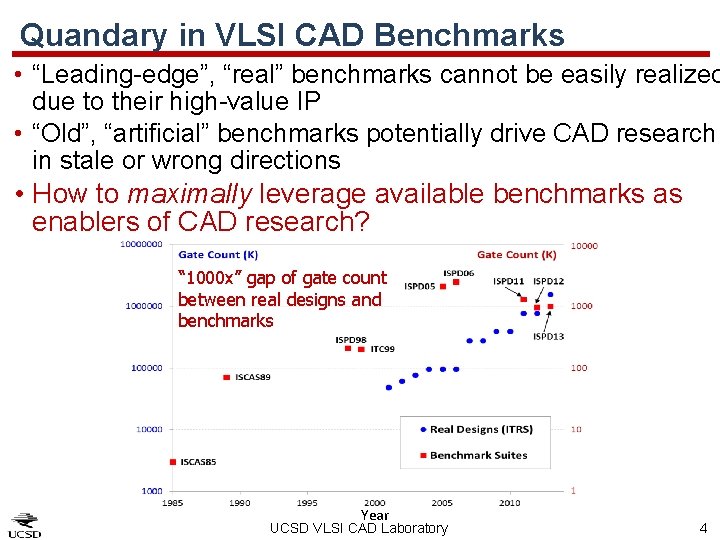
Quandary in VLSI CAD Benchmarks • “Leading-edge”, “real” benchmarks cannot be easily realized due to their high-value IP • “Old”, “artificial” benchmarks potentially drive CAD research in stale or wrong directions • How to maximally leverage available benchmarks as enablers of CAD research? “ 1000 x” gap of gate count between real designs and benchmarks Year UCSD VLSI CAD Laboratory 4
Lack of Horizontal Assessment • Horizontal assessment = evaluation at one flow stage, across technologies, tools, benchmarks • Maximal horizontal assessment reveals tools’ suboptimality guide improvements • Motivation • No previous work pursues maximal horizontal assessment • Horizontal assessments are blocked by gaps between data models, benchmark formats, etc. UCSD VLSI CAD Laboratory 5
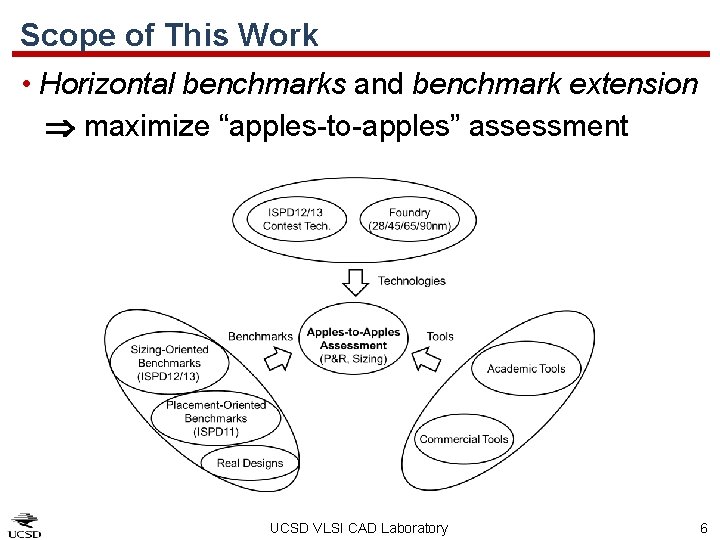
Scope of This Work • Horizontal benchmarks and benchmark extension maximize “apples-to-apples” assessment UCSD VLSI CAD Laboratory 6
Outline • Motivation • Related Work • Our Methodology • Experimental Setup and Results • Conclusion UCSD VLSI CAD Laboratory 7
Related Work Benchmarks based on real designs • MCNC: widely used in various CAD applications • ISPD 98: netlist partitioning; functionality, timing and technology information are removed • ISPD 05/06: mixed size placement, > 2 M placeable modules • ISPD 11: routability-driven placement, derived from industrial ASIC designs • ISPD 12/13: gate sizing and Vt-swapping optimization Artificial benchmarks • Early works: circ/gen, gnl • PEKO/PEKU: placement, w/ know-optimal solution and known upper bounds on wirelegnth • Eyechart: gate sizing optimization, w/ known-optimal solution UCSD VLSI CAD Laboratory 8
![Vertical vs. Horizontal Vertical benchmark [Inacio 99] Horizontal benchmark Ø Multiple levels of abstraction](http://slidetodoc.com/presentation_image_h2/5d3b21b203e196dbb737264b497506a6/image-9.jpg "Vertical vs. Horizontal Vertical benchmark [Inacio 99] Horizontal benchmark Ø Multiple levels of abstraction")
Vertical vs. Horizontal Vertical benchmark [Inacio 99] Horizontal benchmark Ø Multiple levels of abstraction Ø Evaluation across a span of several flow stages Ø Focus on one flow stage Ø Maximize the assessment across technologies/benchmarks/tools UCSD VLSI CAD Laboratory 9
Outline • Motivation • Related Work • Our Methodology • Experimental Setup and Results • Conclusion UCSD VLSI CAD Laboratory 10
Challenges • Benchmark-related challenge • Limited information of benchmarks due to IP protection • Limited scope of target problems • Library-related challenge • Unrealistic and complex constraints or design rules • Hard to make fair comparisons across technologies due to different granularity (e. g. , available sizes/Vt options) • Different tools require different formats • E. g. , bookshelf format vs. LEF/DEF UCSD VLSI CAD Laboratory 11
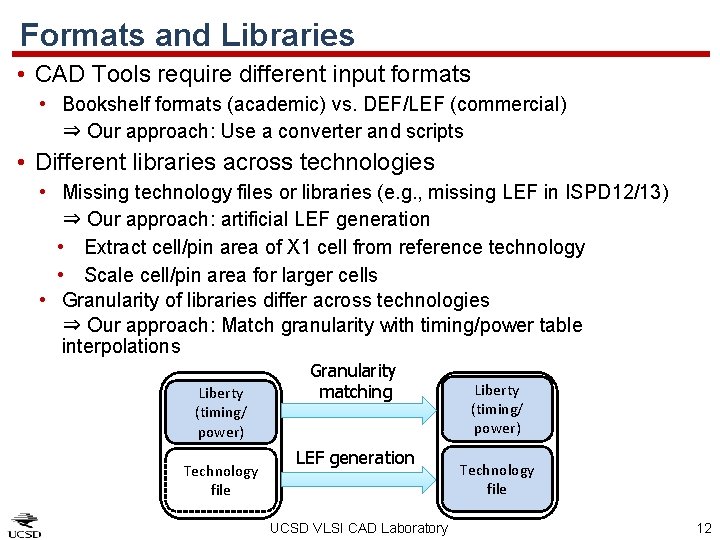
Formats and Libraries • CAD Tools require different input formats • Bookshelf formats (academic) vs. DEF/LEF (commercial) ⇒ Our approach: Use a converter and scripts • Different libraries across technologies • Missing technology files or libraries (e. g. , missing LEF in ISPD 12/13) ⇒ Our approach: artificial LEF generation • Extract cell/pin area of X 1 cell from reference technology • Scale cell/pin area for larger cells • Granularity of libraries differ across technologies ⇒ Our approach: Match granularity with timing/power table interpolations Liberty (timing/ power) Technology file Granularity matching LEF generation UCSD VLSI CAD Laboratory Liberty (timing/ power) Technology file 12
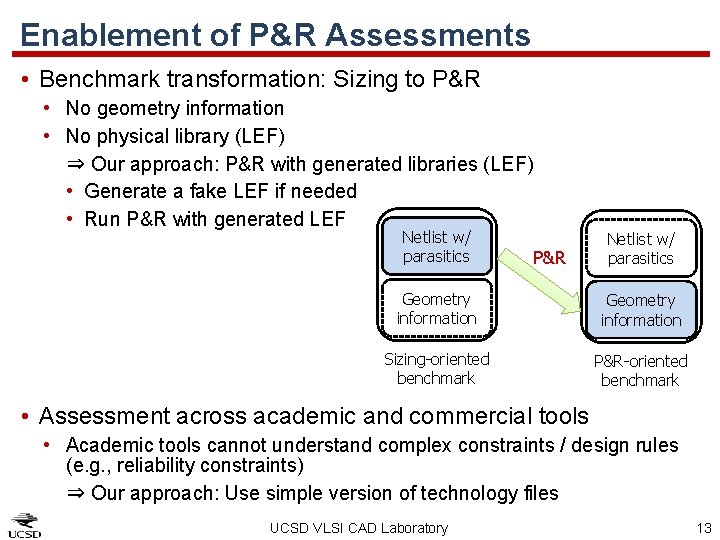
Enablement of P&R Assessments • Benchmark transformation: Sizing to P&R • No geometry information • No physical library (LEF) ⇒ Our approach: P&R with generated libraries (LEF) • Generate a fake LEF if needed • Run P&R with generated LEF Netlist w/ parasitics P&R Netlist w/ parasitics Geometry information Sizing-oriented benchmark P&R-oriented benchmark • Assessment across academic and commercial tools • Academic tools cannot understand complex constraints / design rules (e. g. , reliability constraints) ⇒ Our approach: Use simple version of technology files UCSD VLSI CAD Laboratory 13
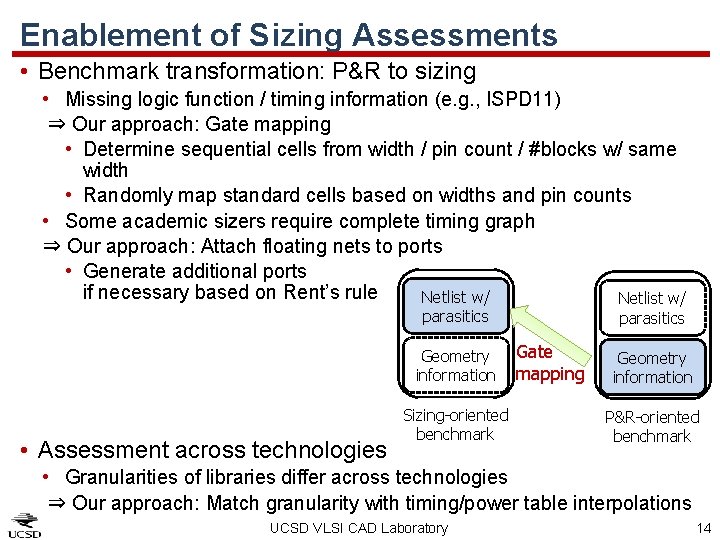
Enablement of Sizing Assessments • Benchmark transformation: P&R to sizing • Missing logic function / timing information (e. g. , ISPD 11) ⇒ Our approach: Gate mapping • Determine sequential cells from width / pin count / #blocks w/ same width • Randomly map standard cells based on widths and pin counts • Some academic sizers require complete timing graph ⇒ Our approach: Attach floating nets to ports • Generate additional ports if necessary based on Rent’s rule Netlist w/ parasitics Geometry information • Assessment across technologies Sizing-oriented benchmark parasitics Gate mapping Geometry information P&R-oriented benchmark • Granularities of libraries differ across technologies ⇒ Our approach: Match granularity with timing/power table interpolations UCSD VLSI CAD Laboratory 14
Outline • Motivation • Related Work • Our Methodology • Experimental Setup and Results • Conclusion UCSD VLSI CAD Laboratory 15
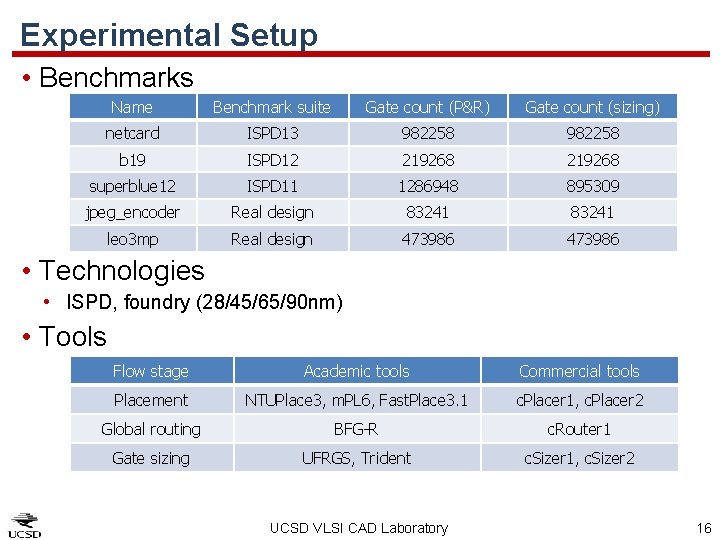
Experimental Setup • Benchmarks Name Benchmark suite Gate count (P&R) Gate count (sizing) netcard ISPD 13 982258 b 19 ISPD 12 219268 superblue 12 ISPD 11 1286948 895309 jpeg_encoder Real design 83241 leo 3 mp Real design 473986 • Technologies • ISPD, foundry (28/45/65/90 nm) • Tools Flow stage Academic tools Commercial tools Placement NTUPlace 3, m. PL 6, Fast. Place 3. 1 c. Placer 1, c. Placer 2 Global routing BFG-R c. Router 1 Gate sizing UFRGS, Trident c. Sizer 1, c. Sizer 2 UCSD VLSI CAD Laboratory 16
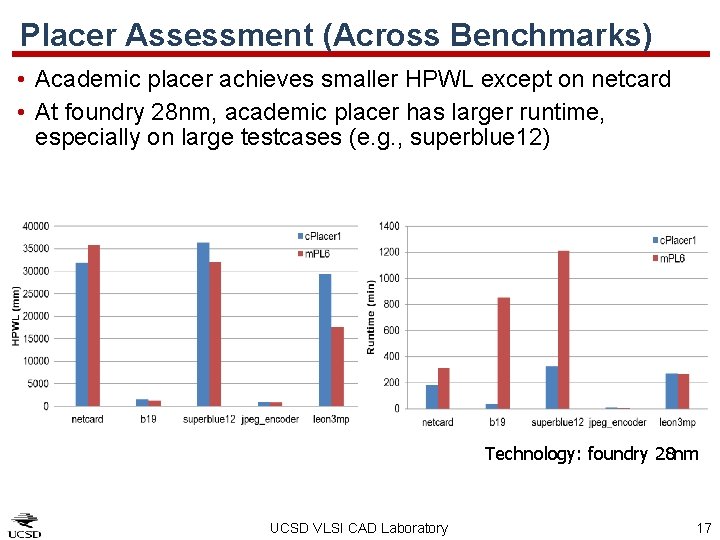
Placer Assessment (Across Benchmarks) • Academic placer achieves smaller HPWL except on netcard • At foundry 28 nm, academic placer has larger runtime, especially on large testcases (e. g. , superblue 12) Technology: foundry 28 nm UCSD VLSI CAD Laboratory 17
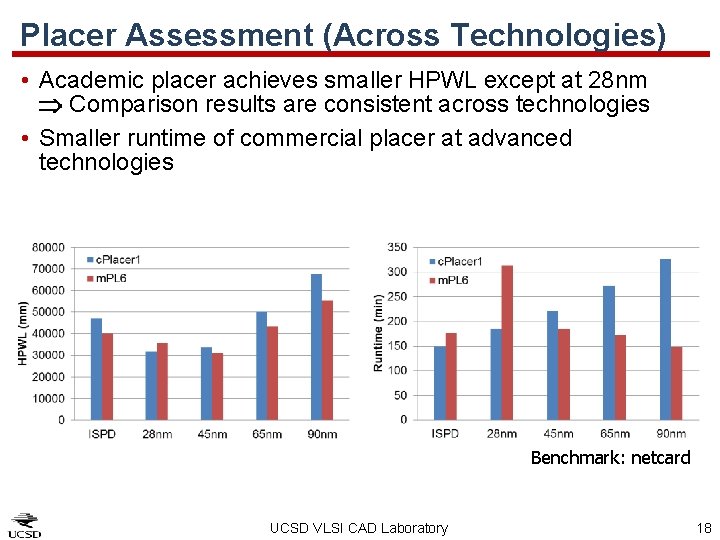
Placer Assessment (Across Technologies) • Academic placer achieves smaller HPWL except at 28 nm Comparison results are consistent across technologies • Smaller runtime of commercial placer at advanced technologies Benchmark: netcard UCSD VLSI CAD Laboratory 18
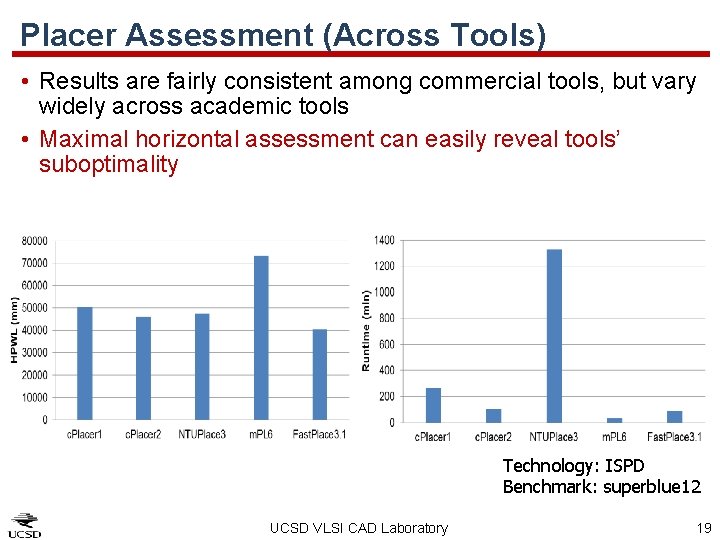
Placer Assessment (Across Tools) • Results are fairly consistent among commercial tools, but vary widely across academic tools • Maximal horizontal assessment can easily reveal tools’ suboptimality Technology: ISPD Benchmark: superblue 12 UCSD VLSI CAD Laboratory 19
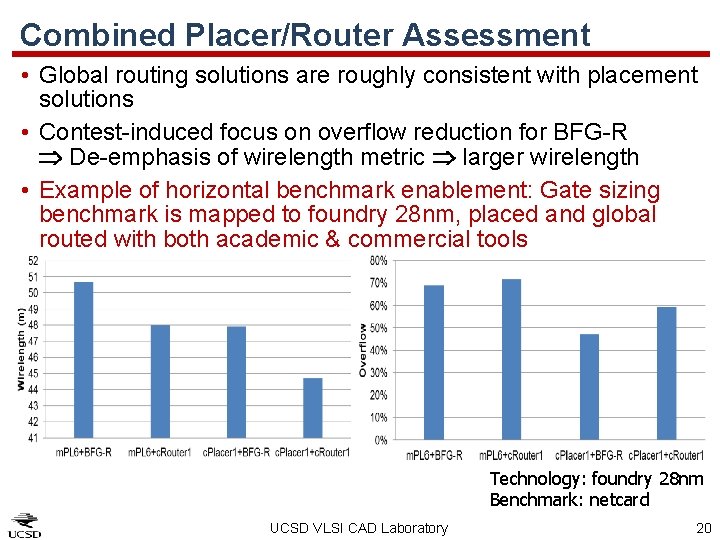
Combined Placer/Router Assessment • Global routing solutions are roughly consistent with placement solutions • Contest-induced focus on overflow reduction for BFG-R De-emphasis of wirelength metric larger wirelength • Example of horizontal benchmark enablement: Gate sizing benchmark is mapped to foundry 28 nm, placed and global routed with both academic & commercial tools Technology: foundry 28 nm Benchmark: netcard UCSD VLSI CAD Laboratory 20
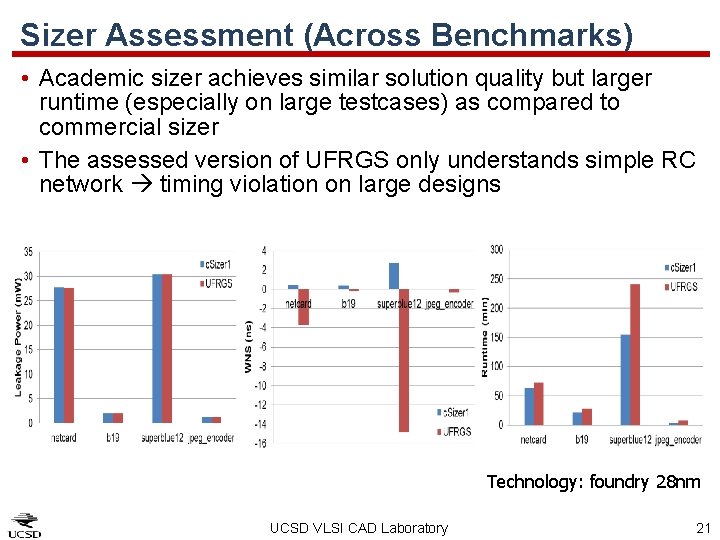
Sizer Assessment (Across Benchmarks) • Academic sizer achieves similar solution quality but larger runtime (especially on large testcases) as compared to commercial sizer • The assessed version of UFRGS only understands simple RC network timing violation on large designs Technology: foundry 28 nm UCSD VLSI CAD Laboratory 21
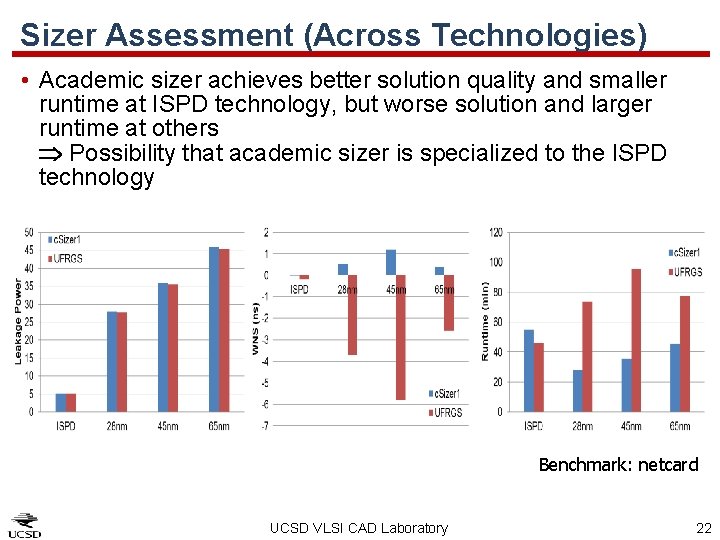
Sizer Assessment (Across Technologies) • Academic sizer achieves better solution quality and smaller runtime at ISPD technology, but worse solution and larger runtime at others Possibility that academic sizer is specialized to the ISPD technology Benchmark: netcard UCSD VLSI CAD Laboratory 22
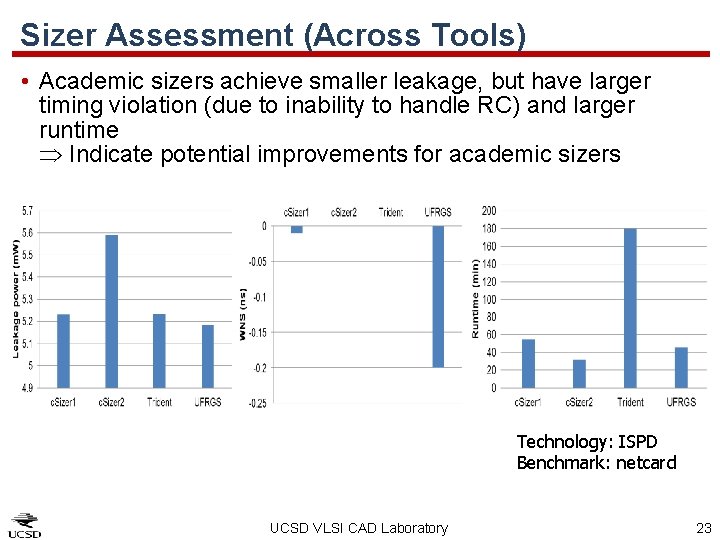
Sizer Assessment (Across Tools) • Academic sizers achieve smaller leakage, but have larger timing violation (due to inability to handle RC) and larger runtime Indicate potential improvements for academic sizers Technology: ISPD Benchmark: netcard UCSD VLSI CAD Laboratory 23
Outline • Motivation • Related Work • Our Methodology • Experimental Setup and Results • Conclusion UCSD VLSI CAD Laboratory 24
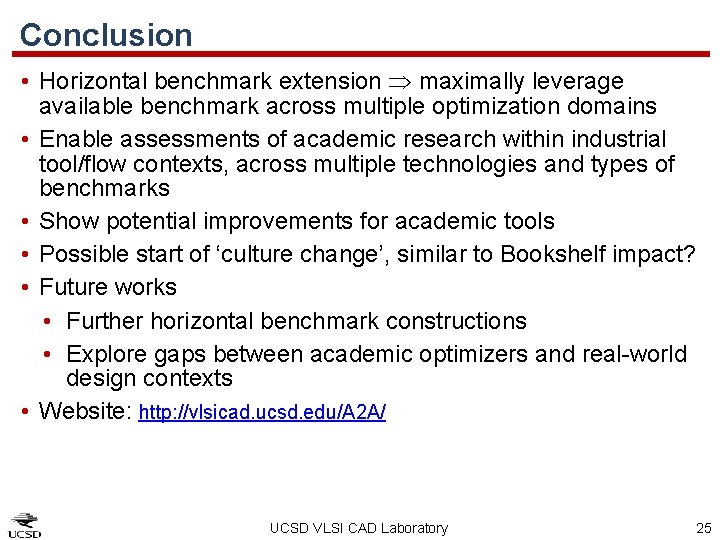
Conclusion • Horizontal benchmark extension maximally leverage available benchmark across multiple optimization domains • Enable assessments of academic research within industrial tool/flow contexts, across multiple technologies and types of benchmarks • Show potential improvements for academic tools • Possible start of ‘culture change’, similar to Bookshelf impact? • Future works • Further horizontal benchmark constructions • Explore gaps between academic optimizers and real-world design contexts • Website: http: //vlsicad. ucsd. edu/A 2 A/ UCSD VLSI CAD Laboratory 25
Acknowledgments • We are grateful to authors of academic tools for providing binaries of their optimizers for our study UCSD VLSI CAD Laboratory 26

THANK YOU! UCSD VLSI CAD Laboratory 27
- Slides: 27