
Horia Hulubei National Institute for Physics and Nuclear
Horia Hulubei National Institute for Physics and Nuclear Engineering, Bucharest-Magurele, Romania Insight of 3 D imaging using Si. RO M. Niculescu-Oglinzanu DFN - Astroparticle Physics Group
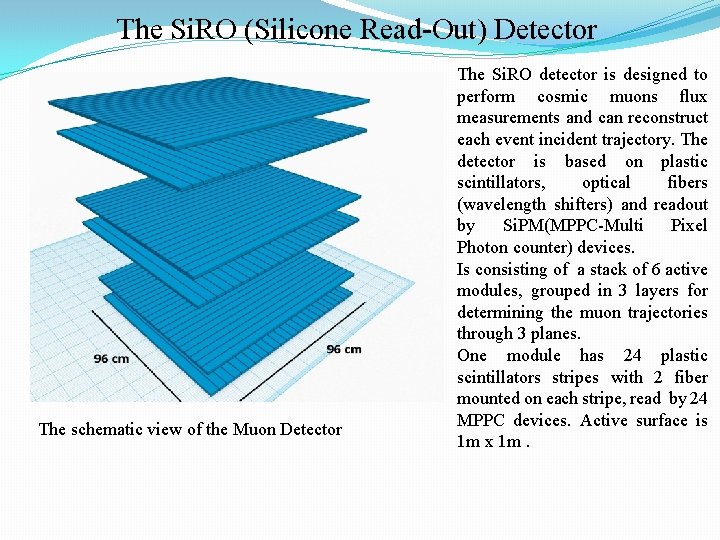
The Si. RO (Silicone Read-Out) Detector The schematic view of the Muon Detector The Si. RO detector is designed to perform cosmic muons flux measurements and can reconstruct each event incident trajectory. The detector is based on plastic scintillators, optical fibers (wavelength shifters) and readout by Si. PM(MPPC-Multi Pixel Photon counter) devices. Is consisting of a stack of 6 active modules, grouped in 3 layers for determining the muon trajectories through 3 planes. One module has 24 plastic scintillators stripes with 2 fiber mounted on each stripe, read by 24 MPPC devices. Active surface is 1 m x 1 m.

Extensive Air Shower (EAS)
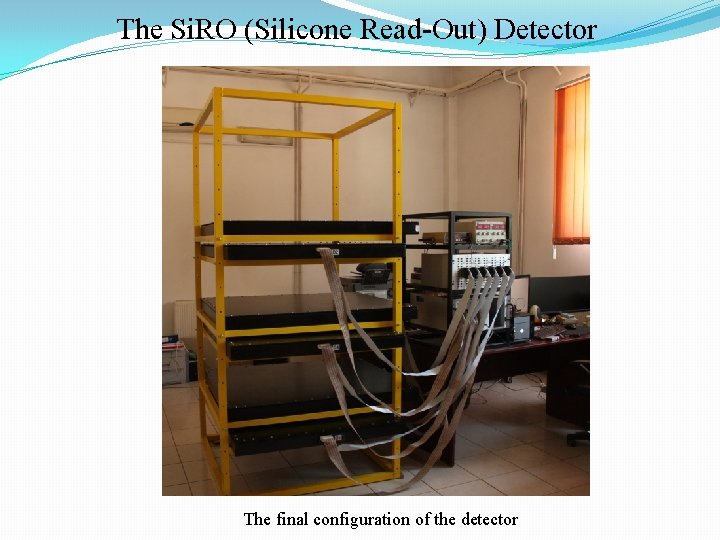
The Si. RO (Silicone Read-Out) Detector The final configuration of the detector
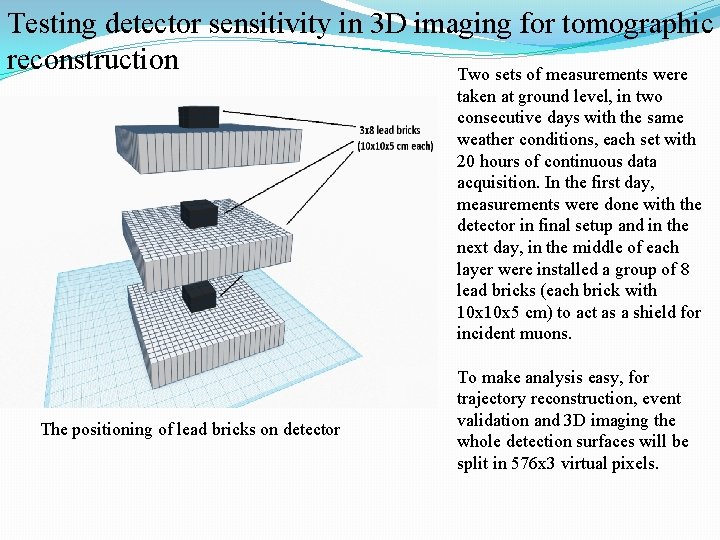
Testing detector sensitivity in 3 D imaging for tomographic reconstruction Two sets of measurements were taken at ground level, in two consecutive days with the same weather conditions, each set with 20 hours of continuous data acquisition. In the first day, measurements were done with the detector in final setup and in the next day, in the middle of each layer were installed a group of 8 lead bricks (each brick with 10 x 5 cm) to act as a shield for incident muons. The positioning of lead bricks on detector To make analysis easy, for trajectory reconstruction, event validation and 3 D imaging the whole detection surfaces will be split in 576 x 3 virtual pixels.
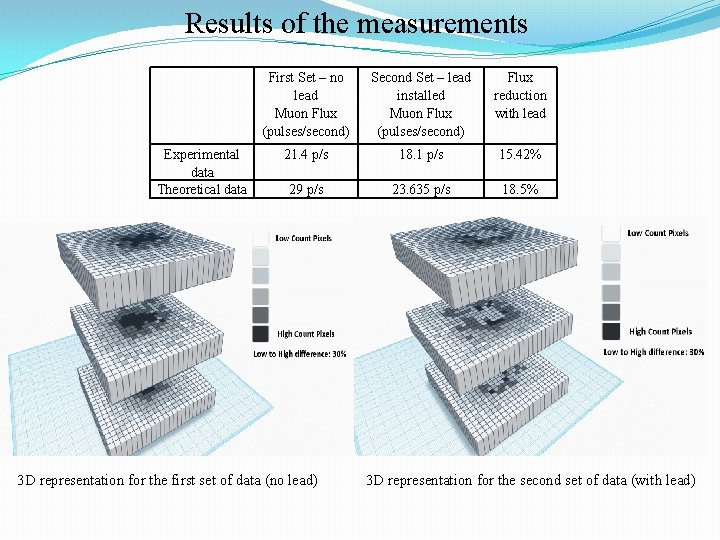
Results of the measurements Experimental data Theoretical data First Set – no lead Muon Flux (pulses/second) Second Set – lead installed Muon Flux (pulses/second) Flux reduction with lead 21. 4 p/s 18. 1 p/s 15. 42% 29 p/s 23. 635 p/s 18. 5% 3 D representation for the first set of data (no lead) 3 D representation for the second set of data (with lead)
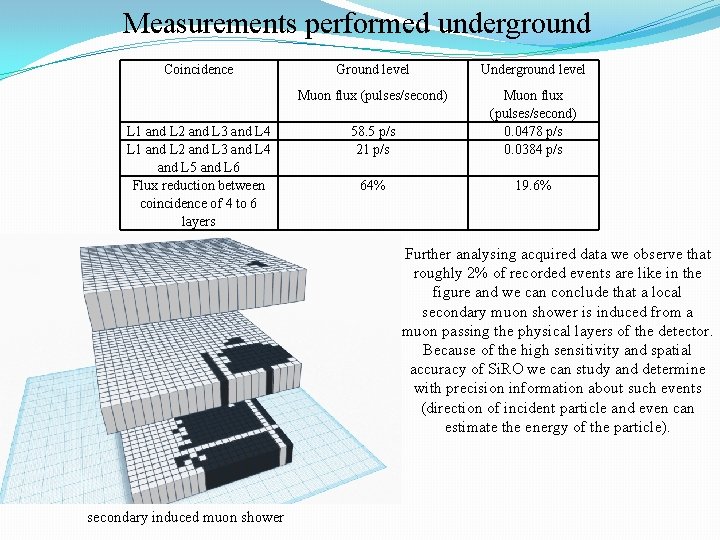
Measurements performed underground Coincidence L 1 and L 2 and L 3 and L 4 and L 5 and L 6 Flux reduction between coincidence of 4 to 6 layers Ground level Underground level Muon flux (pulses/second) 58. 5 p/s 21 p/s Muon flux (pulses/second) 0. 0478 p/s 0. 0384 p/s 64% 19. 6% Further analysing acquired data we observe that roughly 2% of recorded events are like in the figure and we can conclude that a local secondary muon shower is induced from a muon passing the physical layers of the detector. Because of the high sensitivity and spatial accuracy of Si. RO we can study and determine with precision information about such events (direction of incident particle and even can estimate the energy of the particle). secondary induced muon shower
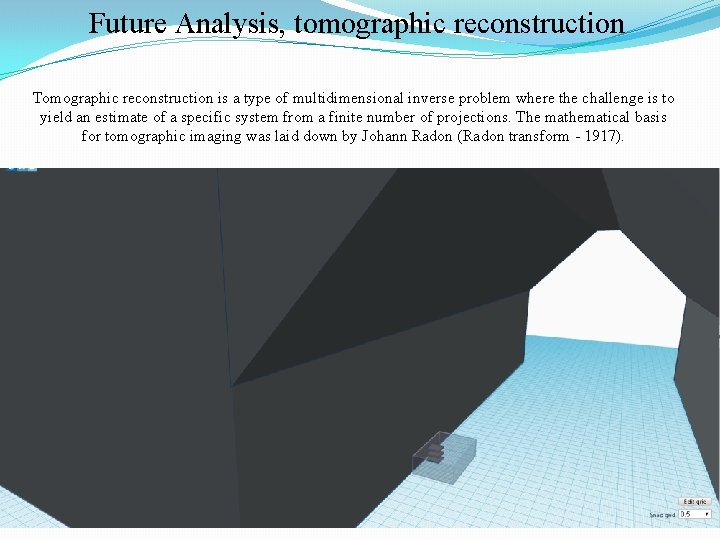
Future Analysis, tomographic reconstruction Tomographic reconstruction is a type of multidimensional inverse problem where the challenge is to yield an estimate of a specific system from a finite number of projections. The mathematical basis for tomographic imaging was laid down by Johann Radon (Radon transform - 1917).
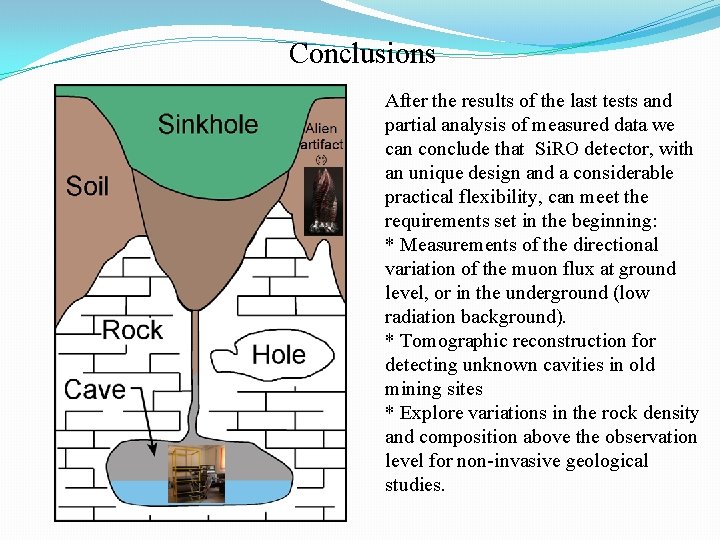
Conclusions After the results of the last tests and partial analysis of measured data we can conclude that Si. RO detector, with an unique design and a considerable practical flexibility, can meet the requirements set in the beginning: * Measurements of the directional variation of the muon flux at ground level, or in the underground (low radiation background). * Tomographic reconstruction for detecting unknown cavities in old mining sites * Explore variations in the rock density and composition above the observation level for non-invasive geological studies.

Thank You!
- Slides: 10