
HOPS HOPS How many have taken the Forensics


- Slides: 49
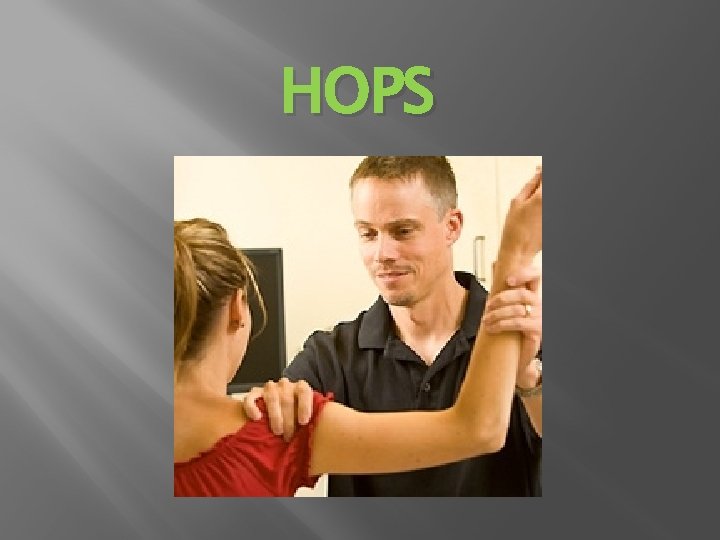
HOPS
HOPS � � How many have taken the Forensics Class? How many enjoy crime shows?
HOPS � Think about the importance of each piece of evidence at a crime scene and share the answers to the following questions with a partner: 1. What would happen if one part of the investigation was left out? � 2. Why is it important to have all of the pieces in order to see the whole picture? � � After discussing the answers with your partner, be prepared to share with the rest of the class.
Objectives Students will be able to… 1. Define new terminology related to the evaluation process. 2. Identify HOPS & MAPPS 3. Identify where information goes into HOPS 4. Explain the injury evaluation process.
Evaluation Goals � To correctly evaluate an athlete’s injury you need to follow an organized process � Includes � � S&S Ensures the end product will successfully be achieved Leads to appropriate treatment and return to play (RTP)
HOPS : Vocabulary Evaluation: �An organized process of determining the type and severity of an injury
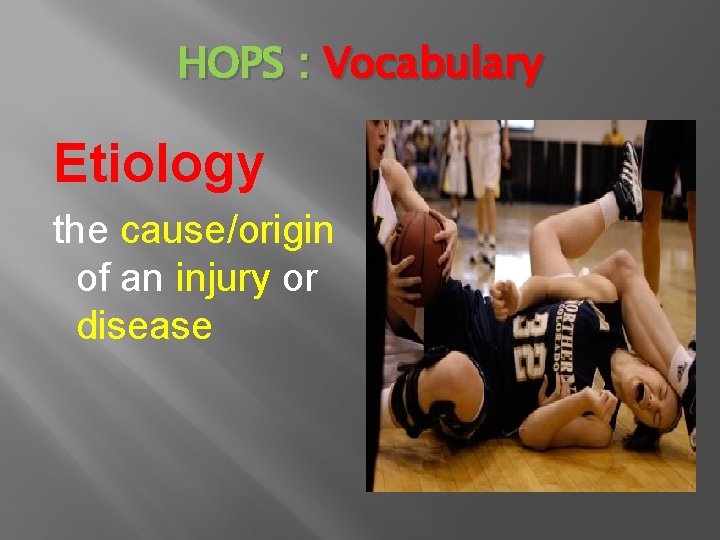
HOPS : Vocabulary Etiology the cause/origin of an injury or disease
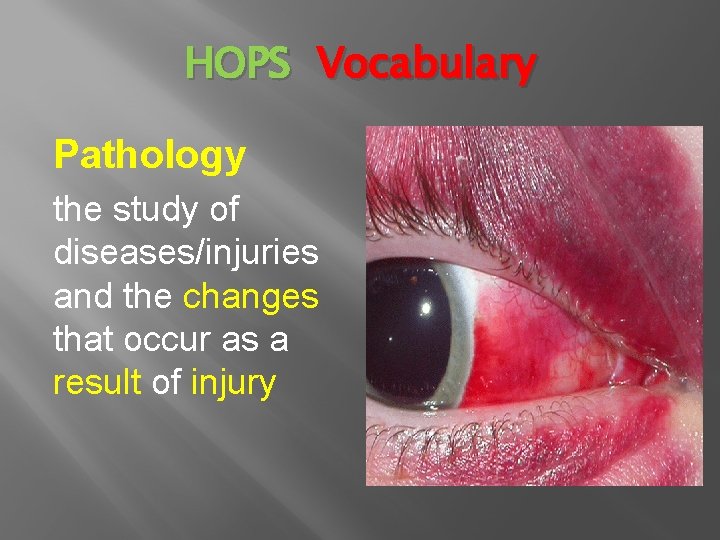
HOPS Vocabulary Pathology the study of diseases/injuries and the changes that occur as a result of injury
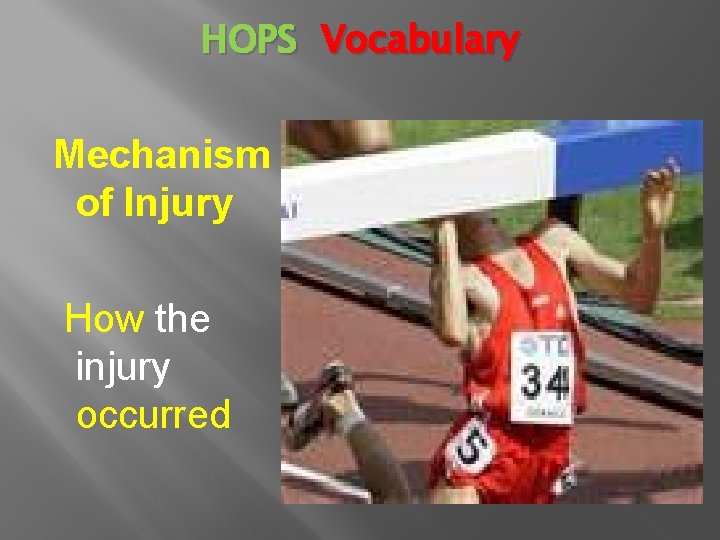
HOPS Vocabulary Mechanism of Injury How the injury occurred
HOPS Vocabulary Acute An injury with a sudden occurrence
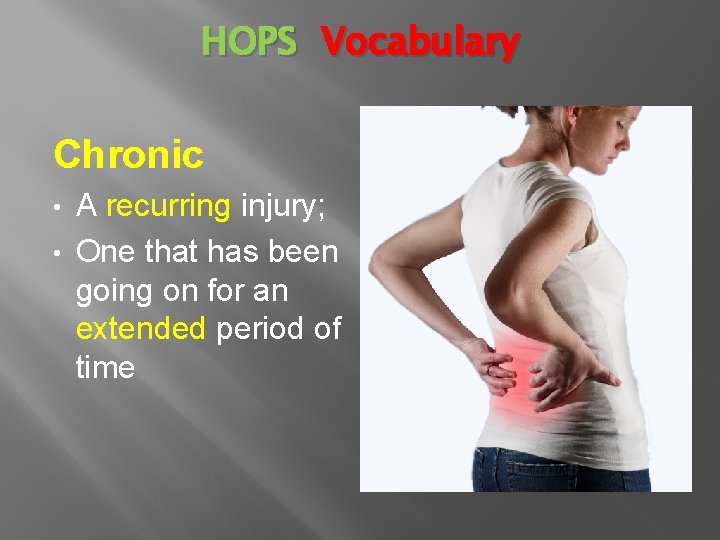
HOPS Vocabulary Chronic A recurring injury; • One that has been going on for an extended period of time •
HOPS: A system of injury evaluation based on History Observation Palpation Stress Tests/Special Tests
History � � � Used to establish the injury background Series of questions to determine nature and location of injury *Based on subjective findings (Symptoms)* � How/when did it happen? � Previous injury? � Hear or feel anything? � Type/location of pain
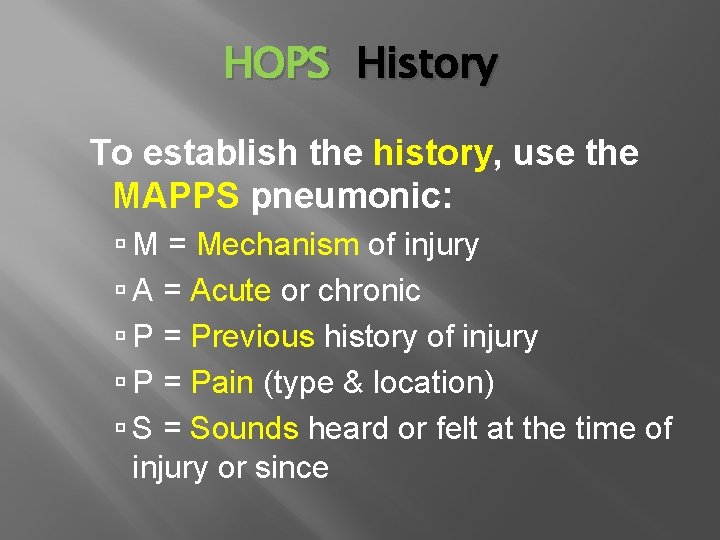
HOPS History To establish the history, use the MAPPS pneumonic: M = Mechanism of injury A = Acute or chronic P = Previous history of injury P = Pain (type & location) S = Sounds heard or felt at the time of injury or since
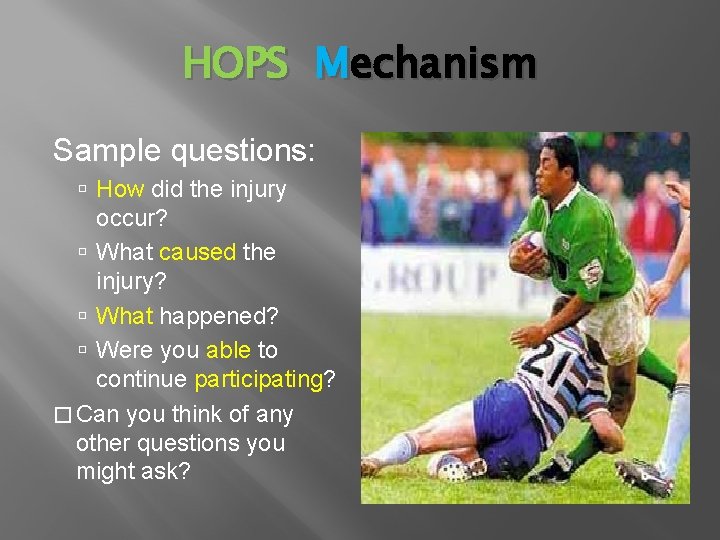
HOPS Mechanism Sample questions: How did the injury occur? What caused the injury? What happened? Were you able to continue participating? � Can you think of any other questions you might ask?
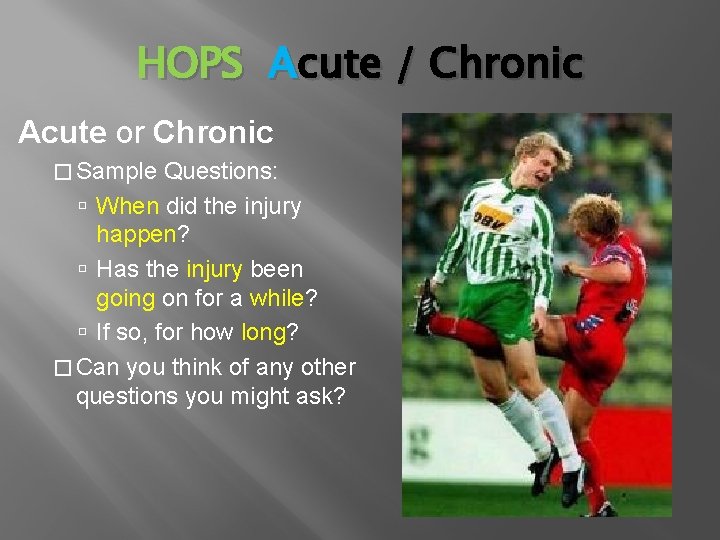
HOPS Acute / Chronic Acute or Chronic � Sample Questions: When did the injury happen? Has the injury been going on for a while? If so, for how long? � Can you think of any other questions you might ask?
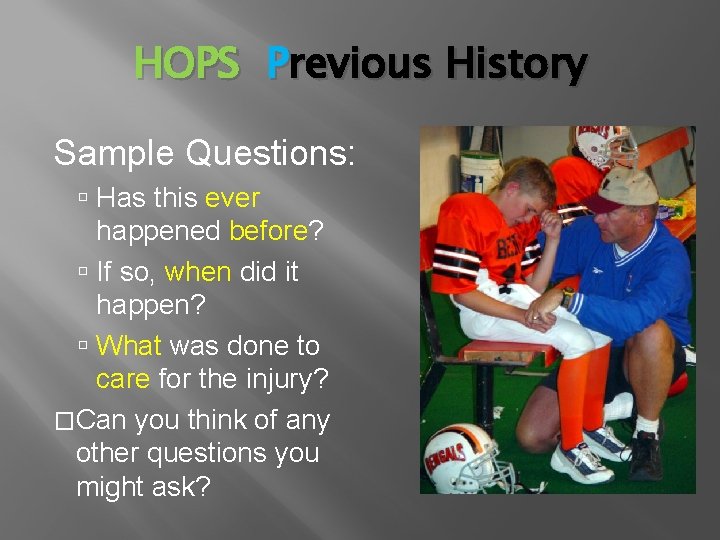
HOPS Previous History Sample Questions: Has this ever happened before? If so, when did it happen? What was done to care for the injury? �Can you think of any other questions you might ask?
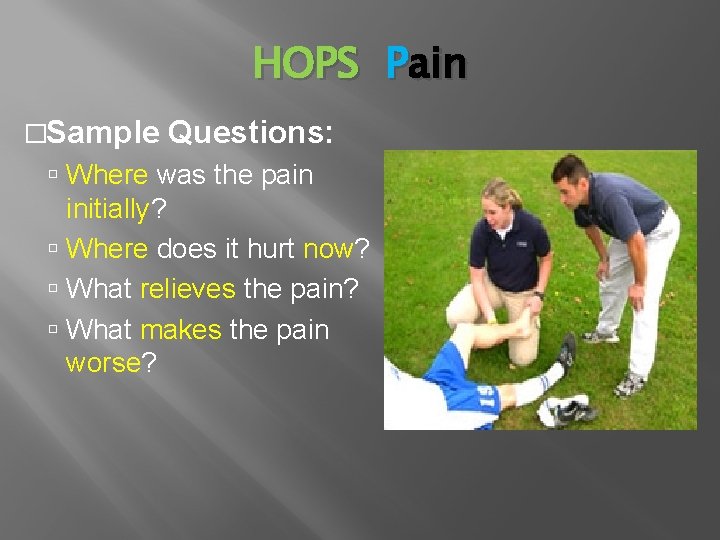
HOPS Pain �Sample Questions: Where was the pain initially? Where does it hurt now? What relieves the pain? What makes the pain worse?
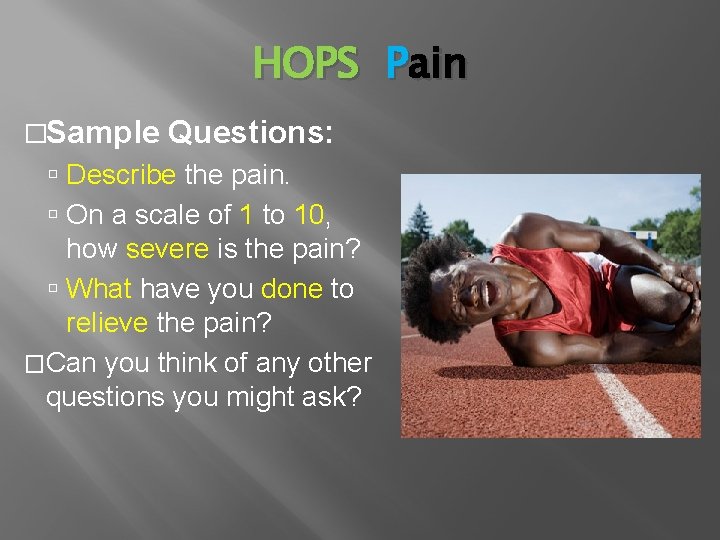
HOPS Pain �Sample Questions: Describe the pain. On a scale of 1 to 10, how severe is the pain? What have you done to relieve the pain? �Can you think of any other questions you might ask?
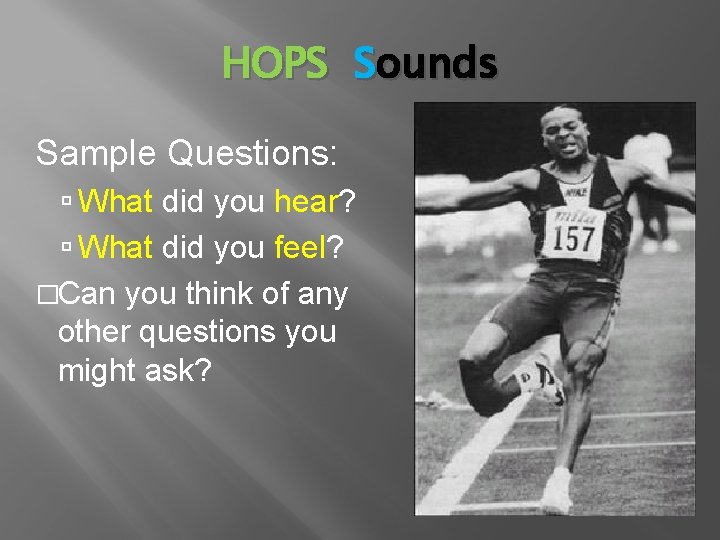
HOPS Sounds Sample Questions: What did you hear? What did you feel? �Can you think of any other questions you might ask?
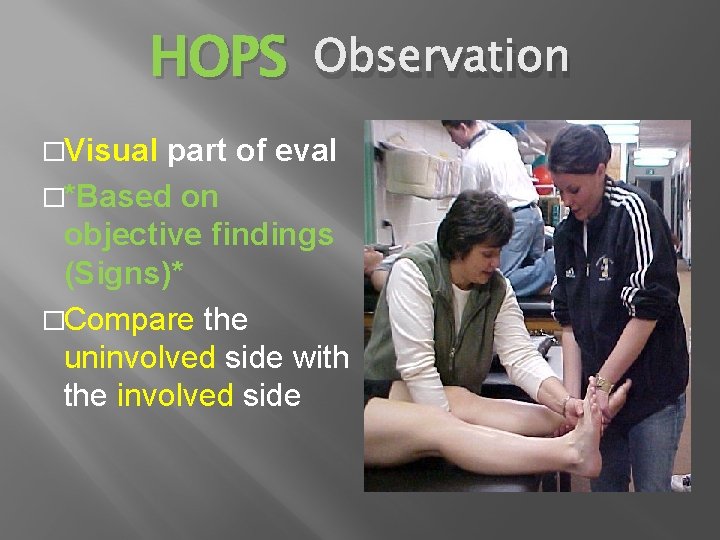
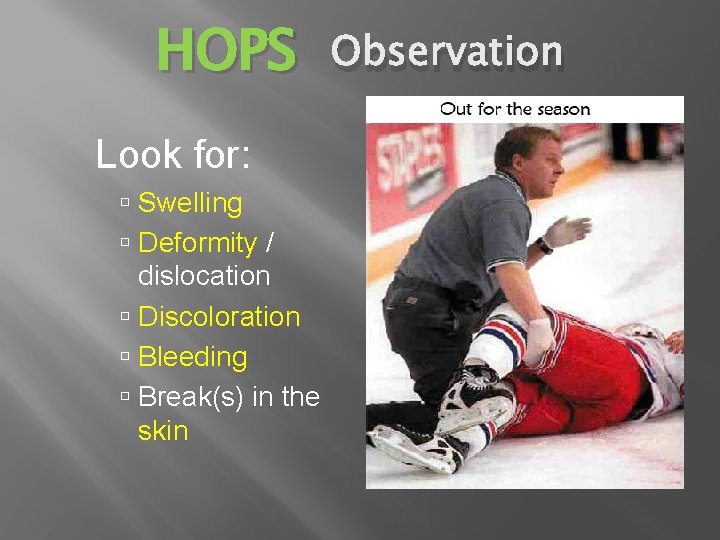
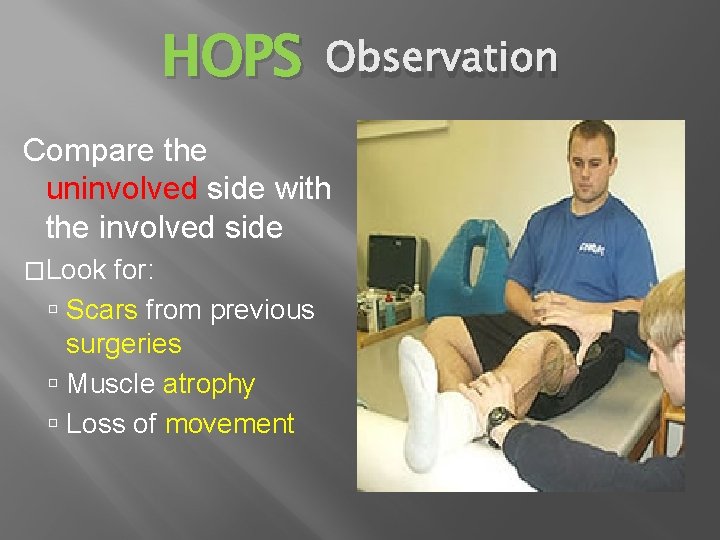
HOPS Observation �Visual part of eval �*Based on objective findings (Signs)* �Compare the uninvolved side with the involved side
HOPS Look for: Swelling Deformity / dislocation Discoloration Bleeding Break(s) in the skin Observation
HOPS Observation Compare the uninvolved side with the involved side �Look for: Scars from previous surgeries Muscle atrophy Loss of movement
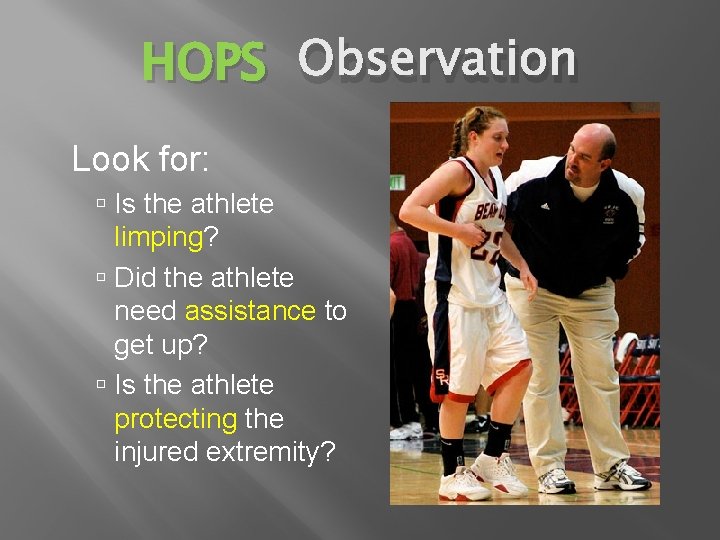
HOPS Observation Look for: Is the athlete limping? Did the athlete need assistance to get up? Is the athlete protecting the injured extremity?
STOP Practice with worksheet to properly identify history and observation
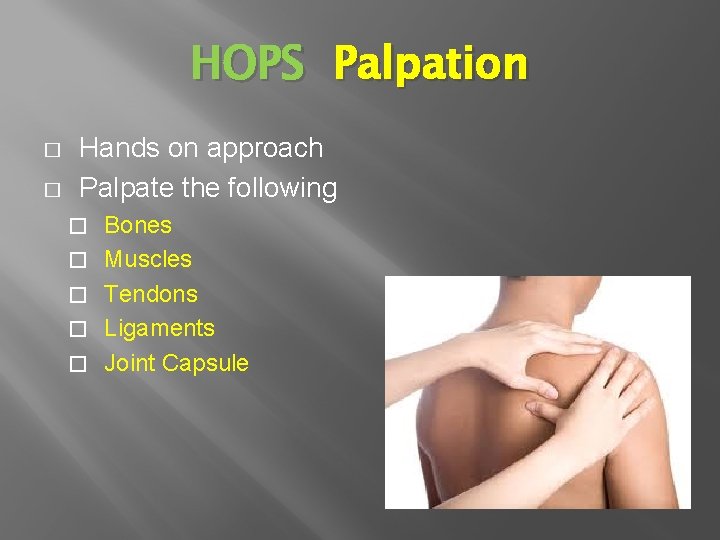
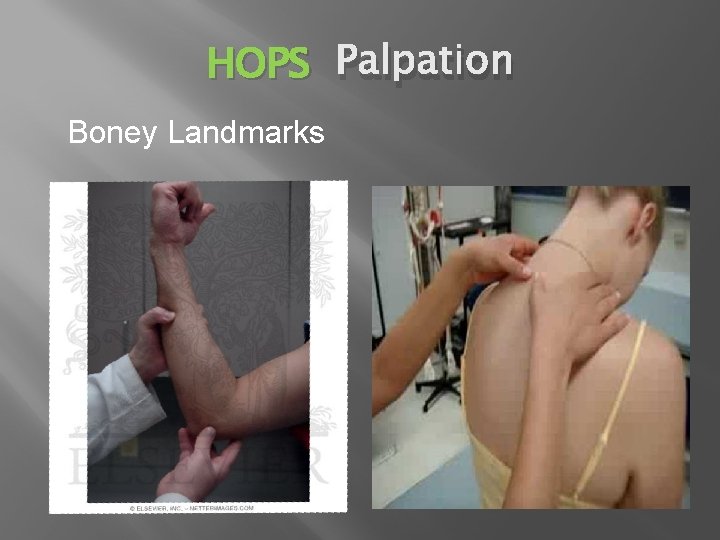
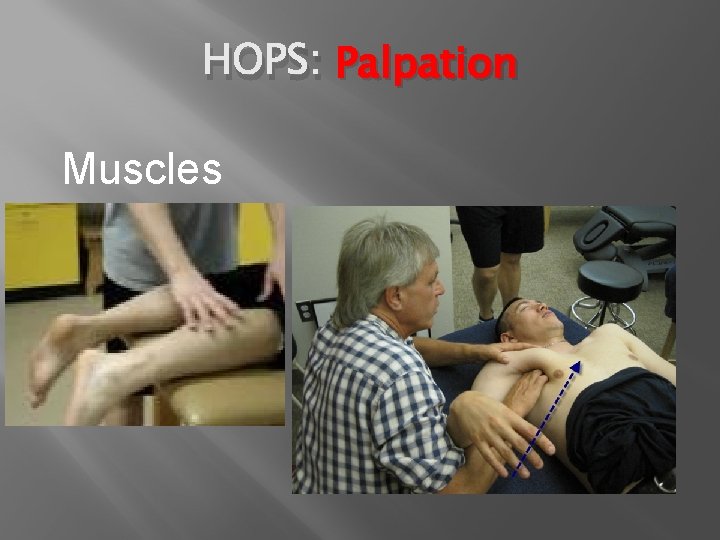
HOPS Palpation � � Hands on approach Palpate the following � � � Bones Muscles Tendons Ligaments Joint Capsule
HOPS Palpation Boney Landmarks
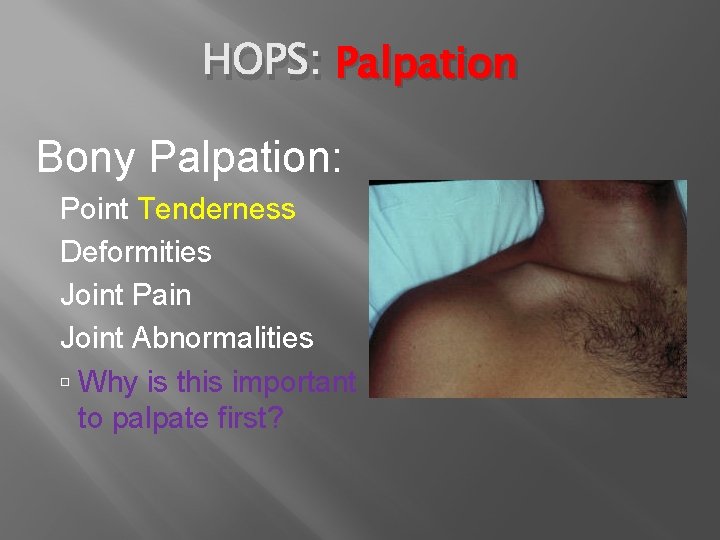
HOPS: Palpation Bony Palpation: Point Tenderness Deformities Joint Pain Joint Abnormalities Why is this important to palpate first?
HOPS: Palpation Muscles
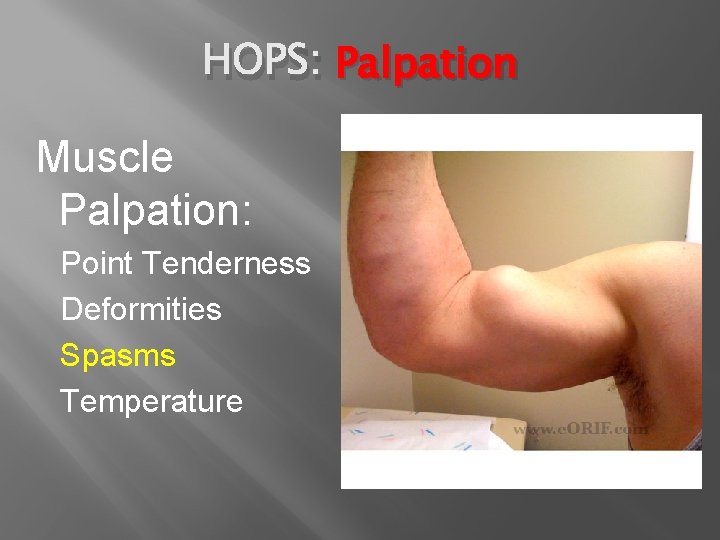
HOPS: Palpation Muscle Palpation: Point Tenderness Deformities Spasms Temperature
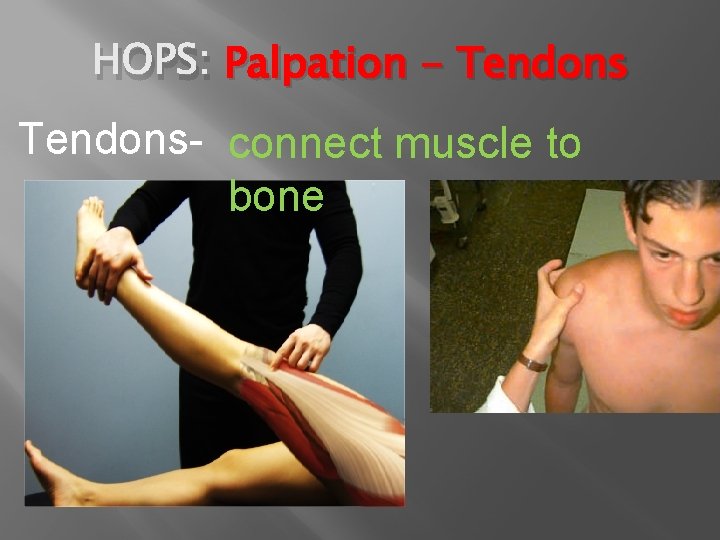
HOPS: Palpation - Tendons- connect muscle to bone
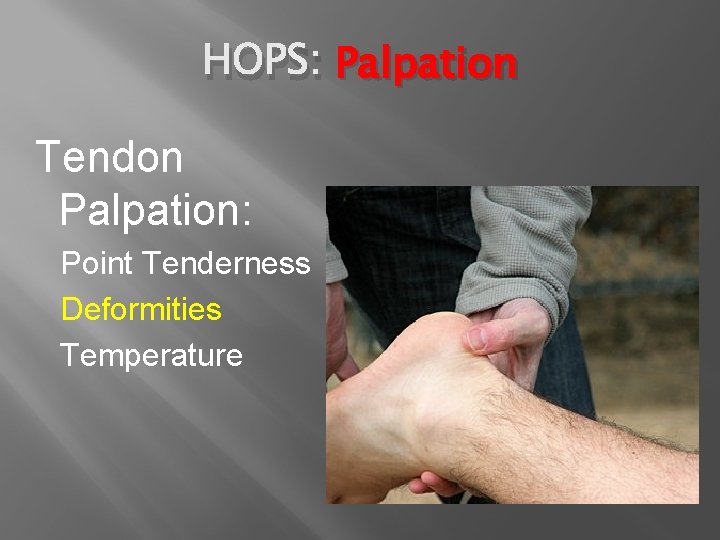
HOPS: Palpation Tendon Palpation: Point Tenderness Deformities Temperature
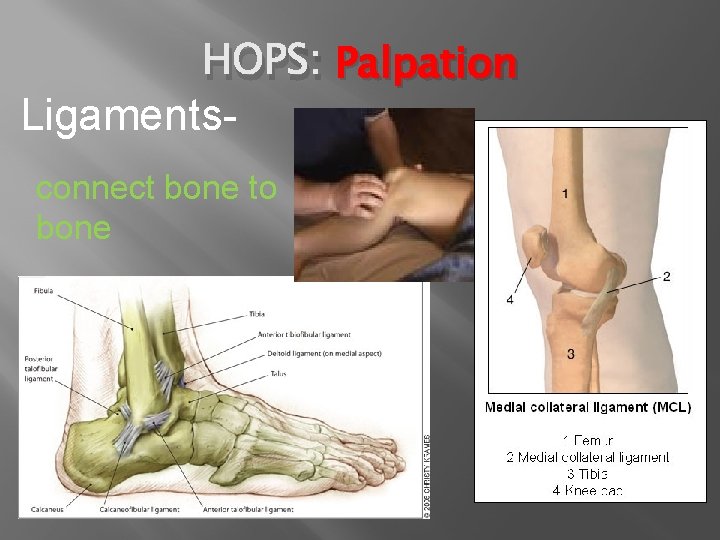
HOPS: Palpation Ligaments- connect bone to bone
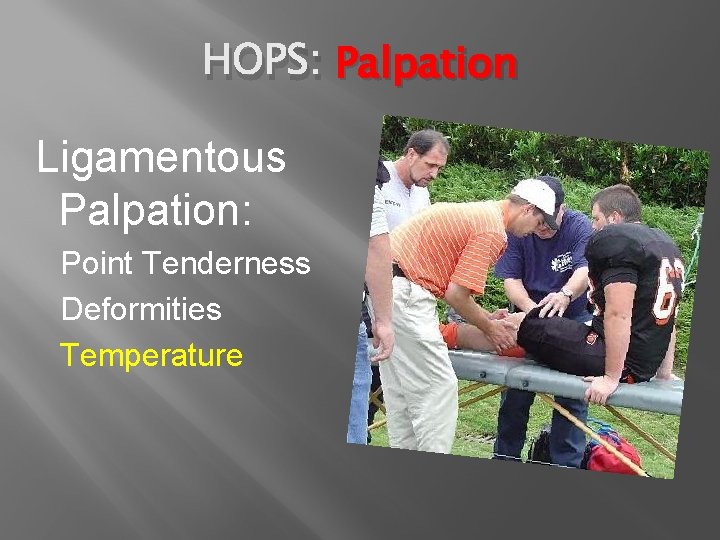
HOPS: Palpation Ligamentous Palpation: Point Tenderness Deformities Temperature
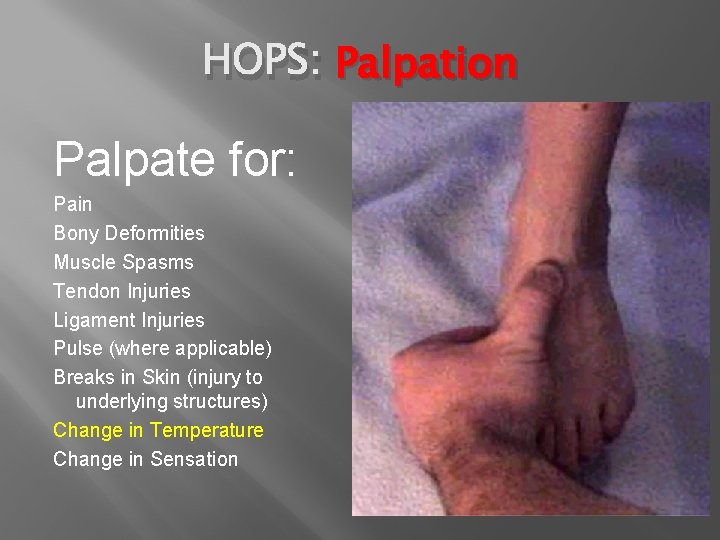
HOPS: Palpation Palpate for: Pain Bony Deformities Muscle Spasms Tendon Injuries Ligament Injuries Pulse (where applicable) Breaks in Skin (injury to underlying structures) Change in Temperature Change in Sensation
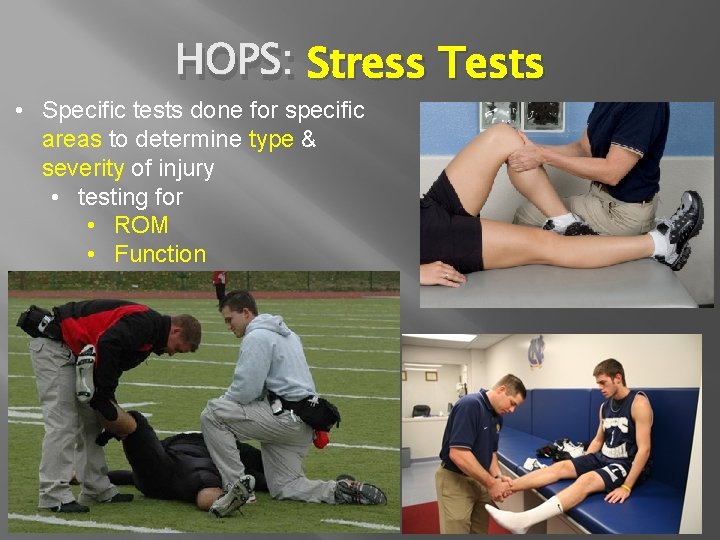
HOPS: Stress Tests • Specific tests done for specific areas to determine type & severity of injury • testing for • ROM • Function
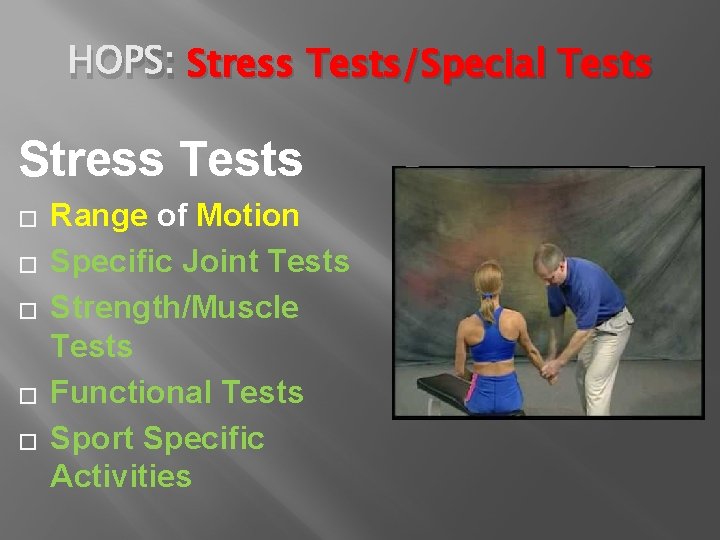
HOPS: Stress Tests/Special Tests Stress Tests � � � Range of Motion Specific Joint Tests Strength/Muscle Tests Functional Tests Sport Specific Activities
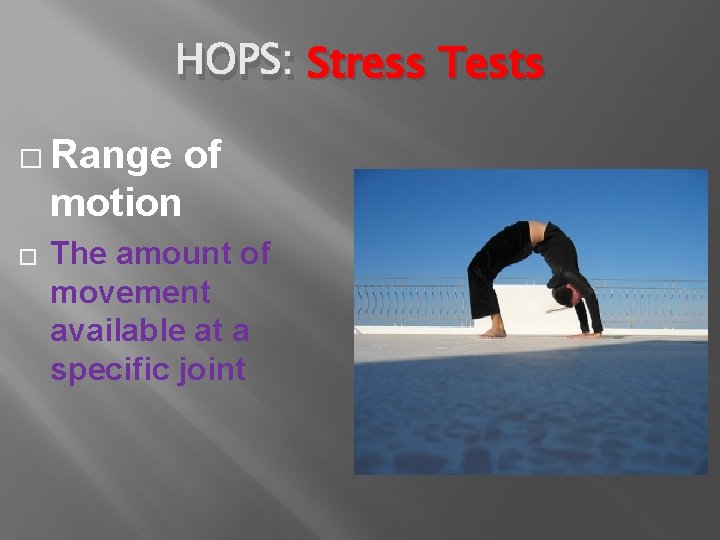
HOPS: Stress Tests � Range of motion � The amount of movement available at a specific joint
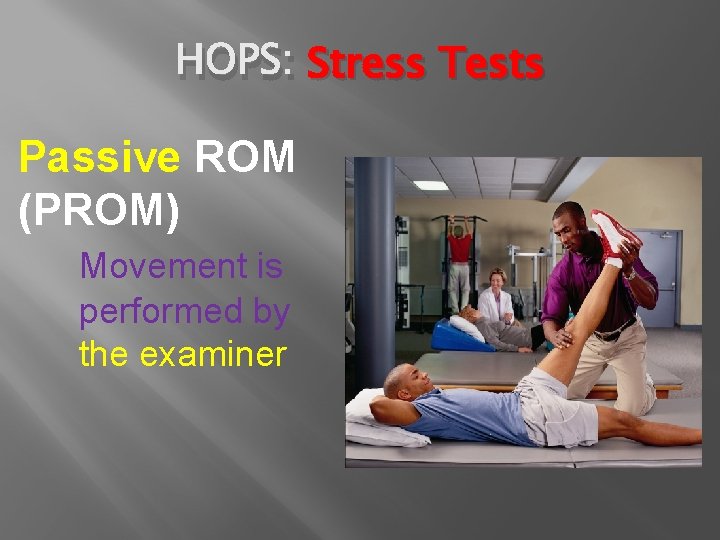
HOPS: Stress Tests Passive ROM (PROM) Movement is performed by the examiner
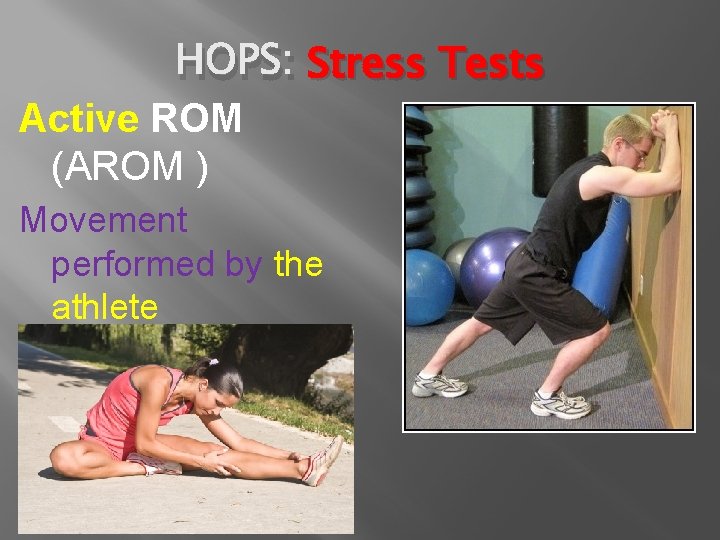
HOPS: Stress Tests Active ROM (AROM ) Movement performed by the athlete
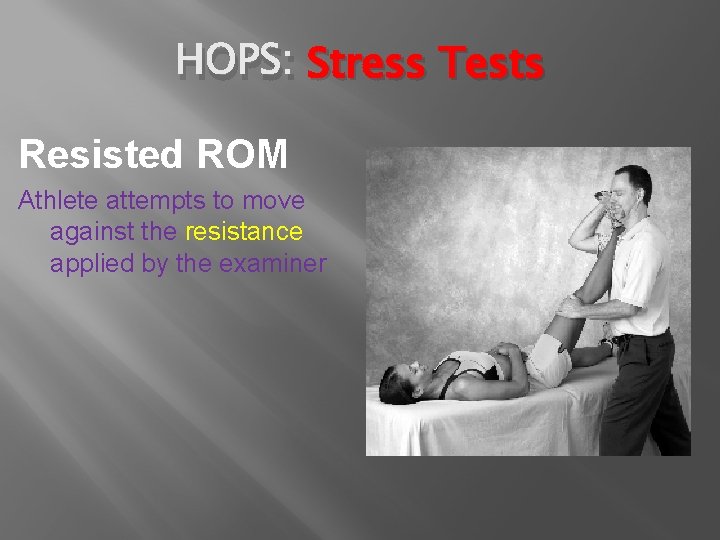
HOPS: Stress Tests Resisted ROM Athlete attempts to move against the resistance applied by the examiner
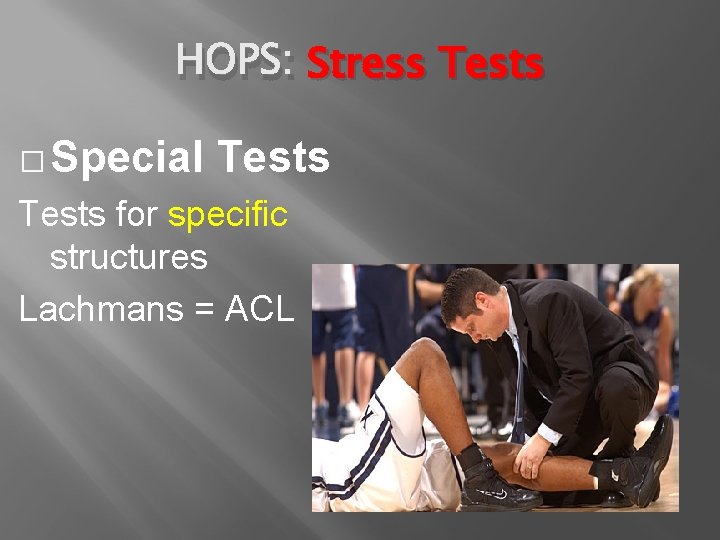
HOPS: Stress Tests � Special Tests for specific structures Lachmans = ACL
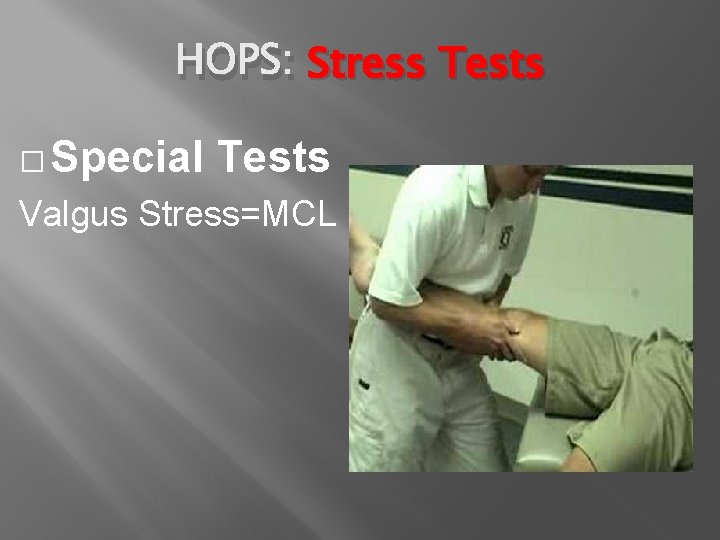
HOPS: Stress Tests � Special Tests Valgus Stress=MCL
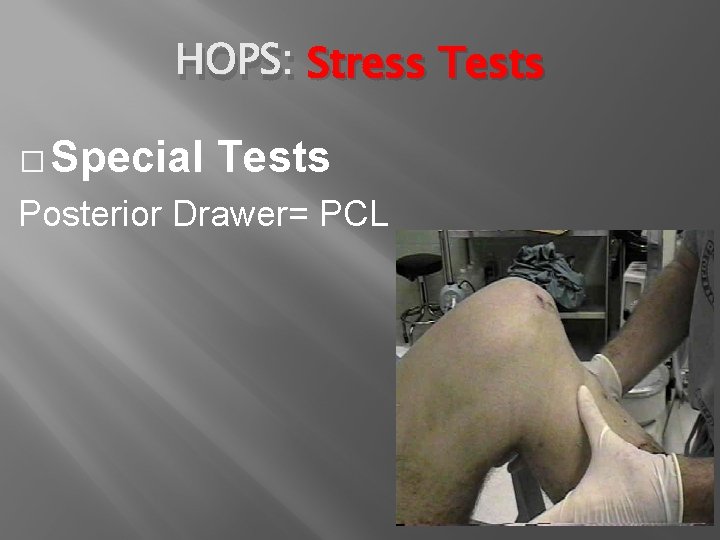
HOPS: Stress Tests � Special Tests Posterior Drawer= PCL
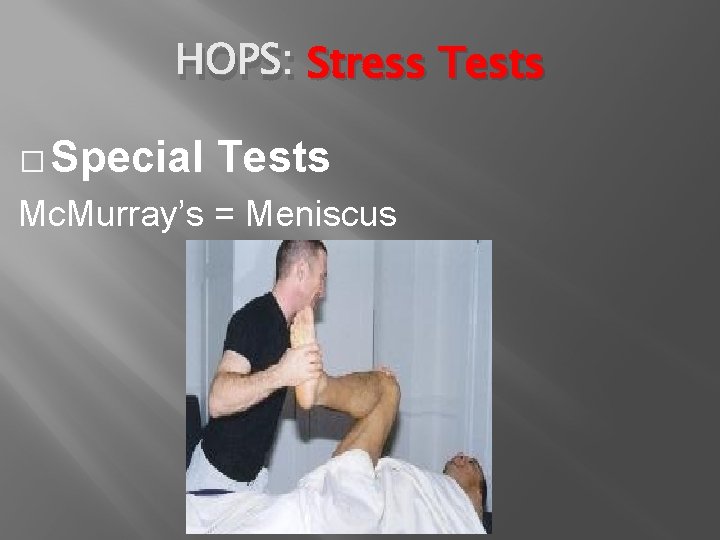
HOPS: Stress Tests � Special Tests Mc. Murray’s = Meniscus
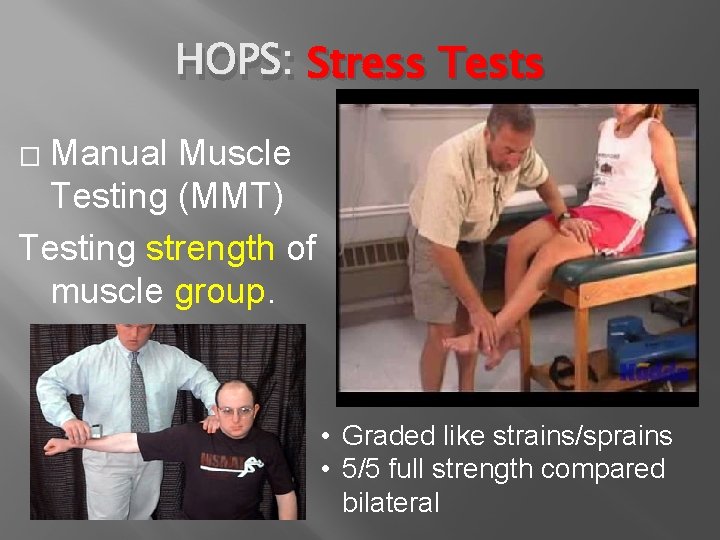
HOPS: Stress Tests Manual Muscle Testing (MMT) Testing strength of muscle group. � • Graded like strains/sprains • 5/5 full strength compared bilateral
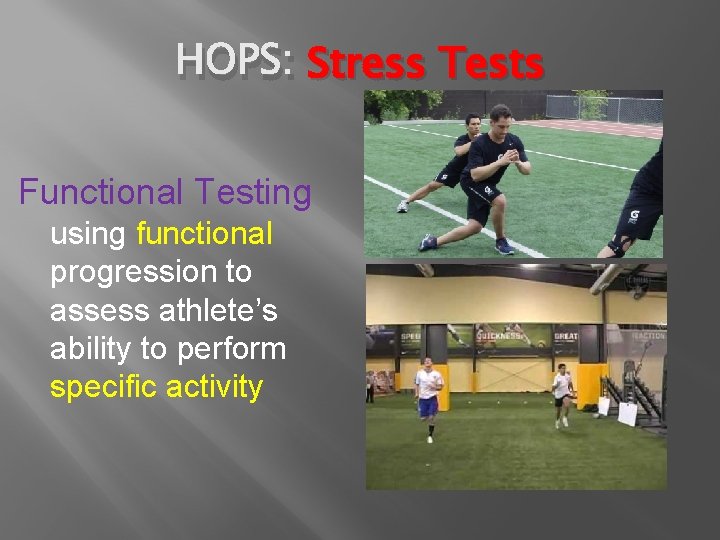
HOPS: Stress Tests Functional Testing using functional progression to assess athlete’s ability to perform specific activity
STOP � Get out your worksheet from yesterday �Complete the P and S sections ON YOUR OWN
Closure 1. 2. 3. 4. List out HOPS and label what each letter stands for. List out MAPPS and label what each letter stands for. Where does MAPPS go in the evaluation process? Give a brief description of each section in HOPS.