
HOPE for Opioid Use Disorders NAMI Southwest Ohio




- Slides: 99
HOPE for Opioid Use Disorders NAMI Southwest Ohio May 12, 2015 Clifford Q Cabansag, MD, DABAM, CTTS Addiction Medicine Physician, Tobacco Treatment Specialist
Disclosures • NONE
Disclosures • NONE
Objectives At the end of this session each participant will be able to: • Discuss the language and appropriate terminology of substance use disorders • State the incidence, prevalence and death rates of opioid use disorders nationally, regionally and locally • Identify available FDA approved medications for treatment of opioid use disorders & their mechanisms of action
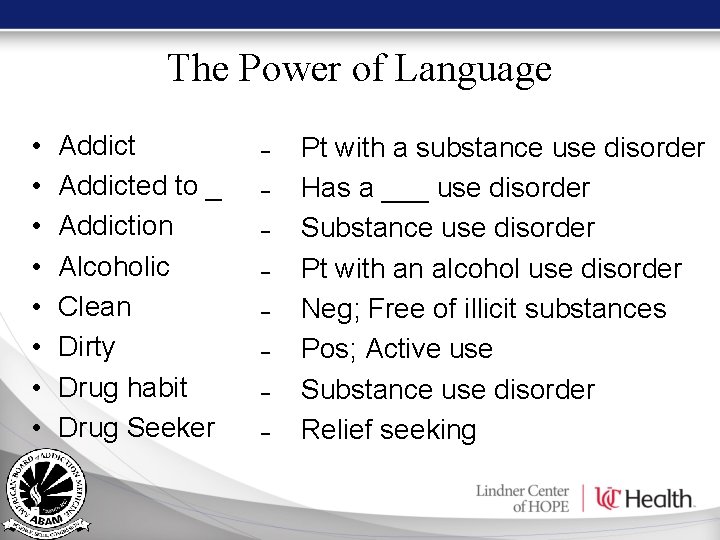
The Power of Language • • Addicted to _ Addiction Alcoholic Clean Dirty Drug habit Drug Seeker Pt with a substance use disorder Has a ___ use disorder Substance use disorder Pt with an alcohol use disorder Neg; Free of illicit substances Pos; Active use Substance use disorder Relief seeking
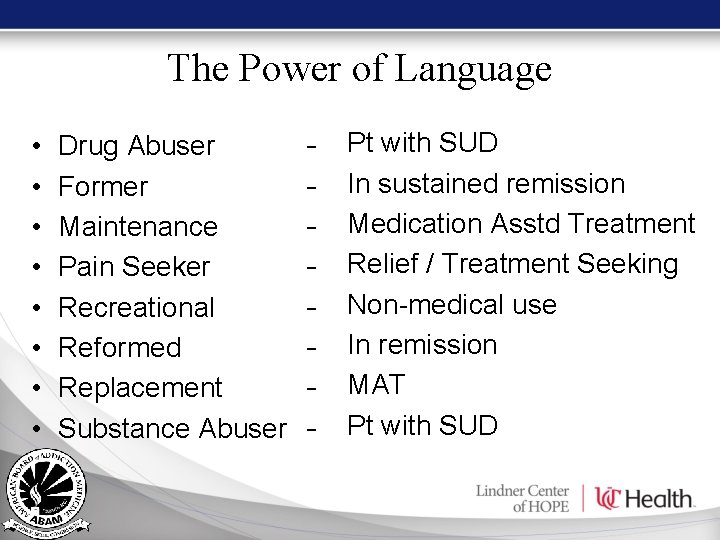
The Power of Language • • Drug Abuser Former Maintenance Pain Seeker Recreational Reformed Replacement Substance Abuser Pt with SUD In sustained remission Medication Asstd Treatment Relief / Treatment Seeking Non-medical use In remission MAT Pt with SUD
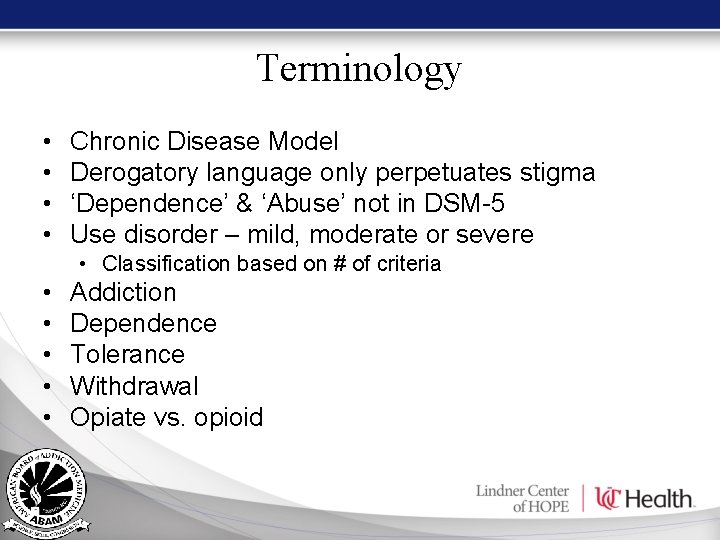
Terminology • • Chronic Disease Model Derogatory language only perpetuates stigma ‘Dependence’ & ‘Abuse’ not in DSM-5 Use disorder – mild, moderate or severe • Classification based on # of criteria • • • Addiction Dependence Tolerance Withdrawal Opiate vs. opioid
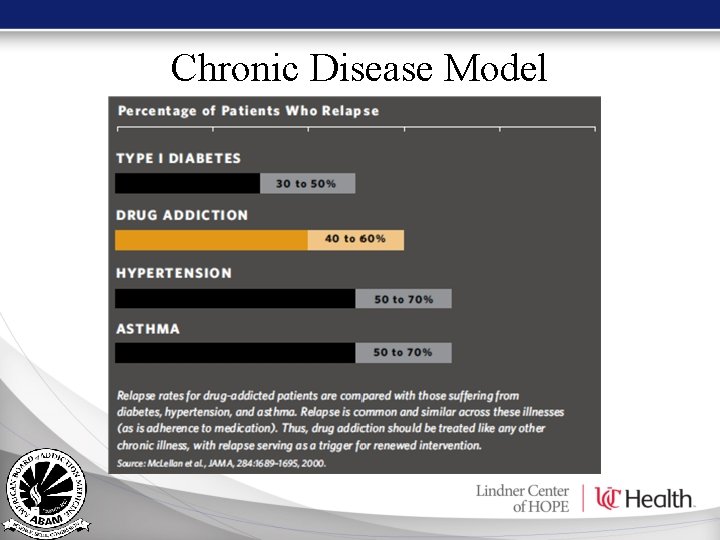
Chronic Disease Model
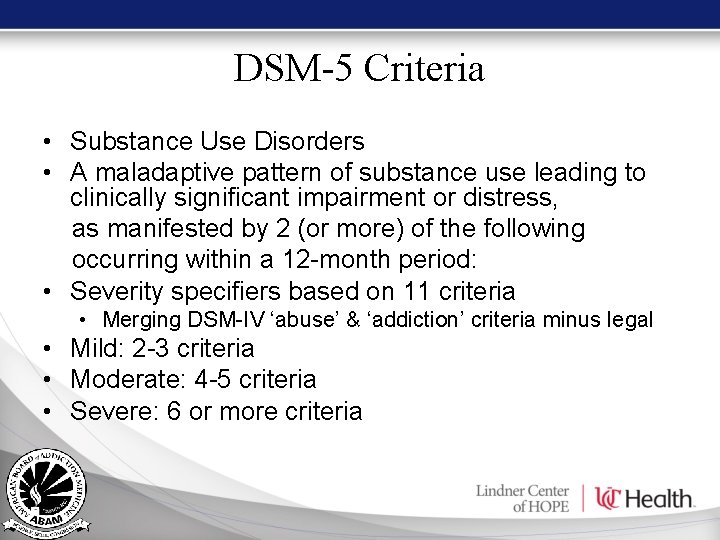
DSM-5 Criteria • Substance Use Disorders • A maladaptive pattern of substance use leading to clinically significant impairment or distress, as manifested by 2 (or more) of the following occurring within a 12 -month period: • Severity specifiers based on 11 criteria • Merging DSM-IV ‘abuse’ & ‘addiction’ criteria minus legal • Mild: 2 -3 criteria • Moderate: 4 -5 criteria • Severe: 6 or more criteria
Questions • (For discussion: Addiction ~ Substance Use Disorder) • What must be present to have dependence? • Aren’t dependence and addiction the same? • Is it possible to have dependence w/o addiction? • To have addiction without dependence? • What about tolerance & withdrawal?
Answers • Tolerance • Same amount of substance insufficient • Greater amount to achieve previous effect • Withdrawal • Characteristic sequelae after discontinuation • Typically opposite effects of substance activity • Classic examples: alcohol & opioids • Atypical example: cannabis • Using similar substance to relieve symptoms
Answers • In order to have dependence: • MUST have both tolerance AND withdrawal • Physiologic symptomatology • So it IS possible to have dependence WITHOUT ‘Addiction’ / Substance Use Disorder • Examples: caffeine; hospice & chronic pain pts • So what makes the difference between having only dependence but not an ‘addiction’?
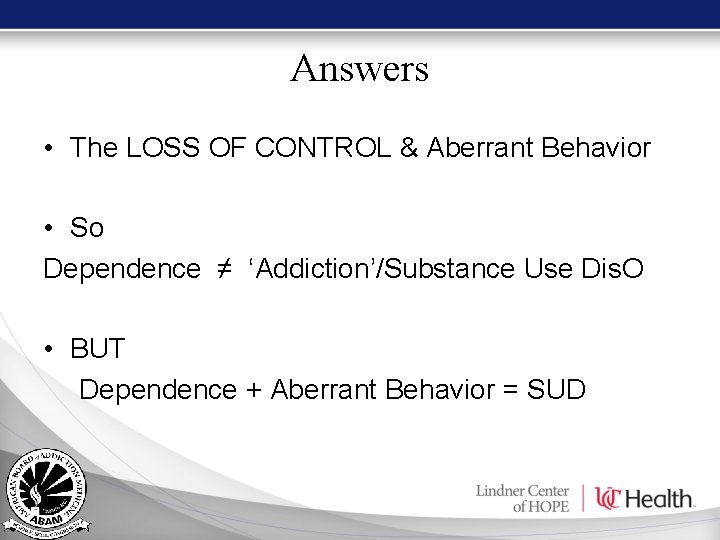
Answers • The LOSS OF CONTROL & Aberrant Behavior • So Dependence ≠ ‘Addiction’/Substance Use Dis. O • BUT Dependence + Aberrant Behavior = SUD
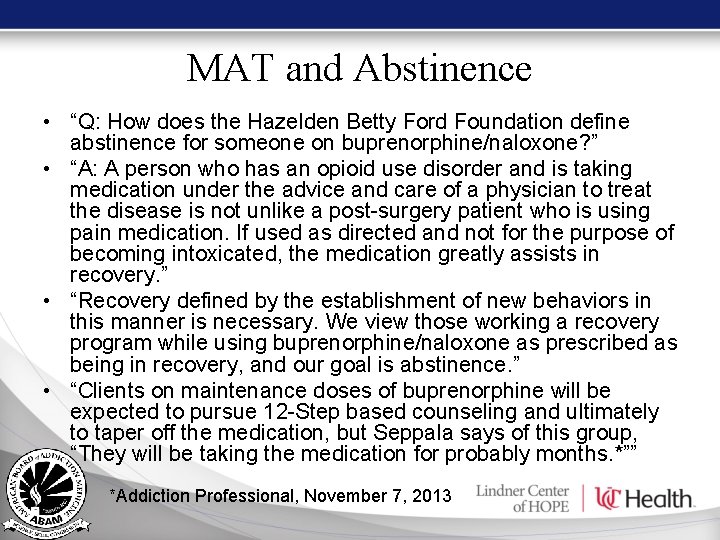
MAT and Abstinence • “Q: How does the Hazelden Betty Ford Foundation define abstinence for someone on buprenorphine/naloxone? ” • “A: A person who has an opioid use disorder and is taking medication under the advice and care of a physician to treat the disease is not unlike a post-surgery patient who is using pain medication. If used as directed and not for the purpose of becoming intoxicated, the medication greatly assists in recovery. ” • “Recovery defined by the establishment of new behaviors in this manner is necessary. We view those working a recovery program while using buprenorphine/naloxone as prescribed as being in recovery, and our goal is abstinence. ” • “Clients on maintenance doses of buprenorphine will be expected to pursue 12 -Step based counseling and ultimately to taper off the medication, but Seppala says of this group, “They will be taking the medication for probably months. *”” *Addiction Professional, November 7, 2013
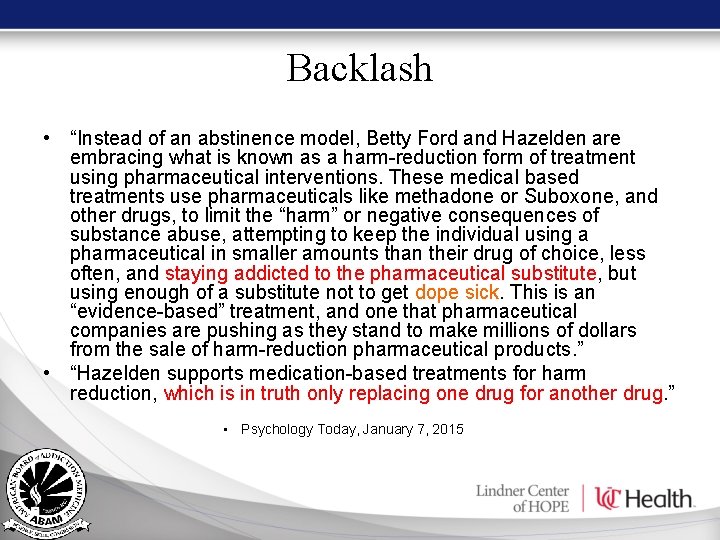
Backlash • “Instead of an abstinence model, Betty Ford and Hazelden are embracing what is known as a harm-reduction form of treatment using pharmaceutical interventions. These medical based treatments use pharmaceuticals like methadone or Suboxone, and other drugs, to limit the “harm” or negative consequences of substance abuse, attempting to keep the individual using a pharmaceutical in smaller amounts than their drug of choice, less often, and staying addicted to the pharmaceutical substitute, but using enough of a substitute not to get dope sick. This is an “evidence-based” treatment, and one that pharmaceutical companies are pushing as they stand to make millions of dollars from the sale of harm-reduction pharmaceutical products. ” • “Hazelden supports medication-based treatments for harm reduction, which is in truth only replacing one drug for another drug. ” • Psychology Today, January 7, 2015
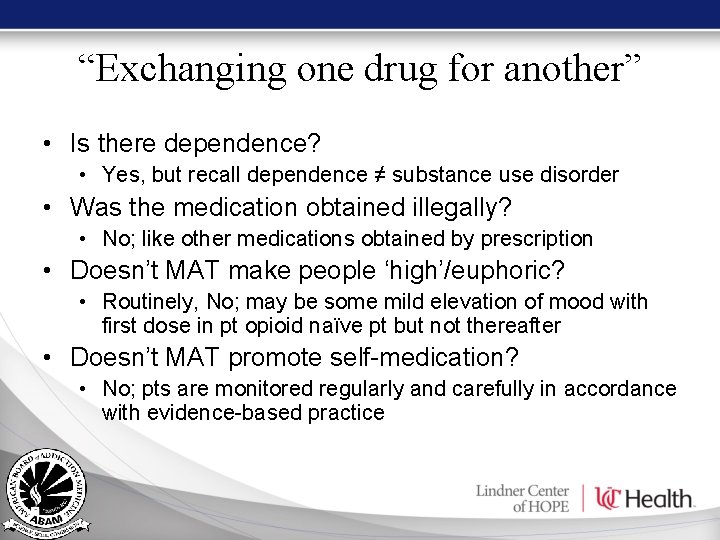
“Exchanging one drug for another” • Is there dependence? • Yes, but recall dependence ≠ substance use disorder • Was the medication obtained illegally? • No; like other medications obtained by prescription • Doesn’t MAT make people ‘high’/euphoric? • Routinely, No; may be some mild elevation of mood with first dose in pt opioid naïve pt but not thereafter • Doesn’t MAT promote self-medication? • No; pts are monitored regularly and carefully in accordance with evidence-based practice
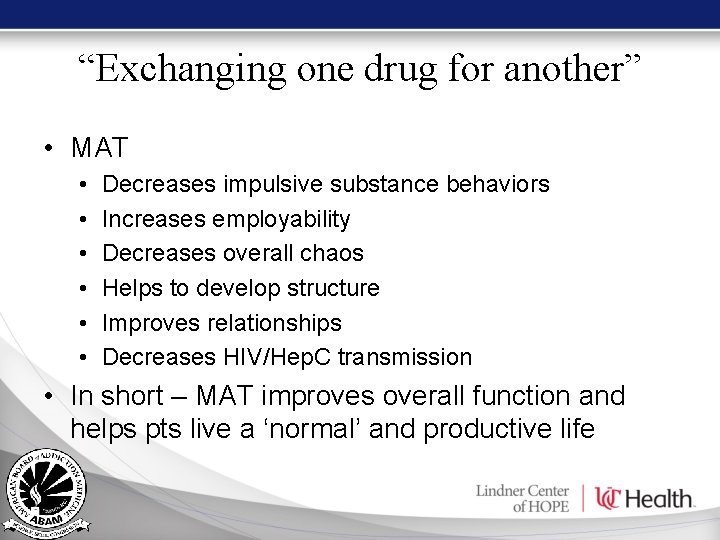
“Exchanging one drug for another” • MAT • • • Decreases impulsive substance behaviors Increases employability Decreases overall chaos Helps to develop structure Improves relationships Decreases HIV/Hep. C transmission • In short – MAT improves overall function and helps pts live a ‘normal’ and productive life
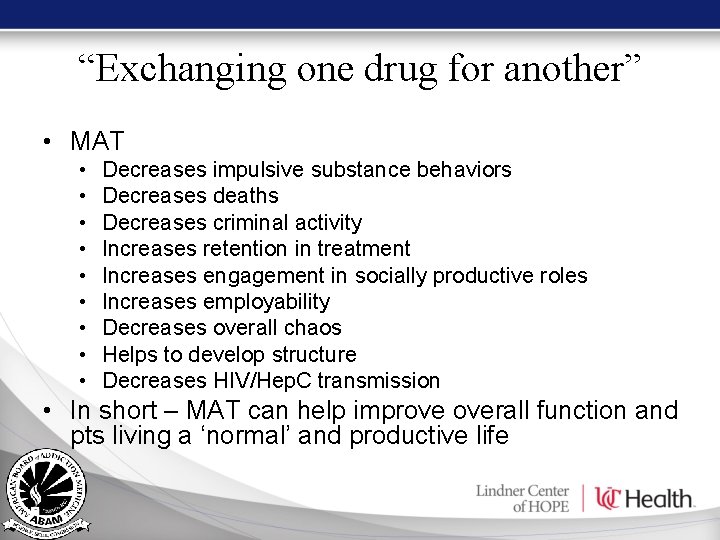
“Exchanging one drug for another” • MAT • • • Decreases impulsive substance behaviors Decreases deaths Decreases criminal activity Increases retention in treatment Increases engagement in socially productive roles Increases employability Decreases overall chaos Helps to develop structure Decreases HIV/Hep. C transmission • In short – MAT can help improve overall function and pts living a ‘normal’ and productive life
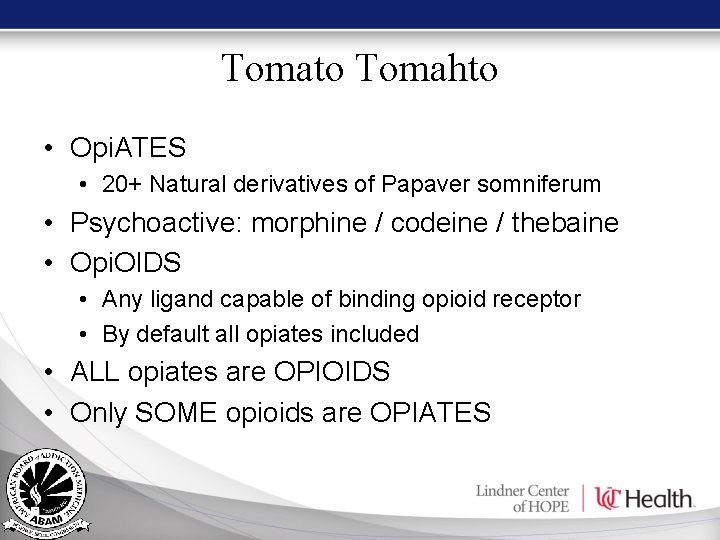
Tomato Tomahto • Opi. ATES • 20+ Natural derivatives of Papaver somniferum • Psychoactive: morphine / codeine / thebaine • Opi. OIDS • Any ligand capable of binding opioid receptor • By default all opiates included • ALL opiates are OPIOIDS • Only SOME opioids are OPIATES
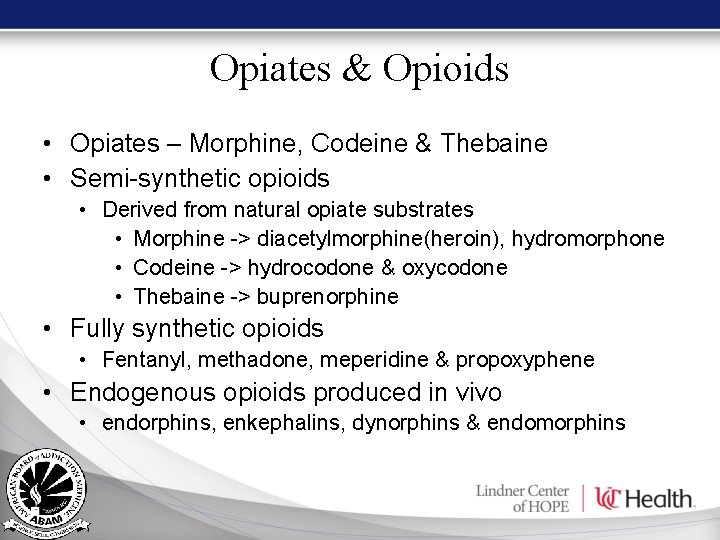
Opiates & Opioids • Opiates – Morphine, Codeine & Thebaine • Semi-synthetic opioids • Derived from natural opiate substrates • Morphine -> diacetylmorphine(heroin), hydromorphone • Codeine -> hydrocodone & oxycodone • Thebaine -> buprenorphine • Fully synthetic opioids • Fentanyl, methadone, meperidine & propoxyphene • Endogenous opioids produced in vivo • endorphins, enkephalins, dynorphins & endomorphins
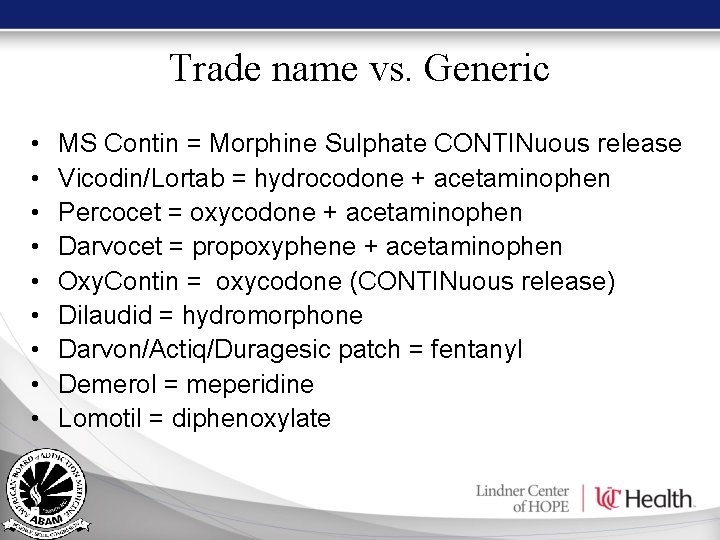
Trade name vs. Generic • • • MS Contin = Morphine Sulphate CONTINuous release Vicodin/Lortab = hydrocodone + acetaminophen Percocet = oxycodone + acetaminophen Darvocet = propoxyphene + acetaminophen Oxy. Contin = oxycodone (CONTINuous release) Dilaudid = hydromorphone Darvon/Actiq/Duragesic patch = fentanyl Demerol = meperidine Lomotil = diphenoxylate
Take a Deep Breath
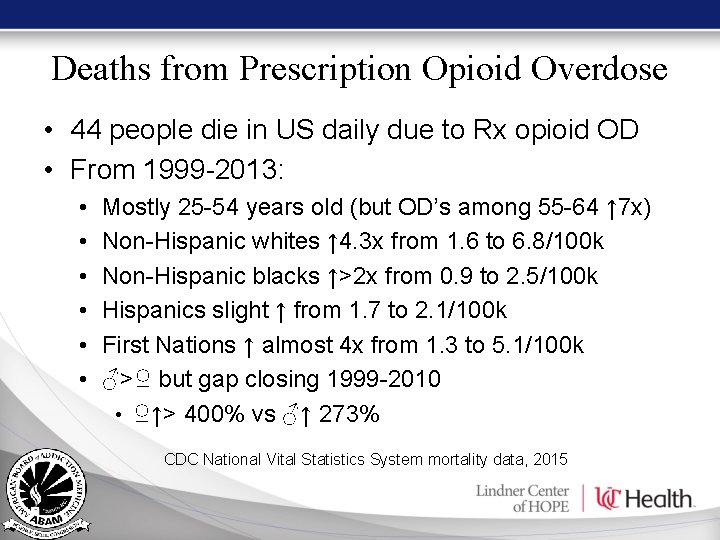
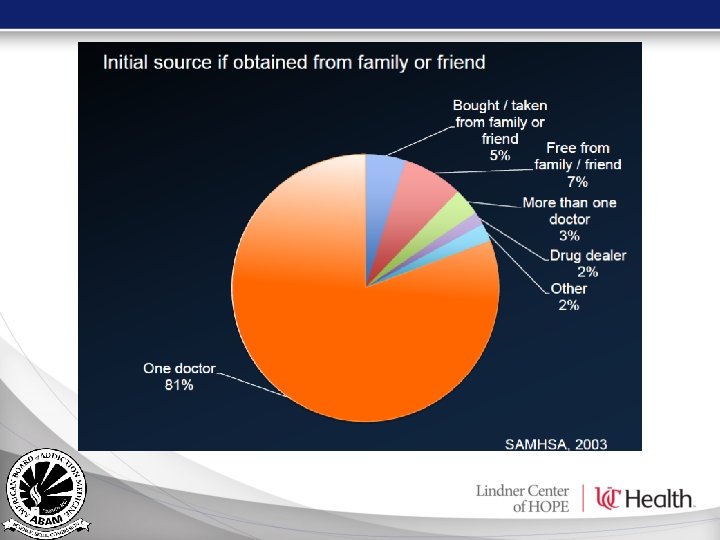
Deaths from Prescription Opioid Overdose • 44 people die in US daily due to Rx opioid OD • From 1999 -2013: • • • Mostly 25 -54 years old (but OD’s among 55 -64 ↑ 7 x) Non-Hispanic whites ↑ 4. 3 x from 1. 6 to 6. 8/100 k Non-Hispanic blacks ↑>2 x from 0. 9 to 2. 5/100 k Hispanics slight ↑ from 1. 7 to 2. 1/100 k First Nations ↑ almost 4 x from 1. 3 to 5. 1/100 k ♂>♀ but gap closing 1999 -2010 • ♀↑> 400% vs ♂↑ 273% CDC National Vital Statistics System mortality data, 2015
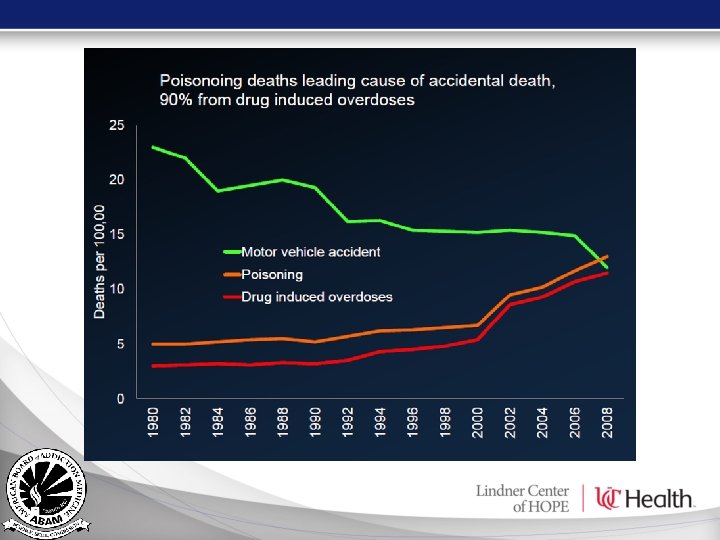
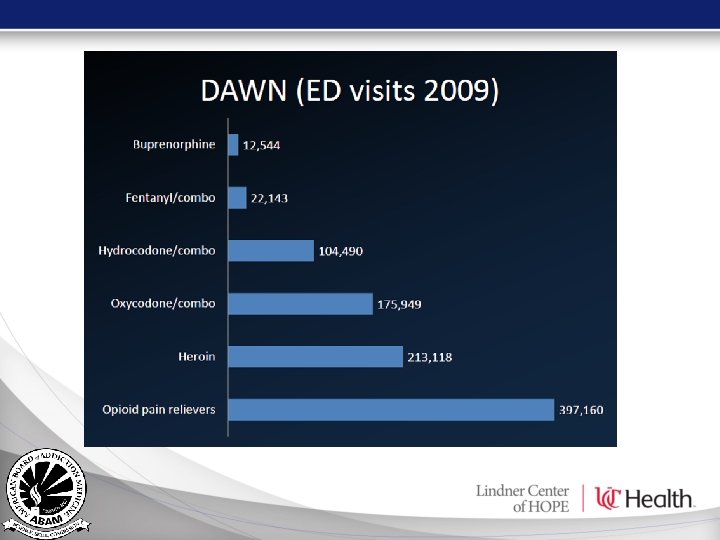
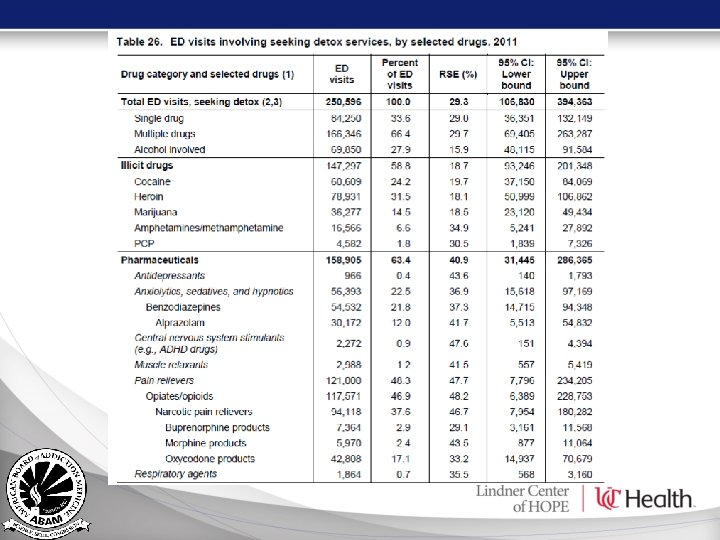
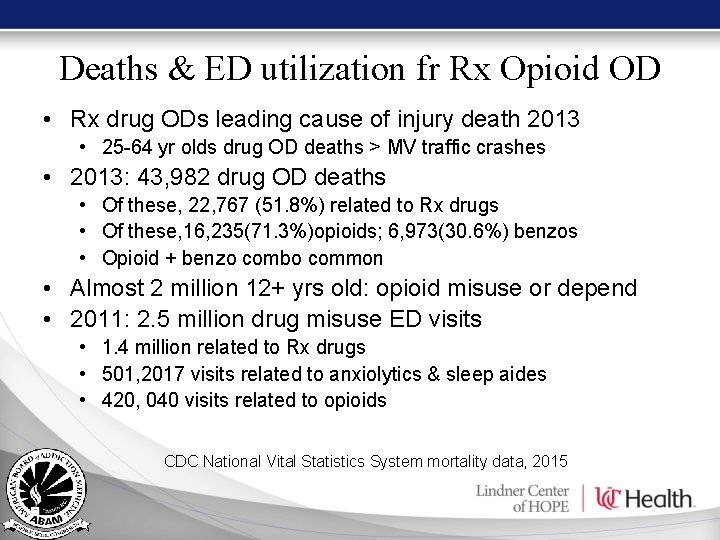
Deaths & ED utilization fr Rx Opioid OD • Rx drug ODs leading cause of injury death 2013 • 25 -64 yr olds drug OD deaths > MV traffic crashes • 2013: 43, 982 drug OD deaths • Of these, 22, 767 (51. 8%) related to Rx drugs • Of these, 16, 235(71. 3%)opioids; 6, 973(30. 6%) benzos • Opioid + benzo combo common • Almost 2 million 12+ yrs old: opioid misuse or depend • 2011: 2. 5 million drug misuse ED visits • 1. 4 million related to Rx drugs • 501, 2017 visits related to anxiolytics & sleep aides • 420, 040 visits related to opioids CDC National Vital Statistics System mortality data, 2015
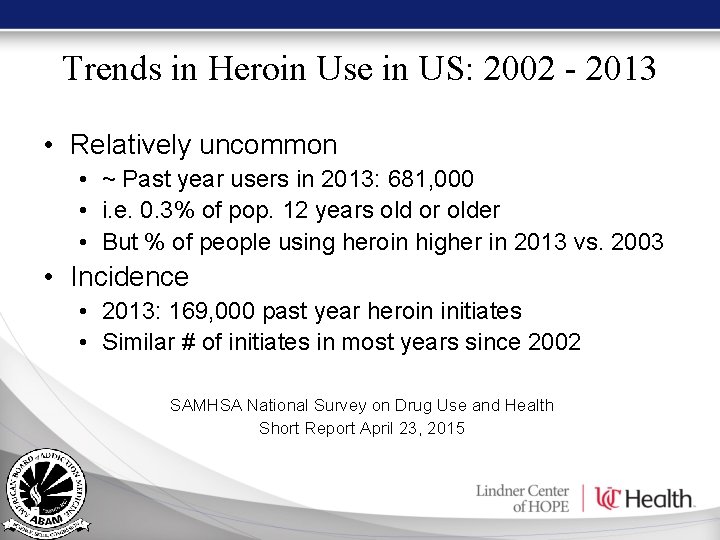
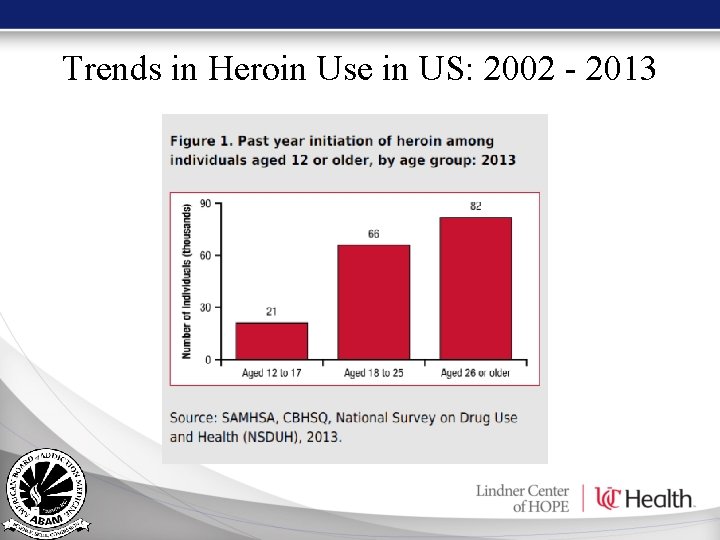
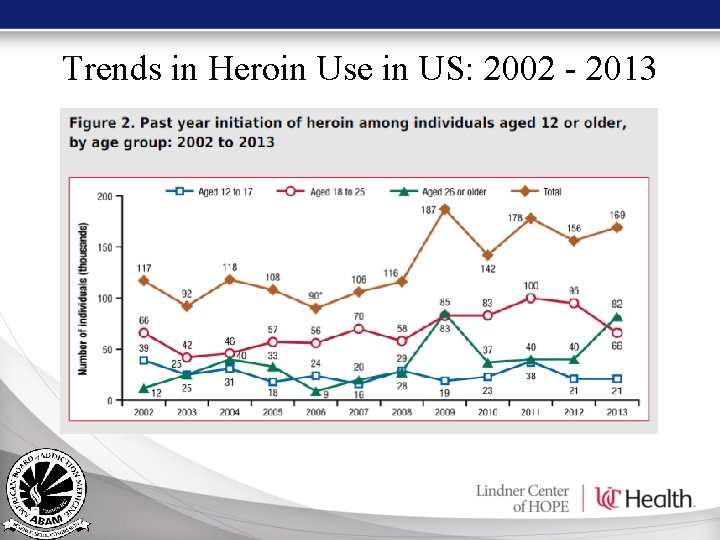
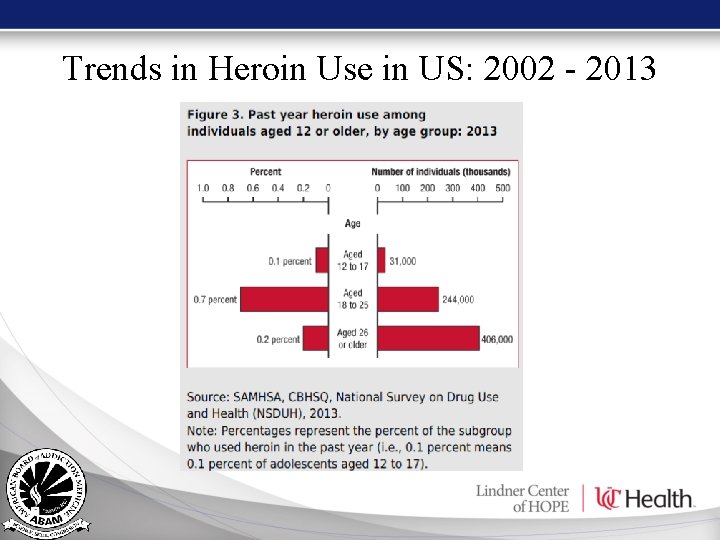
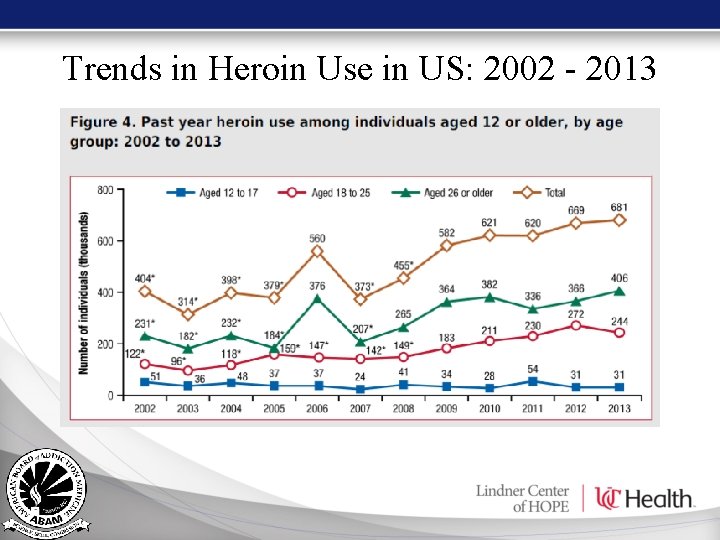
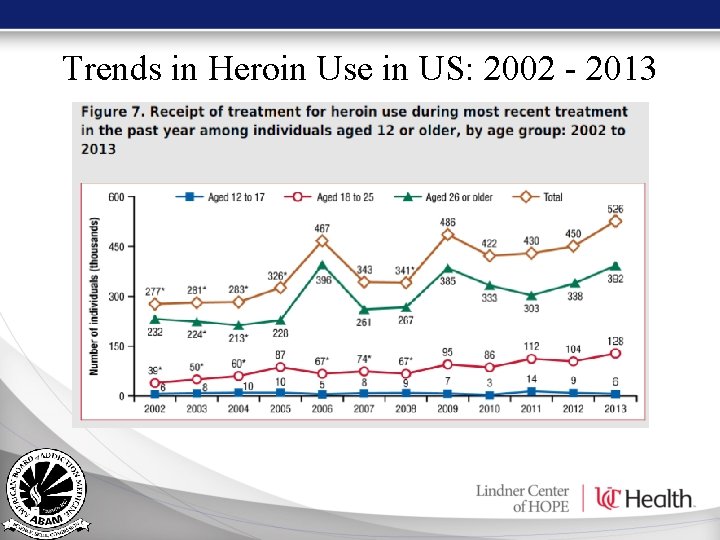
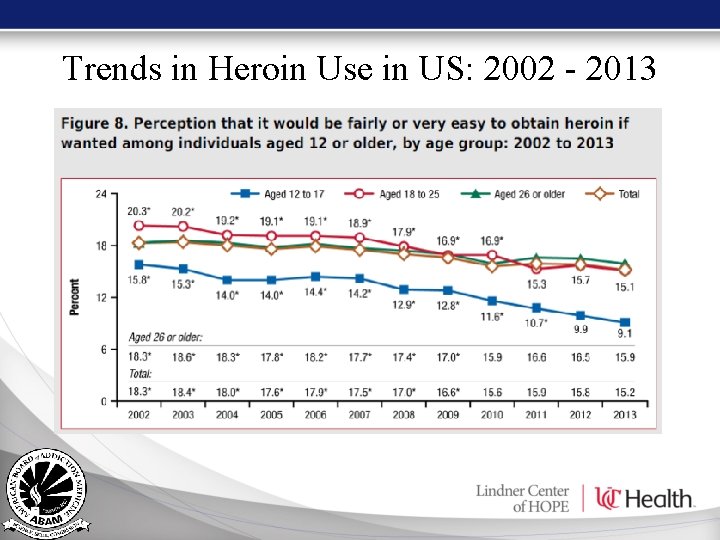
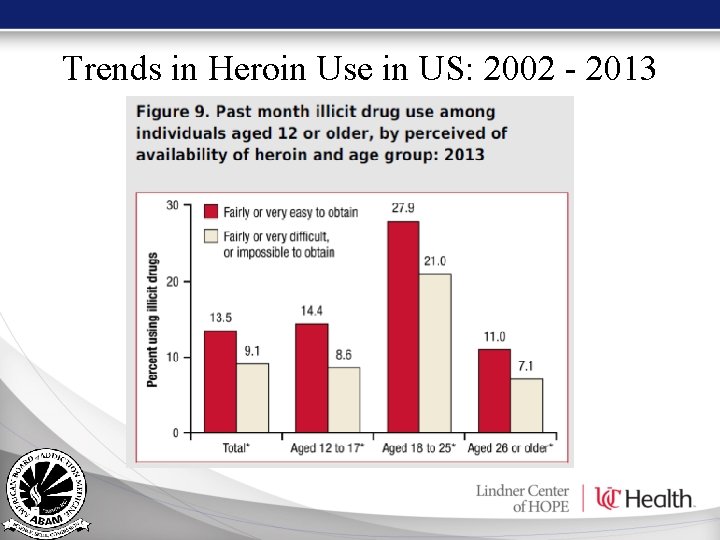
Trends in Heroin Use in US: 2002 - 2013 • Relatively uncommon • ~ Past year users in 2013: 681, 000 • i. e. 0. 3% of pop. 12 years old or older • But % of people using heroin higher in 2013 vs. 2003 • Incidence • 2013: 169, 000 past year heroin initiates • Similar # of initiates in most years since 2002 SAMHSA National Survey on Drug Use and Health Short Report April 23, 2015
Trends in Heroin Use in US: 2002 - 2013
Trends in Heroin Use in US: 2002 - 2013
Trends in Heroin Use in US: 2002 - 2013
Trends in Heroin Use in US: 2002 - 2013
Trends in Heroin Use in US: 2002 - 2013
Trends in Heroin Use in US: 2002 - 2013
Trends in Heroin Use in US: 2002 - 2013
Trends in Heroin Use in US: 2002 - 2013
Trends in Heroin Use in US: 2002 - 2013
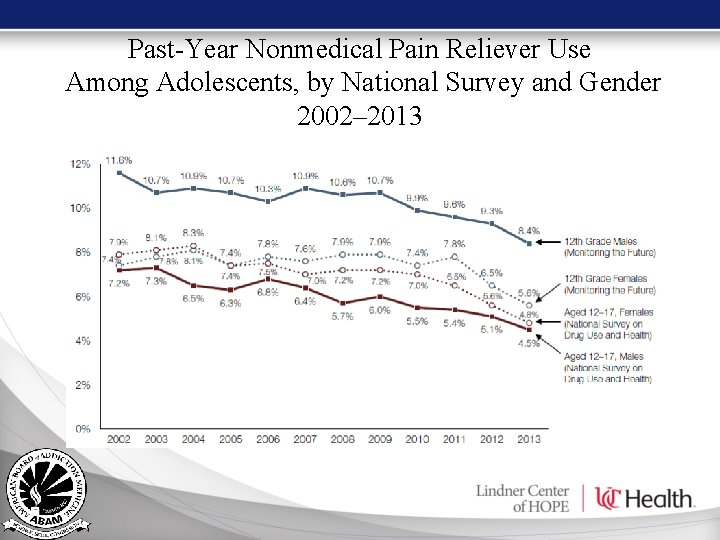
Past-Year Nonmedical Pain Reliever Use Among Adolescents, by National Survey and Gender 2002– 2013
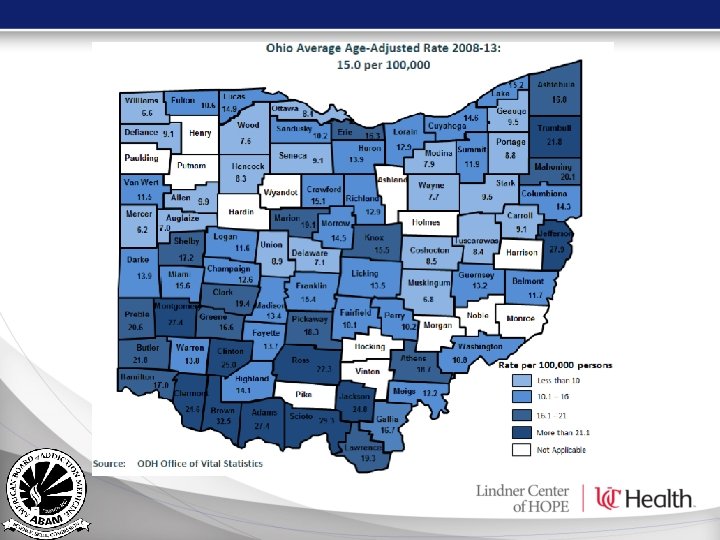
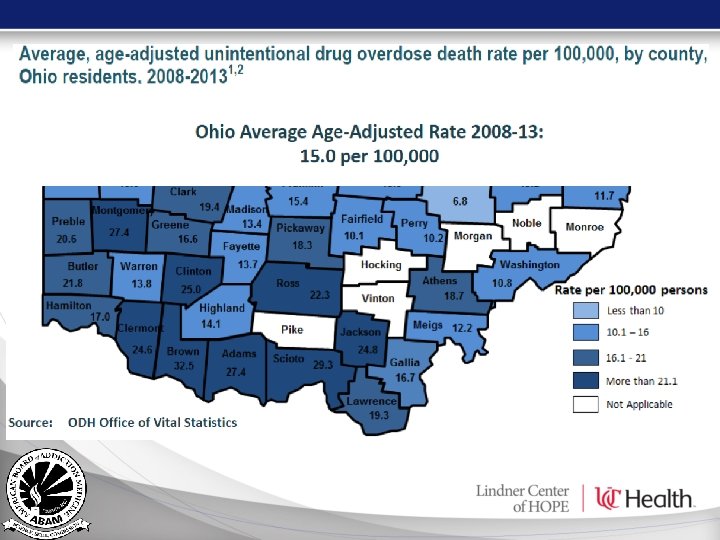
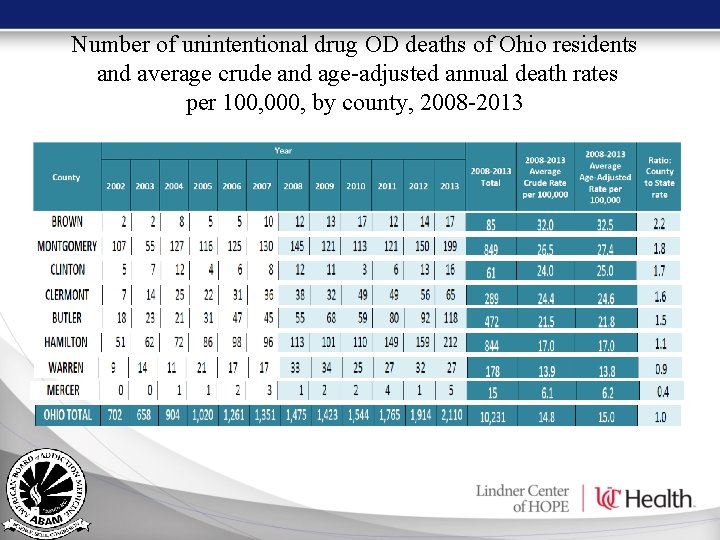
Number of unintentional drug OD deaths of Ohio residents and average crude and age-adjusted annual death rates per 100, 000, by county, 2008 -2013
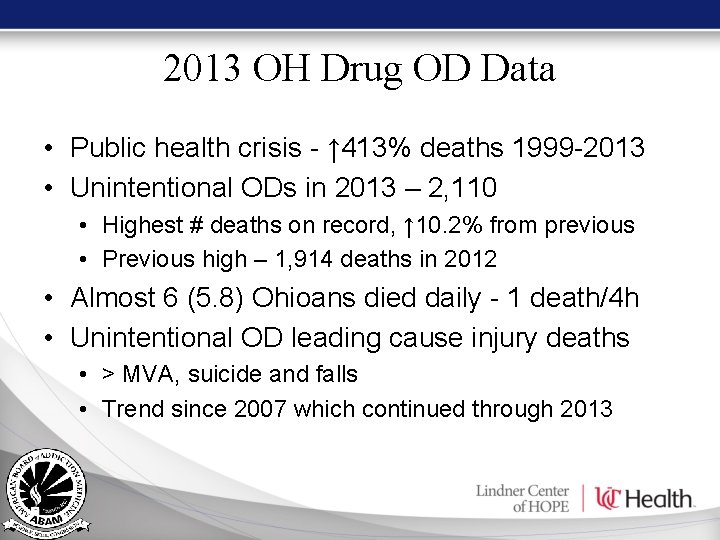
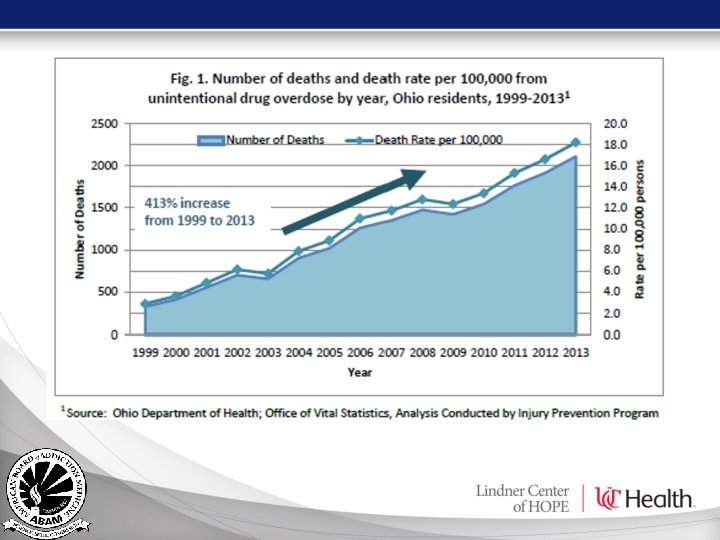
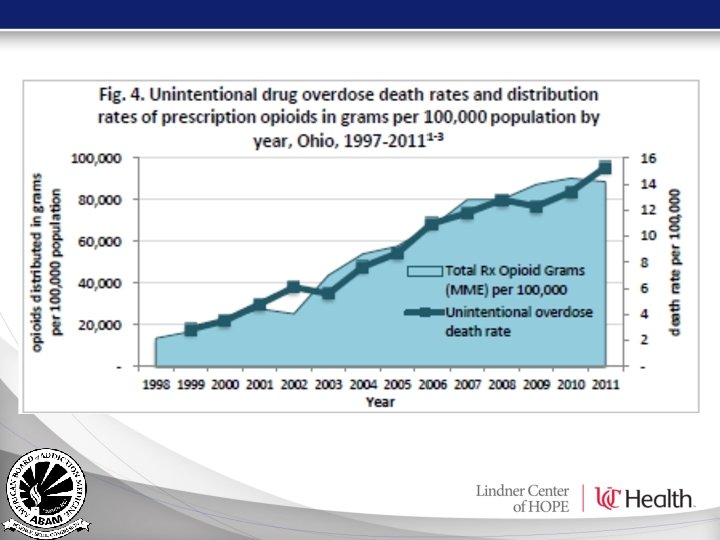
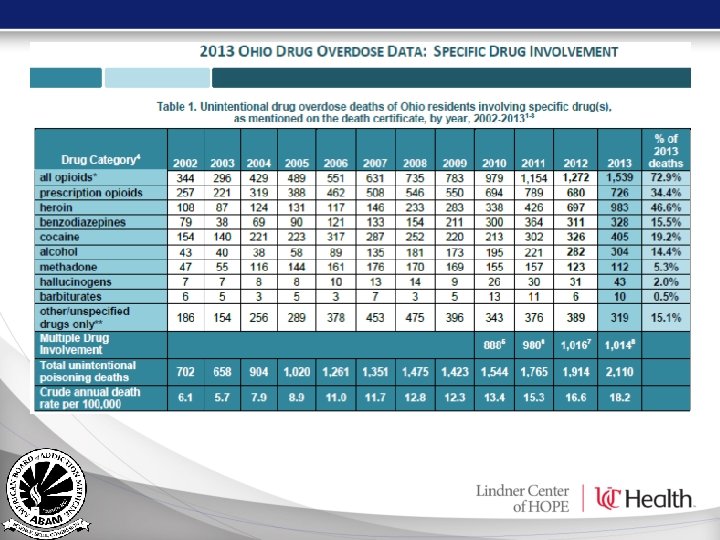
2013 OH Drug OD Data • Public health crisis - ↑ 413% deaths 1999 -2013 • Unintentional ODs in 2013 – 2, 110 • Highest # deaths on record, ↑ 10. 2% from previous • Previous high – 1, 914 deaths in 2012 • Almost 6 (5. 8) Ohioans died daily - 1 death/4 h • Unintentional OD leading cause injury deaths • > MVA, suicide and falls • Trend since 2007 which continued through 2013
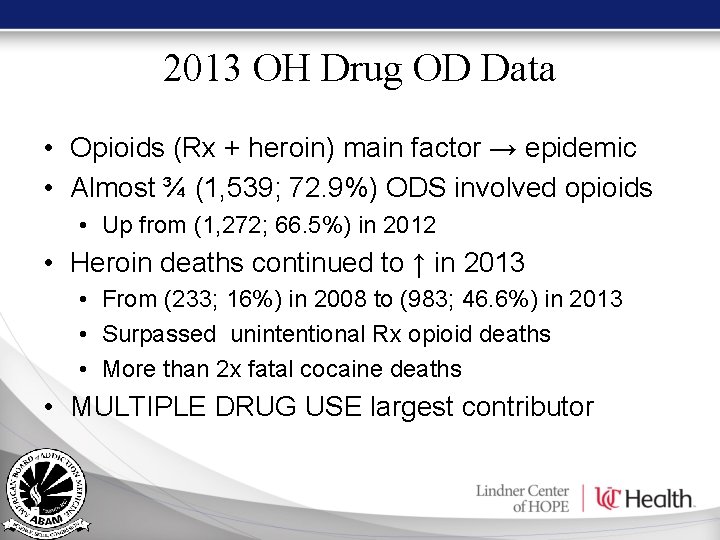
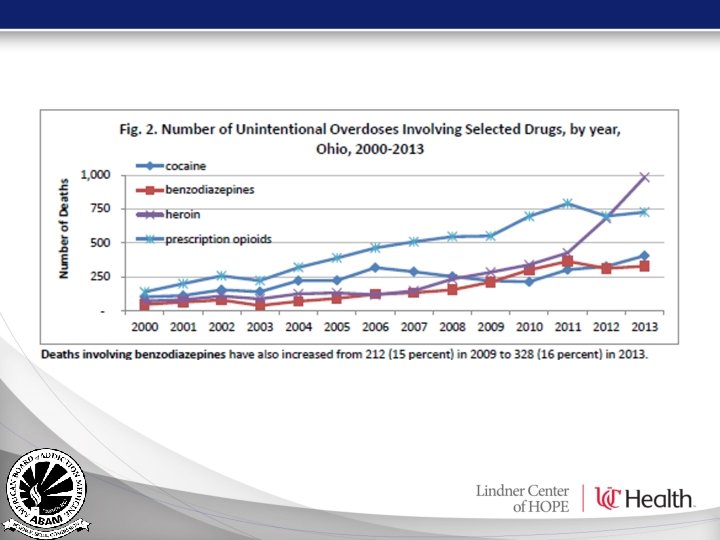
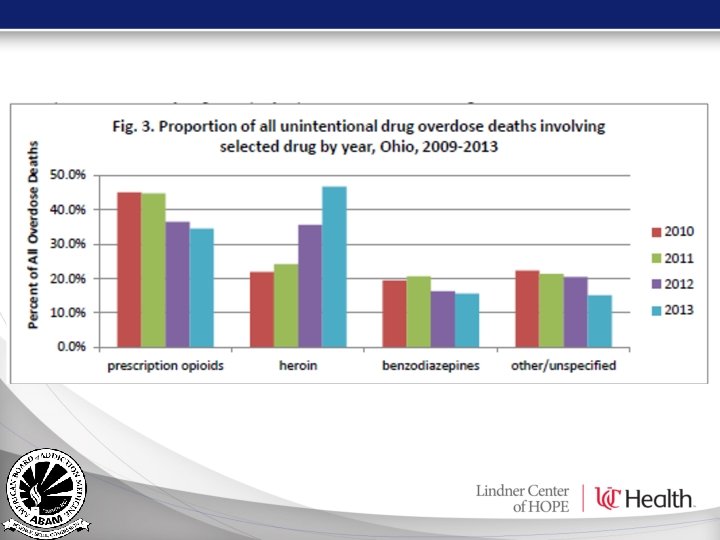
2013 OH Drug OD Data • Opioids (Rx + heroin) main factor → epidemic • Almost ¾ (1, 539; 72. 9%) ODS involved opioids • Up from (1, 272; 66. 5%) in 2012 • Heroin deaths continued to ↑ in 2013 • From (233; 16%) in 2008 to (983; 46. 6%) in 2013 • Surpassed unintentional Rx opioid deaths • More than 2 x fatal cocaine deaths • MULTIPLE DRUG USE largest contributor
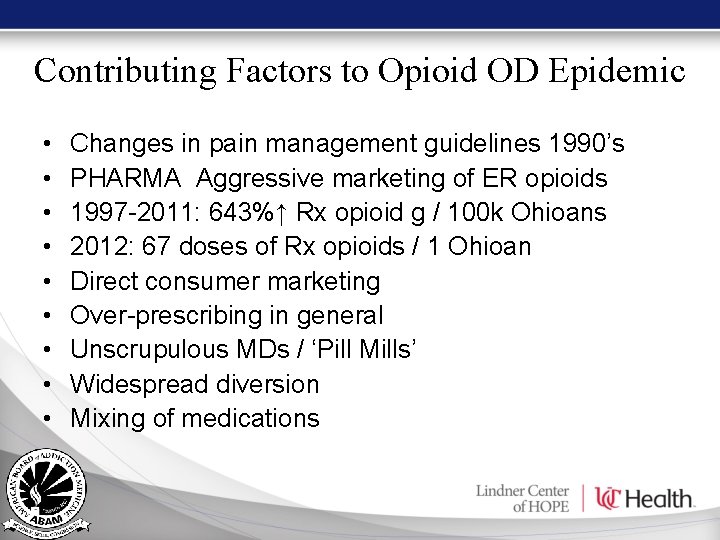
Contributing Factors to Opioid OD Epidemic • • • Changes in pain management guidelines 1990’s PHARMA Aggressive marketing of ER opioids 1997 -2011: 643%↑ Rx opioid g / 100 k Ohioans 2012: 67 doses of Rx opioids / 1 Ohioan Direct consumer marketing Over-prescribing in general Unscrupulous MDs / ‘Pill Mills’ Widespread diversion Mixing of medications
2014
Take a Deep Breath
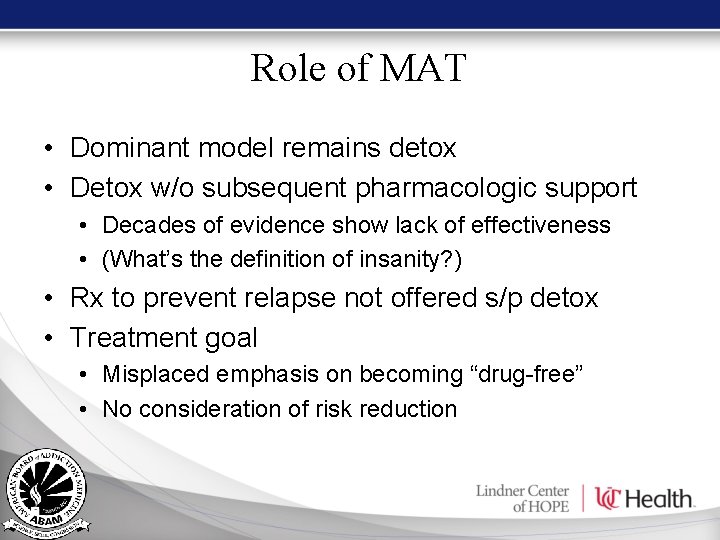
Role of MAT • Dominant model remains detox • Detox w/o subsequent pharmacologic support • Decades of evidence show lack of effectiveness • (What’s the definition of insanity? ) • Rx to prevent relapse not offered s/p detox • Treatment goal • Misplaced emphasis on becoming “drug-free” • No consideration of risk reduction
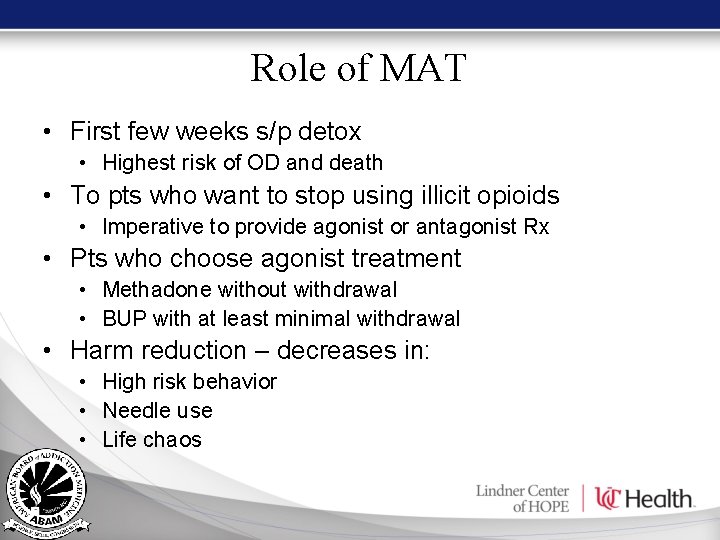
Role of MAT • First few weeks s/p detox • Highest risk of OD and death • To pts who want to stop using illicit opioids • Imperative to provide agonist or antagonist Rx • Pts who choose agonist treatment • Methadone without withdrawal • BUP with at least minimal withdrawal • Harm reduction – decreases in: • High risk behavior • Needle use • Life chaos
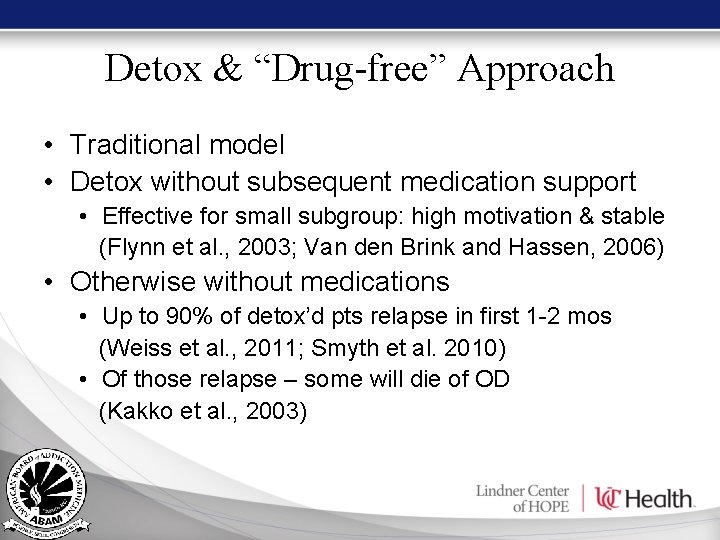
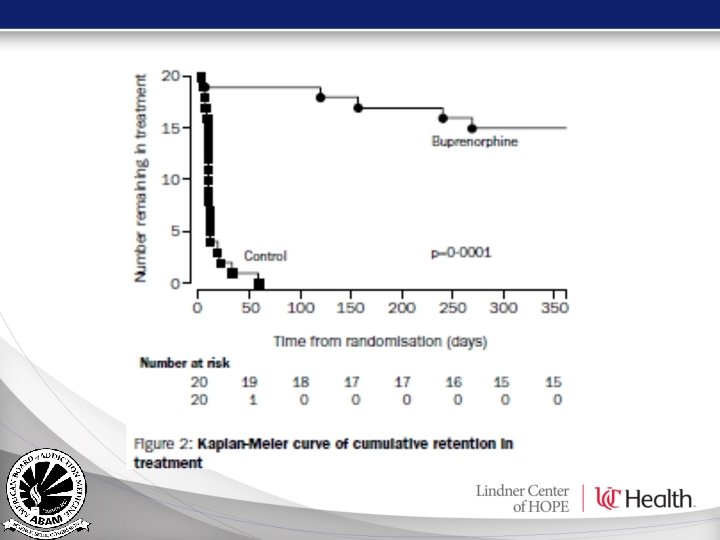
Detox & “Drug-free” Approach • Traditional model • Detox without subsequent medication support • Effective for small subgroup: high motivation & stable (Flynn et al. , 2003; Van den Brink and Hassen, 2006) • Otherwise without medications • Up to 90% of detox’d pts relapse in first 1 -2 mos (Weiss et al. , 2011; Smyth et al. 2010) • Of those relapse – some will die of OD (Kakko et al. , 2003)
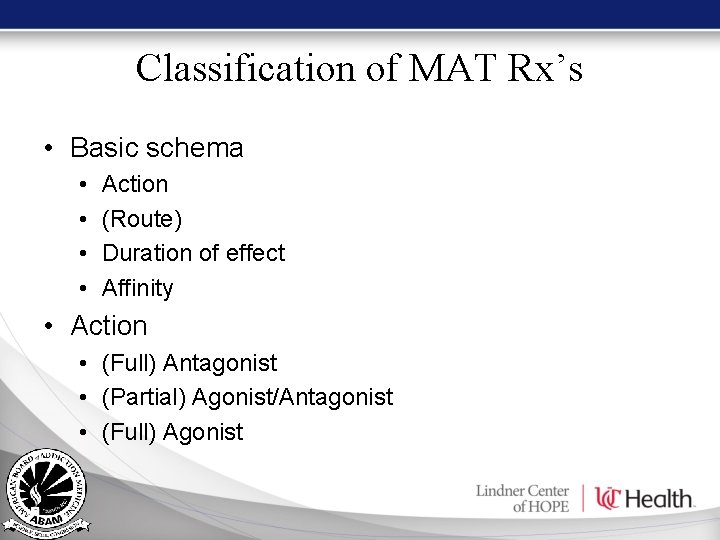
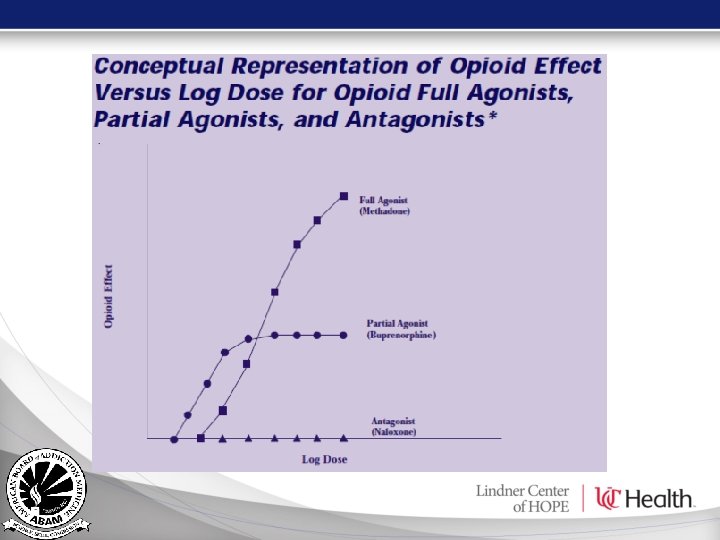
Classification of MAT Rx’s • Basic schema • • Action (Route) Duration of effect Affinity • Action • (Full) Antagonist • (Partial) Agonist/Antagonist • (Full) Agonist
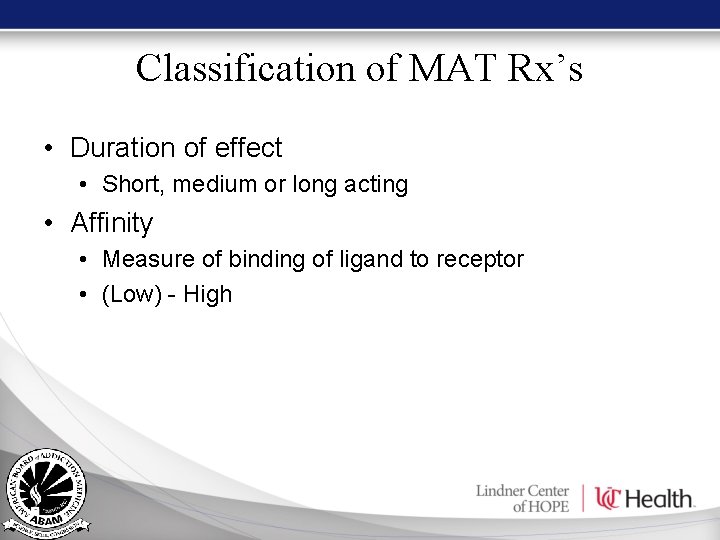
Classification of MAT Rx’s • Duration of effect • Short, medium or long acting • Affinity • Measure of binding of ligand to receptor • (Low) - High
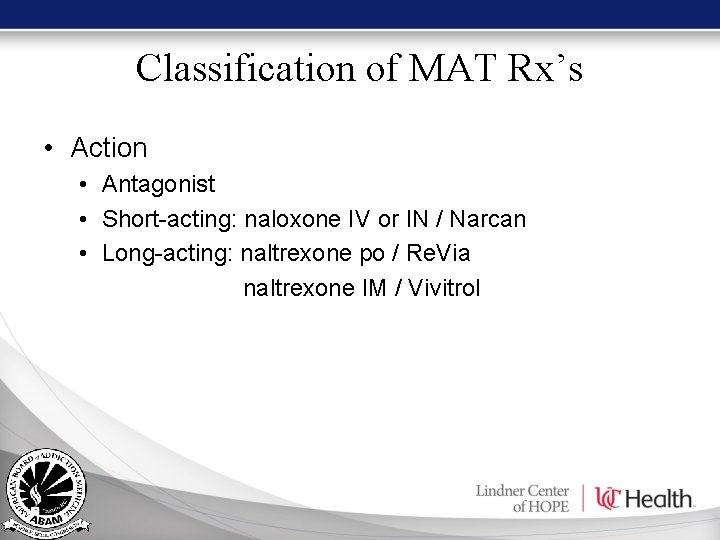
Classification of MAT Rx’s • Action • Antagonist • Short-acting: naloxone IV or IN / Narcan • Long-acting: naltrexone po / Re. Via naltrexone IM / Vivitrol
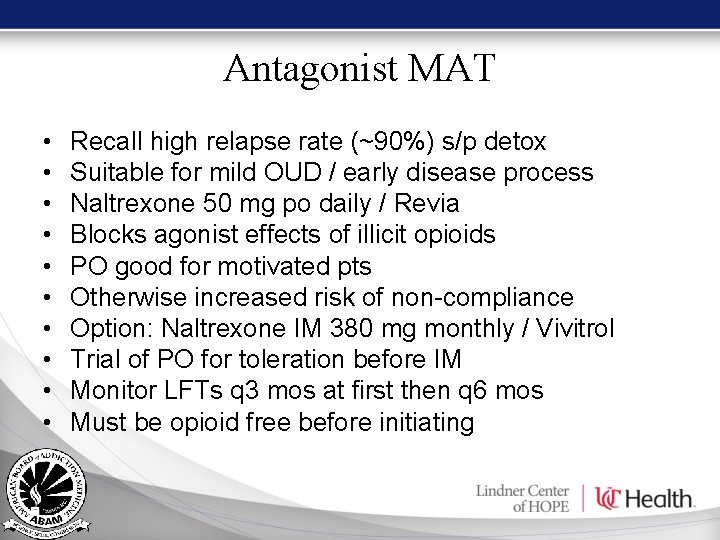
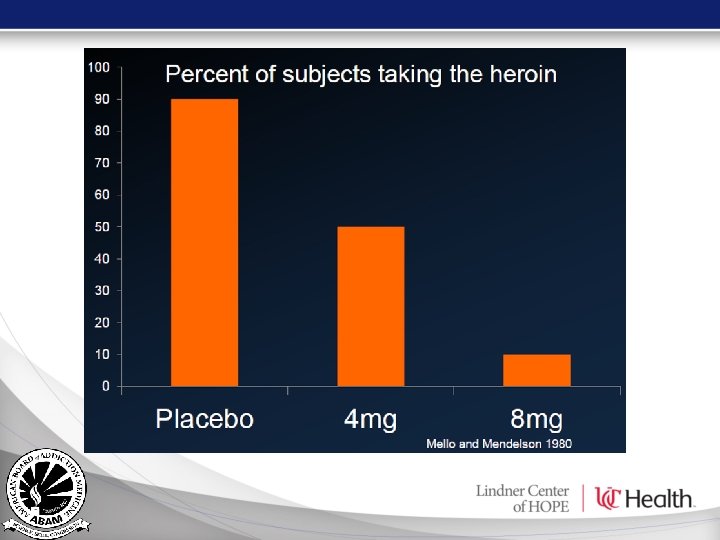
Antagonist MAT • • • Recall high relapse rate (~90%) s/p detox Suitable for mild OUD / early disease process Naltrexone 50 mg po daily / Revia Blocks agonist effects of illicit opioids PO good for motivated pts Otherwise increased risk of non-compliance Option: Naltrexone IM 380 mg monthly / Vivitrol Trial of PO for toleration before IM Monitor LFTs q 3 mos at first then q 6 mos Must be opioid free before initiating
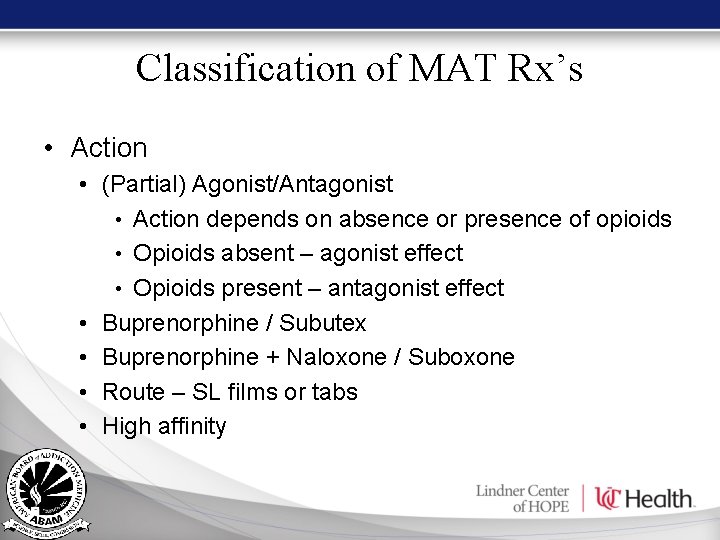
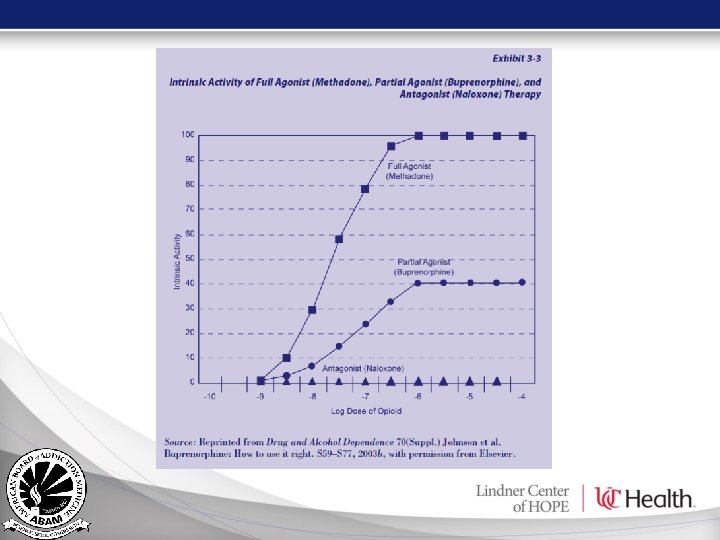
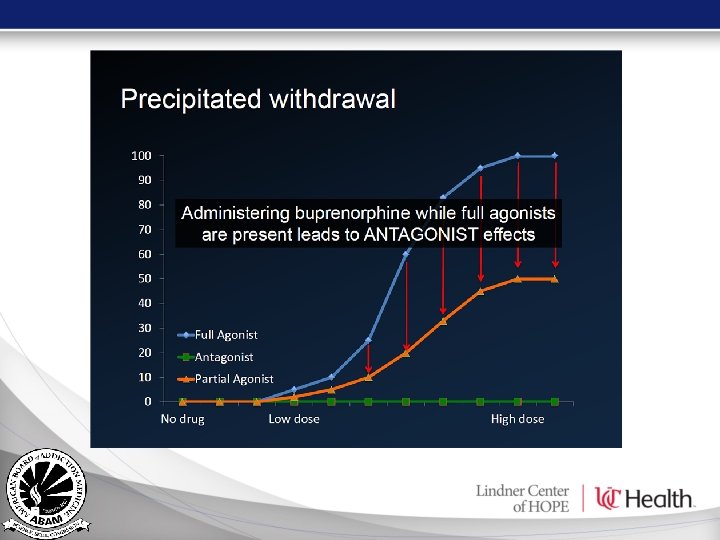
Classification of MAT Rx’s • Action • (Partial) Agonist/Antagonist • Action depends on absence or presence of opioids • Opioids absent – agonist effect • Opioids present – antagonist effect • Buprenorphine / Subutex • Buprenorphine + Naloxone / Suboxone • Route – SL films or tabs • High affinity
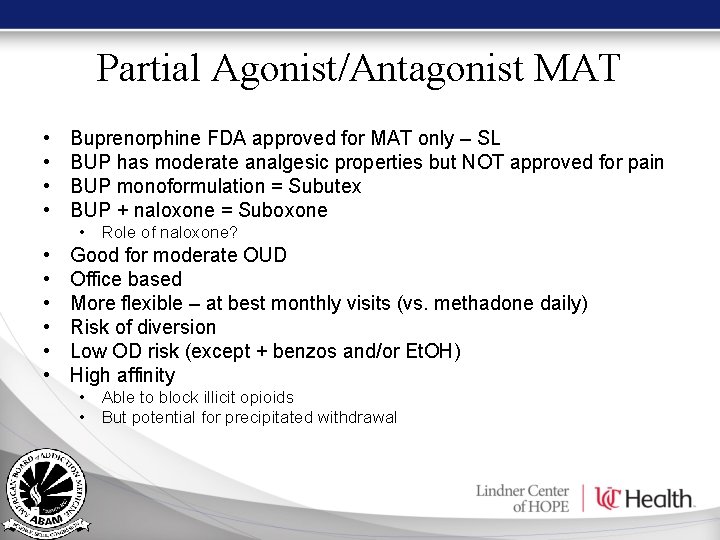
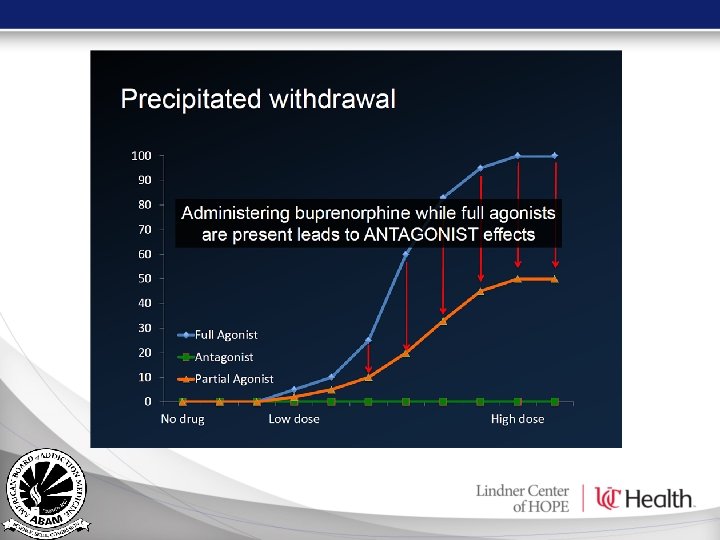
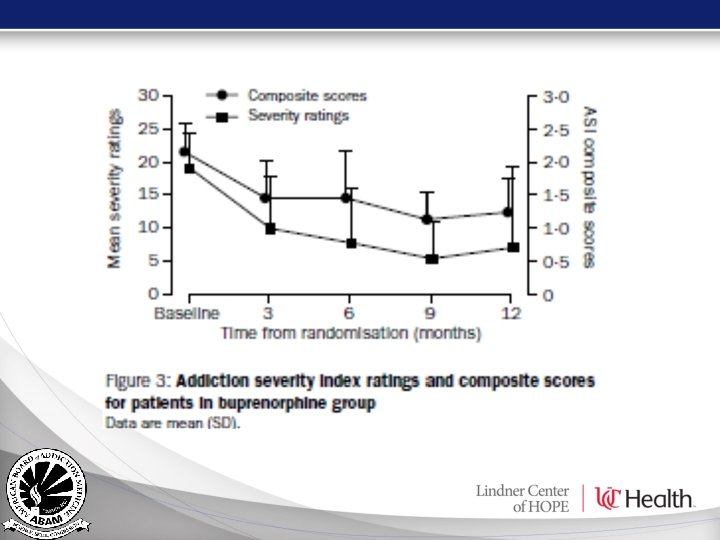
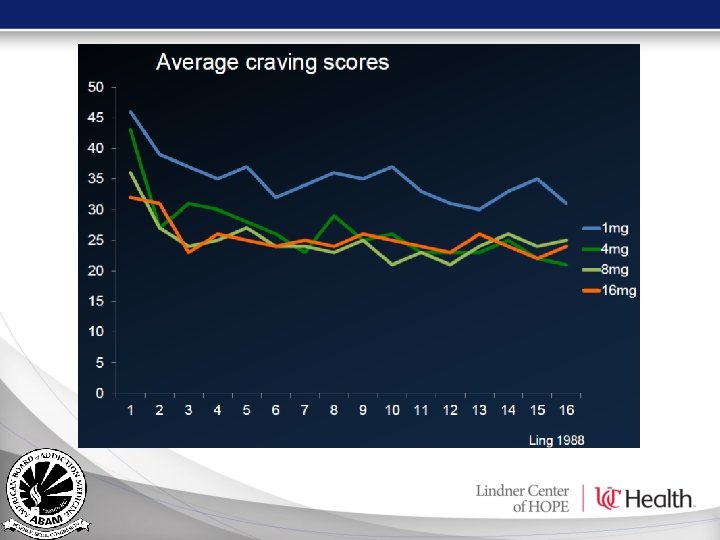
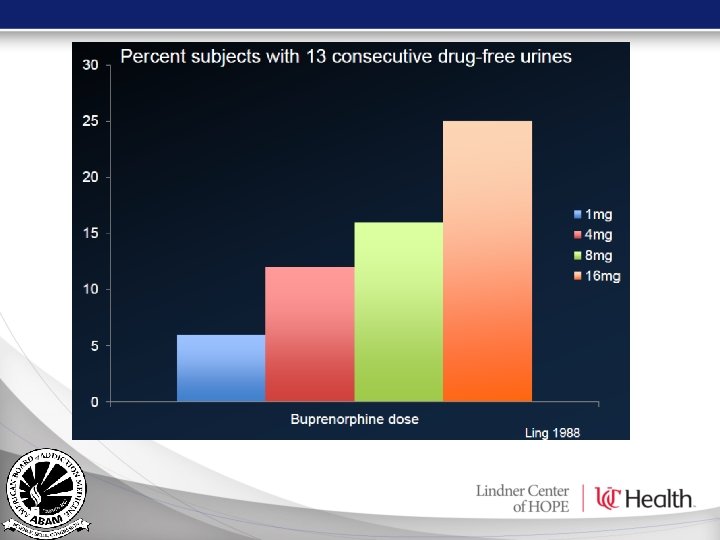
Partial Agonist/Antagonist MAT • • Buprenorphine FDA approved for MAT only – SL BUP has moderate analgesic properties but NOT approved for pain BUP monoformulation = Subutex BUP + naloxone = Suboxone • Role of naloxone? • • • Good for moderate OUD Office based More flexible – at best monthly visits (vs. methadone daily) Risk of diversion Low OD risk (except + benzos and/or Et. OH) High affinity • Able to block illicit opioids • But potential for precipitated withdrawal
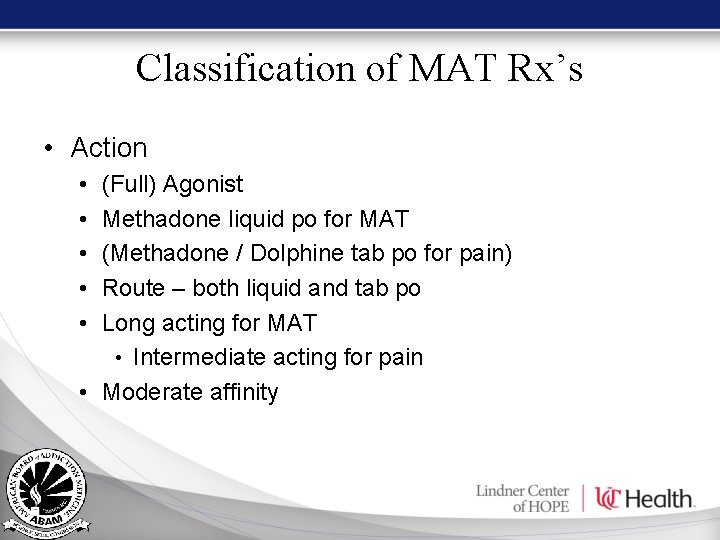
Classification of MAT Rx’s • Action • • • (Full) Agonist Methadone liquid po for MAT (Methadone / Dolphine tab po for pain) Route – both liquid and tab po Long acting for MAT • Intermediate acting for pain • Moderate affinity
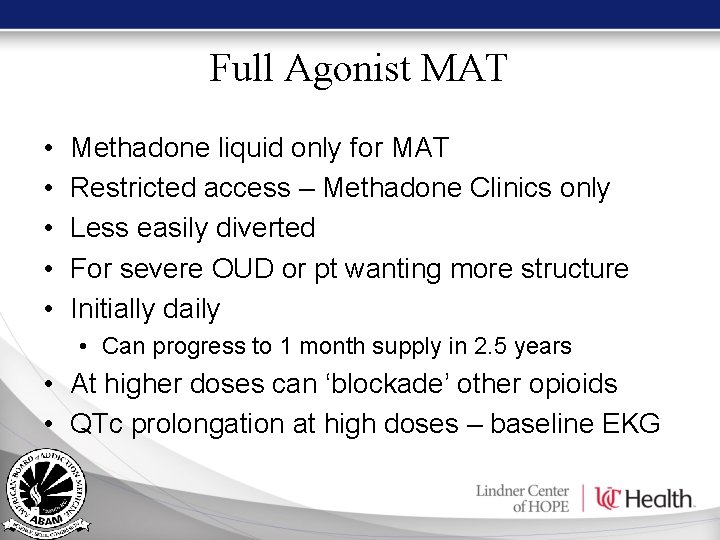
Full Agonist MAT • • • Methadone liquid only for MAT Restricted access – Methadone Clinics only Less easily diverted For severe OUD or pt wanting more structure Initially daily • Can progress to 1 month supply in 2. 5 years • At higher doses can ‘blockade’ other opioids • QTc prolongation at high doses – baseline EKG
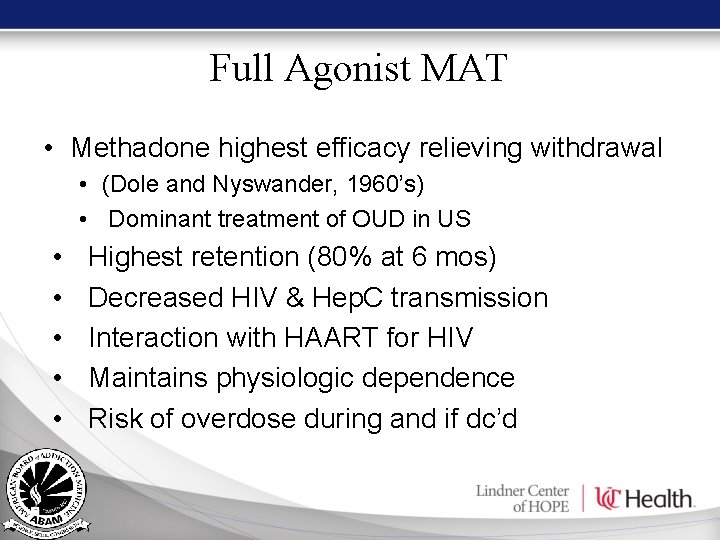
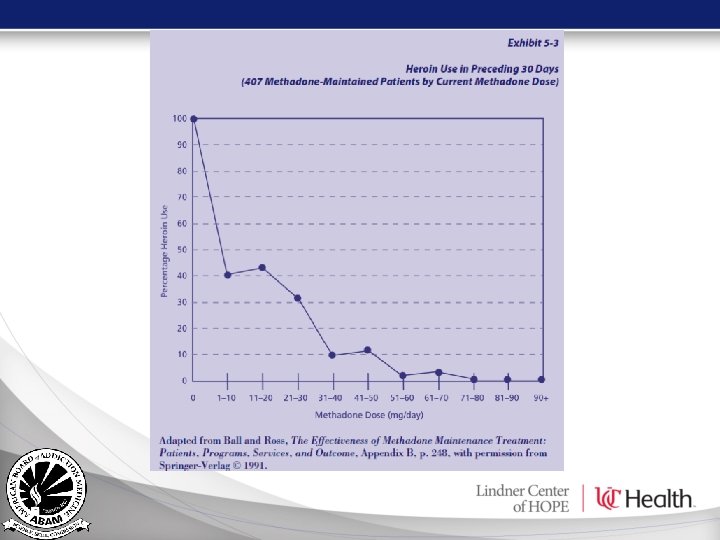
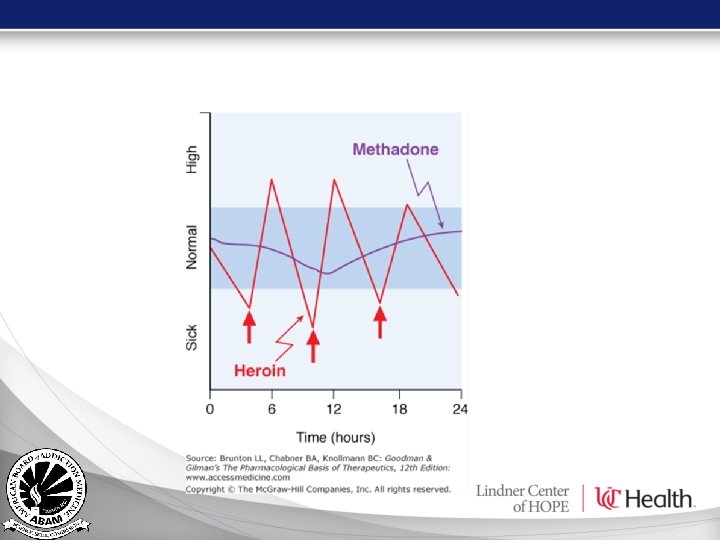
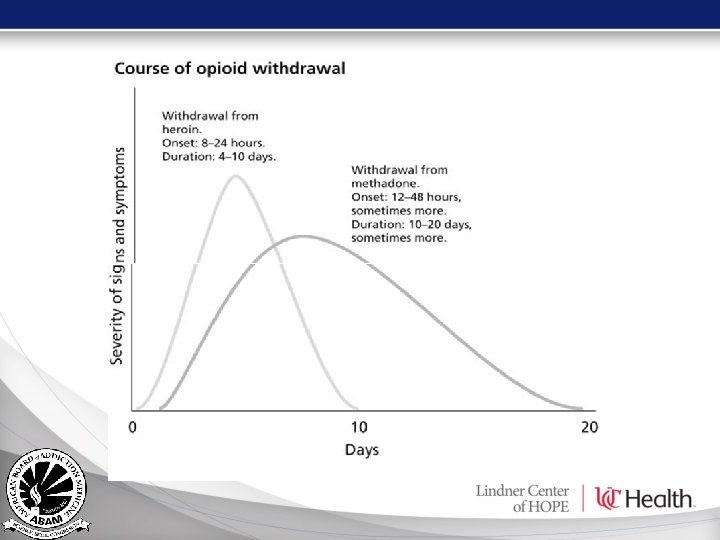
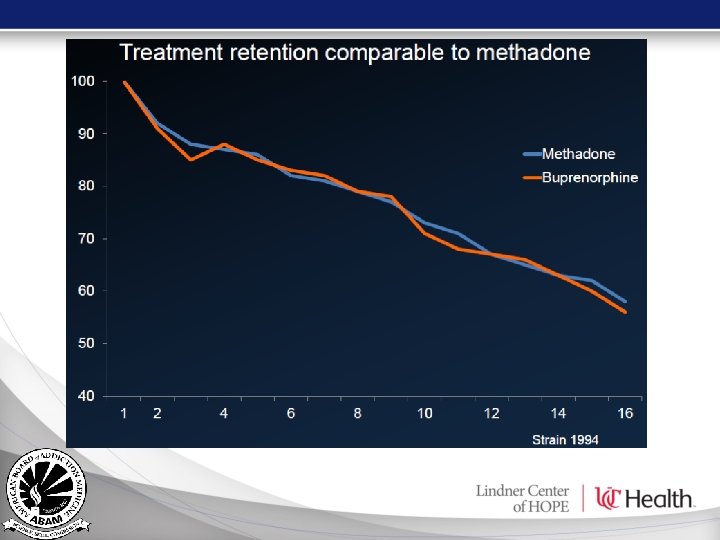
Full Agonist MAT • Methadone highest efficacy relieving withdrawal • (Dole and Nyswander, 1960’s) • Dominant treatment of OUD in US • • • Highest retention (80% at 6 mos) Decreased HIV & Hep. C transmission Interaction with HAART for HIV Maintains physiologic dependence Risk of overdose during and if dc’d
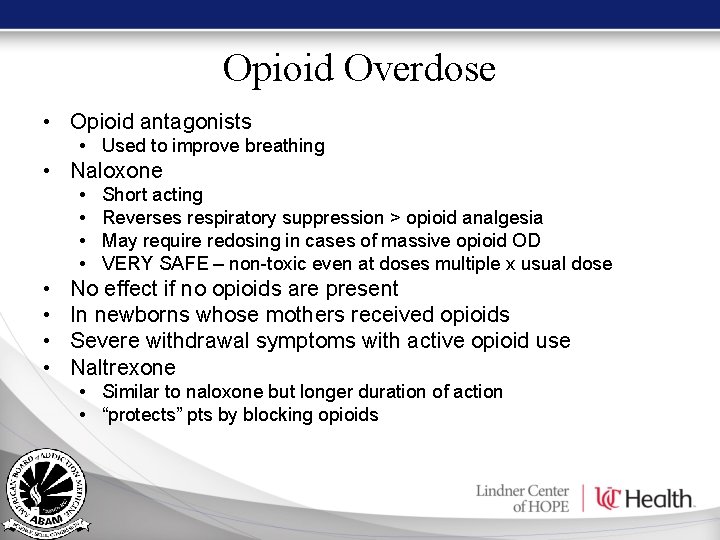
Opioid Overdose • Opioid antagonists • Used to improve breathing • Naloxone • • Short acting Reverses respiratory suppression > opioid analgesia May require redosing in cases of massive opioid OD VERY SAFE – non-toxic even at doses multiple x usual dose No effect if no opioids are present In newborns whose mothers received opioids Severe withdrawal symptoms with active opioid use Naltrexone • Similar to naloxone but longer duration of action • “protects” pts by blocking opioids
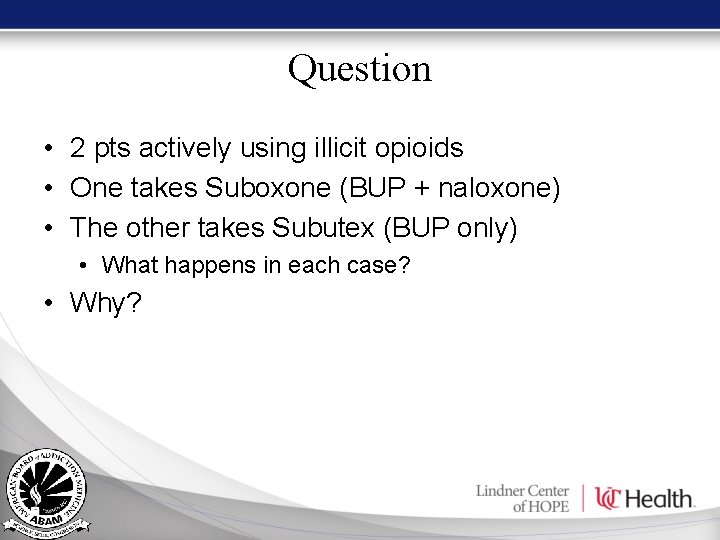
Question • 2 pts actively using illicit opioids • One takes Suboxone (BUP + naloxone) • The other takes Subutex (BUP only) • What happens in each case? • Why?
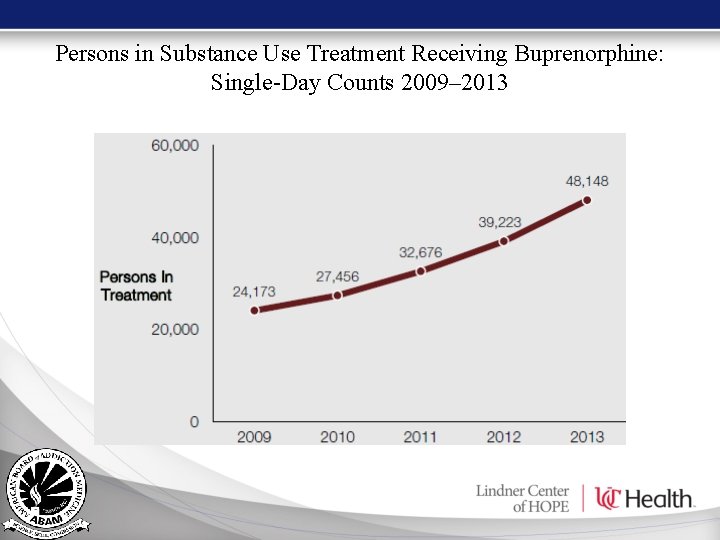
Persons in Substance Use Treatment Receiving Buprenorphine: Single-Day Counts 2009– 2013
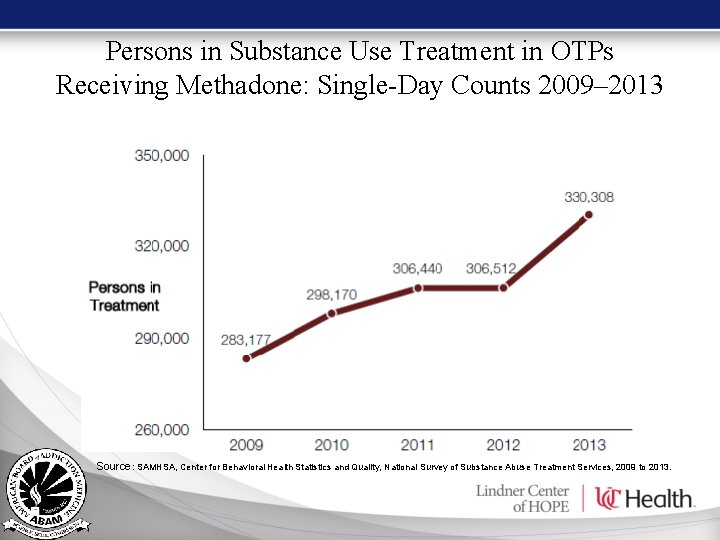
Persons in Substance Use Treatment in OTPs Receiving Methadone: Single-Day Counts 2009– 2013 Source: SAMHSA, Center for Behavioral Health Statistics and Quality, National Survey of Substance Abuse Treatment Services, 2009 to 2013.
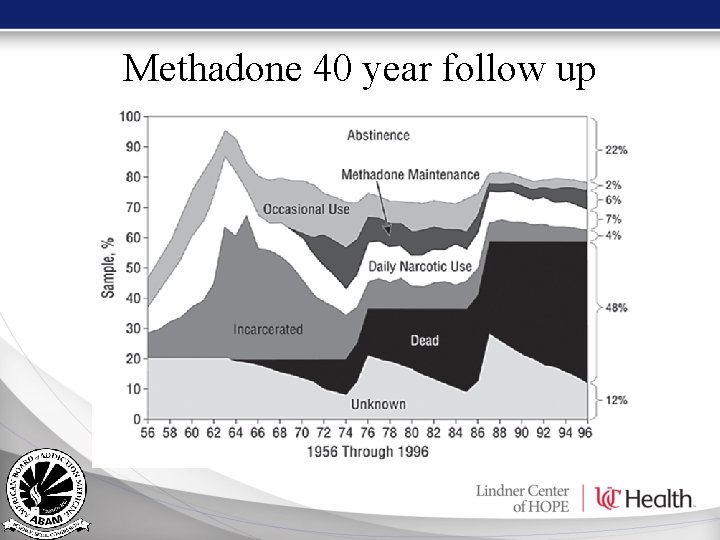
Methadone 40 year follow up
Success Stories • • • We don’t hear about them When properly treated Evidenced Based multi-modal therapies In context of therapeutic alliance – such pts practically INDISTINGUASHABLE from general population
OAT Pts Occupations / Fields of Employment • • • Teacher Electrician Plumber Social Worker Psychologist Chauffer Drug Counselor Computer/IT Tech Accountant Retail Manager • • • Home Security Systems Restaurateur Fish Dept Manager Movie Editor Ph. D Student HVAC Tech School Principal Artist Advertising VP
OAT Pts Occupations / Fields of Employment • • • Bus Driver* Sanitation Driver* Con Ed Utility* Subway Signal* Sales Secretarial Administrator Piano Teacher Elevator Repair Lawyer • • • Physician Landscaper Car Sales/Repair Videographer Heavy Equipment Contractor Entrepreneur Musician Nurse * Safety Sensitive – Employer Aware
Conclusions • Opioid OD signif cause of preventable deaths • Much confusion/misinformation RE: MAT • When used as part of multi-modal treatment: MAT is effective evidenced based treatment • Risk Minimize / Safe treatment↑ when • • Monitored closely Managed carefully Dosed judiciously In context of therapeutic alliance
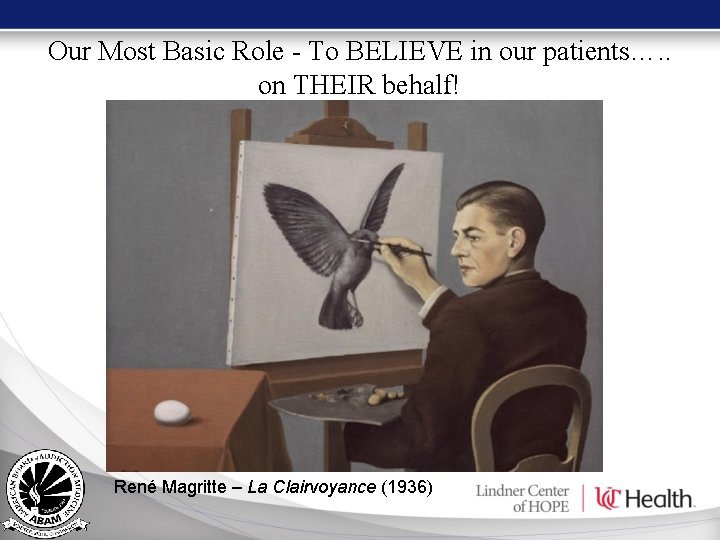
Our Most Basic Role - To BELIEVE in our patients…. . on THEIR behalf! René Magritte – La Clairvoyance (1936)
References American Psychiatric Association: Diagnostic and Statistical Manual of Mental Disorders, 5 th Edition, Washington DC, American Psychiatric Association, 2013. CDC National Vital Statistics System, mortality data, 2015. Dole VP, Nyswander M: A Medical Treatment for Diacetylmorphine (Heroin) Addiction, JAMA 193(8): 80 -84, 1965. Flynn PM, Porto JV, Rounds-Bryant J, and Kristiansen PL: Costs and benefits of methadone treatment in DATOS—Part 1: Discharged versus continuing patients. Journal of Maintenance in the Addictions 2(1/2): 129– 150, 2003. Kakko J, Svanborg KD, Kreek MJ, Heilig M: 1 -year retention and social function after buprenorphine-assisted relapse prevention treatment for heroin dependence in Sweden: a randomised, placebo-controlled trial. Lancet. 361(9358): 662 -8. 2003. Ling W, Hillhouse M, Domier C, et al. : Buprenorphine tapering schedule and illicit opioid use. Addiction 104: 256 -265, 2009. Mc. Lellan AT, Lewis DC, O’Brien CP, Kleber HD: Drug Dependence, a Chronic Medical Illness – Implications for Treatment, Insurance, and Outcomes Evaluation. JAMA, 284: 1689– 1695, 2000. Mello NK, Mendelson JH, Kuehnle JC, Sellers MS: Operant analysis of human heroin self-administration and the effects of naltrexone, J Pharmacol Exp Ther. 1981 Jan; 216(1): 45 -54. NIDA Media Guide – how to find what you need to know about drug abuse and addiction, 2014.
References Ohio Department of Health, Unintentional Drug Overdose Death Rates for Ohio Residents by County, 2008 -2013. Ohio Department of Health, 2013 Ohio Drug Overdose Data. Salsitz EA : Opioid Agonist Therapy – The Duration Dilemma. PCSS-MAT Webinar, 3/10/2015. SAMHSA, CBHSQ, National Survey on Drug Use and Health (NSDUH), 2013. SAMHSA, Center for Behavioral Health Statistics & Quality, National Survey of Substance Abuse Treatment Services, 2009 -13. SAMHSA, Drug Abuse Warning Network, 2009 & 2011: National Estimates of Drug-Related Emergency Department Visits SAMHSA, National Survey on Drug Use and Health Short Report, April 23, 2015. Smyth BP, Fagan J, Kernan K: Outcome of heroin-dependent adolescents presenting for opiate substitution treatment, J Subst Abuse Treat. 2012 Jan; 42(1): 35 -44, Epub 2011 Sep 21. Strain EC, Stitzer ML, Liebson IA, Bigelow GE: Comparison of buprenorphine and methadone in the treatment of opioid dependence, Am. J. Psychiatry 151: 1025 -1030, 1994. Suzuki, J: A Review of Opioids and Treatment of Opioid Dependence. PCSS-O Webinar, 01/14/2015.
References Weiss RD, Potter JS, Fiellin D, Byrne M, Connery HS, Dickinson W, et al. : A Two-Phase Randomized Controlled Trial of Adjunctive Counseling during Brief and Extended Buprenorphine-Naloxone Treatment for Prescription Opioid Dependence. Arch Gen Psychiatry. 2011; 68(12): 1238– 46. Vanden Brink W, Haasen C: Evidenced-based treatment of opioid-dependent patients, Can J Psychiatry. 2006 Sep; 51(10): 635 -46. .