
HOOKES LAW Specification Describe experiments to investigate how

HOOKE’S LAW

Specification Describe experiments to investigate how extension varies with applied force for helical springs, metal wires and rubber bands understand that the initial linear region of a force-extension graph is associated with Hooke’s law describe elastic behaviour as the ability of a material to recover its original shape after the forces causing deformation have been removed.
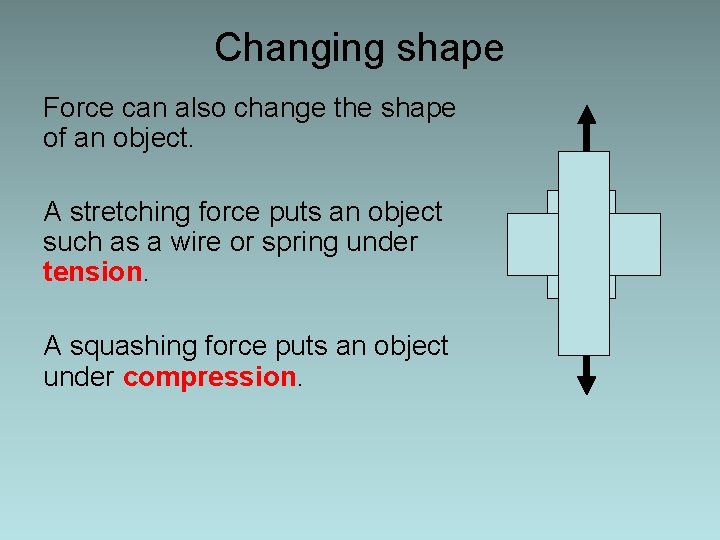
Changing shape Force can also change the shape of an object. A stretching force puts an object such as a wire or spring under tension. A squashing force puts an object under compression.
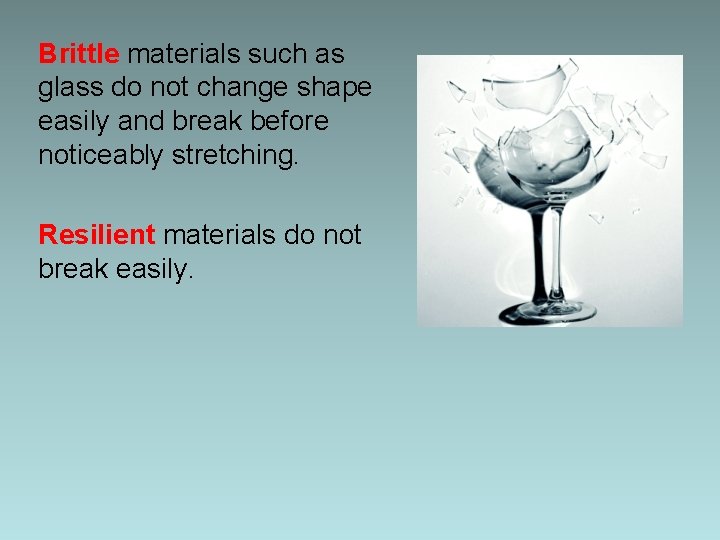
Brittle materials such as glass do not change shape easily and break before noticeably stretching. Resilient materials do not break easily.
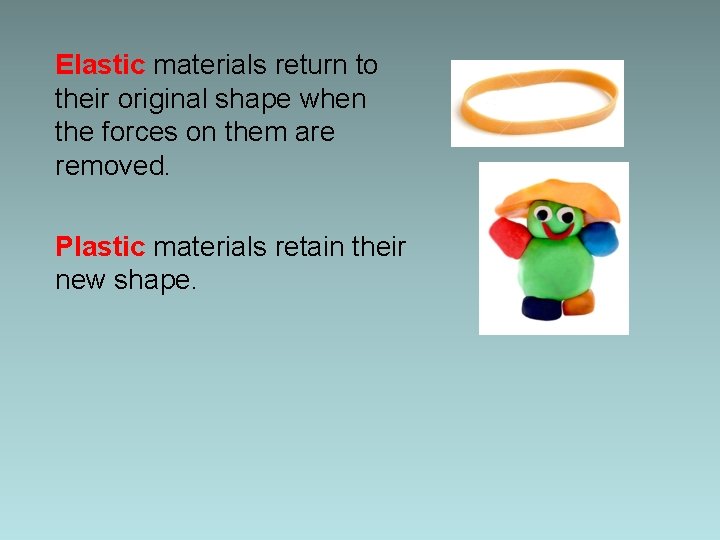
Elastic materials return to their original shape when the forces on them are removed. Plastic materials retain their new shape.

Stretching Springs Experimental procedure: 1. Place the weight holder only on the spring and note the position of the pin against the metre rule. 2. Add 1 N (100 g) to the holder and note the new position of the pin. 3. Calculate the extension of the spring. 4. Repeat stages 1 to 3 for 2 N, 3 N, 4 N, 5 N and 6 N. DO NOT EXCEED 6 N. spring weights pin metre rule
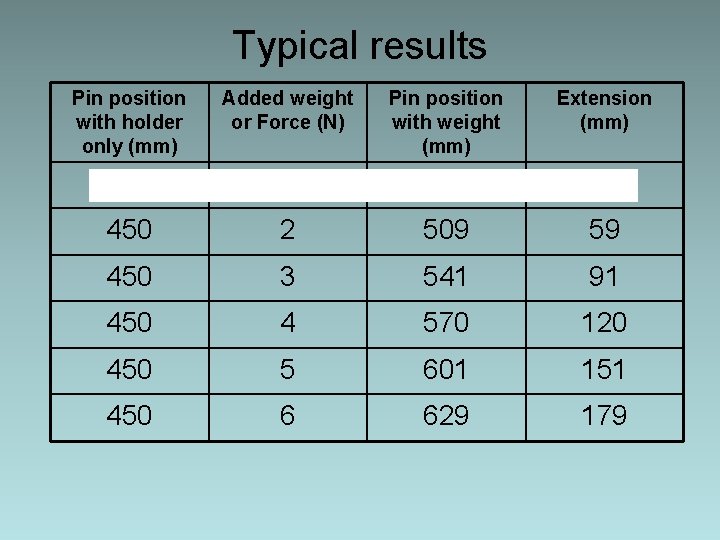
Typical results Pin position with holder only (mm) Added weight or Force (N) Pin position with weight (mm) Extension (mm) 450 1 480 30 450 2 509 59 450 3 541 91 450 4 570 120 450 5 601 151 450 6 629 179
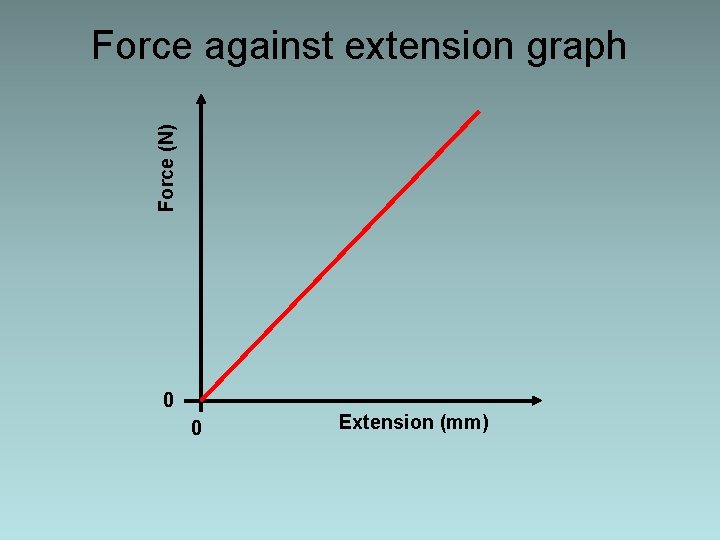
Force (N) Force against extension graph 0 0 Extension (mm)
Hooke’s law states that the extension of a spring is proportional to the force used to stretch the spring. ‘Proportional’ means that if the force is doubled then the extension also doubles. The line on a graph of force against extension will be a straight AND go through the origin.
Question A spring of original length 150 mm is extended by 30 mm by a force of 4 N. Calculate the length of the spring if a force of 12 N is applied.
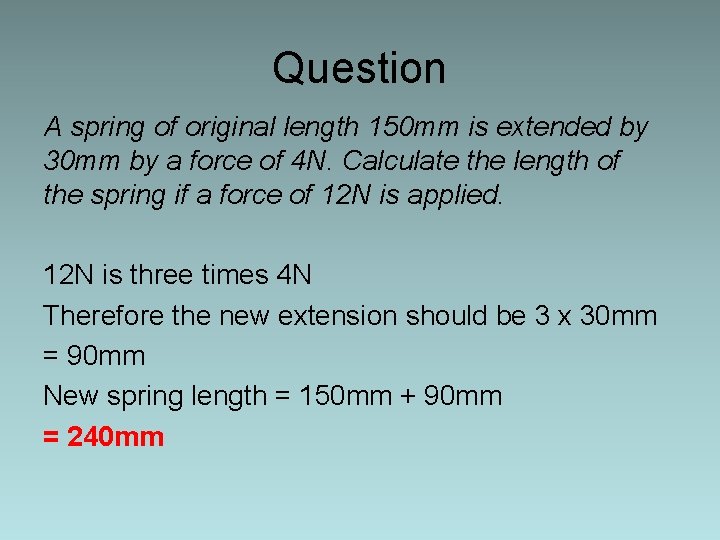
Question A spring of original length 150 mm is extended by 30 mm by a force of 4 N. Calculate the length of the spring if a force of 12 N is applied. 12 N is three times 4 N Therefore the new extension should be 3 x 30 mm = 90 mm New spring length = 150 mm + 90 mm = 240 mm
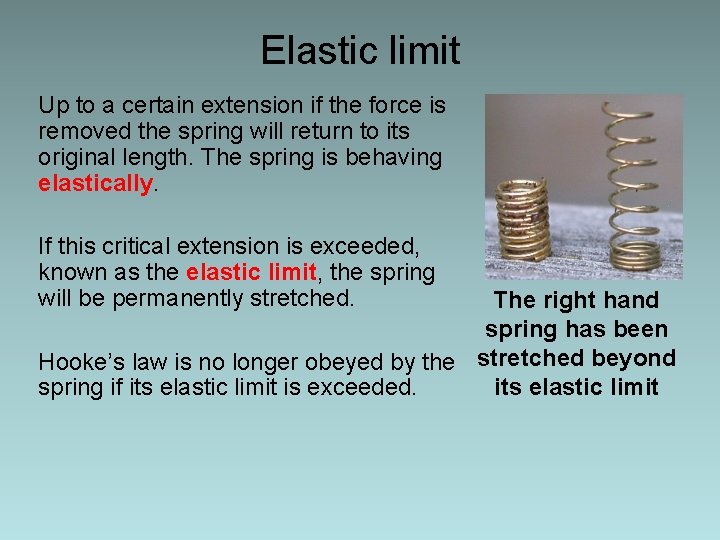
Elastic limit Up to a certain extension if the force is removed the spring will return to its original length. The spring is behaving elastically. If this critical extension is exceeded, known as the elastic limit, the spring will be permanently stretched. The right hand spring has been Hooke’s law is no longer obeyed by the stretched beyond its elastic limit spring if its elastic limit is exceeded.
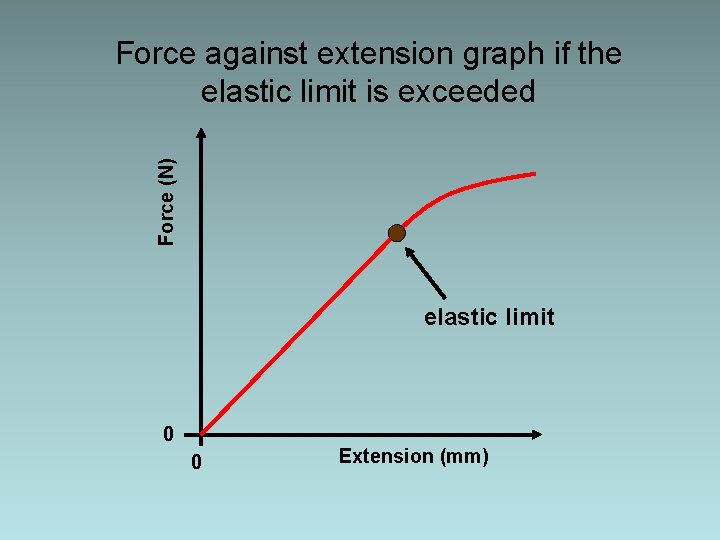
Force (N) Force against extension graph if the elastic limit is exceeded elastic limit 0 0 Extension (mm)
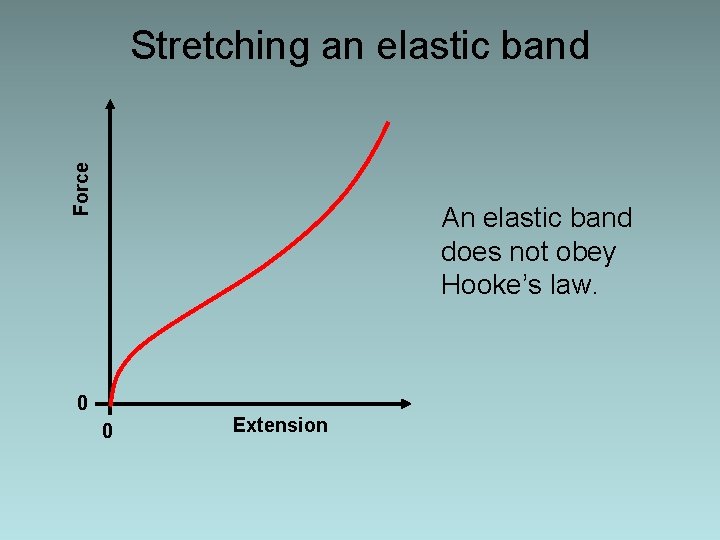
Force Stretching an elastic band An elastic band does not obey Hooke’s law. 0 0 Extension
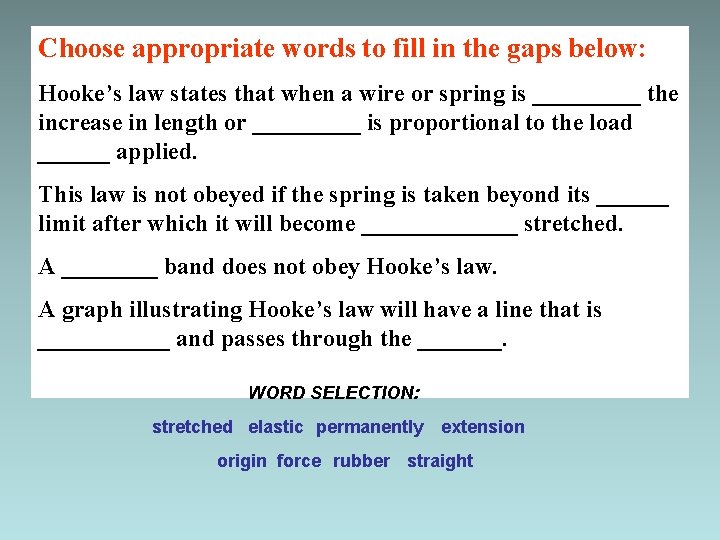
Choose appropriate words to fill in the gaps below: Hooke’s law states that when a wire or spring is _____ the increase in length or _____ is proportional to the load ______ applied. This law is not obeyed if the spring is taken beyond its ______ limit after which it will become _______ stretched. A ____ band does not obey Hooke’s law. A graph illustrating Hooke’s law will have a line that is ______ and passes through the _______. WORD SELECTION: stretched elastic permanently extension origin force rubber straight
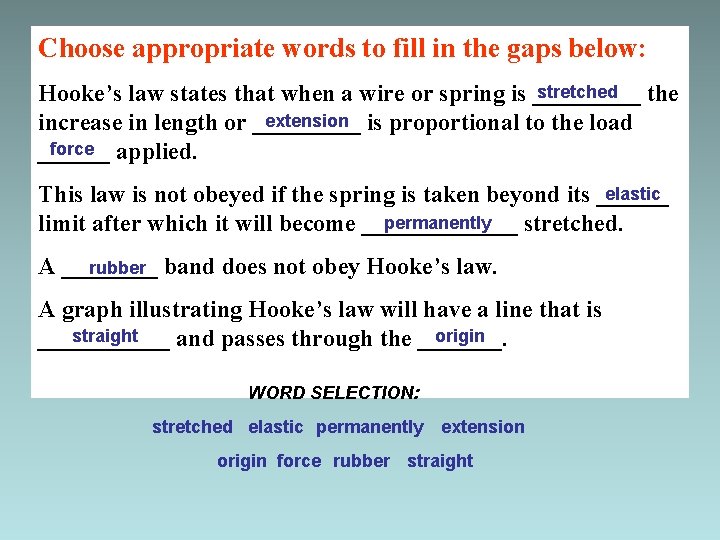
Choose appropriate words to fill in the gaps below: stretched Hooke’s law states that when a wire or spring is _____ the extension is proportional to the load increase in length or _____ force applied. ______ elastic This law is not obeyed if the spring is taken beyond its ______ permanently limit after which it will become _______ stretched. A ____ rubber band does not obey Hooke’s law. A graph illustrating Hooke’s law will have a line that is straight origin ______ and passes through the _______. WORD SELECTION: stretched elastic permanently extension origin force rubber straight
- Slides: 16