
Honors General Chemistry 1 Braxton Mc Kinney Lecture
Honors General Chemistry 1 Braxton Mc. Kinney Lecture 4
The Greenhouse Effect •
Quantities in Chemical Reactions • The study of the numerical relationship between chemical quantities in a chemical reaction is called stoichiometry.
Reaction Stoichiometry • The coefficients in a chemical reaction specify the relative amounts in moles of each of the substances involved in the reaction.
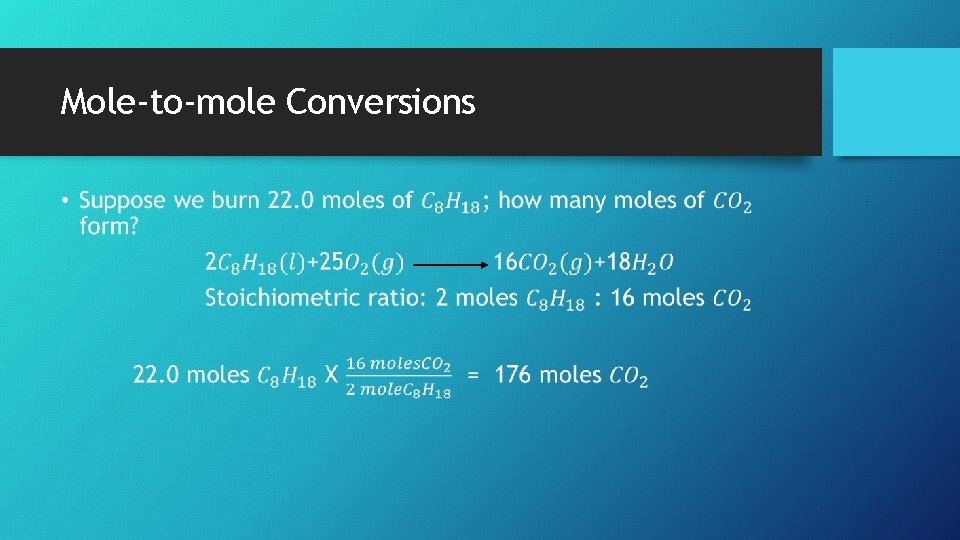
Mole-to-mole Conversions •

Limiting Reactant, Theoretical Yield, Percent Yield • Limiting Reactant Smallest number of pizzas
Theoretical Yield • The tomato sauce is the limiting reactant, the reactant that makes the least amount of product. It is also known as the limiting reagent. • The maximum number of pizzas we can make depends on this ingredient. In chemical reactions, we call this theorietical yield.
Percent Yield • Assume while making pizzas, we burnt one or dropped one on the floor, some incontrollable variable that only allows us to make two pizza. The actual amount (two pizzas) of product made in a chemical reaction is called the actual yield. • If we take our actual yield, and divide it by our theoretical yield. We get our percent yield or what we were able to make versus what we were supposed to be able to make.
In a Chemical Reaction • When you have multiple reactants, odds are one reactant will be completely used before the others. When this happens the reaction stops and no more product is made. • The reactant that limits the amount of product is called the limiting reactant. • Those reactants that aren’t completely used are call excess reactants. • The amount of product that can be made from the limiting reactant is called theoretical yield.

Calculating Limiting Reactant, Theoretical Yield, and Percent Yield •
Solution Concentration and Solution Solubility • When table salt is mixed with water, it seems to disappear or become a liquid, the mixture is homogeneous. • Homogeneous mixtures are called solutions. • The majority component is the solvent. • The minority component is the solute. • A solution in which water is the solvent is an aqueous solution.
Solution Concentrations • Because solutions are mixtures, the composition can vary from one sample to the next. • So to describe the solution accurately, we quantify the amount of solute relative to solvent, or concentration of solution. • Solutions are often described as dilute concentrated. • Dilute solutions have small amounts of solute compared to solvents. • Concentrated solutions have large amounts of solute compared to solvents. • A common way to express solution concentration is molarity (M). • Molarity is the amount of solute (in moles) divided by the volume of solution (in liters).
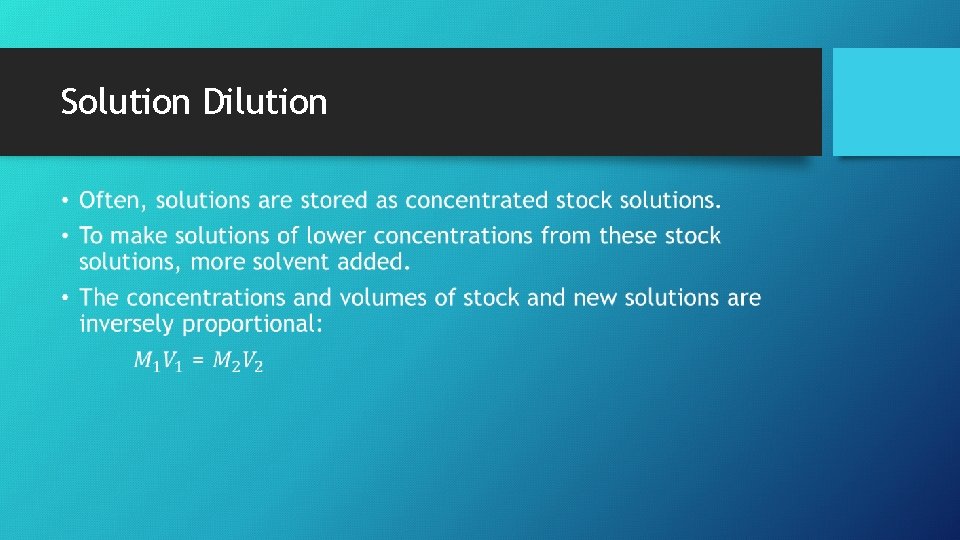
Solution Dilution •
Solution Stoichiometry • Because molarity relates the moles of solute to the liters of solution, it can be used to convert between amounts of reactants and/or products in a chemical reaction.
What Happens when a Solute Dissolves? • There attractive forces between the solute particles holding them together. • There also attractive forces between the solute particles and the solvent molecules. • If the attractions between solute and solvent are strong enough the solute will dissolve.
Charge Distribution in a Water Molecule • There is an uneven distribution of electrons within the water molecule. • This causes the oxygen side of the molecule to have a partial negative charge and the hydrogen side to have a partial positive charge.
Solute and Solvent Interactions in a Sodium Chloride Solution and Dissolution of Ionic Compounds •
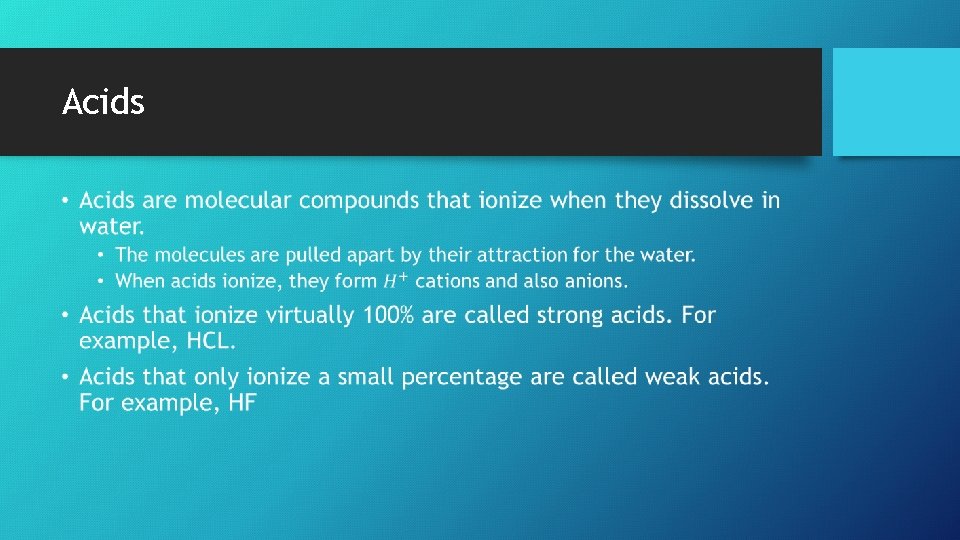
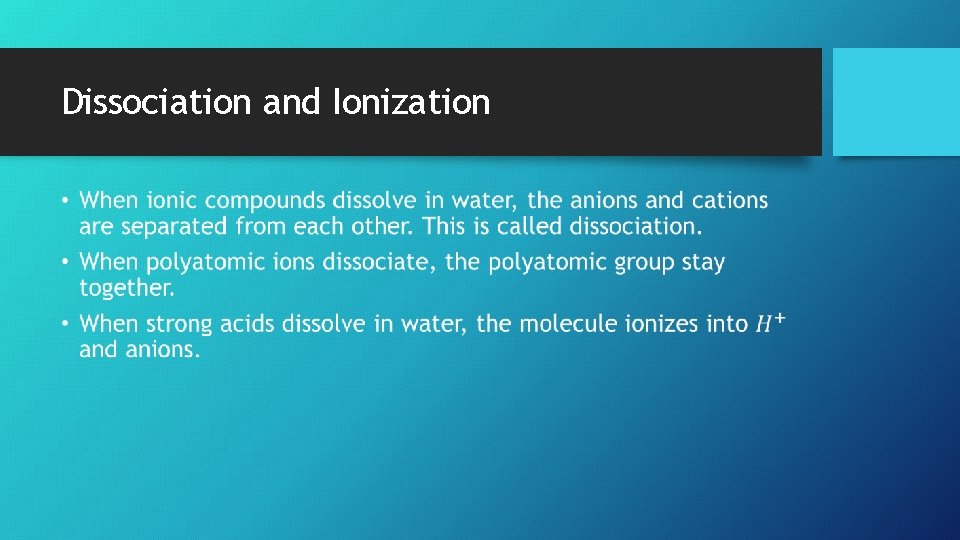
Electrolyte and Nonelectrolyte Solutions • Materials that dissolve in water to for a solution containing ions will conduct electricity. These are called electrolytes. • Materials that dissolve in water to form a solution with no ions will not conduct electricity. These are called nonelectrolytes. • Ionic substances, such as sodium chloride, that completely dissociate into ions when dissolved in water are called strong electrolytes. • Except for acids, most molecular compounds dissolve in water as intact molecules, or nonelectrolytes. • Acids ionize to varying degrees in water. Those that completely ionize are strong acids. Those that don’t are weak acids.
Acids •
Dissociation and Ionization •
The Solubility of Ionic Compounds • When an ionic compound dissolves in water, the resulting solution contains not the intact ionic compound itself but its component ions dissolved in water. • However not all ionic compounds dissolve in water. For example, Ag. Cl remains solid and appear as a white powder at the bottom of the water. • A compound is termed soluble if it dissolves in water and insoluble if it does not. • The best way to determine if a salt will dissolve is to conduct an experiment to test if the compound will dissolve. • This is known as the empirical method.
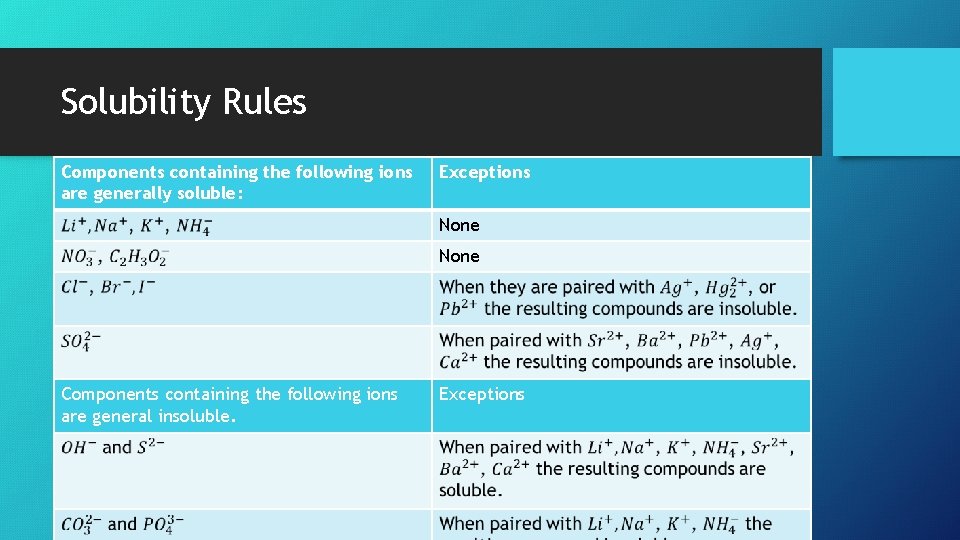
Solubility Rules Components containing the following ions are generally soluble: Exceptions None Components containing the following ions are general insoluble. Exceptions
Precipitation Reactions • Precipitation reactions are reactions in which a solid forms when we mix two solutions. • Precipitation reactions do not always occur when two aqueous solutions are mixed. • Nothing happens when combining solutions of Kl and Na. Cl.
Predicting Precipitation Reactions 1. Determine what ions each aqueous reactant has. 2. Determine formulas of possible products. 1. Balance charges of combined ions to get the formula of each product. 3. Determine solubility of each product in water. 1. Use solubility rules. 4. If neither product will precipitate, write no reaction after the arrow. 5. If any of the possible products are insoluble, write their formulas as the products of the reaction using (s) for solid, (g) for gas, (l) for liquid, and (aq) for aqueous. 6. Balance the equation.
Rules for Writing a Complete Ionic Equation • Aqueous strong electrolytes are written as ions. • Insoluble substances, weak electrolytes, and nonelectrolytes are written in molecule form. • Ionic Equation • Notice in some ionic equations some ions appear unchanged on both sides. • These are called spectator ions because they do not participate in the reaction (soluble salts, strong acids, strong bases). • An ionic equation in which the spectator ions are removed is called a net ionic equation.
Acid-Base and Gas-Evolution Reactions • Two important classes of reactions that occur in aqueous solution are: • Acid-base reactions • Gas-evolution reactions • Acid-base reaction: • AKA Neutralization reaction • When an acid and a base, the two neutralize each other producing water (or in some cases a weak electrolyte). • Gas-evolution reactions: • A gas is produced resulting in a bubble. • The reaction happens when the anion from one reactant combines with the cation of the other. • Many reactions are both gas evolution and acid base reactions.
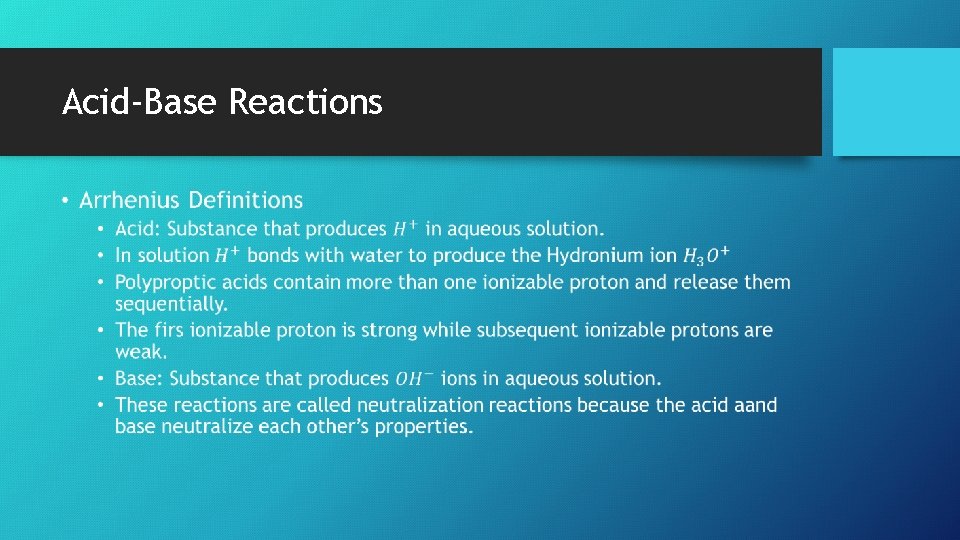
Acid-Base Reactions •
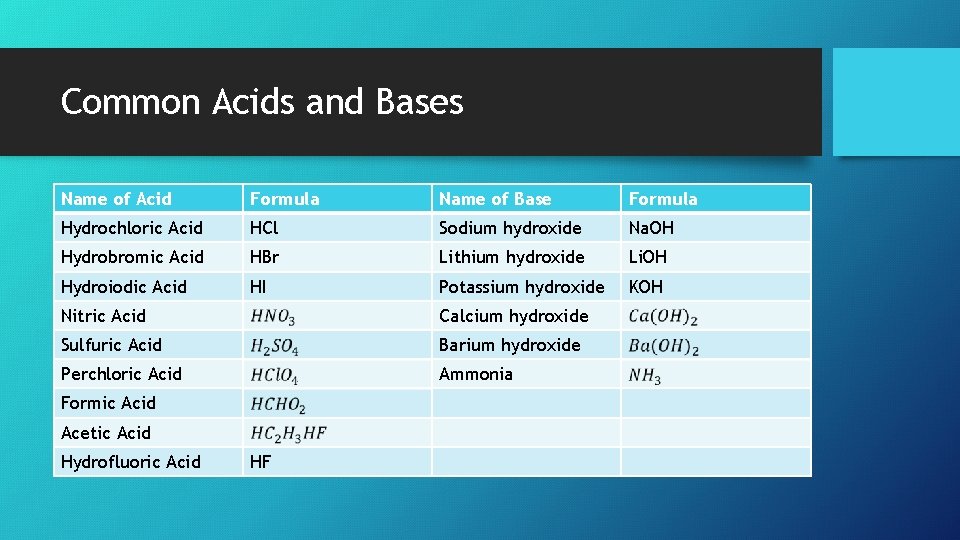
Common Acids and Bases Name of Acid Formula Name of Base Formula Hydrochloric Acid HCl Sodium hydroxide Na. OH Hydrobromic Acid HBr Lithium hydroxide Li. OH Hydroiodic Acid HI Potassium hydroxide KOH Nitric Acid Calcium hydroxide Sulfuric Acid Barium hydroxide Perchloric Acid Ammonia Formic Acid Acetic Acid Hydrofluoric Acid HF
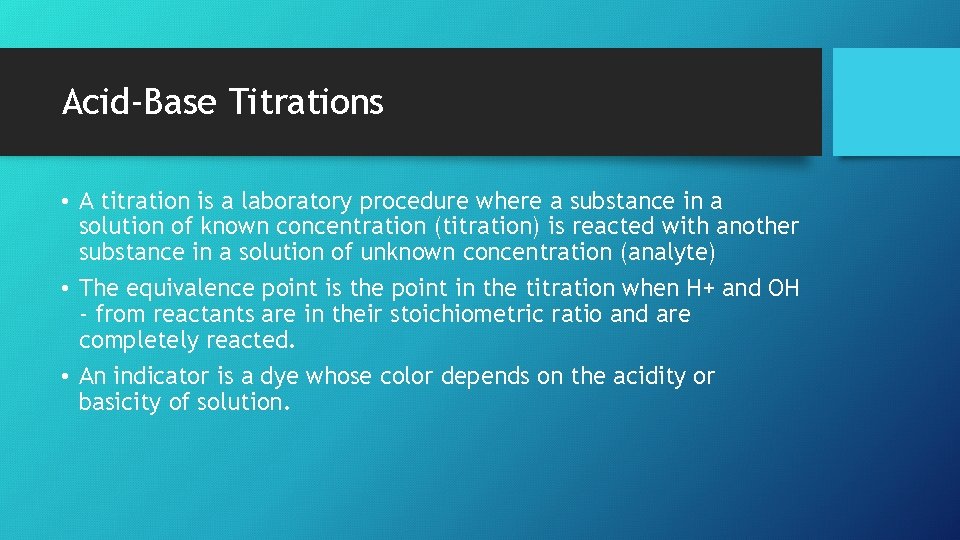
Acid-Base Titrations • A titration is a laboratory procedure where a substance in a solution of known concentration (titration) is reacted with another substance in a solution of unknown concentration (analyte) • The equivalence point is the point in the titration when H+ and OH - from reactants are in their stoichiometric ratio and are completely reacted. • An indicator is a dye whose color depends on the acidity or basicity of solution.
Oxidation-Reduction Reactions • The reactions in which electrons are transferred from one reactant to the other are called oxidation reduction reactions, or redox reactions. • Many redox reactions involve the reaction of a substance with oxygen.
Redox Reaction • Electron transfer for the reaction to qualify as oxidation reduction. • There is uneven sharing of electrons when hydrogen bonds to chlorine, resulting in an increase of electron density 9 reduction) for chlorine and decrease in electron density (oxidation) for hydrogen. • To convert a free element into an ion, the atom must gain or lose electrons. • Reactions where electrons are transferred from one atom to another are redox reactions. • Atoms that lose electrons are being oxidized, while atoms that gain electrons are being reduced.
Oxidation States • Chemists assign a number to each element in a reaction called an oxidation state that allows them to determine the electron flow in the reaction. • Even though they look like them oxidation states are not ion charges!!!

Rules for Assigning Oxidation States • The following are in order of priority. 1. Free elements have an oxidation state = 0 2. Monatomic ions have an oxidation state equal to their charge. 3. The sum of the oxidation states of all the atoms in a compound is 0 4. Group I metals have an oxidation state of +1 in all of their compounds 5. In their compounds, nonmetals have oxidation states based on location on periodic tbale.
Identifying Redox Reactions • Oxidation: An increase in oxidation state. • Reduction: A decrease in oxidation state. • The reactant that causes reduction in another reactant is called the reducing agent. • The reactant that causes oxidation in another reactant is called the oxidizing agent.

A Big Thanks and Credit Given To: • Luisa Whittaker-Brooks of the University of Utah • Pearson Education
- Slides: 35