
Honors Chemistry S 17 Daltons Law of Partial
- Slides: 8
Honors Chemistry S 17 Dalton’s Law of Partial Pressures
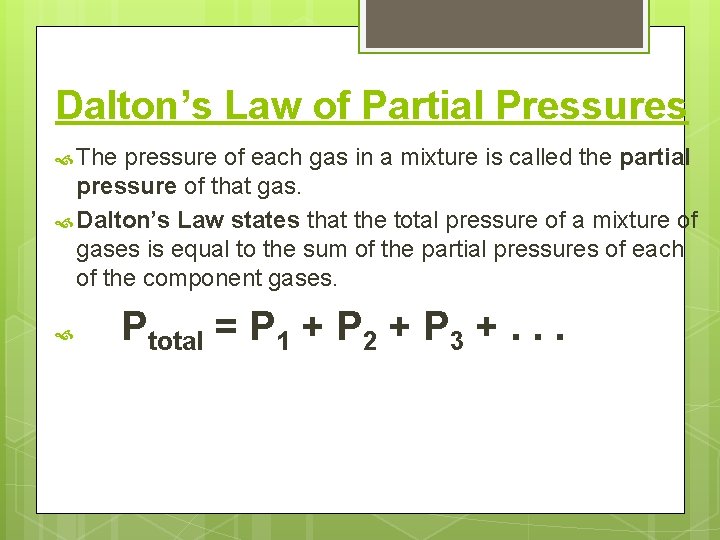
Dalton’s Law of Partial Pressures The pressure of each gas in a mixture is called the partial pressure of that gas. Dalton’s Law states that the total pressure of a mixture of gases is equal to the sum of the partial pressures of each of the component gases. Ptotal = P 1 + P 2 + P 3 +. . .
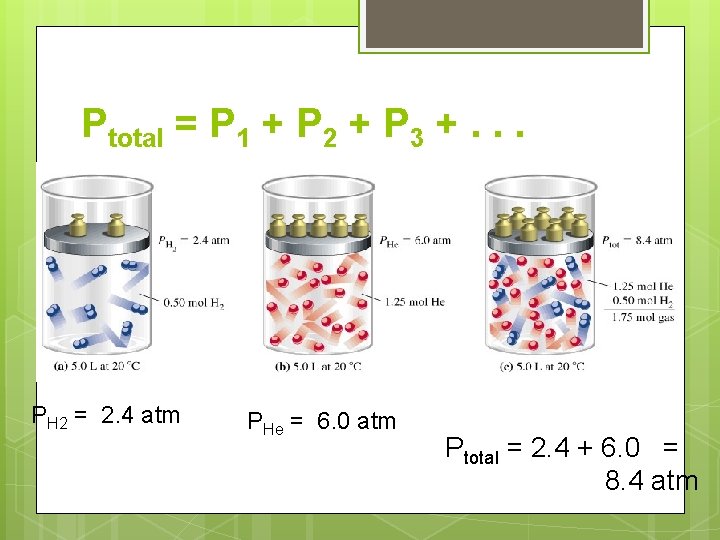
Ptotal = P 1 + P 2 + P 3 +. . . PH 2 = 2. 4 atm PHe = 6. 0 atm Ptotal = 2. 4 + 6. 0 = 8. 4 atm
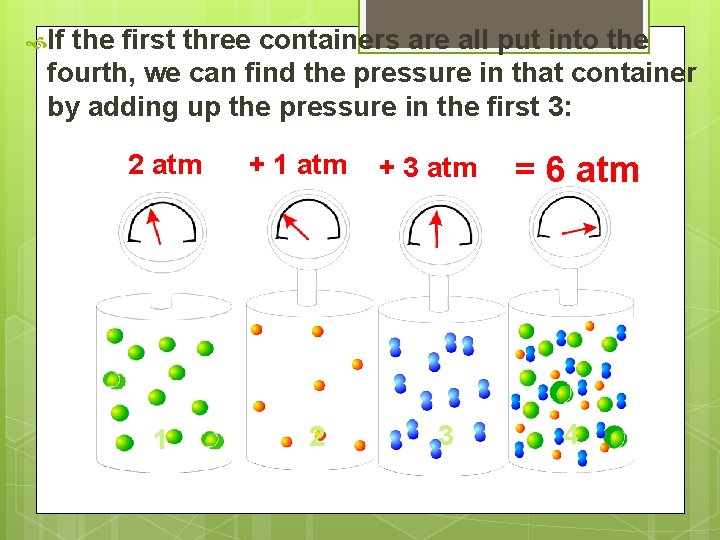
If the first three containers are all put into the fourth, we can find the pressure in that container by adding up the pressure in the first 3: 2 atm 1 + 1 atm 2 + 3 atm 3 = 6 atm 4
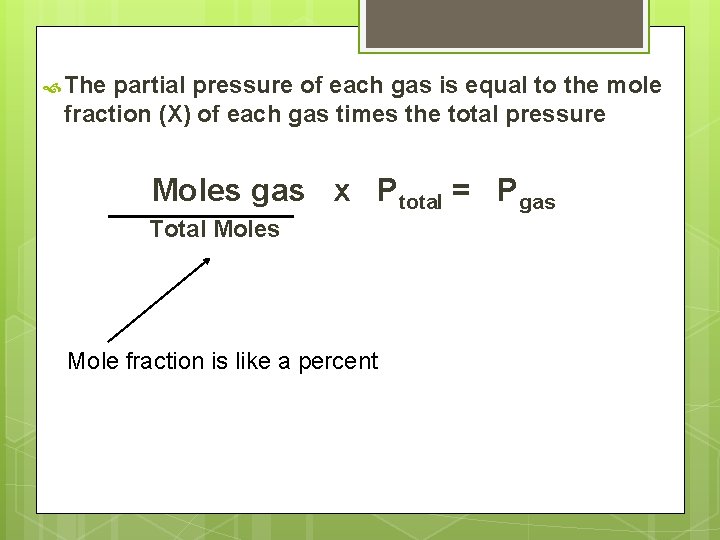
The partial pressure of each gas is equal to the mole fraction (X) of each gas times the total pressure Moles gas x Ptotal = Pgas Total Moles Mole fraction is like a percent
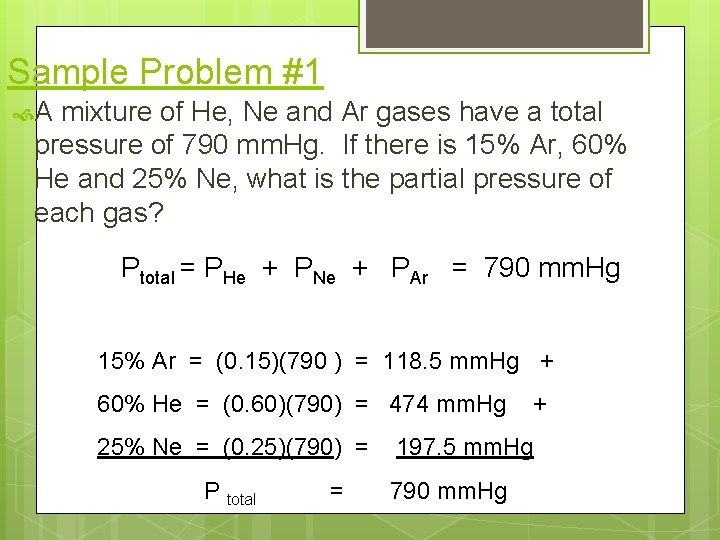
Sample Problem #1 A mixture of He, Ne and Ar gases have a total pressure of 790 mm. Hg. If there is 15% Ar, 60% He and 25% Ne, what is the partial pressure of each gas? Ptotal = PHe + PNe + PAr = 790 mm. Hg 15% Ar = (0. 15)(790 ) = 118. 5 mm. Hg + 60% He = (0. 60)(790) = 474 mm. Hg 25% Ne = (0. 25)(790) = P total = + 197. 5 mm. Hg 790 mm. Hg
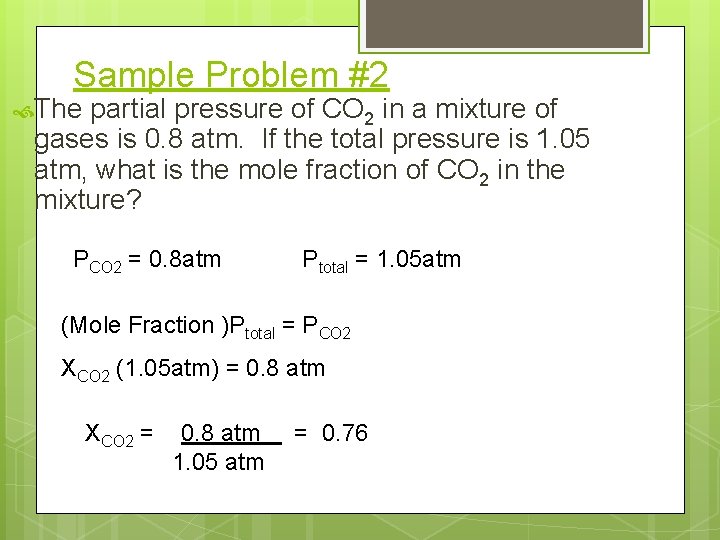
Sample Problem #2 The partial pressure of CO 2 in a mixture of gases is 0. 8 atm. If the total pressure is 1. 05 atm, what is the mole fraction of CO 2 in the mixture? PCO 2 = 0. 8 atm Ptotal = 1. 05 atm (Mole Fraction )Ptotal = PCO 2 XCO 2 (1. 05 atm) = 0. 8 atm XCO 2 = 0. 8 atm 1. 05 atm = 0. 76
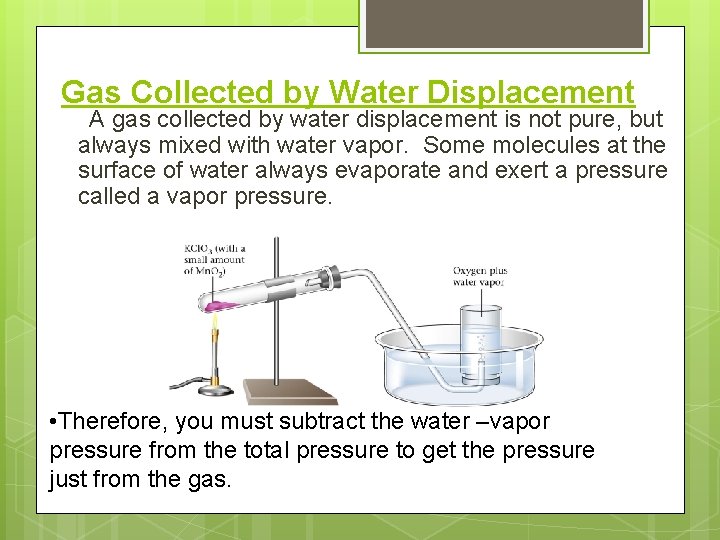
Gas Collected by Water Displacement A gas collected by water displacement is not pure, but always mixed with water vapor. Some molecules at the surface of water always evaporate and exert a pressure called a vapor pressure. • Therefore, you must subtract the water –vapor pressure from the total pressure to get the pressure just from the gas.