
HONORS BIOLOGY CHAPTER 10 TEST REVIEW DNA Protein
HONORS BIOLOGY CHAPTER 10 TEST REVIEW DNA, Protein Synthesis, Bacteria and Viruses
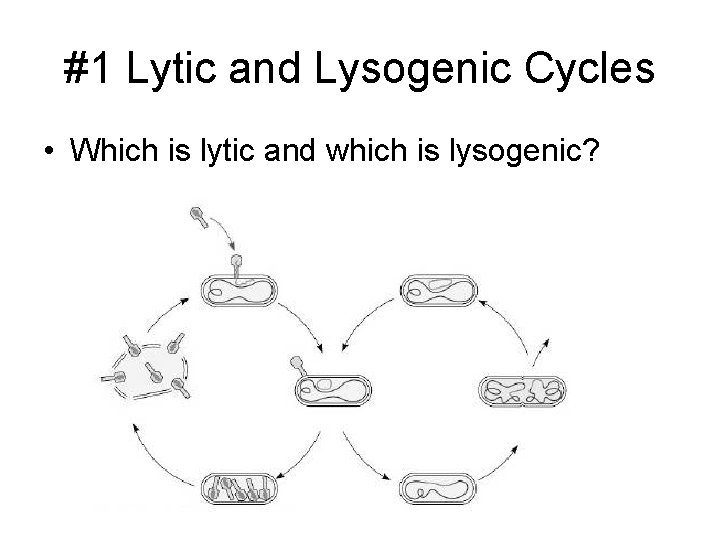
#1 Lytic and Lysogenic Cycles • Which is lytic and which is lysogenic?
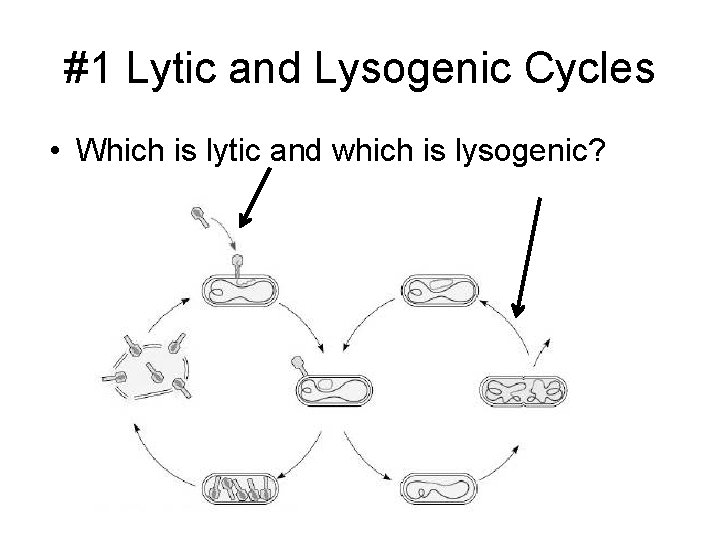
#1 Lytic and Lysogenic Cycles • Which is lytic and which is lysogenic?
#1 • Lytic Infection: Virus injects its DNA into host to replicate the virus, kills the host • EX: cold, influenza • Lysogenic Infection: • Virus DNA becomes part of host DNA and duplicates together forever. Goes into lytic bursting when conditions poor for host cell. • EX: herpes(cold sores), HIV, chicken pox
#2 Which Scientist(s) • HINT 1: worked with Neurospora crassa • HINT 2: worked as a team • HINT 3: one-gene-one-enzyme or one-gene-one-protein • ANSWER: Beadle and Tatum (F)
#2 Which Scientist(s)? • HINT 1: worked on finding DNA structure • HINT 2: stole the Photo 51 • HINT 3: also got Nobel Prize • ANSWER: Maurice (the beast) Wilkins (G)
#2 Which Scientist(s)? • HINT 1: worked with animal sperm • HINT 2: a hottie • HINT 3: found A-T and C-G amounts even • ANSWER: Chargaff (D)
#2 Which Scientist(s)? • HINT 1: 1920’s • HINT 2: worked with Pneumococcus bacteria R and S strains • HINT 3: Found hereditary transformation • ANSWER: Frederick Griffith (B)
#2 Which Scientist(s)? • HINT 1: worked on finding DNA structure • HINT 2: used x-ray crystallography Photo 51 • HINT 3: a woman • ANSWER: Rosalind Franklin (A)
#2 Which Scientist(s)? • HINT 1: worked on finding DNA structure • HINT 2: first put bases on outside instead of inside • HINT 3: won Nobel prize for finding DNA structure • ANSWER: Watson and Crick (E)
#2 Which Scientist(s)? • HINT 1: Found DNA to be the genetic material • HINT 2: used bacteriophages • HINT 3: used “hot” sulfur and phosphorus • ANSWER: Hershey and Chase (C)
#2 Which scientist(s)? • HINT 1: found DNA was genetic material • HINT 2: separated bacteria into: carbos, DNA, protein, RNA by a centrifuge • HINT 3: bald • ANSWER: (H) Avery, Mac. Leod, Mc. Carty
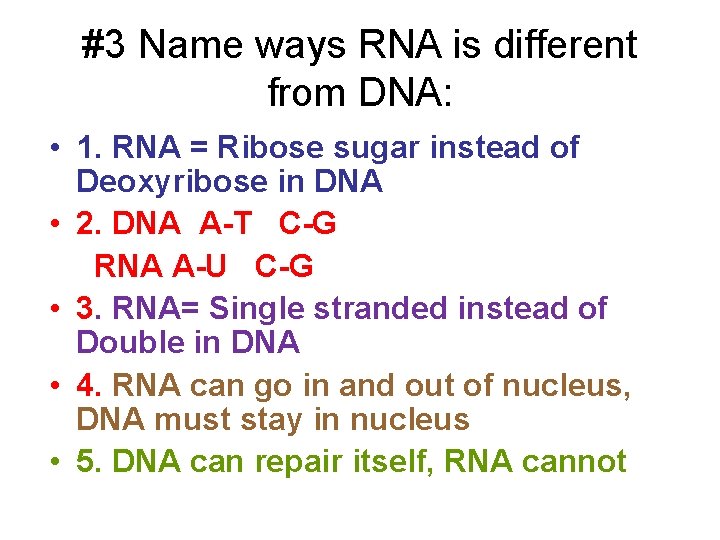
#3 Name ways RNA is different from DNA: • 1. RNA = Ribose sugar instead of Deoxyribose in DNA • 2. DNA A-T C-G RNA A-U C-G • 3. RNA= Single stranded instead of Double in DNA • 4. RNA can go in and out of nucleus, DNA must stay in nucleus • 5. DNA can repair itself, RNA cannot
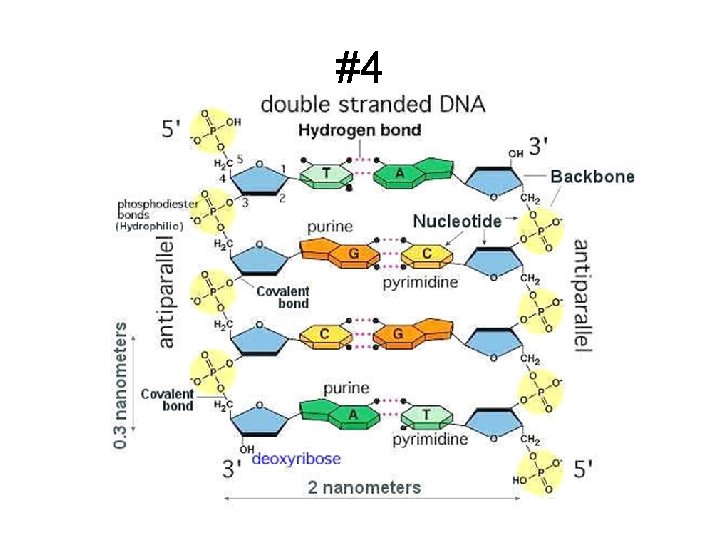
#4
#4 What three parts of DNA make up one nucleotide? • ANSWER: – sugar – Phosphate – Nitrogenous base (remember the song)
EXTRA: What is the complementary side of this DNA strand? (DNA – DNA) • G-A-T-T-G-A-C-C-T-C-G–G • ANSWER: • C - T - A - C - T - G - A - G - C- C
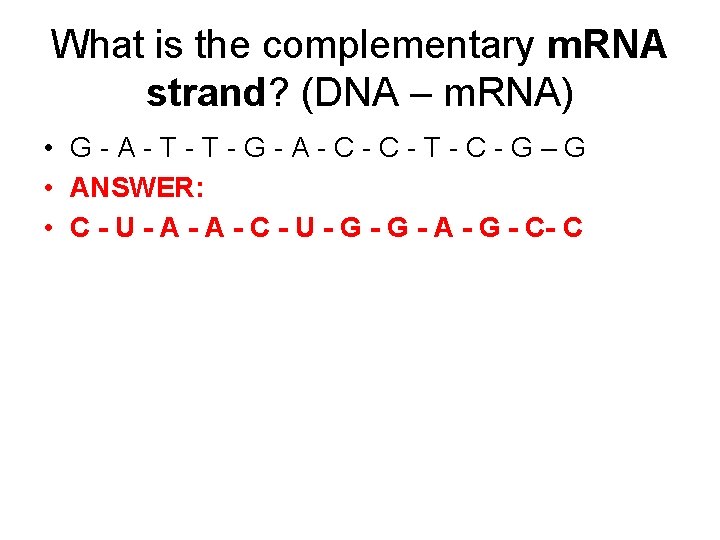
What is the complementary m. RNA strand? (DNA – m. RNA) • G-A-T-T-G-A-C-C-T-C-G–G • ANSWER: • C - U - A - C - U - G - A - G - C- C
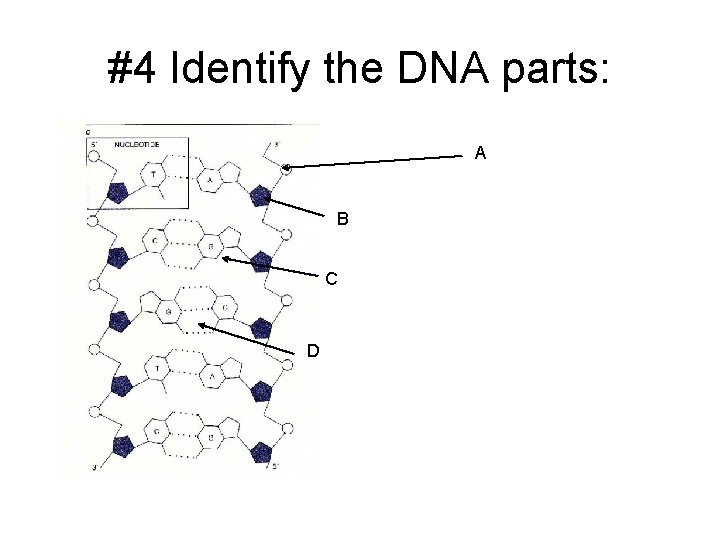
#4 Identify the DNA parts: A B C D
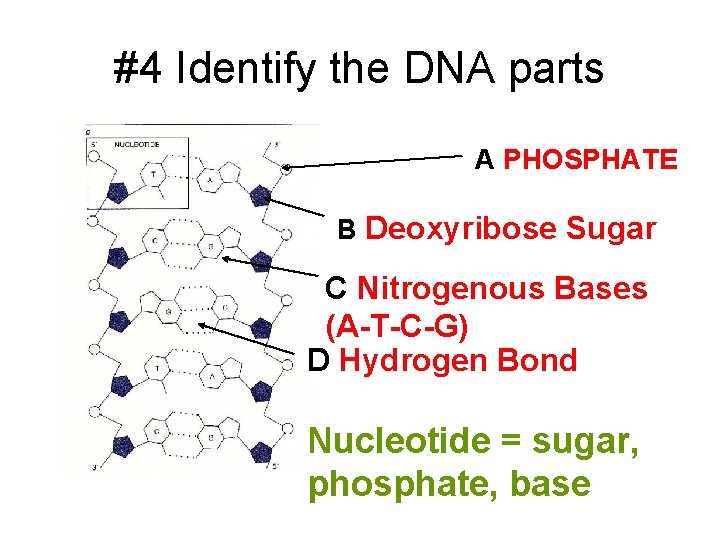
#4 Identify the DNA parts A PHOSPHATE B Deoxyribose Sugar C Nitrogenous Bases (A-T-C-G) D Hydrogen Bond Nucleotide = sugar, phosphate, base
#4 How can you recognize… • Pyrimidines? And what bases? • One ring • CUT • Purines? And what bases? • Two rings • AG
#5 Which process? • Does DNA copy itself? • ANSWER: Replication (A) • Is the movement of t. RNA from A to P site on the ribosome? • ANSWER: Translocation (B)
#5 Which process? • Codes DNA to m. RNA? • ANSWER? Transcription (C) • Codes m. RNA to t. RNA and protein? • ANSWER: Translation (D)
#5 What happens at the P A E sites of a ribosome during translation? • A = amino acid is dropped off • P = polypeptide builds • E = t. RNA exits after dropping off amino acid • Process is translocation (B)
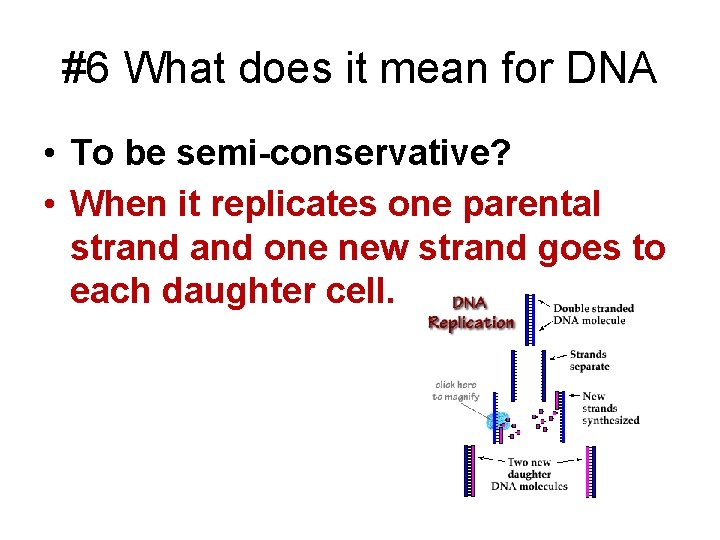
#6 What does it mean for DNA • To be semi-conservative? • When it replicates one parental strand one new strand goes to each daughter cell.
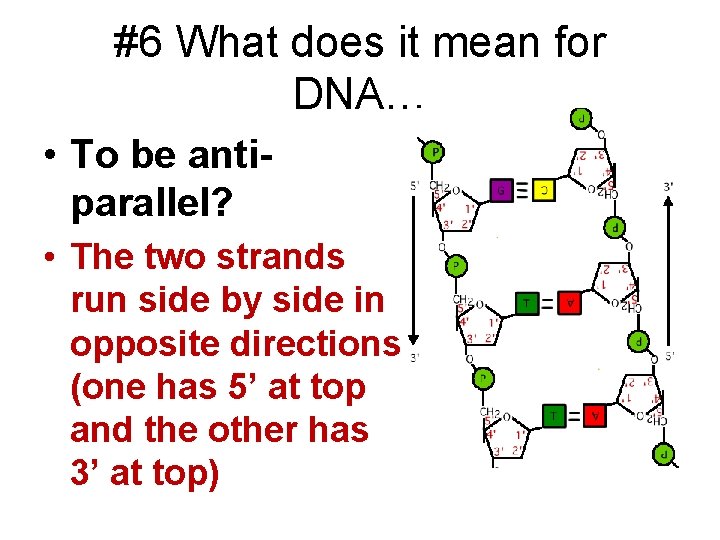
#6 What does it mean for DNA… • To be antiparallel? • The two strands run side by side in opposite directions (one has 5’ at top and the other has 3’ at top)
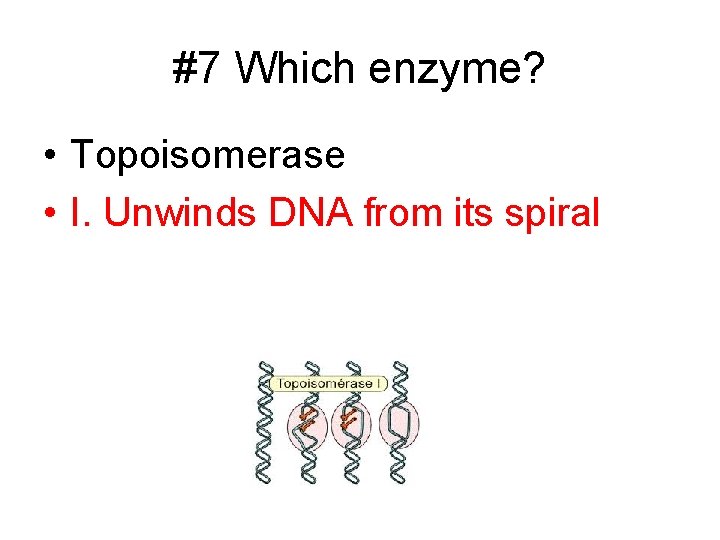
#7 Which enzyme? • Topoisomerase • I. Unwinds DNA from its spiral
#7 Which enzyme? • LIGASE • A. Binds Okazaki fragments in the lagging strand
#7 Which enzyme? • PRIMASE • E. Adds RNA nucleotide primers
#7 Which enzyme? • DNA Polymerase III • C. Adds nucleotides to DNA for elongation and also for proofreading
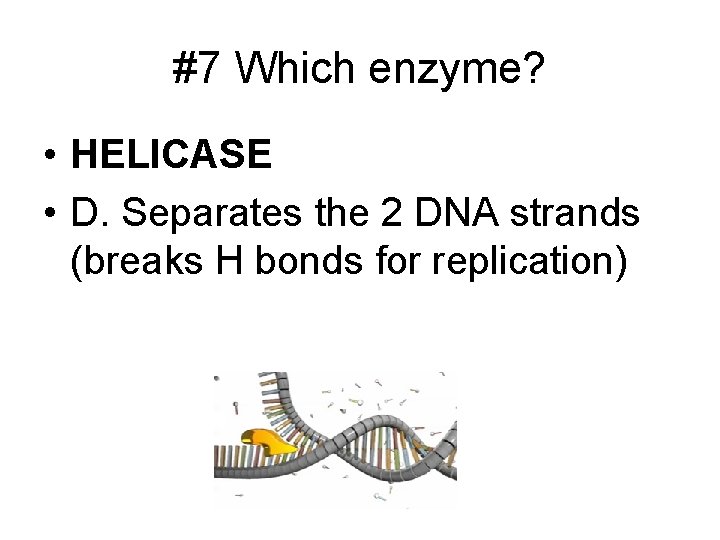
#7 Which enzyme? • HELICASE • D. Separates the 2 DNA strands (breaks H bonds for replication)
#7 Which enzyme? • RNA POLYMERASE • B. Joins RNA nucleotides in making m. RNA’s
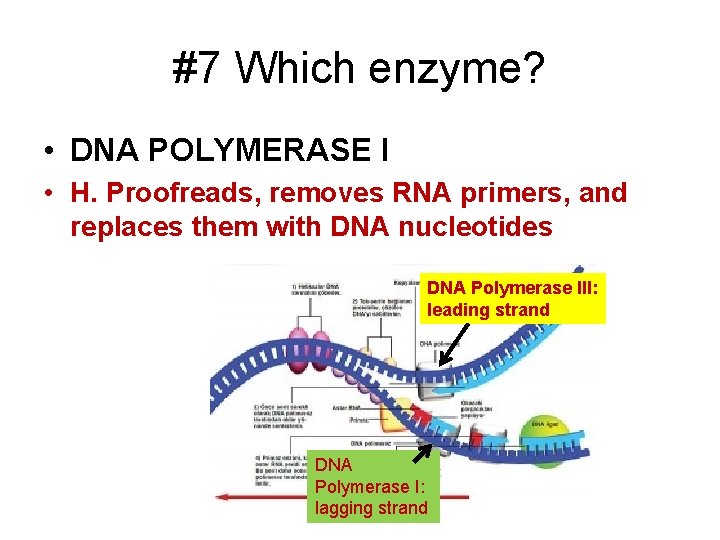
#7 Which enzyme? • DNA POLYMERASE I • H. Proofreads, removes RNA primers, and replaces them with DNA nucleotides DNA Polymerase III: leading strand DNA Polymerase I: lagging strand
• • #8 A. Which is a physical or chemical agent that causes mutations? mutagenesis mutation reading frame • ANSWER: mutagen
#8 B. What mutation… • Is a substitution that causes no change in the protein product? • . nonsense • . silent • . missense • ANSWER: silent
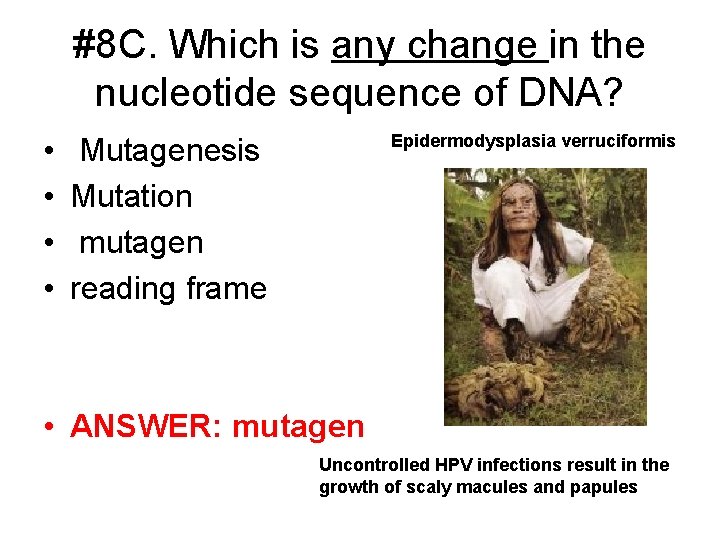
#8 C. Which is any change in the nucleotide sequence of DNA? • • Epidermodysplasia verruciformis Mutagenesis Mutation mutagen reading frame • ANSWER: mutagen Uncontrolled HPV infections result in the growth of scaly macules and papules
Tree Man Pictures • Before and After Images : Tree Man : Discovery Health
#8 D. What mutation… • Causes a substitution that does change the amino acid coding? • Missense • silent • nonsense • ANSWER: Missense
#8 E. What mutation • Is a substitution that changes an amino acid into a STOP codon? • A. silent • B. missense • C. nonsense • ANSWER: nonsense
#8 F Which is the triplet grouping (a mutation can alter it to shift) • • mutation mutagenesis mutagen reading frame • ANSWER: reading shift
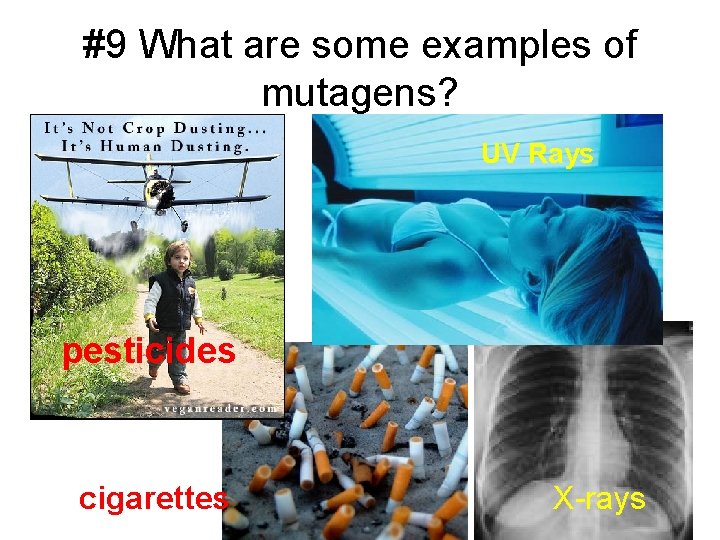
#9 What are some examples of mutagens? UV Rays pesticides cigarettes X-rays
#10 • How does the leading strand behave differently from the lagging strand? • ANSWER: leading strand adds nucleotides 5’ to 3’ toward the replication fork continuously • Lagging strand adds nucleotides 5’ to 3’ away from the replication fork discontinuously (in fragments)
#11 What is the central dogma? • • A. DNA – RNA – protein B. protein – RNA – DNA C. DNA – protein – RNA D. RNA – protein – DNA • ANSWER: A
#11 Who first proposed the central dogma? • • A. Crick B. Watson C. Nirenberg D. Avery • ANSWER: *Crick and Nirenberg
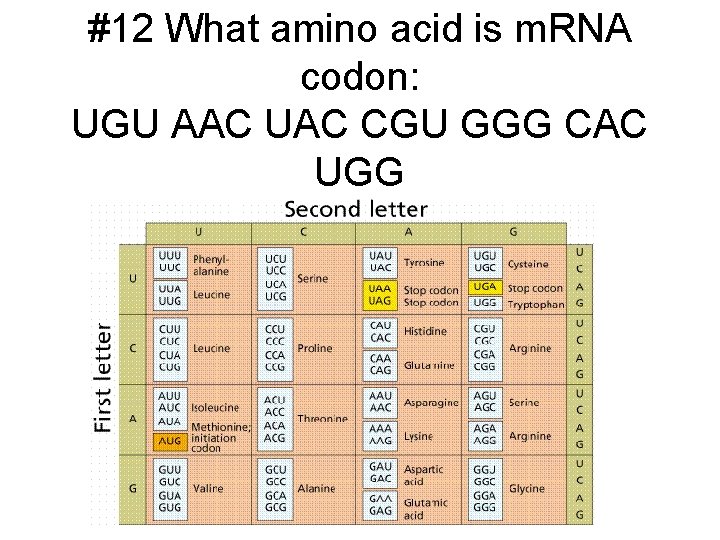
#12 What amino acid is m. RNA codon: UGU AAC UAC CGU GGG CAC UGG
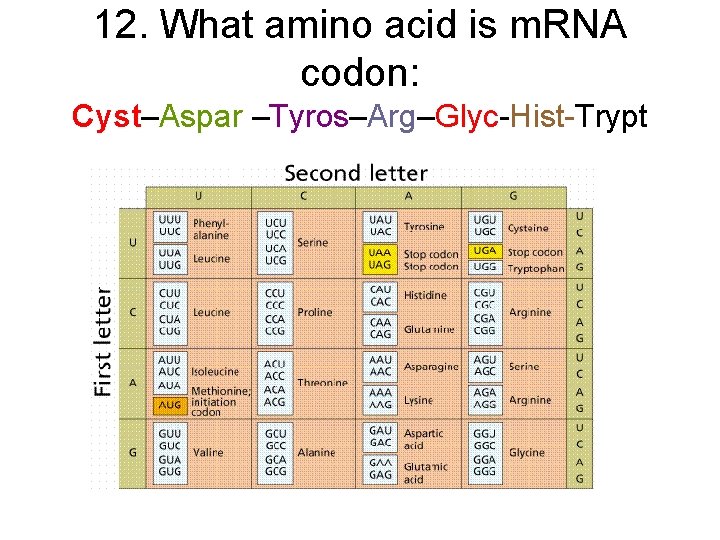
12. What amino acid is m. RNA codon: Cyst–Aspar –Tyros–Arg–Glyc-Hist-Trypt
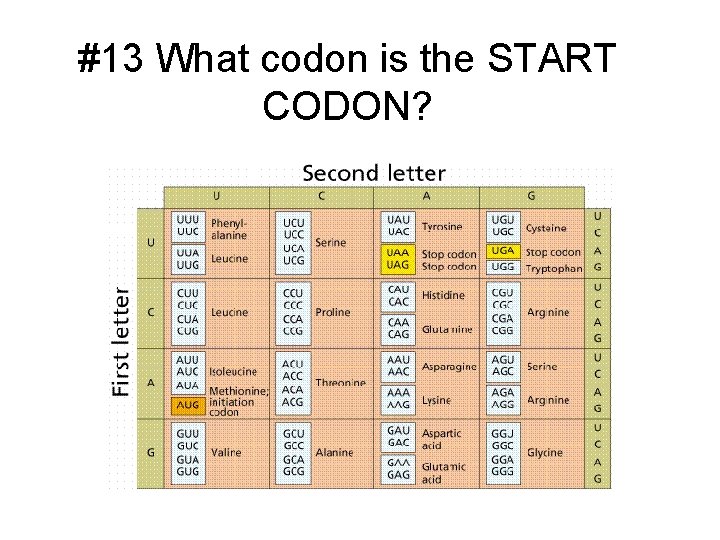
#13 What codon is the START CODON?
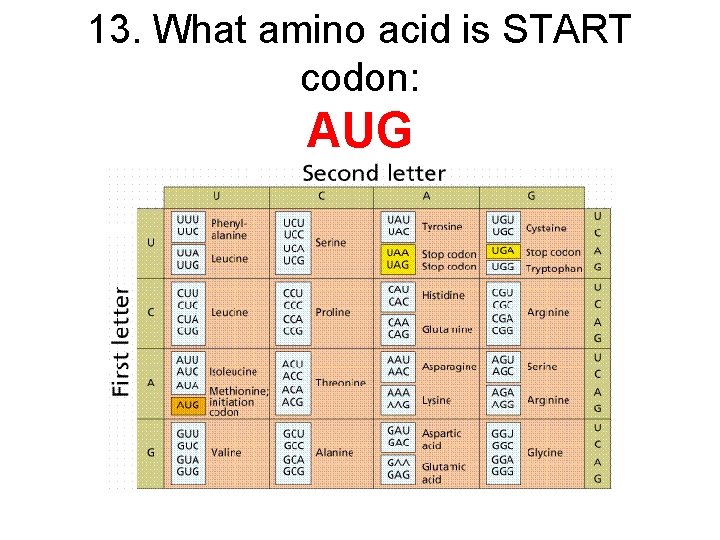
13. What amino acid is START codon: AUG
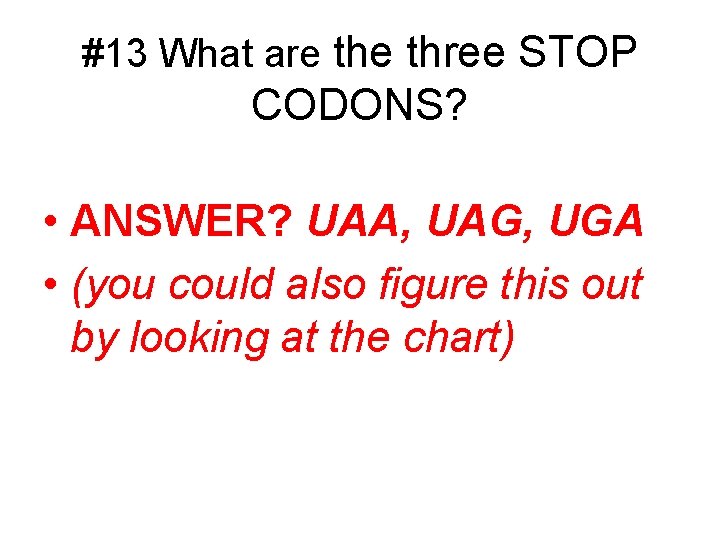
#13 What are three STOP CODONS? • ANSWER? UAA, UAG, UGA • (you could also figure this out by looking at the chart)
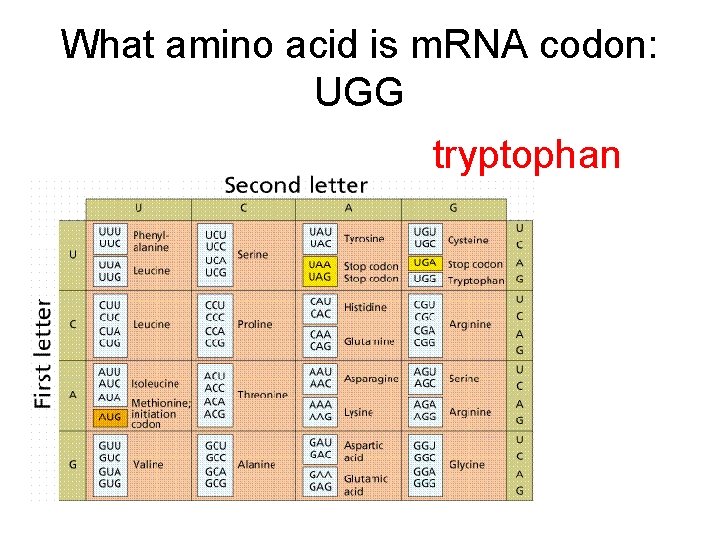
What amino acid is m. RNA codon: UGG tryptophan
# 13 How many? • Different amino acids are there? • ANSWER: 20
#14 How many subunits make up a ribosome? • A. one • B. two • C. Three • D. Four • ANSWER: 2
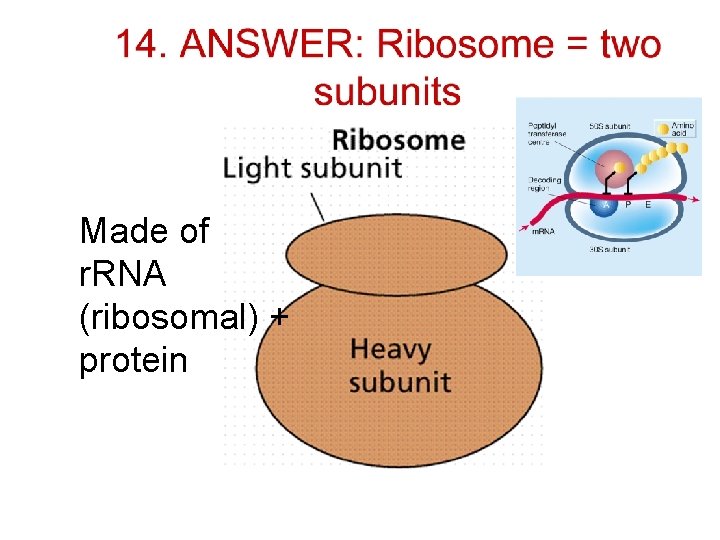
Made of r. RNA (ribosomal) + protein
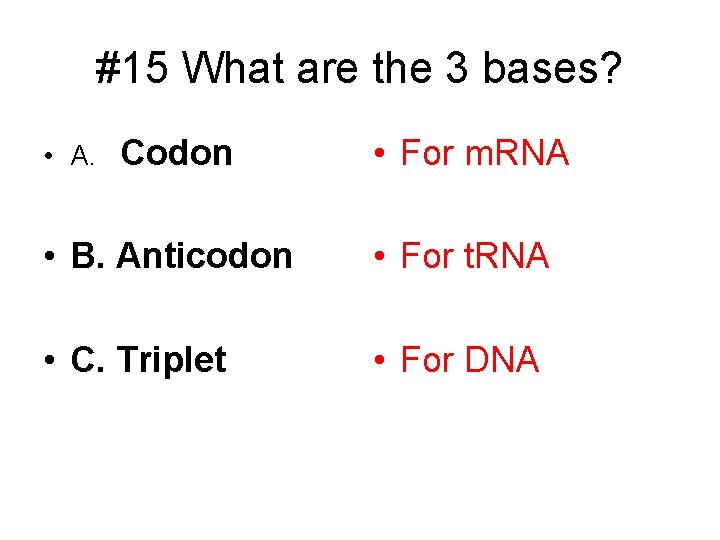
#15 What are the 3 bases? Codon • For m. RNA • B. Anticodon • For t. RNA • C. Triplet • For DNA • A.
What does a t. RNA carry? • A. codon • B. triplet • C. amino acid • D. ribosome • ANSWER: amino acid
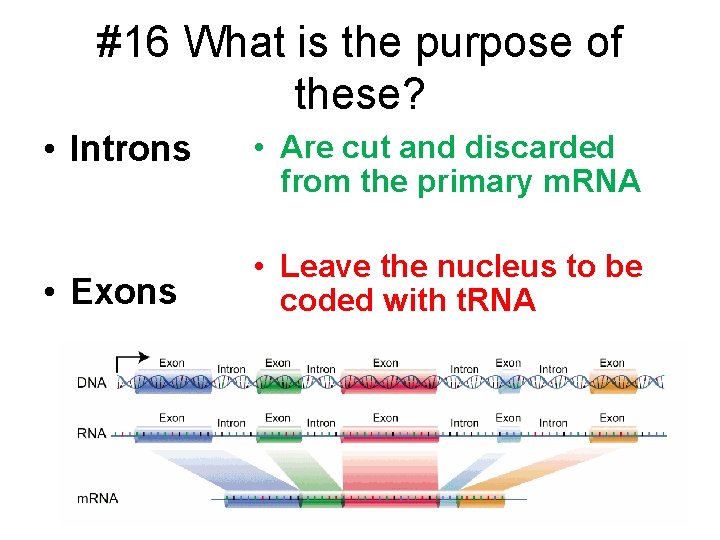
#16 What is the purpose of these? • Introns • Are cut and discarded from the primary m. RNA • Exons • Leave the nucleus to be coded with t. RNA
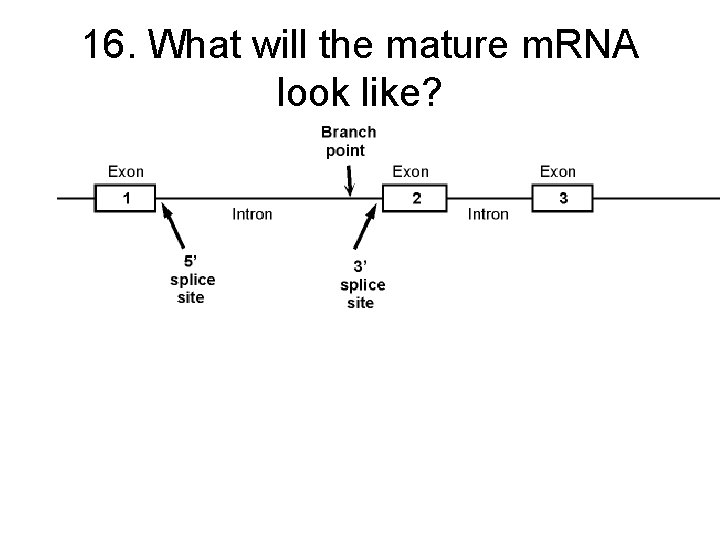
16. What will the mature m. RNA look like?
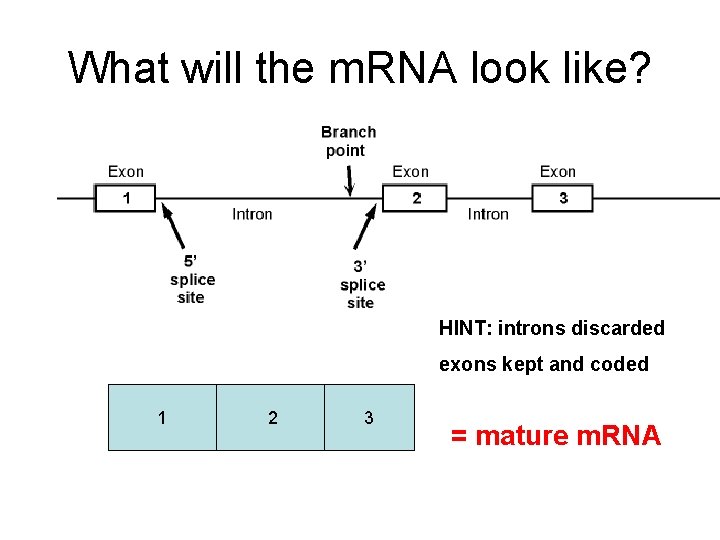
What will the m. RNA look like? HINT: introns discarded exons kept and coded 1 2 3 = mature m. RNA
#16 What’s the difference? • Between Primary m. RNA and mature m. RNA? • Primary m. RNA = introns + exons • Mature m. RNA = only exons
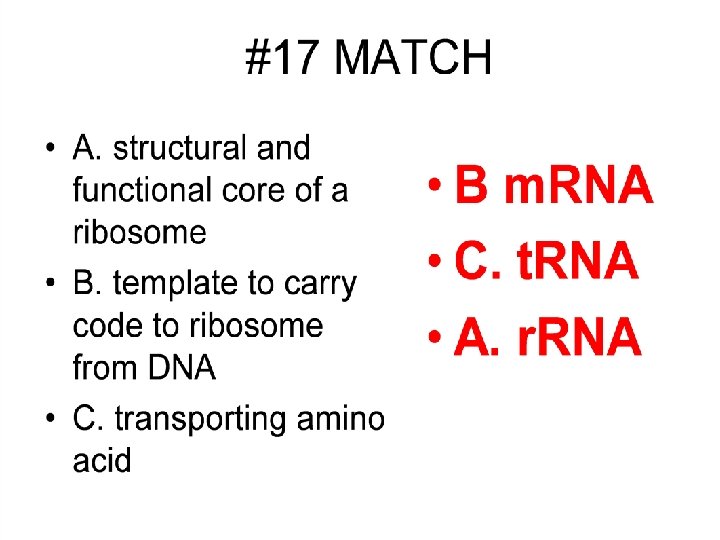
#17 What are the 3 types of RNA? • a) t. RNA (transfer RNA-brings amino acids) • b) m. RNA (messenger RNA-codes from DNA), and • c) r. RNA (ribosomal RNA-structural part of ribosome)
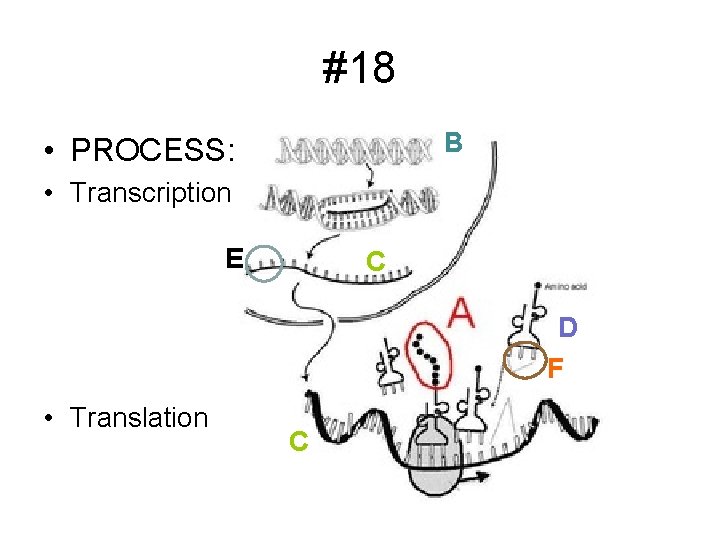
#18 B • PROCESS: • Transcription E C D F • Translation C
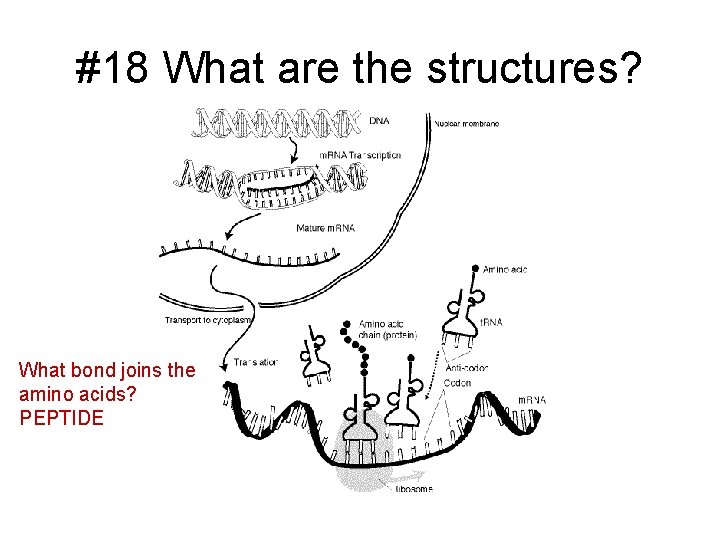
#18 What are the structures? What bond joins the amino acids? PEPTIDE
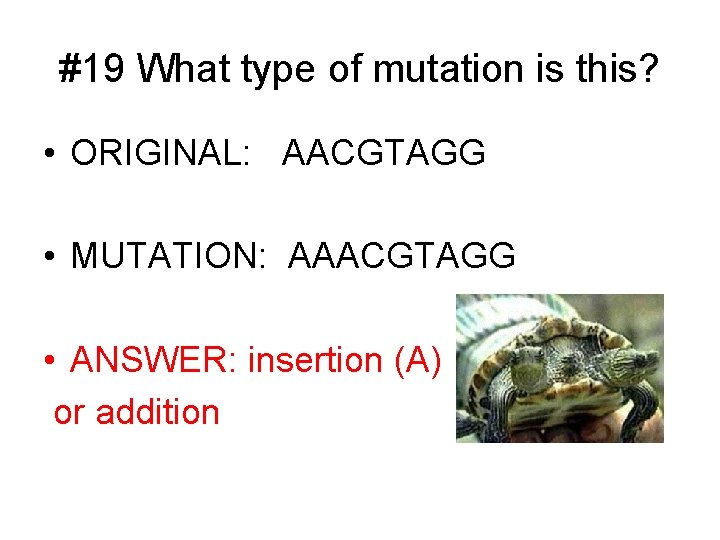
#19 What type of mutation is this? • ORIGINAL: AACGTAGG • MUTATION: AAACGTAGG • ANSWER: insertion (A) or addition
#19 What type of mutation is this? • ORIGINAL: AACGTAGG • MUTATION: AACGAGG • ANSWER: Deletion (T)
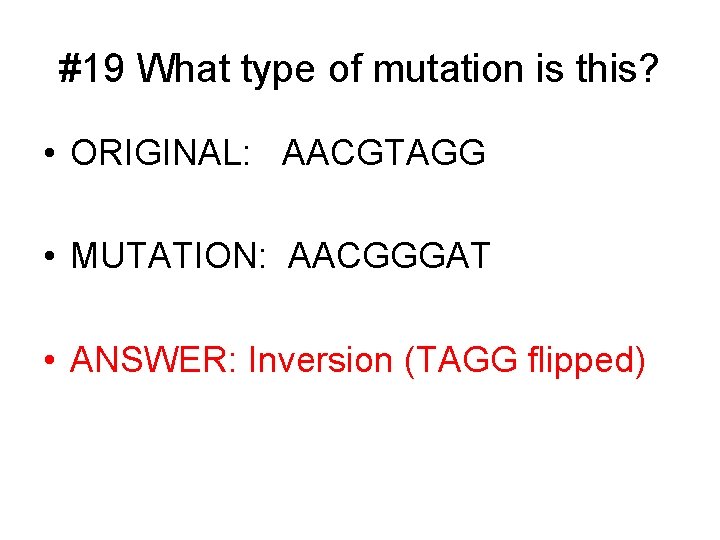
#19 What type of mutation is this? • ORIGINAL: AACGTAGG • MUTATION: AACGGGAT • ANSWER: Inversion (TAGG flipped)
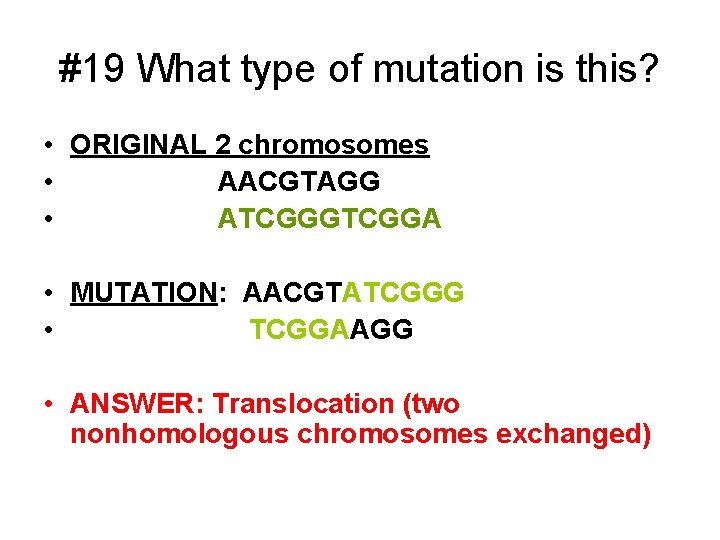
#19 What type of mutation is this? • ORIGINAL 2 chromosomes • AACGTAGG • ATCGGGTCGGA • MUTATION: AACGTATCGGG • TCGGAAGG • ANSWER: Translocation (two nonhomologous chromosomes exchanged)
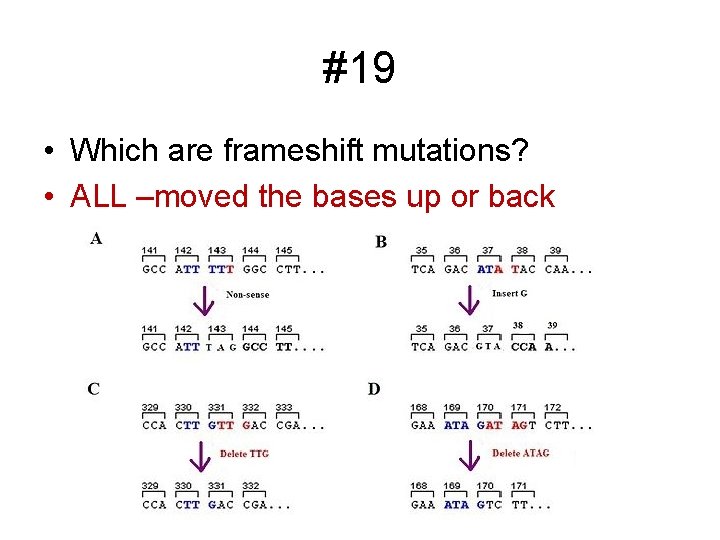
#19 • Which are frameshift mutations? • ALL –moved the bases up or back
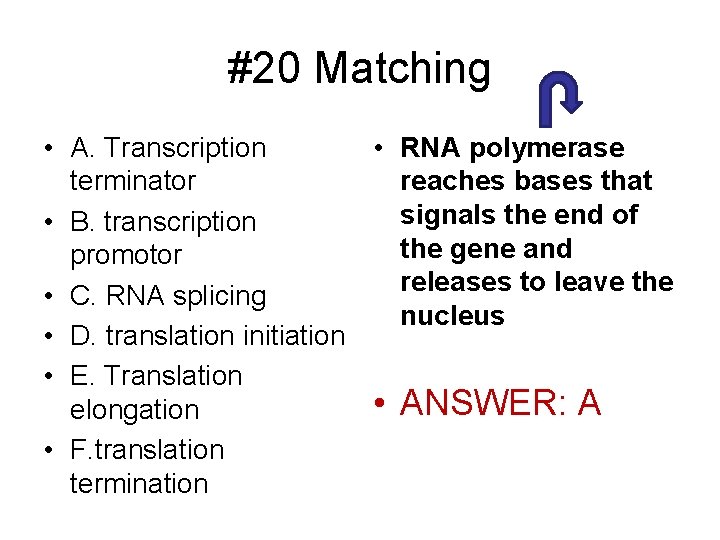
#20 Matching • A. Transcription • RNA polymerase terminator reaches bases that signals the end of • B. transcription the gene and promotor releases to leave the • C. RNA splicing nucleus • D. translation initiation • E. Translation • ANSWER: A elongation • F. translation termination
#20 Matching • A. Transcription • Ribosome terminator recognizes a STOP codon and releases • B. transcription the polypeptide promotor • C. RNA splicing • D. translation initiation • ANSWER: F • E. Translation elongation • F. translation termination
#20 Matching • A. Transcription • Successive t. RNA’s terminator add their amino acids to the • B. transcription polypeptide chain at promotor the ribosome • C. RNA splicing • D. translation initiation • E. Translation • ANSWER: E elongation • F. translation termination
#20 Matching • A. Transcription terminator • B. transcription promotor • C. RNA splicing • D. translation initiation • E. Translation elongation • F. translation termination • Cutting and pasting of the exons and introns to form a mature m. RNA • ANSWER: C
#20 Matching • A. Transcription terminator • B. transcription promotor • C. RNA splicing • D. translation initiation • E. Translation elongation • F. translation termination • The “start transcribing” signal in a nucleotide sequence + binding site for RNA polymerase • ANSWER: B
#20 Matching • A. Transcription terminator • B. transcription promotor • C. RNA splicing • D. translation initiation • E. Translation elongation • F. translation termination • The m. RNA and the first t. RNA and the ribosomal unit come together • ANSWER: D
#21 MATCH • • • A. Viroids B. Virions C. Prions D. emerging virus E. capsid • Misfolded proteins that destroy the brain (one cause is Mad Cow Disease) • ANSWER: C
#21 MATCH • • • A. Viroids B. Virions C. Prions D. emerging virus E. capsid • Small circular RNA molecules that infect plants • ANSWER: A
#21 MATCH • • • A. Viroids B. Virions C. Prions D. emerging virus E. capsid • Outer protein coat of a virus • ANSWER: E
#21 MATCH • • • A. Viroids B. Virions C. Prions D. emerging virus E. capsid • Suddenly appears or is new virus • ANSWER: E
#21 MATCH • • • A. Viroids B. Virions C. Prions D. emerging virus E. capsid • Pieces of the virus • ANSWER: E
#22 What is a retrovirus? • Transcribes from RNA to DNA • Reverse transcriptase is the enzyme that synthesizes DNA from RNA • The virus that causes AIDS is HIV
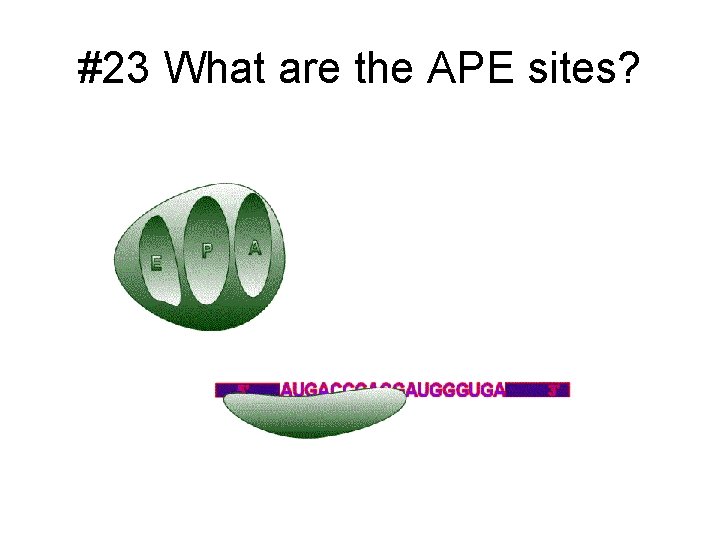
#23 What are the APE sites?
#23 • A- amino acid attaches to the ribosome • P- polypeptide forms as the amino acids join • E- polypeptide exits the ribosome
#24 • Uptake of foreign DNA from the surrounding environment • Transformation • Circular DNA in bacteria separate from its other DNA • plasmid
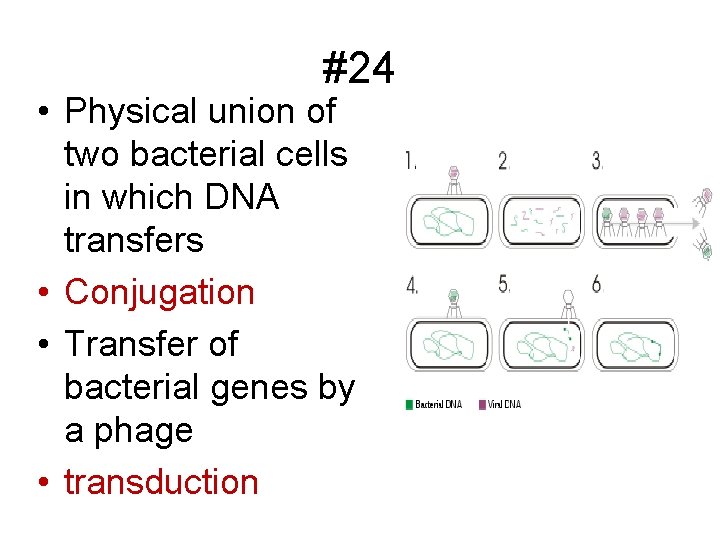
#24 • Physical union of two bacterial cells in which DNA transfers • Conjugation • Transfer of bacterial genes by a phage • transduction
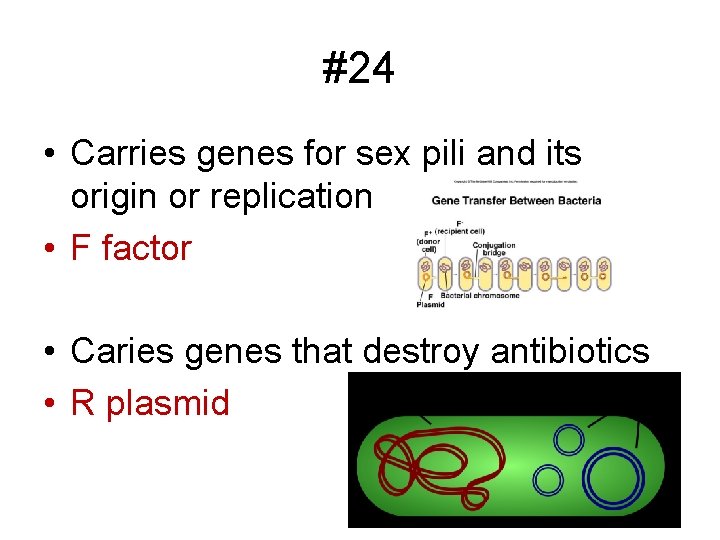
#24 • Carries genes for sex pili and its origin or replication • F factor • Caries genes that destroy antibiotics • R plasmid
- Slides: 85