
Hong Kong Institute of Educational Research MCL 6224
- Slides: 90
Hong Kong Institute of Educational Research MCL 6224: Issues in the Development of Liberal Studies
Levels of Development in Liberal Studies as a NSS School Subject in HKSAR z Development of Liberal Studies as an educational idea z Development of Liberal Studies as a curriculum in NSS education in HKSAR z Development of Liberal Studies as a pedagogical approach in NSS education in HKSAR z Development of Liberal Studies as policy measure to be implemented in HK school organization z Development of Liberal Studies as a school subject within the curricular structure within HK school organization z Development of Liberal Studies as classroominstruction practice in HK school organization
MCL 6224: Issue in the Development of Liberal Lecture 1 Development of the Idea of Liberal Education into the 21 st Century
Understanding the Meanings of Liberal Studies in HKSAR z The myth of Liberal Studies in language game of HKSAR education reform (2004) y Liberal Studies as the panacea of education in knowledge society
Understanding the Meanings of Liberal Studies in HKSAR z The myth of Liberal Studies in language game of HKSAR education reform y Liberal Studies as the panacea of education in knowledge society y Liberal Studies as disaster in HKSAR education reform
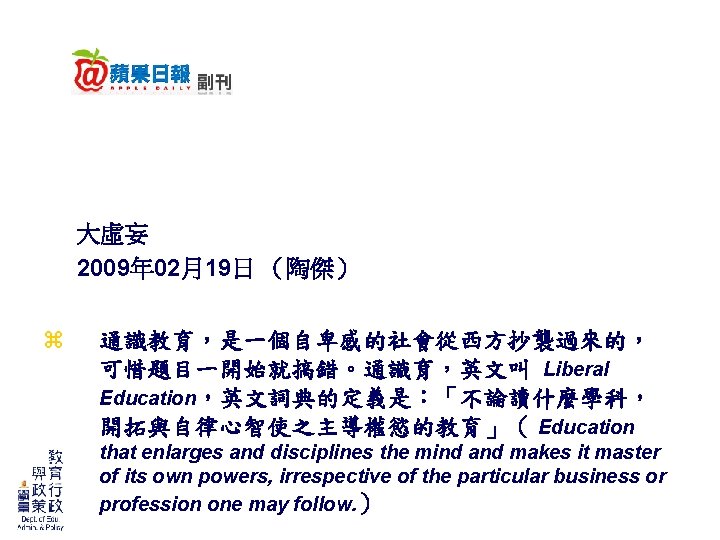
大虛妄 2009年 02月19日 (陶傑) z 通識教育,是一個自卑感的社會從西方抄襲過來的, 可惜題目一開始就搞錯。通識育,英文叫 Liberal Education,英文詞典的定義是:「不論讀什麼學科, 開拓與自律心智使之主導權慾的教育」( Education that enlarges and disciplines the mind and makes it master of its own powers, irrespective of the particular business or profession one may follow. )
Understanding the Meanings of Liberal Studies in HKSAR z Confusion of connotations of liberal studies y Liberal Studies y Liberal education y General Education y Liberal Arts Education
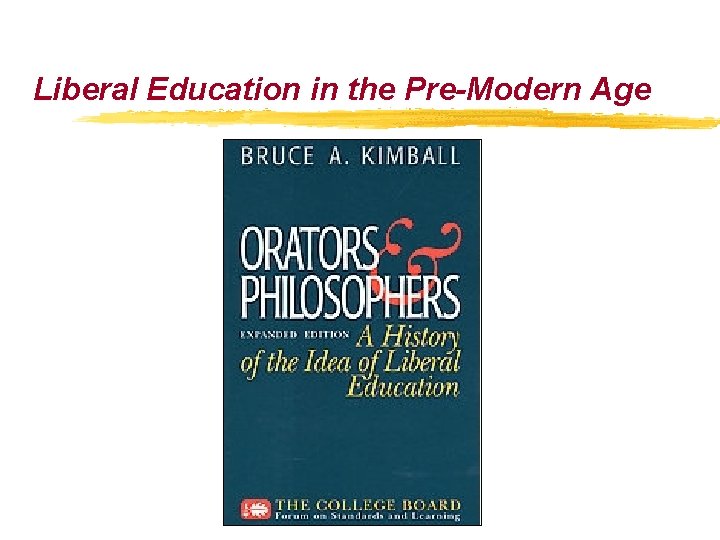
Liberal Education in the Pre-Modern Age
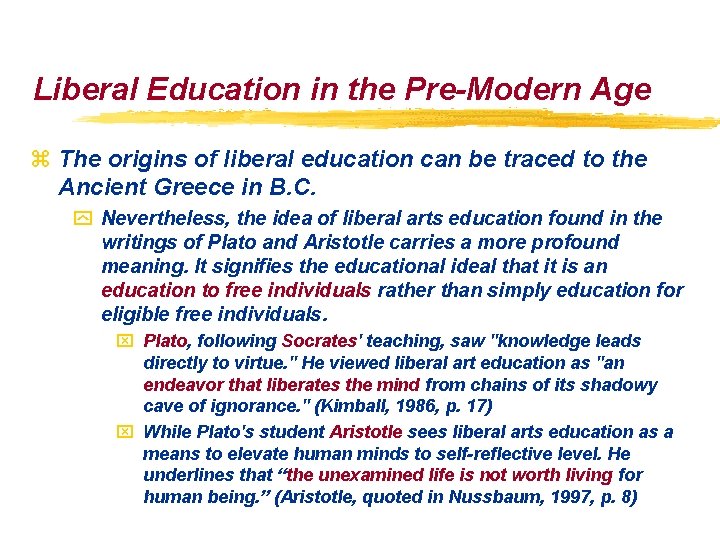
Liberal Education in the Pre-Modern Age z The origins of liberal education can be traced to the Ancient Greece in B. C. y Liberal art (artes liberalis in Greek) was understood as an education ideal underlining the idea of liberalis in Greek. It means “relating to freedom” or “fitted for freedom”. y Accordingly, liberal art education was understood as “education for free citizens” in the city-state of Ancient Greece. y However, in the political context of the Ancient Greece, which was built on a social system of slavery, liberal art education was in fact simply meant “education of free citizens with leisure to study” (Kimball, 1986, p. 14)
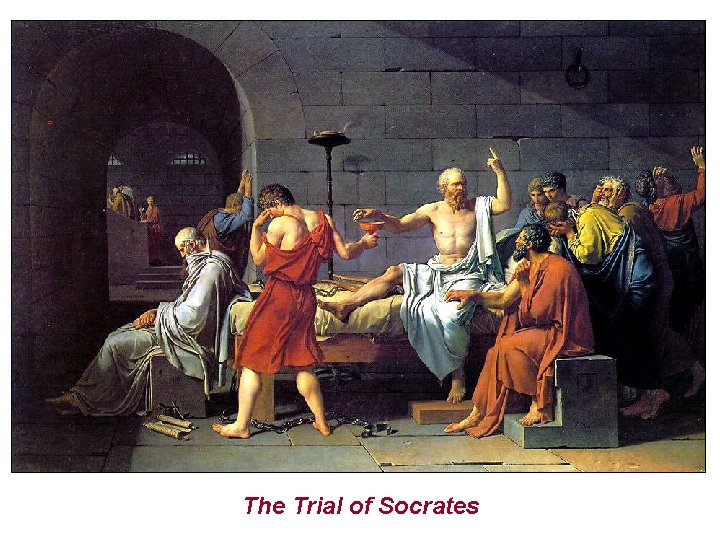
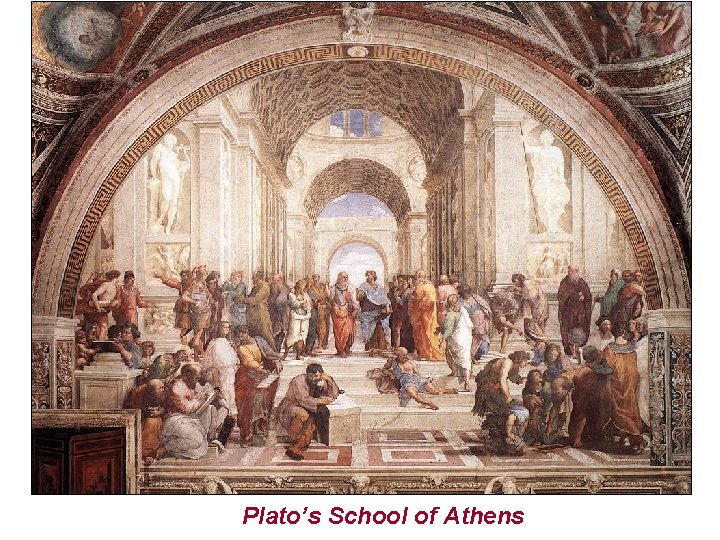
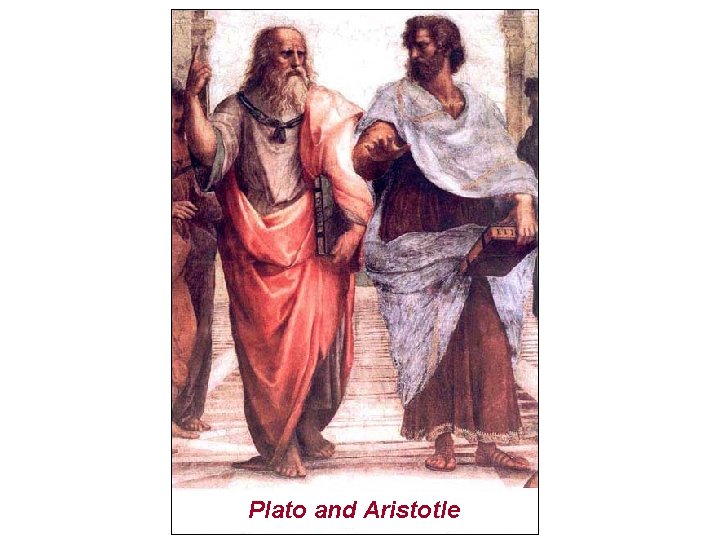
Liberal Education in the Pre-Modern Age z The origins of liberal education can be traced to the Ancient Greece in B. C. y Nevertheless, the idea of liberal arts education found in the writings of Plato and Aristotle carries a more profound meaning. It signifies the educational ideal that it is an education to free individuals rather than simply education for eligible free individuals. x Plato, following Socrates' teaching, saw "knowledge leads directly to virtue. " He viewed liberal art education as "an endeavor that liberates the mind from chains of its shadowy cave of ignorance. " (Kimball, 1986, p. 17) x While Plato's student Aristotle sees liberal arts education as a means to elevate human minds to self-reflective level. He underlines that “the unexamined life is not worth living for human being. ” (Aristotle, quoted in Nussbaum, 1997, p. 8)
The Trial of Socrates
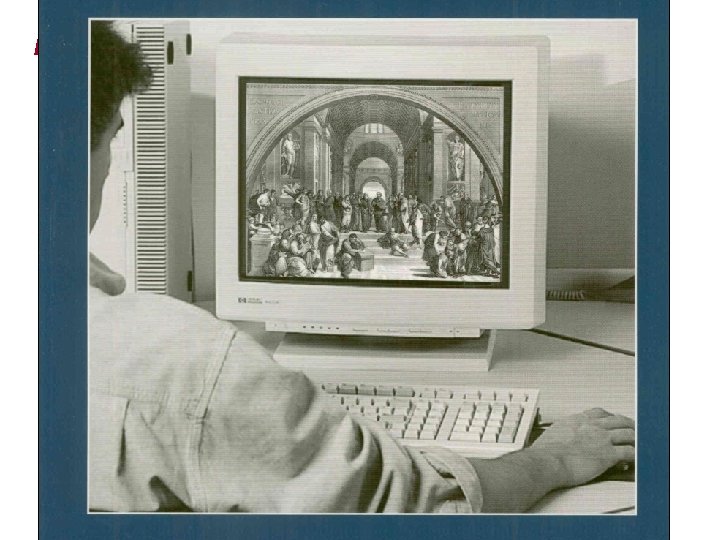
Plato’s School of Athens
Plato and Aristotle
Liberal Education in the Pre-Modern Age z The idea of trivium and quadrium in 5 th and 6 th century y During the Roman Empire in 5 th to sixth century, liberal arts education indicated a curriculum consisted of seven arts. They can further be divided into “trivium” and “quadrivium” y Trivium was made up of grammar, logic and rhetoric. They constituted the lower division of university studies in the Middle Age y Quadrivium composed arithmetic, geometry, music and astronomy. They constituted the upper division of university studies in the Middle Age. y Nevertheless, liberal arts education in this period was still confined to be education for the eligible few, i. e. Roman citizens.
Liberal Education in the Pre-Modern Age z After the fall of Roman Empire and the Barbarian invasion to Rome, the Roman’s idea of liberal art education of “trivium” and “quadrivium” came under the domination of Christianity or more specifically the Catholic Church in the Middle Ages from the sixth to sixteenth centuries. (Lawton and Gordon, 2002) University of Bologna was founded in the twelfth century. It was soon followed by such place as Paris, Oxford and Cambridge. However, these early universities "were developed as a response to the need for institutions to educate priests and monks. " (Lawton and Gordon, 2002, p. 51 -52)
Liberal Education in the Pre-Modern Age z The humanist of the Renaissance and the scientist of the Scientific Revolution in the sixteenth and seventeenth century respectively broke the pursuit of knowledge away from the domination of the Christianity worldview. y The movement of Renaissance humanism can be represented by Pico della Mirandola famous text entitled Oration on the Dignity of Man (1486) in which he emphasized “the genius of man. . . the unique and extraordinary ability of the human mind. ”
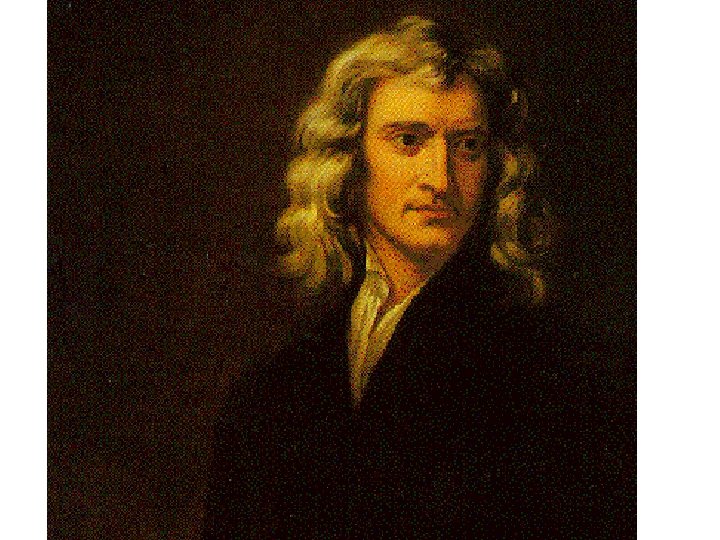
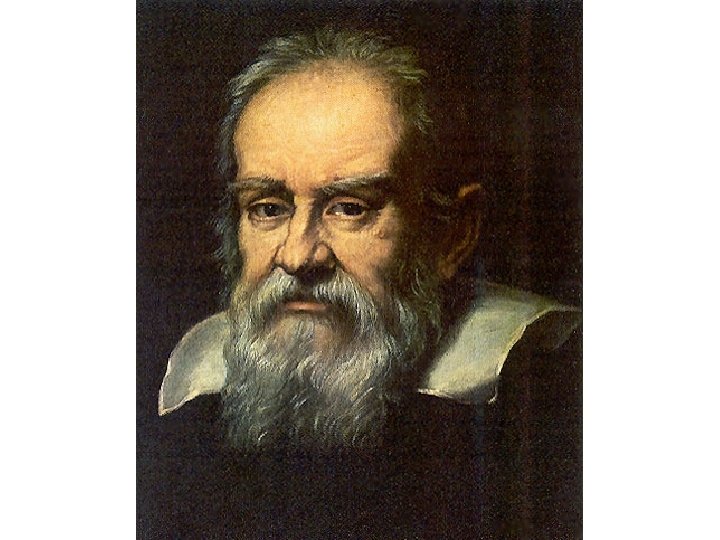
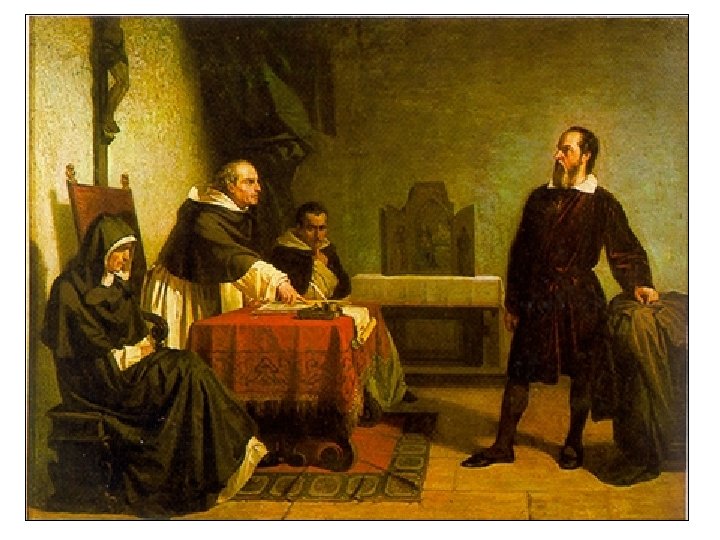
Liberal Education in the Pre-Modern Age z The humanist of the Renaissance and the scientist of the Scientific Revolution in the sixteenth and seventeenth century respectively broke the pursuit of knowledge away from the domination of the Christianity worldview. y The movement of Scientific Revolution can of course be signified by Galileo Galilei and Isaac Newton and their work. More specifically, it is Galilie’ conflict with the Catholic Church, which finally came down to the trial by the Inquisition in Rome in 1633, that signifies the liberation of scientific mind from the Christian doctrine, which subsequently brought about the movement of the Enlightenment and the advent of the Modern Age.
Liberal Education in the Modern Age: The Enlightenment z The idea of the Enlightenment: y According to Immanuel Kant’s definition, "Enlightenment is man's release from his self-incurred tutelage. Tutelage is man's inability to make use of his understanding without direction from another. Self-incurred is this tutelage when its cause lies not in lack of reason but in lack of resolution and courage to use it without direction from another. Sapere aude (Dare to know)! 'Have courage to use your own reason!' - that is the motto of enlightenment. " (Kant, 1959/1784, p. 85) Kant, I. (1959/1784) “ What is Enlightenment. ” Pp. 85 -92. In I. Kant. Foundations of the Metaphysics of Morals. Indianapolis: Bobbs-Merrill.
Liberal Education in the Modern Age: The Enlightenment z The idea of the Enlightenment: y At individual level, enlightened individual is a 'scholar' who possesses the mindset with "the propensity and vocation to free thinking" (Kant, 1996/1784, p. 92) and the ability "to make public use of one's reason at every point. " (Kant, 1959/1784, p. 87) y At societal level, enlightened social institutions should be structured in a way to guarantee "the freedom to make public use of one's reason" (p. 87) that is to "let every citizen …make his comments freely and publicly, i. e. , through writing, on the erroneous aspects of the present institution. " (p. 89) These institutions must submit themselves to be "subject to doubt before the public. " (p. 90)
Liberal Education in the Modern Age: The Enlightenment z The idea of the Enlightenment: y In connection to ideal of the Enlightenment, liberal education in the 18 th century took on an egalitarian meaning. It is the liberating and enlightening education for all human being and every human being is entitled to the "reasoning power. "
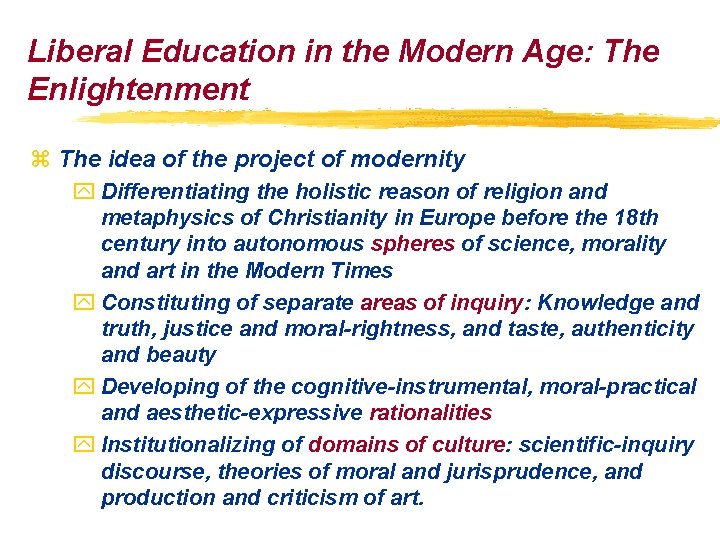
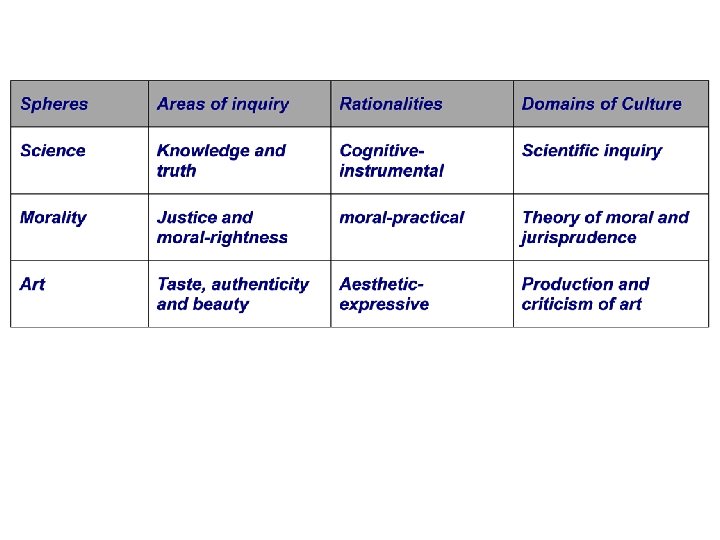
Liberal Education in the Modern Age: The Enlightenment z The idea of the project of modernity Jürgen Habermas' formulation of the project of modernity as collective efforts of human kinds, especially those in Europe in the 18 th century bearing the consequences of : Habermas, Jurgen (1981) Modernity versus Postmodernity. New German Critique 22: 3 -14.
Liberal Education in the Modern Age: The Enlightenment z The idea of the project of modernity y Differentiating the holistic reason of religion and metaphysics of Christianity in Europe before the 18 th century into autonomous spheres of science, morality and art in the Modern Times y Constituting of separate areas of inquiry: Knowledge and truth, justice and moral-rightness, and taste, authenticity and beauty y Developing of the cognitive-instrumental, moral-practical and aesthetic-expressive rationalities y Institutionalizing of domains of culture: scientific-inquiry discourse, theories of moral and jurisprudence, and production and criticism of art.
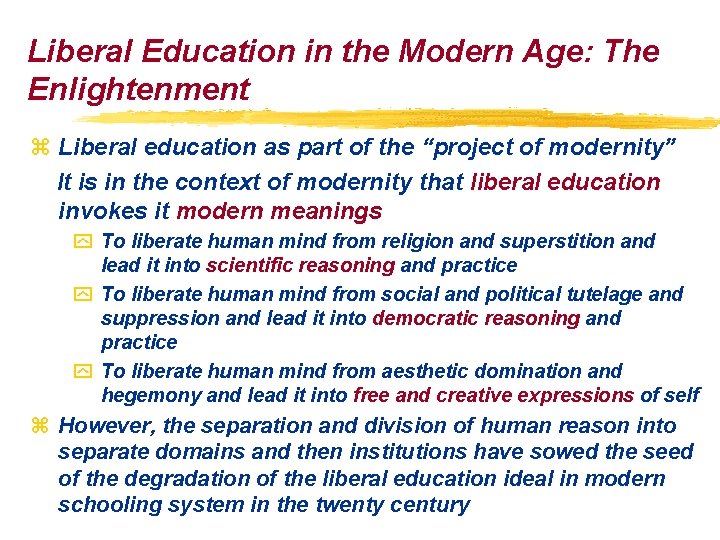
Liberal Education in the Modern Age: The Enlightenment z Liberal education as part of the “project of modernity” It is in the context of modernity that liberal education invokes it modern meanings y To liberate human mind from religion and superstition and lead it into scientific reasoning and practice y To liberate human mind from social and political tutelage and suppression and lead it into democratic reasoning and practice y To liberate human mind from aesthetic domination and hegemony and lead it into free and creative expressions of self z However, the separation and division of human reason into separate domains and then institutions have sowed the seed of the degradation of the liberal education ideal in modern schooling system in the twenty century
Liberal Education in Industrial Society z Max Weber's thesis of rationalization of education and training: y Industrialization and bureaucratization elicit complex division of labor in production process y Compartmentalization of skills and knowledge y System of knowledge was divided into separate disciplines y Constitution of regular curricula and standardized examination within each discipline
Liberal Education in Industrial Society z With the establishment of the University of Berlin in 1809 and its reorientation of the mission of university from teaching of Christian doctrine or established knowledge to scientific research and pursuit of new knowledge, the mind-liberating tradition of liberal art education found its retrieval in university education first in German and then in the US.
Liberal Education in Industrial Society z As U. S. universities, most notably Harvard, re-oriented their missions from the Oxbridge tradition of teaching of the Classics to the free pursuit of scientific knowledge, the single-standard curriculum for undergraduate study instituted in liberal art colleges in the U. S. was to be compartmentalized into specialties, streams and departments.
Liberal Education in Industrial Society z Charles W. Eliot president of Harvard from 1869 to 1909 introduce the idea of “free electives” to the undergraduate curriculum of the university. As a result, the range of courses offered was greatly expanded and schools and departments facilitating specializations were established in vast scale and speed. As for undergraduate students, they were permitted to choose freely from these vast varieties of systems of knowledge.
Liberal Education in Industrial Society z As Abbott L. Lowell replaced Eliot to be the president of Harvard in 1909, the free-elective system was replaced by the academic-major system. As a result, majorconcentration curriculum has become the dominant mode of study in undergraduate programs not only the U. S. but around the world.
The post-WWII Reform of General Education in U. S. Universities z As World War II came to an end, confronted by devastating effects of the Nazism of Germany, Fascism of Italy, and militarism of Japan, educators especially university educators were forced to reflect on the appropriateness of the education and knowledge that they felt fit to inculcate into the young generations. One of such reflection was to look hard into the curriculum of major-concentrated, specialized, professionalized, vocationalized and to some extent instrumentalized mode of study in most of the undergraduate programs in universities.
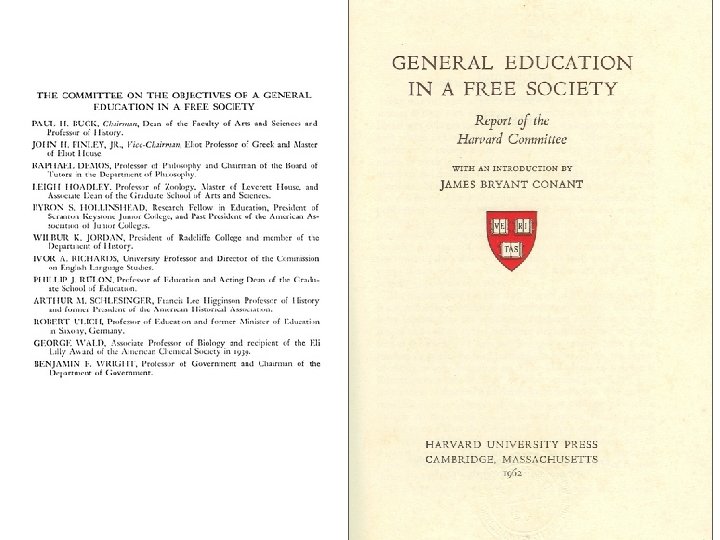
The post-WWII Reform of General Education in U. S. Universities z The Harvard Committee’s (HC) idea of General Education in a Free Society (1945) (HC Report) and its effort to reconcile the emerging conflict between disciplinary-knowledge and liberal education. y HC Report defines the general education as the modernized version of liberal education and the main difference between them is that general education attempts to universalize the liberal-education ideal to all citizens in a democratic society.
The post-WWII Reform of General Education in U. S. Universities z General Education in a Free Society (1945) y “Clearly, general education has somewhat the meaning of liberal education, except that, by applying to high school as to college. …If one cling to the root meaning of liberal as that which befits or helps to make free men, then general and liberal education have identical goals. ” (HC, 1945, p. 52) However, in order to universalize the ideal of liberal education in modern democratic society, educators are confronted by the structural contradiction between general and special education.
The post-WWII Reform of General Education in U. S. Universities z General Education in a Free Society (1945) y “The task of modern democracy is to preserve the ancient ideal of liberal education and to extend it as far as possible to all members of the community. …To believe in the equality of human beings is to believe that the good life, and the education which trains the citizen for the good life, are equally the privilege of all. And these are the touchstones of the liberated man: x First, is he free; that is to say, is able to judge and plan for himself, so that he can truly govern himself? In order to do this, his must be a mind capable of self-criticism; he must lead that self-examined life which according to Socrates is alone worthy of a free man. Thus he will possess in inner freedom, as well as social freedom.
The post-WWII Reform of General Education in U. S. Universities z General Education in a Free Society (1945) y “… And these are the touchstones of the liberated man: x Second, is he universal in his motives and sympathies? For the civilized man is a citizen of the entire universe; he has overcome provincialism, he is objective, and is a ‘spectator of all time and all existence. ’ Surely these two are the very aims of democracy itself. ” (HC, 1945, p. 53)
The post-WWII Reform of General Education in U. S. Universities z General Education in a Free Society (1945) y “We are living in an age of specialism. …Specialism is the means for advancement in our mobile social structure; yet we must envisage the fact that a society controlled wholly by specialists is not a wisely ordered society. We cannot, however, turn away from specialism. The problem is how to save general education and its values within a system where specialism is necessary. ” (HC, 1945, p. 53)
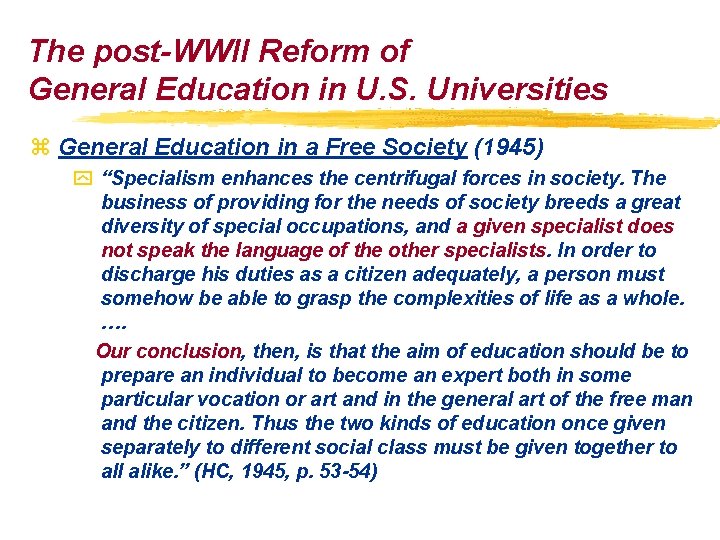
The post-WWII Reform of General Education in U. S. Universities z General Education in a Free Society (1945) y “Specialism enhances the centrifugal forces in society. The business of providing for the needs of society breeds a great diversity of special occupations, and a given specialist does not speak the language of the other specialists. In order to discharge his duties as a citizen adequately, a person must somehow be able to grasp the complexities of life as a whole. …. Our conclusion, then, is that the aim of education should be to prepare an individual to become an expert both in some particular vocation or art and in the general art of the free man and the citizen. Thus the two kinds of education once given separately to different social class must be given together to all alike. ” (HC, 1945, p. 53 -54)
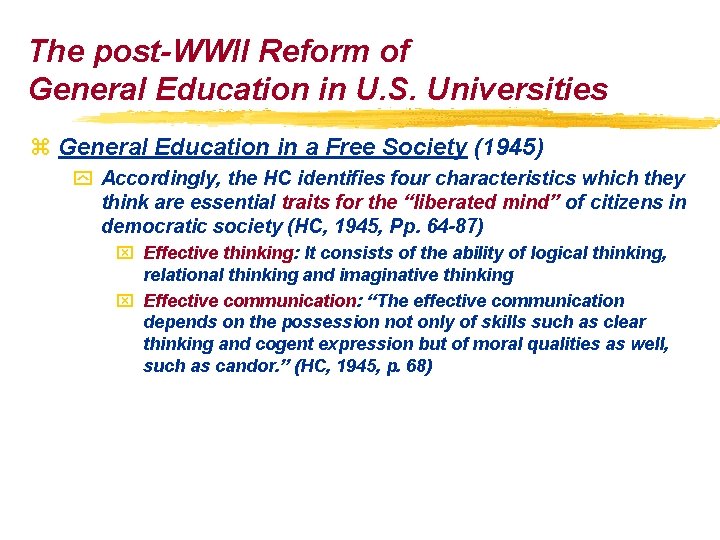
The post-WWII Reform of General Education in U. S. Universities z General Education in a Free Society (1945) y Accordingly, the HC identifies four characteristics which they think are essential traits for the “liberated mind” of citizens in democratic society (HC, 1945, Pp. 64 -87) x Effective thinking: It consists of the ability of logical thinking, relational thinking and imaginative thinking x Effective communication: “The effective communication depends on the possession not only of skills such as clear thinking and cogent expression but of moral qualities as well, such as candor. ” (HC, 1945, p. 68)
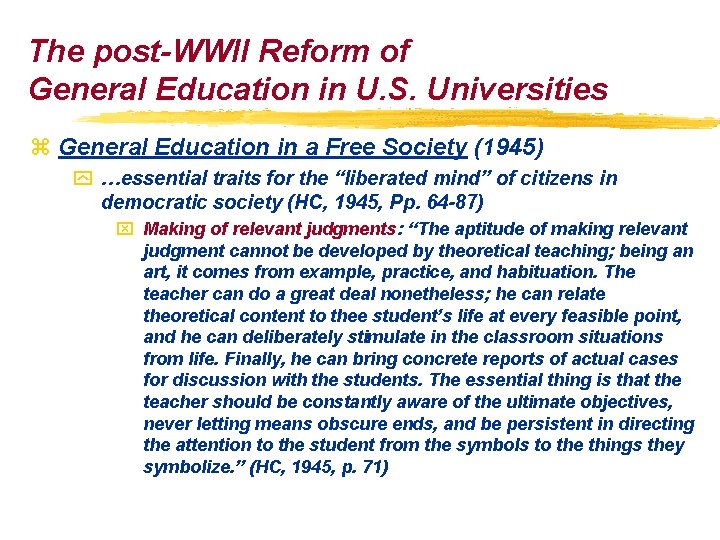
The post-WWII Reform of General Education in U. S. Universities z General Education in a Free Society (1945) y …essential traits for the “liberated mind” of citizens in democratic society (HC, 1945, Pp. 64 -87) x Making of relevant judgments: “The aptitude of making relevant judgment cannot be developed by theoretical teaching; being an art, it comes from example, practice, and habituation. The teacher can do a great deal nonetheless; he can relate theoretical content to thee student’s life at every feasible point, and he can deliberately stimulate in the classroom situations from life. Finally, he can bring concrete reports of actual cases for discussion with the students. The essential thing is that the teacher should be constantly aware of the ultimate objectives, never letting means obscure ends, and be persistent in directing the attention to the student from the symbols to the things they symbolize. ” (HC, 1945, p. 71)
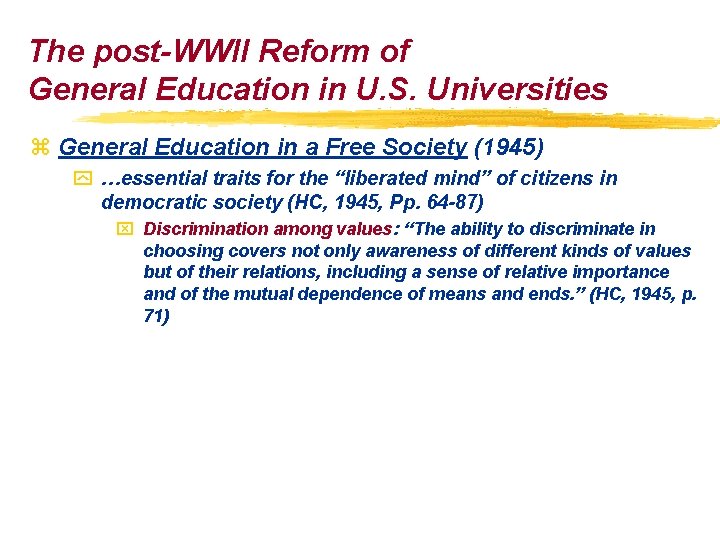
The post-WWII Reform of General Education in U. S. Universities z General Education in a Free Society (1945) y …essential traits for the “liberated mind” of citizens in democratic society (HC, 1945, Pp. 64 -87) x Discrimination among values: “The ability to discriminate in choosing covers not only awareness of different kinds of values but of their relations, including a sense of relative importance and of the mutual dependence of means and ends. ” (HC, 1945, p. 71)
The post-WWII Reform of General Education in U. S. Universities z Similarly, two other universities in the US had also produced substantive reports on reforms of their general education curriculum, namely the University of Chicago (1950) The Idea and Practice of General Education and Columbia University (1966) The Reforming of General Education.
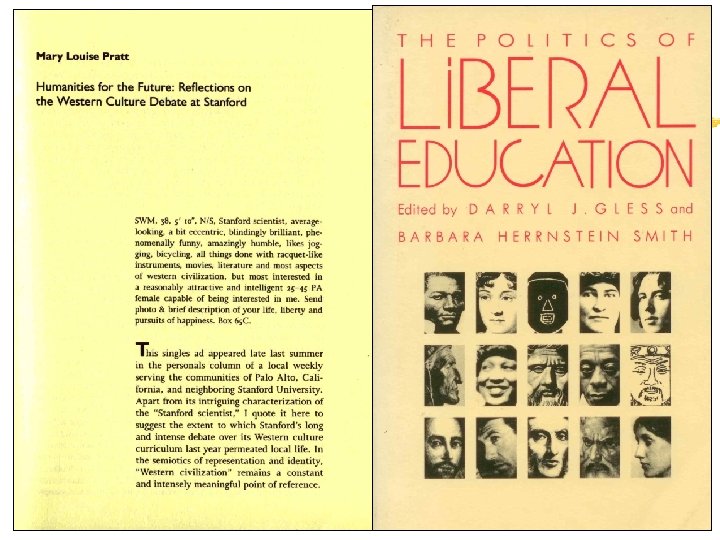
Debates and Reflection on “Western Civilization” in General Education in US higher education z The debate on the required course of Western civilization in Stanford University in the 1980 s y The issue of the “Core Reading List” for the year-long required course Western Civilization
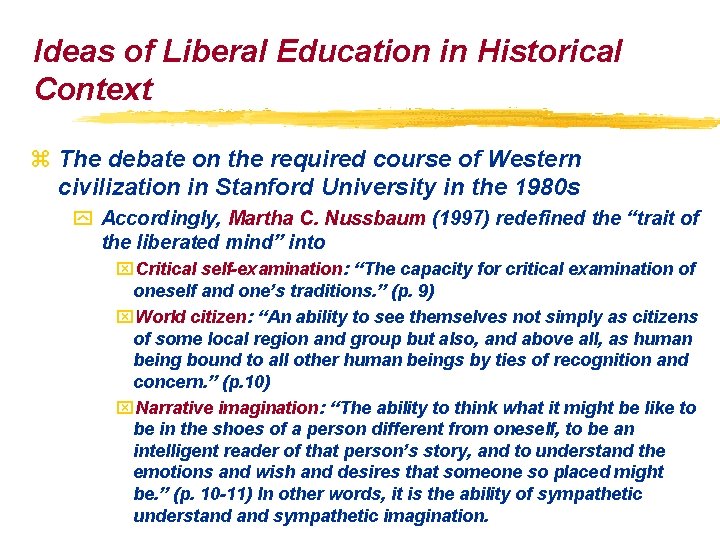
Ideas of Liberal Education in Historical Context z The debate on the required course of Western civilization in Stanford University in the 1980 s y The issue of the “Core Reading List” for the year-long required course on Western Civilization y The list was criticized as ethnocentric in several terms, i. e. Eurocentric, male-centric and Christian-centric. y The outcome of the debate is the input of sensitivity and reflectivity to multiculturalism into the curriculum of nurturing liberated minds
Ideas of Liberal Education in Historical Context z The debate on the required course of Western civilization in Stanford University in the 1980 s y Accordingly, Martha C. Nussbaum (1997) redefined the “trait of the liberated mind” into x. Critical self-examination: “The capacity for critical examination of oneself and one’s traditions. ” (p. 9) x. World citizen: “An ability to see themselves not simply as citizens of some local region and group but also, and above all, as human being bound to all other human beings by ties of recognition and concern. ” (p. 10) x. Narrative imagination: “The ability to think what it might be like to be in the shoes of a person different from oneself, to be an intelligent reader of that person’s story, and to understand the emotions and wish and desires that someone so placed might be. ” (p. 10 -11) In other words, it is the ability of sympathetic understand sympathetic imagination.
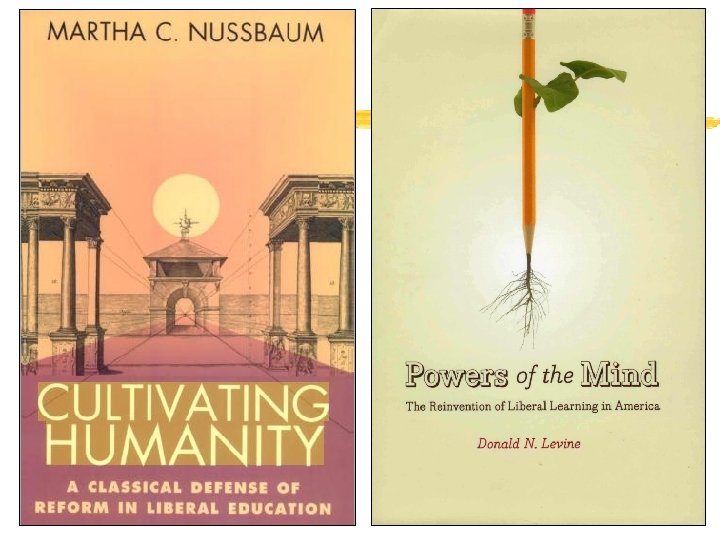
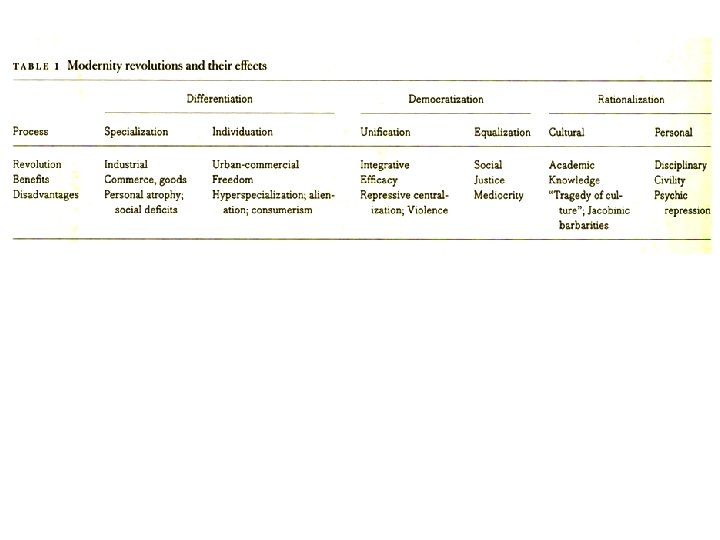
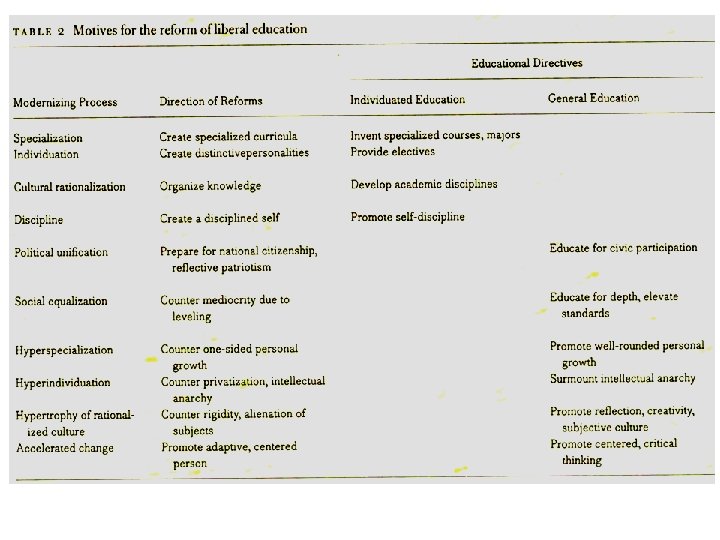
Ideas of Liberal Education in Historical Context z Donald N. Levine reinstates the aim and value of liberal education in the 21 st century in his book Powers of the Mind: The Reinvention of Liberal Learning in American. y Modernity revolution and its effects y Reform agenda of liberal education
Liberal Education in 21 st Century y Donald N. Levine in his book Powers of the Mind: The Reinvention of Liberal Learning in American, x. Reform agenda of liberal education
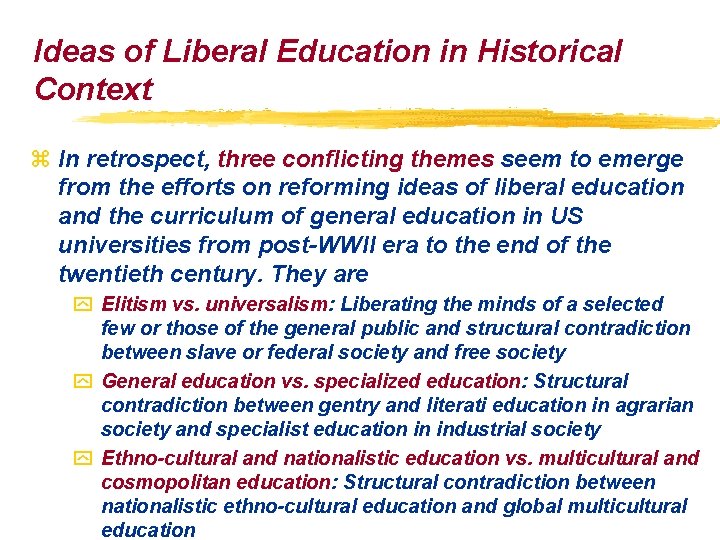
Ideas of Liberal Education in Historical Context z In retrospect, three conflicting themes seem to emerge from the efforts on reforming ideas of liberal education and the curriculum of general education in US universities from post-WWII era to the end of the twentieth century. They are y Elitism vs. universalism: Liberating the minds of a selected few or those of the general public and structural contradiction between slave or federal society and free society y General education vs. specialized education: Structural contradiction between gentry and literati education in agrarian society and specialist education in industrial society y Ethno-cultural and nationalistic education vs. multicultural and cosmopolitan education: Structural contradiction between nationalistic ethno-cultural education and global multicultural education
Liberal Education in the 21 st Century
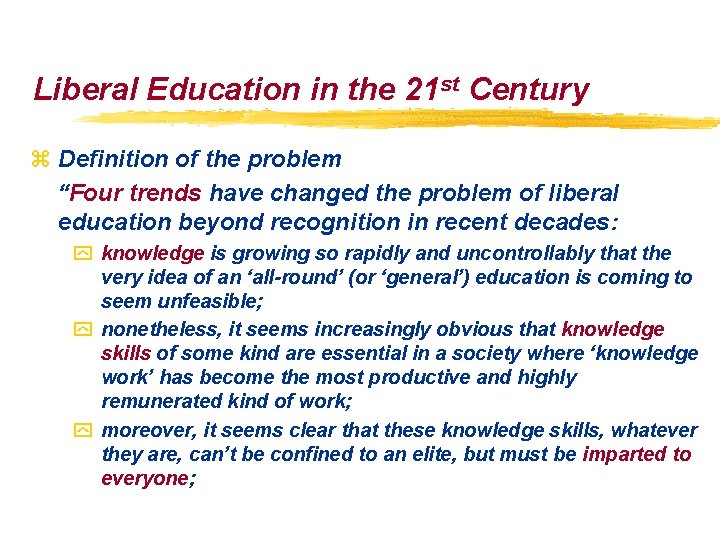
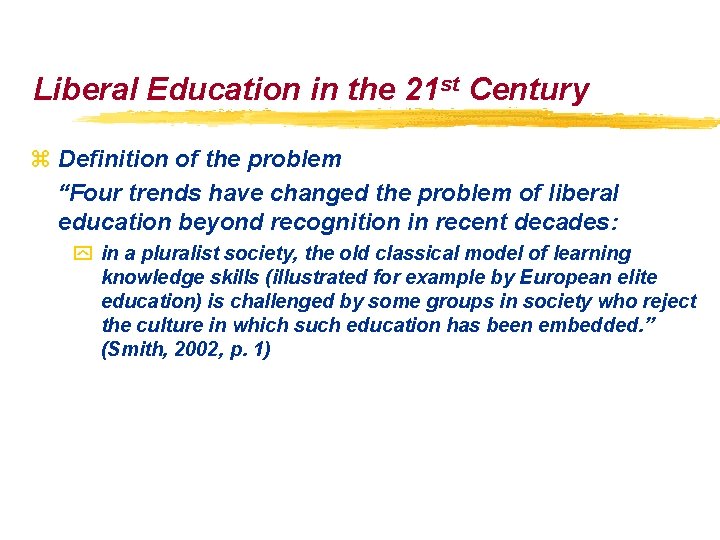
Liberal Education in the 21 st Century z Definition of the problem “Four trends have changed the problem of liberal education beyond recognition in recent decades: y knowledge is growing so rapidly and uncontrollably that the very idea of an ‘all-round’ (or ‘general’) education is coming to seem unfeasible; y nonetheless, it seems increasingly obvious that knowledge skills of some kind are essential in a society where ‘knowledge work’ has become the most productive and highly remunerated kind of work; y moreover, it seems clear that these knowledge skills, whatever they are, can’t be confined to an elite, but must be imparted to everyone;
Liberal Education in the 21 st Century z Definition of the problem “Four trends have changed the problem of liberal education beyond recognition in recent decades: y in a pluralist society, the old classical model of learning knowledge skills (illustrated for example by European elite education) is challenged by some groups in society who reject the culture in which such education has been embedded. ” (Smith, 2002, p. 1)
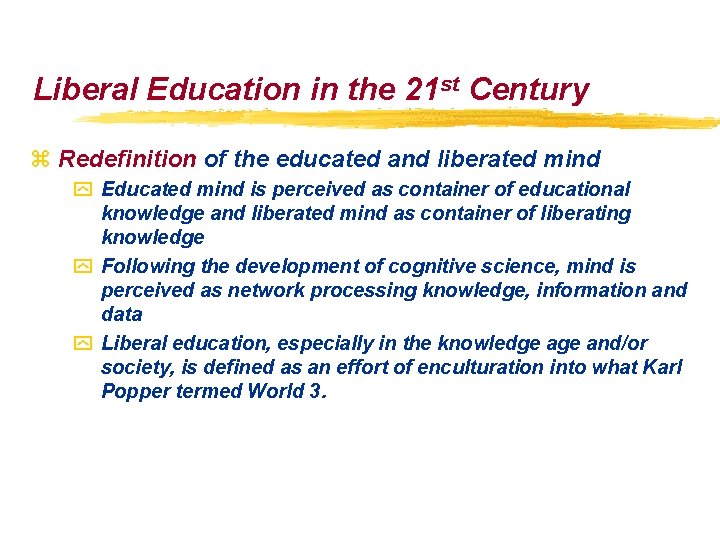
Liberal Education in the 21 st Century z Redefinition of the educated and liberated mind y Educated mind is perceived as container of educational knowledge and liberated mind as container of liberating knowledge y Following the development of cognitive science, mind is perceived as network processing knowledge, information and data y Liberal education, especially in the knowledge and/or society, is defined as an effort of enculturation into what Karl Popper termed World 3.
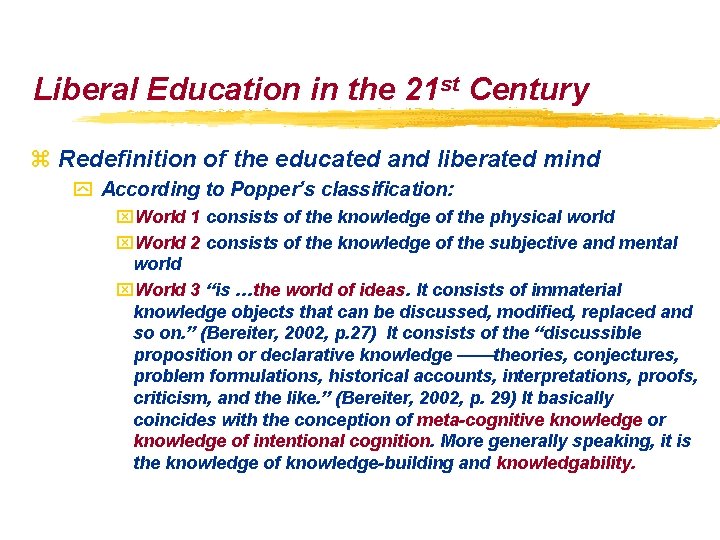
Liberal Education in the 21 st Century z Redefinition of the educated and liberated mind y According to Popper’s classification: x. World 1 consists of the knowledge of the physical world x. World 2 consists of the knowledge of the subjective and mental world x. World 3 “is …the world of ideas. It consists of immaterial knowledge objects that can be discussed, modified, replaced and so on. ” (Bereiter, 2002, p. 27) It consists of the “discussible proposition or declarative knowledge theories, conjectures, problem formulations, historical accounts, interpretations, proofs, criticism, and the like. ” (Bereiter, 2002, p. 29) It basically coincides with the conception of meta-cognitive knowledge or knowledge of intentional cognition. More generally speaking, it is the knowledge of knowledge-building and knowledgability.
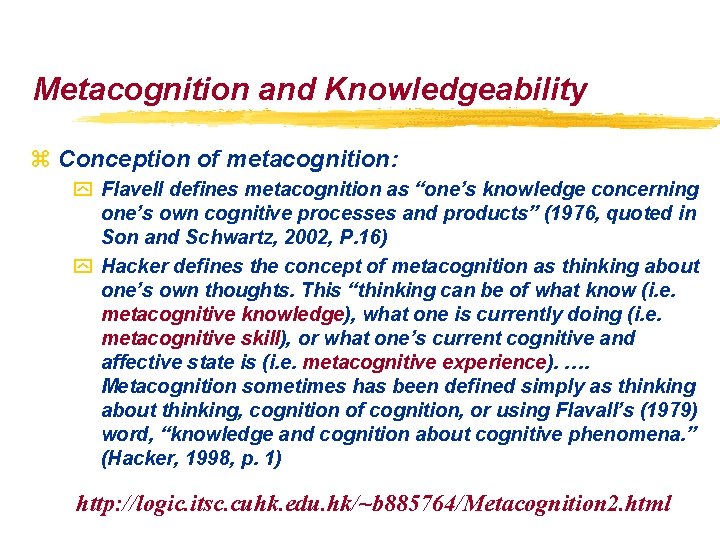
Metacognition and Knowledgeability z Conception of metacognition: y Flavell defines metacognition as “one’s knowledge concerning one’s own cognitive processes and products” (1976, quoted in Son and Schwartz, 2002, P. 16) y Hacker defines the concept of metacognition as thinking about one’s own thoughts. This “thinking can be of what know (i. e. metacognitive knowledge), what one is currently doing (i. e. metacognitive skill), or what one’s current cognitive and affective state is (i. e. metacognitive experience). …. Metacognition sometimes has been defined simply as thinking about thinking, cognition of cognition, or using Flavall’s (1979) word, “knowledge and cognition about cognitive phenomena. ” (Hacker, 1998, p. 1) http: //logic. itsc. cuhk. edu. hk/~b 885764/Metacognition 2. html
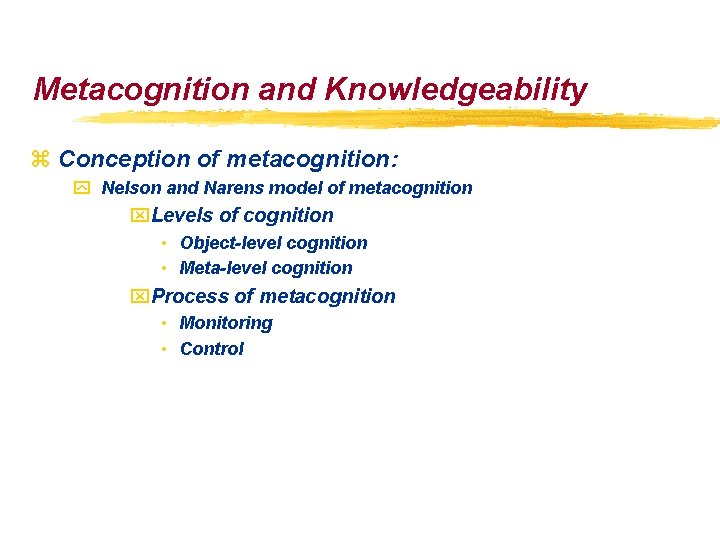
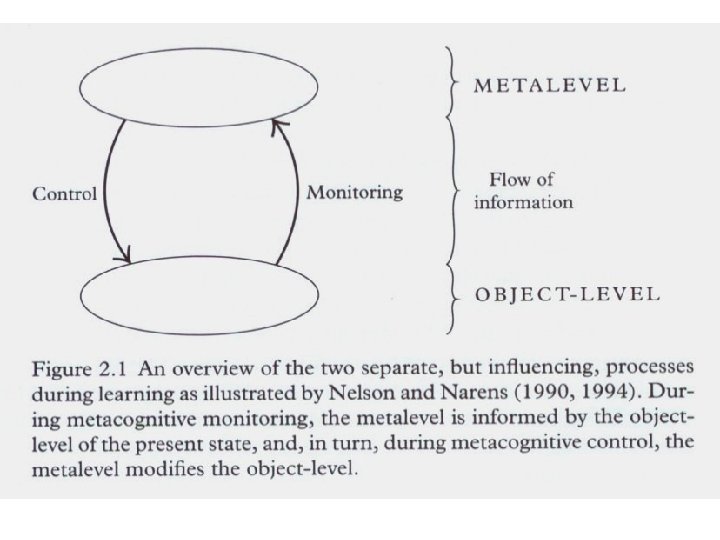
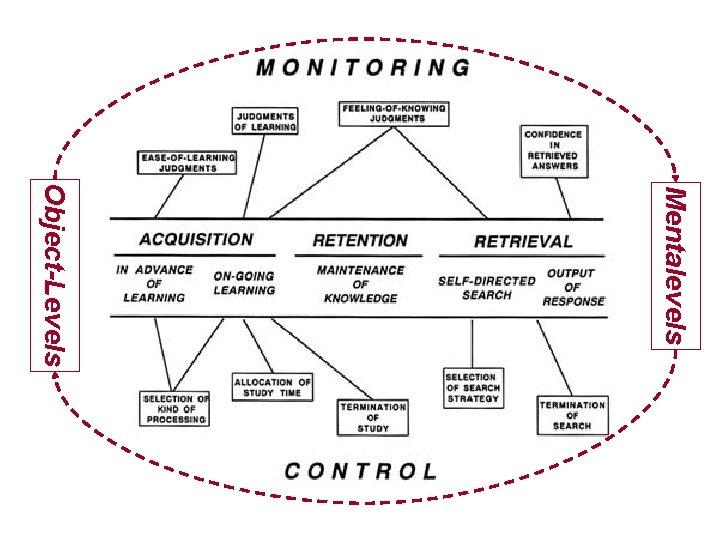
Metacognition and Knowledgeability z Conception of metacognition: y Nelson and Narens model of metacognition x. Levels of cognition • Object-level cognition • Meta-level cognition x. Process of metacognition • Monitoring • Control
Mentalevels Object-Levels
The Curriculum Code of Liberal Studies in Secondary-School Education 1. Basil Bernstein’s Framework of School Curriculum
The Curriculum Code of Liberal Studies in Secondary-School Education z “Formal educational knowledge can be considered to be realized through three message systems: curriculum, pedagogy and evaluation. Curriculum defined what counts as valid knowledge, pedagogy defines what counts as a valid transmission of knowledge, and evaluation defines what counts as a valid realization of this knowledge on the part of the taught. ” (Bernstein, 1971, p. 47)
The Curriculum Code of Liberal Studies in Secondary-School Education z “How a society selects, classifies, distributes, transmits and evaluates the educational knowledge it considers to be public, reflects both the distribution of power and the principles of social control. From this point of view, differences within and changes in the organization, transmission and evaluation of educational knowledge should be a major area of sociological interest. ” (Bernstein, 1971, p. 47)
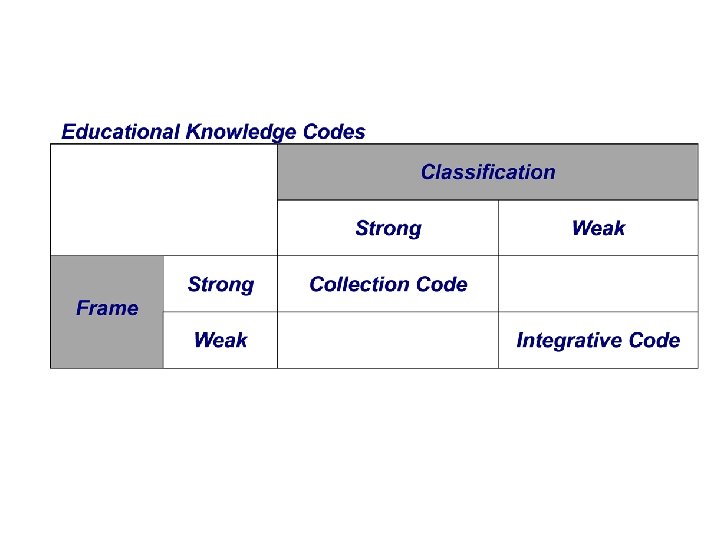
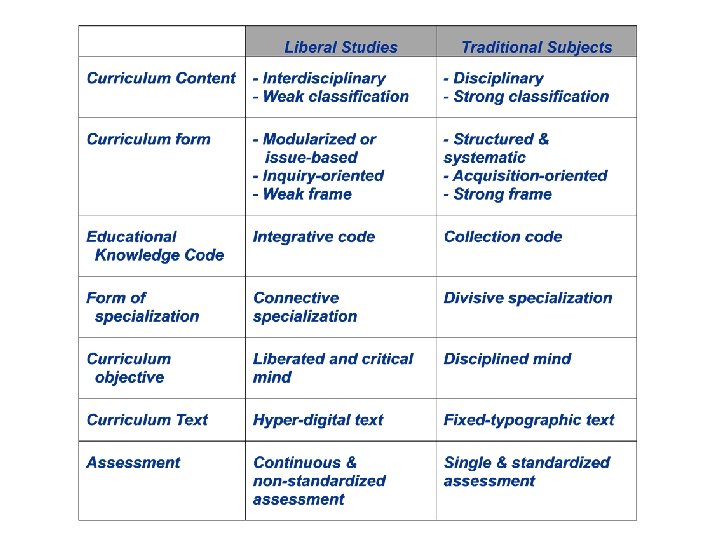
The Curriculum Code of Liberal Studies in Secondary-School Education z Understanding the educational knowledge code of curricula in secondary education y Classification: According to Bernstein's formulation, classification “refers …the relationships between contents. …Where classification is strong, contents are well insulated from each other by strong boundaries. Where classification is weak, there is reduced insulation between contents for the boundaries between contents are weak or blurred. " (p. 49) y For example, relationships between subject-contents in HKCEE and HKALE, such as physics, chemistry, biology, economics, and history, are insulated from each others and also insulated into science or humanities streams. Therefore, they can be perceived as organized in "strong classification.
The Curriculum Code of Liberal Studies in Secondary-School Education z Understanding the educational knowledge code of curricula in secondary education y Frame: "The concept of frame is used to determine the structure of the message system pedagogy. Frame refers to the form of the context in which knowledge is transmitted and received. Frame refers to specific pedagogical relationship of teacher and taught. …Where framing is strong there is sharp boundary, where framing is weak a blurred boundary, between what may be and what may not be transmitted. Frame refers us to the range of options available to teacher and taught in the control of what is transmitted and received in the context of the pedagogical relationship. " (p. 50)
The Curriculum Code of Liberal Studies in Secondary-School Education z Understanding the educational knowledge code of curricula in secondary education y For example, the pedagogical relationships between teachers and taught much stronger in science subjects such as physics, chemistry, and biology than that in Liberal Studies. In Liberal Studies, the pedagogical relationships are characterized as "Issue Inquiry Approach" in which both teachers and taught enjoy much greater control on what can be or cannot be included.
The Curriculum Code of Liberal Studies in Secondary-School Education z Understanding the educational knowledge code y Educational knowledge code: It "refers to the underlying principles that shape curriculum, pedagogy, and evaluation. …The form this code takes depends upon social principles which regulate the classification and framing of knowledge made public in educational institution. " (p. 47 -48)
The Curriculum Code of Liberal Studies in Secondary-School Education z Understanding the educational knowledge code y Bernstien further differentiates educational knowledge code into two types x. Collection code: It refers to the “organization of educational knowledge that involves strong classification” in relationships between curriculum-contents (p. 51). It further gives rise to strong frame in the pedagogical relationships between teacher and taught. Finally it will most probably entail “the evaluative system places an emphasis upon attaining states of knowing rather than ways of knowing. ” (p. 57) In this kind of examination, the examinees are only required to recall specific sets of knowledge and information rather than to demonstrate “ways of knowing”.
The Curriculum Code of Liberal Studies in Secondary-School Education z Understanding the educational knowledge code y Bernstien further differentiates educational knowledge code into two types x. Collection code: Within the collection code of educational knowledge, there constitutes particular kinds of power relationship and identity. • The power relationships constituted in the three message systems are hierarchical and rigid. Occupants in the subordinate levels, such as the pupils, are under tight if not complete control from superior levels. “The stronger the classification and the framing, the more the educational relationship tends to be hierarchical and ritualized and the pupil seen as ignorant, with little status and few rights. ” (p. 58) • Within this type of educational knowledge, the identities of the participants, such as those of the teacher and taught, are definite, strong or even rigid. They basically command a kind of “subject loyalty” in their pupils as well as teachers. (p. 55)
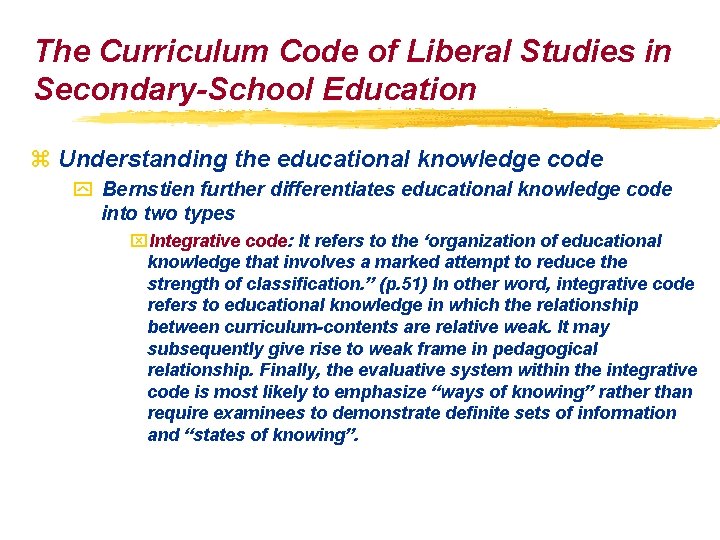
The Curriculum Code of Liberal Studies in Secondary-School Education z Understanding the educational knowledge code y Bernstien further differentiates educational knowledge code into two types x. Integrative code: It refers to the ‘organization of educational knowledge that involves a marked attempt to reduce the strength of classification. ” (p. 51) In other word, integrative code refers to educational knowledge in which the relationship between curriculum-contents are relative weak. It may subsequently give rise to weak frame in pedagogical relationship. Finally, the evaluative system within the integrative code is most likely to emphasize “ways of knowing” rather than require examinees to demonstrate definite sets of information and “states of knowing”.
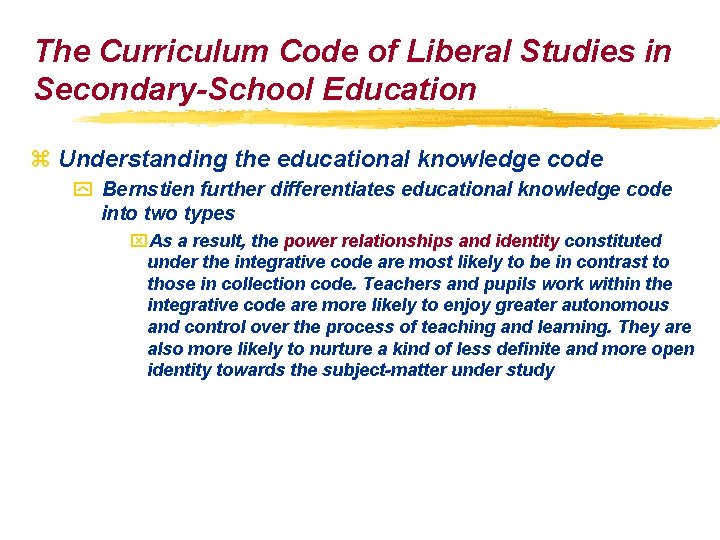
The Curriculum Code of Liberal Studies in Secondary-School Education z Understanding the educational knowledge code y Bernstien further differentiates educational knowledge code into two types x. As a result, the power relationships and identity constituted under the integrative code are most likely to be in contrast to those in collection code. Teachers and pupils work within the integrative code are more likely to enjoy greater autonomous and control over the process of teaching and learning. They are also more likely to nurture a kind of less definite and more open identity towards the subject-matter under study
The Curriculum Code of Liberal Studies in Secondary-School Education 2. Michael Young’s Thesis on the School Curriculum for the 21 st Century
The Curriculum Code of Liberal Studies in Secondary-School Education z Young makes a distinction between curricula of divisive specialization and connective specialization in analyzing the curricular structure of post-compulsory and A-level education in England Wales
The Curriculum Code of Liberal Studies in Secondary-School Education z. Curriculum of divisive specialization y It refers to curriculum in post- compulsory education which corresponds with the mode of production of Fordism, which bears the following features: x Rigid insulation between manual and non-manual labor x Rigid sectional form of divisive specialization among occupational and professional groups x Complex division of labor into mechanical, repetitive and observable motions x Separation between conception and execution of work x Strict Hierarchical structure of delegation of authority and line of commands
The Curriculum Code of Liberal Studies in Secondary-School Education z. Curriculum of divisive specialization y In connection to the mode of production of Fordism, the curriculum of in post-compulsory and A-level education is organized in the form of what Young called "divisive specialization" x Sharpe separation between academic study and vocational training x Sharpe division among curricular streams, such as science, humanities and social study x Selective and exclusive rather than participating and inclusive education system x Inflexible in movement and transferring between divisions and streams x Exaggerate differences between high low prestigious institutions and programs
The Curriculum Code of Liberal Studies in Secondary-School Education z. Curriculum in connective specialization y It refers to curriculum, which Young advocates would be advantageous to the labor formation of the economy of the 21 st century, which bears the following structural attributes x Flexible specialization of production and greatly decrease the division between manual and non-manual labor both in scale and scope x Sectional specialization was replaced by corporate specialization, which encouraging vertical integration among different occupational and professional groups within corporations. x New information-based technology replacing mechanical and repetitive motions of human labor x Human-centred organization and flatter management structure x Interactively integration between conception and execution of work in models such as quality circles, quality terms, learning community
The Curriculum Code of Liberal Studies in Secondary-School Education z. Curriculum in connective specialization y In relation to the mode of production of post-Fordism, Young suggests that school curriculum for the 21 st century should be in the form of “connective specialization” x Connective specialization “as a curriculum concept it points to the interdependence of the concept, processes, and organization of curriculum. As definition of educational purposes it seeks to transcend the traditional dichotomy of ‘the educated person’ (academic and non-manual) and ‘the competent employee’ (vocational and manual) which define the purposes of the two tracks of a divided curriculum. ” (Young, 1998, p. 78)
The Curriculum Code of Liberal Studies in Secondary-School Education z. Curriculum in connective specialization y In relation to the mode of production of post-Fordism, Young suggests that school curriculum for the 21 st century should be in the form of “connective specialization” x It therefore "provides the basis a very different curriculum for the future" which he terms "connective specialization". "Such a curriculum …would need to build on and give specificity to the principles of: • breadth and flexibility • connections between both core and specialist studies and general (academic) and applied (vocational) studies • opportunities for progression and credit transfer • a clear sense of the purpose of the curriculum as a whole. " (Young, 1998, p. 79)
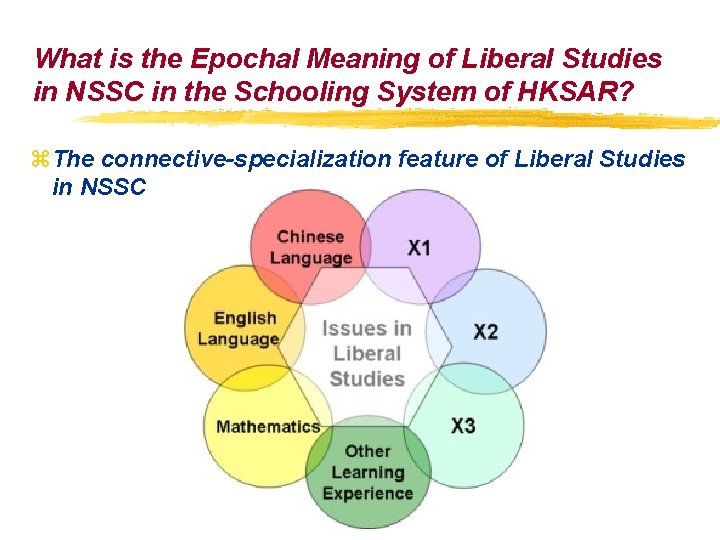
What is the Epochal Meaning of Liberal Studies in NSSC in the Schooling System of HKSAR? z. The connective-specialization feature of Liberal Studies in NSSC
What is the Epochal Meaning of Liberal Studies in NSSC in the Schooling System of HKSAR? z. The relative definitive features of Liberal Studies
Lecture 1 Development of Idea of Liberal Education END