
Hong Kong Ecommerce Readiness APEC Ecommerce Readiness Assessment
- Slides: 12
Hong Kong E-commerce Readiness
APEC E-commerce Readiness Assessment Guide • A self-assessment tool for use by economies in the Asia Pacific Economic Co -operation in assessing their e-commerce readiness • The assessment helps identify actions needed to improve e-commerce environment and facilitates dialogue between government and businesses 2
APEC E-commerce Readiness Assessment Guide • APEC strongly encourages member economies to make use of the Guide on a voluntary basis • So far, Australia, Chinese Taipei, Hong Kong, Japan, Korea, Malaysia, New Zealand, Peru, the Philippines, Thailand, the US, etc. have committed to use the Guide • Hong Kong has conducted the self-assessment in June 2000 3
Readiness Assessment E-commerce Readiness is assessed in terms of six broad indicators • telecommunication infrastructure and technology base • access and supporting services • current level and type of use of the Internet • promotion and facilitation activities • skill and human resources • policy positioning for the digital economy 4
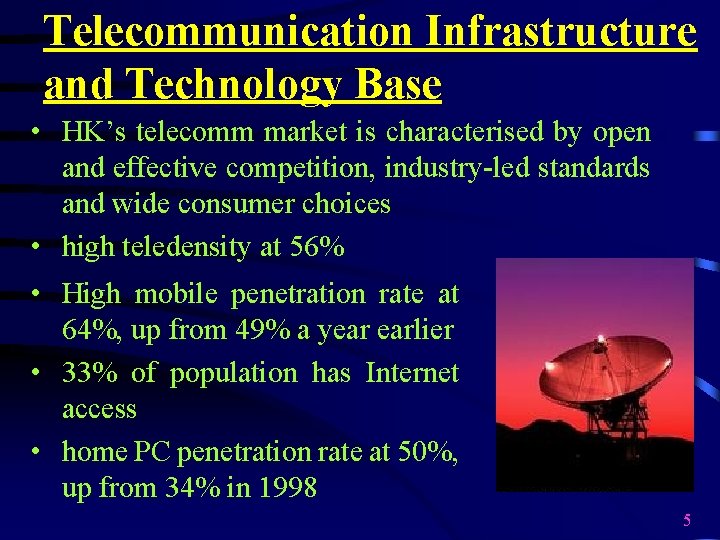
Telecommunication Infrastructure and Technology Base • HK’s telecomm market is characterised by open and effective competition, industry-led standards and wide consumer choices • high teledensity at 56% • High mobile penetration rate at 64%, up from 49% a year earlier • 33% of population has Internet access • home PC penetration rate at 50%, up from 34% in 1998 5
Telecommunication Infrastructure and Technology Base • Broadband access widely available for both businesses and consumers • The maximum connection speed supported is 1 Gbps • The average connection speed available is 1. 5 Mbps 6
Access and Supporting Services • Competitive Internet service market and consumers enjoy wide range of access services at affordable prices • Over 180 Internet Service Providers • Sophisticated IT support and distribution services readily available 7
Level and Type of Use of the Internet • Number of Internet users exceeded 2 million • Internet traffic increases from 0. 8 billion minutes per month in May 1999 to 1. 3 billion minutes per month in May 2000 • 35% of businesses use the Internet in their operation • Value of e-commerce projected to increase from US$145 million in 1999 to US$ 5. 3 billion by 2004* • Government is taking the lead : E-government initiative * Source : International Data Corporation 8
Awareness and Promotion • The Government has promotion programme a comprehensive • Close co-operation between Government and industrial support organisations in providing practical assistance to local businesses • SMEs are the focus 9
Skill and Human Resources • High projected demand for IT professionals • Government is strengthening both basic education and professional training • All primary and secondary schools to have IT/computer as part of curricula and over 80% have been connected to the Internet • Local tertiary and vocation training institutions are rising to the challenge 10
Policy Positioning • Favourable e-commerce policies in areas such as legal framework, taxation, tariffs, regulation of encryption technology and copyright protection • Further development to focus on the adoption of self-regulation mechanisms for the protection of privacy and consumer interests 11
Conclusion • We have strong telecommunication infrastructure and favourable policies for ecommerce • Access and support services widely available • Plenty of room for growth in Internet use • Important to continue with efforts in education and promotion • To focus on self-regulation in the protection of privacy and consumer interests 12