
Hong Kong Attainment Tests Preexam Strategies Listening M
- Slides: 9
Hong Kong Attainment Tests Pre-exam Strategies
Listening (M. C. questions): • Before the recording starts, take some time to read the introduction and questions. Identify the key words to the questions. • Answer while you listen. A beep sound is not indicated in the recording as hints for students to answer the questions. • Some of the M. C. options can be quite similar. Familiarise yourself with distinguishing between similar phrases.
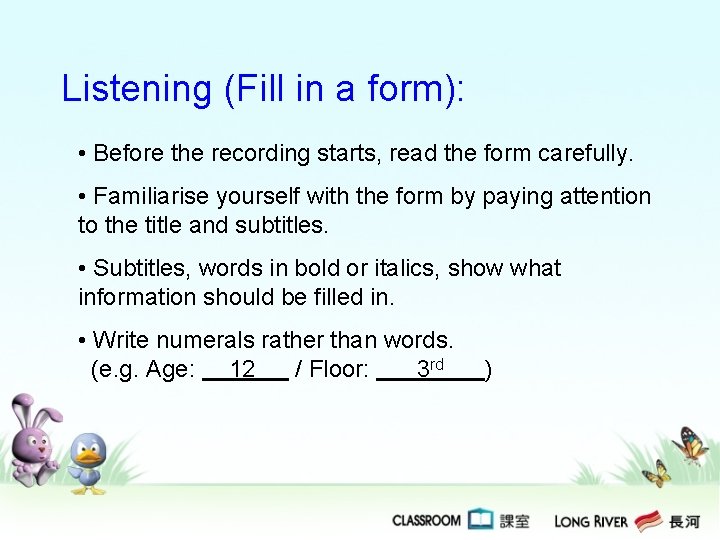
Listening (Fill in a form): • Before the recording starts, read the form carefully. • Familiarise yourself with the form by paying attention to the title and subtitles. • Subtitles, words in bold or italics, show what information should be filled in. • Write numerals rather than words. (e. g. Age: 12 / Floor: 3 rd )
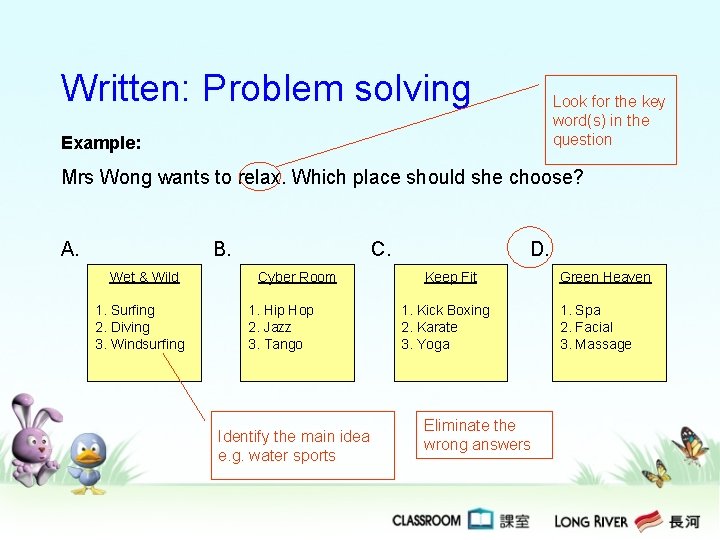
Written: Problem solving Look for the key word(s) in the question Example: Mrs Wong wants to relax. Which place should she choose? A. B. Wet & Wild 1. Surfing 2. Diving 3. Windsurfing C. Cyber Room 1. Hip Hop 2. Jazz 3. Tango Identify the main idea e. g. water sports D. Keep Fit 1. Kick Boxing 2. Karate 3. Yoga Eliminate the wrong answers Green Heaven 1. Spa 2. Facial 3. Massage
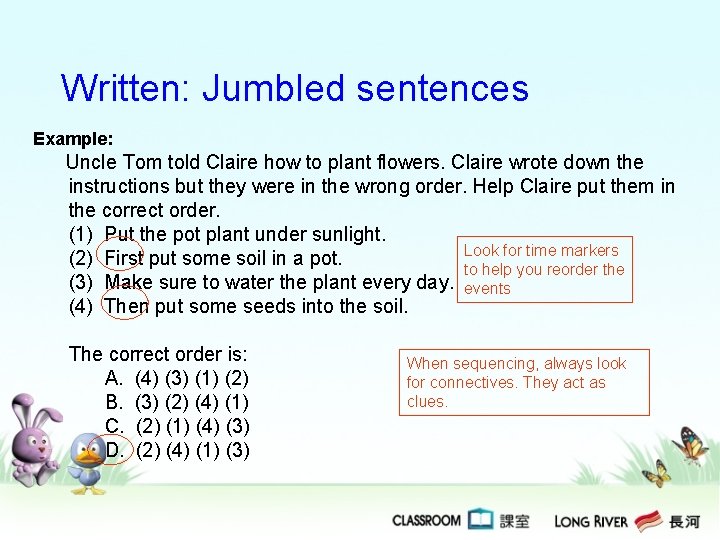
Written: Jumbled sentences Example: Uncle Tom told Claire how to plant flowers. Claire wrote down the instructions but they were in the wrong order. Help Claire put them in the correct order. (1) Put the pot plant under sunlight. Look for time markers (2) First put some soil in a pot. to help you reorder the (3) Make sure to water the plant every day. events (4) Then put some seeds into the soil. The correct order is: A. (4) (3) (1) (2) B. (3) (2) (4) (1) C. (2) (1) (4) (3) D. (2) (4) (1) (3) When sequencing, always look for connectives. They act as clues.
Written: Reading comprehension 1 When answering questions about a piece of text such as a poster or an article: • Use titles, headings and bullet points to identify answers in the text; • Words underlined, in bold or in italics usually show something special about that part of the text; • Take your time to read the questions carefully and always refer back to the text.
Written: Reading comprehension 2 When answering questions about a longer reading passage such as a story: • Scan the passage quickly to get the main idea of the passage; • Identify difficult words and guess its meaning by reading the words around it; • Take your time to read the questions carefully and always refer back to the passage.
Written: Short writing • The question will ask you to write about 30 words, you should not write too little or too much; • Read the question carefully. You only need to write about ONE thing, place, etc; • Your writing should be based on the topic / theme specified in the question (e. g. one activity that you will do with your new friend); • Try to explain your choice, give details; • Display a variety of vocabulary, sentence patterns and cohesive devices in your writing for higher marks.
Written: Guided writing • The question will ask you to write about 80 words, you should not write too little or too much; • Your writing should be based on the pictures and key words given (use the key words); • A few sentences are given as a start to the writing. Use it to guide you to write the rest, use the same tense as the opening; • Display a variety of vocabulary, sentence patterns and cohesive devices in your writing for higher marks.